Thursday, December 12, 1907 Afternoon

“No accident in the entire history of coal mining in America compares with this holocaust. It would be hard to picture a more complete scene of sorrow and desolation than that about the pit mouth. Everywhere are the blown and broken timbers, everywhere the blackened wreckage, showing the fearful force of the explosion. And over the wailing, desolate women and the gaunt, hard featured men working about the ruins, the black smoke hangs like a pall.” (TLA 12.12.07 pg. 1)

~Noon

“Governor Dawson today announced that he will personally attend the inquiry…” (CDT 12.12.07 pg. 1)
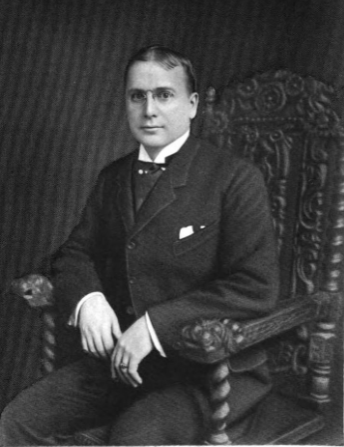
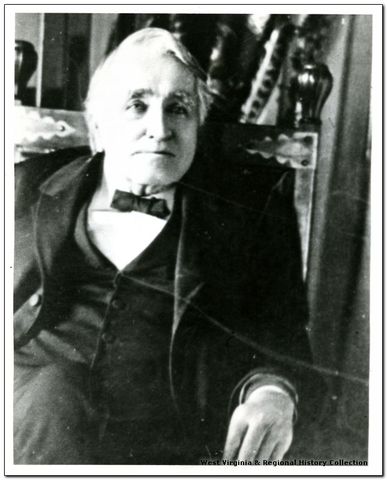
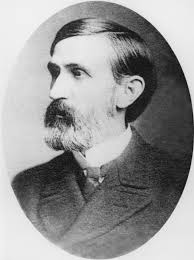
Gov. Dawson - wikipedia
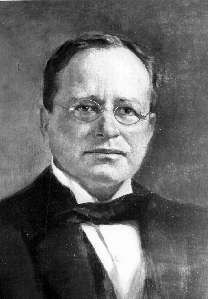
Governor W.M.O. Dawson

In Monongah:

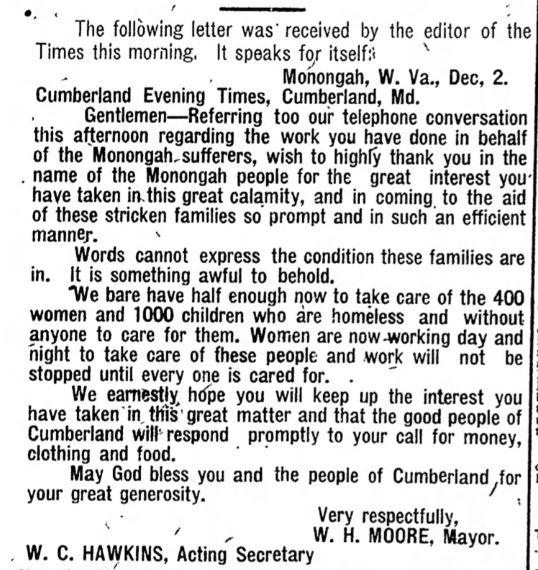
12.13.07 - pg 1 - Monongah 2
CET 12.13.07 pg 1
At the mines:

“Two hundred and eighty-five bodies were recovered at noon from the Monongah mines and twenty-five more were ready to be brought to the surface.” (CDT 12.12.07 pg. 1)

“Up to noon today 285 bodies had been recovered from the Monongah mines. They are being brought out more rapidly now and many more will have been recovered by night.” (ES 12.12.07 pg. 2)

“More than 400 bodies, it is expected, will have been recovered by Saturday night, by which time the rescuers hope to have found every body.” (ES 12.12.07 pg. 2)

2:22 pm

In Monongah:

The body of Timothy Lyden was taken from the morgue “to his home at Monongah to remain three hours and at 2:22 this afternoon accompanied by relatives and friends it was shipped to [Clarksburg] for burial.” (CDT 12.12.07 pg. 4)

“Mr. Lyden’s body will be at the home of his mother, Mrs. Ellen Lyden, on Jackson street tonight and until 10 o’clock tomorrow morning, when it will be taken to the Catholic church where funeral services will be held and interment will be in Holy Cross cemetery.” (CDT 12.12.07 pg. 4)

During the Afternoon

In Pittsburgh:

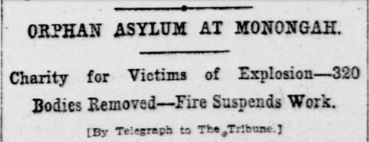
“Officials of the coal company were in Pittsburgh this afternoon, conferring with those familiar with hospital maintenance, and it is understood that $50,000 will be spent by the coal company in erecting a suitable orphan asylum building. After it is finished, the children will be taken care of and educated. It is understood that certain wealthy men have expressed a desire to assist in endowing such an asylum, making it permanent for use of orphans of those who lose their lives in the mines of the company.” (WH 12.13.07 pg. 1)

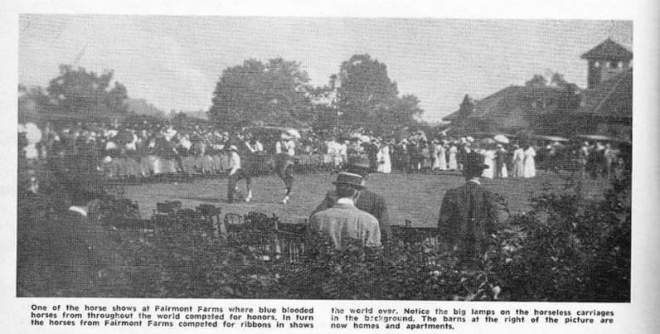
“A woman’s sympathetic heart coupled with her ability to accomplish her purposes has solved the distressing problem of the thousand children who have been made orphans by the mine explosion at Monongah, in which several hundred lives went out. The woman is Mrs. Clarence W. Watson [Minnie Owings Watson], wife of the president of the Fairmont Coal Company which owns the property in which the calamity happened. She is a social leader in Baltimore and New York, but since the explosion she has demonstrated that she can be notable for other things besides driving fine horses for prizes in show rings and planning cotillons. Acting on Mrs. Watson’s suggestion her husband came to Pittsburg today to make contracts for the erection of a $50,000 asylum for the homeless little ones at Monongah. Mr. Watson said that it was the one practical suggestion which had come to him or any of the members of the Fairmont Company.” (RP 12.14.07 pg. 4)

“Mrs. Watson took a prominent part at this season’s horse show in New York. She was a prize winner, carrying off ribbons with her famous Lord Baltimore and My Maryland. Lord Baltimore is considered one of the finest harness horses in America. Mrs. Watson and her millionaire husband carried off several prizes with them in the international show in London.” (RP 12.14.07 pg. 4)

“Bishop Donoghue, of the Wheeling district has been at Monongah leading in the relief work, and Mrs. Watson has been, perhaps, his most able assistant.” (RP 12.14.07 pg. 4)
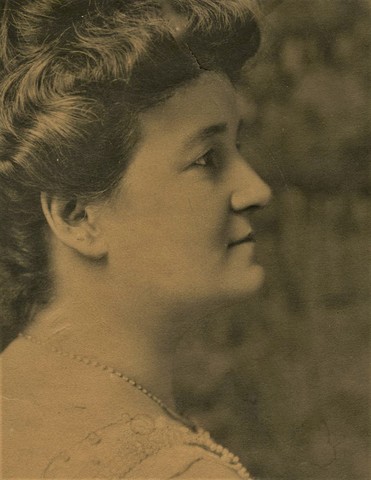
minnie_2__large
Minnie Owings Watson

“The day of the explosion Mrs. Watson hurried to Monongah with her husband. She plunged into the work of relief with her heart open for the suffering and destitute. In a few hours she was recognized as good spirit of the place. Wherever she goes in the stricken town she carried light with her.” (RP 12.14.07 pg. 4)

“It was the children who made a special plea to her sympathy. Their helplessness, their absolute dependence overwhelmed her. After the first couple of days she went to her husband and demanded that he do something. He was at a loss and asked her for her suggestions. She said that the one thing for him and his company to do was build and asylum for the little ones.” (RP 12.14.07 pg. 4)

“How to care for the children of the explosion victims has been and will be a problem until Mrs. Watson’s home for them is built.” (RP 12.14.07 pg. 4)

In Fairmont:

“The body of Charles Wise of Fairmont, one of the best known men, was…brought here for interment this afternoon.” (ES 12.12.07 pg. 2)

Frank A. Wilmot and George A. Campsey from the Carnegie Hero Commission arrive in Fairmont. “After looking over the ground a while Mr. Wilmot decided to go to the Fairmont Coal Company offices at Monongah and make known his mission. Before going, however, he met Col. A.H Fleming of Fairmont whom he knew personally…” (FWV 12.23.07 pg. 1 – extra)
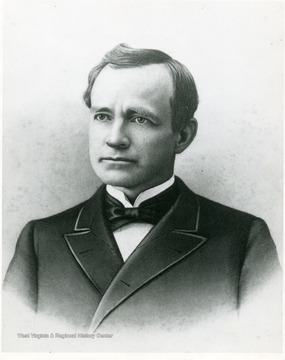
A.B. Fleming
A.B. Fleming

Mr. Harry H Stock, E.M. editor of “Mines and Minerals” of Scranton PA is visitor in the city. He procured copies of the West Virginian for every day since the mine disaster. (FWV 12.12.07 pg. 5)

In Monongah:

“The ladies of the relief corps are continuing their noble work and much food is being dispensed to the workers. Soups, meats, sandwiches, vegetables pie and coffee constitute the mean which is served night and day in a little building near the company office. Hundreds are thus fed every day.” (CDT 12.12.07 pg. 1)

C.W. Watson will not give a statement about the number of victims to the press until the “total number of miners is known…census of miners had not yet been completed. Three or four miners lived in the country and their families would have to be seen before the statement could be made. Mr. Watson said that the number would be between 328 and 334.” (FWV 12.12.07 pg. 1) (FWV 12.13.07 pg. 1)

He provides this statement instead:

“The work of removing bodies from the mines progressed very rapidly today and at the rate that the dead are brought out now the search work will be completed sooner than it was thought. The work in mine No 6 is practically done. The searchers have explored all the rooms of that mine.” (FWV 12.12.07 pg. 1)

Rumors of epidemic begin to surface and are attributed to the many maimed and decomposing bodies and carcasses about the town and still inside the mines. (McAteer) (News)

Mr. Fleming and Wilmot arrive in Monongah and go to the office where Wilmot is introduced to General Manager Lee. L Malone. “Mr. Malone at once placed the records of the company relative to the census of miners being taken at Mr. Wilmot’s disposal and after verifying the newspaper reports he hunted Mayor Moore to take some active steps for relief work.”

“Mr. Wilmot found Mayor Moore surrounded by a crowd of about 50 people engaged in relief work, but he gave Mr. Wilmot a hearing and very kindly consented to do whatever was thought best in the matter of organizing the committees.” (FWV 12.23.07 pg. 1 & 4 – extra)

At the mines:

The removal of livestock begins.

drivers - 1908

Marion County Board of Health issues a 2nd order: “…imminent danger of epidemic of disease breaking out…scores of men working in recovering dead are prostrated…so urgent…all of the streets of Monongah were heavily sprinkled with lime…odors emanating…unbearable.” (McAteer)

At #8:

1st full search is completed in #8 and a second search immediately begins. (McAteer) (Inquiry)

“Patrick Louchney’s remains were found in mines No. 8 and taken to the morgue this afternoon. His body was terribly mangled and mutilated. It will be taken to Clarksburg for burial.” (CDT 12.12.07 pg. 1)

~3:30 pm

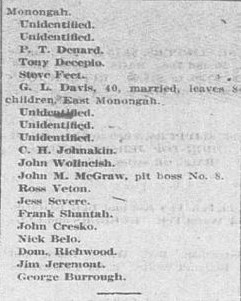
12.12.07 - pg 1 - Monongah 212.12.07 - pg 1 - Monongah 3

CDT 12.12.07 - pg 1 - Monongah 4
CDT 12.12.07 pg 1

“A great many bodies remain unidentified as yet and probably most of these will never be identified or claimed by relatives. The number of the unidentified reached fully sixty so far and doubtless many of those yet to be recovered will be in the same class.” (CDT 12.12.07 pg. 1)

~4:00 pm

In Fairmont:

The 24 members and 2 guests of the Ladies Aid Society of the Diamond Street M.E. Church complete “40 pieces of clothing” and enjoy a dinner “for the small sum of $.15”, the proceeds intended to go to the relief fund. (FWV 12.12.07 pg. 2) (FWV 12.13.07 pg. 2)

~4:30 pm

In Wheeling:

The Wheeling Board of Trade holds special meeting of directors about the Monongah relief fund. Labor Commissioner I.V. Barton (who went to Monongah shortly after the disaster and stated he would bring a report of conditions to Board of Trade) “spoke at some length”.

“There are, Mr. Barton stated, from a thousand to twelve hundred orphans and at least 350 widows it has been estimated. The children have been born since the disaster and there are 60 expectant mothers among the widows. The Fairmont Coal Co. and the local relief committees are doing nobly, and are caring for the situation.” Mr. Barton stated that if the Board of Trade was to contribute, now is the time to do it. “The aid is not necessary now but in the future relief will be needed.”

The Board of Trade contributes $1,000.00 to the relief fund. (FWV 12.13.07 pg. 1)

In Monongah:

In the earliest days after the disaster, various relief committees were formed by well-meaning individuals and groups but there is no representation for the immigrants and their various nationalities among them. Bishop Donahue was added to the initial general relief committee when he pointed out a lack of representation for the Italian and Polish-Slavic Catholic churches and the committee expanded to incorporate immigrant representation. (McAteer) (News)

Manager/Secretary of Carnegie Hero Fund Commission Frank M Wilmot combines the majority of these relief committees into one: the Monongah Mine Relief Committee. (McAteer)

The Carnegie Hero Fund donates $35,000 to this relief committee and takes charge of the organizing.  (McAteer) (News)

Wilmot then has a meeting with Watson, Fleming, and other company officials to discuss their role in the relief efforts. Watson and Fleming are cautious about endorsing notion of public appeal for funds. They are concerned about the effect such an appeal would have politically, particularly on the general public. Wilmot convinces them the response would be well received. Following the meetings with Wilmot and others they soon became supportive of the relief committees and assigned “various employees in the offices of FCC & others to work nights, Sundays, and other extra time helping the Subscription Committee to address envelopes and send out appeals”. Eventually, officials of mine, like Cunningham, serve as members of committee. (McAteer)

The Union Relief Association Committee, made up entirely of women from Fairmont and surrounding areas, is the only one not included into the MMRC.

~5:00 pm

Cunningham sends Watson a list of names along with morgue numbers. Bossilo Pillelo and Petro Frediro are listed with a note: “Italians were in #8. Selecting place to work. Chief Paul found their order copy x of mine laws.” (McAteer)
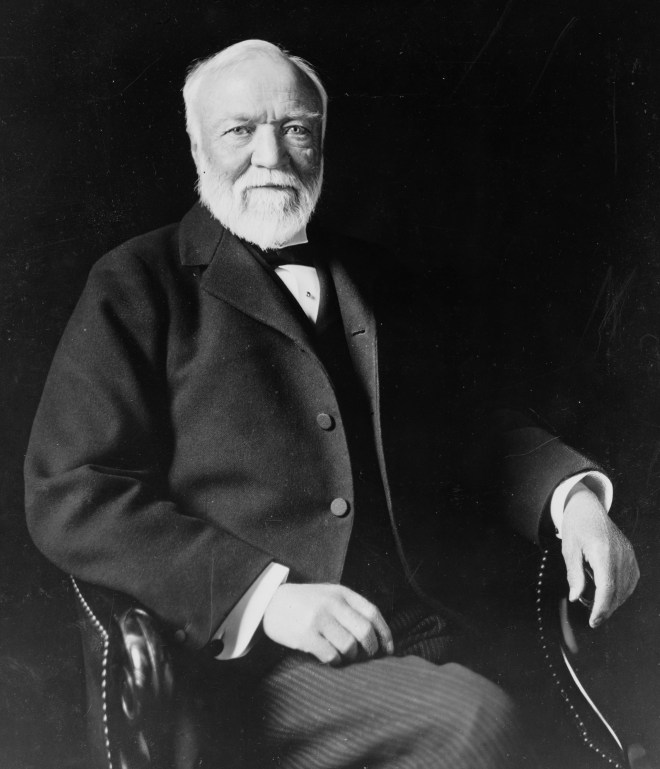
Andrew_Carnegie,1913
Andrew Carnegie


More on How Death Gloated!

Bibliography

Disclaimer and Guide

Introduction

About the Author

Contact Information

Thursday, December 12, 1907 Midnight – Morning

CDT 12.12.07 - pg 1 - Monongah 5
CDT 12.12.07 pg 1

In the early hours of the morning

12.12.07 - pg 6 - Monongah
TMDM 12.12.07 pg 6
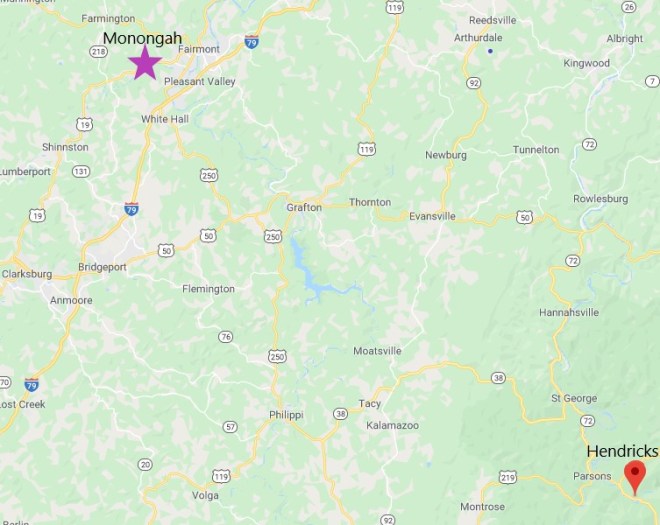
In Hendricks, WV:

Roy Yaeger, 28 year old engineer for Western Maryland railroad, detects an odor of gas in his home and starts to investigate. He quickly finds that a rubber hose has come loose from a stove and “just as he was in the act of turning the gas off the gas was ignited from an oil lamp in another part of the house and the explosion followed.” (FWV 12.13.07 pg. 2)

“Yaeger was ablaze in an instant and jumping out of a window he rushed up street, his clothes burning fiercely. Before he could be succored his clothes were all burned off and was a mass of charred flesh.” (FWV 12.13.07 pg. 2)

Yeager “met with a terrible death”. His wife and little child were severely burned and the home in where they lived was practically blown to pieces. (FWV 12.13.07 pg. 2)

hendricks

~3:00 am

CDT 12.12.07 - pg 4 - Lydens Body“The body of Timothy Lyden was found in mine No. 6 at Monongah at 3 o’clock this morning, taken to the morgue and prepared for burial.” (CDT 12.12.07 pg. 4)
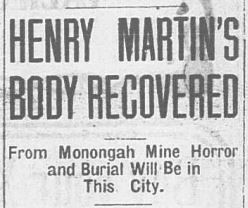
“Relatives identified the body by his clothes and the back of his head. The body was well preserved but the face was badly mutilated.” (CDT 12.12.07 pg. 4)
“Mr. Lyden was 38 years of age and leaves a widow and five children. He was a brother of Patrick J., Michael and Margaret Lyden and Mrs. P.F. Tiernery.” (CDT 12.12.07 pg. 4)
~3:30 am

CDT 12.12.07 - pg 1 - Henry martin

“Henry Martin’s body was found in mine No. 6 at Monongah at 3:30 o’clock this morning and identified by his brother, Patrick Martin, of this city. Mr. Martin has another brother here, too, Thomas Martin.” (CDT 12.12.07 pg. 1)

“Mr. Martin was 42 years of age.” (CDT 12.12.07 pg. 1)

“Mr. Martin leaves a wife and five children making his death particularly sad, as they were dependent upon him for support.” (CDT 12.12.07 pg. 1)

“Accompanied by relatives and friends, the body will leave Monongah at 8:22 o’clock tomorrow morning for Clarksburg, and will be taken to the Catholic church, where at 10 o’clock funeral services will be held at the same time that the Timothy Lyden obsequies are held. It will be a double funeral at the church—all at the same mass. Interment will be in Holy Cross cemetery.” (CDT 12.12.07 pg. 1)

At some point during the early morning hours

The body of John T. McGraw, pitt boss at Monongah mine No. 8, “was recovered from the mine early Thursday morning”. (CDT 12.13.07 pg. 1)

~4:30 am

“The body of Charles Wise of Fairmont, one of the best known men, was recovered at 4:30 o’clock…” (ES 12.12.07 pg. 2)

Wise was personal surveyor for Senator J.N. Camden. He surveyed inside of mines to ensure Camden and others were properly paid by Consolidated Coal Company. (FWV 12.12.07 pg. 1)

The 37 year old Chief Engineer “went into the ill-fated mine only a short time before the explosion.” (ES 12.12.07 pg. 2) (FWV 12.12.07 pg. 1)

Despite early reports announcing that only his jack and shoes had been found, leading people to believe Charles had been “blown to atoms”: “The body was in a good state of preservation and easily recognized. Besides in his pockets were his B&O mileage book, street car book, watch, ring and pipe, which were means to identify him.” (FWV 12.12.07 pg. 1)

Wise was found in #6 near the main heading, in a sitting position ½ mile away from his jacket. He had wrapped his waistcoat around his head indicating that he had survived the explosion and attempted to find his way out but got lost in the darkness and was eventually overcome by afterdamp. (FWV 12.12.07 pg.1)

Charles becomes body #258 to pass through the morgue. (Amos)

He leaves a widow, Pearl Reed Wise, and 2 sons: Thomas Reuben, 2 years, and Lorin Turney, 2 months old. (McAteer) (FWV 12.12.07 pg. 1)

~6:00

In Fairmont:

All mines in the Fairmont Coal Field are up and running to almost full capacity except those in Monongah. (FWV 12.11.07 pg.1)

The Fairmont West Virginian reports the weather as: Partly cloudy tonight and Friday, nearly stationary temperature (FWV 12.12.07 pg. 1)

In Monongah:

The remains of Charles D. Wise are taken to Musgrave’s undertaking parlors “just as they were taken from the mine” on 6:15 street car. (FWV 12.12.07 pg. 1)

At the mines:

“Officials…feel hopeful that the large force of rescuers, entering the mines at Monongah this morning will be the last necessary to send into the workings to recover the bodies…” (ES 12.12.07 pg. 2)

~8:00 am

In Clarksburg:

“The body of Thomas Killeen was brought here Thursday morning from the Monongah mine horror. The funeral was held in the Catholic church and burial in Holy Cross Cemetery.” (CDT 12.12.07 pg. 5)

In Fairmont:

Tom Donlin’s funeral is held at St. Peter’s Catholic church under the direction of the Ancient Order of Hibernians. Services are largely attended by friends and relatives following with interment at Holy Cross cemetery. Pallbearers were: Messrs. M.J. O’Neil, Anthony McDonough, John Kelley, John D Barry, Michael Ford and Jas. Erwin. (FWV 12/12/07 pg. 5)

In Monongah:

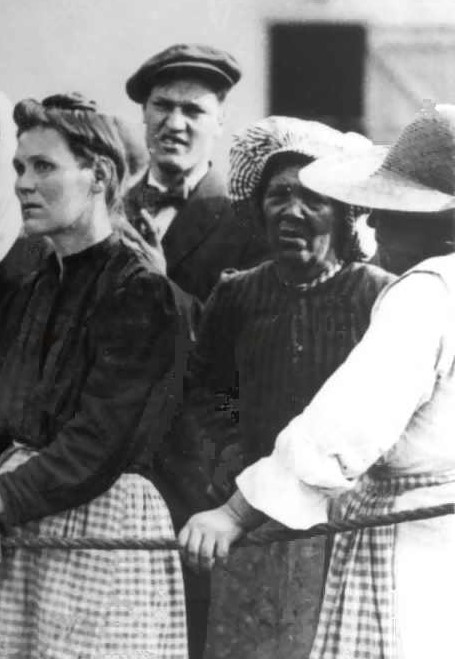
Women and children are still standing guard by the morgue.

women

At the mines:

Ventilation is restored to 8 miles of room headings, 550 rooms have been explored and tracks in 5.5 miles of main headings are cleaned up enough to allow hauling of bodies and materials. (McAteer)

1st full search completed in #6. The search parties have explored all the rooms of the mine and 20 searchers transfer from No 6 to No 8. “…the work in No 8 will be practically completed tonight when all the men will have been removed except those under falls.” (McAteer) (FWV 12.12.07 pg. 1)

The bodies taken out this morning are in “pretty good condition” so as George Gibbon, who has been able to identify most of the miners, was very successful. (FWV 12.11.07 pg.1) (FWV 12.12.07 pg. 1)

Among them is body #287—Ellis V. Herndon, this author’s great-great grandfather. Ellis’s son, Ira Herndon, was unable to go to work Friday morning due to his wet boots, and has had no need to take part in the rescue efforts as “they had other people who did that”.  Ira is able to stay with his family throughout the whole ordeal and mourn their elder. Ellis was found in excellent condition and buried in the cemetery “on the back of Tower Hill, in the hollow.” (Loss)

cemeteries
The mass grave donated earlier this week due to inclement weather is by the Catholic cemetery. However, the original potter’s field, which was used and became full within the first few days after the disaster, is currently unknown/lost. This author has quite the theory as to its potential location and this will be discussed later in an “Issues” post.

~9:00 am

In Belle Vernon, PA:

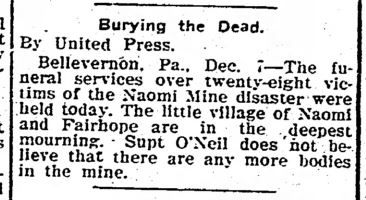
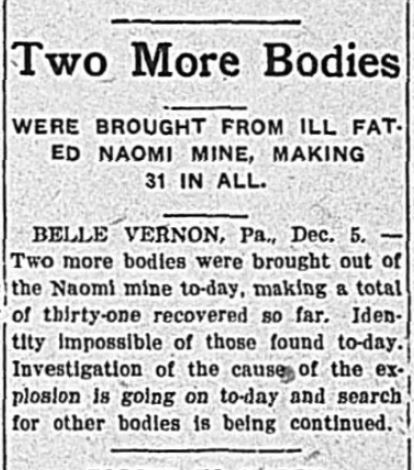
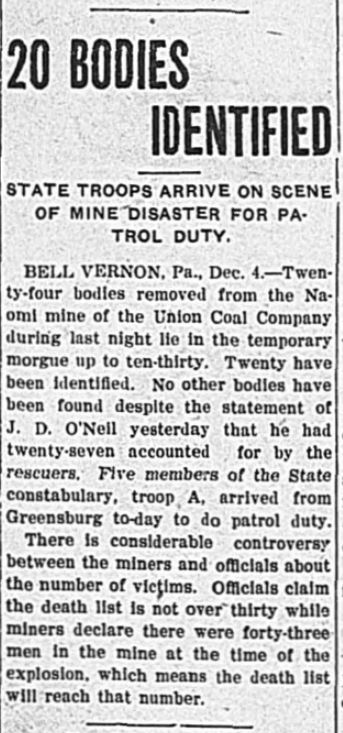
Coroner Hagan commences the official inquiry into the December 1st Naomi mine explosion. A number of officials testified and it was heavily discussed whether or not electricity should be used in mines.

In Fairmont:

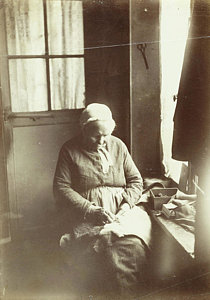
Ladies Aid Society of the Diamond Street M.E. Church meets at the home of Mrs. Priscilla Merrifield on Wilson St. between 9am-4pm. 24 members and 2 visitors spend the day “sewing or doing any other work that may be done for the Monongah sufferers. Clothing or anything which will be donated for the cause will be gladly received by the ladies.” (FWV 12.10.07 pg. 2) (FWV 12.12.07 pg. 2)

old-woman-sitting-by-a-window-sewing-anonymous-artokoloro

“A Pittsburgh man said this morning that he was surprised at the small contributions being sent in for the Monongah relief fund. He thought the big cities were taking too little interest in the matter and that the papers ought to take the question up with a view to creating a larger fund. He thinks there ought to be a fund of at least $200,000 to properly care for 300 widows and 1,000 orphans.” (FWV 12.12.07 pg. )

In Monongah:

2 men try the same trick from day before of posing as workmen to get food and goods. They are caught, arrested, and put in the Monongah jail. (FWV 12.11.07 pg.1)

“About 100 men are digging graves for the dead and as fast as the bodies are prepared and identified they are taken to the cemeteries or shipped to the places designated by friends.” (FWV 12.11.07 pg.1)

Messrs. S.E. Jenkins and J.A.C. Prickett, representatives of the Setting Sun Tribe of the Improved Order of Red Men, accompanied the body of one of the Monongah victims to the home at Connellsville, PA. (FWV 12.12.07 pg. 2)

~10:00 am

“Two hundred and eighty-five bodies were recovered at 10 o’clock today, and 25 more were ready for removal to the surface.” (LET 12.12.07 pg. 1)

~11:00 am

In Pittsburgh, PA:

NYTb 12.13.07 - pg 5 - Monongah

“C.W. Watson…will, in the name of his wife, erect an orphan asylum at Monongah in which will be cared for and educated the children of the men who lost their lives in the disaster. Today representatives of Mr. Watson visited this city, where they inspected various orphan asylums, and announced that work on the new asylum at Monongah will be started at once.” (NYTb 12.13.07 pg. 5)

In Charleston, WV:

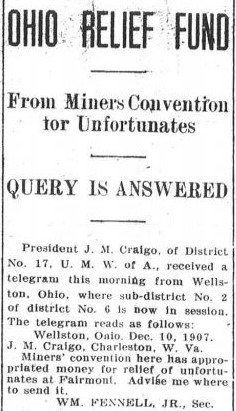
TA 12.12.07 - pg 1 - Ohio Relief Fund

“President Craigo called at the office of the Mail, where a relief fund is being collected and was advised that it would be better to have the contribution from the Wellston miners sent direct from that point to Mayor Moore, at Monongah, rather than have it come to Charleston and then be remitted from here to Monongah. Mr. Craigo adopted the suggestion and wired the convention to the that effect.” (TA 12.12.07 pg. 1)

In Monongah:

“R.H. Spahr went to Monongah this morning and spent a few hours viewing the mine horror.” (CDT 12.12.07 pg. 8)

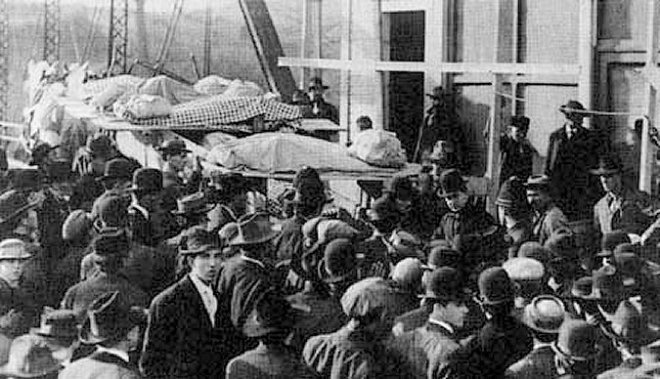
“At 11 0’clock this morning 256 bodies have been waiting for transportation. It is estimated that there are still 145 bodies in the mines. Eighty-five bodies are unidentified. The greater number of these have already been buried.” (WT 12.12.07 pg. 3)

mmd-mining2


More on How Death Gloated!

Bibliography

Disclaimer and Guide

Introduction

About the Author

Contact Information

Sunday, December 8, 1907, Night

“At the home of Mrs. John Hearmans, at Monongah, is one more little soul needing the care which the dead father cannot give. Yesterday at about the same time that the body of her husband was brought from the mines Mrs. Hearmans gave birth to a fifth child. Her condition is serious. ‘He shall never be a coal miner,’ she sobs of her little son, as her wet eyes rest upon the casket of her husband.” (CET 12.9.07 pg. 1)

~10:00 pm

“It seems that casualties and disasters follow so closely upon each other that events which in former years would have thrilled the country in when they happened now excites only conventional expressions of pity.”  (TBS 12.8.07 pg. 4)
 “… the city council sent messages for aid and quick response is expected from surrounding towns.” (TES 12.9.07 pg. 4)

At the mines:

“62 bodies have been taken from the mines late tonight. This number will be augmented by at least 30 more by daylight.” (US Dept of Labor-mine disasters-Dispatch article)

“A young volunteer in a smudged grey sweater, turned out to be the son of a Michigan judge. He had been a mine superintendent at one time and as he had taken a hand in rescue work following 3 explosions they had put him at the head of the exploring work of a party—the most ticklish job of all. ‘These are picked men,’ he explained, ‘at the same time, some hang back when it comes to going into the chambers. If a man goes in there with you, then he’s more than picked. Some like to feel that so we sort of pass the chance around.’ (Kellogg)

 “While more headway has been made, the herculean task of recovering scores of the bodies in any recognizable shape has been abandoned, according to the opinion of mine experts on the scene.”

“It was reported yesterday that the undertakers have ceased to embalm the bodies but it was stated at the morgue that these men will not shrink from their duty however unpleasant it is. The company is desirous that the bodies be made as presentable as possible but if the board of health decides that the decomposition is in a stage too far advanced for convenience and safety the bodies will be removed from the mines, identified at the mouth so far as possible, then buried immediately. It is quite likely that this will be done so the chances are that the majority of the women who saw their husbands or sons go down into the mines alive and happy Friday morning will never again gaze upon their faces that are now cold in death, battered, many of them into and unrecognizable mass” (CET 12.9.07 pg. 1)

“I talked with an Irishman from PA who had ‘come to help.’ Beside him was another Pennsylvanian, a rescue man, who had worked 5 days the week before in Naomi mine, where 36 had been killed.” (Kellogg)

“An old miner, with red cheek bones and dusty wisps of hair at the ears, had carried out two dead men who had been overcome by blackdamp while cementing.” (Kellogg)

“Hope has gone that there can be any living soul in the mines, but there is a burning desire on the part of relatives to obtain possession of the bodies. If this cannot be granted their grief will know no bounds. Thus in gloom and doubt and despair passed the saddest Sunday Fairmont has ever seen.” (CET 12.9.07 pg. 1)

In Monongah:

“One of the many sad occurrences of the disaster and its consequences was the death Sunday night of Mrs. Lawrence Heinerman, widow of one of the victims of the disaster, whose body was among the first taken out of Mine No. 6. She died of childbirth and doubtless her delicate condition was aggravated by the mine horror.” (CDT 12.9.07 pg. 1)

Mrs. John Hinerman, wife of one of the first victims that was found gives birth and dies in labor. Her death leaves 5 small children without any parent. The child died also. (FWV 12.9.07 pg. 1)


More on How Death Gloated!

Bibliography

Disclaimer and Guide

Introduction

About the Author

Contact Information

Saturday, December 7, 1907, Midday

In Pennsylvania:
12.7.07 - pg 1 - Naomi
CET 12.7.07 pg 1
In Baltimore:

“A dispatch from Vice President Jere H. Wheelwright, of the Consolidation Coal Company, was received at the offices in Baltimore yesterday.” (TBS 12.8.07 pg. 2)

“Mr. Wheelwright has been at the Monongah mine since Friday…”(TBS 12.8.07 pg. 2)

“His dispatch, which was sent to Mr. A.G. Dunham, the general auditor, was brief. It merely said that his worst fears had been realized and that the dead miners would number between 350 and 400.” (TBS 12.8.07 pg. 2)

“Further than this the officials here knew nothing more of the disaster than was told in the press dispatches.” (TBS 12.8.07 pg. 2)

Wheelwright-findagrave
J.H. Wheelwright
In Clarksburg:
12.01.07 - pg 1 - Xtra - disaster 13
CDT 12.7.07 pg 1 – 1:30 extra

Noon

In Monongah:

“Even nature seems to dumbly feel the horror of the day and the sun has held its face behind leaded clouds since the fire damp did its fatal work.” (EO 12.7.07 pg. 1)

“There is no home in the village that is not stricken. Each one will harbor a dark coffin if not several after the last body is extricated from the covering of earth and bodies of fellow victims.” (EO 12.7.07 pg. 1)

In Fairmont:

A Fairmont undertaker places order for 100 coffins with Muskingum Coffin Co. in Ohio.  The company goes into emergency production, working around the clock. (McAteer)

“The newspaper offices are kept busy answering specials in all directions.” (FWV 12.7.07. pg. 1 – noon)

The Fairmont West Virginian releases a special, 14-page, Noon edition:

12.7.07 - pg 1 - headlines
FWV 12.7.07. pg. 1 – noon
In Monongah:

“The four hundred and twenty-five checks that were given out yesterday morning hardly represent all the men that were in the mines at the time their ill fate overtook them. Other men not having checks likely to have been ushered into eternity by the same cause.” (FWV 12.7.07. pg. 1 – noon)

“Yesterday the people of this city and of Monongah were sort of dazed but today the realization of the enormity of the explosion and the terrible results following it.” (FWV 12.7.07. pg. 1 – noon)

“The women whose husbands and near relatives are among the entombed are taking it as cooly as possible. There is little excitement and all that there is to see today is the removing of the bodies.” (FWV 12.7.07. pg. 1 – noon)

“The number at the morgue up to this time is 12.” (FWV 12.7.07. pg. 1 – noon)

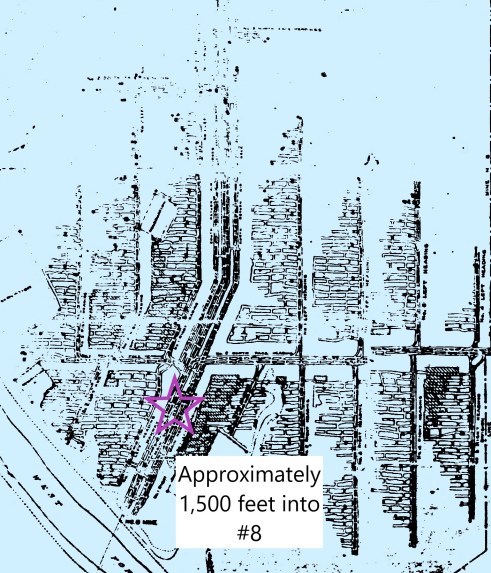
A new force of workers makes a new opening at #8 and “have now gone to a distance of 1500’ in the mine, or about half the distance to where the 2 pits, 6 and 8, meet.”  (FWV 12.7.07 – pg.1)

1500 feet into #8

In Fairmont:

“Photographer Busy: Mr. Marvin D Boland has been one of the busiest men in town since yesterday. City papers in all parts of the country are calling for photographs. In the absence of a picture of the fated mines a Pittsburg afternoon paper ran a stock cut of Otis Watson, the original coal operator of the Fairmont region.” (FWV 12.7.07 pg. 1 – noon)

James Otis Watson
James Otis Watson

“All day today knots of people have been on the street discussing the scenes of the disaster. At the corner of Jefferson and Main streets there was a big group of men and women all day who with eager ears tried to catch every syllable of news…the whole city has been listening, every scrap of news was gobbled up with a craving almost insatiable.” (FWV 12.7.07. pg. 1 – noon)

12.7.07 - pg 1 - media list
FWV 12.7.07. pg. 1 – noon
In Monongah:

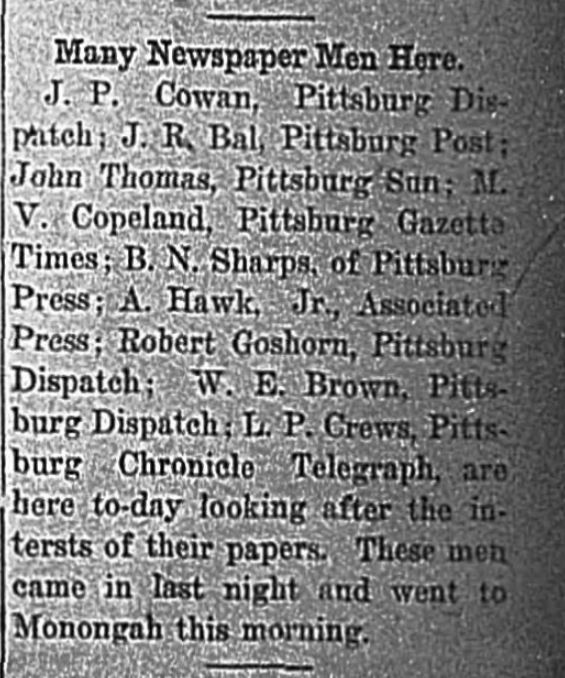
“About 50 newspaper men are on the ground today many from Pittsburg, Cleveland, Baltimore, and New York.”

“G. Girosi of the Italian New York Herald is one among the number as well as L. Friedel, of the Cleveland Zabadsag, a Hungarian paper.” (FWV 12.7.07 – pg.1)

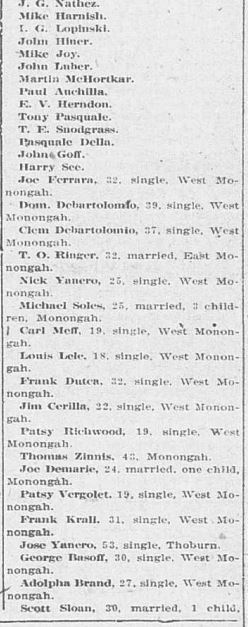
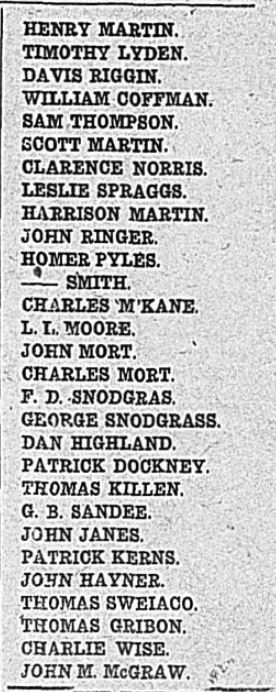
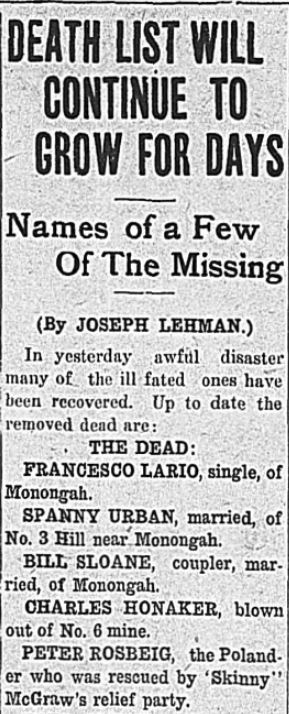
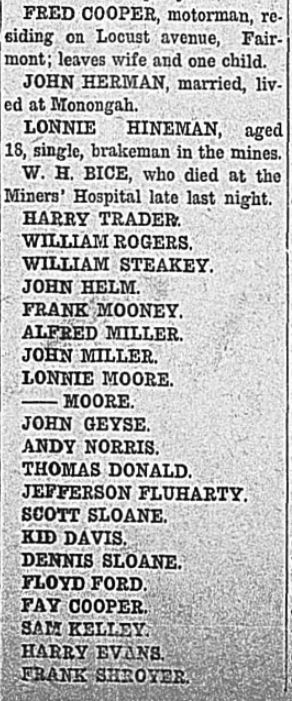
A list of the dead and suspected dead is also published to the public but it is purely American miners only, with the exception of Francesco Loria and Stan Urban who were taken from #8. The list contains about 50 – 60 names though it is not known yet if these men are dead or simply missing, including the name of coupler, Bill Sloane. Bill’s two sons, Scott and Dennis Sloane, are also included in the list though neither has likely been found and identified as of this point.

12.7.07 - pg 1 -list - detail 112.7.07 - pg 1 -list - detail 212.7.07 - pg 1 -list - detail 312.7.07 - pg 1 -list - detail 4


More on How Death Gloated!

Bibliography

Disclaimer and Guide

Introduction

About the Author

Contact Information

Friday, December 6, 1907 11:00 pm – Midnight


12.7.07 - pg 1 - Monongah
TBD 12.7.07 pg. 1
12.7.07 - pg 1 - Monongah 7
CET 12.7.07 pg. 1

“It is believed that the shock of the explosions displaced many of the heavier timbers in the galleries and whole rows where the unfortunate men were working collapsed upon them. In this case the work of reaching the entombed men will be infinitely greater. Some of them are now believed to be separated from the outer world by many tons of earth.” (WED 12.7.07 pg. 8)

“The hope that they are alive lies in the possibility that enough pure air remained in the mine to supply those who were not crushed outright until they can be reached by the rescuers.” (WED 12.7.07 pg. 8)

In Monongah:

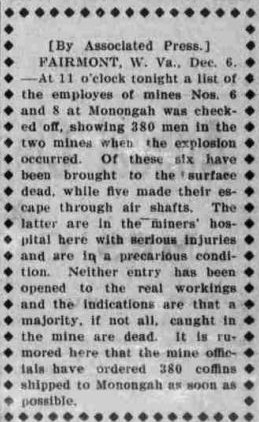
“At eleven o’clock tonight the list of employees had been checked off, showing that 380 were in the two mines when the explosion occurred. Of these six had been brought to the surface dead and five escaped through air shafts. The latter are in the miner’s hospital here in a precarious condition.” (DASB 12.07.07 pg. 1)

For hours now, more than likely since the meeting with Pres. C.W. Watson, General Manager Malone has been sorting through the payroll lists for Monongah mines #6 and #8 to get a better idea of just how many fatalities they are facing. By 11:00 pm, he is as finished as he can be with this aspect of his research. However, he does not deny that this list of around 380 payrolled names does not include any non-payrolled workers (such as B&O railroad workers on loan or those hired and paid by the miner personally—what we would consider an Independent Contractor today), younger trapper boys, or those who have been hired since the last time this list had been updated some two weeks prior, nor will it include those who were known to have been hired the morning of the explosion.

ME18

None the less, the press and public will become fixed with this very first “official” number of 380 and begin to speculate on their own.

“Six charred bodies lying in the improvised morgue, five men near death in the hospital and 369 men imprisoned by tons of coal, rock and mine debris in the depth of the hills surrounding this mining town with chances all against a single one of them being alive is the most accurate summary obtainable at 11 o’clock tonight…” (SFC 12.7.07 pg. 1)

The company nor the press is yet aware of just how many workers, like Bill Sloane and this author’s own great-grandfather, did not go into work that morning. As each one begins to turn up alive over the next several days, the overall number of potential corpses continues to be lowered rather than a name simply getting checked off the potential identity list. Though the extra off-payroll workers are acknowledged by company, they are not included in their factors.

In Fairmont:

“Late in the night…the streets of the city were crowded with anxious people eager to snatch any news that came from the disaster. Every car that came from Monongah, the passengers were stopped while inquiry about the news was made by the waiting crowd but the passengers had little to satisfy the hungering ones.” (FWV 12.7.07 pg. 2 – noon)

At some point during the night at the Miner’s Hospital, William H. Bice, the fan engineer who was blown through the walls of the #8 fan house, dies of his injuries. Though many doctors and nurses have returned to the Miner’s Hospital, the morticians and undertakers are still in Monongah. As a result, Bice had plenty of care in his final hours of life, but in death there is no one on hand to care for his body at the hospital. His body, along with others, is simply left in the hospital morgue.

In Pennsylvania:
12.6.07 pg 5 - Naomi
FWV 12.6.07 pg 5

Clarence Hall has been on the site of the Naomi mine disaster for days, but now he boards a train and heads straight for Monongah. He is considered U.S. President Theodore Roosevelt’s personal representative as one of the few federal government agents attempting to remedy the ever-growing mortal cost of the mining industry in the country.

In Monongah:

Before the midnight hour, rescue work transitions into recovery work as the long process of removing bodies from the mines begins. As #6 mine was not as badly damaged as #8 and workers have been able to restore enough ventilation for rescue crews, the process begins there.

As each body is brought to the surface, Dr. F.W. Hill and several other medical volunteers briefly examine the bodies in hope to quickly determine the true cause of death before sending them over to the temporary morgue. Though Coroner Amos and many other morticians are expecting to have the chance to perform autopsies, they simple become too overwhelmed too quickly and decide against doing so. Due to the conditions of many bodies, it is impossible to embalm them and they must be prepared for burial and identified as quickly as possible.

~Midnight

“Of the victims six dead bodies had been taken from mine Nos 6 at midnight and six others were piled up in the entry awaiting the completion of facilities for bringing them to the surface. From mine No 8 at the same hour, fourteen bodies had been removed, and a number of others are ready to be brought out as soon as arrangements can be completed.” (LAH 12.7.07 pg. 1)

Outside #8:

Once the small fires in #8 are subdued, the temporary 8’ wide fan on loan from a local mine in Shinnston is started up once again. Though they manage to recover some bodies near the mouth and along the main shaft of the mine, the temporary fan is simply not powerful enough to purify the air in the mine and rescue crews only make it around 700 feet beyond the main entrance before they are once again driven out by toxic gases. However, this does not stop the rescue and recovery efforts. A fresh crew replaces those who came in contact with the gases and a round-robin system of smaller crews and shorter trips into the mine takes hold at #8.

In Monongah:

A large number of lingering physicians are “ordered out” of the town; “At midnight these messengers of mercy with pity and patience were on the scene ready to minister to the maimed and moaning, but there was little need for their services.” (FWV 12.7.07. pg. 1 – noon)

wv state archives - CL060064


Previous Post

Next Post


More on How Death Gloated!

Bibliography

Disclaimer and Guide

Timeline

Introduction

About the Author

Contact Information

December 5, 1907 – Eve of St. Nicholas Feast Day

 “The dawn of a new era of prosperity is here.” (FWV 12.5.07 pg. 1)

During the day:

The country is beginning “to recover from the severe shock of the recent panic” on Wall Street. “Naturally there was a little scare at first, but when the people saw that there were rotten spots only here and there they quickly recovered from their fright.” (FWV 12.5.07 pg. 1)

In Pennsylvania:
12.5.07 - pg 1 - Naomi
FWV 12.5.07 pg 1
In Washington D.C.:

Gov. Dawson of West Virginia gives the opening speech at the river convention. (FWV 12.5.07 pg. 1)

“He said his state was particularly interested in the comprehensive improvement of the inland waterways of the country…The governor referred particularly to the resources of West Virginia, the State being second in the production of coal and fifth or sixth in hard wood timber. The bulk of the coal has to find a market outside of the State and if, by water transportation, the state could save the ten cents a ton it would aggregate $3,000,000 a year.” (FWV 12.6.07 pg. 1)

“’We are one people and have a common destiny,’ said he, in conclusion. ‘We want nothing in West Virginia that is forbidden to any other part of the country; but I say to you, gentlemen, that we want to be ready for the Panama Canal when the great waterway is ready for us.’” (FWV 12.6.07 pg. 1)

In Grafton:

Sam Furk, an Italian, has been held for the grand jury on the charge of extorting money at the point of a revolver from several of his fellow countrymen of this section.” An Italian witness from the same area of Italy as Sam Furk ‘testifies’ that Furk is wanted on two murder charges back in Italy, “so it is probable that the local authorities will take up this matter with the Italian embassy at Washington.” (CDT 12.5.07 pg. 1)

“The hearing developed the fact that Furk had been playing the hold-up game among members of his race successfully at Brooklyn, N.Y., Rowlesburg, Manheim, Fairmont, Clarksburg and Grafton.” (CDT 12.5.07 pg. 1)

“Furk is in jail here.” (CDT 12.5.07 pg. 1)

In Fairmont:

The Fairmont West Virginian reports the weather as: Fair tonight and Friday, warmer Friday

In Monongah:

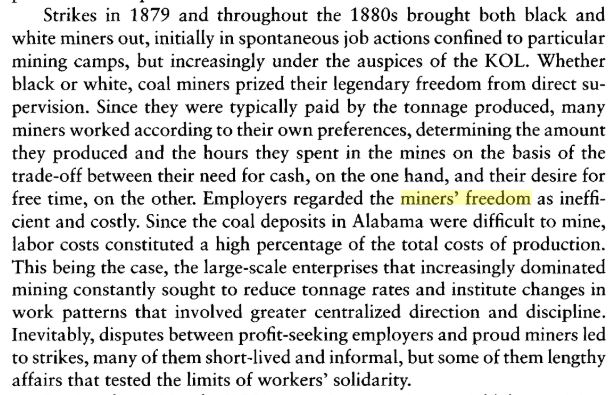
Mines #6 & #8 are not running at full production today but the fans continue running for the skeleton crew inside. Due to the recent stock market crash, there is still a lack of orders & a majority of the working immigrant population will be celebrating the eve of St. Nicholas Feast Day tonight. In these days of “miner’s freedom”, many miners would choose not to go to work during their holidays.

In the Afternoon

In Fairmont:

The Isabella Davis Circle of King’s Daughters opens their annual Christmas Bazaar in the Sunday school room of M.E. Church on Main Street in Fairmont. “The different booths are all decorated in the Christmas colors red and green the color scheme being carried out by the use of crepe paper and autumn leaves in the colors.” (FWV 12.5.07 pg. 1)

In Monongah:

Anestis Stamboulis & several Greek miners take advantage of the holiday and good weather. They take a walk up into the hills surrounding the town and pick some wild mushrooms to be used for dinner. (McAteer)

~5:30 pm – 6 pm

In Monongah:

The Who’s Who Club of Wahoo (a neighborhood of Monongah) holds its monthly meeting where they “disposed of large quantities of the amber fluid, red liquor and refreshments of all varieties.” 8 members will not go into work tomorrow but will end up digging graves. (McAteer)

Homer Pyle and his mother are “sitting before the bright blazing fire” at their home,“…he said let us have a song for it is too cold to go over in town tonight, so he and his mother sang two or three songs and the last song was ‘Will There be Any Stars in My Crown?’”

“But little did Homer think that the next evening he wouldn’t be alive to sing with his mother.” (FWV 12.19.07 pg. 2)

At the mines:

The night shift skeleton crew comes onto work.

Over the next 12 hours these workers will do various jobs throughout the mines.

Inside #8

Peter J. McGraw came in for his fire boss shift around 6 pm.

He does his examinations of the mine alone.

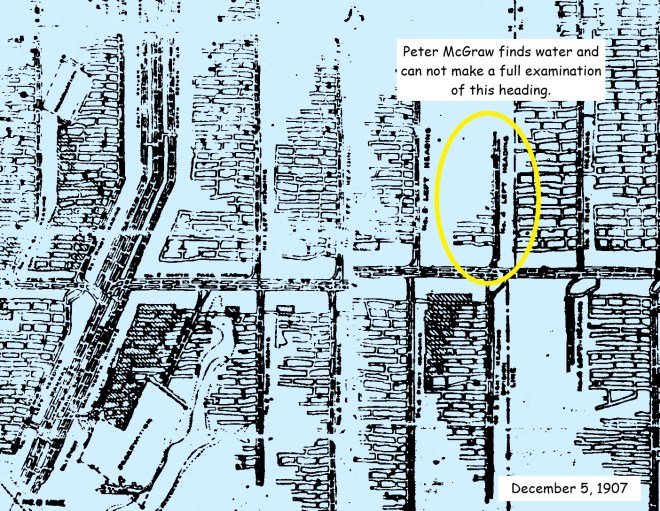
He finds water in 4th left so significant that he can’t get in there to properly examine the heading. (Inquiry)

map - McGraw - water

Inside #6

22-year-old Lester E. Trader arrives for his fire boss shift around 6 pm. (Inquiry, McAteer)

Trader inherited his job when the previous fire boss got sick during Trader’s apprenticing. Trader lacked 3 years necessary experience, training, and certification for his official position so he was kept on the night shift so as to “not run into the inspector”. (McAteer)

Trader worked alone like most fire bosses. He led a horse drawn water cart to sprinkle the mine walls in order to dampen any renegade coal dust.

To check for dangerous gas levels, he used a Wolf Safety Lamp to check for methane. However, due to the size of #6 mine, Trader cannot check everywhere.

~7:00 pm

At the mines:

Libberato Delesandro works the night shift, “helping to get #6 and #8 through together”. (Inquiry)

Inside #8:

Tony Pasquaele arrives to work and drives the horse-drawn water cart in #8 through the night. “The watering carts carried large wooden barrels filled with 300 gallons of water; perforated ends of the barrels were plugged by wooden combs that could be removed to allow water to sprinkle out.” (McAteer)

As he is leading the horse and water cart, he notices that the heading is “a little dry” for this time of year. (Inquiry)

Tony is also responsible for pumping out any rising or standing water which had seeped into the mines. His pattern is systematic; he “would start the pumps then go water mines for a bit, and then would check back on the pumps every 2 hours to see how they were doing.” (Inquiry)

Inside #6:

Ludwig Strezelecki works at F face: 1st right, room 15. His task for the night involves working with his brother-in-law taking out stumps and finishing the headings.

Night

It is the eve of St. Nicholas Day for Italian Catholic and some Polish Catholic immigrants.

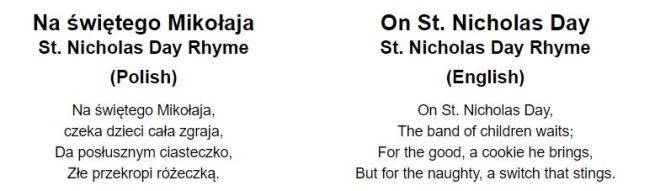
At night, the families gather around their coal stoves or fireplaces (if they are fortunate enough to have a fireplace) and tell stories, sing hymns, or verse simple rhymes about St. Nicholas De Bari.

Polish- St Nick rhyme-mamalisa
Polish rhyme to St. Nicholas
Italian - St Nick rhyme - mamalisa
Italian rhyme for St. Nicholas

Children leave their shoes lined up side-by-side next to the door, window, or hearth. If possible, some would place bits of carrot, oat, or hay inside as a gift for the trusty mule/white horse which traveled along with St. Nicholas as he delivered small gifts.

8:00 pm

In Clarksburg:

At the Bacon & Godfrey skating rink a “Who’s Who” Carnival is held. “Upon entering the rink, you will be furnished with a false head or some contrivance of that kind which will make it almost impossible for your mother to even know you. With everybody thus attired the big show will start, with everyone wondering who is who.”   (CDT 12.5.07 pg. 1)

~10:00 pm

Inside #8:

Homer C. Palmer (electrician) arrives for his night shift.

Through the night:

Inside the mines:

The main ways of the mines are watered.

Fire bosses like Lester Trader and P.J. McGraw walk their respective mine checking for dangerous conditions in both #6 and #8.

Inside #8:

George Bice dug coal (pick work) on 5th right, 2nd north in #8

MF7

Inside #6:

Fred Cooper (motorman) sprinkled headings in #6. (Inquiry)

In Monongah:

Not long after the children have fallen to sleep, several parents quietly replace the bits of hay or carrot in their children’s shoes with a sweet treat, like candy or fruit, and a small present—typically a (gold) coin.


Previous Post

Next Post


More on How Death Gloated!

Bibliography

Disclaimer and Guide

Introduction

About the Author

Contact Information


Wednesday, December 4, 1907

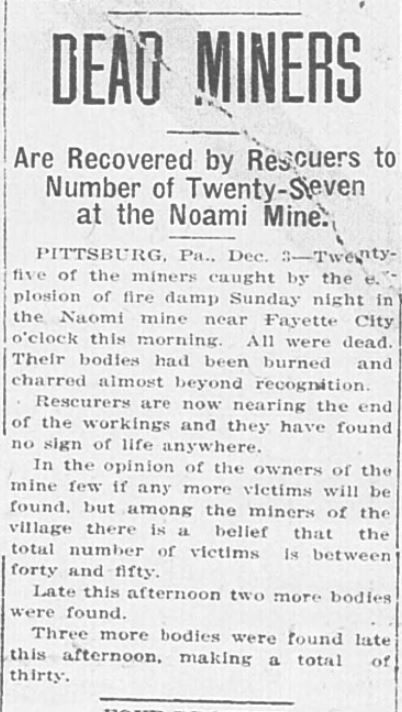
At the Naomi mine in Pennsylvania:
12.4.07 - pg 1 - Naomi

FWV 12.4.07 pg 1
In Washington D.C.:
Gov. Dawson - wikipedia
photo of Governor W.M.O. Dawson from Wikipedia

Governor William M.O. Dawson arrives in D.C. for the national river convention. Governor Dawson conferred “with river enthusiasts from many States and is rejoiced at the enthusiasm…”. (FWV 12.5.07 pg. 1)

ABFleming - wikipedia
Photo of Aretas Brooks Fleming from Wikipedia

Former West Virginia Governor and current Fairmont Coal Company associate, A.B. Fleming, is also at the convention in D.C. (FWV 12.5.07 pg. 1)

In Grafton, WV:

grafton larger map 1

Sam Furk has been arrested in Grafton by local authorities for crimes associated with the Black Hand. Furk is described as a “tough-looking” “big Italian”, believed to be “king of the Black Hand society of this section of the country”.

“Nothing concerning where Furk came from can be elicited from any of the local foreigners and all of them seem to be afraid of him. He arrived here a short time ago and has been spending his time among the foreigners.”

Furk is charged with extorting other Italians for money around the Grafton and Fairmont areas.

“From what could be learned of the matter from the foreigners, most of whom were so badly scared they would not talk, it appears that Furk, since he came here, has been posing as the ‘big man’ in the ‘Black Hand’ society and in making his demands upon the foreigners has emphasized his remarks by the flourish of a big revolver.”

Many local terrorized Italians are “afraid that if they do appear against the fellow that he should not be held for court that he would kill them as soon as he could find them after being released.”

“…Furk was not given a hearing yesterday, but he will probably be arraigned today.” (FWV 12.4.07 pg. 2 & 6)

At the Monongah mines:

Day shift worked at mines #6 and #8

Fred Stubbs is among them but this will be his last day of work for the rest of the week because his wife is very sick at home. At this time, a system known as “miners freedom” allows Fred to choose if he wants to work, rather than requesting the time off.

Ebook - miner's freedom - Race & labor in America
For Jobs and Freedom: Race and Labor in America Since 1865
By Robert H. Zieger, page 37
In #8:

It is the first day on the job for 3 Russian immigrants: Paul Goff, John Goff, and Frank Kreger.

Fred Vandatti works the gathering motor in #8: 4th right, 2nd north. Hugh Reese (brakeman) was his helper.

motorman
Motorman driving a gathering motor.
In #6:

James Rogers (assistant foreman in #6 and foreman in #3) is working in #6. This will be his last day of work this week due to illness.

George Simko works in #6: 2nd right, E face, room 8. This will also be his last day of work this week due to sickness.

Libberato Delasandro is working in #6 and finds gas accumulation earlier in the day at 2nd right off of D face, in rooms 2 & 3. However, it was only a slight trace – normal and relatively safe—so he does what most miners do: he takes off his coat and waves it around, fanning the gases out of the air and working space. Later, he will find gas and dust accumulation on 2nd right of G face in #6. At one point a foreman comes into where he is working, notices the gas and shouts at Libberato to lower the flame on his cap and so he does. (Inquiry, McAteer)

Liberatto map

In Fairmont, WV:

The Fairmont West Virginian reports the weather as: Snow tonight. Thursday fair. Minimum temperature tonight about 15 degrees.

CW Watson - Wikipedia
Photo of C.W. Watson from Wikipedia

Fairmont Coal Company and Consolidated Coal Company President Clarence Wayland Watson is world-renowned for his show horses. 14 of C.W. Watson’s show horses arrive in Fairmont on train No. 7., care of the US Express company from New Haven, Conn. (FWV 12.4.07 pg. 5)

FB_IMG_1516709527023

Night

In Monongah:

A meeting of Monongah mine foremen & superintendents is held in J.C. Gaskill’s office. The meeting is called to go over things regarding safety of the mines.

Fairmont Coal Company supervisor David Victor, Tom Donlin (foreman at #6), and foreman Pete McGraw are present for the meeting.

Gaskill asks McGraw and Donlin about conditions inside and about the mines and they replied that it was good in both cases. “…McGraw said he had a little bit of shooting off the solid that he had not been able to eliminate. He was instructed to eliminate all of that and that he must get rid of the men who had that practice.” (Inquiry– Victor)

James Rogers, assistant foreman in #6, talks with foreman Tom Donlin in the company supply store about watering the mines tonight.

At the mines:

Night shifts work and, per usual, the main-ways of the mines are watered, but not the branching off hallways and rooms. (Inquiry, McAteer)


Previous Post

Next Post


More on How Death Gloated!

Bibliography

Disclaimer and Guide

Introduction

About the Author

Contact Information

Tuesday, December 3, 1907

Morning

At the Naomi mines in Pennsylvania:
12.03.07 - pg 1 - Naomi
CDT 12.03.07 pg. 1
In Fairmont:

Very icy conditions – “The walking…was very treacherous and many people got falls” (FWV 12.4.07 pg. 8)

Mrs. Jacob M Watkins of 5th ward fell and broke her wrist.

Miss Edith Frey slipped on icy pavement on her way to school and broke her elbow.

Mrs. Ellis Billingsiea fell and was unconscious for some time. No broken bones.

Mr. Crawford M. Shaw, a well-known B&O Engineer, fell on icy pavement and broke his arm.

Mrs. J.M. Watkins fell at home on Locust Ave and broke her wrist.


Afternoon

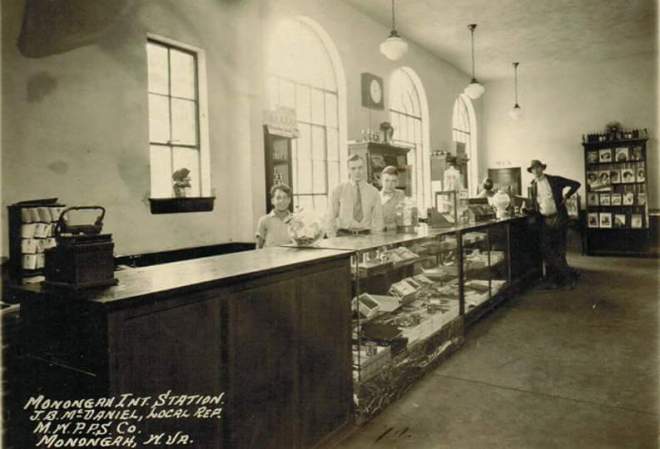
The Women’s Auxiliary of Christ Episcopal church routinely shift hostesses for their meetings. Today the collective leaves Fairmont on the 2:00 pm trolley headed for Monongah. After about a 20 minute ride, they meet up with their hostess, Mrs. Ruckman at Monongah. (FWV 12.2.07 pg. 8)

FB_IMG_1512224499627

Night

In Viropa (mining town one mile north of Shinnston):


Fire destroys the houses of five miners.  “As there was no means of fighting the fire except by volunteer bucket brigade another house was dynamited to prevent the flames from reaching a large boarding house and the mine tipple.” (CDT 12.4.07 pg. 8)

The houses actually belong to the Fairmont Coal Company. “The company’s loss is between $3,000 and $4,000, but the property was fully insured. The houses were occupied by foreigners who saved most of their household goods.” (CDT 12.4.07 pg. 8)


Previous Post

Next Post


More on How Death Gloated!

Bibliography

Disclaimer and Guide

Introduction

About the Author

Contact Information

Monday, December 2, 1907

In Monongah:

Both #6 and #8 mines are working
Ben Coon is working as the stable boss at #8 with Charlie Dean having general supervision over the work.
Leo Dominico notices a toad hole in the roof while working in #8 mine (Inquiry)


At Naomi mines in Pennsylvania:
12.2.07 - pg 1 - Naomi mine
FWV 12.2.07 pg 1 morn

Night

12.2.07 - pg 1 - Naomi
FWV 12.2.07 pg 1 eve.
Whington, PA

William May, whose brother was one of those entombed in the Naomi mine is held up by 3 masked men on his way to the disaster scene. William did not hear about the Naomi disaster until Monday night. 3 men stopped him on his way to the streetcar, held him at gunpoint, searched his clothes, took his money and a gold watch. William had to go back home to get more money before going to disaster scene. (FWV 12.4.07 pg. 4)
 

Previous Post

Next Post


More on How Death Gloated!

Bibliography

Disclaimer and Guide

Introduction

About the Author

Contact Information

December 1, 1907 – Welcome to Bloody December

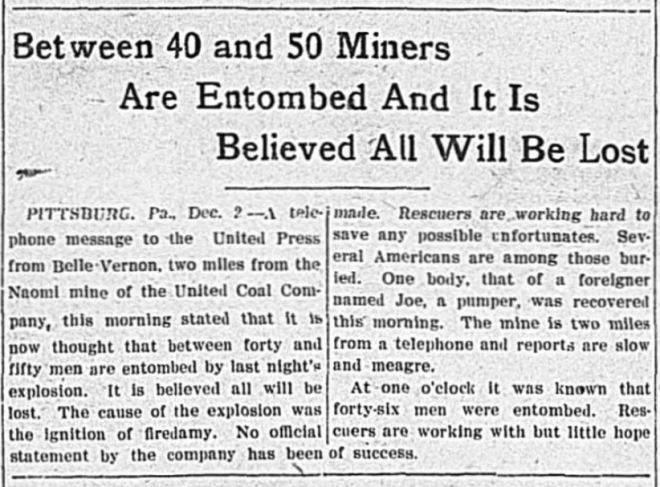
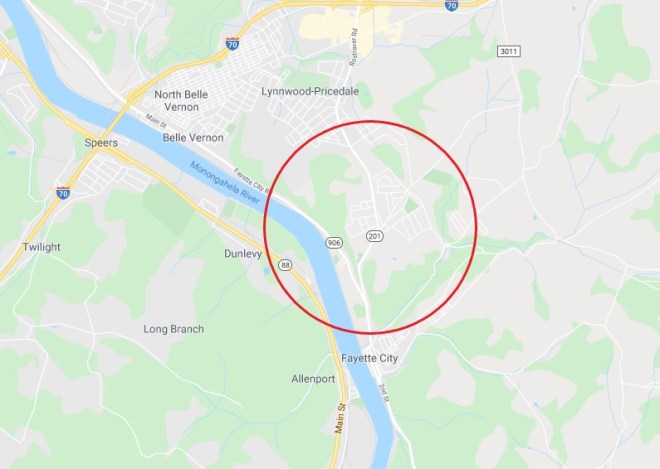
Naomi - approximate location

Belle Vernon, near Fayette City, Pennsylvania.

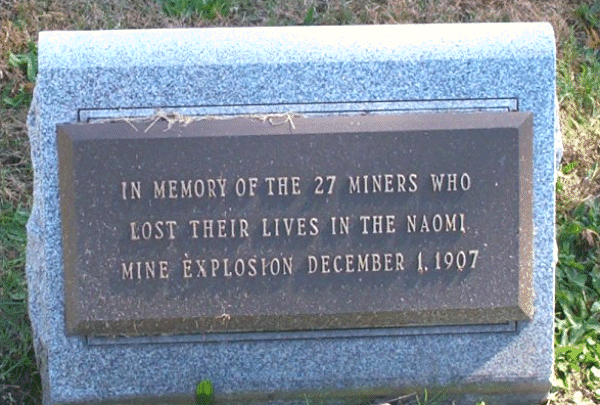
Sometime between 7:15pm – 7:30 pm, the Naomi mine explodes “with a roar that shook the whole countryside.”1

“The explosion was caused by gas being ignited by an open light or an electric spark or flame from the electric wires, and it was greatly augmented by coal dust.”4

Fires inside the mines immediately follow the explosion. The Sunday night shift is relatively small so it is believed some 30 – 60 miners are entombed underground where the fires steadily consume all breathable oxygen and replace it with toxic gases known as black damp.

“Within a few minutes hundreds of people surrounded the pit mouth. The screams were indescribable. Wives and children and friends of the men entombed wrung their hands and begged piteously for rescuing parties to enter the mines and bring out their loved ones. All night they refused to leave the pit mouth.”

“After a brief examination of the conditions, the impression prevailed among the inspectors that no one would be found alive in the mine, as the after damp would in all probability have smothered those who were not burned by the gas or hurled to death against the sides of the mine by the force of the explosion.  The miners, most of whom were foreigners, were at work almost a mile from any entrance.”4

“Only one man, an unknown foreigner, (out of 34 employees), reached the surface after the explosion occurred, and as he reached the open air he fell unconscious from inhaling the gas fumes and died in a few minutes.”4

This slideshow requires JavaScript.

image from usminedisasters.com
In West Virginia:

Governor Dawson leaves for Washington D.C. to attend a meeting of rivers and harbors congress which will be in session for several days. (FWV 12.4.07 pg. 4)
Welcome to Bloody December.


1907 is considered the deadliest year of the mining industry in the United States.2 The month of December produced 5 separate major disasters and numerous accidents which cost the lives of over 800 men and boys, the majority of whom are minorities and immigrants.

This month will be the real catalyst to a decades-long fight to bring an end to negligent labor practices across the country. Bloody December is so horrific that the American public finally lets its government and its industries know that they have had enough. The devastating and very preventable loss of life sparks a heavy push for government regulation in private industry and labor practices.


Previous Post

Next Post


More on How Death Gloated!

Bibliography

Disclaimer and Guide

Introduction

About the Author

Contact Information