Wednesday, December 4, 1907

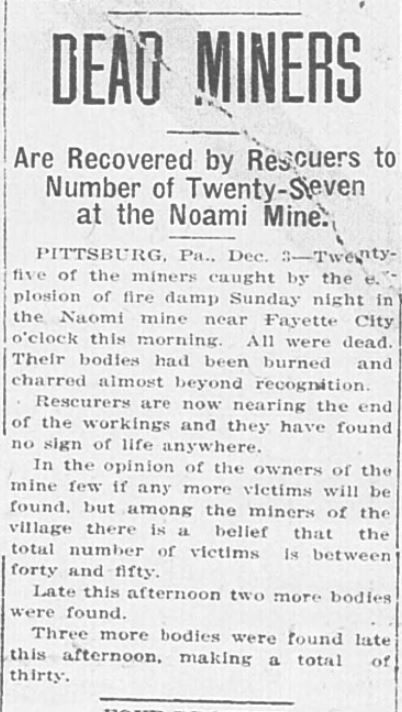
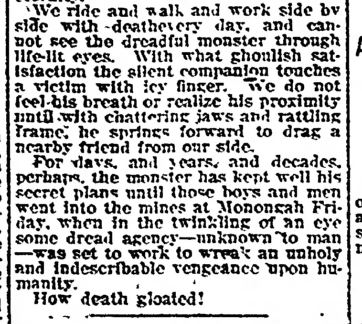
At the Naomi mine in Pennsylvania:
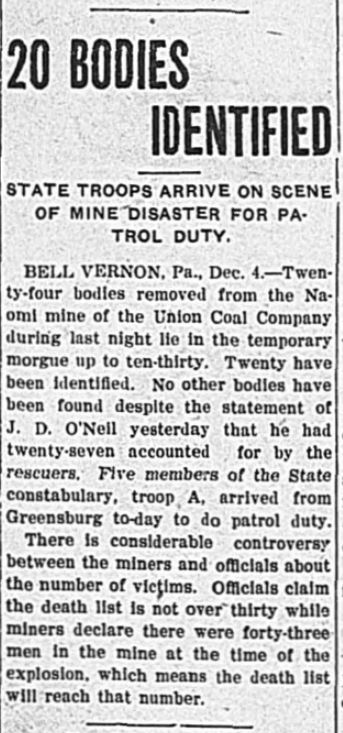
12.4.07 - pg 1 - Naomi

FWV 12.4.07 pg 1
In Washington D.C.:
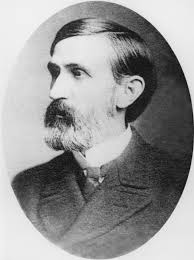
Gov. Dawson - wikipedia
photo of Governor W.M.O. Dawson from Wikipedia

Governor William M.O. Dawson arrives in D.C. for the national river convention. Governor Dawson conferred “with river enthusiasts from many States and is rejoiced at the enthusiasm…”. (FWV 12.5.07 pg. 1)
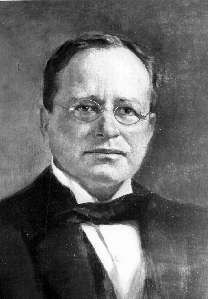
ABFleming - wikipedia
Photo of Aretas Brooks Fleming from Wikipedia

Former West Virginia Governor and current Fairmont Coal Company associate, A.B. Fleming, is also at the convention in D.C. (FWV 12.5.07 pg. 1)

In Grafton, WV:
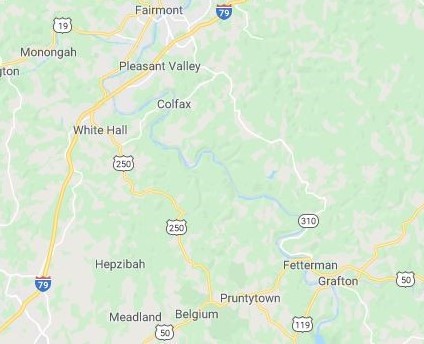
grafton larger map 1

Sam Furk has been arrested in Grafton by local authorities for crimes associated with the Black Hand. Furk is described as a “tough-looking” “big Italian”, believed to be “king of the Black Hand society of this section of the country”.

“Nothing concerning where Furk came from can be elicited from any of the local foreigners and all of them seem to be afraid of him. He arrived here a short time ago and has been spending his time among the foreigners.”

Furk is charged with extorting other Italians for money around the Grafton and Fairmont areas.

“From what could be learned of the matter from the foreigners, most of whom were so badly scared they would not talk, it appears that Furk, since he came here, has been posing as the ‘big man’ in the ‘Black Hand’ society and in making his demands upon the foreigners has emphasized his remarks by the flourish of a big revolver.”

Many local terrorized Italians are “afraid that if they do appear against the fellow that he should not be held for court that he would kill them as soon as he could find them after being released.”

“…Furk was not given a hearing yesterday, but he will probably be arraigned today.” (FWV 12.4.07 pg. 2 & 6)

At the Monongah mines:

Day shift worked at mines #6 and #8

Fred Stubbs is among them but this will be his last day of work for the rest of the week because his wife is very sick at home. At this time, a system known as “miners freedom” allows Fred to choose if he wants to work, rather than requesting the time off.
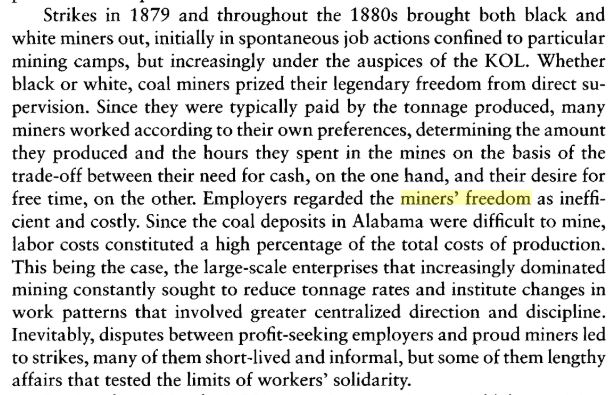
Ebook - miner's freedom - Race & labor in America
For Jobs and Freedom: Race and Labor in America Since 1865
By Robert H. Zieger, page 37
In #8:

It is the first day on the job for 3 Russian immigrants: Paul Goff, John Goff, and Frank Kreger.

Fred Vandatti works the gathering motor in #8: 4th right, 2nd north. Hugh Reese (brakeman) was his helper.

motorman
Motorman driving a gathering motor.
In #6:

James Rogers (assistant foreman in #6 and foreman in #3) is working in #6. This will be his last day of work this week due to illness.

George Simko works in #6: 2nd right, E face, room 8. This will also be his last day of work this week due to sickness.

Libberato Delasandro is working in #6 and finds gas accumulation earlier in the day at 2nd right off of D face, in rooms 2 & 3. However, it was only a slight trace – normal and relatively safe—so he does what most miners do: he takes off his coat and waves it around, fanning the gases out of the air and working space. Later, he will find gas and dust accumulation on 2nd right of G face in #6. At one point a foreman comes into where he is working, notices the gas and shouts at Libberato to lower the flame on his cap and so he does. (Inquiry, McAteer)

Liberatto map

In Fairmont, WV:

The Fairmont West Virginian reports the weather as: Snow tonight. Thursday fair. Minimum temperature tonight about 15 degrees.

CW Watson - Wikipedia
Photo of C.W. Watson from Wikipedia

Fairmont Coal Company and Consolidated Coal Company President Clarence Wayland Watson is world-renowned for his show horses. 14 of C.W. Watson’s show horses arrive in Fairmont on train No. 7., care of the US Express company from New Haven, Conn. (FWV 12.4.07 pg. 5)
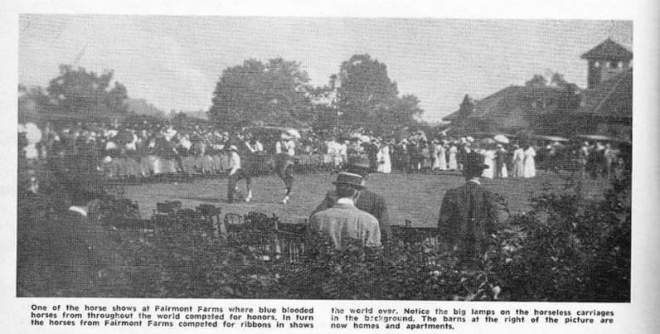
FB_IMG_1516709527023

Night

In Monongah:

A meeting of Monongah mine foremen & superintendents is held in J.C. Gaskill’s office. The meeting is called to go over things regarding safety of the mines.

Fairmont Coal Company supervisor David Victor, Tom Donlin (foreman at #6), and foreman Pete McGraw are present for the meeting.

Gaskill asks McGraw and Donlin about conditions inside and about the mines and they replied that it was good in both cases. “…McGraw said he had a little bit of shooting off the solid that he had not been able to eliminate. He was instructed to eliminate all of that and that he must get rid of the men who had that practice.” (Inquiry– Victor)

James Rogers, assistant foreman in #6, talks with foreman Tom Donlin in the company supply store about watering the mines tonight.

At the mines:

Night shifts work and, per usual, the main-ways of the mines are watered, but not the branching off hallways and rooms. (Inquiry, McAteer)


Previous Post

Next Post


More on How Death Gloated!

Bibliography

Disclaimer and Guide

Introduction

About the Author

Contact Information

Tuesday, December 3, 1907

Morning

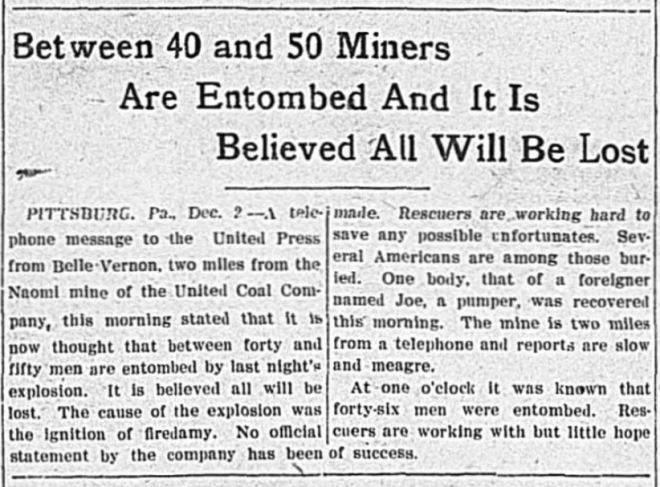
At the Naomi mines in Pennsylvania:
12.03.07 - pg 1 - Naomi
CDT 12.03.07 pg. 1
In Fairmont:

Very icy conditions – “The walking…was very treacherous and many people got falls” (FWV 12.4.07 pg. 8)

Mrs. Jacob M Watkins of 5th ward fell and broke her wrist.

Miss Edith Frey slipped on icy pavement on her way to school and broke her elbow.

Mrs. Ellis Billingsiea fell and was unconscious for some time. No broken bones.

Mr. Crawford M. Shaw, a well-known B&O Engineer, fell on icy pavement and broke his arm.

Mrs. J.M. Watkins fell at home on Locust Ave and broke her wrist.


Afternoon

The Women’s Auxiliary of Christ Episcopal church routinely shift hostesses for their meetings. Today the collective leaves Fairmont on the 2:00 pm trolley headed for Monongah. After about a 20 minute ride, they meet up with their hostess, Mrs. Ruckman at Monongah. (FWV 12.2.07 pg. 8)

FB_IMG_1512224499627

Night

In Viropa (mining town one mile north of Shinnston):


Fire destroys the houses of five miners.  “As there was no means of fighting the fire except by volunteer bucket brigade another house was dynamited to prevent the flames from reaching a large boarding house and the mine tipple.” (CDT 12.4.07 pg. 8)

The houses actually belong to the Fairmont Coal Company. “The company’s loss is between $3,000 and $4,000, but the property was fully insured. The houses were occupied by foreigners who saved most of their household goods.” (CDT 12.4.07 pg. 8)


Previous Post

Next Post


More on How Death Gloated!

Bibliography

Disclaimer and Guide

Introduction

About the Author

Contact Information

Monday, December 2, 1907

In Monongah:

Both #6 and #8 mines are working
Ben Coon is working as the stable boss at #8 with Charlie Dean having general supervision over the work.
Leo Dominico notices a toad hole in the roof while working in #8 mine (Inquiry)


At Naomi mines in Pennsylvania:
12.2.07 - pg 1 - Naomi mine
FWV 12.2.07 pg 1 morn

Night

12.2.07 - pg 1 - Naomi
FWV 12.2.07 pg 1 eve.
Whington, PA

William May, whose brother was one of those entombed in the Naomi mine is held up by 3 masked men on his way to the disaster scene. William did not hear about the Naomi disaster until Monday night. 3 men stopped him on his way to the streetcar, held him at gunpoint, searched his clothes, took his money and a gold watch. William had to go back home to get more money before going to disaster scene. (FWV 12.4.07 pg. 4)


Previous Post

Next Post


More on How Death Gloated!

Bibliography

Disclaimer and Guide

Introduction

About the Author

Contact Information

Disclaimer and Guide


By: Katie Orwig

How Death Gloated! is a collection of numerous resources and publications on the history of the Monongah Mine Disaster. They are arranged and presented in the form of a timeline of events as this better helps my own organization when it comes to working on my historic fiction about Monongah.

The title is taken from a newspaper article published on December 10, 1907 in the Cumberland Evening Times.

12.11.07 - pg 11 - Monongah 6

This timeline is not to be blindly trusted and is constantly subject to future change as I come across any new information. However, as far as I have found in my few years of formal research on this topic, I have yet to come across anything like a detailed timeline of events so I felt obligated to share this form of organizing my research despite the fact that I don’t think it will ever be a finished product.

I’d like to inform you of specific choices I made for How Death Gloated! so that it may help you navigate the information better:

  1. Certain events included in this timeline may have only come with time stamps like “this afternoon,” or “early morning”. In these instances I would do my best to consider the context of the original source, cross check with other sources for anything which may conflict or concur the event being described, and then do my best to estimate the approximate time this event may have occurred based on what information I had to that point. Sometimes an event could get more accurately placed later on when more information is obtained, and sometimes it will remain in its ‘best guess’ slot.
  2. I have not included ALL of my information. Some events which matter very much to the research for my historic fiction but are not necessary to the format and purpose of How Death Gloated!, have been omitted…for now. Almost all of these are just waiting for more clarification on where they should be placed, while the others have more of a storytelling/narrative intent and will not be included at all. For many of these issues, I will be making and posting separate journal entries about the problems they pose.
  3. When considering my sources and their provided information, I often gave greatest partiality to the people of Monongah and the stories I heard through my life about the disaster. They often discussed the wrong information which was spread vs. what they knew or grew up hearing themselves.

These resources include contemporary newspaper, journal, and magazine accounts; photographs from various points in time; documentaries; published texts; personal accounts, etc. They will also be consistently updated.

These resources and the cited information contained on this site are not presented with the intention of formal citation.

In less formal lingo, please cite the source I cited for this information whenever possible.

If you have any questions about any of the information or a citation is unclear or missing, please contact me and I will do my best to answer any of your questions, point you in a possible direction for more information, or clear up something I probably just overlooked.

Please feel free to leave comments or discuss the events with myself and others here or on other media platforms. I welcome conversation and discussion on this matter as I feel collaboration on historic matters is absolutely vital.