

Afternoon
In Fairmont:
“Mr. Zack Robertson on Monday afternoon in the Masonic hall will deliver the last of his series of lectures ‘No matter how many you skin alive just so the company gains.’” (FWV 01.02.08 pg. 5)
1:30 pm
In Fairmont:
The Paint and Powder Club performers are brought to the brewery where a dutch luncheon was served (FWV 01.06.08 pg. 1)
Upon arrival, “the boys will each have one of…the ribbons of different colors pinned on their coat, with the understanding that everyone who comes up to them and says, ‘Hello, Careless Karrie,’ they’ll know they are about to become acquainted with a part of the best this State is so proud of…” (FWV 01.06.08 pg. 4)
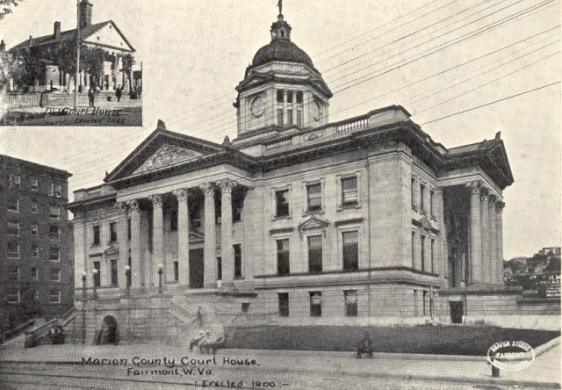
Testimonies resume at the courthouse. “This afternoon the evidence was taken down by Mr. E. C. Frame.” (FWV 01.06.08 pg. 4)

J.J. Burrett, a physician and surgeon in Fairmont, volunteered immediately after the explosion and worked at #6 most of the time. He is examined by Att. Lowe.
Burrett states that the victims he saw showed marks of violence such as bruises, contusions, broken bones, lacerations, and missing limbs. “I think a majority of the men had their hair singed and some had large burns on their bodies, faces and hands.” (Inquiry)
Burrett believes he saw the first three men taken out of #6 and that “there was one of these bodies that didn’t look so much like it had been subjected to so much violence, but the others did.” However, he also admits that he is not positive that these same bodies were those of Cooper, Hinerman, and Harriman as he was not constantly present and “there might have been a few bodies taken out that I did not see.” (Inquiry)
He did examine victims who seemed to show signs of suffocation but he does not know where any of the bodies were found within the mine. (Inquiry)
He is “theoretically but not practically” familiar with the gases found inside of mines and their effect on the human body. He states that is very difficult to determine specific gases without a spectroscope but, at his best guess, carbon monoxide was the mostly likely culprit. “…if an individual were exposed to air containing one per cent of carbon monoxide, he would become sleepy and would probably sit down and die.” (Inquiry)


Lenardo Dominico, the son of Dan Dominico, is examined by Att. Lowe. They both escaped through the toad hole of #8.
Lenardo has worked in #8 mine since it opened, “about three years”. On the morning of the explosion, he says he went into work and found the mine open around 5:30 am. He worked alone on the 2nd right of 1st south in #8 then changed to 3rd left. He knows the fire boss that came in around 9 am, but he did not see any other bosses that morning. (Inquiry)
At the time of the explosion he states that “I never seen at all; I tried to get out, but couldn’t see—just knocked down.” He could only see smoke and heard “lots of noise” for about ten minutes. (Inquiry)
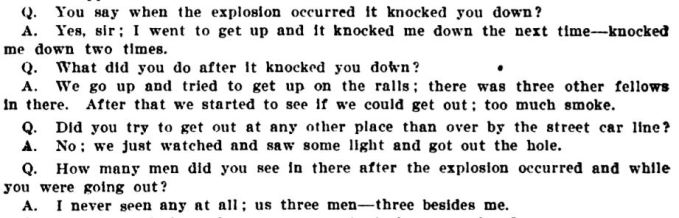
He estimates that the toad hole was about 55 yards away from where he was working. Once he reached the surface, he and Jim Rogers went to the front of the mine. He states that Jim went in the mine again and brought out another victim around 11 am. Though he is not sure of the victim’s identity, the Fairmont West Virginian states it was the body of a Bice—more than likely William Bice, the fan engineer who was trapped beneath the wreckage of the #8 fan house. (Inquiry) (FWV 01.06.08 pg. 1)
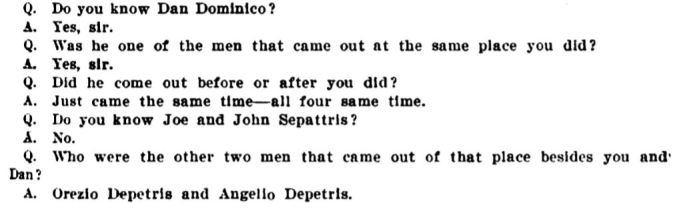

Dan Dominico has lived in Monongah for 17-18 years and was working in #8 with his son, Lenardo, at the time of the explosion. His entire testimony is given through interpreter Joe Beradelli. (Inquiry)
Dan says he didn’t see anything either nor did he hear any noise, he was just thrown down by the shock. However, he was hurt on his ear and arm when thrown down. (Inquiry)
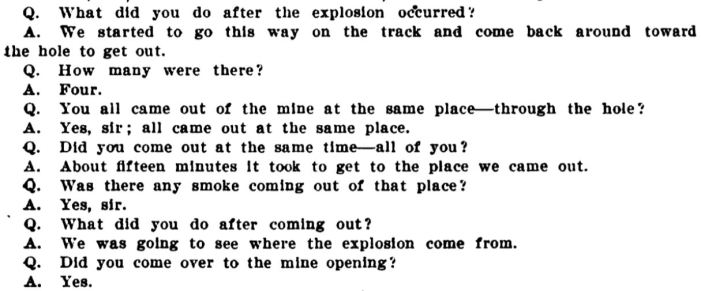
Dan states that he didn’t see any gas in the mine before the explosion and when it comes to ventilation in the mine: “Sometimes plenty of it and sometimes less.” (Inquiry)
Dan says that he went into the mine “by myself” that morning but he is not sure of the time as, “I didn’t have any watch.” He is also not sure if there were any other men already in the mine by the time he went in to work nor of the name of the worker or fire boss who came into his work area that morning. He can only say that, whoever it was, “he went away right away.” (Inquiry)
Att. Lowe asks Dan if he is aware of any other men ever getting in or out of the mine via the hole from which he and the other three men escaped and he simply replies that, “I don’t know if the other people were there before or not.” (Inquiry)
He knows of no other explosion within these mines prior to that of Dec. 6, nor does he know the cause of the explosions on that day. (Inquiry)
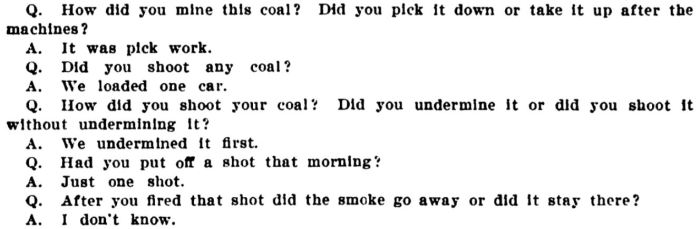

Angelo DePetris, brother of Crazic DePetris, is the last of the 4 men who escaped from #8 to be examined. Angelo has been in living and working Monongah “about eighteen or nineteen years” but had only been working in #8 for “about a month and a half” before the explosions. (Inquiry)
Almost right away, Angelo also encounters misunderstanding / misinterpretation issues with his testimony:

Att. Lowe moves on from that question and asks what type of work they were doing at the time of the explosion. “We had put a shot in and I was picking the coal down from the roof.” When asked about whether or not the smoke from the shot lingered in his area (a question of the ventilation), Angelo states that, “The smoke kind of went away; the air coming in the smoke kind of disappeared.” (Inquiry)
He says the explosion threw him down. He couldn’t find his cap or the light from it. His brother carried the matches and could not find them, so they were left in the dark. After that, they “Walked around to find a way to get outside.” (Inquiry)
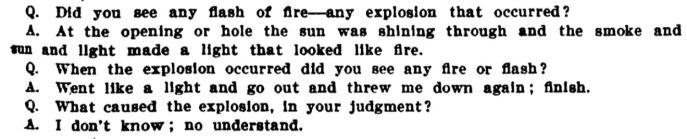

E.P. Knight has been the tipple foreman at #6 for “Three years in March.” He is examined by Att. Lowe. (Inquiry)
Knight tells the jury that, on the morning of the disaster, he “didn’t see anything of it,” and only saw a “good bit” dark brown smoke as it “came out of the air-shaft of No. 6. That was about 10:25.” (Inquiry)
He does not recall hearing any noise prior to the explosion but that the explosion itself sounded like “a dead shot some place—dynamite or something”. (Inquiry)

Knight was not within sight of #8 mine as he was not on the tipple, but under it at the time of the explosions. He does recall the runaway trip of “About nineteen cars”, which he assumes were fully loaded, being around “50 feet beyond the knuckle” before they all fell back. (Inquiry)

Inspector Paul asks if Knight feels that the trip had time to reach the bottom of the slope before he saw the smoke. He does not think it did. He also says he was not in a position to see any smoke coming out of the mouth of #6 because he started right up the steps of the tipple from which he could only see the smoke coming out of the air shaft. He believes the smoke was coming out the air shaft for “five to eight minutes.” (Inquiry)
Paul also asks if Knight knows of any other time, prior to the explosions, when coal cars had broken loose and run back into the mines. Knight acknowledges that it has happened, though he cannot recall much about the last time it occurred other than going down into the mine and helping to clean it up. He guesses that it may have been 6 months prior to the explosions when this coupling hitch broke between the cars which sent them racing back into the mine though, “It didn’t do any damage; only broke some of the cars and tore up a little track.” However, the reporter in the courtroom for the Fairmont West Virginian includes that this runaway trip also tore down some wires. (Inquiry) (FWV 01.06.08 pg. 4)
In all he can only recall 2 loaded trips having broken loose and falling back into the mine, other than the train on the 6th. Other trips had broken loose but did not make it into the mine thanks to someone throwing the derailing switch. (Inquiry)
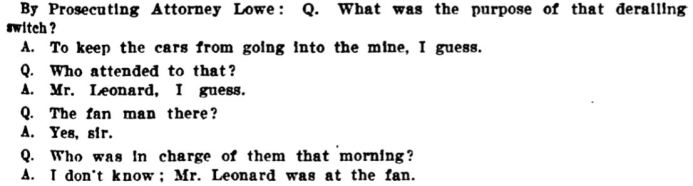
Knight says he was able to look at the place where the cars broke “and saw the pin had broken.” (Inquiry)
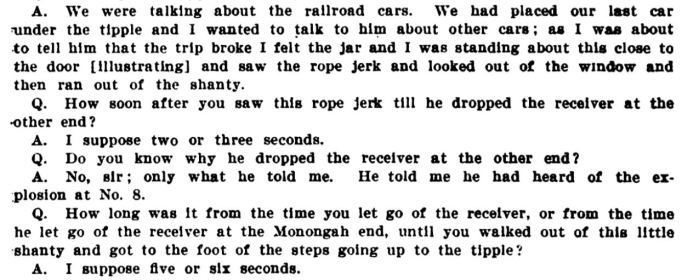
He also states that he was on the phone with Mr. Talbott in the company shipping department when the trip broke loose. (Inquiry)


Knight is also asked if he recalls the last car on that trip being a water car, but he does not. He states that he did, however, find the broken coupling pin and saw no defect in it or its iron at a glance. (Inquiry)
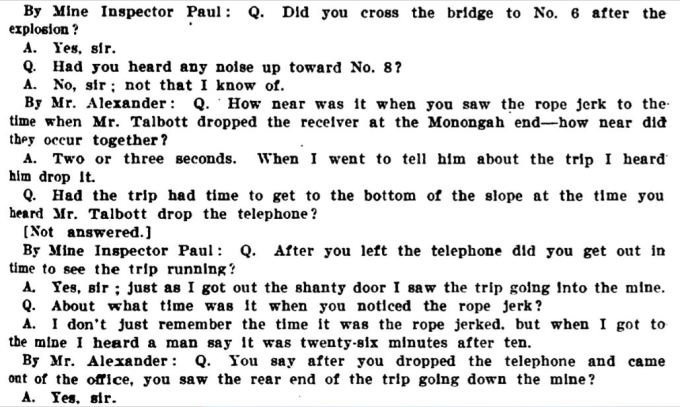
Knight stated that Talbott had “dropped the telephone” before they could finish their conversation. (Inquiry)
It was at the foot of this set of steps that Knight first saw the smoke coming from the air shaft. He is then questioned about distances, stating that he heard a foreman say it was 900 feet from the top of the knuckle on the tipple to the foot of #6 shaft; 400 feet from the top of the knuckle to the pit mouth; from his view under the tipple, the rear car of the trip “looked” to be about 50 feet from the knuckle. Meaning that the cars “would have to run then about 1250 feet to the bottom of the slope”. (Inquiry)
Knight is the presented with wit a portion of a coupling pin and asked to identify it as “a part of the pin that you picked up”. To which Knight replies that, “It looks very much like it.” Knight pocketed the pin on the day of the explosion and gave it to Frank Morris later. (Inquiry)
Knight confirms that he was working the tipple on the day prior to the explosion and that, yes, the fans were running in the mines but he does not know which of the fan men, Mr. Lambert or Mr. Snider, was running it. (Inquiry)


Levi Martin is a laborer outside #6 where he “repairs cars and different things”. He has lived in Monongah for 15 years and at the time of the explosions he was home “near what is called the Willow tree; it is due west” of the mines. He is examined by Chief Mine Inspector Paul. (Inquiry)
Levi is asked about what first alerted him to the explosions. (Inquiry)
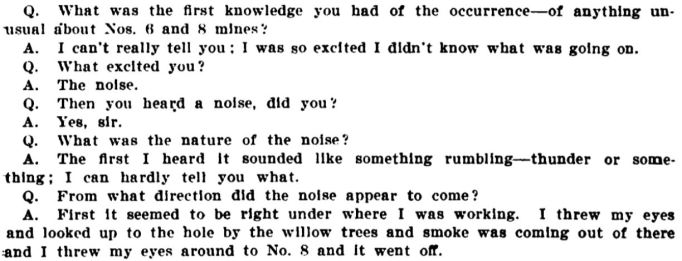
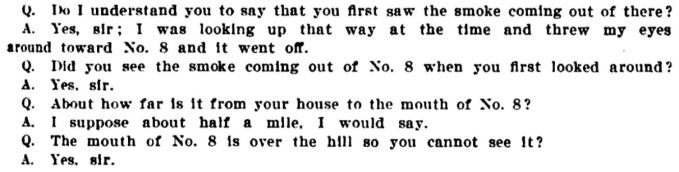
Levi does not know where this hole by the willow trees is located in reference to the mine workings below—“I was never in there and I don’t know anything about it”—but believes he saw smoke rising out around 10:30. He could not see #8 directly but saw the smoke rising. He says he did not see or hear anything from the direction of #6 until after he started over to #8; “I looked down there and saw smoke, but never heard any report down there.” (Inquiry)

Levi was last at work on the 4th of December and has been working at the mines for about three years. He states that he has no knowledge of any explosions in the mines prior to those of the 6th or of dust ever being “inflamed by an explosion at any time a trip of cars might have run back into the mine”. (Inquiry)
Mr. Alexander asks Levi again about the toad hole. “I think that’s what it is—there by the school house; a drilled hole.” He includes that the hole was recently drilled and just beyond the school house.” (Inquiry)

Carl Meredith is the foreman for #8 tipple. He is examined by Att. Lowe. (Inquiry)
Carl came into work at the #8 tipple, across the river from #8 mine, around 6:30 on the morning of the 6th but he did not notice if the fan was running in the mine. (Inquiry)
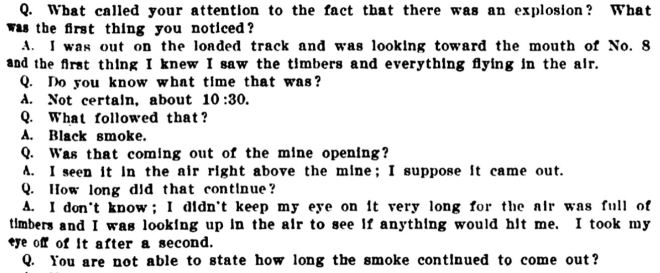
He did not see anything from #6 nor is he sure he could even see #6 from his position on the #8 tipple. He states that he saw the timbers and debris flying in the air before he heard the report. He can also state that he did see fire among the smoke at #8. However, he never looked in the directions of #6; “I didn’t think anything about No.6”, so he can not say that he saw smoke coming from that mine. (Inquiry)
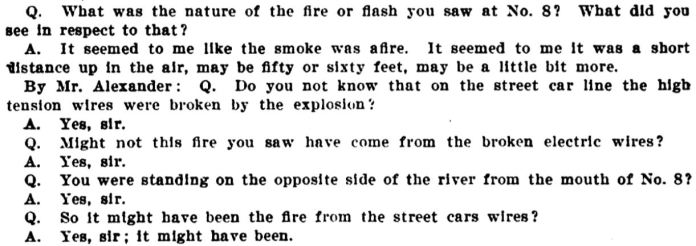
Levi states that he first thought the boiler for #8 had blown up until he “saw the timbers and brick falling and it was only just an instant until I saw the smoke and knew it was the mine.” He has no knowledge of any prior explosions in the mine nor does he have any working association with #6, only #8. (Inquiry)

Hyre “Harry” Stalnaker is a laborer/carpenter for #6 who has lived in Monongah around 5 years. He was working in #8 shop, across the river from the mine “down toward the tipple from the barn”, on the day of the explosions. He is examined by Inspector Paul. (Inquiry)
Hyre is asked if he was looking at the mine at the time of the explosion. “Well, I can’t say I was, in the first place. I was in the shop not expecting anything like that; when I came to myself I was in line with the mouth of the pit.” The force of the explosion “shocked” him; “nearly stunned”. (Inquiry)

Hyre says that immediately following this, he rushed across the bridge to “rescue who might be over there. It was a very short while.” He also did not see or hear anything from the direction of #6 mine. (Inquiry)
Hyre states that he did find Joe Newton on the bridge to #8. (Inquiry)
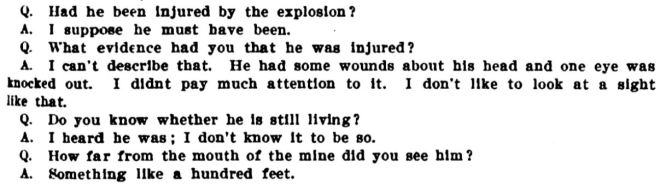
Hyre found George Bice, fan engineer, trapped beneath debris “down next to the street car line. He was lying outside the wall.” Hyre did hear that George did not survive. (Inquiry)

Mr. Alexander asks if any of the stone, brick, or other debris from the explosion injured the carpenter shop in which he was working. (Inquiry)

He is asked if that occurred before or after he heard any noise or shock but he says it al seemed to happen “about the same time to me.” He says that the shock “caused the iron and everything to give in the shop and the widows to break out. Of course a person couldn’t realize the difference between the times.” (Inquiry)
Hyre confirms that a piece of the large fan at No. 8 was blown across to his side of the river. (Inquiry)


Lee Curry is the stationary engineer for #8 who was running the hoisting engine for the rail cars that morning. He has lived in Monongah since 1900. He is examined by Inspector Paul. (Inquiry)
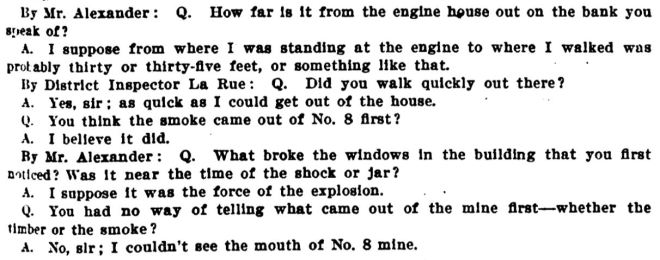
Curry was in the engine house at the time of the explosion and could not see the mine but knew something was wrong when the glass broke out of the window “in the house next to the tipple”, but he thought something had occurred with the boiler. “I went out of the house and started around the house to go to the boiler house.” (Inquiry)
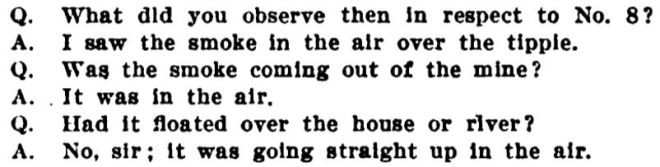
Though he did not hear anything from the direction of #6, he did see smoke coming out and going into the air. (Inquiry)

Lee figures that it was only five or six seconds between the time he felt the jar and saw smoke coming out of #6 mine as he “only had about twenty-five to thirty feet to go” to the boiler house. He saw the smoke from #8 “as soon as I could get out” from the carpenter shop. (Inquiry)
But Lee could not see #6 mine directly from his location, only “directly over the mine” and the area around 75 feet in front of the mine mouth. (Inquiry)
He states that he noticed smoke coming from the toad holes around St. Stanislaus Catholic church before seeing smoke at #6 but he thinks that smoke first came from #8. (Inquiry)

Lee tells Inspector Paul that he saw the smoke over the tipple first. “I ran out on top of the bank facing up toward the church and No. 6 and when I got out there I saw the smoke coming out of the hole and as I looked down at No. 6 the smoke whirled up in the air.” He estimates this bank was about 30-35 feet from the engine house by which he was standing. (Inquiry)
Lee says that the toad hole of which he is speaking is actually “a slope to take the horses in at” though he is not sure if it is supported with timbers. (Inquiry)

George E. Peddicord has been the outside foreman for #8 for about 6 months and has never worked inside either of the mines. He is examined by Att. Lowe. (Inquiry)
George was on the approach leading to the East end of the Iron Bridge at the time of the explosions. “I had been down to the supply house for chain buckets, and was coming up to No. 8 on the west side of the river.” (Inquiry)
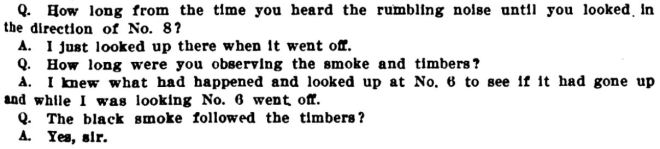
George first noticed the “earth shaking” but not a “loud report—a rumbling noise” from up river toward #8. He then saw timbers and debris in the air “right above” the area he knew was #8 mine, though he could not directly see the mouth. (Inquiry)
He looked at No. 6 “as soon as No. 8 went off” and saw smoke coming out of the air-shaft at #6. He can not say how long the smoke continued to pour out of the mine; “I didn’t look; I knew the mines had exploded and went across the river up to my home and then to No. 8 mine.” He did not notice any flame but did see a distinctive difference between the color of the smoke emitting from each mine— “The smoke that came out of No. 8 was black and that which came out at No.6 was a reddish brown.” (Inquiry)
George was within sight of the #6 tipple but did not see the runaway trip of cars. (Inquiry)

Inspector La Rue asks about the length of time George estimates that he saw the smoke appear between the two mines to which he responds, “Not more than a second.” (Inquiry)
George restates that he did not see smoke coming from #6 mouth because he could not see the mouth, only the smoke coming from the air shaft and confirms that smoke from one mine was black and that from the other was brown in color. (Inquiry)
He estimates that he arrived back at #8 mine in about 10 minutes. There was no steam coming out of the boilers when he arrived. (Inquiry)
Att. Lowe inquires about any former explosions or accidents at these mines but George knows of none. “I had nothing to do with the inside; I was an outside man.” (Inquiry)
George states that he had been at #8 that morning and that Will Bice was running the fan; “the fan ran all the time.” He also states that, though #8 did not technically run the day before the explosions, he was at work on the 5th with many others, including William Bice who was running the #8 fan. “Alvy Yost worked the night shift.” (Inquiry)
Inspector Paul asks if George had charge of the livestock outside of the mine but George says those duties fell to the general foreman, Charlie Dean. (Inquiry)

Will Jenkins has been a blacksmith for FCC at the #6 mine for about “seventeen months”. He is examined by Att. Lowe. (Inquiry)
Will arrived at work around 6:40 am that morning. He had gone into the mine before the explosions occurred to shoe a horse. (Inquiry)

Will estimates that he was inside the mine “about half an hour—a little bit longer than that probably.” He also estimates that he had only be out of the mine 15 or 20 minutes before the explosions occurred. While inside, he did not notice any evidence of gas and that the ventilation was “Good. I made a remark to myself about my lamp nearly blowing out two or three times.” (Inquiry)
Will says there was a horse waiting to be shod in the blacksmith shop, some 25-30 feet down river from the mine, so that is where he went after coming out. He had only gotten one shoe on and was reaching around to pick up the next shoe when the explosion happened. (Inquiry)

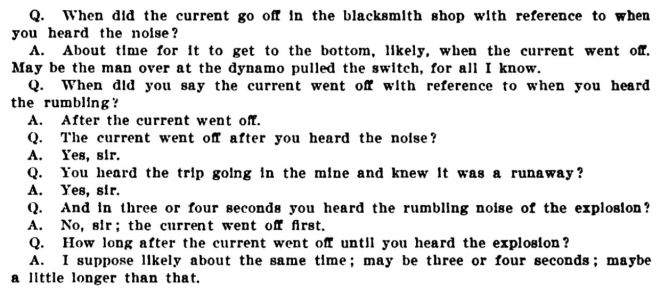
Even though Will is not familiar with the exact numerical distance it is “from the bottom of the slope to the bottom of the mine” he believes that the trip of cars “must have gotten to the bottom, for the power went off at the blacksmith shop.” (Inquiry)

Will confirms that he knew the trip of cars must have been a runaway trip and that it was accompanied by an “unusual noise”. (Inquiry)

Will says it was about 2-3 seconds between the time the power went off in the shop and smoke started coming out of the mine and again confirms that he believes that the trip of cars had enough time to reach the bottom of the mine. (Inquiry)

Will says he saw no flame, just a steady blow out of smoke with a “kind of sootish color” and no return. (Inquiry)
Inspector Paul asks how long it took Will to get from the blacksmith shop to the mouth of #6 mine. Will says he was “right over the mouth while it was still blowing” but he heard no other noise after the one he first heard in the shop. Inspector La Rue asks is the rumblings were steady or jerky “as if explosions were going on at different places”. But Will is not sure, he says he was pinned down under the horse and was struggling to get out at first. (Inquiry)
Will is asked about the quality of ventilation in the areas that he worked inside of #6 that morning, if it was “fully as good as at any time prior?” Will recalls it as being even better that morning, “I remember of pulling the wick up out of my lamp three or four times on account of the current.” (Inquiry)
He says he did not walk in and out of the mine that morning but, instead, took the motor. (Inquiry)
Will states that based on “the way it was going past”, he figured the trip must have reached the bottom. He is not sure exactly how many feet it is to the bottom of the slope and he guesses 500 feet or more. (Inquiry)

Will is asked if he stopped shoeing the horse when he heard the runaway trip go by but Will says he could not as he was already down under the horse. “The trip going by scared it. He was still tramping around over me when the explosion occurred. I didn’t see the first start of it, but felt the jar of it.” (Inquiry)

William Finley is the “Town Sergeant” for Monongah. He is examined by Inspector Paul.(Inquiry)
At the time of the explosions, Finley was “standing on the street by the coal company’s office, at the south side of it” where he could see # 8 mine. He says he “heard a report of some kind up the river like a heavy blast and I seen smoke coming up over the bridge at No. 8.” He noticed smoke coming out of #6 afterward, 4-6 seconds later “or something like that.” (Inquiry)
Finley did not see or hear the runaway trip of cars at #6. (Inquiry)

Peter Urban (Rosebeig) is the only man to survive rescue from the mines. He is examined by Inspector Paul. (Inquiry)

Peter has lived in Monongah on No. 3 hill for around 6 months. He went into work around 6 am on the morning of the explosions and began work in 1st Right off the 1st heading. He is asked if anything “unusual” occurred in the mine. “I know nothing what happened.” (Inquiry)

When asked if the force of the explosion extinguished his light he replies, “I don’t remember; I was so frightened I don’t remember anything.” However, his brother, Stan did have a light. (Inquiry)

Peter states that he does not know what caused the explosion. He says he has, however, encountered gas in the mine before, but not on the day of the explosion. “It was some time before. At this time we were driving a heading and gas and water came in. We were driving a hole—I suppose high up—and gas and water came.” (Inquiry)

Peter says that he encountered this gas no more than 3 days prior to explosions, but they were told to stay. He states that there was “bad air” on the heading they were working on and that gases were “allowed” to accumulate “after the firing; after we fired them there would be heat and here and there a little flame burning of the gas.” Peter says he has never been burned or harmed from the lighting of these gas traces. (Inquiry)

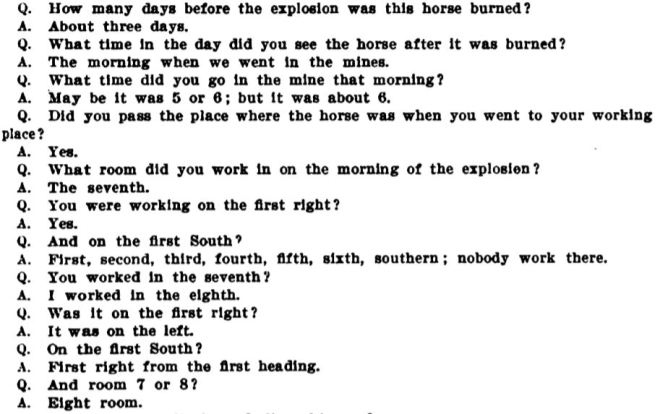
Peter says this occurred at the end of a North entry heading in the 7th room, though he is not sure exactly which heading as it is not one he goes to very often, but he did see the horse and aftermath in person as they came through, “…they said it had been killed by an explosion.” (Inquiry)
Peter states that no human was injured in the event and that the carcass was buried at night; “It happened about 8 o’clock in the morning, about in the evening.” (Inquiry)

Peter is not sure who exactly buried the horse other than “it was someone from the company pulled him out and buried him.” However, Peter says that no one told him the horse had been burned, he saw it with his own eyes. “I saw the horse that was burned and then I heard he was hurt from others; he was burned by gas. When I went down to the mine we passed the horse.” (Inquiry)
Mr. Alexander, a lawyer for FCC, asks about the color of the horse but Peter replies that he couldn’t really see the color of the horse in the mine, “and after he was buried I couldn’t tell.” When asked about why he knows that the horse was buried, Peter says that he also saw this with his own eyes as it was buried “near the No. 3 mine where they buried the other horses now”, meaning those who perished in the disaster. (Inquiry)
When asked if he could point out this grave, Peter says if he couldn’t, his wife probably could, and that “right next to this horse they buried the other horses.” (Inquiry)

Mr. Alexander makes Peter run through the questioning again:
Peter says that Stan told “John, the boss” about the gas and water they encountered the same week that it happened and that they couldn’t work in that area; “Not the old one—but the tall one—the big boss.” (Inquiry)
At some point, Italian Consulate, G.D. Caldera, storms out of the courtroom in protest of Mr. Alexander’s aggressive attacks against the witness. (McAteer)

COURT IS ADJOURNED UNTIL TOMORROW
More on the Monongah Disaster of 1907
How Death Gloated!: A Timeline of the Monongah Disaster and Bloody December of 1907
Who is Guilty?: A Timeline of January 1908 and the Coroner’s Inquiry

 The Monongah Disaster