

5:30 am
Engine No. 1779, helper on the B&O between Piedmont and Altamont blows up. Engineer Frank Smith was buried under debris and it was thought at first that he was killed, but he was gotten out alive. The fireman jumped or was thrown off and escaped unhurt. Traffic was delayed several hours, No. 8 getting to Clarksburg about 4 hours late. (FWV 01.06.08 pg. 5)
During the Morning
The Paint and Powder Club performers arrive in Clarksburg “this morning on train No 3 and they there boarded a special and were brought to Monongah…” (FWV 01.06.08 pg. 1)
In Monongah:
George T. Watson is in charge of keeping the men of the theatrical company entertained and is “arranging a trolley trip to show points of interest and Mr. Brooks Fleming is going to show them the disrupted Monongah mines, take them on a trip into New England (mines) and give them an idea of the intricacies encountered in the mining of coal before it reaches their furnace doors, a lecture as only a Princeton man like himself can give.” (FWV 01.02.08 pg. 5)
“Dr. Hugh Carr, now of Fairmont, met many of these boys when he was a member of Cornell’s Silk Stocking Vendettas, an organization on the same lines, and the doctor now will be right on hand to give first aid to those of the boys who may perchance imbibe too freely of the Monongahela river water and if any of them are stung by the snakes around the mines he has a barrel of a special rubber glove 3 ply killer variety locked up in his office which he will administer freely to those bitten only.” (FWV 01.02.08 pg. 5)
At the mines:
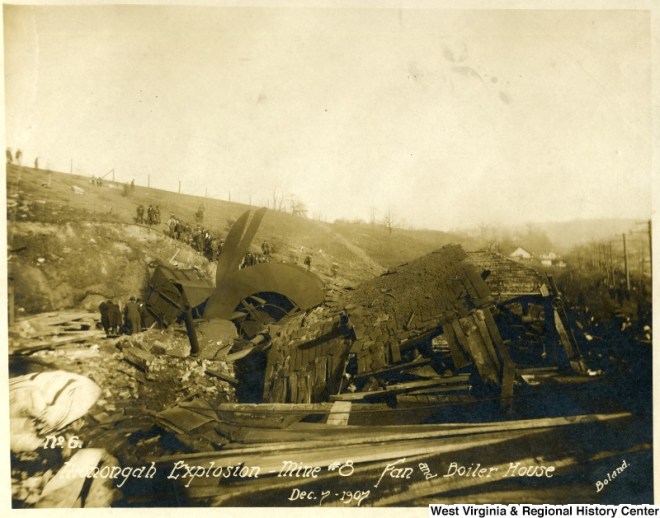
Work begins on the foundation for the “big fan that will be rebuilt at Monongah mine…”. The trenches for the concrete work have been dug. The damaged pieces have been shipped to Connellsville, where they will be remolded and when finished, which will take about two weeks, will be shipped back here. It will take about a month before the fan will be in working order. (FWV 01.06.08 pg. 5)
~9:00 am
In Fairmont:
Fairmont West Virginian reports that the weather will be: Rain or snow tonight and Tuesday; warmer tonight.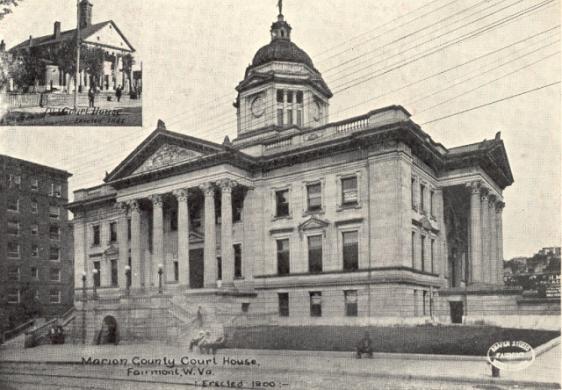
Coroner E.S Amos and his selected jury: W.E. Corday, G.H. Richardson, A.S. Prichard, Festus Downs, J.M. Jacobs, and W.S. Hamilton meet at the Marion County Court house and prepare for the first day of hearing evidence from witness testimony. (Inquiry)
~10:20 am
In Fairmont:

“The presiding investigators are Coroner E.S. Amos, Prosecuting Attorney S.S. Lowe and State Mine Inspector J.W. Paul of West Virginia.” (ES 01.06.08 pg. 1) (Inquiry)
George W. Alexander, Charles Powell, and Harry Shaw—lawyers for the Fairmont Coal Company—are also among the investigators. (Inquiry)
“M. Tomasko, of Connellsville, Pa., representative of the Slovish Catholic Union and C.L. Orbach, of New York, representative of the Slavish Evangelical Union, P. Bufano, of Connells, and M.G. Bufano, of Morgantown are here.” (FWV 01.06.08 pg. 4)
Over the next several days, “Fully one hundred witnesses will give testimony…” (FWV 01.06.08 pg. 1)
“The evidence this morning was taken down in shorthand by Miss Nellie Bly Clemmer.” (FWV 01.06.08 pg. 4)
E.C. Frame was also sworn in “to take in shorthand and transcribe all the evidence of witnesses.” (Inquiry)
“The evidence will be transcribed to long hand as fast as the stenographers can do it.” (FWV 01.06.08 pg. 4)

George S. Gibbons, payroll clerk for FCC who assisted the coroners with keeping the record of the dead at the morgue, is examined by Prosecuting Attorney Lowe. (Inquiry)
Gibbons was present when the bodies were taken from the stretcher and he personally superintended the work of making inquiries as to the identity of each victim. He was in turn assisted by Mr. Charles Rabson and Mr. S.J. Brobst. (Inquiry) (FWV 01.06.08 pg. 1)
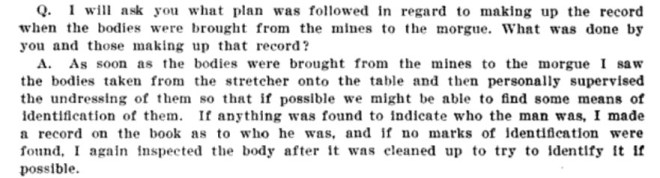
A detailed record was kept and a number given each body as it came into the morgue, “…afterwards when the name of the party was ascertained the name was written opposite the number”. Att. Lowe hands Gibbons a copy of this record book, “made there by you and those assisting you”, and Gibbons confirms that this is an accurate list of those who died in the disaster, so far as he knows. (Inquiry) (FWV 01.06.08 pg. 1)


S.J. Brobst, who assisted the coroners and George Gibbons in making records at the morgue, is examined by Attorney Lowe. Brobst has little to contribute other than acknowledging that he assisted in the morgue with these details, that he made the most of the records himself—”put down the facts”, and that they “tried our very best” to give ample time for identification and correct names for the bodies. (Inquiry)

Charles A Rabson, clerk for 2 years at Fairmont Coal Company office in Monongah, is examined by Att. Lowe. Rabson issues the store checks on the company store in Monongah and was aquainted with the miners who worked in #6 & #8.
Rabson helped the coroners and Gibbons ID the dead and states that all the information he obtained was placed in the main record. (Inquiry) (FWV 01.06.08 pg. 1)

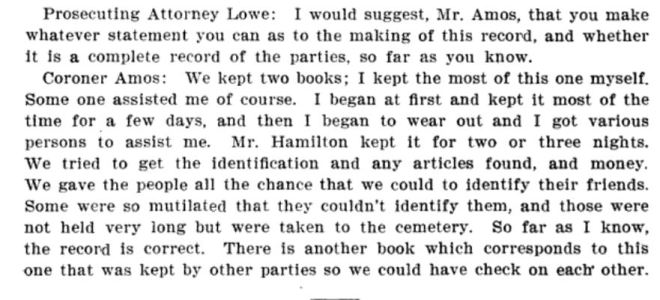
E.S. Amos, coroner for Marion County, adds his testimony to the record.
 F. W. Hill, a physician in Fairmont who volunteered at #8 immediately after the explosions is examined by Att. Lowe.
Dr. Hill “rendered assistance to the relief corps that were overcome by the gas, and as the bodies were brought out (of #8) I looked after them.” (Inquiry)
Dr. Hill is the physician who examined Peter Urban (Rosbieg) and believes he did so around “2:30 ‘clock”. Peter is the only living man brought out of the mine which he saw and at the time Peter’s pulse was very weak and “he was not rational. He was in a condition of shock”. He went back on Sunday, the 8th, to examine Peter again and “found him improving”. (Inquiry) (FWV 01.06.08 pg. 1)
Att. Lowe asks for Dr. Hill’s opinion as to the cause of this state of shock.

Dr. Hill also states that the some of the victims were badly mutilated or burned which “showed that they had come to their death by an explosion—by violence—probably due to the explosion or other cause” while others were not. (Inquiry)

Inspector Paul asks about those that died from asphyxiation but Dr. Hill states that he did not examine them close enough to determine what gases caused death, nor is there a quick or easy way to determine what gases caused death to each individual. (Inquiry) (FWV 01.06.08 pg. 1)

Crazic “Orazio” DePetris is one of the four men who escaped from the toad hole in #8. He is examined by Att. Lowe.
Crazic tells Att. Lowe that he first came to Monongah in 1889 and did pick work in the mines but had to go back to the old county for four years to care for his wife while she was sick, having only returned a few summers ago—“two years next June”. (Inquiry)
He tells Att. Lowe that on the morning of the explosion he was in the mines with his brother, Dan, and his son, Felix. (Inquiry)
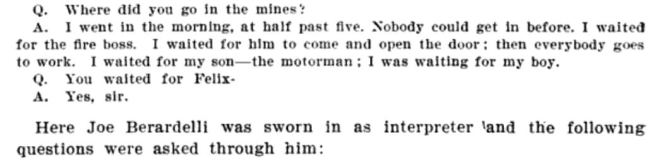
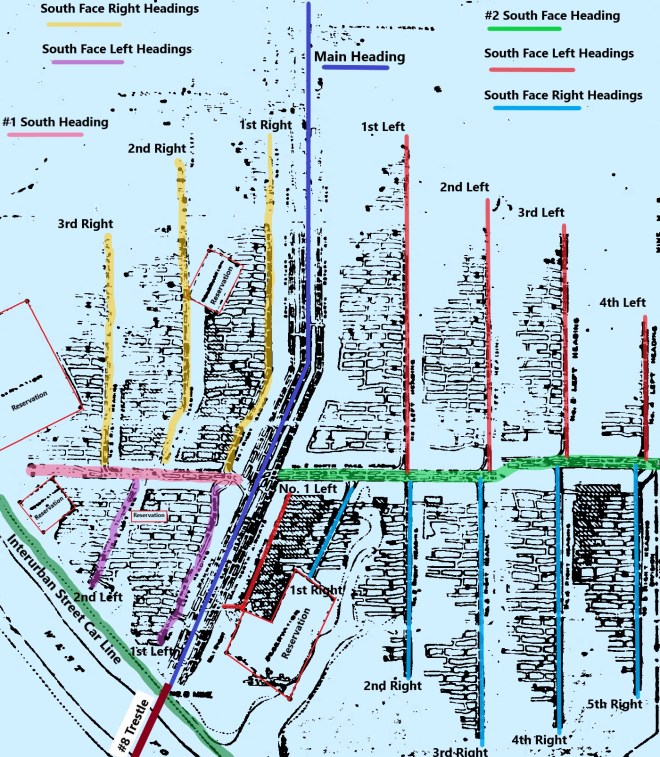
Crazic testifies that he began work in 2nd right south, room 15, in #8 until he was stopped and sent to work in an area he had never worked before, left south. He was able to make a cut, shoot down the coal, and load a car before the explosion happened. They were working about 50 yards from the toad hole where he and 3 others made their escape. (Inquiry) (FWV 01.06.08 pg. 1)
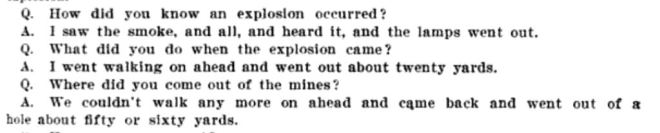
At this point, either Crazic or his interpreter, Joe, mistakenly list Crazic’s son, Felix, among the men who escaped through the toad hole. He states that he and his brother, Dan, were working “in the right room, and the others were about from here to the wall, but all in one room.”
Inspector Paul asks Crazic about the ventilation in his area but Crazic says he “didn’t notice any change, because it was the same as other places.”

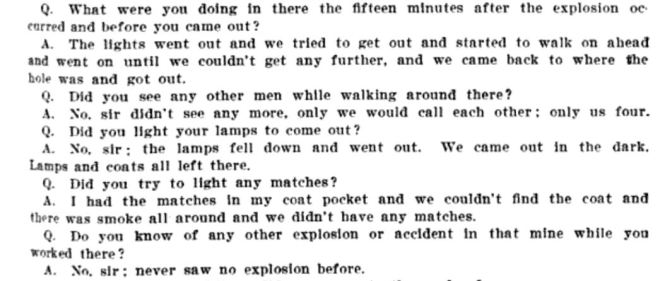
Crazic estimates he was in the mine about 15 minutes after the explosion until the time he escaped. Inspector Paul asks if he knew the fire boos working at the time. Crazic did and says that “he came in and left us about ten minutes before the explosion”, but could not recall his name. Paul also asks about encounters with gas in the mines, to which Crazic replies that he has never seen any.
A juror asks Crazic about the location of the toad hole from which he and the others escaped. He is provided with a map and Mr. Alexander asks him to point out this location on the map. (Inquiry)

Crazic says he can not read English but “didn’t see” the fire boss’s blackboard when he went into work that morning, He also says that the gate to the mine shaft was closed prior to 5:30 am and that the fire boss must have opened it on his way out, as Crazic found it open upon his arrival. (Inquiry)
 J. R. Cook is a physician and surgeon who volunteered outside of both #6 & #8 mines the day of the disaster and for several subsequent days following. He is examined by Att. Lowe. (Inquiry) (FWV 01.06.08 pg. 1)
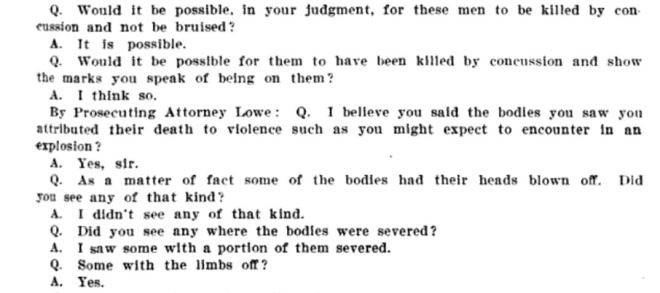
Dr. Cook states that many victims, nearly every one he saw, showed marks of violence such as burns—the hair, the clothing, and skin scorched on many. He reinforces that this is only among those that he saw as he was “not in constant attendance”. He did not, however, see any who appeared to have suffocated, only those who “showed some marks of violence, like something thrust against them or something. In nearly every instance there was some injury.” (Inquiry)
Dr. Cook stated he did not hold any post mortem examinations, that there could not have been any special benefit gained by the post mortem; “If I had thought so I would have made a special effort and had the post mortem.”
He states that the matter of holding such an examination was discussed, but it was given up because “there could not be anything specially derived from an examination at that time.” (Inquiry) (FWV 01.06.08 pg. 1)
Dr. Cook was present and examined the first 3 men brought out of #6—Fred Cooper, John Harriman, and Lawrence Hinerman who were found in the cabin at the foot of #6 slope. He says that their bodies “were considerably bruised and there was some singeing of the hair.” He recalls that their faces were bruised and that one of the men “had very considerable bruises along the body.” (Inquiry)
Recess is called until 1:30 pm
More on the Monongah Disaster of 1907
How Death Gloated!: A Timeline of the Monongah Disaster and Bloody December of 1907
Who is Guilty?: A Timeline of January 1908 and the Coroner’s Inquiry

 The Monongah Disaster