

At the morgue:
“Nearly 400 coffins reached Monongah today from Pittsburg and from West Virginia cities.” (ES 12.7.07 pg. 1)
“Many coffins have arrived and more have been ordered and as fast as identification is made sure the bodies are being taken away by their friends for burial.” (FWV 12.7.07 – pg.1)
At the mines:
“The galleries are still filled with poisonous gases and it is impossible to open them till the main entries are opened and the fans can clear them.” (TBE 12.7.07 pg. 1)
“Working conditions are terrible, owing to gas and the wrecking, shifts can work less than an hour at a time.” (ES 12.7.07 pg. 1)
“While only sixteen bodies have been recovered or brought out of the mine, members of the rescuing parties stated that eighty bodies have been located.” (ES 12.7.07 pg. 1)
“Only sixteen of the dead bodies have been removed from the shaft entrance of No. 6, but 100 others are in the first level and are being kept in the mine until the authorities can get the half-crazed people away from the entrance.“ (TBE 12.7.07 pg. 1)
“Preparations are being made to bring the bodies from the mines in electric cars, with which the mines were equipped.” (WT 12.7.07 pg. 1)
“The rescuers in mine No. 6 report so many bodies that it will take hours to get them all out. In No 8 mine the rescuing parties are just getting started as poisonous gases there were worse than in No 6 mine.” (TEP 12.7.07 pg. 1)
~1:00 pm
At the mines:
“Up to 1 o’clock today but sixteen bodies have been brought to the surface…” (ES 12.7.07 pg. 1)
“A dozen undertakers are also in waiting in one of the buildings near the entrance to take charge of the bodies as soon as they are brought out and make them as presentable as possible.” (WT 12.7.07 pg. 1)
“A thousand men are working…” “About 130 corpses had been found in the wrecked Monongah mines here at 1 o’clock this afternoon.” (Pitt. Press. 12.7.07, Sparks)
In Monongah:
The body of Fred Cooper (one of first men found in the shanty of #6 mine) has been fully processed through the morgue and his body is brought into Fairmont on the one o’clock car. He is taken to his father-in-law’s home, Mr. Shingleton, at the corner of Locust Ave and 11th St. (FWV 12-7-07, pg. 1)
~1:30 pm
Clarksburg Daily Telegram puts out a special, extra edition:


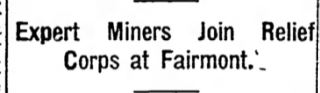
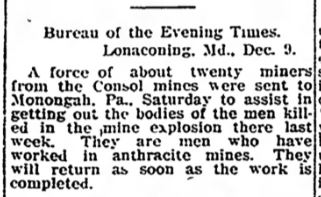
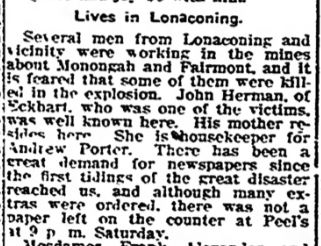
The local newspapers are correcting their previously published information on the location of the mines. Though the Clarksburg Daily Telegram puts out far more accurate information now that they have their own reporters on the scene, their original source—the Associated Press—never corrects their original inaccurate information at any point and it continues to circle around the country for the next several weeks.
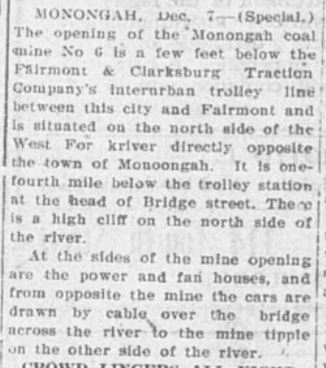
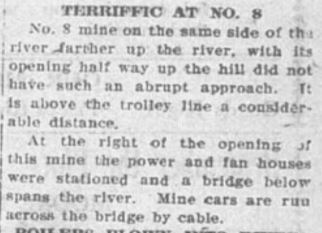
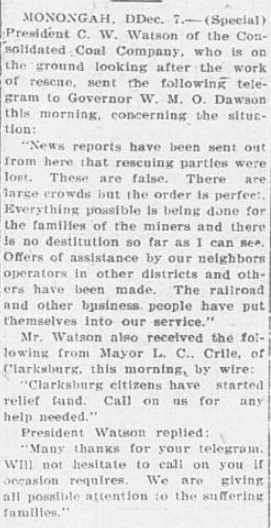
The results of just some of these inaccurate reports have already made their way back to Monongah. For the next several days, Watson and other officials will struggle with the press. They have little to no experience with mass swarms of reporters nor with managing a catastrophe of such magnitude. They will make several mistakes in their attempt to control the release of information over the next week, including the most devastating mistake of making it obvious to the press that information is being controlled.
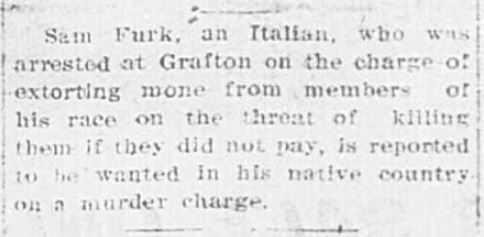
Quietly tucked away on page 3 is an update on Sam Furk, reported leader of the local Black Hand, which would have taken front page status had the disaster in Monongah not occurred:
~2:00 -2:30 pm
Inside #6:
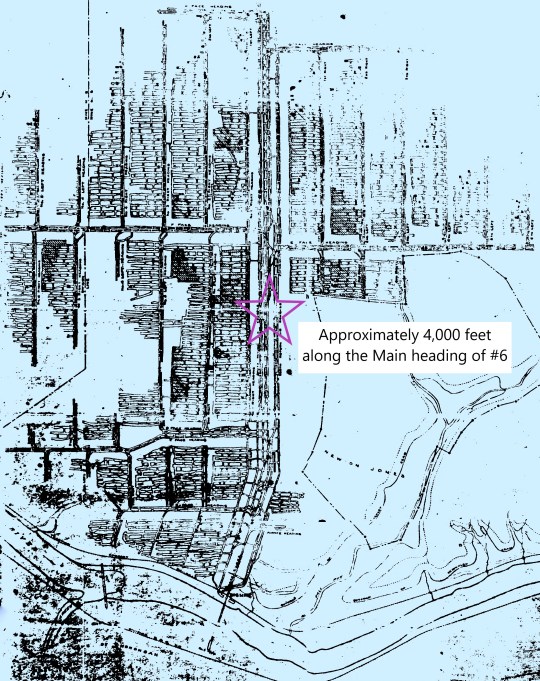
Search parties find only 5 men between the bottom of the slope of #6 to the connection of the 2 mines – distance of about ¾ of a mile, over 4,000’. Only the main heading has proper ventilation and cleared wreckage that far back, but not the rest of the mines proper (rooms, hallways, etc.) where most of the victims surely lay. Ventilation systems “will have to be rebuilt throughout the mine” starting “this afternoon”. (FWV 12.7.07 – pg.1)
“The resources are being reinforced as men are needed, so that as soon as one man is overcome his place is taken by another.” (FWV 12.7.07 – pg.1)
Though it is quite clear that the town is teaming with news reporters all day based on the sheer number of events accounted throughout the afternoon, few reporters managed to note the time of when certain events occurred. The best this author can provide at this moment is a list of these events in what is the most likely order in which they occur, trying to keep in mind that some of these may have been occurring simultaneously.
At some point during the afternoon,
“…with hysteria in all its devious forms rampant among the populace.” (RIA 12.7.7 pg. 1)
At the mines:
Several rescuers enter the mines “only to return to the open much more dead than alive.” (CDT 12.7.07 pg. 1)
“The first emergency hospital is crowded with men who have been overcome with the mine gas…” (FWV 12.7.07 – pg.1)
“The rescuers as they come out report that men to the right and left of them are lying all about the mine…” (FWV 12.7.07 – pg.1)
“A foreign woman whose husband was in the mine, rushed to the entrance but the gas forced her back. Realizing that she could do nothing toward aiding her husband, she tore the skin off her face with her finger nails and pulled out large twists of hair.” (WT 12.7.07 pg. 1)
At the morgue:
“The following bodies were identified in the morgue today: DOMINICK, who worked for John Preston. MIKE ____, also one of Preston’s men. FRANCISCO LORIA, who is horribly mangled. CARMO ZEVOLA, who was identified after some time by his [whole line of text is missing]. Much doubt existed in the authenticity of her identification but the small tobacco sack which he carried was the means of making the identification sure.” (FWV 12.7.07 – pg.1)
“Another body that has been positively identified is a man who is known as Louis, his other name not being known. Mr. Caldara says he is from Naples.” (FWV 12.7.07 – pg.1)
In Monongah:
Lorin Wise, brother of Charlie Wise, and Mabel & Edith Wise, his sisters, arrive from Canton, OH. (FWV 12.12.07 pg. 1)
A wagon load of bodies is trying to get from #6 mine across the Iron Bridge and to the morgue. Before it reaches the bridge, the crowd rushes the cart from all angles, pinning in and frightening the horses. The horses panic and bolt, racing through the crowd, overturning the cart, and dumping the bodies onto the ground before running over the embankment. The crazed horses continue down the river bank and run straight into the icy waters of the West Fork River, taking along the driver and his assistant. As the cart hits the water, the driver is violently thrown out and seriously injured. (McAteer)
“As the day advanced, [the widows] became almost crazed through grief and suspense. One pulled out her hair in handfuls at a time and another tore all the skin from both cheeks with her fingernails. Some lay down on the frozen ground and cried themselves asleep, and in this condition, many were carried to homes nearby without awakening.” (RIA 12.7.07 pg. 1)
“The company has provided clothing, food, and supplies for all who are in need and charity on every hand is being observed.” (CDT 12.7.07 pg. 1)
The body of a young man is brought to his home and placed inside. 2 hours later and one room away, his wife gives birth to their child. (FWV 12.9.07 – pg.8)
At the mines:
“The workers at both pits are being cheered and helped in their heroic task by the presence and good words of their bosses.” (FWV 12.7.07 – pg.1)
“Everything possible has been and is being done to recover the bodies of the dead miners and to take out any who might be alive. The coal company officials have given their best energies to the work and are yet grimly at work sleepless and hungry without thought of rest until all has been done to reach any miner possibly alive and to recover the bodies of the dead ones.” (CDT 12.7.07 pg. 1)
“Late today the deadly blackdamp became more pronounced as the more farther recesses of the mines were approached…” (DASB 12.8.07 pg. 1) (LODD 12.12.07 pg. 1)
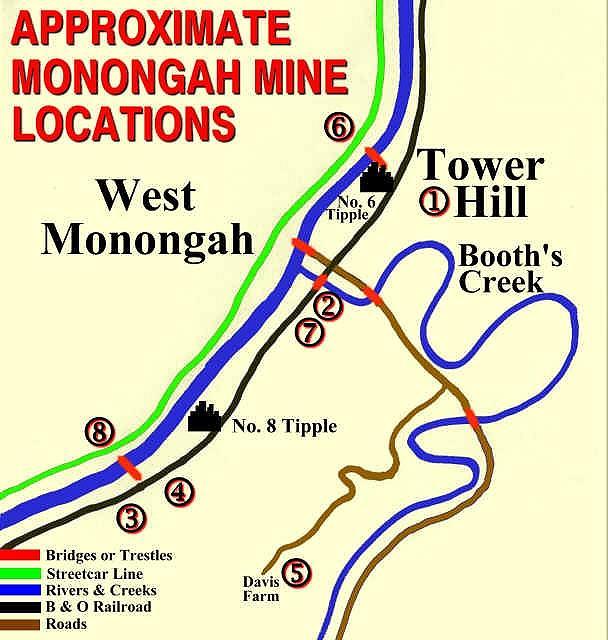
At #8:
“One hundred men are working in mine No 8, where the damage was greatest…” (WT 12.7.07 pg. 1)
In Charleston, WV:
Gov. William M.O. Dawson calls out the National Guard: Company H of First Infantry under the direction of Col. M.M. Neely. Despite Watson’s telegram earlier in the day, the Governor is concerned about potential disturbances among immigrant families and the throngs of sightseers. (McAteer)
At #6:
“Some bodies have been brought to the mouth of #6 but have not yet been made known.” (FWV 12.7.07 – pg.1)
“In No. 6 there are 150 workers. Though the interior of this mine is not so badly damaged as the other, the gas in the tunnels is more troublesome, and it is necessary to come frequently to the surface for fresh air.” (WT 12.7.07 pg. 1)
“As the rescuers groping and dazed came from the mouth of the mine they were besieged by anxious ones and bringing no tidings or news of the unfortunate men below there were fresh outbursts of sobbing and cries of grief went up for their loved ones.” (CDT 12.7.07 pg. 1)
“Now and then rescuers came staggering forth, gasping for fresh breath but to hear from the women gathered near the pit renowned cries of distress and sorrow.” (CDT 12.7.07 pg. 1)
“And to add further to the mine horrors the wails and moans of the wives and daughters of the entombed miners were heartrending.” (CDT 12.7.07 pg. 1)
“In the great crowd one or two women would scream, perhaps faint, and be carried to their homes while the undertakers put the bodies in coffins and followed the bereaved ones to the little miners’ cottages. This scene was repeated again and again all day.” (TEP 12.7.07 pg. 1)
~4:00 pm
All saloons and bars in Marion county are closed by order of the mayors and the Marion county Sheriff and no liquor sales, anywhere, are permitted. “The saloon keepers willingly consented and will not open their places again until Monday.” (FWV 12.7.07 – pg.1)
As the main morgue in the bank overflows, bodies are taken directly from the mouth of mine to tent morgues at the cemetery or to church basements (McAteer)
If no ID has been made on a body within several hours, the dressed body is placed in a coffin and buried in the potter’s field as unknown.
“Foul gases in the No. 8 mine prevented any attempt at rescue until late this afternoon and even now it is impossible to make any headway. At this time the force of the explosion was so great that holes were blown through the side of the hill in several places along the river bank.” (TBE 12.7.07 pg. 1)
~5:00 pm
Newspapers are just beginning to hit the streets and stands. A majority will sell out within the hour.
More on How Death Gloated!

 The Monongah Disaster