

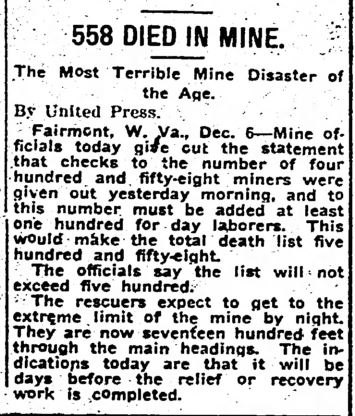
“It is believed that the shock of the explosions displaced many of the heavier timbers in the galleries and whole rows where the unfortunate men were working collapsed upon them. In this case the work of reaching the entombed men will be infinitely greater. Some of them are now believed to be separated from the outer world by many tons of earth.” (WED 12.7.07 pg. 8)
“The hope that they are alive lies in the possibility that enough pure air remained in the mine to supply those who were not crushed outright until they can be reached by the rescuers.” (WED 12.7.07 pg. 8)
In Monongah:
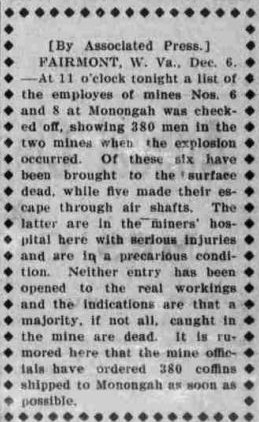
“At eleven o’clock tonight the list of employees had been checked off, showing that 380 were in the two mines when the explosion occurred. Of these six had been brought to the surface dead and five escaped through air shafts. The latter are in the miner’s hospital here in a precarious condition.” (DASB 12.07.07 pg. 1)
For hours now, more than likely since the meeting with Pres. C.W. Watson, General Manager Malone has been sorting through the payroll lists for Monongah mines #6 and #8 to get a better idea of just how many fatalities they are facing. By 11:00 pm, he is as finished as he can be with this aspect of his research. However, he does not deny that this list of around 380 payrolled names does not include any non-payrolled workers (such as B&O railroad workers on loan or those hired and paid by the miner personally—what we would consider an Independent Contractor today), younger trapper boys, or those who have been hired since the last time this list had been updated some two weeks prior, nor will it include those who were known to have been hired the morning of the explosion.

None the less, the press and public will become fixed with this very first “official” number of 380 and begin to speculate on their own.
“Six charred bodies lying in the improvised morgue, five men near death in the hospital and 369 men imprisoned by tons of coal, rock and mine debris in the depth of the hills surrounding this mining town with chances all against a single one of them being alive is the most accurate summary obtainable at 11 o’clock tonight…” (SFC 12.7.07 pg. 1)
The company nor the press is yet aware of just how many workers, like Bill Sloane and this author’s own great-grandfather, did not go into work that morning. As each one begins to turn up alive over the next several days, the overall number of potential corpses continues to be lowered rather than a name simply getting checked off the potential identity list. Though the extra off-payroll workers are acknowledged by company, they are not included in their factors.
In Fairmont:
“Late in the night…the streets of the city were crowded with anxious people eager to snatch any news that came from the disaster. Every car that came from Monongah, the passengers were stopped while inquiry about the news was made by the waiting crowd but the passengers had little to satisfy the hungering ones.” (FWV 12.7.07 pg. 2 – noon)
At some point during the night at the Miner’s Hospital, William H. Bice, the fan engineer who was blown through the walls of the #8 fan house, dies of his injuries. Though many doctors and nurses have returned to the Miner’s Hospital, the morticians and undertakers are still in Monongah. As a result, Bice had plenty of care in his final hours of life, but in death there is no one on hand to care for his body at the hospital. His body, along with others, is simply left in the hospital morgue.
In Pennsylvania:

Clarence Hall has been on the site of the Naomi mine disaster for days, but now he boards a train and heads straight for Monongah. He is considered U.S. President Theodore Roosevelt’s personal representative as one of the few federal government agents attempting to remedy the ever-growing mortal cost of the mining industry in the country.
In Monongah:
Before the midnight hour, rescue work transitions into recovery work as the long process of removing bodies from the mines begins. As #6 mine was not as badly damaged as #8 and workers have been able to restore enough ventilation for rescue crews, the process begins there.
As each body is brought to the surface, Dr. F.W. Hill and several other medical volunteers briefly examine the bodies in hope to quickly determine the true cause of death before sending them over to the temporary morgue. Though Coroner Amos and many other morticians are expecting to have the chance to perform autopsies, they simple become too overwhelmed too quickly and decide against doing so. Due to the conditions of many bodies, it is impossible to embalm them and they must be prepared for burial and identified as quickly as possible.
~Midnight
“Of the victims six dead bodies had been taken from mine Nos 6 at midnight and six others were piled up in the entry awaiting the completion of facilities for bringing them to the surface. From mine No 8 at the same hour, fourteen bodies had been removed, and a number of others are ready to be brought out as soon as arrangements can be completed.” (LAH 12.7.07 pg. 1)
Outside #8:
Once the small fires in #8 are subdued, the temporary 8’ wide fan on loan from a local mine in Shinnston is started up once again. Though they manage to recover some bodies near the mouth and along the main shaft of the mine, the temporary fan is simply not powerful enough to purify the air in the mine and rescue crews only make it around 700 feet beyond the main entrance before they are once again driven out by toxic gases. However, this does not stop the rescue and recovery efforts. A fresh crew replaces those who came in contact with the gases and a round-robin system of smaller crews and shorter trips into the mine takes hold at #8.
In Monongah:
A large number of lingering physicians are “ordered out” of the town; “At midnight these messengers of mercy with pity and patience were on the scene ready to minister to the maimed and moaning, but there was little need for their services.” (FWV 12.7.07. pg. 1 – noon)

More on How Death Gloated!

 The Monongah Disaster