“At noon today no additional bodies had been recovered from the mines…” (WT 12.13.07 pg. 8)
John Graham Smyth, assistant chief engineer, is placed in charge of recovery efforts underground. (McAteer)
Smyth reports to E. Scott outside. (McAteer)
E. Scott reports to Ruckman and Malone. (McAteer)
~2:00 pm
In Fairmont:
Jess Severe is buried at Woodlawn Cemetery. The Improved Order of Red Men is in charge of the funeral. (FWV 12.13.07 pg. 1)
In Monongah:
“The work in the mine was resumed this afternoon, but the men are engaged in cleaning out the debris. In this manner they may run across more bodies.” (CDT 12.13.07 pg. 1)
“A census taken of the town shows three hundred and thirty-eight men missing, which leaves eighteen bodies still in the mines.” (CDT 12.13.07 pg. 1)
“In addition, however, there was a number of contractors and men hired by these contractors are believed to have been in the mines when the explosions occurred.” (CDT 12.13.07 pg. 1)
At some point during the afternoon:
In Fairmont:
The Fairmont West Virginian receives a letter from Elkins post office employees with a donation of $50 included. (FWV 12.14.07 pg. 1)
In Monongah:
One body is recovered from #6. (FWV 12.13.07 pg.1)
“One more body was found in the Monongah mine disaster this afternoon, bringing the total number of bodies recovered up to 321. The last body is that of a man named Burt. It is at the mouth of Mine No. 6, in which mine it was found.” (CDT 12.13.07 pg. 1)
Frank H. Wilmot and George A Campsey, representatives of Carnegie Hero Fund Commission of Pittsburgh are still in town “to find out the progress made in relieving the sufferers and in what way the commission could best serve the needs.” (FWV 12.14.07 pg. 2)
J.H. Wheelwright makes a statement speaking of the difficulties that the searching parties had to encounter: “The difficulties the rescue parties have undergone cannot be realized or appreciated by those outside the mines. It is necessary to make an inspection inside to know the actual conditions.” (FWV 12.13.07 pg. 1)
~3:00 pm
In Fairmont:
Union Relief Association holds a meeting in the M.P. Temple in order to get “As full a report of committee as possible…” (FWV 12.13.07 pg. 1)
Coroner Amos deposited the sum of $367.12 in the People’s Bank of Fairmont to go toward the relief fund. This was all the money found except $23.19 found on the body of Andy Morris which was turned over to the proper relative. (McAteer) (FWV 12.13.07 pg. 1)
Mr. George Linn and daughter, of Benton’s Ferry, attend the funeral of J.H. Mort, member of Marion Lodge No. 27 R.P. (FWV 12.14.07 pg. 2)
The remains were taken across the river in a boat and interred at Maple Grove cemetery. He leaves a wife and four children. (FWV 12.13.07 pg.1)
In Monongah:
Coroner E.S. Amos and Prosecuting Attorney Scott C. Lowe went to Monongah to confer with State Mine Inspector J. W. Paul in regard to the time of holding the inquest. “It is not known at this time if the jury will be taken through the mines or not. If the jury does go through the mines it will likely be after the evidence is taken.” (FWV 12.13.07 pg.1)
~3:30 pm (Press Time)
“Although search was abandoned last night, two more victims…were found today. This makes the total number recovered three hundred and twenty-two.” (BDT 12.14.07 pg. 1)
“Two bodies were taken out of the wrecked No. 6 mine…making the total of recovered bodies 322, of which number 96 were unidentified.” (CET 12.16.07 pg. 1)
“One body taken out of No 6…was identified as Nick Tertza, a Greek, aged 29, single, of West Monongah, and another body was taken from the same mine the same afternoon and has been identified as Henry Burke, an American, aged 69, of East Monongah.” (CDT 12.14.07 pg. 1)
“The census takers made another report, which increases their list from 338 to 344, and it is now predicted that the fatalities all told will number nearly 350. The bodies taken out…were in a bad state of decomposition and identification was made from their mine checks.” (CET 12.16.07 pg. 1)
~4:00 pm
State Mine Inspector J.W. Paul leaves Monongah and travels to the Naomi Mines in Pennsylvania. (FWV 12.14.07 pg.1)
By Late Afternoon
Some 40-50 horses have been removed over the past few days. (McAteer)
The matter of dealing with carcasses was put off for some time in favor of corpses and these carcasses had merely been covered with canvas tarps until all corpses had been found and mostly recovered. (Haas) (McAteer) (News)
Information on the conditions of these animals is included in the formal report made by General Manager Frank Haas for the Fairmont Coal Company:
“One driver was found beneath a loaded car completely covered, only one foot sticking out, his horse lying nearby, stripped completely of harness, which was found 100 yards up the heading lodged in a pile against a pillar fall.” (Haas)
“On another heading, pieces of horse were scattered for a distance of 500 feet, torn so badly that the remains had to be gathered with a shovel, while in a small hole in the rib of this heading the body of a trapper boy was found in a sitting posture without a mark or scratch of any kind.” (Haas)
This slideshow requires JavaScript.
“Tracks had to be thoroughly cleaned up to the carcass which after being thoroughly disinfected, were pulled on trucks by block & tackle, wrapped in canvas and hauled outside.” (Haas)
“Where roof falls made it impractical to clean up tracks to get trucks to livestock, block & tackle was attached and they were skidded for hundreds of feet, sometimes over falls and through crosscuts, to the track, occasionally necessitating the sawing off of a leg or head in order to make progress possible.” (Haas)
One of the most notorious and lingering ghost tales about the Monongah Mine Disaster includes this information about the horses:
“In just one crosscut, in one section halfway up 3rd Right of Old #6, at least 12 horses perished-and some said many more.” (Coffin Hollow, Musick)
“When the explosion came, the pressure from both ends of the crosscut pressed and squeezed the horses into one solid mass of flesh and bone.” When rescue/clean up crews came upon the pile, they decided “the best and quickest disposal that could be made was to gob their remains into an old working area and seal it off.” (Coffin Hollow, Musick)
“Three hundred and twenty bodies have been recovered. Of these 71 were American, 11 Negroes, 146 Italians, 54 Slavs, 31 Poles, 5 Greeks and 2 Bulgarians.” (TC 12.15.07 pg. 3)
During the night:
Rescue crews are shifted out and a new clean-up crew of 100 men arrives to remove roof falls in order to recover more bodies. (McAteer) (Haas) (News)
~4:00 am
*In Littleton, WV:
“As a Cameron helper in charge of Pete Fleming, engineer, and George Keifer, fireman, was coming in on the siding the engine started to run away.” (FWV 12.14.07 pg. 5)
Fleming reversed the engine and tried to stop it but he and Keifer had to jump to save themselves. Fleming broke one leg below the knee and his face is cut and bruised by falling stones. “He was taken to Regers’ Hospital” (FWV 12.14.07 pg. 5)
“The engine struck the cars on the siding with great force then started backward and before it could be overtaken had gained the main track and was running at a rapid rate. The telegraph operator at Burton was called but the engine passed that place in its mad fight, which is six miles distance, in six minutes from the time it started. The operator not understanding the order gave it a ‘white light’ not realizing his mistake until he saw it flash by unoccupied. The operator at Glover’s Gap was called and arrangements made to derail the engine at that place.” (FWV 12.14.07 pg. 5)
“The track was cleared and the engine getting out of steam stopped of its own accord at Shey’s Tunnel, one mile east of Glover’s Gap.” (FWV 12.14.07 pg. 5)
~6:00 am
The First Regiment Band takes the trolley car to Clarksburg to attend the funeral services of John M McGraw. (FWV 12.12.07 pg. 5)
The Fairmont West Virginian reports the weather as: rain or snow tonight; warmer
~8:00 am
The remains of Harry Seese, a son of Samuel Seese, a victim of the Monongah mine disaster, is brought to Shinnston on the 8 o’clock train and buried in the Masonic cemetery. “His many friends and relatives here have the sympathy of the entire community.” (CDT 12.14.07 pg. 5)
During the Morning
In Pennsylvania:
FWV 12.13.07 pg 1
In Fairmont:
Frank M Murphy, proprietor of the Bijou Theatre, brings the cash box containing the entire receipts of the Bijou Theatre for Thursday, securely locked, into the offices of the Fairmont West Virginian. When opened it contained sum of $32.03 all of which he very generously contributes to the Monongah Relief Fund. (FWV 12.13.07 pg. 1)
Justice/Coroner Amos fills out 11 insurance claims over the course of the morning. (FWV 12.13.07 pg. 1)
In Monongah:
“Twenty funerals were held here this morning, the bodies being buried in the potter’s field set aside for the purpose.” (WT 12.13.07 pg. 8)
C.W. Watson is asked for a statement. He said that there was nothing new in the situation and that there had been a great deal said about the officials and the coal company and about the state representatives but little had been said about those whom he thought were the real heroes in the calamity, the men who made up the searching parties. (FWV 12.13.07 pg. 1)
“These men came in from many places in the state and volunteered their services without thinking of getting their names in print. They did not stop to inquire nor did they seem to care whether their names were on the payroll or not. The one thing that they were bent on was to get the entombed men out and no sacrifices seemed too great for these men to make. There were the real heroes, the burden bearers.” (FWV 12.13.07 pg. 1)
Mr. Watson said that the rumor this morning that the mines were on fire proved to be untrue when the workers had made a thorough investigation of the matter. (FWV 12.13.07 pg. 1)
“It was found that some of the afterdamp coming in contact with the good air caused a peculiar odor and that was the foundation for the report that the mines were on fire. Worked stopped for a while because it was the workers who did the investigation.” (FWV 12.13.07 pg. 1)
~9:30 am
In Clarksburg:
“Four funerals were held at the Church of the Immaculate Conception Friday morning, three of them for victims of the Monongah disaster.” (CDT 12.13.07 pg. 1)
“The first funeral was that of John T. McGraw, pitt boss at Monongah mine No. 8, whose body was recovered from the mine early Thursday morning. The body arrived in Clarksburg from Monongah on a Baltimore & Ohio train and was taken to the church where at 9:30 o’clock funeral services were held followed by the burial in Holy Cross cemetery. A large number of friends and relatives, accompanied the body here and the First Regiment band of Fairmont, of which the dead man was a member, also came along.” (CDT 12.13.07 pg. 1)
~10:00 am
In Clarksburg:
Timothy Lyden’s body is taken from his mother’s home on Jackson Street “to the Catholic church where funeral services will be held and interment will be in Holy Cross cemetery.” (CDT 12.12.07 pg. 4)
“Fire which started in the No 8 mine last night is entirely out today and an unusually large force of men put to work at 10 o’clock.” (WT 12.13.07 pg. 8)
“Two forces of men are at work clearing up the falls where it is thought dead miners may be entombed. The number in each force is 45 and they are working 8-hour shifts. The men are only making a search for the miners. Mine Inspector J.W. Paul gave orders that the mines should not be disturbed except where it was necessary to get a body…the debris is still very loose and the men can be located by the odor. General Lee. L. Malone, who has been through the mines, gave it as his opinion that there are not more than four or five more bodies to be found.” (FWV 12.13.07 pg. 1)
Deodorizing and disinfecting squads went ahead of recovery teams and work just as they have for the days prior. As soon as a body is located it is disinfected with a solution of carbolic acid (prescribed by physicians in charge) and properly marked with all available information for identification. All carcasses of horses are treated with either a very strong solution of carbolic acid or with a half barrel of slacked lime on top of which chloride of lime was sprinkled. (McAteer) (Haas)
~10:30 am
In Clarksburg at the Church of the Immaculate Conception:
“The next funeral was a double one and was for Timothy Lyden and Henry Martin, also victims of the awful Monongah disaster. Lyden’s body was taken from the home of his mother, Ellen Lyden, on Jackson street to the church and Martin’s body was brought here on the interurban trolley arriving at 9:30 o’clock and taken to the church. At 10:30 o’clock services were held over both bodies, attended by a large number of sorrowing friends and the interment followed in Holy Cross cemetery.” (CDT 12.13.07 pg. 1)
~11:30 am
In Clarksburg at the Church of the Immaculate Conception:
The 4th funeral is that of “Thomas Flynn, who died at his home on Flynn street Wednesday afternoon of consumption, took place at the church at 11:30 o’clock and was also largely attended by sorrowing friends. The burial was in Holy Cross cemetery.” (CDT 12.13.07 pg. 1)
*Author’s Note: The event of the runaway car at 4 am in Littleton is not directly related to Monongah, other than giving an impression of how fast runaway rail cars can manage to go all on their own; 6 miles in 6 minutes is…impressive. But, this author mostly included it because it is just a really neat and kind-of funny story (in hindsight, of course) which always manages to cheer me up at this point of the Timeline so I felt I should go ahead and keep it in for those reasons.
“This great transformation was all brought about in less than three hours. This whole settlement is bereaved and weeping. Those who have been more fortunate and are known positively to have lost no loved ones when the explosion let go are downcast and mourn for those who lost relatives and friends.” (AR 12.12.07 pg. 5)
Evening
In Wheeling:
Bishop Donahue sends a message to several New York newspapers in answer to inquiries made from that city as to the extent of the disaster. “I have the honor to be a member of the general relief committee and will take pleasure in receiving any sums, however small, in aid of the fund, and seeing to it that it reached the right hands. There are approximately 400 widows and 1,000 orphans.” (FWV 12.13.07 pg. 1)
The Wheeling relief fund reaches $2,860.00. Contributions to the fund are being made through Bishop Donahue, the Intelligencer, the Board of Trade, House & Herrmann and direct to Mr. Sands. (FWV 12.13.07 pg. 1)
In Fairmont:
Mayor Arnett receives 3 packages of children’s clothing “expressed” from “HUB” in Wheeling. (FWV 12.13.07 pg. 1)
~7:00 pm
Remains of Jess Sever and J.W. Miller are brought to Fairmont on the 7 o’clock car. (FWV 12.13.07 pg. 1)
After Dark
In Clarksburg:
Mr. F. M. Murphy gives the entire receipts of tonight’s performance at the Bijou Theatre to the relief fund. (McAteer)
In Fairmont:
The remains of J.W. Miller are buried at Woodlawn cemetery. The funeral is under the direction of the Improved Order of Red Men. Miller leaves a wife and 2 children. (FWV 12.13.07 pg. 1)
C.W. Watson invites and hosts the visiting mine safety experts to a magnificent dinner at his home, LaGrange. (McAteer)
La Grange on Fairmont Farms
At the mines:
“Vice president Wheelwright and General Manager Lee L. Malone believe that all the bodies not deeply buried in the old workings have been removed.” (BDT 12.13.07 pg. 1)
TEW 12.13.07 pg. 10
“Explorations stopped in wrecked mines Nos 6 and 8 last night at which time a total of three hundred and twenty bodies had been recovered.” (CDT 12.13.07 pg. 1)
“The search…for victims…was suspended early tonight, partly because fire had broken out again in Mine 8 and partly because practically every section of the two mines has been explored and it was not believed that further search along the same lines would result in the finding of more bodies.” (NYTb 12.13.07 pg. 5)
“Three hundred and twenty bodies have been removed. Of these 71 were Americans, 11 Negroes, 146 Italians, 54 Slovaks, 31 Poles, 5 Greeks and 2 Hungarians.” (NYTb 12.13.07 pg. 5)
“A force of ninety men will begin in the morning to clean up the mine and remove the heavy falls that were not disturbed by the rescuing parties and it is understood that some additional bodies will be found.” (BDT 12.13.07 pg. 1)
“The fire which started this evening is not considered serious. No trouble in controlling it is anticipated.” (BDT 12.13.07 pg. 1)
“The disaster at Monongah seems too terrible to contemplate, too pathetic for feeble words to describe. The imagination wanders in vain through the realms of philosophy and religion for a reason for such events.” (FWV 12.12.07 pg 2)
~6:00 pm
C.W. Watson gives a statement that: “After a careful census of the community we can say positively that the death list does not exceed 338. A total of 320 bodies have been recovered. All working places in Nos 6 & 8 have been explored. Some additional bodies may be found under wreckage or falls. Of the accounted for list of 338 a few may be found safe. A large force of men are now looking for bodies under falls.” (FWV 12.13.07 pg. 1)
Newspapers
Fairmont West Virginian:
“Although it will be a week tomorrow since the Monongah mine disaster, the story is still holding front page position on many of the leading daily papers both outside and inside of the state. Conditions in that regard will hardly change until the search for bodies is given up and the findings in the coroner’s jury are reported.” (FWV 12.12.06 pg. )
“The total relief receipts so far reported amount to $34,651.15 which seems to some to be a large amount but when it is considered there are 300 widows and 1,000 orphan children to divide this amount with it brings the amount per capita down to $26.65 which is a small sum to go through winter on to say nothing of their welfare for future years. (FWV 12.12.07 pg. 1)
“To name each person from here who has been to Monongah since Friday noon would be to almost mention by name the total population of Hoult and the vicinity.” (FWV 12.12.07 pg. 2)
“At first, people seemed dazed by the news and nobody took in its full import seemingly and are just now beginning to realize the awfulness of the terrible tragedy that has happened at our very doors.” (FWV 12.12.07 pg. 2)
“We notice a refrain constantly repeated in all the Fairmont papers that ‘nobody’s to blame’ least of all the Fairmont Coal Company…Why the necessity for all this? The echo of the explosion had scarcely wore out with which brush and pot of whitewash and had begun to administer a snowwhite coat to everybody connected with the Fairmont Coal Company.” (FWV 12.12.07 pg. 2)
“For instance, it was said that nobody around here believes that the coal company is in any way to blame, that the company’s employees all felt that there was no dissatisfaction, etc. Now on the contrary the writer has heard the company bitterly arraigned and condemned since the explosion, often by miners. I have talked with scores of people all of whom declare that the fans were not run at Monongah on Thursday, that as the day was an ‘off-day’ the fans were stopped two nights and a day to save expense and started again a few hours before the explosion. I don’t know that it’s true but it is one of the most persistent rumors or report circulated about the explosion and is believed by practically everybody and I have seen no attempt to dispute it. It is easily proved or disproved.” (FWV 12.12.07 pg. 2)
“No one knows better than the writer the unreliability of rumors. There has been a very persistent rumor that No 8 is on fire and although denied time and again, keeps bobbing up, even persons who have been working with rescue parties helping circulate it.” (FWV 12.12.07 pg. 2)
“But laying all that aside why pass judgement at all until the truth is ascertained if possible…But while that does not mean to condemn it does not mean to do any white washing. The writer believes somebody is to blame, but why not assume a calm and judicial attitude until the truth is known?…We should not condemn the company or anyone else without satisfactory proof. Neither are we called upon by common sense to throw over them a saintly mantle of innocence. Wait for the truth. ‘Suspend judgement’.” (FWV 12.12.07 pg. 2)
Dr. Henry Mace Payne of school of mining engineering is interviewed by the Fairmont West Virginian and asked if “West Virginia mining laws are adequate for the protection of the men in the mines.” (FWV 12.12.07 pg. )
“No laws, no matter how perfect, can absolutely protect the miner under all circumstances from the dangers incident to his calling. Nor can any set of rules and regulations for the conduct of mine laborers be enforced with such stringency as to prevent ignorant or reckless disregard of wise and necessary precautions.” (FWV 12.12.07 pg. )
“There are, however, some points at which our laws are probably at fault.” He points out the “…striking illustration of the unwisdom of allowing two or more mines to be connected as were Nos 6 and 8.” (FWV 12.12.07 pg. )
“Undoubtedly, too there should be some legislative requirement looking toward the prevention of any possibility of dust explosions.” (FWV 12.12.07 pg. )
“Our laws are defective in reference to the limitations which they place on the use of explosives in the mines. There are other points, perhaps, at which the laws are weak; but after all is said and done, the ignorance and recklessness of the one careless miner always to be found in any considerable number of them is the most serious menace to his own life and that of his fellows.” (FWV 12.12.07 pg. )
“You may show a group of miners just how a fulminate cartridge explodes and the danger of crimping the cartridge with their teeth. Then you may give them all copper crimpers which do the work better. Some of the men will use the crimpers all right, but you may be just as sure that as soon as your back is turned some of the boys will be crimping cartridges with their teeth in the old way.” (FWV 12.12.07 pg. )
Not long after Dr. Payne’s talk with the newspaper man, the doctor was suddenly summoned to Fairmont by one of the high officials of the Fairmont Coal Company. (FWV 12.12.07 pg. )
Clarksburg Daily Telegram:
“The Rev. L.W. Sifferd, pastor of Park Avenue Lutheran church, requests the Telegram to announce that the members of that church will be given the opportunity to contribute to the relief fund for the Monongah mine sufferers at Sunday morning’s service, and it is expected the congregation will make a very neat contribution. They all appreciate the seriousness of the situation at Monongah and the urgent necessity of helping the suffering.” (CDT 12.12.07 pg. 4)
“Substantial donations are being received daily at the Telegram office for the relief fund…and the Telegram is glad to note that such is the case—that the people of Clarksburg are always ready and willing to lend assistance to their brothers and sisters in the time of deep distress and misfortune.” (CDT 12.12.07 pg. 4)
“Entertainments, socials and other events have been planned by some of the churches and other societies and the Telegram, desiring to lend further aid to the most worthy cause, will gladly print, free of all charges, admission tickets for these affairs.” (CDT 12.12.07 pg. 4)
“If charity should begin at home, surely now is the time for Clarksburgers to extend to the suffering at their very doors.” (CDT 12.12.07 pg. 4)
The Advocate in West Virginia:
“Senator T.C. Gartlan, of Parkersburg, has called a meeting of the mining investigating committee appointed by Pres. McDermott of the senate and Speaker Scaman of the House of Delegates at the last session of the legislature, to meet at Clarksburg Dec 17th for the purpose of making an investigation into the Monongah disaster in which the lives of 400 men were sacrificed last Friday.” (TA 12.12.07 pg. 1)
“Owing to the destitute circumstances in which many of the bereaved families at Monongah are placed offers of air are pouring in from all over the country.” (TA 12.12.07 pg. 1)
The Advocate is one of the few papers to do the following:
First, the correspondent for The Advocate waits several days before reporting on very personal and dramatic events like the births of a few children, specifically the 5th child of John Harriman (also reported as Herman, Hearman, Hearmans, Hearmons, and on Sunday they were catastrophically confused with the Hinermans).
But The Advocate waits to publish Caroline’s story, and will get it the most accurate of all reports:
“A fifth child was born to Mrs. John Hearmans, at Monongah, just as the corpse of her husband was brought from the morgue and laid in the front parlor of the miner’s cottage for the view of the four orphaned children and other relatives.
“Mrs. Hearmans’ condition is very serious. She is aware of the fact that there has been an explosion, realizes that the entombed miners are dead beyond her adventure, and knows that the little son whose coming has been looked forward to for months is born into the world of an orphan.” (TA 12.12.07 pg. 1)
On Sunday, many papers scrambled to report the dramatic tale of both Mrs. Harriman and Mrs. Hinerman and as a result of their exhaustion combined with being utterly overwhelmed by the events around them, the stories get confused and, unfortunately, Caroline Harriman and her new child, James, repeatedly get reported as deceased across the country for the next several weeks when they did, in fact, survive. As far as is known, Mrs. Lawrence Hinerman and her child did not survive.
Another thing that is particular to The Advocate is their regular attempts at informing the public about the black miners who were killed at the Monongah mines. They more than any other paper outside of the local area, strive to make the black miners known.
“The loss of life is unknown, but it is estimated at between 400 and 500, twelve of whom were colored so far as known.” (TA 12.12.07 pg. 3)
“The colored men entombed in the mines are Richard Farmer, K.D. Kyalls [K.D. Ryles], John Adkins, Hall Perkins and others whose names are not known by your correspondent.” (TA 12.12.07 pg. 3)
The Labor Argus in West Virginia:
“It is believed that over five hundred perished, but the exact number may never be known, as many of the men employed ‘back hands’ of whom the company had no record. The latest reports given out by the company place the death list at about 260, but it is claimed by others that double that figure will be nearer the number.” (TLA 12.12.07 pg. 1)
Arizona Republican:
C.L. Michael, formerly of Fairmont, WV, now resident of Phoenix received copy of Morgantown Chronicle containing account of disaster. (AR 12.12.07 pg. 5)
“The paper states that the shock of the explosion was felt in Morgantown, which is nearly 30 miles away from the mines, Fairmont being about 5 miles away.” (AR 12.12.08 pg. 5)
“In this instance the news from the local papers indicates that the dispatches have but weakly painted the real effect of the trouble, though there is little to add except the story of horror, for the facts as to the death list etc. have been very accurate.” (AR 12.12.08 pg. 5)
“Mr. Michael says he was acquainted with a few men who had employment at the mine as engineer or some similar capacity but he has not heard whether they escaped or not.” (AR 12.12.08 pg. 5)
“The paper relates that thousands of people gathered at the mines and remained, only being succeeded by other thousands who came to relieve them.” (AR 12.12.08 pg. 5)
“Some were drawn by curiosity but by far the most of them were interested in learning the fate of some relative or friend.”
“All the friends of 500 entombed men would make a good big army.” (AR 12.12.08 pg. 5)
“Frantic women and children have collected in crowds about the mines. Some of them are able to control their emotions and stand about sad-eyed but stolidly waiting and prepared to hear the worst. It is not so with a great majority of them however, and many of the women, principally foreigners, are hysterical. They run about screaming and wailing at the top of their voices, tearing their hair and shouting out the names of their dead ones who they believe are lost.” (AR 12.12.08 pg. 5)
“Everything possible is being done to allay the fears of the women and children and keep them composed, but it is a difficult problem, and one that is meeting with but little success.” (AR 12.12.08 pg. 5)
“Wild eyed women and children go about in the crowds from man to man, peering anxiously into the smutted and coal dusted features of each of the men, looking for a husband a son or a father. The saddest and most heartrending scenes are being witnessed.” (AR 12.12.08 pg. 5)
Evening Star in D.C.:
“The opening of the coroner’s inquest has been set for next Monday.” (ES 12.12.07 pg. 2)
“Governor Dawson announced today that he will personally attend the inquiry for the purpose of instituting a rigid investigation with a view to ending West Virginia mine disasters.” (ES 12.12.07 pg. 2)
The Washington Times:
“It is said by the officers of the company that there are bodies in the mine that will never be recovered. They are lying under a fall of slate, and it may be months before this section of the mine is opened.” (WT 12.12.07 pg. 3)
“It is hoped, however, to have most of the bodies recovered before Saturday night.” (WT 12.12.07 pg. 3)
“Governor Dawson will come to Fairmont to hear the testimony at the coroner’s inquest which will probably begin next week.” (WT 12.12.07 pg. 3)
The Brandon News in Mississipi:
The Marion Daily Mirror in Ohio:
The Daily Press in Virginia:
“…and there was no question that the destitution among them would be very great.” (DP 12.12. 07 pg. 1)
Cumberland Evening Times:
“Mayor Moore, of Monongah, wires the editor of the Times that the need of the community is very great, and that the sufferings of the bereaved women and children will be intense unless assistance comes promptly and generously. Let all who have an abundance of those world’s goods give freely and promptly.” (CET 12.12.07 pg. 4)
The Ladies Auxiliary of Christ Episcopal Church puts on a musical at the Masonic Temple and, as promised, they give the proceeds to the Monongah Mine Relief Committee. (FWV 12.11.07 pg. 5)
“A large and enthusiastic audience greeted…at the Masonic Temple and the program rendered was fully up to the high expectations of the audience.” (FWV 12.12.07 pg. 5)
The soloist is Miss Franciska Kaspar, daughter of Anton Kaspar; “…her efforts fully deserved the applause which was accorded her. She poses a clear flexible soprano voice which she has under the most excellent control.” (FWV 12.12.07 pg. 5)
The pianist is Mr. Edwin Arthur Kraft: “His technique and expression were faultless and his selections were well chosen.” (FWV 12.12.07 pg. 5)
“Both Miss Kaspar and Mr. Kraft have studied under the old masters of Paris and Berlin…” (FWV 12.12.07 pg. 5)
“…though the coming of these musicians to Fairmont had been advertised long before the Monongah disaster and was to benefit the treasury of the Ladies Guild of Christ Church. Later it was unanimously decided by the Guild to devote the proceeds to the Monongah sufferers.” (FWV 12.12.07 pg. 5)
In Shinnston:
This morning, Mayor L.J. Rowand “issued a call for the citizens of the town to meet in the M.E. church at 7 o’clock pm to organize for the relief of the distressed families of the Monongah disaster.” (CDT 12.12.07 pg. 4)
At the meeting, B.T. Harmer, Rev. Wayne K. Stalnaker, Geo. T. Randall, C.L. Watkins and Miss Linnie Monroe are appointed as “a committee to solicit cash and provisions.” (CDT 12.12.07 pg. 4)
“A contribution amounting to $117.00 and one barrel of flour was taken from those in attendance.” (CDT 12.12.07 pg. 4)
In Grafton:
Grafton Mayor John W. McClung calls a mass town meeting at the courthouse for the purpose of organizing a relief committee to solicit funds and other things necessary and to forward the same on to the relief committee at Monongah. “Arrangements will be made to have some of those who have visited the mines to speak and all those who attend will be expected to donate at least a small amount.” (FWV 12.11.07 pg. 2)
In Clarksburg:
“The Grand Opera house was crowded to its full capacity Wednesday evening on the occasion of the benefit performance given by the Chester DeVonde company under the auspices of the Daily Telegram. The proceeds of the performance were for the Telegram’s relief fund for the Monongah mine sufferers.” (CDT 12.12.07 pg. 1)
“The receipts of the theater benefit…will add $150 to the fund.” (CDT 12.12.07 pg. 1)
“The following letter has been mailed to the ministers inviting their co-operation: ‘In our endeavor to make the relief fund as large as possible, we desire to get into close touch with the churches and assist them in every way possible. In cases where entertainments are to be held, we shall donate tickets and insert notices in the news columns of the Telegram. Will you kindly give us your cooperation?’” (CDT 12.12.07 pg. 1)
“Tuesday, December 17, will be Parsons-Souders’ Day at the Bijou theater. All the theaters are giving benefit shows this week.” (CDT 12.12.07 pg. 1)
“Small donations will be acceptable. Little Ruth Souders starts a children’s fund with 5 cents and doubtless there are many girls and boys who will follow her example by giving something.” (CDT 12.12.07 pg. 1)
Night
In Wheeling:
I.V. Barton returns to Wheeling from Monongah and makes report to the Secretary of the Board of Trade, Mr. Naylor and talks about calling a meeting. “In a talk with a reporter regarding the effects of the disaster, Mr. Barton said, ‘After a few weeks the conditions in and about Monongah will be bad for a long time.’” (FWV 12.13.07 pg. )
“The Fairmont Coal Company is exhausting all efforts and means to care for the suffers and the churches and societies to which they belong are seeing that they do not want for anything. But the company and societies will be unable to see to this for any great length of time…Several appeals have been made to many towns and cities in the country and quick responses are being made, but a large amount will be needed.”
In Clarksburg:
John Brooks returns from Monongah, “where he has been at work since last Friday helping to recover the bodies of miners.” (CDT 12.12.07 pg. 8)
At the mines:
“As the mine has become cleared of debris the recovery of the bodies is becoming easier and it is expected that the work will progress more rapidly during the night and tomorrow.” (RP 12.10.07 pg. 1)
“Many of those engaged in the rescue work have not slept for several days and few of them have them have taken off their clothes in that time.” (RP 12.10.07 pg. 1)
In Monongah:
“Many sensational reports are being circulated in connection with the catastrophe. Prominent among these are rumors that the National Guard has quietly taken charge of Monongah; that additional explosions have further wrecked the mines and that the bodies of the dead miners are being robbed of all valuables. All these reports are without even frail foundations.” (MA 12.12.07 pg. 8)
“The Verdi Brass Band, of Monongah, composed mostly of Italians, will probably never again discourse sweet music on the streets of the mining town, for fully half of the membership was lost in the recent disaster.” (TA 12.12.07 pg. 1)
“Black Diamond Lodge Knights of Pyathis lost a large number of the members and other organizations have suffered terribly by the removal of the 370 miners from that city.” (TA 12.12.07 pg. 1)
“It is hard to realize the changed conditions of the mining town. Many of the very best citizens of the town were among victims of the explosion.” (TA 12.12.07 pg. 1)
“Probably as popular a man as there was in the town was John M McGraw, whose body has not yet been recovered, although it is reported that the relief men found the lantern he carried.” (TA 12.12.07 pg. 1)
“The change of the weather with an accompanying mud and snow has made conditions about the mines so bad that only those who could not possibly get away remained during the night. Officers of the company who had been almost constantly on duty also retired for much needed rest.” (MA 12.12.07 pg. 8)
After almost a week of reporting on the disaster and as the work in and around Monongah becomes more and more organized, there is less to actually ‘report’ on the disaster itself. Journalistic columns and public opinions begin to fill the papers across the country.
~6:00 pm
Newspapers
Clarksburg Daily Telegram:
“Those of the bodies recovered today that have been identified so far are as follows:
“The rescue workers have finished the main headings and the sections to the right of the main headings and all work is now in the interior heading and rooms.” (CDT 12.11.07 pg. 1)
“I.C. White of Morgantown, state geologist is on the scene making observations. Mr. White has a practical knowledge of mining.” (CDT 12.11.07 pg. 1)
“Additional miners from Maryland and eastern parts of the State have arrived to aid in the rescue work.” (CDT 12.11.07 pg. 1)
“All theories that have been advanced as to the cause of the explosion are being thoroughly investigated, but explanations up to this time are not thorough enough to locate the immediate cause.” (CDT 12.11.07 pg. 1)
“According to experienced miners the interior of the mines show evidences of an explosion from dust, but there are many who adhere to the gas theory. The inspectors hope to find the exact spot where the explosion originated and when this place is located the exact cause of the disaster may be determined.” (CDT 12.11.07 pg. 1)
“D.F. Lepley, of Connellsville, who is a representative of the company which placed the fan at No. 8 mine at Monongah, is a visitor at the scene of the disaster. He says that he can have the fan replaced in a period of two weeks. The damages to the mine are not nearly so great as at first though and it is not unlikely that both mines will be working again inside of 90 days. One estimate puts the damage to the mines as low as $125,000.” (CDT 12.11.07 pg. 1)
On page 3, a poem written by Pastor E.V. Potter of the Wesleyan Methodist Church is published:
“The woman who has never experienced widowhood can scarcely know, in fact, would not know the fears for the future in this life of a woman left with a dependent family without means of support. Indeed, happy families with plenty never know. They can not. It is impossible for them to realize the drudgery, the sacrifices, the care that the widow has under such conditions. A double duty devolves upon her. She must be mother and she must be bread-earner. Not only must the household be taken care of by her but she must also provide shelter, clothing, education and all for the children. Scarcely a man is there who would not shrink from suck a task and why should a woman be expected to accomplish such an undertaking? Fate sometimes cruelly devolves it on woman to have this terrible lot in life, but, perhaps, it will not always be so.” (CDT 12.11.07 pg. 4)
“Certainly, the time in American brotherhood is passing beyond that stage, and the love for mankind in American hearts is above the miserly point of keeping all we have and doing nothing for our fellows, unfortunate not from their own acts but from a fate that they themselves did not bring about. God forbid that there should be any such.” (CDT 12.11.07 pg. 4)
“This is no time for prejudice, no time for class hatred, no time to argue that others ought to come to the rescue and relief. The only thing to do now is follow the Golden rule. The Telegram offers the opportunity, and yet it matters not to if what medium or avenue is used in reaching the suffering.” (CDT 12.11.07 pg. 4)
“Those who are in distress themselves ought not to contribute, as the widow’s mite, though an example, need not be given, for that sort of charity works a hardship materially, though in the end it has its richest blessings. It is to those who have plenty that this appeal should be most effective. And yet none should give who cannot cheerfully do so.” (CDT 12.11.07 pg. 4)
“The rumor that has reached the ears of many in Clarksburg to the effect that the air fans at Monongah Mines Nos 6 and 8 were not in good order and not working properly the day of and just prior to the terrible disaster last Friday, is false.” (CDT 12.11.07 pg. 6)
“Tuesday night the Telegram telegraphed to President C.W. Watson, of the Fairmont Coal Company, at Monongah, as follows: ‘Please inform us as to the rumor that fans at Mines 6 and 8 were not in good order and not working properly just before the explosion.’ To this Mr. Watson replied by wire as follows: ‘Absolutely false. Be no foundation for the report.’” (CDT 12.11.07 pg. 6)
“How the report was started that there had been something wrong with the mine fans just before the disaster and that possibly that had something to do with the explosion is a matter of mere conjecture, but nevertheless there is nothing to the report as had been shown by the words of President Watson. The machinery at both of the mines was in good working order. Experienced workmen were at their posts of duty at the mines and it is absurd to entertain the thought that either they or officials of the company would permit a big force of men to go into the mines while there was something the matter with the ventilating machinery.” (CDT 12.11.07 pg. 6)
Evansville Press in Indiana:
“There is not much danger of mine explosions like the Monongah disaster in mines about Evansville, it was stated at the mines today. There is but little gas and the mines are damp, so that there is no dry coal dust to explode as in West Virginia. The only danger is from powder explosions through sparks from the miners’ lamps.” (TEP 12.11.07 pg. 1)
By: Geo. Satterfield
“I came to Monongah—to this charnel house of the coal mining industry—to draw in pen and ink some of the scenes of the great disaster that the camera failed to depict.” (TEP 12.11.07 pg. 2)
“I have gazed with wonder on the piled up, wrenched and torn surface ruins, evidences of the titanic shock that in a second blasted the lives out of nearly 500 human beings.” (TEP 12.11.07 pg. 2)
“I saw brave men in jeans, heroes born of the moment, plunge into the hell pits, risking their own lives in noxious gas and fire, that they might save the earthly remains of their comrades.” (TEP 12.11.07 pg. 2)
“With gruesome fascination I inspected great piles of coffins, heaped up within 100 feet of the mouth of the mines, ready to receive the burdens they will carry in long procession to the grave. But God knows how commonplace all this was when I turned my face to that fringe of helpless humanity on the outskirts—that group of agonized women and orphans.” (TEP 12.11.07 pg. 2)
“Carry your imagination this winter day, you who read these lines, to this little village of Monongah and calculate if you can the horror, the agony, the despair, the utter desolation and destitution of these 300 widows and these 1000 orphans.” (TEP 12.11.07 pg. 2)
“They wait about the mine mouths; dry-eyed, grief-exhausted, heartbroken, they wait. Waiting for what? For the right to claim the inanimate, blackened clay of what was so short a time before a loved one. It is all that is left in the hour when the hand of the Great Master seems to lie so heavily upon them, the primal instinct is strong. Each demands that which, when the divine spark glowed, was all the world to them.” (TEP 12.11.07 pg. 2)
“Their hands and faces dirty, clothes awry and covered with the yellow clay of the neighborhood or the soot which lies over all, the widows and orphans are heedless of the present. They can see through the mountainside, where the loved one lies as the fire damp caught him.” (TEP 12.11.07 pg. 2
“Everyone is dry-eyed, for grief such as this call not for tears; is too deep to be assuaged by welling eyes, this affliction which has fallen upon those left helpless by the catastrophe.” (TEP 12.11.07 pg. 2)
“I saw them bring bodies from No. 8. It was at night. They could have taken them out sooner, but waited for the merciful shadows to fall. Only the workers and the hushed, ever-waiting women and children remained.” (TEP 12.11.07 pg. 2
“Four men bore a blanket-covered figure from the black mouth of Monongah’s hell. A sound, as of the night wind gently sighing, passed over the watchers, eloquent in its concert of relief.” (TEP 12.11.07 pg. 2
“Reverently the bearers passed between rows of the bared, bowed heads to where the piled up rough boxes were awaiting their own. Suddenly a woman, gaunt and pallid, evaded the guards and rushed forward. She half-carried, half-dragged a child; two others clung to her thin skirt. Dante never depicted the grief, fear, agony, and expectation which marked her face as she sped over the debris-covered ground toward the body.” (TEP 12.11.07 pg. 2)
“The men deposited their burden and the poor, distraught creature stopped and seemed to recoil. One hand clutched her bosom convulsively. One the brink of the great unknown she hesitated. But she had waited through long dark hours for this moment and was not to be balked. Leaning forward she lifted the covering from the face of the dead, looked, gave utterance to a wailing shriek, heart-rending in its pathos—and sank unconscious to the ground. It was not the face of her husband, and the reaction mercifully broke the terrible strain.” (TEP 12.11.07 pg. 2)
(Special to The Press)
“The theory that an accidental explosion of dynamite was the cause of the disaster that killed nearly 500 in the Fairmont Coal company’s collieries here, is the one now generally accepted.” (TEP 12.11.07 pg. 2)
“The explosion of dynamite caused the explosion of dust which is a most dreadful force when loose.” (TEP 12.11.07 pg. 2)
“In the narrow tunnels the explosion sought an outlet to expand and rushed along the line of the least resistance, toward the mouth of No 6, mowing down men as stalks of grain before the sickle. When it reached the heavy atmosphere at the mouth of No 6 the explosion rebounded going back over its original track, still seeking an outlet. As it swept along, the body of flaming, seething gases, compressed by the confines of the mine, found the underground entrance into mine No. 8 through which it leaped madly and tore its devastating way to the mouth of this mine, where it ripped the masonry from the earth, hurling great blocks of cement and stone in all directions. The heat engendered left nothing but bare walls in its path. It burned the oxygen out of the atmosphere, leaving only the deadly afterdamp, which claimed those left alive by the explosion in various drifts.” (TEP 12.11.07 pg. 2)
Cumberland Evening Times in Maryland:
“The matins of the Sabbath tolled a death knell a hundred, aye four hundred times and the vespers were like the mourning of a dove—for a pall hangs over the valley.” (CET 12.11.07 pg. 11)
“When the flash of a mysterious explosion heaved the earth and hurled the timbers of the mines at Monongah and twisted the ponderous machinery within and without, the gaunt specter of death floated through the caverns and touched the men who went to their toil with music and laughter in their souls.” (CET 12.11.07 pg. 11)
“No human agency could stay that hand and the ghoulish monster called Death had its moment of glee uninterrupted and alone.” (CET 12.11.07 pg. 11)
“Man with his cunning and his knowledge cannot stay the mysterious ways of an inscrutable Providence.” (CET 12.11.07 pg. 11)
“Those stricken stand in awe as the grimy-faced men bear from the mines the stretchers, for sooner or later, today or tomorrow, the carriers will bring to the sunlight that one whose mute lips cannot answer the wails of the loved ones—that one whose children are fatherless.” (CET 12.11.07 pg. 11)
“Paled are the cheeks of the men whose money had builded those works.” (CET 12.11.07 pg. 11)
“The huge fan is a tangled mass of wreckage, a mockery to human endeavor. Stockholder, official, superintendent, boss, miner, volunteers, all work side by side to rescue—no, not to rescue, to bring out the mangled forms of those corpses of what were once men in the pride of manhood health and happiness.” (CET 12.11.07 pg. 11)
“General Manager L.L. Malone, of the Fairmont Coal Company, received offers of assistance from all over several states, while others hurried to the scene, experts, officials, plain miners, those who knew what was to be done and came to do it, of their own free will.” (CET 12.11.07 pg. 11)
“Far and wide the Fairmont Coal Company has been reputed as a humane and generous company. Lee Malone has lived close to his men. He knows them by name. He had toiled with them in the early days and he insists always that the best of machinery for the safety of the toilers should be bought and constantly used. Today his face is blanched, for a mysterious force laid low the men whose interest was his interest. His heart is bowed down.” (CET 12.11.07 pg. 11)
“A ribbon of moving restless humanity has moved in and out of this city toward the mines where death is holding a gruesome feast. This stream of human beings will continue to move throughout the coming days, until the last body is borne out into the sunlight and the last clod falls upon the last coffin. Yet this mass of humanity, pulsating with life and health, can not solve the mystery or speak the words of condolence to those who mourn.” (CET 12.11.07 pg. 11)
“The officials of the Fairmont Coal Company clasp hands across this unspeakable harvest of souls with those who mourn their loved ones and no man will ever be able to tell the story or give reason why Monongah mines should have become a tomb. The curtain will never be lifted. It is held taunt by bony hands, death-gripped, for eternity.” (CET 12.11.07 pg. 11)
“We ride and walk and work side by side with death every day and can not see the dreadful monster through life-lit eyes. With what ghoulish satisfaction the silent companion touches a victim with icy finger. We do not feel his breath or realize his proximity until with chattering jaws and rattling frame, he springs forward to drag a nearby friend from our side. How death gloated!” (CET 12.11.07 pg. 11)
“It is beyond the human pen to describe the spectacle presented, when bodies are brought up from the bowels of the earth whither courageous men day in and day out were wont to toil for the support of their loved ones. Fathers, brothers, husbands and sons, are carried from the slope leading to the fatal regions of the earth. Their bodies are as black as the coal itself. The experienced eye of the undertaker cannot detect their color, whether white or black, until after the bodies have been washed. Even then the mutilation in some cases make it difficult.” (CDT 12.9.07 xtra pg. 4)
~7:30 pm
At the mines:
“Rain began falling early in the evening and continued almost incessantly throughout the night.” (WED 12.10.07 pg. 1)
“Last night they took out two bodies from No.8. Tonight, they will take out many more dead who have already been dug out of the wreckage and are lying along the catacombs ready for removal.” (RP 12.9.07 pg. 1)
“When darkness came tonight a total of sixty-six bodies had been brought to the surface from the two wrecked mines at Monongah.” (DASB 12.10.07 pg. 1) (LODD 12.13.07 pg. 3)
In Fairmont:
The Union Relief Association is formed by local women who were among the first responders to the disaster. Mrs. F. E. Nichols, President & Mrs. R. T. Webb, Secretary hold a meeting at M.P. Temple – “all ladies urged to be present.” “All women interested in the relief work are earnestly requested to be present. Committees will come prepared to report the progress made today.” (FWV 12.9.07 pg. 8)
Walter Zirkle is located safe and alive. He had been employed at the Gaston mines in Fairmont, not the Monongah mines. “The wish of his sister and mother were at once communicated to him and he has no doubt reached his home…” (FWV 12.10.07 pg. 2)
“Over $25,000 was added to the various relief funds during the day.” (BME 12.11.07 pg. 6)
In Monongah:
The General Relief Committee meets in Mayor Moore’s office. The first members are: Mayor Moore of Monongah; Mayor Arnett of Fairmont, chairman; Father Boutlou, Rev. J.C. Broomfield, Rev. H.G. Stoetzer; J.E. Sands, treasurer, and J.M. Jacobs, secretary. “Five responsible men will handle large gifts.” All checks will be payable to J.E. Sands, who will see that the funds are properly distributed. (FWV 12.10.07 pg. 1)
Paul Kellogg is talking with the children of a grieving family at their home. One of the oldest daughters tells him of the father they call “Pap” and brother, referred to as “George” who was a machine man:
“…and as we stood there on the door step, the sisters showed me his picture that of a clean cut young fellow, taken with his dog in a field. ‘Many’s the woman was dependent on each day’s wages,’ they said, –‘nothing at all ahead—and now that’s cut off. We’re not that way—not quite. Pap was all we had and he was getting’ old and couldn’t do so much. But George—soon as he’d get through cutting, he’d come help him load and so Pap’d make more. That was the way with George—5 girls, the only brother we had, and he that good to us! And such a good wife.’ One after another, the sisters broke in parts with the story. ‘Pap was singing the morning he left when he went to work—we heard him as far’s it carried. It was Nearer My God to Thee. That’s what he was singing. They worked 3 miles in—Pap and George—r-right under us. Two of the girls broke off there and ran into the house, and a third, who had come out and was combing her hair while we talked, gave it a savage twist that would have brought tears to her eyes if they hadn’t been there already. ‘Oh, we know we’ve got to give him up. We know he’s dead; but if we could only get his body out of the pit.” (Kellogg)
In the morgue:
George Gibbons is very successful in telling who victims are as they are brought in through the night. (FWV 12.10.07 pg. 1)
The first money found on any of the victims is found on the 69th body to be taken out, Dan Dominico Jr.* He had $27 on him when found. (FWV 12.10.07 pg. 1)
*The paper reports that this is “Dan Domico”. However, body #69 on the Coroner’s List is actually Dan Dominico Jr.—the son of the injured miner who was among the 4 men to escape through a toad hole the morning of the explosion. Despite being seriously injured, his father ran to the mouth of the mine after escaping and wanted to go back inside in an attempt to save his son. Dan Domico did not attend work on Friday and is, in fact, still alive.
At the mines:
“The rescue work, while slow, is progressing smoothly and as rapidly as due precaution for the rescuers would permit. It is believed that close to a hundred dead will be recovered by daylight tomorrow.” (News)
~8:00 pm
In Monongah:
Paul Kellogg visits the Italian Catholic priest, Father D’Andrea. Kellogg writes that, “it was raining heavily and a hearse was ploughing up through the mud when I reached the little Italian church…where last year alone he [D’Andrea] baptized 170 American born children.”
Kellogg describes D’Andrea as “a young, spare man with a quick smile on his dark face. His beard had gone 3 days without shaving and his eyes were hollow for sleep.” D’Andrea has been so consumed with his duties as a priest and to his brother’s family that he has had no time to personally grieve his brother.
“It was only one cry all day until now,” he said and turned his palms out and dropped his shoulders. Then in answer to the door, he directed a driver who for 2 hours had been searching for the right house, and was going back with the body. (Kellogg)
~10:00 pm
C.W. Watson issues statement:
At the mines:
“The heavy rainfall caused a veritable mortar of mud more than shoe top depth in many places through which the workers and the anxious watchers could make their way only with the greatest difficulty.” (WED 12.10.07 pg. 1)
The body of Charles McCain is finally reached. McCain was a well-known man of his city and had many friends here. Despite numerous early accounts of Charles being found “blown to bits”, his body was in good condition. There were no marks on it showing that he was a victim of the after damp. His remains were brought to his home. (FWV 12.10.07 pg.1)
~11:00 pm
At the mines:
“Heavy rain storms make the conditions around the mine worse than any time since the explosion. Only a few stragglers are now keeping the gruesome vigil.” (DASB 12.10.07 pg. 1)
“Milder temperatures today resulted in a thaw which converted the soil near the entrance into a sticky, dirty mortar…now almost knee deep in places.” (SLH 12.10.07 pg. 1)
“It dispersed, however, a very large portion of the great, impatient surging crowd that from the first has hovered as near the entries as they could get, a constant handicap to the rescuing forces whose work they retarded.” (WED 12.10.07 pg. 1)
“The rain has also interrupted the makeshift telephone and telegraph communication between the mines this city and the outside world.” (AMJ 12.10.07 pg. 1)
“Twelve bodies have been taken from the mines tonight, bringing the total number up to 11 p.m., seventy-eight.” (DASB 12.10.07 pg. 1) (CB 12.10.07 pf 1)
“At a late hour, …the officials of the company said they had reached a point where there were a great many bodies. From this time on the work of bringing out the dead will be done more rapidly.” (CET 12.10.07 pg. 1)
At the morgue:
“The rapid recovery of the bodies is making lively work at the morgue and at a late hour…thirty-five more undertakers were telegraphed for besides the several who arrived early in the evening from Grafton and Fairmont. Spring wagons bringing the bodies from the traction station across the river, to which they are conveyed from the mine openings by an ambulance street car, are followed by throngs of men, women and children, who gather around the morgue and remain in the rain until the bodies are placed in the caskets and laid in state in the bank building for viewing and identification.” (CDT 12.10.07 pg. 1)
“Over the heartrending protests of the widowed and orphaned, it has been necessary for the authorities to act to preserve the health of the living and orders for immediate burial of the victims has been issued. The only exception will be in cases of bodies that are fully preserved and can be embalmed. These will be taken care of and taken to the morgues for identification. Failing this, all will be buried in the common grave…”
(WT 12.9.07 pg. 5)
~8:00 am
In Fairmont:
Lawrence E Sands sends a message from Wheeling that “citizens of city are planning a relief fund for Monongah…thinks Wheeling will contribute at least $1,000.” (FWV 12.9.07 pg.8)
In Monongah:
“The fourth day was a repetition of its three predecessors in the matter of pathetic scenes. Hundreds of women remained near the mines all day screaming and crying until they almost collapsed. As on former days hot coffee was served at intervals by the company to keep the unfortunate women from falling to the ground from exhaustion.” (News)
Bishop P.J. Donahue arrives by train from Wheeling joined by St. Peter’s of Fairmont priest Father Arsenius Boutou to assist the Monongah priests, Father Joseph Lekston & Father Joseph D’Andrea. Both Lekston and D’Andrea have been working nonstop since Friday and are close to exhaustion.
Father Joseph D’Andrea has also lost his brother, Victor D’Andrea, in the disaster. Victor was a father of 3 and his wife is 6 months pregnant. D’Andrea had worked for 3 days and nights, never stopping to sleep or bathe, continuously ministering to the bereaved and guiding coffin carts to correct homes.
The priests did services in the mornings and visited with families in the evenings.
Priests on the scene:
FWV 12.9.07 pg 1
At the mines:
“The work of rescuing bodies was resumed this morning…”
52 bodies have been recovered and the remains of 43 have been identified. (FWV 12.9.07 – pg. 1 – extra)
“Most of the bodies found have been those of foreigners and nearly all have been identified by their pay checks. [Th]ree large fans are pumping air into the mines and a pipe line 2.500 feet long was put in on the advice of Chief State Mine Inspector Paul as a precaution against fires.” (CET 12.10.07 pg. 1)
Weekend crowds and sightseers are gone. Only somber groups of men—relief workers, explorers, brothers and men waiting their turn to go in—remained around mines.
At the churches in Monongah:
Church basements became make-shift funeral parlors.
Many came early to the Polish Catholic church, St. Stanislaus, “…a-foot, with bowed heads, sorrowing in low voices, sometimes a woman half held up by her companions, to that basement where the coffin lids closed in on blistered, swollen faces and parts of men.” (Kellogg)
“4 or 5 widows wept compulsively.” (Kellogg)
“An older woman read from a religious book held to the flickering light of a candle at the head of a closed coffin.” (Kellogg)
“A peasant, ugly with her pitted face, but beautiful in her great sorrow, bent often and kissed the lips of her husband.” (Kellogg)
“All of a sudden there was cry more piercing than the others. It was from an older mother who has lost 7—her husband, a son, 2 sons in law, and 3 nephews. She had come upon one of them, and the people with her could scarcely hold her. She threw her head on the casket and spoke to the boy fondly, trying to caress the crumpled face with poor, wrinkled hands. She had moaned all the way that morning from her lonely house to the church door, giving infinite sorrow to those who heard, and here her grief at last found vent.” (Kellogg)
~8:30 am
CDT 12.9.07 pg 3
~9:00 am
The court of inquiry convenes in Monongah. (FWV 12.10.07 pg. 1)
“Coroner E.S. Amos, of Fairmont, is personally engaged in looking after the identification of bodies and is having a complete list kept, as well as recording the circumstances of identification and the disposition of the bodies. In this he is ably assisted by the several undertakers of this town, Fairmont and Clarksburg and other places. The jury organized by him will meet in Fairmont this morning at 9 o’clock to begin its work of investigation. Such representative men as W.S. Hamilton, Festus Downs, and W.E. Codray are members of the jury. Their work it is announced will be thorough and complete.”
The jury with Coroner Amos and Prosecuting Att. Scott C. Lowe went to No 8 and then visited No 6.
At the morgue:
“There is no more room in the morgue and the bodies are prepared at the mouth of the mine for burial.” (CET 12.9.07 pg. 1)
“In the case of complete identification, the bodies, after being viewed by the coroner and jury, are not held, pending further action of the coroner, as it is established, they all came out of the mine and met death by the same cause.” (CDT 12.9.07 xtra pg. 1) (CDT 12.9.07 xtra pg. 10)
Widows and family members were permitted “ample time” to view the bodies and attempt to ID them, but the time allotted for the body to be identified has been drastically diminished since the decision of the Marion County Health Board last night.
“After the identification of the bodies and they are claimed by friends, Coroner Amos holds the inquest and permits the relatives to remove them to their homes. The bodies of all Polish miners are being removed to the Polish church just above Monongah as fast as they are identified and are being placed in the basement of that edifice.” (US Dept of Labor-mine disasters-Dispatch article)
When ID is not possible, the body is taken directly from the mine entrance to the graveyard and buried immediately.
“Work of burying the dead that have been taken from the mines is in progress and because of the many bodies they have to be interred with dispatch and little ceremony.” (CDT 12.9.07 xtra pg. 1) (CDT 12.9.07 xtra pg. 10)
In Fairmont:
“All organizations in the city are taking steps to institute relief measures” (FWV 12.9.07 pg.8)
In Clarksburg:
“The body of Patrick McDonough, the miner who was killed in the Monongah disaster, was brought to this city Monday morning on the 9 o’clock interurban car. Funeral services were held at 9:30 o’clock at the Catholic church and interment was made in Holy Cross cemetery. McDonough was a brother-in-law of Pat Connell and Thomas Gill.” (CDT 12.9.07 pg. 1)
The remains of Patrick McDonough were taken to Clarksburg. Patrick is brother of townsman, Policeman Anthony McDonough. (FWV 12.9.07 pg. 1)
At the mines:
Miners linger outside waiting to go into the mines. “The knot of silent mine workers in boots and corduroys and overalls could be made out from the rim of the bluff…; and at its edge sat in heavier silence a group of shawled women, waiting. Behind them ran a little street, thick in mud, with domino shaped stepping stones at the crossways with colorless little houses and propped walks and here and there dove-cotes nailed under the eaves or reared on poles.” (Kellogg)
TES 12.9.07 pg 4
“The body of W.H. Byse will be taken to Roane county Monday for burial there.” (CDT 12.9.07 xtra pg. 1)
“Quite a number of Clarksburgers attended the funeral of John Howard Preston, at Monongah, Monday. Preston was a victim of the horrible mine disaster which occurred at Monongah Friday.” (TA 12.12.07 pg. 2)
“In the town families were mourning inconsolably the death or absence of a loved one and on all sides were little groups of weeping women and children. Thousands of strangers thronged the streets all day. They came from towns and country within a radius of many miles and by every means of travel.” (RP 12.9.07 pg. 2)
Some 30 – 40 funerals are performed throughout the day. “They were merely repetitions of those of Sunday, the crowds being almost as large and the scenes and incidents just as distressing.” (ES 12.10.07 pg. 1)
A majority of today’s funerals are held in the little Polish Catholic Church located between the two mines. 5 priests directed funerals.
Father Boutlou held short funeral services for the Irish Catholics. (FWV 12.9.07 pg. 1)
“Services were held over several of the bodies at one time.” (CDT 12.9.07 pg. 1)
“The people gathered above, the men on one side and the women on the other, as is the custom in the Polish church. The candles of the little altar lit up the chapel as they had done on other Sundays and the familiar intonations of the mass brought a brooding quiet. Then the priest addressed his people in Polish and with his first words, they began to weep aloud.” (Kellogg)
A service preached by Rev. Father Emil Musine, of St. Ladis Las Church of Wheeling was of “a very effective discourse. Sobs and wails went up from the wives and children of the unfortunate. After Father Emil Musine’s sermon Bishop Donahue of Wheeling spoke words of consolation promising relief to the orphans.” (FWV 12.9.07 pg. 1)
In English, Bishop Donahue told the congregants that he empathized with them and how much “the whole world laments” the terrible disaster which “robbed them” of their loved ones. He concluded in assuring that he would do his “utmost” to help the people and if any of them found that they could not support their children that he would see that they “all were sent to orphanages” where they “would be well cared for”. For those who could not understand his words, they were soon told by their fellow congregants that could. Though his words “cheered” them to a degree, there was not a single woman in the church “who would part with a child, no matter how many she had, even if the pangs of starvation tempted her.” (CET 12.10.07 pg. 1)
“Outside, an Italian laborer offered his services for carrying the dead to the church yard. He spoke to a Slovak and said that everyone is the brother of the other, no matter what nationality he belongs to. He said it in broken English.” (Kellogg)
“The ministers refrained from making any reference to the catastrophe and the commitment services at the graveyard were as short as possible. There were no carriages and no flowers. The caskets were hauled for the most part in undertakers’ wagons. Large crowds of pedestrians followed and the church was crowded almost to suffocation. Several of the services were interrupted by women fainting, causing momentary excitement, but this was soon dispelled.” (RP 12.9.07 pg. 2)
~10:00 am
“Up to 10 o’clock the list stood at 53.” (OTC 12.10.07 pg. 1)
At the morgue:
The temporary morgue inside the First National Bank is getting overwhelmed; coffins and bodies begin lining the streets in front of the bank.
On the west side of Monongah:
The National Guard, called in by Governor Dawson, arrives and sets up on the north side of the Italian side of the largest graveyard. (McAteer)
They set up their large white tents in typical military fashion with graves in front, resembling military trenches.
These tents will act as a secondary morgue and will serve the needs of the gravediggers.
“Captain M.M. Neely furnished a big tent that has been pitched near the Catholic church. The tent is being used for the Italian morgue. The bodies are first identified at the morgue proper and are then taken to the tent. So far there has been a change in the name of one man.” (FWV 12.9.07 pg. 1)
On the east side of Monongah:
Paul Kellogg has wandered over to the corner of Main street, where the morgue has begun to lay coffins with prepared bodies out for identification. “At the end of the street were store buildings, and the Italian woman who kept one had let them leave a coffin box on her steps until the right household should be found.” Kellogg talks with this woman at length. “Standing at the head of the street, she pointed out with stretched finger the houses in a row on the bluff where the shawled women sat and waited…and she raised and lowered her arm in a counting of the houses, one after another.” She describes the condition inside several houses where losses have been felt:
Of the man and 7 boarders killed at house No 151— “All married. Old country. No see ‘tall, no see. He can’ find. All burn.”
“Woman cry all time,” she said of another house with three boys killed. (Kellogg)
“A hearse drove up to the corner house and the driver beckoned to me and to a workman who had come up. There was a coffin to be taken away and he needed help lifting it. The women had to be pushed back while he worked at closing the lid. Their cries rose and fell in that half unison of Slavic people which makes almost a ritual sobbing. The wife stood on the porch as they drove off; bare armed, stupid in her loss, her face knotted with two little, open-mouthed children whimpering and plucking at her apron and behind them a grandmother.
“A little red-cheeked Irish boy had poked his way into the Slavic house as they lifted the body out. He was going for the doctor, he said; the baby had been sick all night. ‘Got heem pap yet?’ asked the Italian woman. ‘Nope,’ said the boy.” (Kellogg)
“Across the street the tears were running down the face of the Italian storekeeper and she was giving herself up to the impetuous crying of her race.” (Kellogg)
~11:00 am
In Columbus, Ohio, Governor Andrew Harris has “ordered the chief state mine inspector, Harrison and deputies to Monongah, to make a careful investigation of the circumstance surrounding the explosion there. The information secured will be applied to correcting any shortcoming in Ohio mines. Inspector Harrison left for Monongah today.” (RP 12.9.07 pg. 2)
“It is a low estimate to say that the recovery of the bodies of the victims of the mine explosion will cost the coal company at least $75,000 and possibly a great deal more. But this is an item the company has not even thought of and it will spare no effort or money to recover every body from the mine.” (CDT 12.9.07 xtra pg. 1)
“The property loss will be very heavy, as the artificial interior work of the two mines was entirely destroyed to the extent of the tracks being torn all to pieces in the mine No. 8 especially where the rails broke and curled themselves up into rings.” (CDT 12.9.07 xtra pg. 1)
“Not taking the loss of life into consideration and the out lay that may result from that, the company’s loss will reach at least a quarter a million dollars, and, unless No 8 can be saved from fire, the loss will reach many millions.” (CDT 12.9.07 xtra pg. 1)
“The task of taking out bodies from Nos 6 and 8 mines will not be completed before the end of the week. Sixty-six bodies have been taken out of the mine heading of No. 6 at 11 o’clock. It is still impossible to reach many in the rooms leading off from way headings, owing to afterdamp which continues there.” (CET 12.9.07 pg. 1)
In Monongah:
“No more touching spectacle could possibly be witnessed by human eyes than to see the bereaved women and children of Monongah walking the streets wringing their hands and crying grief for loved ones…” (FWV 12.9.07 – pg. 7)
Women wander the streets aimlessly, wailing in the pouring rain. (Scalabrinians)
“Two Slav women, with big boned grief wrenched faces, were walking up and down the street, going nowhere. They wore great shawls, and diagonally across their breasts were the papoose-like bodies of their babies, wrapped in with a knack which is handed down by the mother wit of the old country.” (Kellogg)
“Part way along an angling road, lined with older company houses, I came upon a woman of perhaps 55 and her daughter. They walked spiritlessly as if climbing a long hill. 5 other daughters and a son’s wife were waiting for them in a house beyond, –8 women and 2 men gone. These were West Virginians, I took it; at least they had seen the settlement grow up about the mines and knew its people as only villagers do. What were just door steps and dull windows to me, were individualized to them…the mother counted them off as we went.” (Kellogg)
“Farther on was a little 5-year-old girl, playing by the fence. ‘We’ve got two dead in our house,’ she said, smiling.” (Kellogg)
“75 men digging graves on the hillside, a depot platform piled high with pine boxes, a row of coffins in the main street stacked 3 high and nearly a block in length, a corps of undertakers as large as a regiment’s hospital corps, women whose eyes could weep no more, with orphaned children clinging to their skirts—these were some of the evidences that there would be no Christmas in Monongah for another year.” (Forbes)
~ Noon
In Monongah:
“Many newspaper men, including photographers, from all over the country are at Monongah. All of the nearby cities have special reporters on the scene and there are newspaper men from Pittsburg, Wheeling, Cincinnati, Cleveland, Washington and other cities.” (CDT 12.8.07 pg. 1)
“Probably never before on any occasion have the interurban cars carried as many people as they have in the last few days since the mine disaster. All along the line hundreds of anxious people are found at every station eagerly trying to get on a car to go to the scene of the disaster. Many of them are foreigners who had relatives working in the two mines. Sunday the interurban station in this city was crowded all day and many people visited the scene of the disaster. The street cars were run double all day and every one was crowded to its utmost. Many people took advantage of it being Sunday, to go to Monongah.” (CDT 12.8.07 pg. 1)
Inside the mines:
“The farther into the mines the workers proceed the greater the destruction is found to be. Many side entries and rooms are completely blocked by falls of slate. One room where it was known two of the miners were working was entered but instead of finding the blackened bodies of the two miners tons and tons of slate were found burying them so that it will be several days before their bodies can be recovered. The same condition of affairs is reported at many other points in the mine.” (US Dept of Labor-mine disasters-Dispatch article)
Outside the mines:
“Finally, a horse came out of the hill and behind it a train of empty mine cars but the last car was loaded and covered with stained canvas and blankets. The coverings were thrown off and one by one the blackened and mutilated bodies of what had once been men were carried to the waiting wagons to be hauled over the bridge into the town and delivered to the undertakers.” (Forbes)
“They all looked as if they had been par-boiled, they were so red. Many of them were mutilated and in several cases the eyeballs had been split by the force of the explosion. The bodies were beginning to decompose.” (CET 12.10.07 pg. 6)
~2:00 pm
Col. J. H. McDermott arrives in Fairmont as representative of Gov. Dawson, who was unable to come to the scene of the Monongah disaster. Judge J.W. Mason and Clerk W.T. Black met him at the train station. (FWV 12.9.07 – pg. 1 – extra) (FWV 12.9.07 pg. 1)
“I am here to look over the situation,” said Col. McDermott, “and will advise Gov. Dawson from time to time what I learn. I am not here to interfere with any department of the mines, as each representative of every department will adhere strictly to his own work.” (WH 12.9.07 pg. 1)
“At the last meeting of the State legislature Col. McDermott, in his capacity as President of the Senate, appointed a committee to investigate the mines of West Virginia and the mine disasters. This committee had visited both the mines at which the explosion took place, about two months ago, and pronounced them as being as finely equipped and managed as any they had ever seen. It is quite probable that this same committee will arrive here shortly for another examination of the Monongah mines.” (WH 12.9.07 pg. 1)
At some point during the afternoon
In Fairmont:
“This town has some plucky girls, and it is a question as to whether their equal can be found. …Sunday there were 4 of them walked to Monongah, across the hill, taking all the near cuts and making the distance as short as possible. That’s game, that is.” (FWV 12.16.07 pg. )
“Headed by the churches, relief work was well started yesterday and a general appeal to the public is being made. Many West Virginia towns have already acted and others are ready to do so. The work will be thoroughly organized and systemized.” (ES 12.9.07 pg. 1-2)
“Relief corps were organized by the women of Fairmont today. Already hundreds of dollars are pouring in.” (WH 12.9.07 pg. 1)
In Morgantown:
Collections from all Morgantown churches are handed over to relief funds. (FWV 12.9.07 pg. ?)
At the morgue in Monongah:
“R.L. Cunningham, of Fairmont, who is one of the undertakers who have charge of the band of fifteen caring for the bodies brought out of the mines, preparing them for burial and placing them in coffins, met with an accident that has laid him up. While hurrying from the morgue in the First National Bank building on Main street to one of the branch morgues, he slipped and fell, spraining a weak knee joint so badly that he cannot walk. He is confined to his room in the Curry hotel under care of a physician and his work has devolved upon another undertaker. Messrs. W.G. Osborn and Sleppy & Warne, of this city, are still with the undertakers assisting in the work of taking care of the dead.” (CDT 12.8.07 pg. 1)
At the cemeteries:
“About twenty victims were buried today in the three cemeteries near the town.” (AMJ 12.9.07 pg. 1)
“The bodies of fifteen Italians were buried in Holy Cross cemetery Sunday afternoon. The cemetery is located on the hill over the mines. The bodies of two Polanders were also buried the same afternoon in the Polish cemetery which is on the same hill adjoining Holy Cross cemetery. The bodies of two Polanders are lying in the Polish church where services will be held over them.” (CDT 12.9.07 xtra pg. 1) (CDT 12.9.07 xtra pg. 10)
In Monongah:
“Another woman, the mother of five little children, whose husband was killed in mine No. 8, became so distracted at her home that she began throwing household articles about the house and then to tear her clothing from her. She became so violent that friends had to tie her to a chair and stand watch over her until she became quieted.” (CDT 12.8.07 pg. 1)
“The body of Fred Rogers was taken to Fairchance Sunday afternoon and buried there.” (CDT 12.9.07 xtra pg. 1) (CDT 12.9.07 xtra pg. 10)
“…3 men who were thought to be victims but escaped are Ross Morka, Marie Bagenealla and Anebra Spaw. The 2 former went to Clarksburg to visit some friends early in the morning of the explosion but did not notify their boarding boss of their intentions. They were given a royal reception when they appeared today. Spaw, one of the men supposed to have been blown into the river at the entrance of No 6 was not at work that fateful morning. When he learned that his friends were mourning him as dead he lost no time in returning from a visit to Grafton.” (US Dept of Labor-mine disasters-Dispatch article)
At the mines:
“But 3 bodies have been removed from No 8 mine this afternoon, two being those of a motorman and a brakeman found near their car at the first left entry of the north heading near where the third body was found. All were badly burned about the face and hands but friends were able to recognize them at the morgue.” (US Dept of Labor-mine disasters-Dispatch article)
“A thrilling incident occurred on the bridge on which the mine cars were pulled from mine No. 8 in which an aged Polish woman nearly lost her life. Her only son, and the bread winner of the family, was killed in the awful explosion. She wandered out on the bridge and was climbing on some planks used as a temporary walk and was viewing the workers about the wreckage in front of the mine. Suddenly she staggered and fell. Several men ran to her side and caught her just as she was falling into the river. Friends carried her away in hysterics.” (CDT 12.8.07 pg. 1)
In McKeesport, PA:
Lester E. Trader and his brother are at their father’s home in McKeesport when General Manager Frank Haas “… called up and said he wants us to get back here. Frank and I couldn’t leave the company that way. I went back and they gave me a job in the auditor’s office in Clairmont.” (McAteer)
Victor told Trader that in return for being given an office and a job in the accounting department, he would be quoted as official spokesperson for company. (McAteer)
In Fairmont:
The Union Relief Association is organized at the Methodist Protestant Temple for the purpose of receiving and distributing aid of all kinds to the stricken families in and about Monongah and is rapidly shaping plans through the various committees, to do the necessary work in a thoroughly business-like way. (FWV 12.9.07 pg. ?)
Collections from the morning’s church services are turned over to Mrs. Thomas W. Fleming, “who will see that it does the most possible good to lessen burdens that the grief-stricken ones are bearing.” (FWV 12.9.07 – pg. 1 – extra)
“Donations of money can be handed to any member of the following committee and receipt for the same will be sent to the donor by Mrs. Thomas W Fleming, chairman.”
~2:30 pm
Chief Mine Inspector J.W. Paul goes into #6 to inspect conditions. (McAteer)
“At both mines members of rescuing parties are being taken from the mines weakened and unconscious condition but after being out for a few hours they have fully recovered. None of the rescuers who have been overcome is now in serious condition.” (US Dept of Labor-mine disasters-Dispatch article)
At the morgue:
“One thing that is considered strange is that few things of value are being found among the effects of the dead. From information received from the company officials Coroner Amos was of opinion that large sums of money would be found in the clothes of the foreign miners and working upon this supposition a careful search was made of every garment removed from the body. It was known to be a custom of the foreigners to carry their money with them, but the most valuable article so far found was a silver watch in the pocket of Peter Alexander, who was removed to the morgue Sunday afternoon.” (CDT 12.9.07 pg. 1)
~3:00 pm
At #8:
“All Sunday until 3 o’clock in the afternoon, when the searching parties were ordered out so that the mine inspectors make a test and experiment with the new fan at No. 8, there were sixty men engaged in the work of recovering bodies and nearly a score were taken out during the day.” (CDT 12.9.07 xtra pg. 1) (CDT 12.9.07 xtra pg. 10)
*For the past 32 hours or so, all of the local mines owned by Fairmont Coal Company have been shut down and those miners have been reporting to Monongah for work. 2 small fans on loan from local smaller mines have been circulating air into #8. With rescue and recovery work now formally systemized under Inspector Paul and the other state inspectors and a plan to regularly change out volunteer crews, Fairmont Coal Company intends to restart regular work in their other local mines tomorrow.
*A replacement fan is currently is on its way from Pittsburg and scheduled to arrive on a special train around 4 pm. One of the fans is to be switched out and sent back to its original mine so that regular work may resume there tomorrow.
*Around 3 pm General Manager Frank Haas, who has been in charge of overseeing work at #8, begins to put their devised plan for switching out the fans into action. A majority but not all miners are ordered out of #8 just before one of the 2 fans is switched off. The outside crews are prepared to begin unmounting the fan from its temporary housing and get it across the trestle to the railroad line.
*Inside #8, small “hot spots” in explored and still unexplored areas of the mine (where coal is smoldering and radiating heat but there is not enough oxygen to ignite flame or smoke) become fully deprived of air. As the coal burns, it continues to release methane gases, but the air circulation is not powerful enough anymore to disperse or dilute these gases. Those who are permitted to remain in the mine during the fan switch are more than likely those who are working near or in the direct path of the 2nd fan which is not turned off.
*At #6, men are also ordered out at this time as the air current from #8 will likely push dangerous gases into the workings of #6.
“The work at No 6 progressed rapidly owing to the conditions of the powerful fan there, until the rescuers were ordered from the mine because of the temporary cessation at No 8.” (US Dept of Labor-mine disasters-Dispatch article)
“After the men were ordered to cease temporarily from the rescue work at No. 6 the opening was closed and late in the day the big new fan was set to work at No. 8. One reason for the ordering of the men out was the discovery of some gas at the connection of the two mines, and another was that it was the purpose to divert the air-course from No. 8 into No. 6, thus making it dangerous for men to work in No. 6. While this was going on a heavy guard was placed on the city side of the bridge running across the river to the tipple and no one was allowed to cross there, lest there might be a deadly current of air out of No. 6 at any moment.” (CDT 12.9.07 xtra pg. 1) (CDT 12.9.07 xtra pg. 10)
~4:00 pm
In Monongah:
The Company hires 3 Fairmont undertakers to manage the bulk of transporting the dead: Musgrove & Sons, R.I. Cunningham, and Jones & Co.; these 3 hire on 20 more undertakers from Fairmont and surrounding towns. (McAteer)
Unfortunately, the undertaker transport drivers are not very familiar with area of Monongah. Much confusion occurs over the next days in the transport of bodies to the correct homes. Priests will end up helping with most. (McAteer)
“The rapidity with which the remains began to be recovered late this afternoon and evening necessitated the coal company pressing into service a number of transfer wagons. These were filled with straw and the gruesome work of carting the charred remains across the river through the dense crowd began. Scenes that were sublimely pathetic transpired. The weeping of the bereaved ones as they madly chased after the vehicles was heartrending. They overwhelmed the morgue in their clamors for a look at the dead and it was necessary to drive them back by force and draw ropes across the main street. Pickets were stationed and the crowd thus held in check. It would only separate when the carriages of death were forced through to take the bodies to the cemeteries.” (US Dept of Labor-mine disasters-Dispatch article)
At #8:
*The anticipated 4 o’clock B&O special train arrives carrying very important materials for the rescue efforts and, more than likely, Paul U. Kellogg and several others who will become key figures over the next few days
“The victims at Monongah were working with open lamps on their caps; it was 2 days after the explosion before a supply of safety lights sufficient even for the exploring parties reached the mine.” (Forbes)
“A big mine fan, with auxiliary machinery arrived here on a special train from Pittsburg this afternoon at 4 o’clock, for use at the opening of Mine No. 8. Machinists and other workmen at once began work on installing it at the mine entrance and as soon as possible the machinery was in operation.” (CDT 12.8.07 pg. 1)
*When the train arrives, crews load the uninstalled fan onto an empty car or flat bed. The train pulls up slightly and crews unload the new fan and begin to haul it back across #8 trestle. The train continues on southbound to return the old fan to its proper mine in the Shinnston area.
*It takes approximately 45 minutes for this very experienced and driven crew to complete this task and get the fan running ventilation through #8 again. As far as Haas and the other onlooking reporters who may have known of this plan in advance, everything is going splendidly. Once ventilation has had some time to work its way through the mine, the state inspectors will perform the first formal fire and air check of #8.
“As soon as the fan was in operation the work of rescue was stopped at both Mine No. 6 and at Mine No. 8 for the purpose of testing the fan and ascertaining the result of the air current it would make.” (CDT 12.8.07 pg. 1)
*It does not take long for the new burst of air flowing through #8 to begin feeding these small “hot spots” throughout the mine. Smoke begins to fill the galleries and headings of the mine.
“New difficulties and complications have confronted the rescuers on every hand, but with only brief interruptions the work was continued until 3 o’clock yesterday afternoon. Then the fire drove all from the unexplored regions and the search had to be abandoned for the remainder of the day and for the night.” (TEW 12.9.07 pg. 7)
* = Author’s description of events. There is much conflicting information over the next 24 hours for several reasons and there will be an “Issues” post about this event and this author’s choices in the future. See ‘Dislaimer and Guide’ for more insight on this process.
“Acts of heroism must have been numerous within the mines after the explosion. Two corpses were found together in such a position that it was apparent that one miner was carrying another out on his shoulder when the afterdamp caught him. The bodies were found against the wall of the mine where they had been pushed by a broken car, the corpse of one still clung to the back of the other. Several corpses were found lying on cans of powder which did not explode when the disaster occurred.” (CDT 12.8.07 pg. 1)
~Midnight
“At 12 o’clock tonight a total of 25 bodies had been recovered…” (DP 12.8.07 pg. 1)
~12:30 am
“Twenty-nine bodies had been brought to the surface up to 12:30 o’clock this morning, and word comes from the rescuing party that many objects are ready to be brought out.” (AMJ 12.8.07 pg. 1)
“It will indeed be a sad Christmas at Monongah. What families have not been made fatherless or have lost some member in the disaster will have little money to spend for the festive season. There are many in the town who worked in the mines and who will be out of employment for some time. It may be six weeks or perhaps even longer before either of the mines will resume operations according to estimates made by some. It will probably be longer than that before No. 8 is cleared and repaired so it can be operated again as this one was very badly wrecked.” (CDT 12.8.07 pg. 1)
~3:45 am
#21 = Fred Rogers, aged 25, single; body shipped to Fairchance, PA; body removed from No 6 at 3:45 am Sunday; machine miner; identified by Geo. Gibbons (FWV 12.9.07 extra)
Sometime before morning shifts begin
“Nearly all of the coal mines in the Fairmont and Clarksburg region have practically closed down owing to a lack of men to continue the operations. Many of the miners had friends and acquaintances in the disaster and they were all anxious to get from their work and learn the fate of the men who were employed in Monongah mines No 6 and 8.” (CDT 12.9.07 xtra pg. 1) (CDT 12.9.07 xtra pg. 10)
All 64 of CONSOLs mines in the area are closed for the day and all CONSOL officers and employees, some 20,000 company miners and supervisors, from mines throughout the area are ordered to Monongah and brought into the relief efforts. (McAteer)
“Others wanted to learn of the disaster through curiosity and many left their work to go to the scene of the terrible explosions. Some of the mines will resume operations Monday morning but it is not expected that many men will report for duty.” (CDT 12.9.07 xtra pg. 4)
~5:00 am
“Clarence Hall and his assistants, representing the National Geographic Department are on the ground and rendering heroic help and advice.” (FWV 12.9.07 pg. 6)
~5:30 am
In Monongah:
“The scenes in Monongah on Sunday were more harrowing than those of a battlefield. The first visitors from Fairmont saw a reproduction of the Inferno. It was not yet dawn in the town and the white clouds of steam from the power-house looked ghostly against the background of hills as they floated past the electric light. About the entrance waited a score of weary men, some of them exhausted, the lamps on their caps giving them the appearance of demons. Out of the pit, now and then, straggled men carrying safety lamps in their hands, the pallor of their faces showing through the coal dust that covered them; these were members of the exploring party that had come to revive themselves in the air. They came out dripping with perspiration and stood in an atmosphere that was uncomfortable even to men wearing overcoats. There was none of the tumult and the shouting. When dawn lit up the sky, it outlined the forms of shivering women high up on the hill-top, watching the mine entry.” (Forbes)
At the mines:
“All of the officials of the company are on the scene of the disaster. Mrs. C.W. Watson, who drove the blue-ribbon winners in the recent New York Horse Show, is boiling coffee in a blacksmith shop near No. 6, where the relief corps get refreshments every hour or so.” (WH 12.9.07 pg. 1)
“There are many empty stalls in the coal company’s barns located at Monongah. The stable boss reported that about fifty horses and mules were lost by the explosion. The horses that were not in the mine at the time of the explosion are being worked night and day. They are used in hauling back the dead from the mines, hauling caskets from the station and in getting supplies to each of the mines.” (CDT 12.8.07 pg. 1)
~6:00 am
Central Committee of American National Red Cross authorizes each of its branches to receive and forward contributions to Monongah.
In Monongah:
“Nearly everybody in Downs went to Monongah” (FWV 12.12.07 pg. 2)
“Heartrending scenes and incidents crowded fast one upon another in this sorely afflicted mining community today.” (LAH 12.9.07 pg. 2) (SFC 12.9.07 pg. 2) (HS 12.19.07 pg. 3)
“Mrs. Sylvia Giovanni, and old woman who lost her husband and two sons in the disaster and who is made destitute by their deaths, disappeared in the night and it is thought she has become demented and is wandering about in the cold air of the woods. A searching party of friends is now out hunting for her.” (CDT 12.8.07 pg. 1)
At the mines:
“Many women believe their husbands or sons will be still found alive and refuse to leave the vicinity of the mine. When bodies are carried from the mine these women become almost insane, screaming and pacing back and forth and calling aloud the names of their loved ones.” (SLH 12.9.07 pg. 1) (LAH 12.9.07 pg. 2) (HS 12.19.07 pg. 3)
“Chief Mine Inspector J.W. Paul arrived here early this morning from Charleston and has been at work all day directing the work.” (CDT 12.8.07 pg. 1)
“Clarence Hall…is here pursuing his investigations for the Government. He entered the mines early today and will continue his work until the end of the week.” (US Dept of Labor-mine disasters-Dispatch article)
At the morgue:
18 bodies have been identified, removed from the morgue, and taken to the families’ homes
“As fast as the bodies are removed from the mines they are being taken to the morgue and prepared for burial. After being placed in coffins they are taken to an adjoining room, where a steady stream of people files by all day long. When a body is recognized by relatives or friends the information is at once given to Coroner E.S. Amos who has been on duty since the first body was brought from the mines.” (US Dept of Labor-mine disasters-Dispatch article)
“If identified, the families were notified; if not, the bodies were placed in rows in the bank building.” (Forbes)
“The burying of the dead has begun at Monongah. Several of the unfortunate victims that were among the first found were buried yesterday afternoon at local cemeteries about Monongah. Several of the American miner’s bodies will be taken to their homes as soon as possible after they are found. Others whose homes are away from Monongah will be shipped away as soon as possible.” (CDT 12.8.07 pg. 1)


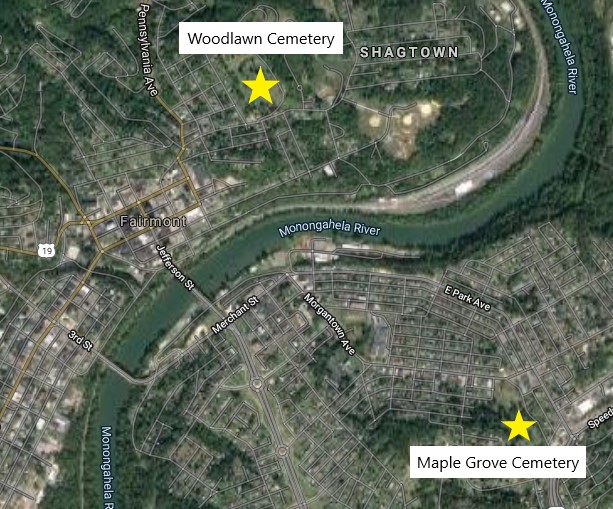
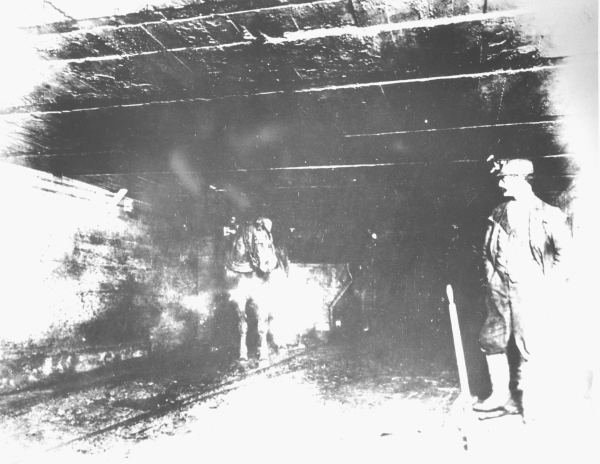
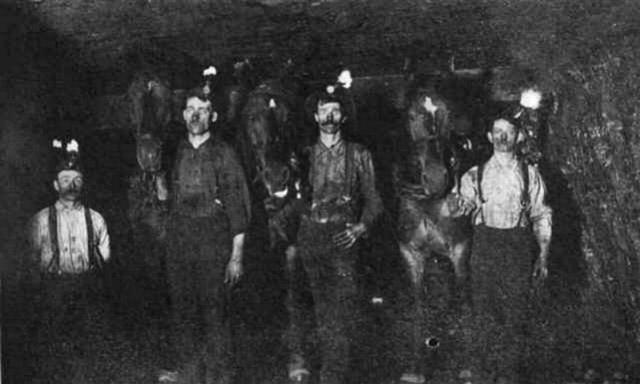
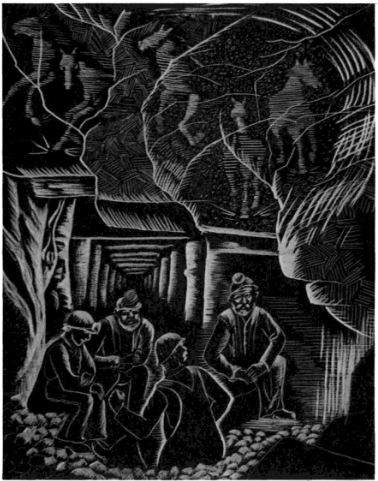
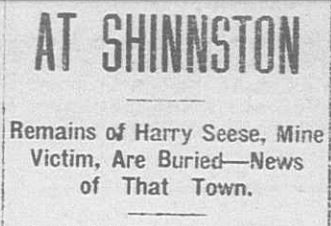

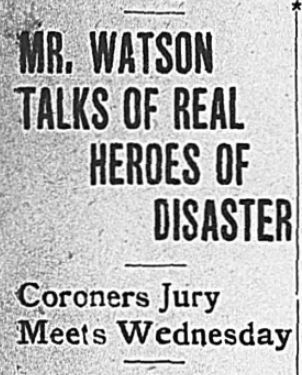
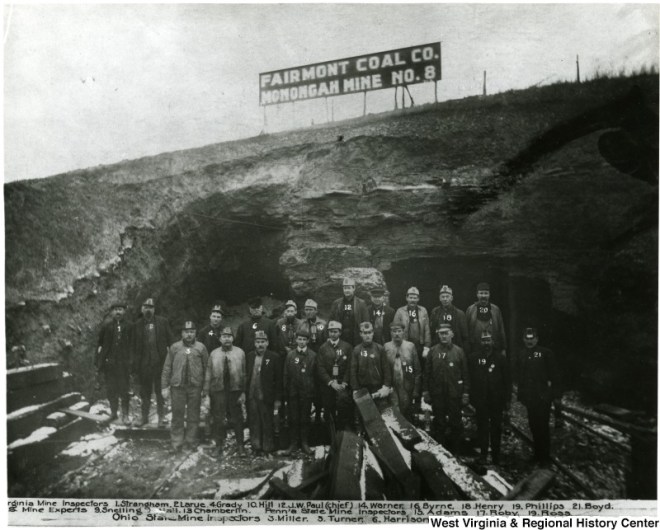

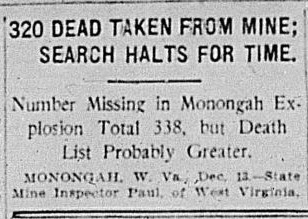

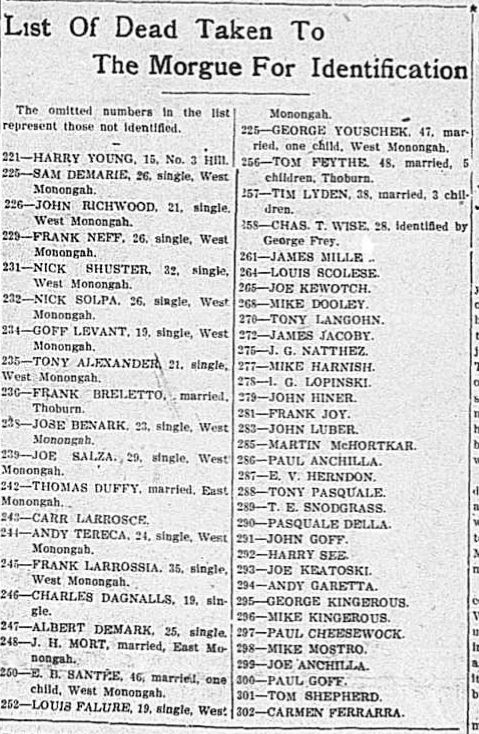


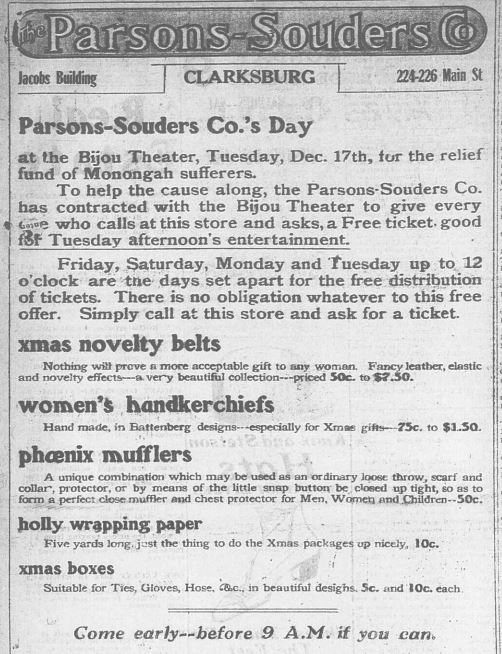
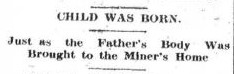


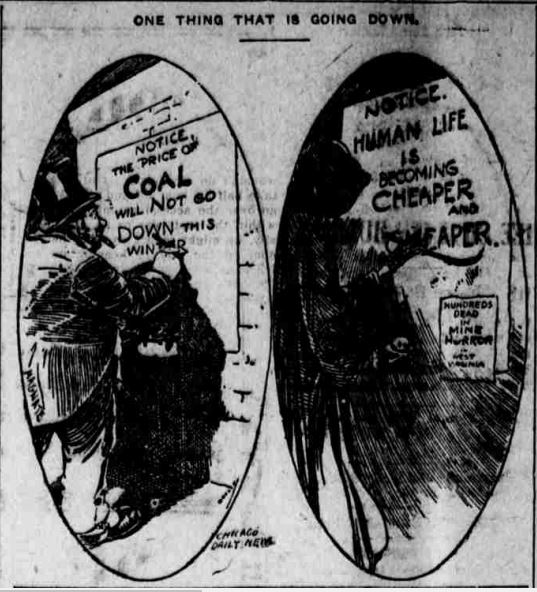






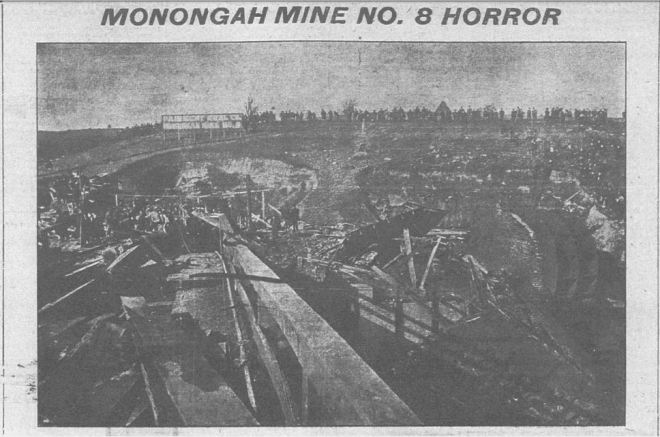









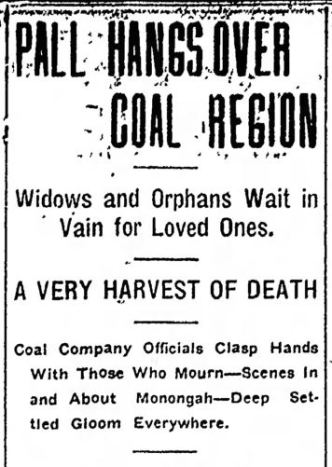


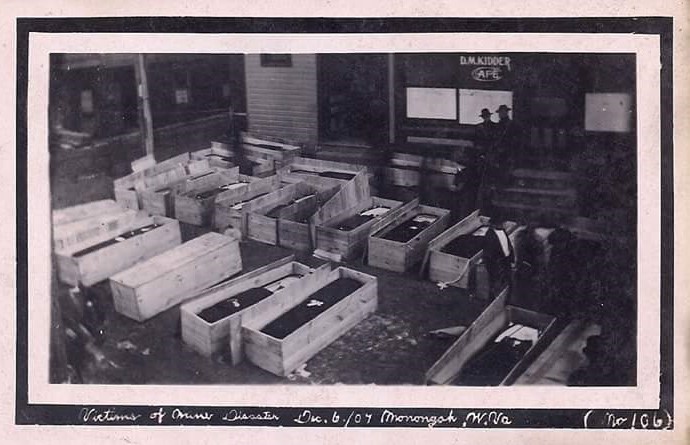
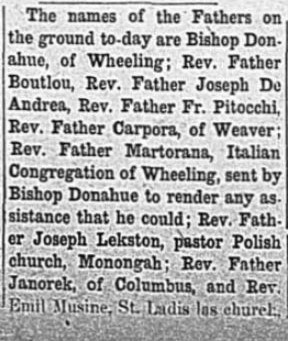
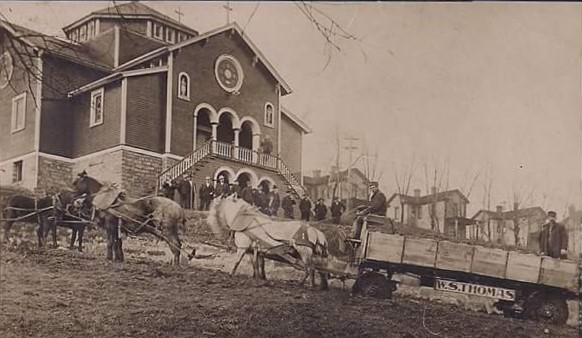


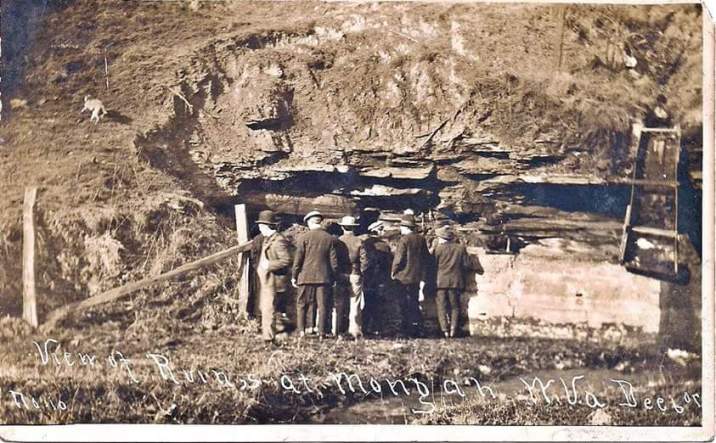
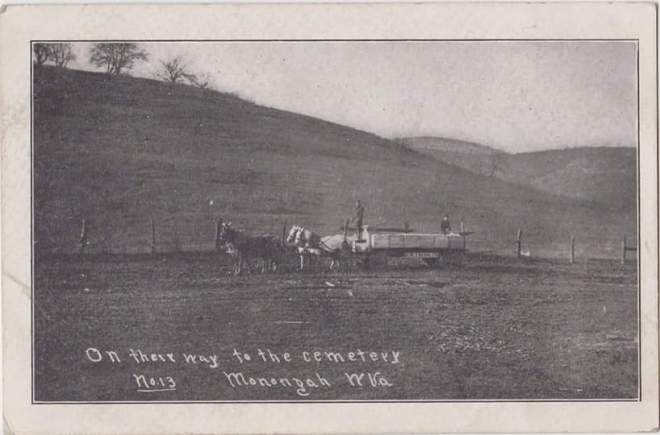
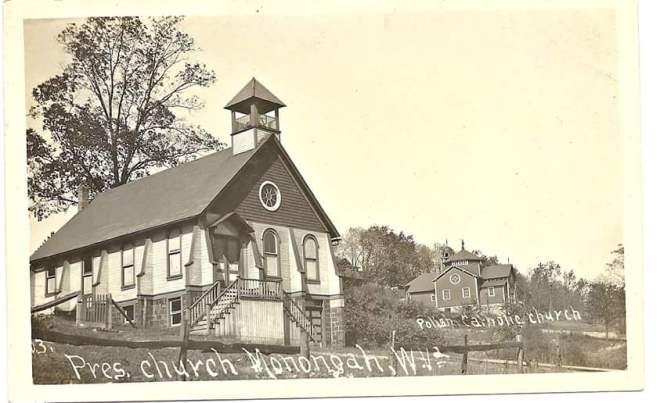
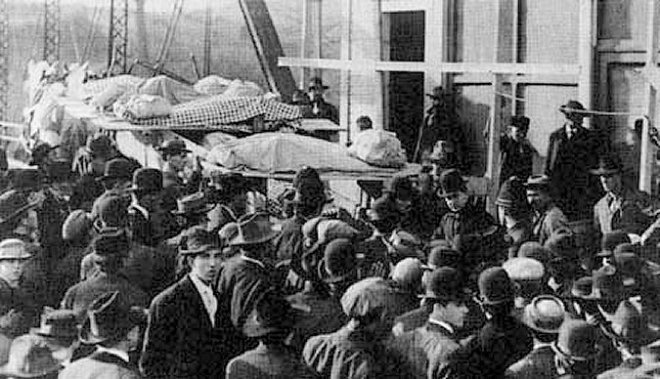


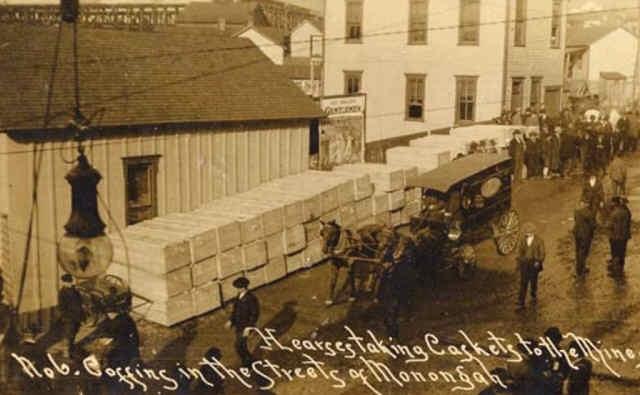
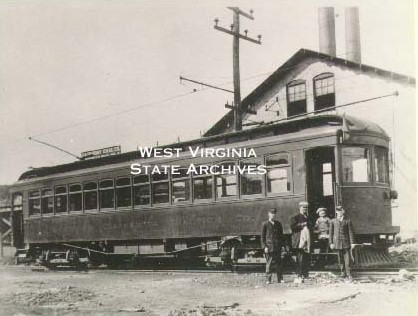
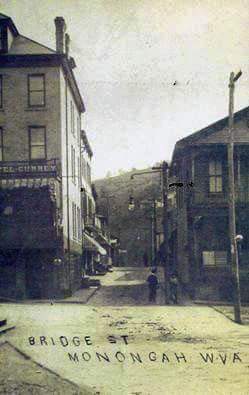
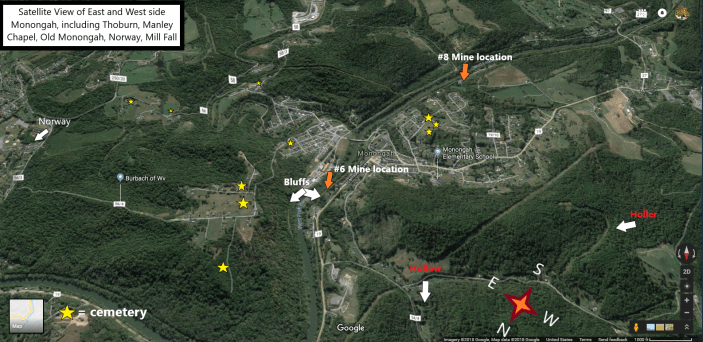
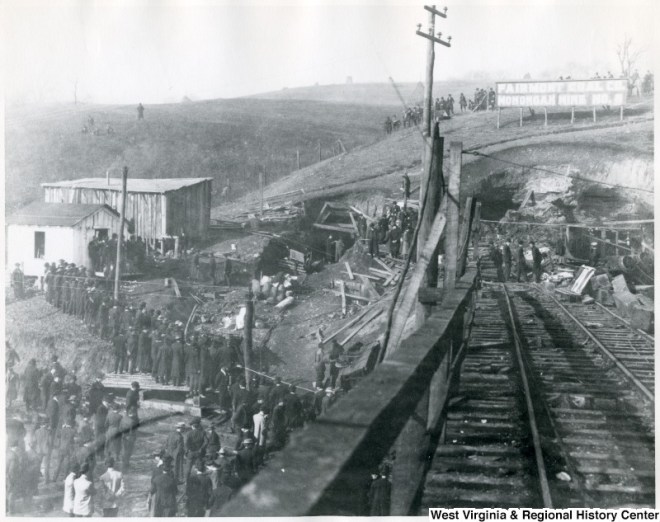
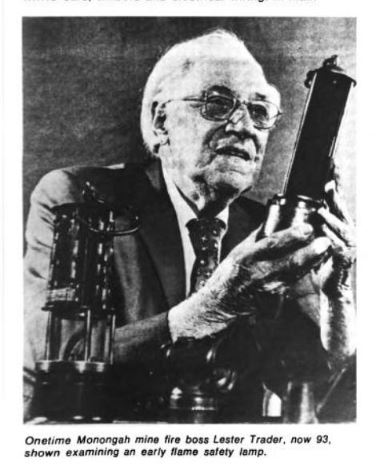


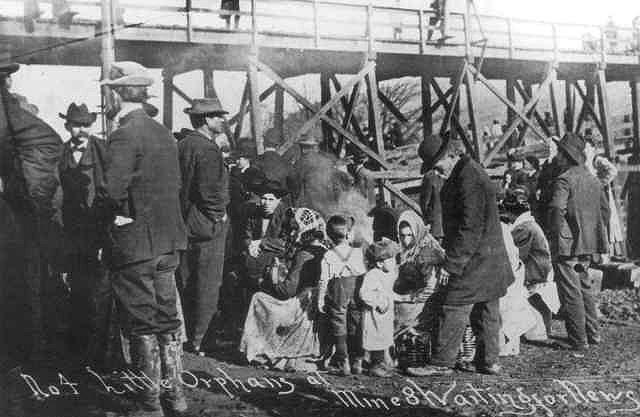

 The Monongah Disaster