

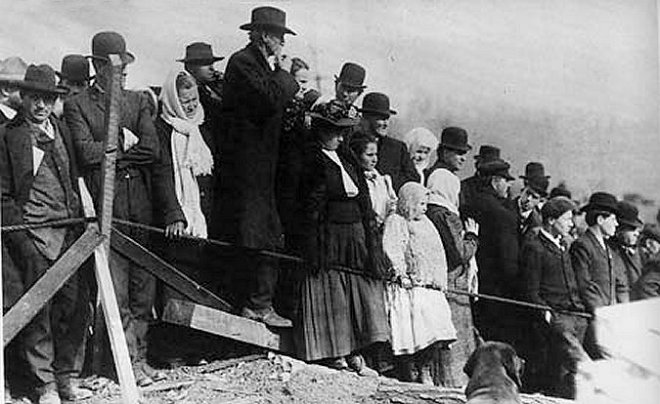
“Through the night the vigil of a large crowd of people did not lag from that during the day. Forbidden to approach near the opening because of the barriers and ropes and heavy guard, they waited on the trolley embankment anxiously awaiting above the opening and watching the work of those on the outside of the mine who assisted the rescuing party. Here the crowd is thick with the wives and daughters of the hundred entombed fifteen hundred to two thousand feet beneath the surface, and with tear-stained and drawn faces watch with unbroken gaze the opening.” (CDT 12.7.07 pg. 1)
Midnight
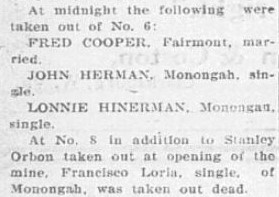
At #6:
“Of these victims six dead bodies had been taken from mine No 6 and sixty-five others were piled up in the entry awaiting the completion of facilities for bringing them to the surface.” (WED 12.7.07 pg. 8)
At #8:
“Deputy Mine Inspector F.E. Parsons, of Clarksburg, and General Superintendent John Brooks, of the Clarksburg Fuel Company, are leading the rescue work at this mine and are assisted by Superintendent Albert J. Ruckman and John Brennen, Superintendent of the West Fairmont shaft, with a squad of some twenty men.” (CDT 12.7.07 pg. 1)
The Morgues:
As the bodies arrive on the surface, they are examined right at the mine by Dr. F.W. Hill and other medical volunteers.
In one of the nearby emergency hospitals at the mine mouth, now a temporary morgue, one of the dozens of volunteer undertakers from the area will search any remaining clothing pockets for personal items and make any notation possible of the body and its discovered location in hopes it will aid in identification.
In these first hours of systematically managing the dead, physicians require little time to ascertain how several met their death based on nothing more than their burnt and/or mangled bodies. Those in these conditions, like a brakeman who was found in one of the mines as nothing more than a headless and limbless torso, will be impossible to embalm and display for identification.
After each one is quickly checked for cause of death it is placed in a casket on hand or shrouded as best as possible. Several bodies are placed on a horse-drawn wagon filled with straw and carried across the river to east side of town where the temporary morgue in the First National bank is finally prepared to start accepting, washing, embalming, and dressing the victims.
Throughout the night and following day, throngs of families and onlookers crowd around the carts as they travel across the river. They frequently block the forward path and frighten the horses, making the transport slow and difficult.
“The bodies brought to the surface during the night were washed and made as presentable as possible by a dozen undertakers from this and surrounding towns and placed in one of the mine buildings which was converted into a temporary morgue.” (RIA 12.7.07 pg. 1) (ETR 12.7.07 pg. 1)
~1:00 am
At #8:
J.C. Gaskill moves from mine #6 to #8 and remains there “recovering bodies” (Inquiry)
Fire discovered once again in #8, this time in the 1st north heading about 450’ from the pit mouth. However, more brattice work will need to constructed in the area before the workers can actually reach the location of the fire.
“The openings in the ground were all covered with canvass to shut off the draft and the hose was turned on the fire soon after it was discovered.” (FWV 12.7.07 – pg.1)
~2:00 am
“…near No. 8 Howard Preston, colored, of Monongah, was taken out, and also four Italians, names unknown.” (CDT 12.7.07 pg. 1)
~3:00 am
At #8:
#8 is still burning “…with no prospect of extinguishing the blaze and hundreds of dead miners will be burned. Excitement is intense and the whole town is out fighting the flames.” (CDT 12.7.07 pg. 1)
Dozens line up down the bank to the river and haul water brought in buckets to the mine mouth. Fire extinguishers have also been brought in from Fairmont.
At the mines:
“During the night few women were to be seen, but all day yesterday the women were the chief actors in most pathetic and heartrending scenes.” (WED 12.7.07 pg. 1) (ES 12.7.07 pg. 1)
Throughout the night, men stood about the mouth of the mines. “They said nothing but when approached and asked questions they would give way to their emotions, often to tears.” (RIA 12.7.07 pg. 1)
~3:20 am
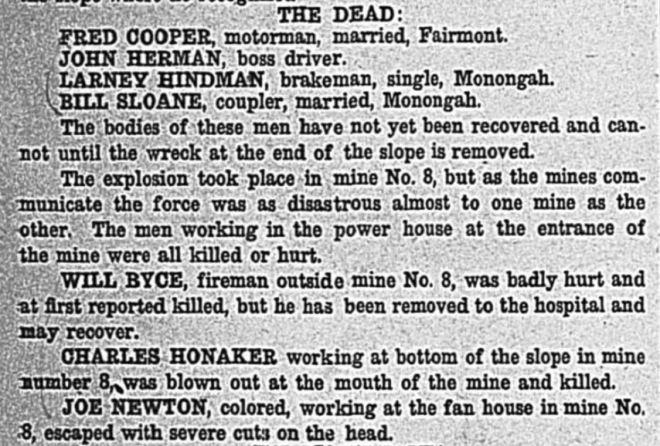
The body of Charles Honaker is brought to the morgue. (CDT 12.7.07 pg. 1)
~3:30 am
At the mines:
“…eleven bodies had been brought from mine Nos 6 and 8 and placed in the temporary morgue.” (CDT 12.7.07 pg. 1)
“To date eleven bodies have been taken out of #6 opening and two from a small opening about a quarter mile from #8 opening. All available means are being used to hasten an entrance into the mines where dead bodies are now entombed.” (FWV 12.7.07 – pg.1)
~4:00 am
“The officers of the company checked up their list of employees so far as possible, and later stated that at least 380 men were in the mine when the disaster occurred. Their list, they admit, is not complete, and statements that 500 men were caught by the explosion go unchallenged.” (TBE 12.7.07 pg. 1)
“It is given out by officials of the two wrecked mines that the number of entombed miners will reach 450. Mine officials have these classed as follows: Americans,100; Polanders, 150; Italians 275; Total, 450.” (CDT 12.7.07 pg. 1)
“The mine records, time books and other information lead to the conclusion that 450 will cover the number completely, but it is not thought the number will fall under that and there exists the firm belief with the officials that all have perished.” (CDT 12.7.07 pg. 1)
“There is no question whatever but that four hundred, possibly more, are dead, said Superintendent Malone this morning.” (RP 12.7.07 pg. 1)
“President Watson of the mining company stated this morning every possible investigation will be made to ascertain the cause and fix the responsibility.” (RIA 12.7.07 pg. 1)
~5:00 am
At #6:
“At 5 o’clock this morning seventy-nine blackened bodies had been recovered. Six bodies were brought from No. 6 mine.” (TBE 12.7.07 pg. 1)
Inside #8:
Workers are winning the battle with the fire in #8.
In Monongah:
“The wives and children of many of the entombed men have not left the mouths of the shafts since the first alarm was given. The night was a cold one and the mourners suffered intensely, but few heeded the offers of shelter from their friends. Several of the women fell unconscious or went temporarily mad from grief and exposure and had to be carried or forcibly removed from the scene of the disaster.” (WT 12.7.07 pg. 1)
In Fairmont:
FCC suspends operations in all mines today and Malone orders all experienced supervisors and craftsmen from surrounding mines to come and help speed the rescue. (FWV 12.7.07 – pg. 1 – noon)
Every undertaker in Fairmont is contracted and the supply of readily available coffins in the area is immediately exhausted.
“The company has sent rush orders for coffins to Pittsburg, Zanesville, and other towns, the total number ordered up to this time being 380.” (WED 12.7.07 pg. 1)
“Four hundred coffins have been ordered by the Fairmont Coal Company. All of these boxes will be used—sooner or later—for it may be weeks before all of the victims of the mine explosion are recovered. Possibly the order will be increased.” (WT 12.7.07 pg. 1)
In Monongah:
“Gloom possesses the entire town as never before in the history of Marion county and excepting the piteous cries of bereft families,…the town was wrapped in death-like stillness last night.” (CDT 12.7.07 pg. 1)











 The Monongah Disaster