

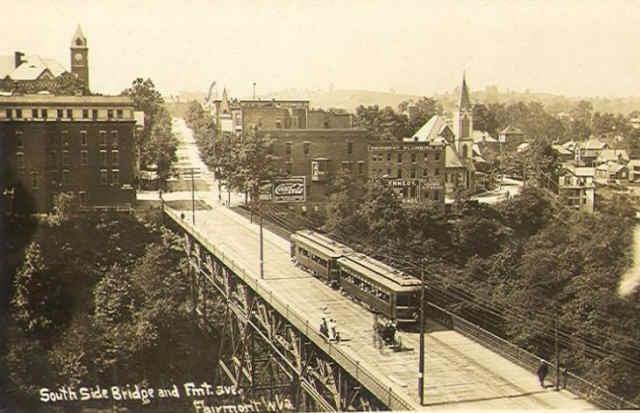
“Semi-officially it is stated that the street cars hauled fully 35,000 people both ways yesterday, making it a record-breaking day in the history of the interurban line. Many thousands were here from Clarksburg and, owing to the lack of facilities on the upper end of the line to handle the immense crowd, they did not all get away until 9:30 at night. Many spent as many as three hours in attempts to board the cars. On the Fairmont end cars were more numerous and ran more frequently, but the crowds from that terminal of the line were much larger.” (CDT 12.9.07 xtra pg. 4)
~12:00 am
Outside the mines:
“Sixty hours after the explosion of black damp…, fifty-three bodies, or only about one-eighth of the total number of victims, have been brought to the surface and less than one-fourth of the total number have been actually located.” (SFNM 12.9.07 pg. 1)
“But, at midnight there was no indication that the work of rescue would be resumed so early, as the condition of mine No. 8 was very perilous, the heat there being registered at 110 degrees, and thus making it impossible to penetrate the mine. Most of the work of the night at this mine was in preparing to place brattices in No. 8.” (CDT 12.9.07 xtra pg. 4)
A majority of rescuers have not been home since Friday nor have they slept or rested. Doctors stand outside at the entries of the mines and give the men some “tablets to stimulate their over-worked hearts and lungs.”
“All night long hot soup was served to those who were exploring the mines in hope to find some fellow workman.” (FWV 12.9.07 – pg. 1 – extra)
“Several relatives from Clarksburg of entombed miners have been here since Friday evening awaiting the bringing of their loved ones from the ill-fated mines, with the result that to date but one—Patrick McDonough—has been recovered from the mine. They will continue to remain here as long as there is hope of getting their relatives out.” (CDT 12.9.07 xtra pg. 4)
“Here for 60 hours men had worked, feverishly and unafraid, to wrest blackened bodies out of the ground that they might be counted and put back; and here at this same pitiful commission they were to work for a week to come.” (Kellogg)
Inside the mines:
“The deadly black damp hinders the work of rescue quite as much as the broken rock and timbers. It is this which most exhausts the men.” (RP 12.9.07 pg. 1)
“Most of the bodies are decomposing and this renders the work of the searching parties doubly hard.” (WT 12.10.07 pg. 5)
In Monongah:
“During the night, guards employed by the owners have been greatly increased until each piece of property looks like a fortress. Pedestrians passing through the mining camp were held up by mine guards and compelled to account for themselves before they were allowed to proceed. This action was resented in a number of instances, but didn’t deter the guards from carrying out their instructions.” (PES 12.9.07 pg. 1)
~2:00 am
At #8:
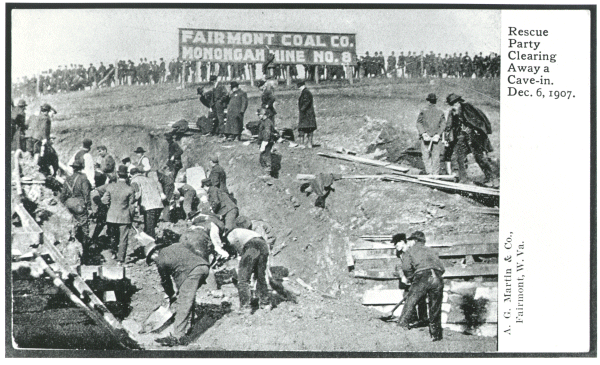
Search given up for a while but resumed in early hours. “The fire, which broke out afresh in No. 8 shaft, was extinguished soon after 2 o’clock this morning. Almost before the smoke had ceased arising from the ruined workings a relief party had started down the shaft and were striving to clear the passage into the farther recesses.” (WT 12.9.07 pg. 5)
~2:15 am
At #8:
“At 2:15, however, another fire broke out beyond the third entry, accompanied by an explosion. The explosion did no additional damage but the fire once more drove the workers out.” (CET 12.9.07 pg. 1)
“Fire, which began yesterday, was extinguished early today in mine No. 8, but a second fire occurred, which delayed rescuing.” (PES 12.9.07 pg. 1)
“The fire in No 8 shaft broke out again this morning, followed by another explosion, which fortunately did little damage and hurt none of the rescuing party. It took three hours, however, to get the shaft in such condition that the workers could continue.” (WT 12.09.07 pg. 5)
~3:00 am
“At 3 o’clock this morning the rescue party had not resumed work. It is now accepted that mine No. 8 is on fire and the effort to divert the air current from No. 8 into No. 6 has not as yet been successful. Activity will be renewed at daybreak to get the fans in successful play on No. 8.” (CDT 12.9.07 xtra pg. 1) (CDT 12.9.07 xtra pg. 10)
4 bodies are taken out of #8. 3 bodies are taken out of #6 (FWV 12.9.07 – pg. 1 – extra)
~4:00 am
“The fire which started in mine No 8 this afternoon is now under control and is said to have done little damage. Rescue work will be resumed as soon as the federal and state authorities finish an investigation they are making and pronounce conditions safe.” (SLH 12.9.07 pg.1) (LAH 12.9.07 pg. 2)
All headings are explored and no active fire is found. Smoke fumes are present at all times but no fire. (McAteer)
~5:00 am
At the mines:
“A large force of skilled miners, volunteers for the hazardous task of rescue work are on the scene, ready to re-enter the mines and take up the work where they were forced to leave it yesterday when fire broke out in mine No 8. These men await only the word from Clarence Hall, the expert of the federal government, and J.W. Paul, West Virginia’s chief mine inspector. These men are now in charge, superseding officers of the mining company and others who directed the rescue work.” (ES 12.9.07 pg. 1)
“Moving steadily about the ground at the man-way, meeting them on equal terms, was Lee L Malone, who they tell you, worked his way up from digger to general manager and has always stood close to his men. I heard him speaking to J. H Wheelwright, VP of the company, during a lull in relief work while the state inspectors were investigating the localization of afterdamp to the left and south of No 8 mine. These two had been at the mine almost continuously since the disaster and they were going over some of the men who had been killed, calling many of them by their first names—the ‘best pit boss in the state’ and so on.” (Kellogg)
“Volunteers who had worked with them other years came up to shake hands and others to tell how old Jerry Nicholas had for a second time saved his skin in a mine disaster by going on a spree the night before.” (Kellogg)
“’We never thought we’d live to see the like of this in this country.’ Wheelwright stamped his feet with cold and impatience. ‘It seems so slow,’ he said, ‘when you aren’t taking men out and pushing ahead.’” (Kellogg)
Kellogg meets a “young foreigner with two checks pinned on the breast of his overalls, which showed that he had been working on the rescue shifts in both mines. He was an explorer and he had been out and in since Friday evening, 3 days and 3 nights without a break long enough to lie down.”
In the Monongah offices:
“Equally approachable was Pres. C. W. Watson, at the office of the company at Monongah, where relief workers and reporters were finding their way through every door and where 2 of the secretaries acted as a bureau of information. The general attitude of none of the public’s business, adopted by some corporate officials at such times, was entirely lacking.” (Kellogg)
Outside the mines:
“The fire in No 8 mine, which started late yesterday afternoon, was walled in this morning, and following an examination by… Inspector Paul the rescuing parties again began their quest for the dead.” (ES 12.9.07 pg. 1)
“From 5 until 7 o’clock this morning the bodies of John Coney, Andy Stee, and K.D. Ryles were taken out of Mine No. 6 and the bodies of Melroy Watkins, Richard Farmer, Patrick Kearns, Andrew Majeska, and Victor Neviskey were taken out of Mine No. 8.” (CDT 12.9.07 pg. 1)
These men will make up bodies #44-#51 of the Coroner’s List.
“All through last night the work of recovering the men entombed in the mines here went steadily forward, shift followed shift into the black opening of the man-ways, and shift after shift dragged themselves into the fresh air, reeling and exhausted. These, as they appeared were forced into the temporary hospitals, but they refused to take rest.” (RP 12.9.07 pg. 1)
At the morgue:
“Outside the morgue in the mud stands a shivering mass of humanity, many of the people have been there for hours, braving the cold to get a chance to once again gaze on the face of their dead loved ones.” (US Dept of Labor-mine disasters-Dispatch article)
Coroner Amos has this notice posted to the door:

Dawn:
In Fairmont:
“At dawn began the struggle of thousands of people to reach Monongah from Fairmont. The transportation facilities are meager and it is common sight to see persons boarding the cars through the windows.” (ES 12.9.07 pg. 1)
“There was a group of Italian laborers before the fog hung court house in Fairmont, where we took the car in the early morning. They were huddling, dark-skinned little men from South Italy, such as stand unnoticed; but my fellow traveler was Naples born, big-hearted in his love for humble folk, and his ears caught judgements being passed by these peasants from the Abruzzi, from Terra di Lavoro and Calabria. Now and then their words broke off in sighs—signs, he told me, ‘for the fate met by their brother workers and for the destitute condition in which so many families had been left.’ Today, tomorrow, and God knows till when, these laborers are to be grave diggers.” (Kellogg)
In Monongah:
“Guards have been placed about Monongah, and the town is practically under martial law, though good order has prevailed.” (WT 12.9.07 pg. 5)
Undertaker Cunningham is still confined to bed at the Curry hotel. (FWV 12.9.07 pg. 1)
“The details for the transportation of friends to the place of burial has not been worked out yet but will soon engage the attention of the officials. All the arrangements for the transportation of the corpses have been made.” (FWV 12.9.07 pg. 1)
At the mines:
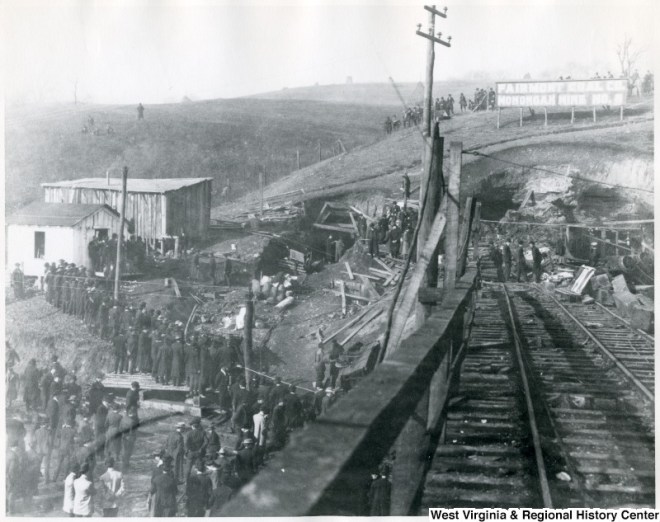
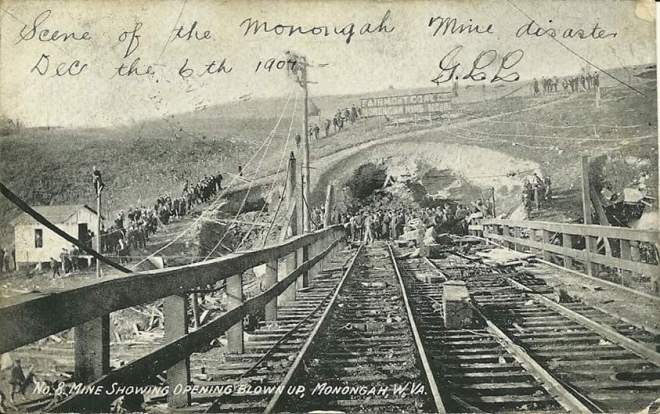
“Here and there among the debris were groups of twinkling lights, the lamps of the dead miners. As the dawn brightened the car tracks became black with moving processions of people, which halted and bunched around the mine.” (RP 12.9.07 pg. 1)
“The hammers of a score of men working on a temporary morgue rang out sharply. Cots, beddings, blankets and stretchers were stacked here and there. Special officers kept the crowd beyond a barbed-wire barricade.” (RP 12.9.07 pg. 1)
“Though the rescuers have been practically through the main heading of mine No. 6, yet the larger portion of the mine has not yet been penetrated. There has been virtually no progress at the other mine, though a small number of men have been taken out at some of the hill openings. The main heading has not yet yielded to any appreciable extent to the work of the men engaged in trying to enter it.” (CDT 12.9.07 xtra pg. 1) (CDT 12.9.07 xtra pg. 10)
General Manager Malone said this morning that the searching parties are unable to find the ill-fated men. “Whether the men have been blown to atoms or whether they are still farther back is not apparent at this time.” (FWV 12.9.07 pg. 1)
Outside #8
“Suddenly out of the lark mouth of the slope came one of the night shifts, a dozen men in all, roped together like steers. Their faces were black and gleaming with sweat. Their eyes rolled whitely. The leader seemed strong enough but number 4 staggered and hung to his rope. The last man out, a huge Norwegian cursed savagely. “No use,” he said, “It’s hell in there. What’s the use anyway. The mine is on fire, look.” (RP 12.9.07 pg. 1)
~6:00 am
In Fairmont:
Fairmont mines back up and running. “There was little coal loaded. It is thought that in a few days that practically all the mines will be running about normally.” (FWV 12.10.07 pg. 1)
In Monongah:
“Double rows of brown trenches in the little cemetery will soon mark the last resting place of the 400 victims of the explosion…” (WT 12.9.07 pg. 5)
“On the hillside above the mines where there is a hamlet, women have stood and sat from the very hour of the catastrophe. Hunger and cold wake them not from care and grief and they have not been persuaded as yet to return to their homes or to take nourishment. Others lie at their homes prostrated. Some in delicate condition have been thrown into grave sickness since the news of the disaster reached them, and the unborn have been born but not to live to learn of the terrible fate of their fathers.” (CDT 12.9.07 xtra pg. 4)
“All business is suspended and the town and its surviving inhabitants have assumed an attitude of mourning and melancholy. All the stores and business places have been closed since the explosion occurred and those who are not prostrated with grief are making efforts to rescue the perished miners and comfort those who are stricken with grief.” (FWV 12.9.07 – pg. 7)
“While the coal company and others have furnished a great many food supplies, every car coming into the city, yet there is more than a well-founded belief that universal hunger and physical distress will soon prevail, in fact, there is already crying need for help.” (CDT 12.9.07 xtra pg. 1)
At the mines:
(By United Press) “Fire which broke out in No 8 mine, stopping the rescue of the bodies of the entombed miners yesterday, was extinguished at 2 o’clock this morning. At 2:15 a.m., however, another fire broke out beyond the third entry. This fire was put out at 6 o’clock and at 9 o’clock eight more bodies were brought out.” (TEP 12.9.07 pg. 1)
“The rescue forces at work at Mines Nos 6 and 8 have been augmented by men from Enterprise and Georges Creek and Frostburg, Md. These men kindly volunteered their services and have gone in work with the rescuing party with vim and willingness.” (CDT 12.9.07 pg. 1)
“It is expected that 100 bodies will be recovered today, if there are no more fires.” (PES 12.9.07 pg. 1)
“Cars have been stationed at the mouths of the shafts and as quickly as the bodies are taken out they will be cared for.” (Wash. Times 12.09.07 pg. 5)
“Trouble has arisen between the board of health and the mine officials.” (Wash. Times 12.9.07 pg. 5)
“Health authorities and the mine officers are now in a clash. The health board wants to bury the dead bodies in a trench without identification, while on the other hand, the mine officials wish to turn them over to friends. This argument between the two interested parties is doing much to increase sorrow of the immediate families of the dead miners. It too, is delaying the work of rescuing parties.” (RP 12.9.07 pg. 1)
At #8:
“While the company does not admit it, there is a general feeling that No. 8 is afire, and the intense heat would indicate it. The blaze it is believed is inside the mine a considerable distance. Owing to this work there will likely progress very slowly.” (CDT 12.9.07 xtra pg. 4)
“This morning a gaunt old miner named John Morgan came staggering out of the hole at No. 8, gasping for breath. He was noted for his bravery. He had been a miner all his life and his face was shot blue with oil burns from the blasting. ‘I have been back a mile and a half,’ he said. ‘I went in as long as I could get any air. I had to crawl out with my mouth to the ground to get breath. There is no hope. They are all dead. They are at least two miles in.’ Outside the crowd, gazing over the sunny hills, measured a mile and a half with their eyes. ‘Why it must be away over there,’ said one, indicating the far-off sky line. Yes, just beyond that sky line there were hills and hills outside the range of vision under which the dead were lying in hundreds.” (RP 12.9.07 pg. 1)
Inside the mines:
“…between 300 and 400 in number, lie in unknown sections of the vast workings in the bowels of the great hills that overlook the town and extend two miles and more back from the main entries to the mines. These unlocated bodies…are seriously menaced by two destroying elements—by decay in the overheated, humid and vapor-poisoned atmosphere of the mines, and by fires that are smoldering here and there in the workings, and from time to time, bursting into flame. Steadily the chance is ebbing that these bodies will be brought to the surface, identified by friends and relatives and given Christian burial.” (ES 12.9.07 pg. 1)
At the morgue:
“The body of Patrick McDonough, the Clarksburger, who was killed in the mine disaster, has been prepared for burial and will be taken to Clarksburg for burial Monday morning. Now is the time for all good men to come to the aid of the people.” (CDT 12.9.07 xtra pg. 1)
Bodies are getting to point of unidentifiable; “Many were brought forth with their heads literally torn off, others are without arms or feet. One was entirely naked, another had only a small part of the underpants, still another nothing but the heel of a shoe. Motorman Ford, only the arms and legs, which were found at the motor where he was stationed at the time of the explosion. His body has not been found and probably will not be. Many were terribly burned.” (CDT 12.9.07 xtra pg. 4)
“An undertaker is authority for the statement that of the fifty-three bodies handled only three were intact. Some were headless, arms were missing from some and legs or other members from others.” (ES 12.9.07 pg. 1)
~7:00 am
In Monongah:
Weather worsens. “It was drizzling and a heavy mist hung over the river, shutting off the bare hills that bunch close at #6 mine and blanketing the trestle work. Seemingly, from every pore of the earth there rose a white cloud which wrapped old objects in new meanings—a broken wheel, the dirty white of some clothes left in the corner, the gleam of the rails.” (Kellogg)
At the morgue:
“The reports here are as unreliable as they are numerous. The undertakers have lost about fifteen hours sleep on account of the fake reports of bringing in more bodies.” (FWV 12.9.07 pg. 1)
“Of the 43 bodies recovered from the mines, all but 9 have been identified. All of these bodies were horribly mutilated by the force of the explosion.” (Wash. Times 12.9.07 pg. 5)
At the mines:
“The scene at the mines has not changed much since Friday.” (FWV 12.9.07 pg.8)
The body of Charles McKain has been located and will soon be brought out. His remains will be interred at Clarksburg. (FWV 12.9.07 pg. 1) (FWV 12.10.07 pg.1
The body of Mike Cosic has been recovered and identified. (FWV 12.9.07 pg. 1) Mike is body #52 on the Coroner’s List.
More on How Death Gloated!



 The Monongah Disaster