

“It is beyond the human pen to describe the spectacle presented, when bodies are brought up from the bowels of the earth whither courageous men day in and day out were wont to toil for the support of their loved ones. Fathers, brothers, husbands and sons, are carried from the slope leading to the fatal regions of the earth. Their bodies are as black as the coal itself. The experienced eye of the undertaker cannot detect their color, whether white or black, until after the bodies have been washed. Even then the mutilation in some cases make it difficult.” (CDT 12.9.07 xtra pg. 4)
~7:30 pm
At the mines:
“Rain began falling early in the evening and continued almost incessantly throughout the night.” (WED 12.10.07 pg. 1)
“Last night they took out two bodies from No.8. Tonight, they will take out many more dead who have already been dug out of the wreckage and are lying along the catacombs ready for removal.” (RP 12.9.07 pg. 1)
“When darkness came tonight a total of sixty-six bodies had been brought to the surface from the two wrecked mines at Monongah.” (DASB 12.10.07 pg. 1) (LODD 12.13.07 pg. 3)
In Fairmont:
The Union Relief Association is formed by local women who were among the first responders to the disaster. Mrs. F. E. Nichols, President & Mrs. R. T. Webb, Secretary hold a meeting at M.P. Temple – “all ladies urged to be present.” “All women interested in the relief work are earnestly requested to be present. Committees will come prepared to report the progress made today.” (FWV 12.9.07 pg. 8)
Walter Zirkle is located safe and alive. He had been employed at the Gaston mines in Fairmont, not the Monongah mines. “The wish of his sister and mother were at once communicated to him and he has no doubt reached his home…” (FWV 12.10.07 pg. 2)
“Over $25,000 was added to the various relief funds during the day.” (BME 12.11.07 pg. 6)
In Monongah:
The General Relief Committee meets in Mayor Moore’s office. The first members are: Mayor Moore of Monongah; Mayor Arnett of Fairmont, chairman; Father Boutlou, Rev. J.C. Broomfield, Rev. H.G. Stoetzer; J.E. Sands, treasurer, and J.M. Jacobs, secretary. “Five responsible men will handle large gifts.” All checks will be payable to J.E. Sands, who will see that the funds are properly distributed. (FWV 12.10.07 pg. 1)
Paul Kellogg is talking with the children of a grieving family at their home. One of the oldest daughters tells him of the father they call “Pap” and brother, referred to as “George” who was a machine man:
“…and as we stood there on the door step, the sisters showed me his picture that of a clean cut young fellow, taken with his dog in a field. ‘Many’s the woman was dependent on each day’s wages,’ they said, –‘nothing at all ahead—and now that’s cut off. We’re not that way—not quite. Pap was all we had and he was getting’ old and couldn’t do so much. But George—soon as he’d get through cutting, he’d come help him load and so Pap’d make more. That was the way with George—5 girls, the only brother we had, and he that good to us! And such a good wife.’ One after another, the sisters broke in parts with the story. ‘Pap was singing the morning he left when he went to work—we heard him as far’s it carried. It was Nearer My God to Thee. That’s what he was singing. They worked 3 miles in—Pap and George—r-right under us. Two of the girls broke off there and ran into the house, and a third, who had come out and was combing her hair while we talked, gave it a savage twist that would have brought tears to her eyes if they hadn’t been there already. ‘Oh, we know we’ve got to give him up. We know he’s dead; but if we could only get his body out of the pit.” (Kellogg)
In the morgue:
George Gibbons is very successful in telling who victims are as they are brought in through the night. (FWV 12.10.07 pg. 1)
The first money found on any of the victims is found on the 69th body to be taken out, Dan Dominico Jr.* He had $27 on him when found. (FWV 12.10.07 pg. 1)
*The paper reports that this is “Dan Domico”. However, body #69 on the Coroner’s List is actually Dan Dominico Jr.—the son of the injured miner who was among the 4 men to escape through a toad hole the morning of the explosion. Despite being seriously injured, his father ran to the mouth of the mine after escaping and wanted to go back inside in an attempt to save his son. Dan Domico did not attend work on Friday and is, in fact, still alive.
At the mines:
“The rescue work, while slow, is progressing smoothly and as rapidly as due precaution for the rescuers would permit. It is believed that close to a hundred dead will be recovered by daylight tomorrow.” (News)
~8:00 pm
In Monongah:
Paul Kellogg visits the Italian Catholic priest, Father D’Andrea. Kellogg writes that, “it was raining heavily and a hearse was ploughing up through the mud when I reached the little Italian church…where last year alone he [D’Andrea] baptized 170 American born children.”
Kellogg describes D’Andrea as “a young, spare man with a quick smile on his dark face. His beard had gone 3 days without shaving and his eyes were hollow for sleep.” D’Andrea has been so consumed with his duties as a priest and to his brother’s family that he has had no time to personally grieve his brother.
“It was only one cry all day until now,” he said and turned his palms out and dropped his shoulders. Then in answer to the door, he directed a driver who for 2 hours had been searching for the right house, and was going back with the body. (Kellogg)
~10:00 pm
C.W. Watson issues statement:

At the mines:
“The heavy rainfall caused a veritable mortar of mud more than shoe top depth in many places through which the workers and the anxious watchers could make their way only with the greatest difficulty.” (WED 12.10.07 pg. 1)
The body of Charles McCain is finally reached. McCain was a well-known man of his city and had many friends here. Despite numerous early accounts of Charles being found “blown to bits”, his body was in good condition. There were no marks on it showing that he was a victim of the after damp. His remains were brought to his home. (FWV 12.10.07 pg.1)
~11:00 pm
At the mines:
“Heavy rain storms make the conditions around the mine worse than any time since the explosion. Only a few stragglers are now keeping the gruesome vigil.” (DASB 12.10.07 pg. 1)
“Milder temperatures today resulted in a thaw which converted the soil near the entrance into a sticky, dirty mortar…now almost knee deep in places.” (SLH 12.10.07 pg. 1)
“It dispersed, however, a very large portion of the great, impatient surging crowd that from the first has hovered as near the entries as they could get, a constant handicap to the rescuing forces whose work they retarded.” (WED 12.10.07 pg. 1)
“The rain has also interrupted the makeshift telephone and telegraph communication between the mines this city and the outside world.” (AMJ 12.10.07 pg. 1)
“Twelve bodies have been taken from the mines tonight, bringing the total number up to 11 p.m., seventy-eight.” (DASB 12.10.07 pg. 1) (CB 12.10.07 pf 1)
“At a late hour, …the officials of the company said they had reached a point where there were a great many bodies. From this time on the work of bringing out the dead will be done more rapidly.” (CET 12.10.07 pg. 1)
At the morgue:
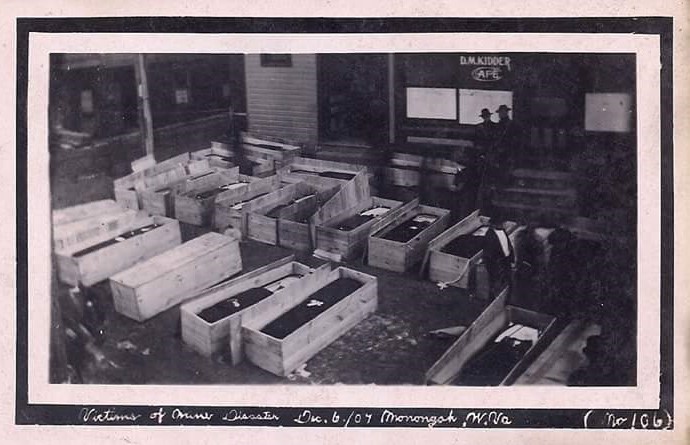
“The rapid recovery of the bodies is making lively work at the morgue and at a late hour…thirty-five more undertakers were telegraphed for besides the several who arrived early in the evening from Grafton and Fairmont. Spring wagons bringing the bodies from the traction station across the river, to which they are conveyed from the mine openings by an ambulance street car, are followed by throngs of men, women and children, who gather around the morgue and remain in the rain until the bodies are placed in the caskets and laid in state in the bank building for viewing and identification.” (CDT 12.10.07 pg. 1)
More on How Death Gloated!
 The Monongah Disaster