

During the Day
In Easton, PA:
Philip Biglioni (14 years), Angelo Talmeiri (16 years), and Peter Falconi (17 years) are skating on a pond near Bangor when the ice gives way. All 3 boys are drowned but the bodies are recovered. (FWV 12.30.07 pg. 1)
In Stroudsburg, PA:
Mrs. Geo. Hoonshilt is talking to a friend over the telephone while her 8-year-old son, Lewis, had been “shooting at a mark with a flobert rifle”. At one point, her son “came into the room and pointing the weapon at her pulled the trigger. The bullet struck Mrs. Moonshilt in a vital spot and she lived but a short time.” (FWV 12.30.07 pg. 1)

In Pittsburg, PA:
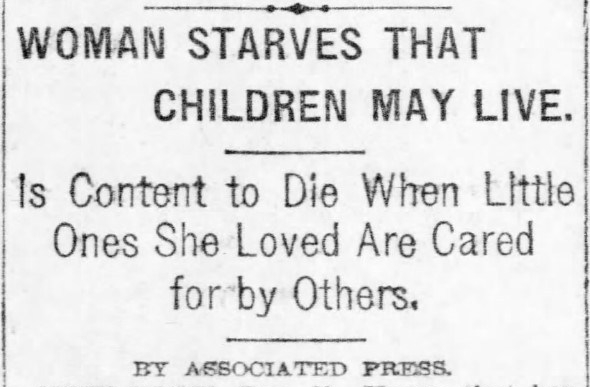
Miss May Messmer, a school friend of Stella Hartzell, calls and spends a pleasant afternoon with Stella and her husband George. George was “27 years old and for a number of years had been employed as a brakeman…at the Piticarn yards of the PA Railroad Co.” Stella was “15 years old May 23, 1907, and was married to Hartzell August 14, last.” (FWV 12.30.07 pg. 5)
“After their marriage Mrs. Hartzell complained of being lonely and afraid to remain alone at nights” while her husband worked. (FWV 12.30.07 pg. 5)
“On several occasions she went during the night to the office in the railroad yards and sought her husband with tears in her eyes, declaring she was afraid to remain alone.” (FWV 12.30.07 pg. 5)
Her husband was unable to secure a position which kept him home at nights, “so she gradually grew despondent and often declared she hated to see the approach of night.” (FWV 12.30.07 pg. 5)
Ms. Messmer remained for supper and after the meal was over Mrs. Hartzell asked her friend to remain and keep her company so she would not be lonesome but Ms. Messmer was unable to stay longer and left for home. (FWV 12.30.07 pg. 5)
~6:00 pm, News Hour
The Tombstone Epitaph in Arizona:
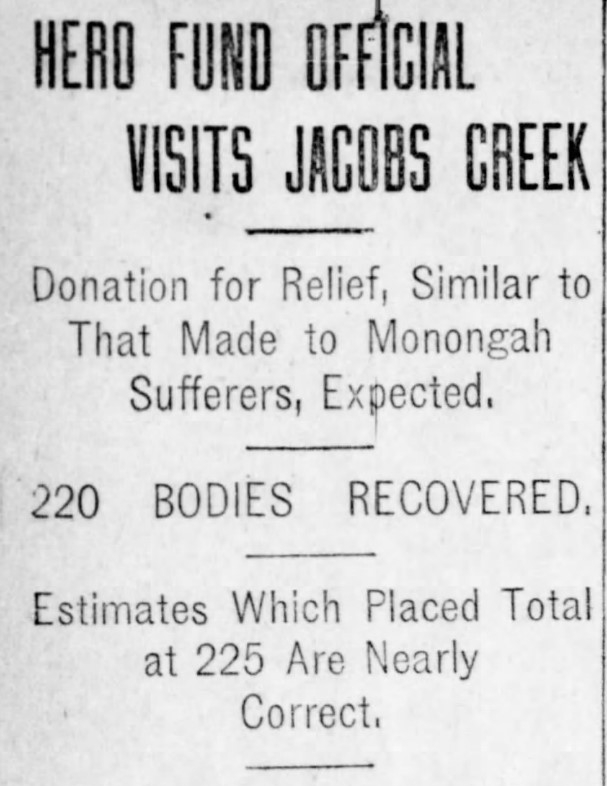
“Phoenix is raising funds for the sufferers of the Monongah mine disaster.” (TE 12.29.07 pg. 2)
Los Angeles Herald in California:
“LURAY—The mass meeting of citizens of Luray held in the Main Street Baptist church to raise a fund for the relief of the Monongah mine sufferers resulted in securing about $100. A committee was appointed to get further subscriptions from the citizens of Luray and it is thought about $200 will be realized. A resolution was passed directing that the money be forwarded to the Red Cross society.” (LAH 12.29.07 pg. 11)
Omaha Daily Bee in Nebraska:
“The rescuers believe they are within reach of all of the bodies that will be recovered and as air is now being forced to the most remote workings it is hoped to have the work practically completed early tomorrow.” (ODB 12.29.07 pg. 2)

Salt Lake Herald in Utah:
The Boston Globe in Massachusetts:
Pittsburgh Post-Gazette in Pennsylvania:
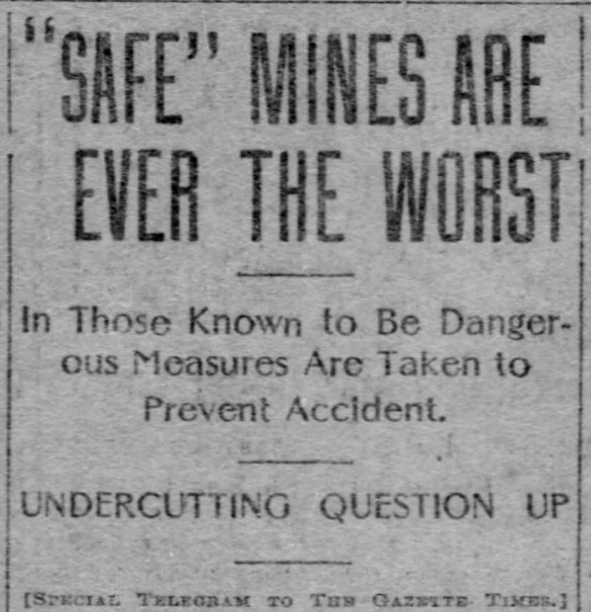
“The question of undercutting coal in mines before blasting it is an important one just now between the coal operators and mine inspectors of this region; and is, therefore of interest everywhere in the bituminous districts of this state. Particularly in this case since the recent great mine catastrophes have raised into prominence the matter of making such provisions as will insure the miner’s safety.” (PPG 12.29.07 pg. 7)
“The law says the coal shall be ‘properly’ undercut before blasting. But nothing is said about the reach of the undercut. Mine owners insist that the extent of the undercutting is thus left to the discretion of the mine boss.” (PPG 12.29.07 pg. 7)
“The effect of blasting after deep undercutting is that the coal comes away in large blocks. In this region, where the coal is soft, the more it is broken up by the blast the better it is for coking.” (PPG 12.29.07 pg. 7)
“Undercutting is done by miners both with picks and by machines. The miner cuts away about a foot thickness of coal at the bottom of the vein. The distance of this cut must be the same as that of the hole bored higher up into the body of the coal in which the explosive is placed, usually about six feet. When the blast is effectively set off it dislodges the entire six feet of coal that has been undercut. This mass comes away in blocks. And it is this fact which is said to have been potential in securing the enactment of the undercutting law for the benefit of owners of river mines, where the coal is hard. These owners want their coal in lumps.” (PPG 12.29.07 pg. 7)
“Owners of coking coal mines want their coal crushed and this is better accomplished by abolishing undercutting.” (PPG 12.29.07 pg. 7)
“Coal mine owners do not want the undercutting law strictly enforced in this region. They say it adds nothing to the safety of the mine, and that it is burdensome to them in its application. But mine inspectors and mining engineers think differently. They insist that it tends to the safety of the miner and should be enforced by law.” (PPG 12.29.07 pg. 7)
“What is regarded by some as an objectionable feature of the coal mining business in the bituminous region is the facility with which mine owners can get rid of mine foreman who, for any reason whatever, may become obnoxious to them. Such a foreman is an officer of the state. He has to pass an examination by the state and get his certificate from the state. Yet when appointed to the foremanship of a mine he is subject to dismissal at any moment, without knowing why, by the superintendent of the mine, who may or may not be a practical foreman, and who is responsible only to his employer.” (PPG 12.29.07 pg. 7)
“A well-known and thoroughly capable local mining engineer is authority for the statement that the mining laws in Pennsylvania are largely farcical, and ineffective in practical application, and have been moulded and managed for years, in some localities, with the express purpose of putting moral responsibility for disasters upon the state, so far as possible.” (PPG 12.29.07 pg. 7)
“Experts regard the most dangerous active mines in the gas coal region as really the safest in which to work, because knowledge of the danger has made both miners and operators very cautious. An expert said yesterday that it had been so long since there had been an explosion in a so-called dangerous mine that he could not recall it. But he could recall many, and all of the later ones in mines accounted safe—so safe that it was not thought much worth while either by miners or operators to take any particular pains against disasters. The Naomi, Monongah, and Darr mines were all known as ‘safe’ mines.” (PPG 12.29.07 pg. 7)
“One of the great mines near Uniontown is known as ‘dangerous’ yet there never has been a serious accident in it. Great fans are not alone relied upon for ventilation. Holes or wells have been drilled at eight widely separated spots over the surface of the mine down into its heart and cased with iron tubing, like oil wells. An additional well is sunk whenever its need has become apparent. The tube reaches up about 10 feet into the air and through this vent an immense quantity of gas escapes unassisted from the mine. The natural draft thus created is very strong. A man with a torch passing within 50 feet of one of the tubes recently ignited the gas flowing from it. This indicates the volume coming from a single vent. What must it be from all?” (PPG 12.29.07 pg. 7)
The Baltimore Sun in Maryland:

Pittsburgh Daily Post in Pennsylvania:
~7:00 pm
In Easton, PA:
Mrs. Messmer has left the Hartzell home and Mrs. Hartzell packs her husband’s dinner bucket. She again asks him not to go to work. “He explained that he must be at work, and his wife grew despondent because he insisted, he must leave her.” Stella hands George his packed dinner bucket then, “shot herself behind the right ear with her husband’s revolver…She died instantly.” (FWV 12.30.07 pg.5)

More on How Death Gloated!
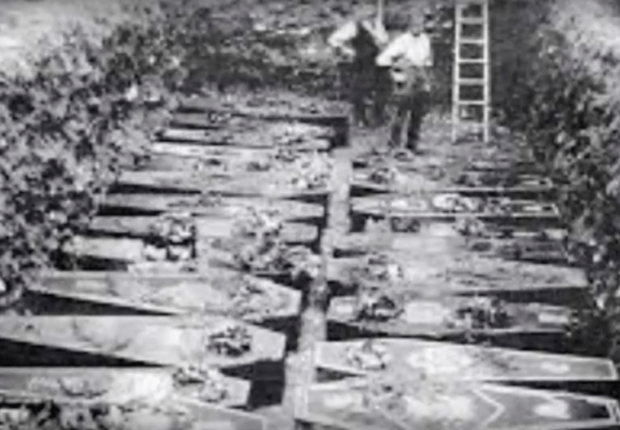

 The Monongah Disaster