

~6:00 pm, News Hour
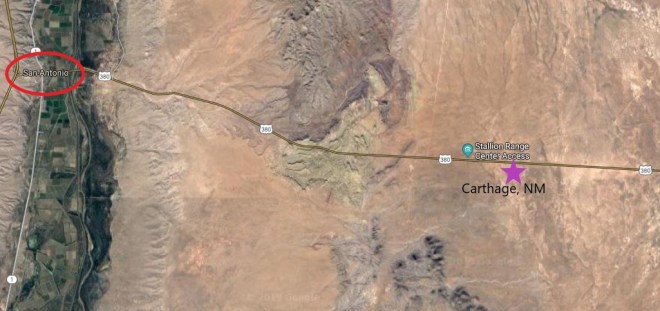
At the Bernal mine in New Mexico:
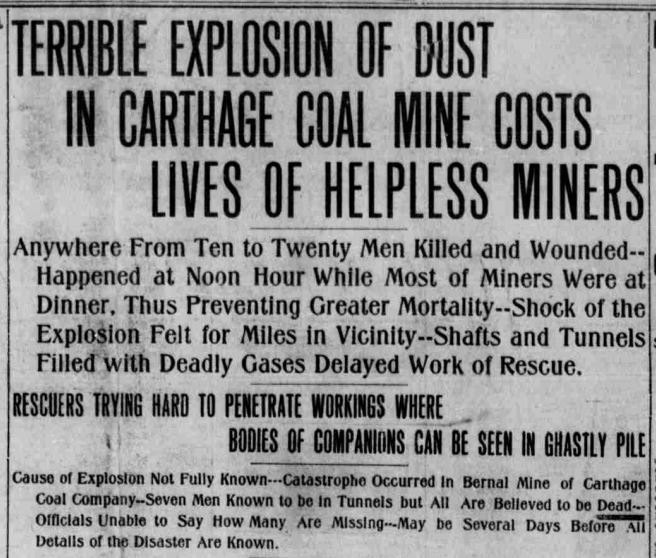
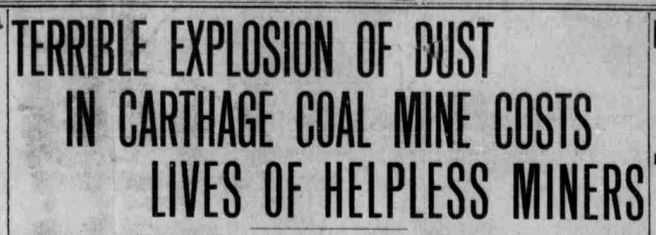
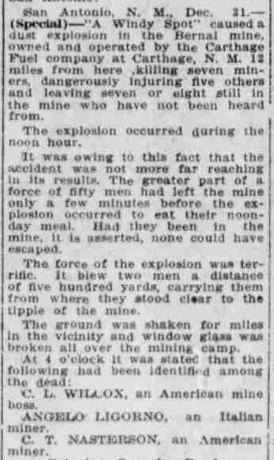
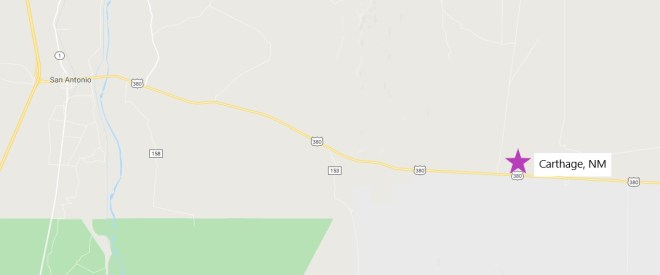
“Rescuers are still searching the Bernal mine of the Carthage Fuel company at Carthage, N.M., for the five miners known to be still in the shaft. Eight dead miners and five seriously injured have already been taken out.” (BEL 01.01.08 pg. 1)
Fairmont West Virginian:
The Fairmont Coal Company announces that it will purchase 2 bloodhounds which will be kept at Enterprise, midway between Fairmont and Clarksburg, partly in Marion County partly in Harrison County. “The dogs are Morrison’s famous hounds, so criminals beware.” (FWV 12.31.07 pg. 4)
Clarksburg Daily Telegram:
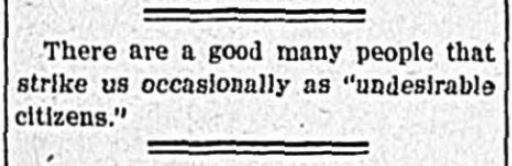
“A member of the house of delegates, whose name is suppressed for some reason, rushed into print at Charleston, through the agency of the Charleston Gazette, about the mining laws of West Virginia and makes some cracks so raw that they show ignorance, prejudice, or a lack of desire to be just to any one. The trend of his remarks convinces one that there is a deeper design than to be square with anyone—mine inspector, operator or miner. He talks like he is wiser, rather thinks he is, than other people. His very first sentence condemns his position. He does not want anyone to find the cause of the Monongah explosions. Every one who has any regard for human life does want the cause found. Every miner, every operator, every citizen wants the cause found. But, that this ‘wise’ sage, a member of the legislature, may not be misunderstood or misquoted, the Telegram gives at some length what he has to say on the subject, as follows:
“‘The work which the experts should now seek to do,’ said the legislator, ‘is not to find the cause of the explosion at Monongah, but to find and point out wherein if at all, our mining laws are defective, and if they are, as I believe, not defective, find where and why the laws are not being enforced. The Monongah explosion is now history and the cause of that is only important insofar as the knowledge of it might prevent future disaster.
“‘I believe that the law passed at the last session of the legislature, if enforced to the letter, would prevent mine explosion entirely. The law is complete, covering the ground thoroughly, I think, and if this provision, (here he read section 16 of the mining law) be enforced, there would be no disasters.’” (CDT 12.31.07 pg. 4)
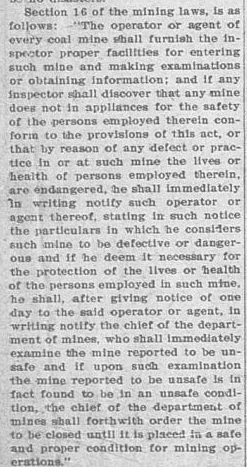
“’Now,’ continued the legislator, ‘the question which remains to be solved is: Is miner, operator, or the department of mines responsible for the non-enforcement of the law?’” (CDT 12.31.07 pg. 4)
“The mine is doubly good as far as it goes and to the general run of mine operations is doubtless sufficient, but it does not cover sudden happenings. Suppose the rules and regulations were strictly enforced at Monongah, and, so far there has been nothing to develop showing that they were not, how would the mine laws have prevented the explosion? Certainly, the mine inspector is not expected to be at a single mine every minute in the year. Surely, the operator himself can not be there at all times. And it is not reasonable to believe that the miner himself would snuff his life out. Indeed, there is no credence to be put in the assertion that operator, mine inspector or miner would knowingly cause such a disaster as that at Monongah.” (CDT 12.31.07 pg. 4)
“Again, it is strange that there should be an epidemic of carelessness and indifference spreading over the vast territory, in which four bad mine horrors occurred within a single month.” (CDT 12.31.07 pg. 4)
“All-wise legislator needs more knowledge on the subject than merely to assert that a new mine law observed would prevent horrors which the best experts of the country have thus far failed to account for. And, it is conclusive that he does not know very well what he is talking about, when he says it is of no concern that the cause of the Monongah disaster be learned. All other men believe it is important to mining in West Virginia that the cause should be ascertained, if possible, but, if legislator wants to be in a class by himself let it be so. All others are not satisfied to content themselves thus.” (CDT 12.31.07 pg. 4)
Waterbury Evening Democrat in Connecticut:

Rock Island Argus in Illinois:

New York Tribune:

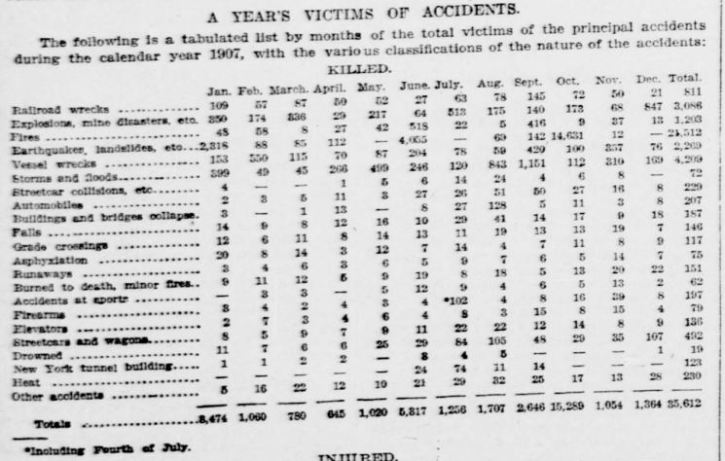
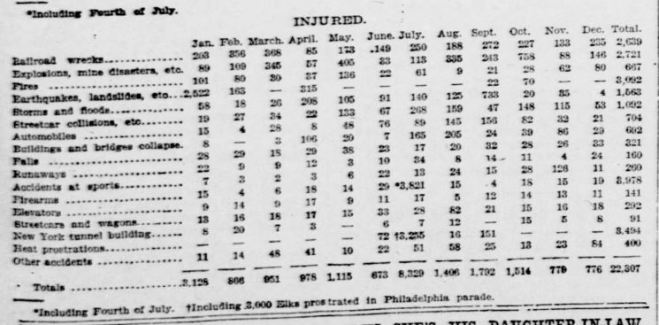
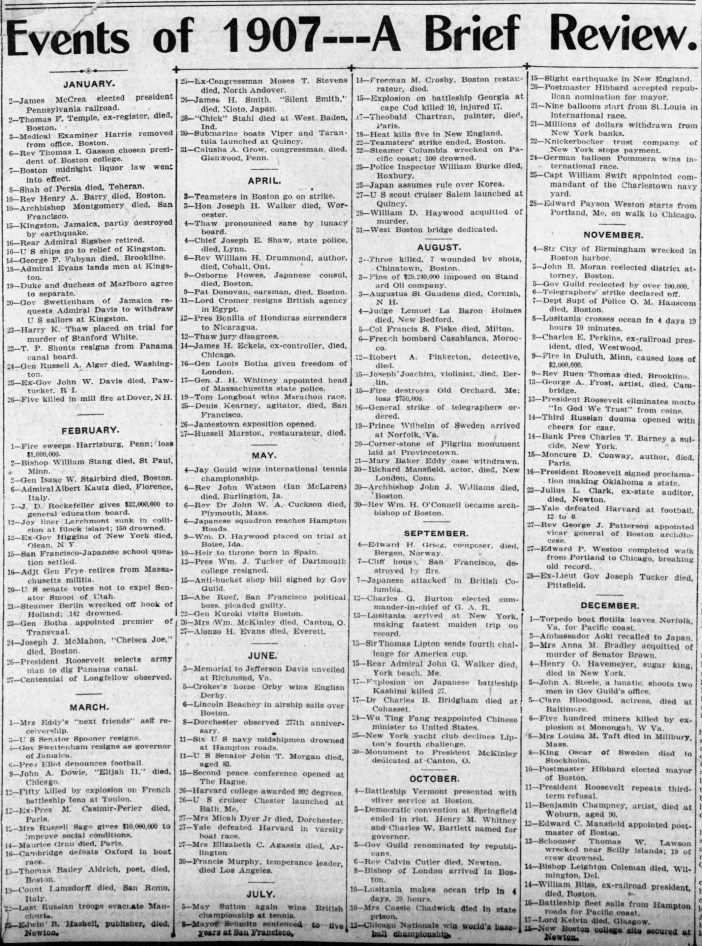
“The total number of killed and injured in the principal accidents during the calendar year 1907, as chronicled in The Tribune, reached enormous proportions. If the killed had been concentrated in one day at Elmira that city of politicians and prosperity would have been wiped out of existence as completely as was Pompeii or Herculaneum.” (WED 12.31.07 pg. 5)
“Aside from earthquakes and similar upheavals of nature, practically all of these accidents were in the United States.” (WED 12.31.07 pg. 5)
“The great disparity between the total of killed and injured—the latter usually more than doubling the former—is due to a number of causes.” (WED 12.31.07 pg. 5)
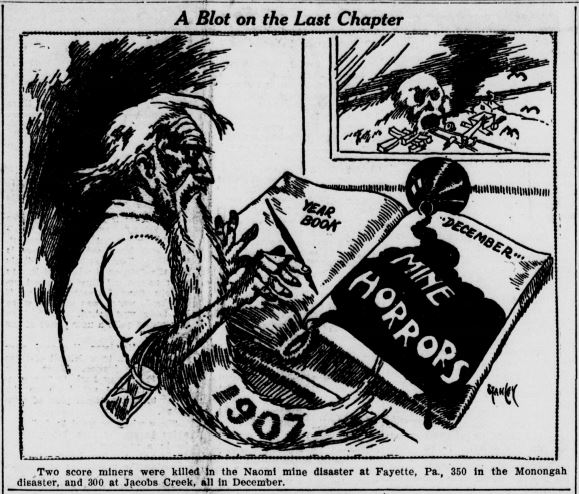
“Mine explosion and various kinds stand second in the totals for the year. Moreover, the killed in the month of December through this agency aggregate more than one-quarter of the total for the entire year.” (WED 12.31.07 pg. 5)
“Close scrutiny into the causes of these disasters tends to place the responsibility in great measure on the contributory negligence of the employees. Investigation in some cases has revealed almost criminal carelessness in the carrying of lighted lamps in the danger zones, despite the most stringent regulations prepared by the officials.” (WED 12.31.07 pg. 5)
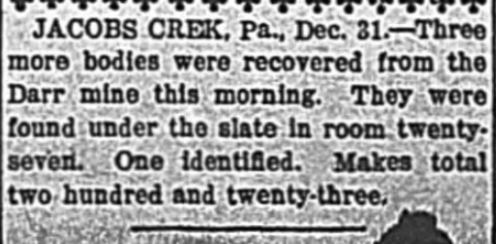
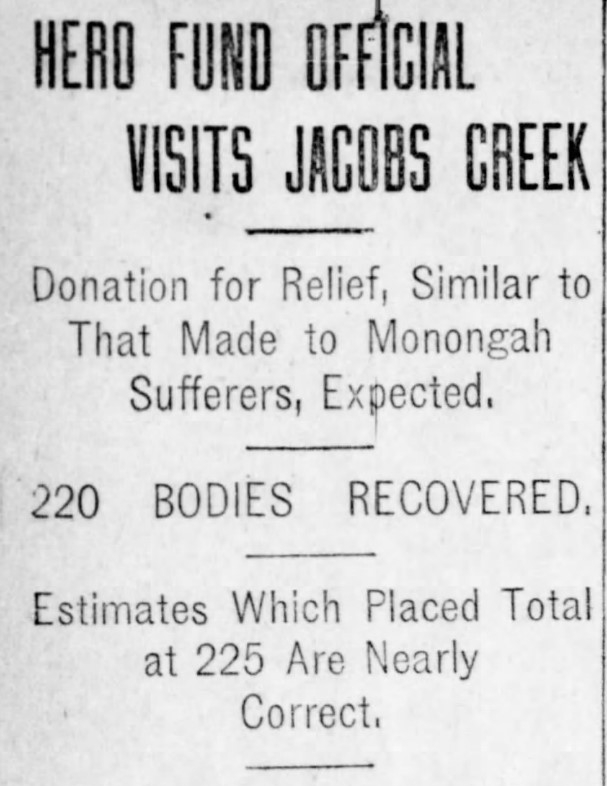
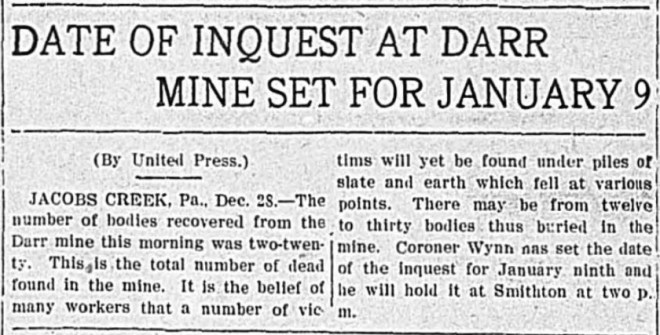
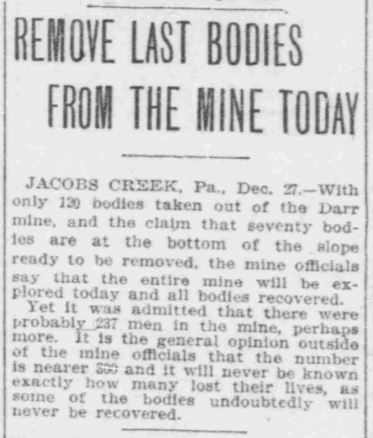
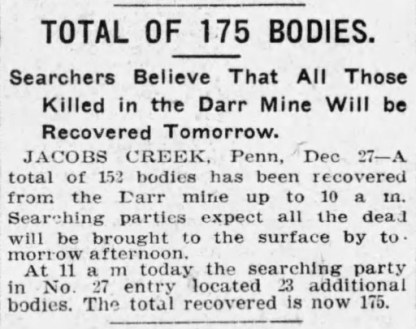
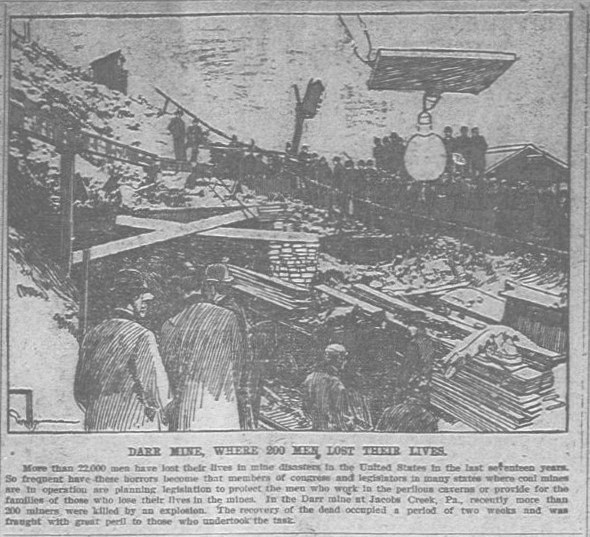
“The noxious black damp, though, is the deadliest foe of the miner, and both state and national governmental investigations are now under way to ascertain how the fatal power of this noxious underground ruler can be curbed. In December alone its irreversible fumes killed more than five hundred coal diggers in Fayette City, Penn,; Monongah, W.Va., and Yolande, Ala. The explosion at Jacobs City, Penn., in which nearly two hundred and fifty men lost their lives, was merely a trifling variation of this cause of disaster. A miniature mine is to be constructed in or near Pittsburgh by the United States authorities, and experiements on an exhaustive scale are to be conducted in order to ascertain how these dangers can be best avoided. Both miners and mine owners look hopefully to this source for relief from present perils.” (WED 12.31.07 pg. 5)
Bismarck Daily Tribune in North Dakota:
Wilkes-Barre Record in Pennsylvania:

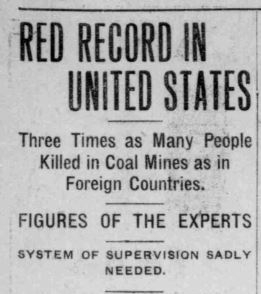
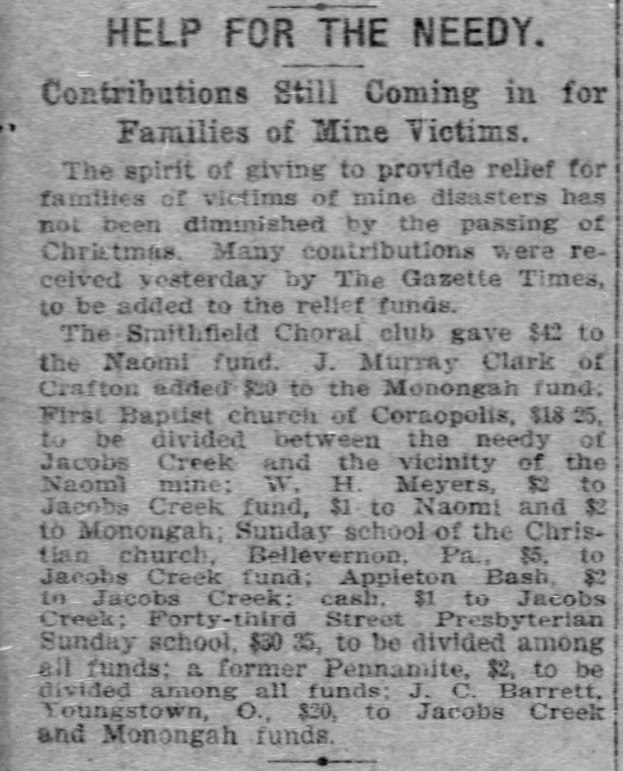
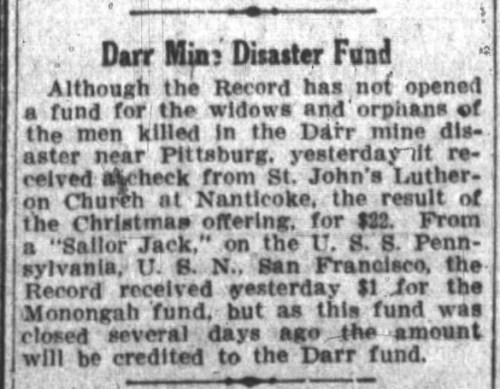
“The recent and frequent disasters in the coal fields of Pennsylvania, West Virginia and Alabama have served to call the attention of the public in a tragic manner to the immense loss of life that occurs in the coal mines of the country and have resulted in starting a great wave of popular sympathy for the families of the victims of these terrible disasters.” (WBR 12.31.07 pg. 5)
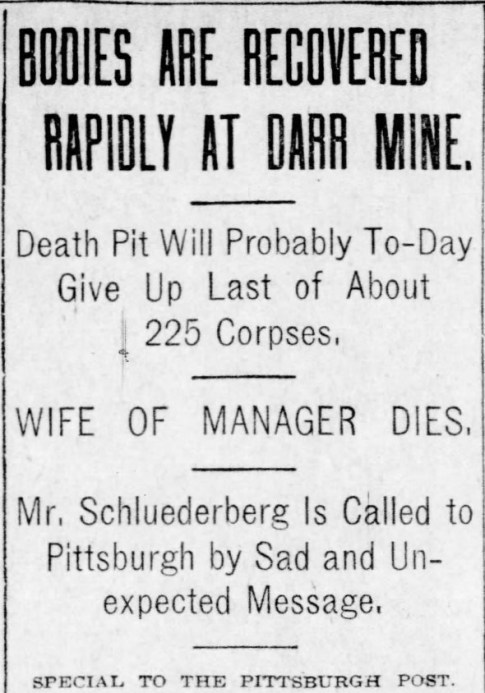
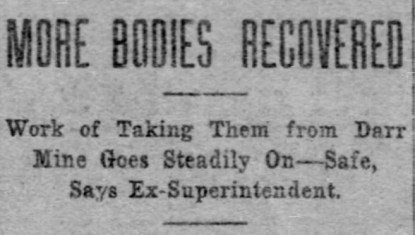
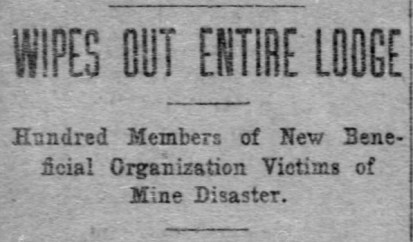
Pittsburgh Daily Post in Pennsylvania:

Albuquerque Citizen in New Mexico:

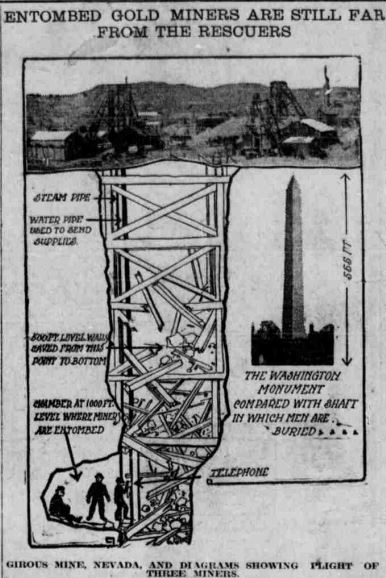
Ely, Nevada—“What will day light look like to men who have been imprisoned for a month and a half in mine darkness so impenetrable, so dense, so blanket-like that it seemed one could almost reach out and seize it?” (AC 12.31.07 pg 1)
“Will they be totally blind? Will their hair be white and their nerves shattered?” (AC 12.31.07 pg 1)
“What will the fresh, invigorating ozone of the mountains feel like to lungs that have been weakened and clogged by sucking in so long the dust-laden stifling, befouled air of a shut-in cavern 1,000 feet beneath the surface of the earth?” (AC 12.31.07 pg 1)
“And what will be the reactionary effect of the absorption of so much poison from the noxious, fume-laden atmosphere? Will it be typhoid fever, jaundice, or what racking disease?” (AC 12.31.07 pg 1)
“These are the questions that stand out first when you consider the plight of three men entombed in the most remarkable mine disaster of a generation. These men, R.A. Bailey, Pete McDonald, and Fred Brown, were imprisoned by a cave-in Dec. 1. They were caught on the 1,000 foot drift of the Alpha shaft of the Girous gold mine here with hundreds of feet of almost solid debris above them.” (AC 12.31.07 pg 1)
“They are still there. There is little prospect that they will be reached before January 15th.” (AC 12.31.07 pg 1)
“Waiting a few minutes after the accident Bailey communication with the upper levels by telephone, giving instructions that probably saved their lives. Then the wire was broken by another cave.” (AC 12.31.07 pg 1)
“It was three days before communication was reopened by means of a six-inch water pipe.” (AC 12.31.07 pg 1)
“Imagine the horror of that desperate wait. Imagine if you can the terrible apprehension which has enshrouded them ever since, knowing as they do that at any moment many come another slipping of the drift that may crush out their lives in a twinkling. This is the menace both prisoners and rescuers fear most.” (AC 12.31.07 pg 1)
“The best progress yet on the filled in mines shaft lying between their place of refuge and the feverishly working rescue party has been only 25 feet a day. Over 400 feet of debris remains.” (AC 12.31.07 pg 1)
“Food is let down to the men daily through the six inch water pipe. A chain of metal tubes in two-foot lengths, connected by wire couplings is used for this. Food and water fill the tubes. The telephone is repaired and they talk to friends and relatives.” (AC 12.31.07 pg 1)
“The men display wonderfully good spirits; they joke with their friends and jibe the rescuers for their slowness, and Mrs. Bailey talks hours each day with her husband.” (AC 12.31.07 pg 1)
“Yet the terrible nervous strain must tell, the horrible uncertainty, that day and night fear, ever present that something may happen at the last moment.” (AC 12.31.07 pg 1)
Night
At the Bernal mine in New Mexico:
“Nine dead bodies have already been taken out. Although the mine is still filled with gas, it is believed that no more victims remain in the workings. All the men had apparently been killed instantly and some of the bodies were mangled beyond recognition.” (BDR 01.01.08 pg. 1)
“…communication is difficult.” (BDR 01.01.08 pg. 1)
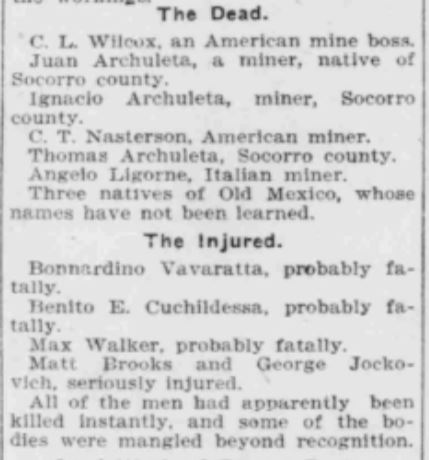
“No cause for the explosion is assigned.” (BDR 01.01.08 pg. 1)
“The explosion resulted from ignition of coal dust by a windy shot.” (BEL 01.01.08 pg. 1)
In Fairmont:
In Wheeling, WV:
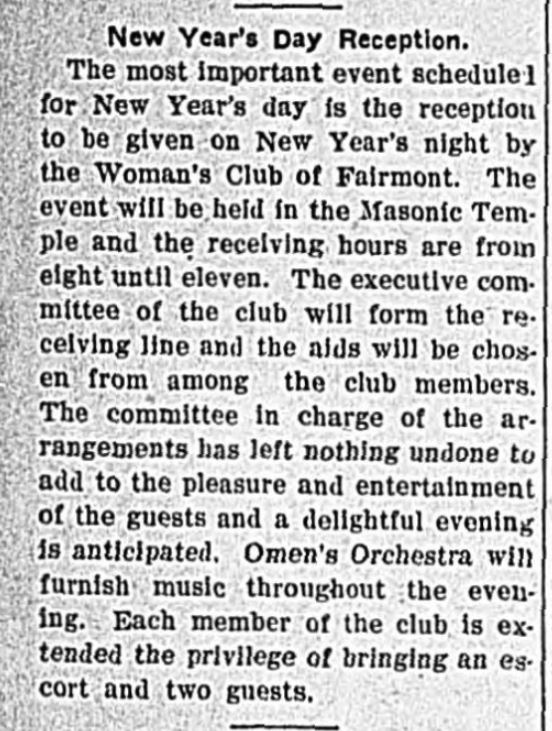
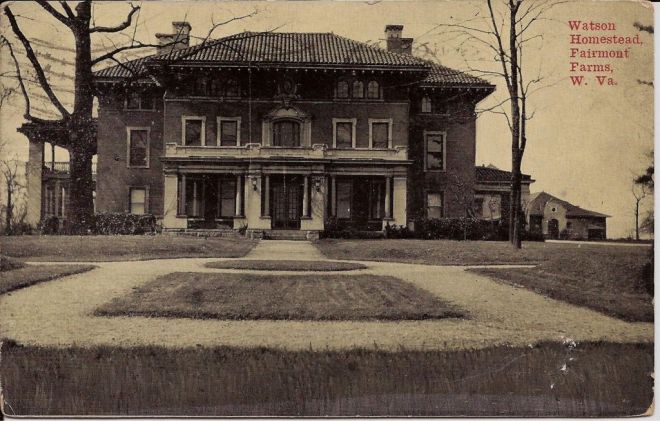
Miss Elizabeth Watson, Dr. Hugh Carr, Sweeney Fleming and Carney Carpenter attend the New Years assembly ball. (FWV 01.02.08 pg. 5)
In Clarksburg:
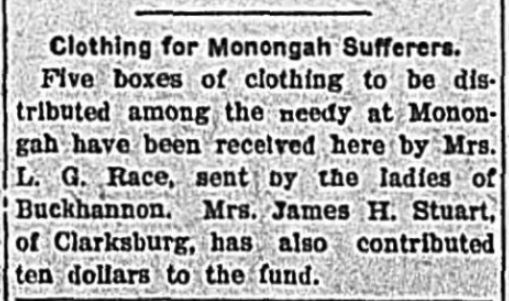
“The last car to be sent out by Parkersburgers with provisions and clothing for the Monongah sufferers will arrive here late tonight and be transferred to the river division and taken down to Monongah.” (CDT 12.31.07 pg. 1)
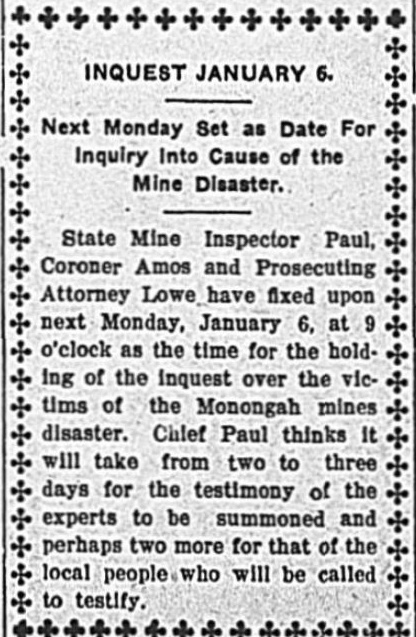
This concludes the posts for Bloody December of 1907. However, this does not conclude the Monongah Timeline as the Coroner’s Inquiry for the Monongah Disaster begins January, 6.
Thank you for reading through this epic month.
More on the Monongah Disaster of 1907
How Death Gloated!: A Timeline of the Monongah Disaster and Bloody December of 1907
Who is Guilty?: A Timeline of January 1908 and the Coroner’s Inquiry



















 The Monongah Disaster