Monday, December 9, 1907, Afternoon – Evening

The utterness of that desolation seemed by sheer force of numbers to overshadow anything else she had to tell—the children of the McFeeleys, “all little ones and not a bite to eat yesterday and him home dead”—(in some cases the women were so broken as to be unable to prepare food for their children, even if they had it)… What the housewives said as they met on the narrow walks or rocked at each other’s door sills was after all close to the pith of the matter…The Italian mother, “where I got the peppers,” with no money and no English and “2 little bits of children”…The Slavish wife who “tore blood out of her face”…The two crazed women on the hill who, rumor had it, had to be tied down to their beds…The young widow of the English machine man who lived just over No 8 mine, “who tore out her beautiful yellow hair in grabs,”… (Kellogg)

~12:00 pm

At the mines:

“Fire which caused a suspension of rescue work yesterday and early today in Mine No. 8 was extinguished, it was said, at noon today.” (News)

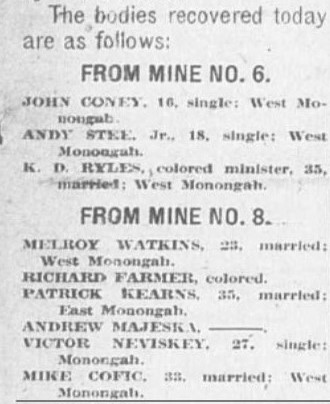
At noon the body of Mike Cosic was taken out of Mine No. 8. (CDT 12.9.07 pg. 1)

“No identification has been made of the eight unknown men taken out Sunday.” (CDT 12.9.07 pg. 1)

carnations

“A pathetic incident of the day occurred at Mine No. 6. A foreign woman whose husband had been killed stood near the mine all day with a half dozen carnations in her hand. The little floral tribute was wrapped with white ribbons.  Shortly after noon her husband’s body was recovered in such condition that burial was necessary at once. She followed the wagon to the temporary morgue where the body was placed in a box, and then to the cemetery near by.” (NYTb 12.10.07 pg. 14)

In Monongah:

C.W. Watson gives the following statement:

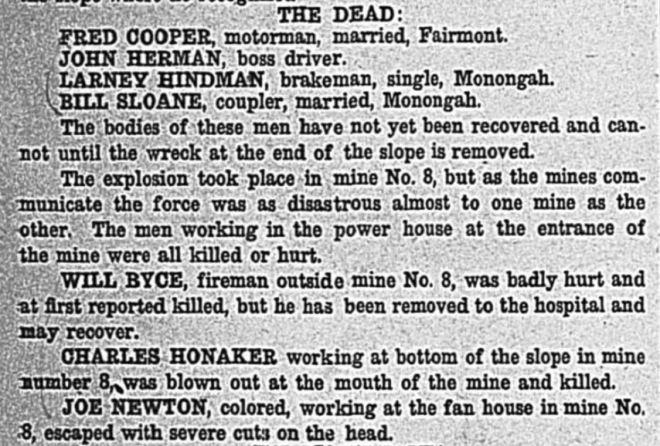
12.9.07 - pg 1 - Watson statement
FWV 12.9.07 pg 1

“Senator J.A. McDermott, of Morgantown, president of the State senate, who was requested by Governor W.M.O Dawson to go to the scene of the mine horror, gave the Telegram representative the following statement at noon today:

‘I consider that the resolution passed by the legislature gives the mine investigating committee the power to investigate all mine horrors that occur during the existence of the committee. The coal company wants a most thorough investigation by that committee or by any other committee. I have been at both mines and looked over the whole situation. I notice a fine organization and a systematic plan of rescue work and everything possible is being done promptly. The number in the mines as given out is considerably overestimated. I am here for no special purpose but it is possible that this disaster might come before the legislature or come up in some other way and therefore desired to be personally informed.’” (CDT 12.9.07 pg. 1)

“There has been no change in the situation at Monongah today except that it is very probable that the death list is not so large as was first thought. According to a telegram sent to the Governor by Watson the dead number almost a hundred fewer than given out.” (FWV 12.9.07 pg. 1)

“When the explosion occurred the town officials ordered the saloons closed…there is no drinking and among the thousands of people who have flocked to Monongah to witness the grave disaster not one disorderly act has been committed…” (FWV 12.9.07 – pg. 7)

Fairmont West Virginian puts out an extra Noon paper. Bill Sloane is no longer included on the list of the dead.

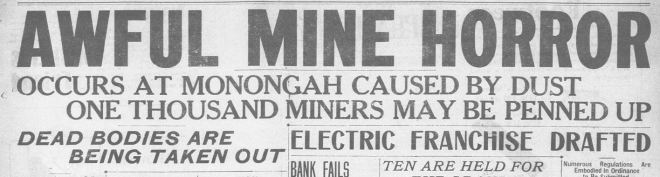
12.9.07 - pg 1 - headline

12.9.07 - pg 1 - letter for aid from Moore

Chief of Police Shumaker received letter asking him for assistance to locate Walter Zirkle. (FWV.12.10.07 pg. 2)
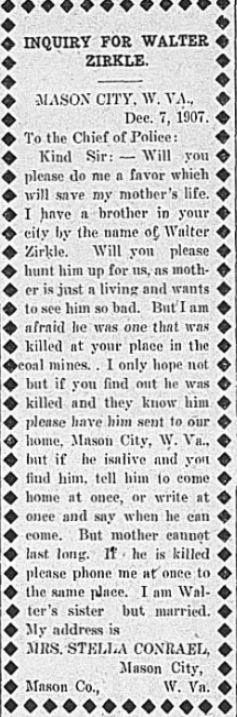
12.9.07 - pg - missing man

~2:00 pm

12.10.07 - pg 6 - funeral 1
CET 12.10.07 pg 6

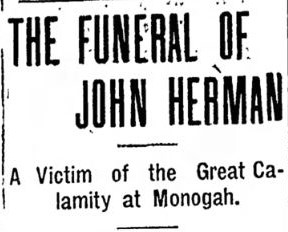
“The funeral of Mr. John Herman…whose remains were brought to Eckhart Mine for interment took place on Monday afternoon at 2 o’clock from the Jr. O.U.A.M. hall, as the church to which the deceased belonged is undergoing repairs.” (CET 12.10.07 pg. 6)

“The services were conducted by Rev. Edwards, pastor of Methodist Episcopal church, who spoke in a very beautiful and touching manner of the deceased’s past and of his terrible end. At the conclusion of the services the remains were taken to the Allegany cemetery at this place, where they were laid to rest, attended by a large concourse of friends and relatives.” (CET 12.10.07 pg. 6)

“The deceased was about thirty-eight years of age and is survived by his wife and several children, also his mother and several brothers and sisters residing in this vicinity. The floral offerings were very beautiful.” (CET 12.10.07 pg. 6)

~2:30 pm

“Five more bodies were removed from the mines today, making the total 58 up to 2:30 o’clock.” (ETR 12.9.07 pg. 1)

During the Afternoon

“A foreigner who is employed at the Riverdale Mine, ten miles above Monongah, lost a brother and thirteen other relatives in the catastrophe, and he is left alone in this country. Today he came to the offices of the coal company and reported that he wanted to remain at the mines until the bodies were recovered. He asked whether he would get his job back at Riverdale should he stay away from it for several days. He was assured he would not lose his place and became happy in the fact that he could assist in finding the bodies of fourteen loved ones.” (NYTb 12.10.07 pg. 14)

In Monongah:

“General Manager L.L. Malone told the Telegram representative this afternoon that likely all of the bodies, with perhaps the exception of a few in the remote parts of the mines, will be brought out within two or three days.” (CDT 12.9.07 pg. 1)

Fred Cooper’s funeral services held at the home of his uncle, Mr. Boggess, near Monongah. Rev. R.T. Webb of the M.E. Church South, pastor of the deceased, conducted the services, which were largely attended by friends of the deceased. Younger brother, Fay Cooper, also lost his life in the disaster but his body has not yet been found. Fred’s wife who survives him with one child has in the past 2 years lost 2 brothers, Fred Shingleton and an infant brother. Mr. Cooper’s mother, Mrs. Jerome Hobbs, who today mourns the loss of two sons, yesterday received announcement of the death of her husband, but today another message has corrected that statement. Mr. Hobbs is at Hot Springs, Arkansas, on account of rheumatism. (FWV 12.9.07 pg. ?)

“Considerable excitement was caused late this afternoon when rumors were current that a second explosion had occurred in the mines. An investigation made immediately by the company showed the reports had reached this vicinity from the East. There was absolutely no truth in the statement, and it was not necessary for the company to deny the report in this section.” (NYTb 12.10.07 pg. 14)

In Clarksburg:

“The Richard Farmer, whose body was taken out of Mine No. 8, is a cousin of Policeman Farmer, of Clarksburg. His body was buried here this afternoon.” (CDT 12.9.07 pg. 1)
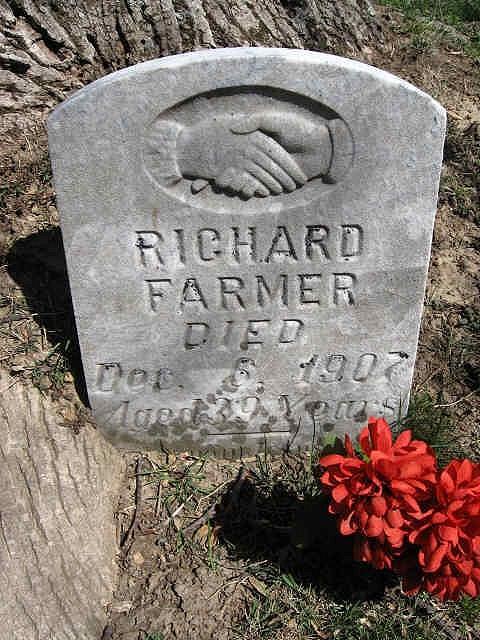
Grave of Richard Farmer on Tower Hill

In Fairmont:

The remains of Charles Honaker are brought to the city and buried at Woodlawn cemetery. The funeral was under the direction of the Improved Order of Red Men and the Degree of Pocahontas. (FWV 12.10.07 pg. 1)

“The work of caring for the widows and orphans has been entrusted to a committee headed by Rt. Rev. P.J. Donahue of the Catholic diocese of Wheeling.” Bishop Donahue estimates over 80% of dead were members of the Polish or Italian parishes. (Wash. Times 12.9.07 pg. 5) (McAteer)

In the cemeteries:

Burials are continual throughout the day. At the Catholic cemetery, there is great concern of bodies being buried in their proper ethnic graveyards; Polish on the Left, Italians on the right.

“Scenes of touching sadness were caused throughout the day by the burial of the recovered dead and the pitiful actions of relatives of the entombed victims.” (LODD 12.13.07 pg. 3)

Following the custom of old country, each family member would throw a handful of earth into the grave and say a final prayer.

Near Grant Town, WV:

The home of Mr. and Mrs. John Collins of Gray’s Flats is destroyed by fire while Mr. Collins is at work in mines and Mrs. Collins is at Monongah on account of the death of relatives caused by the great explosion. The fire was caused by the children knocking a stove leg off. There were 3 children in the house but they escaped. (FWV 12.10.07 pg. 8)

grey flats

At the mines:

“Nine more bodies were brought out of Monongah Mines Nos. 6 and 8 today. There are ten more bodies near the opening of No. 6 and they will be brought out by 5 or 6 o’clock.” (CDT 12.9.07 pg. 1)

~6:00 pm

Newspapers

Fairmont West Virginian:

Weather predicts more rain tonight; Tuesday, rain or snow; much colder (FWV 12.9.07 pg. 1)

12.9.07 - pg 1 - splash

Clarksburg Daily Telegram:

12.9.07 - pg 1 - headline

12.9.07 - pg 1 - list

“…the Clarksburg Amusement Company has decided to give the net receipts of both the Odeon and Bijou family theatres all of next week to the relief fund for the sufferers. The regular performances with vaudeville specialties will be given and all who wish to lend a little aid to the unfortunate people of Monongah should attend the theatres.” (CDT 12.9.07 pg. 1)

“The proceeds of the Dreamland theatre this week will also be for the miner’s relief fund. A National cash register will be placed in the ticket office and all the monies taken in will be put in this register. The key of the register will be given to Chief of Police Richard Scott, who will count the money every morning and announcement will be made in the Telegram of the amount taken in every day. All above, the running expenses will go to the miner’s relief fund.” (CDT 12.9.07 pg. 1)
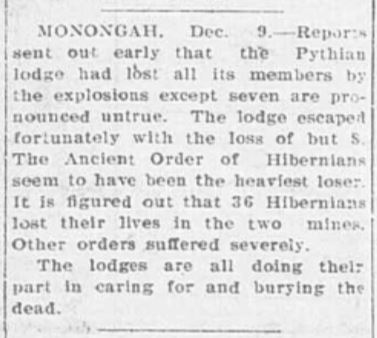
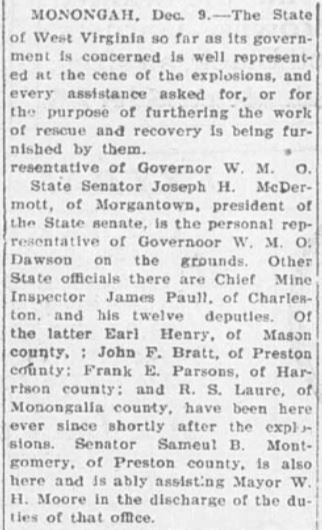
12.9.07 - pg 3 - lodges and orders12.9.07 - pg 3 - officials 2

12.9.07 - pg 5 - Shinnston 1

“The Monongah mine horror is still the all-absorbing topic of interest to everyone here, many of our people having relatives or friends who were victims of that awful explosion, the concussion of which was plenty felt here, and telephone messages came from as far away as H.R. McCord’s on Simpson Creek, inquiring if there had been an explosion here. Relief parties were formed here, headed by Superintendent Thomas Jarrett and Mine Foreman E.P. McAlvin and O. Bush, of the local mines and hurried to the scene on a freight train and have been working there since. Superintendent Jarrett was twice very nearly overcome with the gaseous fumes, but each time after recovery he returned to the work of rescue.” (CDT 12.9.07 pg. 5)

Washington Times, page 5:
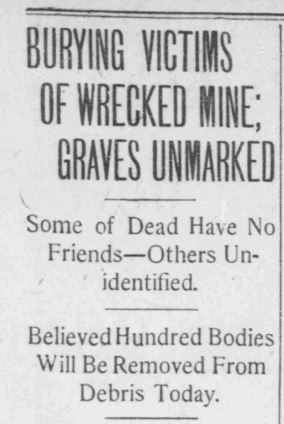
12.09.07 - pg 5 - Monongah 1

The D.C. Evening Star, page 12:

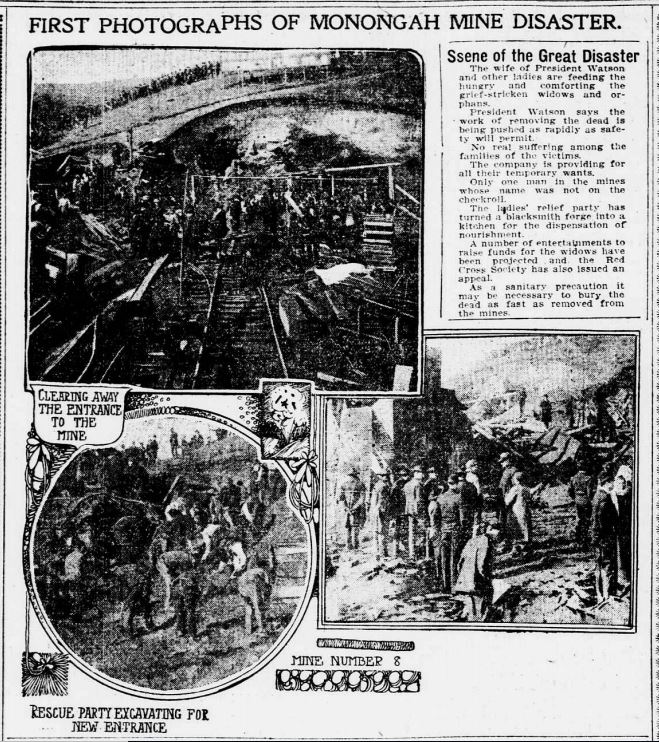
12.9.07 - pg 12 - photos of Monongah

Evening Journal in Deleware:

12.9.07 - pg 1 - Monongah 1

The Evansville Press:

12.9.07 - pg 1 - Monongah 1

Evening:

In Fairmont:

Mayor Arnett is strongly considering closing the saloons again tonight. (FWV 12.9.07 pg. 1)

The list of 406 dead published on Monday is “not complete”.  “Mr. Harry Dawson of Woodsfield, OH was in the office yesterday evening looking over the list for the name of his brother, Fred Dawson, who was employed at Monongah and is known to be lost but his name was not found. Mr. Dawson also says that J.L. Hunsaker was also employed with his brother and his name is not on the list. These were both young unmarried men and were machine men.” (FWV 12.10.07 pg. 7)

“So this proves that the list is not near large enough and how many more instances of this kind will appear will only be known by waiting.” (FWV 12.10.07 pg. 7)

In Monongah:

Jury and court of inquiry adjourn “but will be recalled by the Coroner.” (FWV 12.10.07 pg. 1)

“The company issued a statement today in which the claim is made that later developments lead the officials to believe that there were only 260 men in the mine when the explosion occurred. It is insisted by the miners that 406 men were checked off as entering…” (CB 12.10.07 pg. 1)


More on How Death Gloated!

Bibliography

Disclaimer and Guide

Introduction

About the Author

Contact Information

Monday, December 9, 1907, Morning

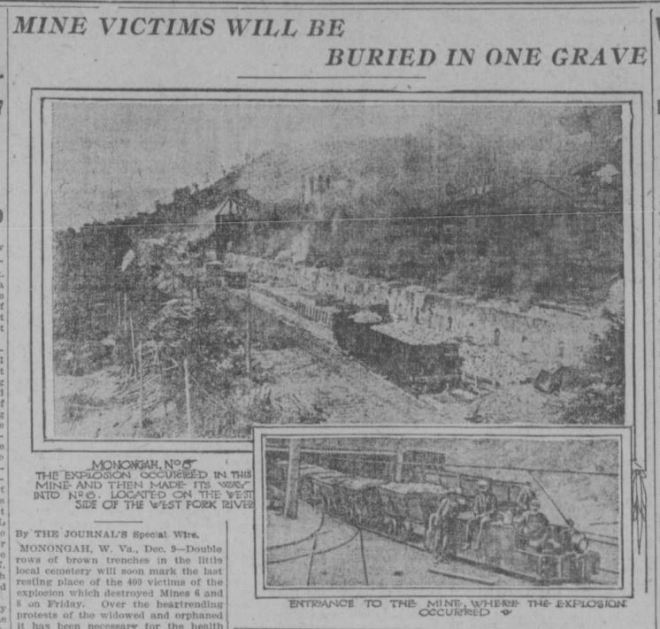
“Over the heartrending protests of the widowed and orphaned, it has been necessary for the authorities to act to preserve the health of the living and orders for immediate burial of the victims has been issued. The only exception will be in cases of bodies that are fully preserved and can be embalmed. These will be taken care of and taken to the morgues for identification. Failing this, all will be buried in the common grave…”

(WT 12.9.07 pg. 5)

~8:00 am

In Fairmont:

Lawrence E Sands sends a message from Wheeling that “citizens of city are planning a relief fund for Monongah…thinks Wheeling will contribute at least $1,000.” (FWV 12.9.07 pg.8)

In Monongah:

“The fourth day was a repetition of its three predecessors in the matter of pathetic scenes. Hundreds of women remained near the mines all day screaming and crying until they almost collapsed. As on former days hot coffee was served at intervals by the company to keep the unfortunate women from falling to the ground from exhaustion.” (News)

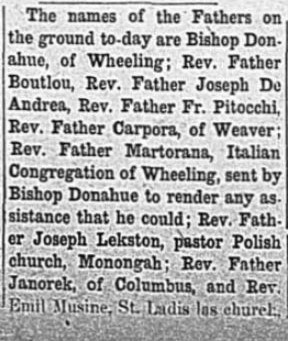
Bishop P.J. Donahue arrives by train from Wheeling joined by St. Peter’s of Fairmont priest Father Arsenius Boutou to assist the Monongah priests, Father Joseph Lekston & Father Joseph D’Andrea. Both Lekston and D’Andrea have been working nonstop since Friday and are close to exhaustion.

Father Joseph D’Andrea has also lost his brother, Victor D’Andrea, in the disaster. Victor was a father of 3 and his wife is 6 months pregnant. D’Andrea had worked for 3 days and nights, never stopping to sleep or bathe, continuously ministering to the bereaved and guiding coffin carts to correct homes.

The priests did services in the mornings and visited with families in the evenings.

Priests on the scene:

12.9.07 - pg 1 - Priests on ground
FWV 12.9.07 pg 1


At the mines:

“The work of rescuing bodies was resumed this morning…”

52 bodies have been recovered and the remains of 43 have been identified. (FWV 12.9.07 – pg. 1 – extra)

“Most of the bodies found have been those of foreigners and nearly all have been identified by their pay checks. [Th]ree large fans are pumping air into the mines and a pipe line 2.500 feet long was put in on the advice of Chief State Mine Inspector Paul as a precaution against fires.” (CET 12.10.07 pg. 1)

Weekend crowds and sightseers are gone. Only somber groups of men—relief workers, explorers, brothers and men waiting their turn to go in—remained around mines.

At the churches in Monongah:

Church basements became make-shift funeral parlors.

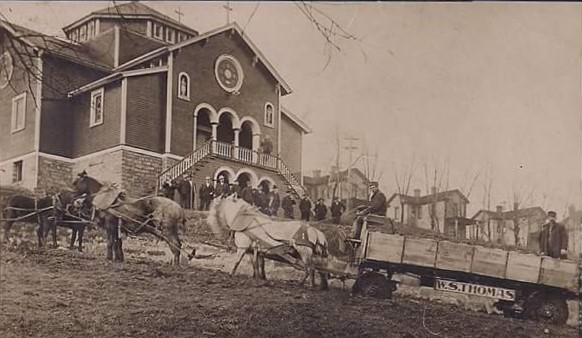
wagon by st stanislaus

Many came early to the Polish Catholic church, St. Stanislaus, “…a-foot, with bowed heads, sorrowing in low voices, sometimes a woman half held up by her companions, to that basement where the coffin lids closed in on blistered, swollen faces and parts of men.” (Kellogg)

“4 or 5 widows wept compulsively.” (Kellogg)

“An older woman read from a religious book held to the flickering light of a candle at the head of a closed coffin.” (Kellogg)

“A peasant, ugly with her pitted face, but beautiful in her great sorrow, bent often and kissed the lips of her husband.” (Kellogg)

“All of a sudden there was cry more piercing than the others. It was from an older mother who has lost 7—her husband, a son, 2 sons in law, and 3 nephews. She had come upon one of them, and the people with her could scarcely hold her. She threw her head on the casket and spoke to the boy fondly, trying to caress the crumpled face with poor, wrinkled hands. She had moaned all the way that morning from her lonely house to the church door, giving infinite sorrow to those who heard, and here her grief at last found vent.” (Kellogg)

frontThumbnail (6)

~8:30 am

12.9.07 - pg 3 - McDonough
CDT 12.9.07 pg 3

~9:00 am

The court of inquiry convenes in Monongah. (FWV 12.10.07 pg. 1)

“Coroner E.S. Amos, of Fairmont, is personally engaged in looking after the identification of bodies and is having a complete list kept, as well as recording the circumstances of identification and the disposition of the bodies. In this he is ably assisted by the several undertakers of this town, Fairmont and Clarksburg and other places. The jury organized by him will meet in Fairmont this morning at 9 o’clock to begin its work of investigation. Such representative men as W.S. Hamilton, Festus Downs, and W.E. Codray are members of the jury. Their work it is announced will be thorough and complete.”

The jury with Coroner Amos and Prosecuting Att. Scott C. Lowe went to No 8 and then visited No 6.

Jury visits

At the morgue:

“There is no more room in the morgue and the bodies are prepared at the mouth of the mine for burial.” (CET 12.9.07 pg. 1)

“In the case of complete identification, the bodies, after being viewed by the coroner and jury, are not held, pending further action of the coroner, as it is established, they all came out of the mine and met death by the same cause.” (CDT 12.9.07 xtra pg. 1) (CDT 12.9.07 xtra pg. 10)

Widows and family members were permitted “ample time” to view the bodies and attempt to ID them, but the time allotted for the body to be identified has been drastically diminished since the decision of the Marion County Health Board last night.

“After the identification of the bodies and they are claimed by friends, Coroner Amos holds the inquest and permits the relatives to remove them to their homes. The bodies of all Polish miners are being removed to the Polish church just above Monongah as fast as they are identified and are being placed in the basement of that edifice.” (US Dept of Labor-mine disasters-Dispatch article)

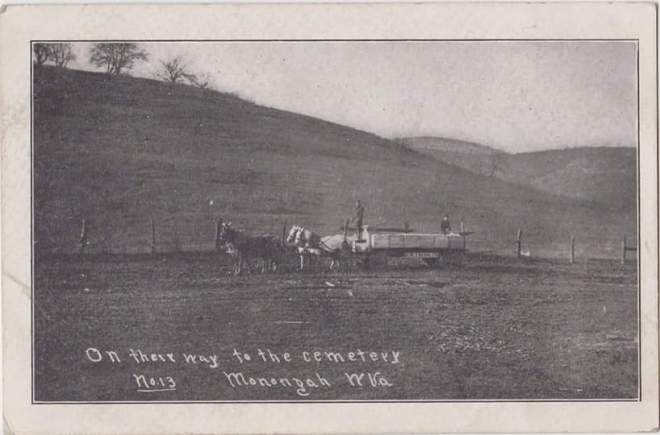
When ID is not possible, the body is taken directly from the mine entrance to the graveyard and buried immediately.

“Work of burying the dead that have been taken from the mines is in progress and because of the many bodies they have to be interred with dispatch and little ceremony.” (CDT 12.9.07 xtra pg. 1) (CDT 12.9.07 xtra pg. 10)

FB_IMG_1511974249680

In Fairmont:

“All organizations in the city are taking steps to institute relief measures” (FWV 12.9.07 pg.8)

In Clarksburg:

“The body of Patrick McDonough, the miner who was killed in the Monongah disaster, was brought to this city Monday morning on the 9 o’clock interurban car. Funeral services were held at 9:30 o’clock at the Catholic church and interment was made in Holy Cross cemetery. McDonough was a brother-in-law of Pat Connell and Thomas Gill.” (CDT 12.9.07 pg. 1)

The remains of Patrick McDonough were taken to Clarksburg. Patrick is brother of townsman, Policeman Anthony McDonough. (FWV 12.9.07 pg. 1)

At the mines:

Miners linger outside waiting to go into the mines. “The knot of silent mine workers in boots and corduroys and overalls could be made out from the rim of the bluff…; and at its edge sat in heavier silence a group of shawled women, waiting. Behind them ran a little street, thick in mud, with domino shaped stepping stones at the crossways with colorless little houses and propped walks and here and there dove-cotes nailed under the eaves or reared on poles.” (Kellogg)

12.9.07 - pg 4 - Funeral day
TES 12.9.07 pg 4

“The body of W.H. Byse will be taken to Roane county Monday for burial there.” (CDT 12.9.07 xtra pg. 1)

“Quite a number of Clarksburgers attended the funeral of John Howard Preston, at Monongah, Monday. Preston was a victim of the horrible mine disaster which occurred at Monongah Friday.” (TA 12.12.07 pg. 2)

“In the town families were mourning inconsolably the death or absence of a loved one and on all sides were little groups of weeping women and children. Thousands of strangers thronged the streets all day. They came from towns and country within a radius of many miles and by every means of travel.” (RP 12.9.07 pg. 2)

Some 30 – 40 funerals are performed throughout the day. “They were merely repetitions of those of Sunday, the crowds being almost as large and the scenes and incidents just as distressing.” (ES 12.10.07 pg. 1)

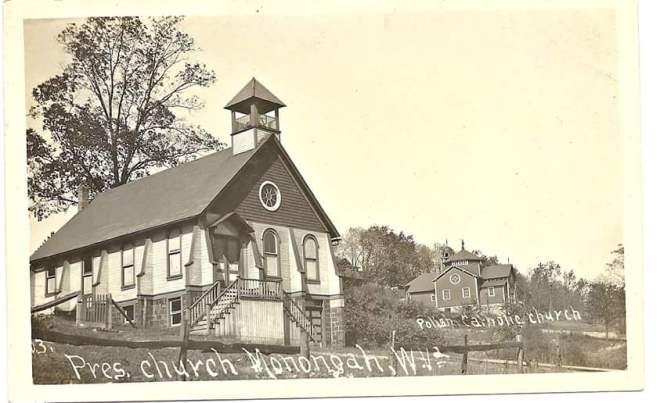
Churches near Bridge Street

A majority of today’s funerals are held in the little Polish Catholic Church located between the two mines. 5 priests directed funerals.

Father Boutlou held short funeral services for the Irish Catholics. (FWV 12.9.07 pg. 1)

“Services were held over several of the bodies at one time.” (CDT 12.9.07 pg. 1)

“The people gathered above, the men on one side and the women on the other, as is the custom in the Polish church. The candles of the little altar lit up the chapel as they had done on other Sundays and the familiar intonations of the mass brought a brooding quiet. Then the priest addressed his people in Polish and with his first words, they began to weep aloud.” (Kellogg)

A service preached by Rev. Father Emil Musine, of St. Ladis Las Church of Wheeling was of “a very effective discourse. Sobs and wails went up from the wives and children of the unfortunate. After Father Emil Musine’s sermon Bishop Donahue of Wheeling spoke words of consolation promising relief to the orphans.” (FWV 12.9.07 pg. 1)

In English, Bishop Donahue told the congregants that he empathized with them and how much “the whole world laments” the terrible disaster which “robbed them” of their loved ones. He concluded in assuring that he would do his “utmost” to help the people and if any of them found that they could not support their children that he would see that they “all were sent to orphanages” where they “would be well cared for”. For those who could not understand his words, they were soon told by their fellow congregants that could. Though his words “cheered” them to a degree, there was not a single woman in the church “who would part with a child, no matter how many she had, even if the pangs of starvation tempted her.” (CET 12.10.07 pg. 1)

“Outside, an Italian laborer offered his services for carrying the dead to the church yard. He spoke to a Slovak and said that everyone is the brother of the other, no matter what nationality he belongs to. He said it in broken English.” (Kellogg)

“The ministers refrained from making any reference to the catastrophe and the commitment services at the graveyard were as short as possible. There were no carriages and no flowers. The caskets were hauled for the most part in undertakers’ wagons. Large crowds of pedestrians followed and the church was crowded almost to suffocation. Several of the services were interrupted by women fainting, causing momentary excitement, but this was soon dispelled.” (RP 12.9.07 pg. 2)

~10:00 am

“Up to 10 o’clock the list stood at 53.” (OTC 12.10.07 pg. 1)

At the morgue:

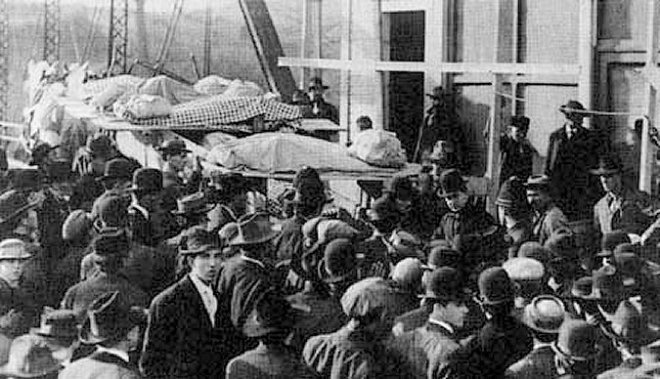
The temporary morgue inside the First National Bank is getting overwhelmed; coffins and bodies begin lining the streets in front of the bank.

mmd-mining2

On the west side of Monongah:

The National Guard, called in by Governor Dawson, arrives and sets up on the north side of the Italian side of the largest graveyard. (McAteer)

They set up their large white tents in typical military fashion with graves in front, resembling military trenches.

These tents will act as a secondary morgue and will serve the needs of the gravediggers.

“Captain M.M. Neely furnished a big tent that has been pitched near the Catholic church. The tent is being used for the Italian morgue. The bodies are first identified at the morgue proper and are then taken to the tent. So far there has been a change in the name of one man.” (FWV 12.9.07 pg. 1)

file


On the east side of Monongah:

Paul Kellogg has wandered over to the corner of Main street, where the morgue has begun to lay coffins with prepared bodies out for identification. “At the end of the street were store buildings, and the Italian woman who kept one had let them leave a coffin box on her steps until the right household should be found.” Kellogg talks with this woman at length. “Standing at the head of the street, she pointed out with stretched finger the houses in a row on the bluff where the shawled women sat and waited…and she raised and lowered her arm in a counting of the houses, one after another.” She describes the condition inside several houses where losses have been felt:

Of the man and 7 boarders killed at house No 151— “All married. Old country. No see ‘tall, no see. He can’ find. All burn.”

“Woman cry all time,” she said of another house with three boys killed. (Kellogg)

“A hearse drove up to the corner house and the driver beckoned to me and to a workman who had come up. There was a coffin to be taken away and he needed help lifting it. The women had to be pushed back while he worked at closing the lid. Their cries rose and fell in that half unison of Slavic people which makes almost a ritual sobbing. The wife stood on the porch as they drove off; bare armed, stupid in her loss, her face knotted with two little, open-mouthed children whimpering and plucking at her apron and behind them a grandmother.

“A little red-cheeked Irish boy had poked his way into the Slavic house as they lifted the body out. He was going for the doctor, he said; the baby had been sick all night. ‘Got heem pap yet?’ asked the Italian woman. ‘Nope,’ said the boy.” (Kellogg)

“Across the street the tears were running down the face of the Italian storekeeper and she was giving herself up to the impetuous crying of her race.” (Kellogg)

~11:00 am

In Columbus, Ohio, Governor Andrew Harris has “ordered the chief state mine inspector, Harrison and deputies to Monongah, to make a careful investigation of the circumstance surrounding the explosion there. The information secured will be applied to correcting any shortcoming in Ohio mines. Inspector Harrison left for Monongah today.” (RP 12.9.07 pg. 2)

“It is a low estimate to say that the recovery of the bodies of the victims of the mine explosion will cost the coal company at least $75,000 and possibly a great deal more. But this is an item the company has not even thought of and it will spare no effort or money to recover every body from the mine.” (CDT 12.9.07 xtra pg. 1)

“The property loss will be very heavy, as the artificial interior work of the two mines was entirely destroyed to the extent of the tracks being torn all to pieces in the mine No. 8 especially where the rails broke and curled themselves up into rings.” (CDT 12.9.07 xtra pg. 1)

“Not taking the loss of life into consideration and the out lay that may result from that, the company’s loss will reach at least a quarter a million dollars, and, unless No 8 can be saved from fire, the loss will reach many millions.” (CDT 12.9.07 xtra pg. 1)

“The task of taking out bodies from Nos 6 and 8 mines will not be completed before the end of the week. Sixty-six bodies have been taken out of the mine heading of No. 6 at 11 o’clock. It is still impossible to reach many in the rooms leading off from way headings, owing to afterdamp which continues there.” (CET 12.9.07 pg. 1)

In Monongah:

“No more touching spectacle could possibly be witnessed by human eyes than to see the bereaved women and children of Monongah walking the streets wringing their hands and crying grief for loved ones…” (FWV 12.9.07 – pg. 7)

Women wander the streets aimlessly, wailing in the pouring rain. (Scalabrinians)

“Two Slav women, with big boned grief wrenched faces, were walking up and down the street, going nowhere. They wore great shawls, and diagonally across their breasts were the papoose-like bodies of their babies, wrapped in with a knack which is handed down by the mother wit of the old country.” (Kellogg)

“Part way along an angling road, lined with older company houses, I came upon a woman of perhaps 55 and her daughter. They walked spiritlessly as if climbing a long hill. 5 other daughters and a son’s wife were waiting for them in a house beyond, –8 women and 2 men gone. These were West Virginians, I took it; at least they had seen the settlement grow up about the mines and knew its people as only villagers do. What were just door steps and dull windows to me, were individualized to them…the mother counted them off as we went.” (Kellogg)

“Farther on was a little 5-year-old girl, playing by the fence. ‘We’ve got two dead in our house,’ she said, smiling.” (Kellogg)

women at 8


More on How Death Gloated!
Bibliography

Disclaimer and Guide

Introduction

About the Author

Contact Information

Friday, December 6, 1907, Mid-Afternoon – Dusk, 3:00 pm – 7:00 pm

“Not less than 400 are dead and the number may run to 700, as officials have been keeping down the number as much as possible.” (FWDN 12.6.07 pg. 1)

~3:00 pm

“At 3 o’clock this afternoon it is known that the mine disaster is the worst in the history of the country.” (FWDN 12.6.07 pg. 1)

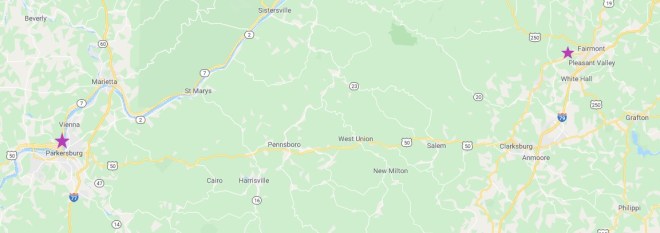
In Parkersburg:

“Mr. Watson was in Parkersburg at the time of the accident and went at once to the scene.” (TBS 12.7.07 pg. 2)

map - parkersburg

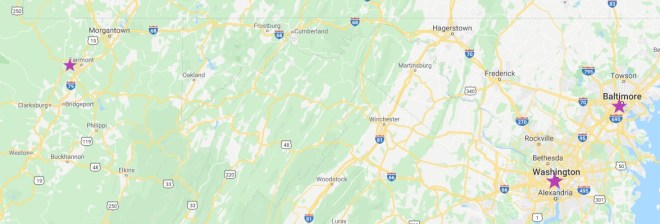
In Baltimore:

“Mr. Wheelwright left here at 3 pm over the Baltimore and Ohio for the mines. He was accompanied by Mr. J.R. Buckingham, his secretary, and some of the others of the company’s officers.” (TBS 12.7.07 pg. 2)

map - baltimore and DC

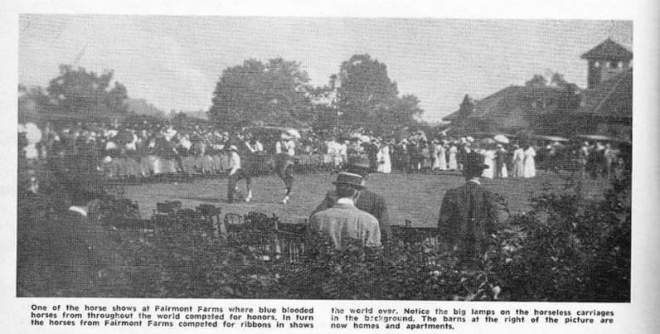
“Mr. Clarence W. Watson is the president and Mr. Jere H. Wheelwright the vice-president, both of whom spend most of their time here in directing the executive affairs of the corporation. Mr. Watson has a home at Fairmont, where he spends the summer. On this estate, which is just on the outskirts of that city, he has recently built a magnificent stable for his famous show horses and also a half-mile track for their exercise.” (TBS 12.7.07 pg. 2)

FB_IMG_1516709527023

In Monongah:

It is “Press Time” and some of the reporters are in line to use the telegraph or telephone in the company store post office or the company office just across the river from #6 to submit their reports in time for the evening papers. A majority have had to go into Fairmont to find more communication resources. (News)

Outside #6:

Carl Tarleton arrives from the mines just down the tracks in Enterprise to help with the recovery. He works personally with David Victor on restoring proper ventilation to the mines, despite only having one working fan. By this point they have only achieved breathable air in most of the main shaft of #6, but they are almost to the area where the two mines are conjoined. David Victor decides to go ahead and make an attempt at a fire examination of #6. (Inquiry)

~3:30 pm

The two staff writers for The Clarksburg Daily Telegram make “fast time” despite taking the back roads to Monongah. “…they arrived some time before the first train and about two hours before the first trolley car arrived from Clarksburg, beating other newspaper representatives.” (CDT 12.8.07 pg. 1)

Outside #6:

The second round of rescue crews is starting to be organized just as several experienced miners arrive from the Montana mines just outside of Fairmont. As these men already work together as a congruent team underground, they are formed into a rescue crew all their own. (FWV 12.7.07 pg. 1 – noon)

Outside #8:

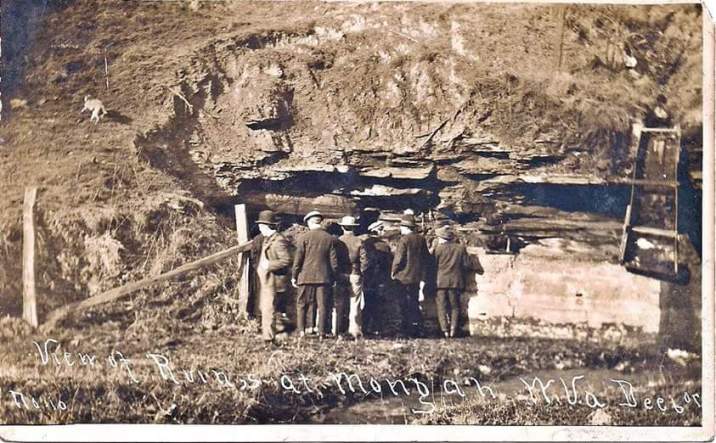
Someone standing near a toad hole, possibly a company watchman, happens to hear a sound like moaning coming from the ground. He calls out to nearby work crews for help. Several run off to a nearby supply house to collect materials.

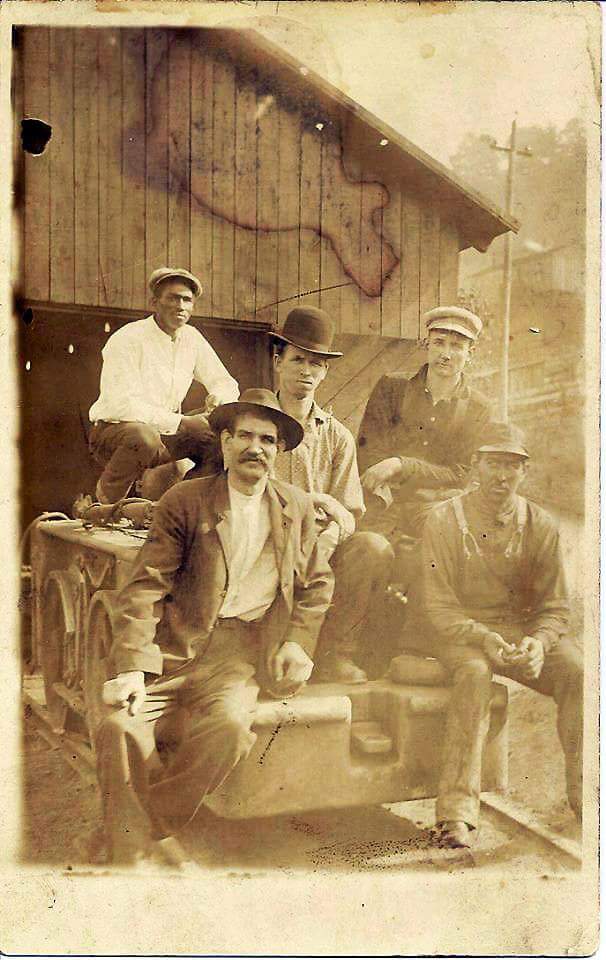
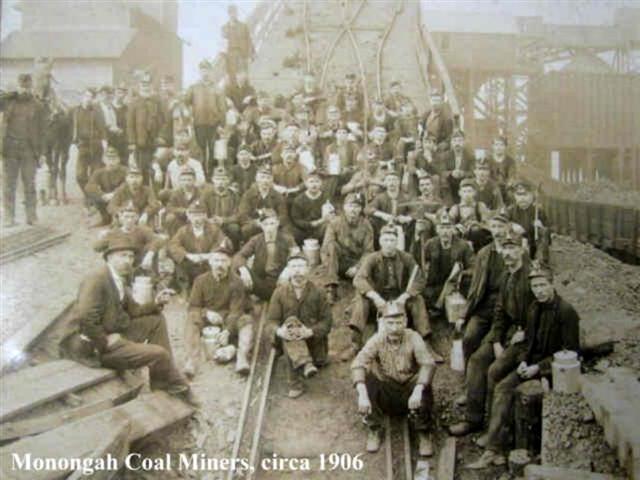
miners-monongah

~3:33-3:35 pm

Outside #8:

The rescuers have returned quickly from the supply house with armloads of rope and begin tying critical hitch and harness knots in one end to safely support the men who will be lowered down through the toad hole.

~ 3:40 – 3:45 pm

Inside #8:

The first rescuer, a long slender rail worker in the mines named Charlie “Skinny” McGraw, has been lowered over 100 feet before getting to the floor of the mine. He unties himself from the lowering lines so they can be raised back to the surface for the next man to follow down and help.

He follows the moans through the dark and soon finds the Urban brothers. Stan is lying face down in a puddle of water and Peter is sitting atop Stan’s back sobbing uncontrollably, simply staring ahead into the dark space with wide glassy eyes.

~3:45 – 3:50 pm

Inside #8:

The second rescuer, Tom Weeks, has been lowered into the room with McGraw and the Urbans. As they come upon Peter and Stan, Peter begins to shout at them and protect his nonresponsive brother. The Urbans are from Poland (their original last name is Rosebeiq) and, unfortunately, Stan knew more American English than Peter and neither of the two rescuers speak or understand Polish. (News, Ancestry, Inquiry, McAteer)

Absolutely crazed by the trauma, fear, and utter darkness he has endured for the past 5-6 hours, Peter begins to aggressively fight with McGraw and Weeks to keep them away from his brother. He shouts at them but they do not understand him and again try to grab Peter and force him away from his brother. A full-on struggle ensues.

~3:50-3:55 pm

Inside #8:

Weeks and McGraw have managed to wrangle Peter into submission. They tie him into the rope hitch and give a signal to the men on the surface to start pulling. The workers on the surface grapple with the line as Peter continues reaching and screaming for his brother on his way back up the 100’ ascent to the surface

As Tom Weeks keeps an eye on Peter from below, Charlie McGraw rushes back to check on Stan’s condition. Despite the severe head injury and 5 hours face down in a puddle, Stan is still breathing but barely hanging on to life.

~3:55 – 4:00 pm

Outside #8:

Several people grab a hold of Peter as he nears the surface and assist in pulling him out. They get him safely out of the hole, pull him away to solid ground and untie his rope when, again, Peter begins to fight off the rescuers around him. The rope is dropped back into the toad hole again as Peter continues to struggle against those trying to help him.

Inside #8:

McGraw and Weeks have moved Stan out of the puddle and closer to the toad hole. They begin to tie him into the rope harness, just as they did with Peter. Stan is still breathing but unconscious.

~4:00 – 4:10 pm

Inside #6:

“For fully two hours nothing but wreckage, such as blocks of coal mine timbers and machinery rewarded the search, but at 4 o’clock in mine No. 6, twenty bodies were found in a heap a short distance from the opening. These were not brought out at the time as the purpose of the searches was to find if any survived the awful disaster and to bring them out first.” (CDT 12.7.07 pg. 1)

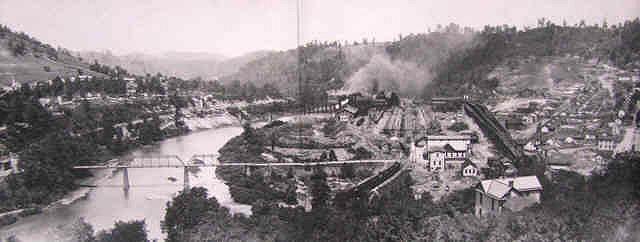
MT6

“Men who entered the mine say there are twenty dead men sitting on one bench, where they were awaiting their turns to take cars.” (TS 12.7.07 pg. 1)

Outside #8:

Peter Urban manages to break free from the rescuers. He tears through the crowd of onlookers, screaming and crying, sprints down the bank towards the river but crashes full-force into a fence. Rescuers follow and though Peter gives them quite the chase he begins to put up another brief fight as they catch up with him. Peter is simply too exhausted by this point and they manage to subdue him again with little issue.

Inside #8:

At some point during the ascent back to the surface, Stan Urban dies.

~4:10 – 4:15 pm

Outside #8:

Dr. F.W. Hill quickly looks over Peter Urban for any sign of significant injury or need for hospitalization. Though Peter is so distressed and upset that he can not even give the doctor his own name, Dr. Hill finds no reason to hospitalize him and sends Peter home to his family to rest.

At the toad hole, Stan is pulled out and taken to the side. Though he shows no signs of life, the warmth coming off his body gives them hope. Resuscitation is attempted but soon it is accepted that they are too late.

Stanislaus Urban is put onto a horse drawn cart, sent across the river to the morgue.

~4:30 pm

Word has already begun to spread through town and reaches #6 that at least one man has been found alive and rescued from #8.

MT39
Peter Urban
Outside #6:

Crowds swarm in the direction of #8. For some, especially many newspaper reporters who have arrived from out of town, this is the first notice they get that the #8 mine they have just submitted reports on isn’t actually #8 mine at all. Dozens of reporters who have been on or around the Iron Bridge all day have already gone to print and have mistakingly identifyied either #1 or #2 mine, which are across the river from #6, as being mine #8 simply because they can see smoke coming out of this mine from their vantage point.

Outside #8:

Despite the lack of ventilation and being driven out hours earlier by toxic gases, the discovery of Peter Urban alive and relatively well encourages another round of rescue crews to prepare to attempt another tour into #8. John C Thompson is in charge of one of those crews. (News, Inquiry)

Inside #6

By late afternoon, part of the broken trip that clogged the heading of mine #6 was removed and the entrance to the mine proper was clear enough to allow for the removal of bodies. “It was the blockade of broken cars that made it so difficult to get the work started.” (FWV 12.7.07 – pg. 1 – noon)

“The entry of No 6 mine, 300 feet from the mountain is piled high with wreckage of two strings of cars and two electric motors. Some of the rescuers have climbed over this and found dead bodies beyond, but have made no attempt to remove these to the surface, partly because it would be almost impossible to carry the bodies over the debris, but more particularly because they do not want to lose any time in reaching other sections of the mine where it is possible men still living may be imprisoned.” (ES 12.7.07 pg. 2)

~5:00 pm

At the mines:

By now, it has become very clear to the physicians and nurses who rushed to the scene that their services will not be needed. Some stay for the night to care for the rescue workers who are injured or overcome by the gases. Many leave on the 5 o’clock trolley car as a 3rd round of rescue crews gets organized.

~6:00 pm

In Monongah:

By this time, only Stan Urban has been recovered from the inside of #8 mine and arrangements are being made to begin bringing bodies out of #6.

Dr. Hill calls on Peter Urban at his house just to check on his condition. Peter can finally tell the doctor his name and now that Peter is around those who can understand him, he tells them that not far from where he and Stan were found, another man was also trapped but still alive.

A special train arrives on the main B&O line from Parkersburg and pulls into the center of Monongah carrying C.W. Watson, president of Consolidated Coal Company and its subsidiary Fairmont Coal Company, along with his private secretary.

ME56

In Fairmont and other cities around the country:

Newspapers are already publishing reports in their evening editions which have been circulating for about an hour now. Local papers from Monongah’s neighboring cities will put out several special extra additions over the next few days in an attempt to keep the local populace as updated as possible.

The Fairmont West Virginian publishes these headlines along with an article written by reporter L.M. Davis who was on the very first trolley to Monongah and got the opportunity to watch the action go down all day long and speak directly to some rescue workers like Fred Shaver.

12.6.07 - pg 1 - headline

They also publish a list of those “known” to be dead or injured based solely on what little information they have received from rescuers like Fred Shaver and officials who are simply too busy at the time to give in depth, detailed statements.

12.6.07 - pg 1 - Davis article - detail 2

In the next city south of Monongah, the Clarksburg Daily Telegram publishes slightly different information.

12.06.07 - pg 1 - headline


Unlike the Fairmont West Virginian, The Clarksburg Daily Telegram is not yet publishing personal reports from those directly on the scene, though they do include a small announcement that they have reporters on the scene and will put out a special evening edition with those updates. Rather, for this first printing they rely on an article created by the Associated Press after a candid conversation with an official from either the Consolidated Coal Company or Fairmont Coal Company, or possibly a combination of both.

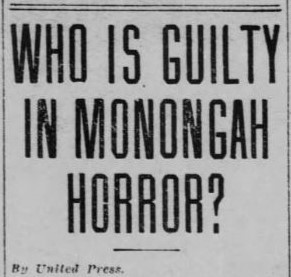
At this point in U.S. history, the Associated Press has a practical monopoly over the spread of news across the country and a majority of U.S. papers rely almost entirely on the Associated Press for national news at this time. To battle what many saw as a corrupt control of information, The United Press formed earlier in the year to challenge that hold. Over the next month they will both make drastic, lingering mistakes in the mad dash to be the first to publish the latest information to the country.

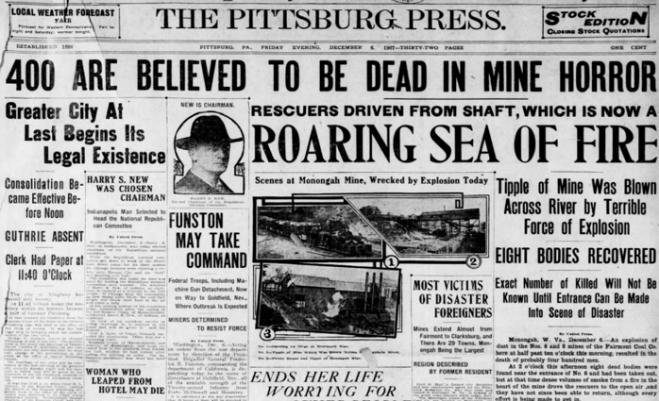
The Pittsburg Press is just one of the many papers that uses the United Press to collect their information. On the evening of Dec. 6, it publishes what will become one of the most notorious headlines associated with the disaster, some of the first photos of Monongah, and several articles detailing events that have taken place through the day.

Almost all of it is wrong.

Monongah-MnDs-HdLn-Ptt-Prs-Dec-6-1907

The Cumberland Evening Times in Maryland also uses the United Press as a primary source and reports that, “The accident happened in Monongahela mines Nos 6 and 8 and was caused by the fan house, which supplied the miners with air, failing to work.” They follow, “The mines were idle yesterday and that is why it is thought that the fans failed to work this morning.” They will also, unfortunately, report that “Over one hundred men are known to have escaped.” (CET 12.6.07 pg. 1)

~6:30 pm

In the Monongah offices:

C.W. Watson and several other company officials hold a meeting to bring the president up to date with events. Watson decides that, “the bodies of the miners, so far as could be reached should be taken out during the night.”  From here, Watson personally supervises all rescue work aided by General Manager Malone. (CDT 12.7.07 pg. 1)

At #8:

Word makes it back to #8 mine that Peter Urban has revealed that another man was still trapped in the mine, not far from where he and his brother were found.

General Manager Frank Haas is personally overseeing the rescue work at #8 but little progress has been made compared to #6. Nonetheless, rescue crews, again led by “Skinny” McGraw, reenter #8 through the toad hole. True to Peter’s word, 20-year-old Francisco Loria is found nearby, but it is too late.

Francisco will be the 5th body to enter the morgue.

At the mines:

By dusk, rescue crews are once again pushed out of the mines by gases but it is confirmed to those on the surface that there is no hope of finding any survivors inside of #6.

“Men and women who had congregated around the mine knelt down in the falling snow and prayed, offering a miner’s benediction.”

me6


Previous Post

Next Post


More on How Death Gloated!
Bibliography

Timeline

Disclaimer and Guide

Introduction

About the Author

Contact Information