

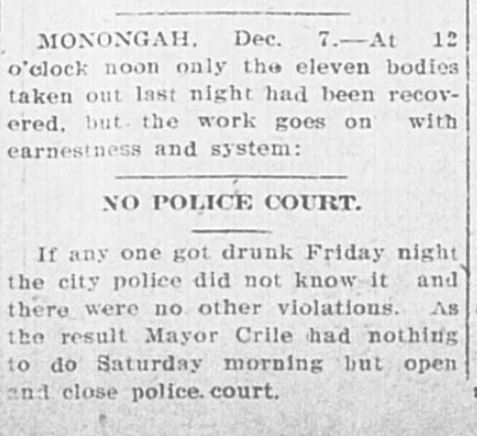
“Today it seemed like a continual procession of men carrying out corpses. The bringing up of each mangled form would be followed by a rush from women and men around the mines looking for their dead ones.” (TEP 12.7.07 pg. 1)
~6:00 pm
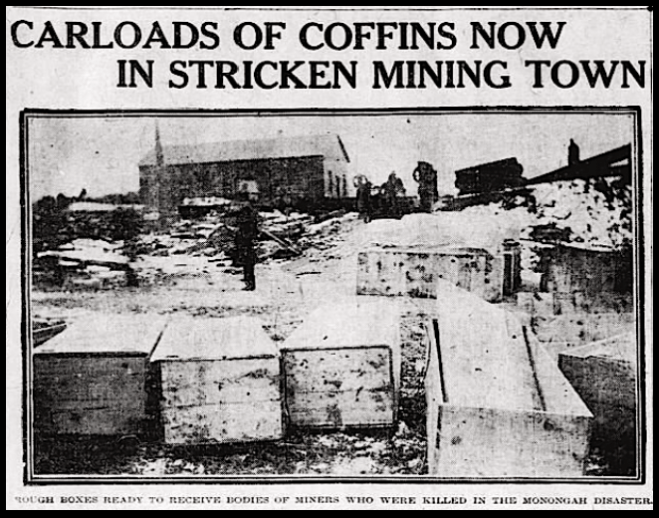
“All day long today little groups of men brought dead bodies from the mines…” (TEP 12.7.07 pg. 1)
“Five additional bodies were taken out of the mine at 6 o’clock tonight, making twenty up to date.” (WH 12.8.07 pg. 1)
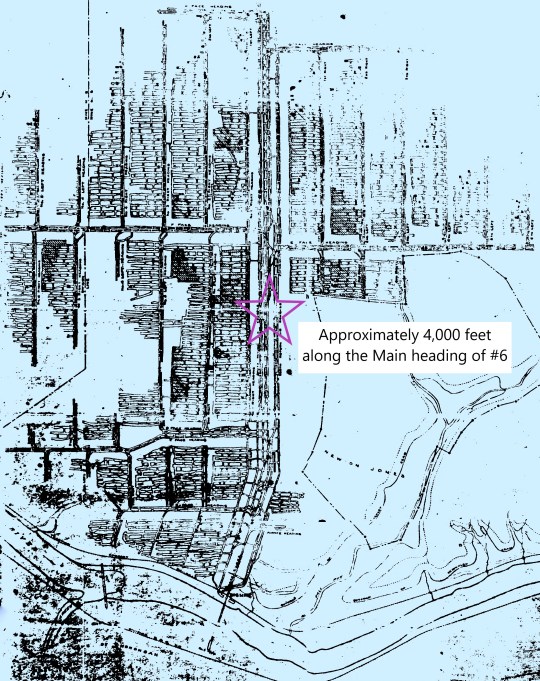
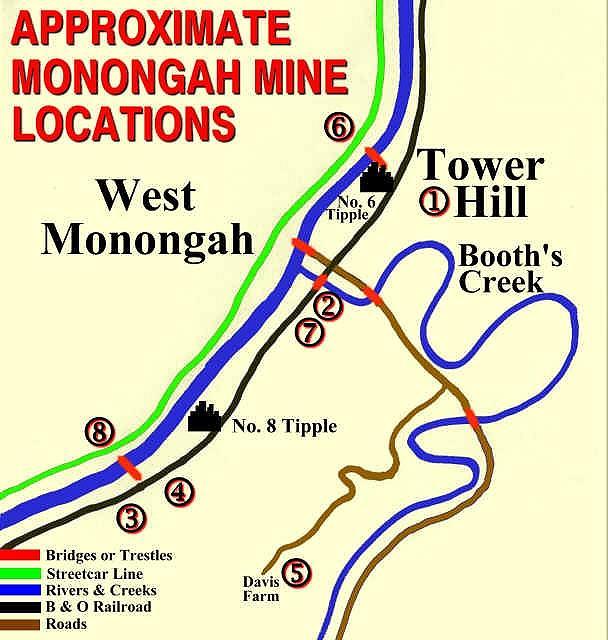
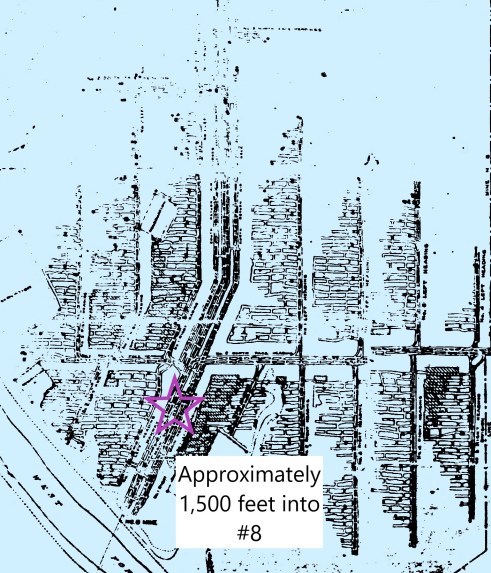
“The rescuers say they have about seventy others in sight, which they will bring out within the next few hours. All of these are in No. 6 and so far, nothing has been done toward recovering the dead in No. 8, where the gases are strongest.” (WH 12.8.07 pg. 1)
“The fumes from the explosion and decomposition of bodies has greatly hampered the work.” (WT 12.7.07 pg. 1)
“…the shafts and tunnels are still filled with smoke and gas.” (WT 12.7.07 pg. 1)
“Although there are great crowds about the mine entrance there are innumerable women and children crouching in modest homes awaiting what they know must come—the blackened remains of a husband, of a father, of a brother.” (WT 12.7.07 pg. 1)
Governor Dawson has arrived in Charleston from Washington D.C. (FWV 12.7.07 – pg.1)
Newspapers
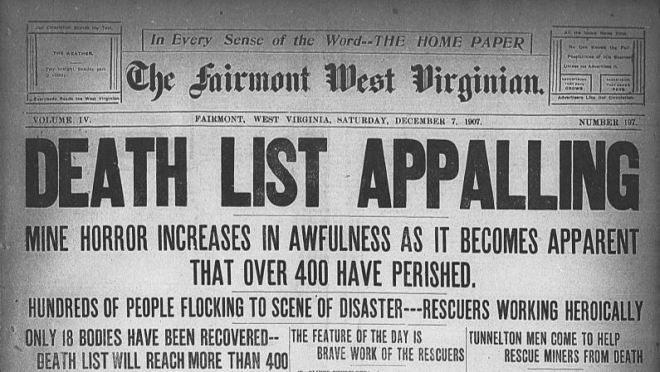
The Ladies’ Auxiliary of Christ Protestant Episcopal Church is the first social organization in city to offer financial aid. They announce that they will be giving proceeds from their musical planned for Dec. 11 to the Monongah relief aid. (McAteer)

The paper also informs the Fairmont populace of just a few miners who regularly traveled from Clarksburg to work in the mines.
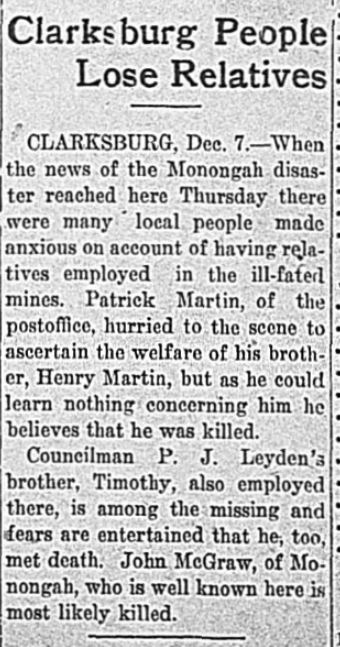
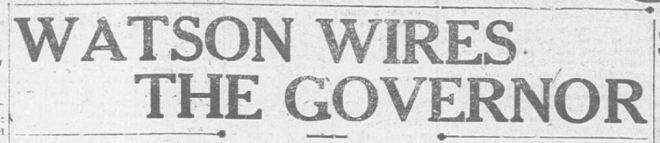
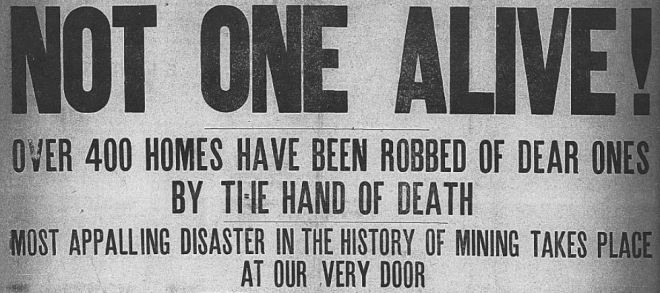
The Clarksburg Daily Telegram startles the public with its evening headline:


“President C.W. Watson in a brief interview stated that he had nothing definite to give out as to the cause, but from the small amount of smoke, he judged it was caused by dust, which ignited from a small pocket of gas, or a blown out shot.” (CDT 12.7.07 pg. 1)
“Mr. Watson explained that the two mines were connected for the purpose of giving more openings.” (CDT 12.7.07 pg. 1)
“General Manager Lee Malone of the Fairmont Coal Company in an interview at the scene of the horror, given to the Telegram representative, stated that there were 450 men in the mine at the time of the explosions and that he was of the firm belief that all were dead.” “He pointed out that there was nothing particularly strange about there being an explosion in both mines at once, one immediately after the other, as the two mines are on the same side of the river instead of opposite side, as first reported,…” (CDT 12.7.07 pg. 1)
They report that on the 6th: “George Bice, a member of the rescue party at mine No 8 was overcome by the afterdamp, brought to the surface unconscious and died shortly afterward.” And that, “A man named Stuart of the rescue party was also overcome by the afterdamp. He was brought above unconscious but soon revived and will doubtless recover.” (CDT 12.7.07 pg. 1)
Luckily, the George Bice did not die. In fact, he may have never been overcome with gas at all. There were, however, 3 men among the rescue crews who will die in the process, more than likely from inhaling too many toxic fumes: John Neary, and brothers Maurice and Richard Beedle.
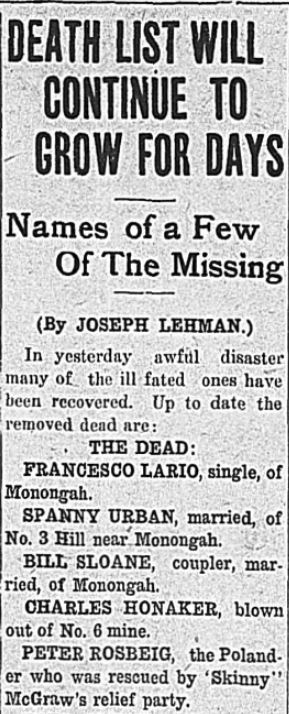
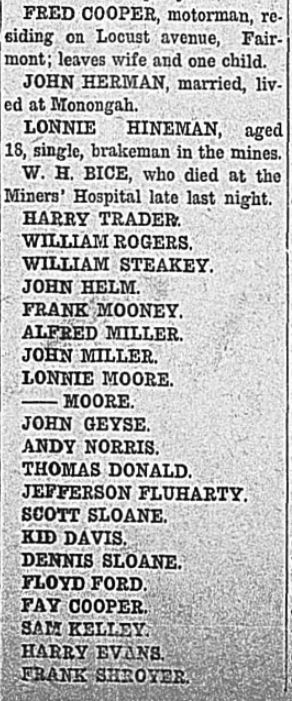
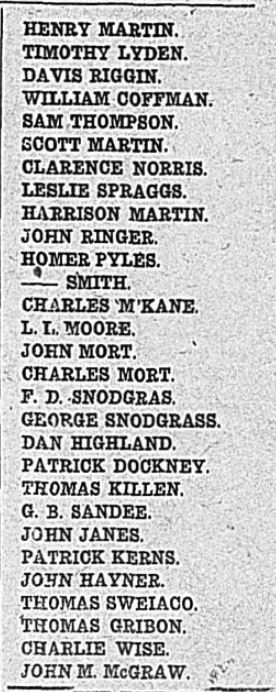
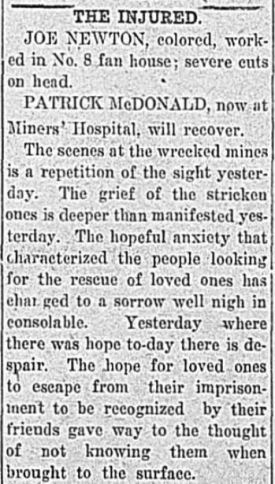
When it comes to publishing the names of the dead, the Telegram focuses entirely on the names of known Americans.
The D.C. Evening Star publishes a list of just the West Virginia Mine Disasters of 1907.
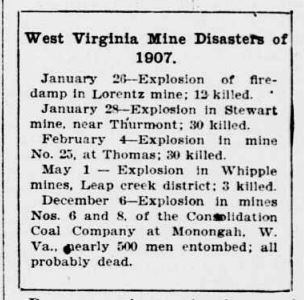
The Rock Island Argus of Illinois published a list of all mining disasters in 1907:
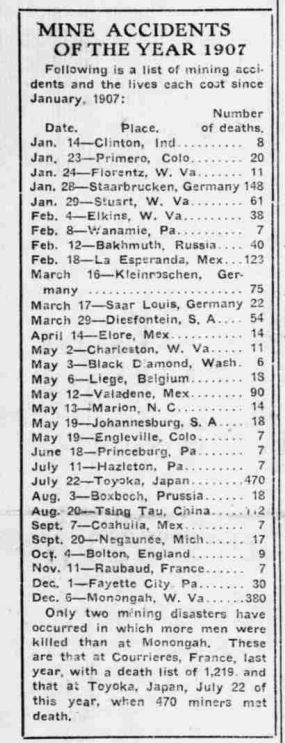
In Iowa, the Evening Times Republican informs their readers that:
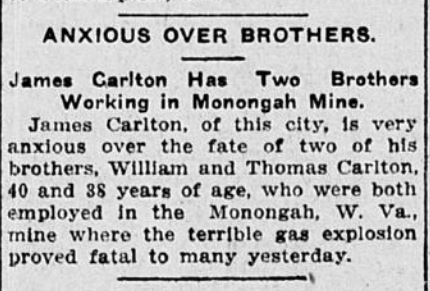
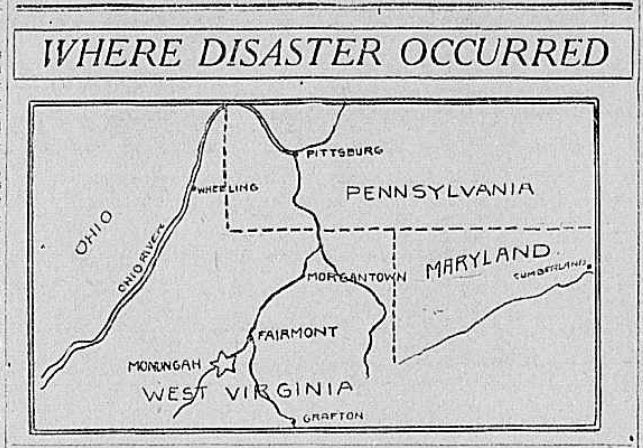
The Times Dispatch in Virginia publishes a (very) rough map of where Monongah lies in the state:
The Cumberland Evening Times is already trying to clear up confusion and rumors:
“The terrible mine disaster at Fairmont, W.Va., caused unusual excitement up along the George’s Creek region, due to the fact that a number of miners in that section had sought employment in the West Virginia territory.” (CET 12.7.07 pg. 1)
“At this writing, however, but one miner from this county is known to have been killed by the explosion. He was John Herman, who resided at Eckhart until about two years ago, when he removed to Fairmont, and was employed in mine No. 8 when the explosion occurred.” (CET 12.7.07 pg. 1)
“A sister of the unfortunate man, living at Eckhart, was notified by wire yesterday afternoon that her brother had been killed and last evening three other brothers, John, Jacob and Frank Herman, all of whom live at Eckhart, went to Fairmont to recover the body.” (CET 12.7.07 pg. 1)
“The deceased was 37 years of age, and leaves a wife and one child.” (CET 12.7.07 pg. 1)
“Joseph Milkowsy, another miner formerly residing at Eckhart, is also employed at one of the mines at Fairmont, but whether he was one of the victims of the terrible disaster could not be learned.” (CET 12.7.07 pg. 1)
They also report that, “Messrs. Philip Jenkins, Sr., Philip Jenkins, Jr., Edward Jenkins, E.T. Thomas, William Hensell, Alex Crawford, and Andrew Crawford, left today for Fairmont, W.Va., to assist in the work of rescuing the miners who were killed in the mine disaster at Fairmont yesterday.” (CET 12.7.07 pg. 1)
“The above relief corps will remain at the scene of the horrible calamity until the last victim has been taken out of the mines.” (CET 12.7.07 pg. 1)
“This action on the part of the Frostburg contingent is purely for sympathy’s sake.” (CET 12.7.07 pg. 1)
Like several other papers, The Buffalo Enquirer of New York is not only reporting that, at noon, workers are still battling the early morning fire from #8, they are already telling their populace, “Yesterday the company officials endeavored to keep the number of men in the ill-fated mine down as much as possible.” (TBE 12.7.07 pg. 1)
The Evening Star in Washington D.C. reports:
“It is thought that by tonight the full extent of the horror will be known, and it is feared the knowledge of this will precipitate even more pitiful scenes than those of today, with hysteria in all of its devious forms rampant among the populace. Precautions have already been taken to prevent these harrowing manifestations of grief, but there is little hope that they will avail.” (ES 12.7.07 pg. 1 – 2)
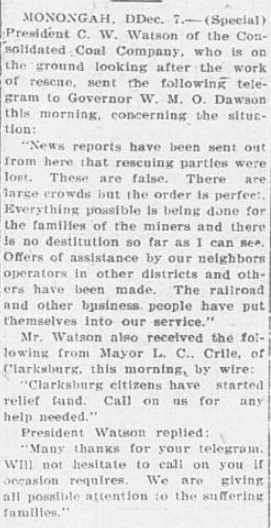
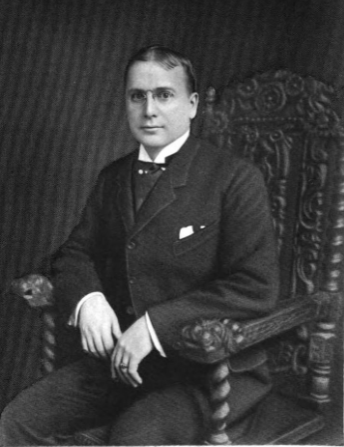
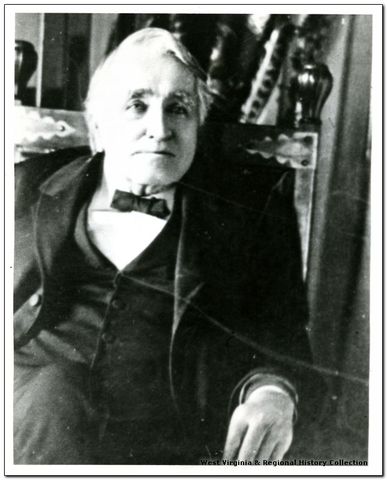
C.W. Watson, president of the Consolidation Coal Company, dictated the following statement to the Associated Press:
“The accident is deplorable from any standpoint. It was entirely unexpected. As yet we do not know the exact cause of the explosion.
“It might have resulted from a blown out shot igniting a pocket of gas. About 50 per cent of the mine accidents of the country are caused in this manner. It is probable the present one resulted from the same cause. We will conduct a rigid investigation. Investigations, however, will not benefit the dead miners. Their families will be looked after. The company will bury all the dead. Every facility within the power of the company is being extended to all newspapermen in order that the general public may be accurately informed as to the disaster. We have nothing to conceal and are pleased to give whatever information we can.” (ES 12.7.07 pg. 2)
~6:30 pm
In Monongah:
“Up to 6:30 o’clock tonight twenty-two bodies had been brought to the surface from mines Nos. 6 and 8… Over 100 bodies have been found.” (ODB 12.8.07 pg. 1)
“President C.W. Watson of the mining company in a statement to the Associated Press today said every possible investigation would be made of the disaster to ascertain its cause and fix responsibility.” (ODB 12.8.07 pg. 1)
More on How Death Gloated!



 The Monongah Disaster