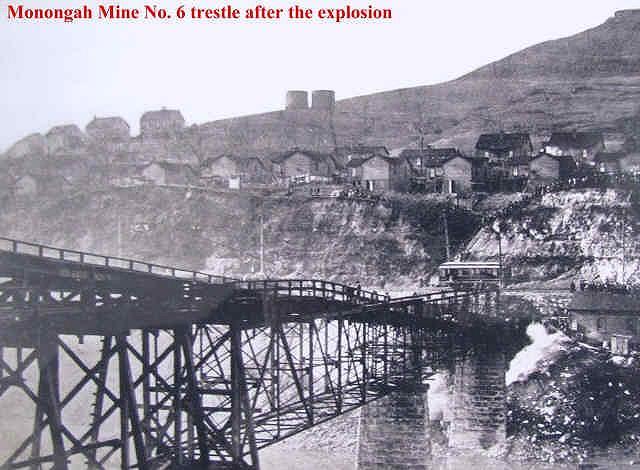
Tuesday, December 10, 1907, Afternoon & News Hour

“The moment it is announced in town that bodies have been brought from the mines there is a renewed stir of expectancy and anxiety until the bodies have been viewed in the bank building. Relatives and friends press forward to get the first glimpse of the features of the dead, eye them closely and turn away in deeper sadness and depression, if they recognize them not. Recognition is followed by outburst of grief and distraction, which with some impends upon the very brink of insanity.”  (CDT 12.10.07 pg. 1)

~12:00 pm

At the mines:

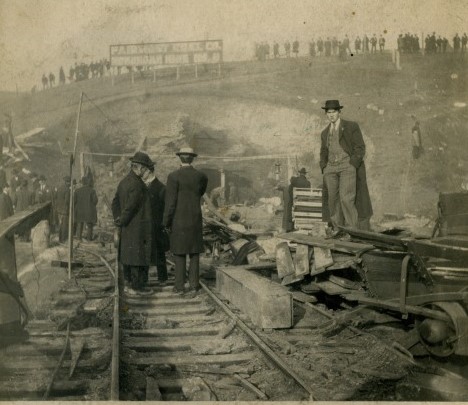
“At noon today the bodies of 146 of the men…had been taken out and it was said at that time that by the night a majority of those not buried under the debris would be removed.” (TMDM 12.10.07 pg. 1)

Snow and sleet fall all day long and “…miserable conditions prevail throughout this section.” (CDT 12.10.07 pg. 1)

“Rescuing parties are able today to reach all parts of the mine.” (TMDM 12.10.07 pg. 1)

“The work of rescue is being pushed along rapidly and by night it is expected most of the bodies will have been taken out.” (CDT 12.10.07 pg. 1)

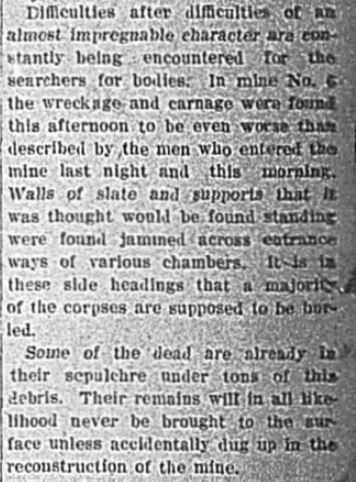
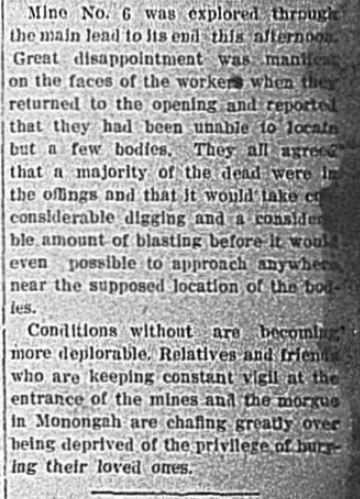
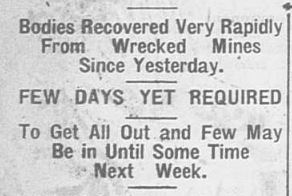
“At noon today the company announced that at least three or four more days would be required to get all the bodies out, unless the work of recovery becomes still more rapid. There is every reason to believe that the bodies will be taken out even faster as all the brattices have now been installed and the air currents amply furnish opportunity to get into all the side headings and rooms.” (CDT 12.10.07 pg. 1)

“The wide scope of territory to be searched, however, will prolong the search even beyond the next three or four days and the same may even extend into next week for scattering bodies.” (CDT 12.10.07 pg. 1)

Floyd Parsons leaves Grafton to return to Monongah “where he will continue his investigation until tonight, and he will then go to Pittsburg.” (FWV 12.10.07 pg. 2)

During the Afternoon

At the mines:

“…rescuers…in a sorry plight this afternoon. In a driving rain, which is more unpleasant and discouraging even than last night, the workers are, nevertheless, able to do more than yesterday as the smoldering fires have practically been put out…” (PP 12.10.07 pg. 1)

“One young woman on Tuesday viewed the charred remains of the man she was to marry that day as they were brought from the fatal hill.” (FWV 12.12.07 pg. )

In Monongah:

The Union Relief Association completes its own survey of the community.

“A canvas by women workers of Fairmont, completed today, develops the fact that practically 100 women who were made widows…are soon to be mothers. As a consequence of the fearful strain of the past few days, at least 20 of these women are seriously ill. 10 of the babies are said to have died unborn and into 30 or 40 of the little cottages physicians have been called within the last 24 hours. Four of the afflicted widows are at the point of death today…48 of the men killed were widowers with small children. There are 19 brides of 3 months. This feature of the disaster appealed to the women of Fairmont, who organized yesterday for relief. They called it the ‘Mother’s Work’ and enlisted the sympathies of woman friends and relatives in Fairmont and nearby towns. Some of the prominent women, known throughout this section of the state, volunteered to assist financially at least, personally if possible.” (RP 12.10.07 pg. 1)

“A count by the women has said to have developed nearly 900 fatherless children.” (RP 12.10.07 pg. 1)

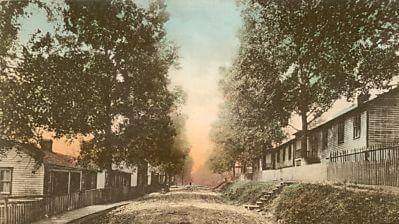
Out of 30 houses on Camden Ave., 27 didn’t have a man left in them.

“Deeper and more hopeless depression now seems to have seized the town of Monongah.” (TMDM 12.10.07 pg. 1)

The Monongah Verdi Brass Band suffers greatest loss from the disaster. “This was a very proficient musical organization of the mining town and had gained a reputation for the discoursing of high-grade music.”  (FWV 12.10.07 pg. 6)

Professor Verdi disbands the group and will be returning to Italy. (McAteer)

“Undertaker R.C. Jones came down from Monongah today to attend to business matters. Mr Jones stated that he had found it necessary to send for three extra men to aid in the embalming the bodies from the Monongah mine. Two men are expected from Wheeling and one from Parkersburg.” (FWV 12.10.07 pg. 5)

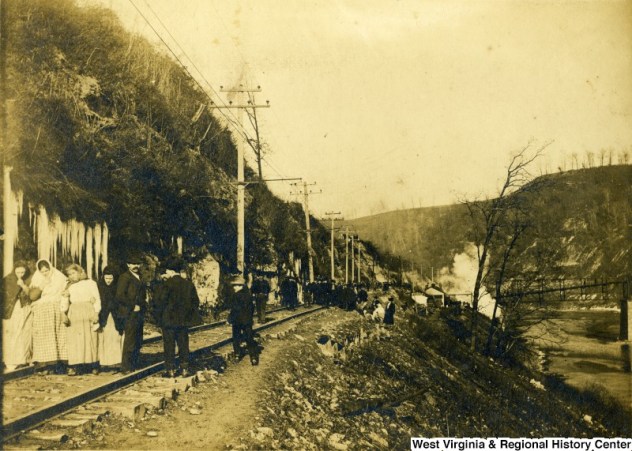
“Many bodies are being buried direct from the mine entrance, while others were buried yesterday either from the residences or from Catholic churches.” (TMDM 12.10.07 pg. 1)

~3:30 pm

“Up to press time there were no official statements given out. The search work is being done with all possible dispatch. There is no one in destitution. All are being cared for and the relief organizations are doing effective work.” (FWV 12.10.09 pg. 1)

“Special guards are still on duty, while physicians under the direction of the Marion County Guards are looking after the injured.” (WT 12.10.07 pg. 11)

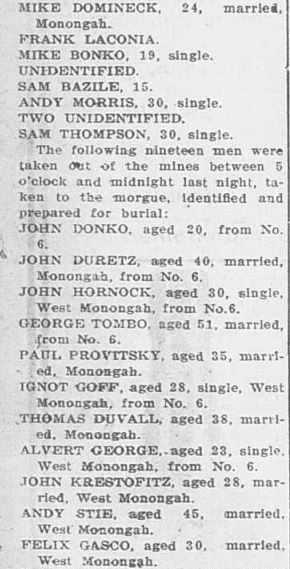
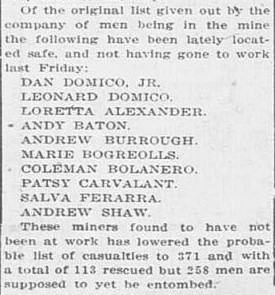
“There is not much change in the situation at Monongah today except that the mines are yielding up more of their dead. Of the 114 bodies that had been found up to 3:30 today, 13 bodies were unidentified, having nothing on them to indicate who they were.” (FWV 12.10.07 pg. 1)

“The work of relief is becoming better systemized and is performed with much more ease on account of the crowds of curious having departed.” (WT 12.10.07 pg. 11)

~6:00 pm

Newspapers

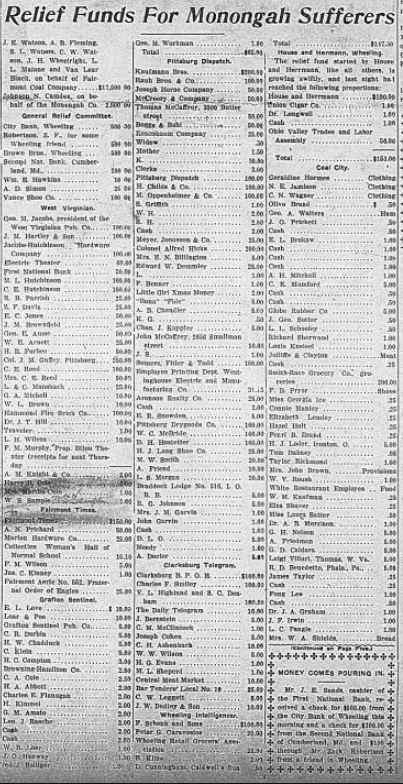
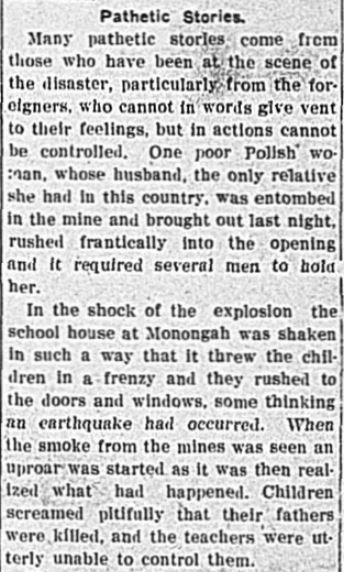
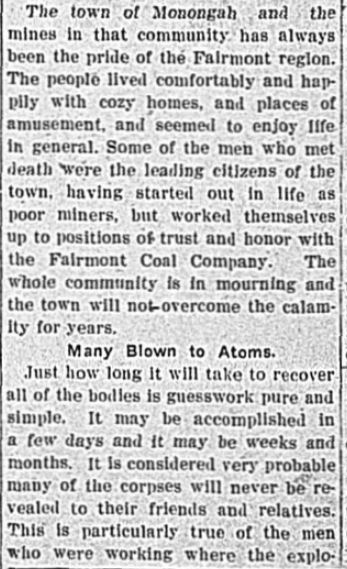
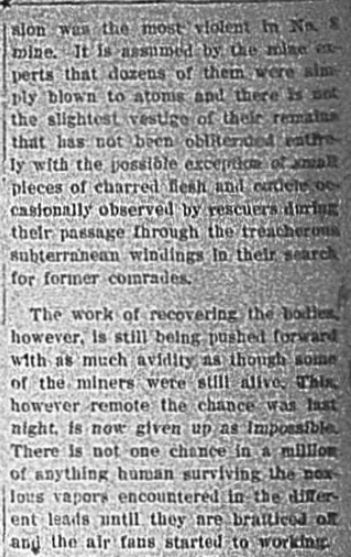
The Fairmont West Virginian publishes a list those who have already contributed to the various relief funds and a rather unclear picture of #8 on the first page:12.10.07 - pg 1 - photo
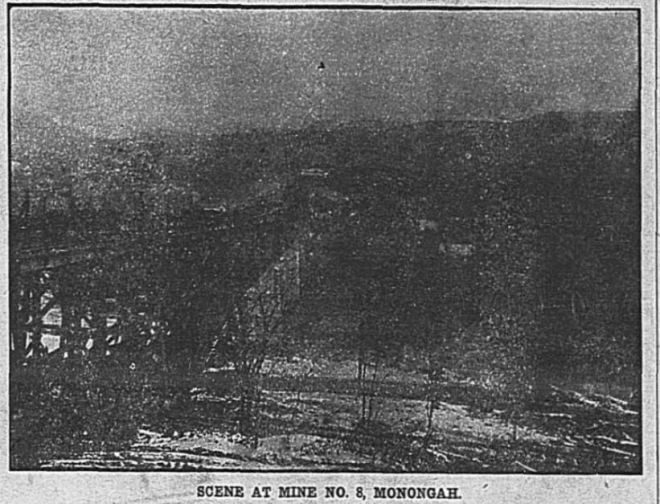
12.10.07 - pg 1 - relief funds

Floyd Parsons publishes his theories in FWV and Grafton papers. (FWV 12.10.07 pg. 2)

C.W. Watson’s theory is also published. It is apparent he wrote it over the course of a few days and that Watson is utterly exhausted and overwhelmed. (FWV 12.10.07 pg. 7)
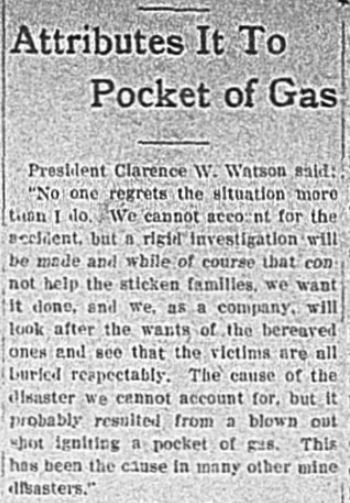
12.10.07 - pg 7 - CW Watsons theory 1

12.10.07 - pg 7 - CW Watsons theory 212.10.07 - pg 7 - CW Watsons theory 312.10.07 - pg 7 - CW Watsons theory 412.10.07 - pg 7 - CW Watsons theory 512.10.07 - pg 7 - CW Watsons theory 612.10.07 - pg 7 - CW Watsons theory 712.10.07 - pg 7 - CW Watsons theory 8

Clarksburg Daily Telegram:
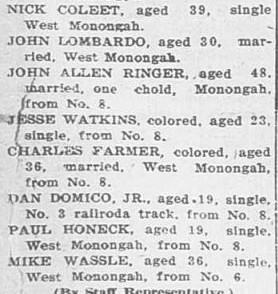
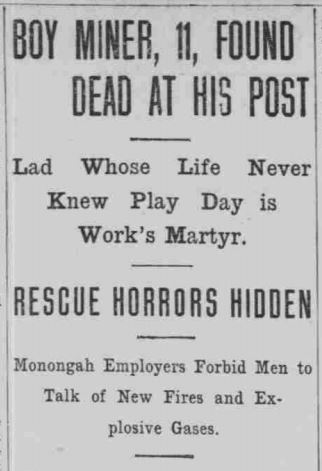
12.10.07 - pg 1 - headline

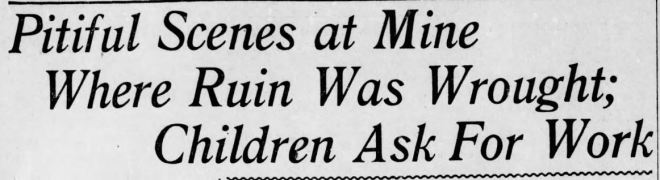
12.10.07 - pg 1 - sub headline 2

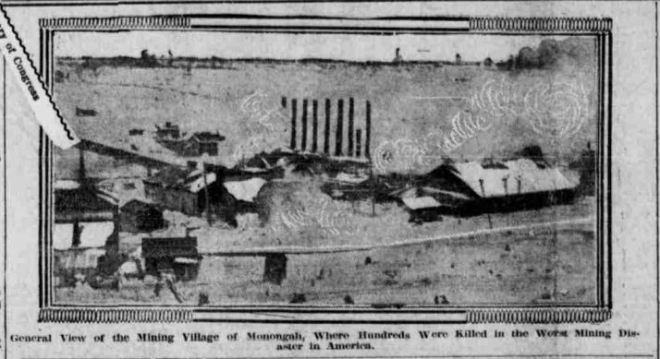
CDT 12.10.07 - pg 1 - Monongah 112.10.07 - pg 1 - Monongah 2CDT 12.10.07 - pg 1 - Monongah 3


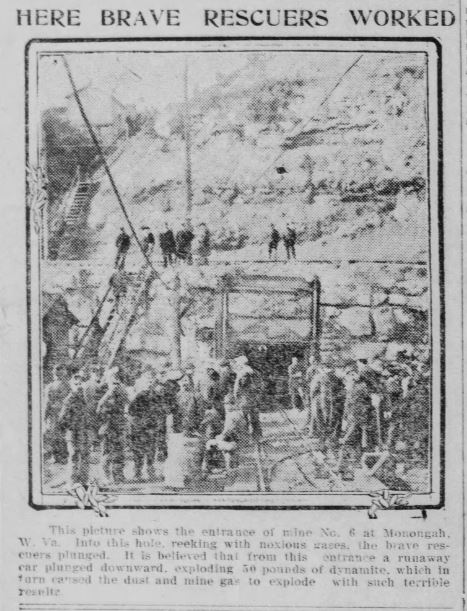
CDT 12.10.07 - pg 1 - Monongah 6

CDT 12.10.07 - pg 7 - Monongah 2

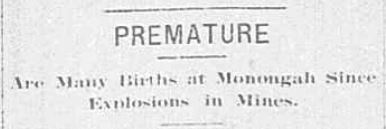
“Among the bad effects of the terrible mine disaster is the continuance of premature births. It is estimated that there has been more than forty of these since last Friday morning, when the explosion occurred. In some instances, the mothers have died.” (CDT 12.10.07 pg. 7)

Waterbury Evening Democrat:

“Chief State Mine Inspector J. W. Paul is quoted as saying he believes the explosion was started by an electric spark from runaway cars in the main entry. A string of these cars was piled up in the entry at the bottom of a slope.” (WED 12.10.07 pg. 1)

The Pittsburg Press:
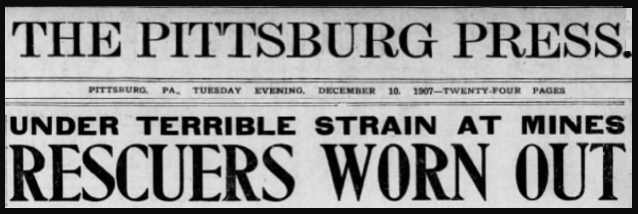
Monongah-MnDs-Rescuers-Worn-Out-Ptt-Prs-Dec-10-1907

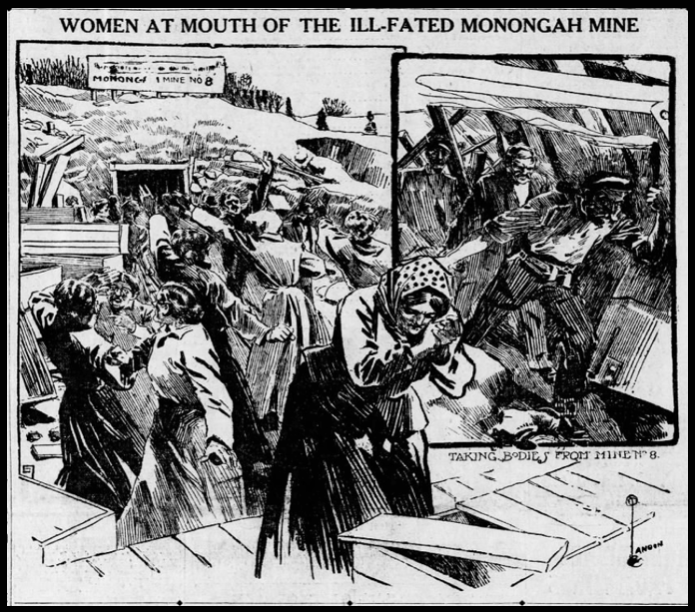
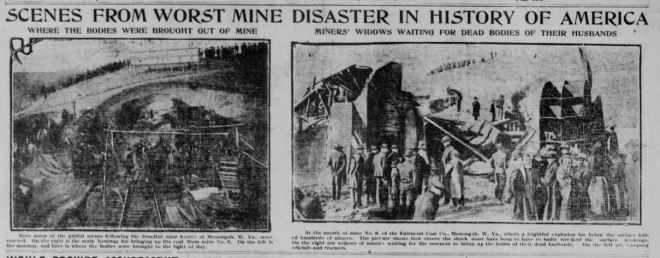
Monongah-MnDs-Women-at-Mouth-of-Mine-Ptt-Prs-Dec-10-1907

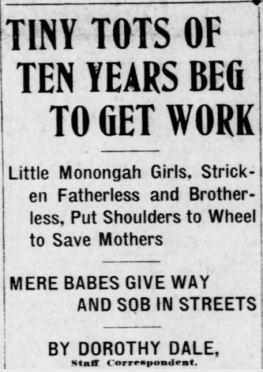
Monongah-MnDs-Tots-Beg-for-Work-Ptt-Prs-Dec-10-1907

The D.C. Evening Star:

12.10.07 - pg 1 - Monongah 1

“Many of the rescuers have been stricken with illness and it was found necessary to bring a number of recruits here from the George Creek district.” (ES 12.10.07 pg. 1)

12.10.07 - pg 1 - Monongah 5

“…considerable suffering is likely to occur during the winter months and for such a contingency assistance should be available. Mayor W.H. Moore of Monongah has telegraphed to the headquarters of the organization here that contributions would be gratefully received.” (ES 12.10.07 pg. 1)

The Evening Journal in Deleware:

“During the great anthracite coal strike of 1903, George Baer, president of the Reading Railroad Company, said there were no particular dangers attached to the mining of coal. As a matter of course he gave out this piece of information to offset the claim of the miners, and when he uttered the words he either falsified or exhibited his ignorance. The terrible calamity at Monongah, West Virginia, is the answer to his statement. How long will God’s children permit such men as George Baer to fool them is the question I would like someone to answer. Sincerely yours, William John Hogan. Wilmington, December 8” (EJ 12.10.07 pg. 4)

The Hawaiian Star, page 3:
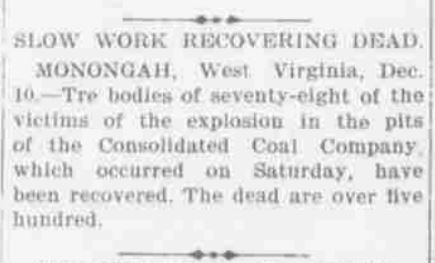
12.10.07 - pg 3 - Monongah

Lake County Times in Indiana prints:

12.10.07 - pg 8 - Monongah 1

“The coal company officials have adopted a scheme of news suppression. The men in the rescue shifts were given explicit orders not to talk to any outsiders, and the policemen around the temporary morgue were told to allow no newspaper men to enter. The explosion, therefore, takes on a propriety air—it belongs exclusively to the Fairmont Coal Company.” (LCT 12.10.07 pg. 8)

“There is no doubt that there is a serious fire in No. 8 and that the work of rescue in that mine has been hampered. The smoke of it was visible over the mouth of the shaft on Sunday and all miners were ordered out.” (LCT 12.10.07 pg. 8)

“The people were driven away from the mouth of the mines by the authorities because they feared another explosion. The miners themselves confessed that the smoke inside the shaft was practically unbearable.” (LCT 12.10.07 pg. 8)

“’I don’t know why they should deny it,’ said one of the miners this morning. ‘It does not do any harm and we have it under control right now. Neither do I understand why they will not allow us to take the bodies out as fast as we find them. Yesterday we found and dug out thirty bodies. We placed them all in a row, according to the company’s orders. Then the fire drove us out and the bodies are there yet. Many of them are so torn up that they cannot be recognized. But I’m pretty sure I recognized Tom Duval and John Bloner. Somebody else said that Nick Sandy was there, too, but I did not see anything that looked like him. Several of the ones we dug out were trapper boys.’” (LCT 12.10.07 pg. 8)

Albuquerque Citizen publishes 2 pictures:
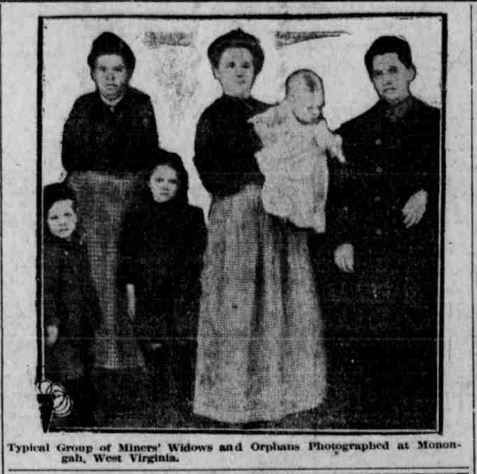
12.10.07 - pg 1 - Monongah 112.10.07 - pg 1 - Monongah 2

“Who is guilty? Is a question newspaper men and others are asking. The only answer obtainable is the echo, ‘guilty’.” (AC 12.10.07 pg. 1)

“Theory follows theory regarding the cause.” (AC 12.10.07 pg. 1)

“A possible explanation which old miners give is that a string of coal cars, breaking loose, plunged down the tunnel and probably crashed into a lot of dynamite, which is taken into the mines in 50-pound lots. This, it is thought, caused an explosion which in turn exploded the first collection of deadly coal dust, wrecking both mines.” (AC 12.10.07 pg. 1)

“Another story, and one that is given credence despite the fact that every effort to hush it has been made, is that a connection was made between the two mines, and that the gases rushing together exploded.” (AC 12.10.07 pg. 1)

“This is West Virginia’s fourth mine horror in 10 months and the governor has promised swift punishment if negligence has been shown.” (AC 12.10.07 pg. 1)

“A New York correspondent, who was hurried to the scene of the recent big disaster by his paper, wrote a short description—a word picture of the flight of the women and children left to shift for themselves by the sudden taking off of their husbands and fathers and sons and brothers.” (AC 12.10.07 pg. 4)

“The men who died in the mine met a merciful fate as compared to the ones they left behind.” (AC 12.10.07 pg. 4)

“A flash and it was all over, so far as they were concerned. They were stricken down in nearly every instance without a minute’s warning and with no time in which to suffer.” (AC 12.10.07 pg. 4)

“But up above, in the little mining town, were women and children whose sufferings will only be cured by time.” (AC 12.10.07 pg. 4)

“Writing of these—the ones who bore real suffering, the New York correspondent in his paper said:

‘The tragedy of the wives, mothers, the sisters and sweethearts of the victims of this awful mine horror is the tragedy of the mine women the world over.

‘Her whole life is one of apprehension. And when at last the blow falls, her lot is to wait and suffer, to hope against hope, to meet the worst with such courage as God has given her, to take up the miserable battle of life again single handed and to retain her faith in Omnipotence if she may.

‘There is a grewsome sameness in these mine horrors which differ only in detail, the number of dead, the periods of heart wringing uncertainty, the waiting women must endure, the pitiable harvest of widows and orphans that is left. There is always the same agonizing despair, the same utter hopelessness.

‘The surmounting of it all centers about the newly made orphans who do not understand. They follow their mothers to the pit mouth, where the rope cordon keeps back the swaying crowd and upon the strange shifting scene of woe with inexplicable tearless wonder written in every line of their little faces. Perhaps it is their common fate in the years to come, but mercifully they do not know.

‘For hours, long, agonizing, almost never-ending hours, the women weep and wait before the first return party of rescuers, smoke-blackened and dirt-begrimed, emerges from the yawning mouth of this subterranean hell. The first revolution of the throbbing engine starts a quiver of alternating hope and fear in every heart, there is the distracted babble of many tongues, but above and over and through it all the woman’s cry of heartbreak.

‘Perhaps they bring only a comrade who has been overcome by the dread black damp in his heroic effort to rescue. Mayhap they bring a body, burned and blackened, the arms crooked over the scorched, coal-pitted face in a last pitiable effort at protection. Be it the one or the other, the first sight of the inanimate body opens the long pent-up floodgate of that awful terror which has held them in its thrall. Here is all the horror of the inferno itself; here seems the concentrated agony of the universe.

‘And so it is until the bodies are all removed. Perhaps some are still missing after a week, but haunting the pit-mouth, even as the myriad tolling of the bells tells its own mute story, are the women of the dead, faithful to the last, waiting and weeping and suffering as is their fate.

‘And the real tragedy of it all is only begun. The woman has lived and obeyed and suffered. Now does her real trials begin. She has children, perhaps; boys big enough to be door-tenders and oilers, who to help her in her fight to keep the wolf from the door, must go into the pit where their father went down to death. If there be babies, only so much the worse.” (AC 12.10.07 pg. 4)

The Stark County Democrat in Ohio attempts to correct rumors:
12.10.07 - pg 1 - Monongah 112.10.07 - pg 1 - Monongah 2

“The force of the explosion was awful. Fifty bodies, at least, have been blown to atoms. One motorman had his head cut off at the neck.”

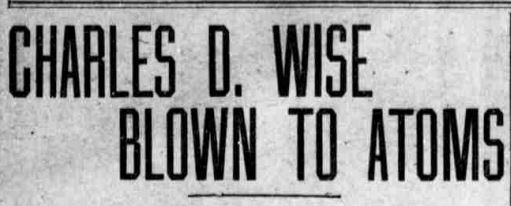
“Charles D. Wise’s body was blown to atoms. His overcoat and shoes alone were recovered. Wise represented Senator J.N. Camden of Parkersburg, who owned the mines, and the Fairmont coal company paid him five cents a thousand royalty as the coal was mined.” (SCD 12.10.07 pg. 1)

“Advices from Monongah, W. Va., last night were to the effect that the body of Charles Wise, civil engineer and brother of Lorin C Wise, the local attorney, had not been removed from the mine in which he was making an inspection at the time of his supposed death. There were contradictory reports out, some to the effect that the body had been found and others that it had not. The latter statement proved to be the truth.” (SCD 12.10.07 pg. 1)

“Attorney Wise left for Monongah the night he heard of the mine accident and of his brother’s probable death. Since that time numerous messages have been received from him.” (SCD 12.10.07 pg. 1)

“At the mine, waiting for the searchers to find the engineer, either dead or alive, are, besides Attorney Wise, the wife and two children of the missing man. The wife had not given up hope of her husband’s safety yesterday afternoon and had their home prepared for his coming. She said, however, that if he is found dead she wants the body taken home as soon as [text missing] where the funeral will be held is not yet known but it is thought it will be in West Virginia at the home of the engineer.” (SCD 12.10.07 pg. 1)

The Salt Lake Herald:

12.10.07 - pg 4 - Mononah 1

“The hearts of the people of Utah will go out to the stricken ones, for the disaster of May 1, 1900, at Scofield, is still fresh in the minds of this people. And there is a striking similarity in the causes.” (SLH 12.10.07 pg. 4)

“The Scofield catastrophe was caused by an explosion of coal dust. That at Monongah seems to have come from the same cause.” (SLH 12.10.07 pg. 4)

“The great different between the two is in the rescuing of the bodies of the unfortunates who lost their lives. At Scofield, where 299 perished, it was possible to go into the mine almost immediately. At Monongah the deadly after-damp is seriously hampering the work of the rescuers. It is in connection with this rescue work that a bright light is cast over the gloom.” (SLH 12.10.07 pg. 4)

“According to the dispatches the men who form the rescue parties, though thoroughly cognizant of the danger of suffocation, are valiantly battling to bring forth the bodies of their comrades. There has been no hesitation, no halting, no falling back. Ten men are said to be dying as a result of their attempts at rescuing bodies. Every one, if he lives, should be given a medal for bravery and the families of those that die should be cared for.” (SLH 12.10.07 pg. 4)

“Another bright feature of these situation is the prompt relief that is being given to the families of the men who were lost. Every case of distress and there must have been many, have been relieved, and all that is humanly possible is being done for the afflicted. This was done also in Utah. The public remembers that we took care of our own without help from outside sources.” (SLH 12.10.07 pg. 4)

“There will be time enough later for investigations with a view to fixing the responsibility for the disaster. And, if the responsibility can be fixed, the guilty party should be made to suffer the extreme penalty of the law.” (SLH 12.10.07 pg. 4)

Times Dispatch in Virginia:

12.10.07 - pg 6 - Monongah 1

“It is distressing beyond the power of words to express that several hundred men who had the hardihood and industry to dig the coal from the bowels of the earth for the world’s benefit should have been caught in the mine, like so many rats in a hole, and smothered to death.” (TD 12.10.07 pg. 6)

“There is necessarily some risk in mining, but the public and the legislative bodies should demand that this risk be reduced to the minimum by the use of scientific agencies of prevention.” (TD 12.10.07 pg. 6)

The Evansville Press in Indiana:
12.10.07 - pg 1 - Monongah 2

12.10.07 - pg 3 - Monongah

Lincoln Journal Star in Nebraska:

12.10.07 - pg 1 - Monongah 1

New Castle Herald in Pennsylvania:

12.10.07 - pg 1 - Monongah 112.10.07 - pg 1 - Monongah 2


More on How Death Gloated!
Bibliography

Disclaimer and Guide

Introduction

About the Author

Contact Information

Saturday, December 7, 1907, Late Night 10:00 pm – Midnight

 “Mining experts pronounce the rescue work in this disaster the most thorough ever provided under similar circumstances, and friends and relatives receive every courtesy and consideration.” (NYTb 12.8.07 pg. 3)

~10:00 pm

At the morgue:

“One hundred and twenty-five bodies had been brought to the surface tonight and the dozen undertakers from this and surrounding towns, who have been on duty since the catastrophe had the bodies washed and made as presentable as possible in an improvised morgue, into which one of the nine buildings has been converted.” (RP 12.8.07 pg. 1)

wv cult - 8 crop

At the mines:

Floyd W. Parsons spends the night working “in the wrecked mines” (FWV 12.10.07 pg. 2)

Rescue efforts shift to recovery efforts as teams enter, explore, and exit finding only dead bodies.

“The condition of the bodies thus far recovered is horrible; many are dismembered, some fearfully crushed and the rest blackened and burned beyond recognition.” (DASB 12.8.07 pg. 1) (LAH 12.8.07 pg. 1) (ES 12.8.07 pg. 1)

“A score or more of men of rescuing parties are in a critical condition tonight from inhaling black damp, and several of them are not expected to live.” (DASB 12.8.07 pg. 1) (LAH 12.8.07 pg. 1)

In Monongah:

“In certain vicinities of Monongah the newspaper representatives visited house after house in rotation and found that in every home there was grief and mourning as a result of the terrible catastrophe. In some instances, it was the father who left his family at 7 o’clock yesterday morning or a son or brother to enter the unsuspected death trap. When this grief and suffering is witnessed human tongue cannot describe the scene of horror and suffering that is being witnessed here.” (FWV 12.9.07 – pg. 7)

postcard - camden ave
Camden Avenue in Monongah

~11:00 pm

(Out of Pittsburg) “A special to the Gazette-Times from Fairmont W. Va., says: ‘That at least ten members of the heroic band of rescuers will die of gas poisoning was admitted tonight by the physicians who are attending them as they are drawn out of the mines unconscious…” (DASB 12.8.07 pg. 1)

At the mines:

Telephones are established between both mines and the company office. There is a telephone at foot of the slope in #6 and a telephone is regularly moved along the main heading as work advances in #8. (McAteer)

“The gases are still strong in the No. 6 mine and scores of rescuers have been overcome and carried to the hospitals. With the exception of Charles Cain, the company’s inspector, one of those overcome is in a serious condition.” (WH 12.8.07 pg. 1)

Chief Mine Inspector Paul and all of the State District inspectors have arrived and taken over the rescue and recovery work. 6 inspectors are assigned to each mine – 3 for each shift. They will serve in an advisory capacity, oversee the progress, and will assist in exploring and locating bodies. (McAteer)

Work forces are formally organized into 3 crews of 6 men each and rescue crews are changed out regularly. A squad of 4 men with a leader did disinfecting.

The workmen are composed of volunteers from other mines.

About 40-50 men are employed on each shift. Each man is furnished with a Wolf safety lamp to test for foul air; his name is taken down, assigned a number and he is given a tin check bearing that number. On entering and leaving the mine his number is recorded; no one is to be given a check unless he is a workman or an official. (McAteer)

Shifts in #8 were 8 hours long. Shift in #6 were 6 hours long. As work progressed in #6 it took about an hour to walk from the surface to working places, meaning the shift in all was still 8 hrs. (McAteer)

“Only the strict discipline of the officials has prevented many of the men from rushing into useless danger. The best men in the company’s employ, and under the direction of the State mine department, are watching the work with a view to protecting those who are searching for the dead.” (WH 12.8.07 pg. 1)

“Starting tomorrow, a new system of rescue work will be inaugurated at both mines. It is the intention to dispense with the services of the miners who have been employed in either of the mines. In their places there will be about 200 expert mining men from Pennsylvania, Ohio, and West Virginia, all of whom have volunteered. These men, under the direction of Chief Mine Inspector Paul of West Virginia, who arrived today from Charleston, will be more fitted to render effective service in the recovering of the dead. The reason for this is that conditions now existing in the mines are extremely dangerous, and it is feared, should inexperienced men make an incorrect move, a second explosion would occur, which would completely wreck the mines.” (ES 12.8.07 pg. 1) (BDT 12.8.07 pg. 1)

Kellog article


More on How Death Gloated!
Bibliography

Disclaimer and Guide

Introduction

About the Author

Contact Information

Friday, December 6, 1907 11:00 pm – Midnight


12.7.07 - pg 1 - Monongah
TBD 12.7.07 pg. 1
12.7.07 - pg 1 - Monongah 7
CET 12.7.07 pg. 1

“It is believed that the shock of the explosions displaced many of the heavier timbers in the galleries and whole rows where the unfortunate men were working collapsed upon them. In this case the work of reaching the entombed men will be infinitely greater. Some of them are now believed to be separated from the outer world by many tons of earth.” (WED 12.7.07 pg. 8)

“The hope that they are alive lies in the possibility that enough pure air remained in the mine to supply those who were not crushed outright until they can be reached by the rescuers.” (WED 12.7.07 pg. 8)

In Monongah:

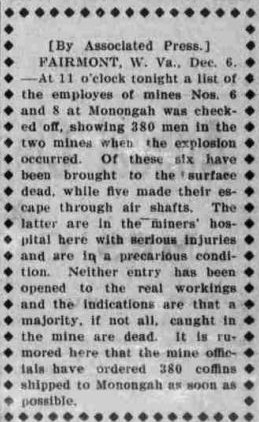
“At eleven o’clock tonight the list of employees had been checked off, showing that 380 were in the two mines when the explosion occurred. Of these six had been brought to the surface dead and five escaped through air shafts. The latter are in the miner’s hospital here in a precarious condition.” (DASB 12.07.07 pg. 1)

For hours now, more than likely since the meeting with Pres. C.W. Watson, General Manager Malone has been sorting through the payroll lists for Monongah mines #6 and #8 to get a better idea of just how many fatalities they are facing. By 11:00 pm, he is as finished as he can be with this aspect of his research. However, he does not deny that this list of around 380 payrolled names does not include any non-payrolled workers (such as B&O railroad workers on loan or those hired and paid by the miner personally—what we would consider an Independent Contractor today), younger trapper boys, or those who have been hired since the last time this list had been updated some two weeks prior, nor will it include those who were known to have been hired the morning of the explosion.

ME18

None the less, the press and public will become fixed with this very first “official” number of 380 and begin to speculate on their own.

“Six charred bodies lying in the improvised morgue, five men near death in the hospital and 369 men imprisoned by tons of coal, rock and mine debris in the depth of the hills surrounding this mining town with chances all against a single one of them being alive is the most accurate summary obtainable at 11 o’clock tonight…” (SFC 12.7.07 pg. 1)

The company nor the press is yet aware of just how many workers, like Bill Sloane and this author’s own great-grandfather, did not go into work that morning. As each one begins to turn up alive over the next several days, the overall number of potential corpses continues to be lowered rather than a name simply getting checked off the potential identity list. Though the extra off-payroll workers are acknowledged by company, they are not included in their factors.

In Fairmont:

“Late in the night…the streets of the city were crowded with anxious people eager to snatch any news that came from the disaster. Every car that came from Monongah, the passengers were stopped while inquiry about the news was made by the waiting crowd but the passengers had little to satisfy the hungering ones.” (FWV 12.7.07 pg. 2 – noon)

At some point during the night at the Miner’s Hospital, William H. Bice, the fan engineer who was blown through the walls of the #8 fan house, dies of his injuries. Though many doctors and nurses have returned to the Miner’s Hospital, the morticians and undertakers are still in Monongah. As a result, Bice had plenty of care in his final hours of life, but in death there is no one on hand to care for his body at the hospital. His body, along with others, is simply left in the hospital morgue.

In Pennsylvania:
12.6.07 pg 5 - Naomi
FWV 12.6.07 pg 5

Clarence Hall has been on the site of the Naomi mine disaster for days, but now he boards a train and heads straight for Monongah. He is considered U.S. President Theodore Roosevelt’s personal representative as one of the few federal government agents attempting to remedy the ever-growing mortal cost of the mining industry in the country.

In Monongah:

Before the midnight hour, rescue work transitions into recovery work as the long process of removing bodies from the mines begins. As #6 mine was not as badly damaged as #8 and workers have been able to restore enough ventilation for rescue crews, the process begins there.

As each body is brought to the surface, Dr. F.W. Hill and several other medical volunteers briefly examine the bodies in hope to quickly determine the true cause of death before sending them over to the temporary morgue. Though Coroner Amos and many other morticians are expecting to have the chance to perform autopsies, they simple become too overwhelmed too quickly and decide against doing so. Due to the conditions of many bodies, it is impossible to embalm them and they must be prepared for burial and identified as quickly as possible.

~Midnight

“Of the victims six dead bodies had been taken from mine Nos 6 at midnight and six others were piled up in the entry awaiting the completion of facilities for bringing them to the surface. From mine No 8 at the same hour, fourteen bodies had been removed, and a number of others are ready to be brought out as soon as arrangements can be completed.” (LAH 12.7.07 pg. 1)

Outside #8:

Once the small fires in #8 are subdued, the temporary 8’ wide fan on loan from a local mine in Shinnston is started up once again. Though they manage to recover some bodies near the mouth and along the main shaft of the mine, the temporary fan is simply not powerful enough to purify the air in the mine and rescue crews only make it around 700 feet beyond the main entrance before they are once again driven out by toxic gases. However, this does not stop the rescue and recovery efforts. A fresh crew replaces those who came in contact with the gases and a round-robin system of smaller crews and shorter trips into the mine takes hold at #8.

In Monongah:

A large number of lingering physicians are “ordered out” of the town; “At midnight these messengers of mercy with pity and patience were on the scene ready to minister to the maimed and moaning, but there was little need for their services.” (FWV 12.7.07. pg. 1 – noon)

wv state archives - CL060064


Previous Post

Next Post


More on How Death Gloated!

Bibliography

Disclaimer and Guide

Timeline

Introduction

About the Author

Contact Information

Friday, December 6, 1907, 11:00 am – 12:00 pm

MR4

11:00 am

“The American miners of the town have been placed in charge of the relief work but the Italians and other foreigners are working under them most faithfully.”  (ES 12.7.07 pg. 2)

“Monongah…has a population…, most of whom are foreigners although there is a larger proportion of American miners in this district than in most of the other bituminous fields. Until about ten years ago the mines were operated almost exclusively by Americans, but during a general strike of Miners in the Pennsylvania and Ohio fields many of these West Virginia miners went out in sympathy to prevent the filling of contracts at lake ports and elsewhere with West Virginia coal by the companies in Ohio and West Virginia against which the strike was directed. At that time the mine owners brought a large number of foreigners into the field to take the places of the strikers and ever since the foreigners have been displacing Americans until they are now the majority.” (ES 12.7.07 pg. 2)

In the town of Monongah:

“The banks and hills surrounding the mine are literally crowded with anxious people, many women and children who are weeping and crying hysterically for love of their fathers, husbands and brothers known to be entombed. The foreign women are indeed to be pitied for their great sorrow and their way of expressing it by tearing their hair, scratching their faces with their finger nails until the blood runs down their cheeks. Several were witnessed in this condition leading their little children around through the mud and cold not noticing either in face or their great sorrow.” (FWV 12.6.07 pg. 1)

frontThumbnail (6)

Company officials Frank Haas and J.J. Burrett arrive from Fairmont as well as the representative of the Italian consulate, G.D. Caldara, who “was doing much to pacify the women of his country, who were most loudly giving vent to their terrible feelings.”  (FWV 12.6.07 pg. 1)

Over a dozen physicians are now on the scene: Dr. D.P. Fitch, Dr. John R. Cook, Dr. Brownfield, Dr. Jesse A Jamison, Dr. W.C. Jamison, Dr. Graham, Dr. Reidy, Dr. Bowcock, Dr. Durrett (mine physician of the New England mines), Dr. Howard, Dr. Carr, Dr. L.N. Yost, Dr. Sands, Dr. Nutter, and Dr. Hal Hall accompanied by nurses from the various hospitals in Fairmont. They begin to establish an emergency hospital in the blacksmith shop of #6. They have also arranged for the interurban trolleys and railroad companies to transport survivors to the Fairmont hospitals once they are tended and stabilized at the make-shift ER in the blacksmith shop (FWV 12.6.07 pg. 1) (Nurses on Front Lines)

“Medical men who came on the scene after…were: Dr. F.W. Hill, B.F. Bone of Fairmont, Drs. Culp and Thrash of Farmington, Dr. Falconer of Everson and Dr. Alkire of Chiefton.” (FWV 12.7.07. pg. 1 – noon)

Marion County Coroner E.S. Amos also arrives in Monongah.

Dr. Durrett of the New England mines tells a reporter with the Fairmont West Virginian that there is little hope for the men trapped in both mines; “He says that the force of the explosion traveled with the air courses and only those men who were in this air course were killed by the explosion or from the debris thrown in its wake.” (FWV 12.6.07 pg. 1)

Outside #6:

Carpenters are putting the last support boards along the roof of the approach which connects the mine shaft to the fan. It is just a temporary fix, but it is good enough to warrant restarting the fan.

In Washington D.C.:

Governor Dawson, A.B. Fleming, and a few other state/company officials receive word about the disaster. Gov. Dawson immediately telephones certain state officials while former Gov. Fleming immediately leaves D.C. for Monongah after sending word ahead to the sheriff to “preserve order”. (News, McAteer)

11:05 am

Outside #6:

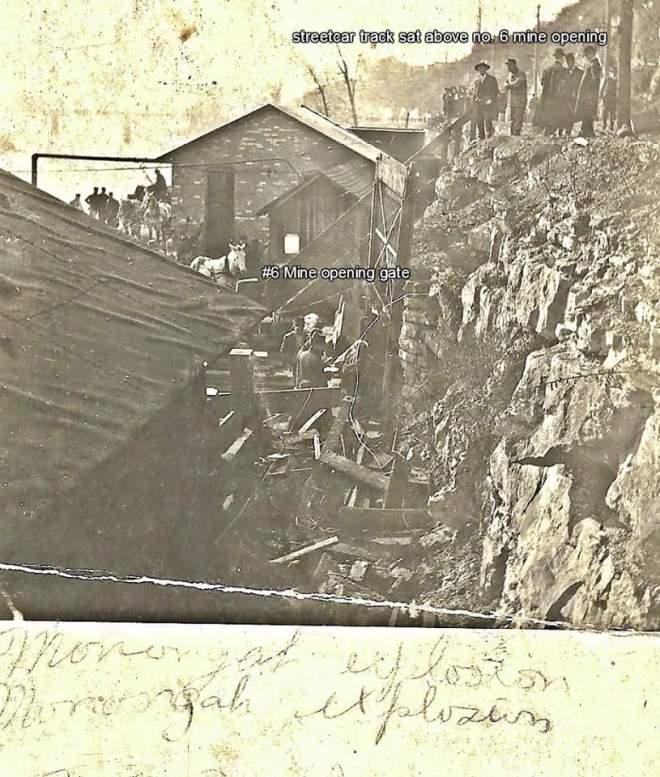
35 minutes after the explosion, #6 fan is restored and started. However, the gage only rises “a little above 2” which is lower than prior to the explosion. This means that air is still not able to properly circulate through #6 because the partition which once divided the two mines has been destroyed by the explosion, allowing air to flow into #6 from #8.  This needs to be a closed system in order to properly circulate breathable air and it will be impossible to close this system without getting to one of the deepest parts of the two mines. (Inquiry)

11:30 am

Outside #6:

“The rescue was started in mine No 6 about 11:30 after the fan was again put in running order and the rescue work is being vigorously pushed by Mr. J.C. Gaskill and other mine officials.” (FWV 12.6.07 pg. 1)

“As soon as the men could be organized for a plan of action forty rescuers began the work.” (CDT 12.7.07 pg. 1)

Three teams were organized: one headed by #6 foreman Charlie Dean, another by Supt. Brennon of #8, and the other by Supt. J.C. Gaskill.

The first party to enter #6 was “composed of Messrs. D.C. Dean,—Toothman, — Nichols, —Graham, —Clayton, J.G. Smith, —Clayton, … these men, armed with all the available necessary tools and safety lamps marched undaunted back into the scene of carnage…”  This is an excellent choice crew. Being outside foreman of #6 mine, Charlie Dean still had plenty occasions when he had to go inside #6. He is the most ideal person available at the time to head the first relief crew and give instruction about what is and isn’t right about the conditions inside of #6 and what needs to be done to correct those conditions in order to get relief efforts underway. (FWV 12.6.07 pg. 1) (Inquiry) (News)

Dean and his crew have a primary goal—determine how far rescuers can get into the mine safely and if any victims can be reached. It is presumed that Dean and his crew are aware of the runaway trip which should most certainly be a pile of wreckage somewhere along the main shaft. Hopefully, they can reach this point and determine if the wreck and/or the explosion have caused any blockages of potential exits before they personally encounter any deadly gasses. (Inquiry, News)

~11:33-11:35 am

Inside #6

As these men steadily work their way down the #6 shaft portal, a second party of ten men headed by West Fairmont mine Supt. John Brannon prepare themselves for the decent.  They enter #6, following along and continuing to clean the path already partially cleared by Charlie Dean’s crew. Naturally, Dean and his crew only cleared what was necessary for them to pass so they can survey conditions and try to reach survivors as quickly as possible. As these rescuers expect to find survivors inside of the mine, they must also make as clear and safe a path through and out of the mine as they can while still constantly pushing forward, knowing that more crews will be following to pick up where they left off. (Inquiry, News)

~11:38-11:40 am

Supt. John Brannon and his team catch up with Charlie Dean and his crew near B face entry, where the slope of the portal changes to a more gradual angle. It is here, at B face, that several other track lines which branch out to the rest of the inner workings of the mine intersect with the main shaft line. At this spot they discover one of their worst fears to be confirmed: the only true way in and out of #6, the main shaft line just before B face, is entirely blocked with wrecked coal cars and debris at the worst possible point, literally entombing every miner—dead or alive—inside with no chance of escape. (Inquiry)

Dean’s crew has already begun to tear away what debris they can to create at least enough space for one man to cross the wreckage. Charlie Price, a member of Supt. Brannon’s crew, also begins working on clearing a way through the debris. After only a few more minutes, they successfully break through near the top left of the pile. Charlie Price is the first to take in the air coming out from the enclosed workings behind the debris pile. In a matter of moments, he collapses. (Inquiry, News)

~11:45-11:50 am

Outside #6

Gen. Supt. J.C. Gaskill has assembled his own relief crew on the surface and they are preparing to enter #6 when Supt. Brennon’s crew resurfaces from the mine shaft. A few of the rescuers are carrying Charlie Price. He was overcome by the fire damp which escaped from the inner workings. At this, both crews fled #6 to avoid the same fate. Charlie is in serious condition and taken to the make-shift hospital in the #6 blacksmith shop which is still being set up by the physicians and nurses which have since arrived on the scene. (Inquiry, News)

Inside #6

“When the Brennon forces returned C.E. Gaskill headed another relief party, which continued the work.” (WH 12.7.07 pg. 1)*

Despite the knowledge that toxic gases have been released, Gaskill and his team consisting of mine foreman PJ McGraw, #6 fire boss Lester Trader, and an extended crew of carpenters like Fred Shaver press back into #6. They continue to clear away debris along the main shaft until they reach the wreckage pile by B Face. Gaskill notes that the wreckage is, “piled up pretty bad—a lot of cars piled up just like any wrecked trip…crossways and piled up generally.” However, it was “not so bad but we could pass…by climbing over…”. (Inquiry)

~11:50 am-12:00 pm

Outside #6

FB_IMG_1511974211592

A key official of the Fairmont Coal Company, Supervisor and Chief Mine Inspector David Victor arrives in Monongah from the New England mines in Fairmont and immediately goes inside #6. He is aware that other crews of men are already working, including John Smith from Charlie Dean’s crew and Supt. Gaskill & crew, though he is not sure how much farther ahead they are at this point. (Inquiry, Victor)

Inside #6

“All of the headings leading off from the main entry are being cut off by canvas and barricaded as fast as they are reached by the relief workers, so that the inner most workings of the mine may be given the benefit of the ventilating system…” (ES 12.7.07 pg. 2)

Beyond the wreckage:

“The rescuing parties penetrated mine No 6 about 3500 feet before they came upon the first of the dead. A majority of the corpses will be found about a mile further back.” (LAH 12.8.07 pg. 1) (WED 12.7.07 pg. 1)

Supt. Gaskill and his team have successfully crossed over the wreckage pile and are now continuing along the main track into #6. At the very base of the slope, where the more gradual angle of the slope finally levels out to match the rest of the working areas, the team comes across a small shanty. Inside they find 3 men—all are dead. (Inquiry, News, McAteer)

The first is 23-year-old husband, father, and motorman Fred Cooper. He is lying on the ground, on his back, his head near the shanty door, his mouth wide open.

Another, 21-year-old brakeman Laurence “Larney” Hindman, is also on the floor lying face down with his feet toward the shanty door, the opposite direction as Fred.

The last man is still sitting upright on a bench, holding his opened dinner bucket between his legs, though his head and arms are drooped down. Lester Trader steps into the shanty and lightly pushes his head back to see the face. Coffee dribbles out of the lifeless mouth and Trader can tell it is 36-year-old driver John Herman.

This rescue crew of Gaskill, Trader, McGraw, Fred Shaver and others will not linger at the shanty long—their primary goal is to find survivors—though they do take a few solemn moments to examine and observe that not one of these men shows a single sign of traumatic impact to their bodies and yet their positions, paired with John Herman’s mouthful of unswallowed coffee, indicate an instantaneous death for them all. (Inquiry)

At the wreckage site:

David Victor makes it to the general area known as the ‘foot’ of the slope and sees the “badly wrecked” trip on the main track. He counts 14 loaded cars wrecked on the middle track but, “The fellow who had been cleaning up the cars told me that he had taken two off the trip that had come back down the slope.” As David Victor begins to examine the area “to a certain extent”, he notes that there is another trip with a motor about 20 feet away “standing on the side track of about the same number of cars, 2 or 3 of the first cars had been wrecked…”, behind that was another trip of coal cars. (Inquiry, Victor)

One of the first concerns relating to the cause of the explosion circles around the new addition of electricity and the relatively recent introduction of live, uninsulated wires inside the mines. Victor examines for any evidence of a short circuit in these wires which could have sparked a fire or explosion, but he finds that the wires are surprisingly still intact, hanging along the roof of the mine and no such evidence these wires fusing or burning at the foot of the slope or on any wires, the mine roof, or walls. He decides to move on. (News, Inquiry)

“I remember climbing over the wrecked cars but had plenty of room to go over. I remember the wrecked trip happened right on the switch where there were 3 entries opened up. The wreck had happened in the middle entry and that entry was closed. The entry to the left was not closed. I remember climbing over the empty cars in order to get through to build brattices.” (Inquiry)

Not far beyond the wrecked pile, Victor sees a coal car laying “crossways of the track” and just beyond that, the shanty at the bottom of #6 slope. He does not go in nor does he take any time to examine the 3 dead men other than to acknowledge their positions. (Inquiry)

1907-monongah-wv-mining-disaster


Previous Post

Next Post


More on How Death Gloated!

Bibliography

Disclaimer and Guide

Timeline

Introduction

About the Author

Contact Information