Tuesday, January 7, 1908 – Morning

Midnight – 3:15 am

In Fairmont:

“About one hundred gentlemen comprising of Fairmont’s representative citizens, gave the Paint and Powder boys an elaborate reception at the Elks club between the hours of 12 and train time (3:15).” (FWV 01.07.08 pg. 5)
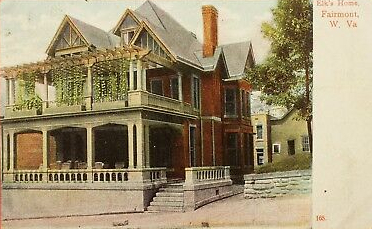
1908-Postcard-Elks-Home-Fairmont-West-Virginia-Wv

“A splendid collection was served by Steward Pangle and speeches were made and responded to by the P.P. Boys.” (FWV 01.07.08 pg. 5)

“The boys rolled out of the station to the strain of “Maryland, My Maryland” played by Prof. Omen’s band and the lusty cheers of the delegation of Fairmonters there to see them off.” (FWV 01.07.08 pg. 5)

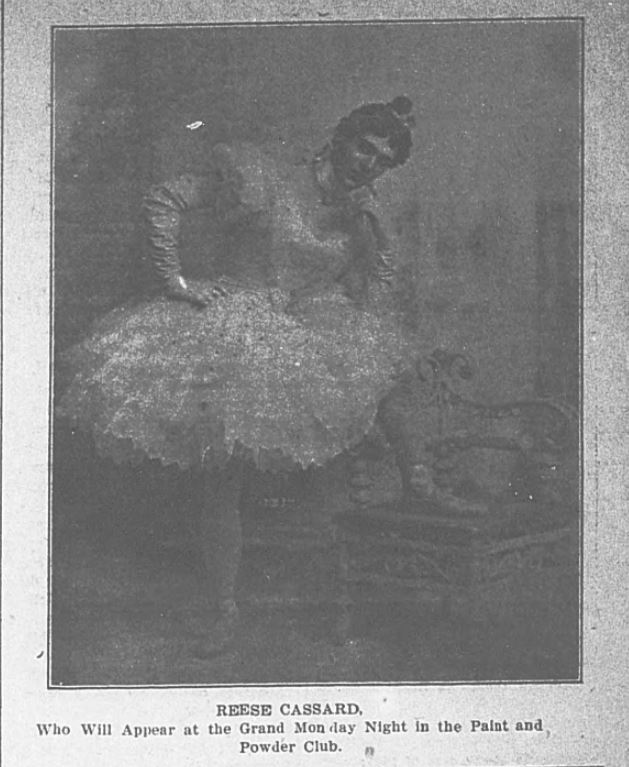
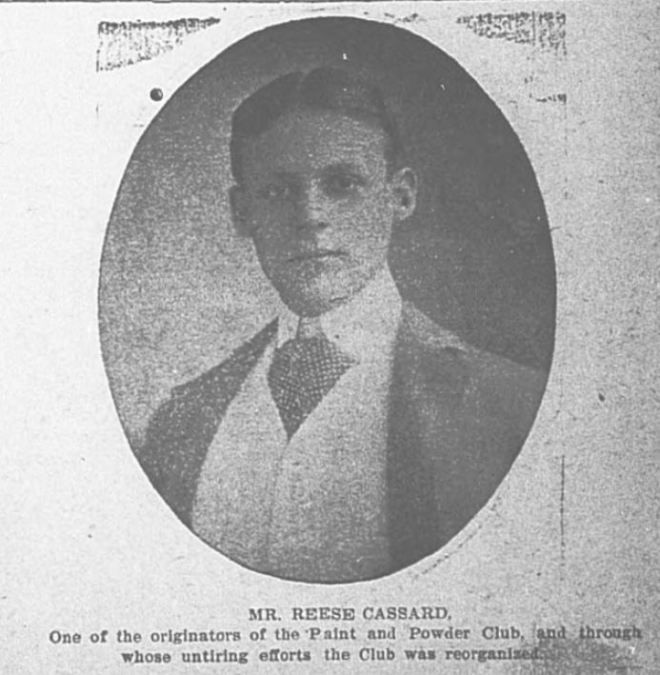
“Reese Cassard in his parting from the rear of the slowly moving train expressed most feelingly the grateful thanks of all the boys for the hearty and successful efforts made for their comfort and the generous applause for their work and said Fairmont is on the P&P annual itinerary as long as there is a P&P.” (FWV 01.07.08 pg. 5)
FWV 01.04.08 - pg 1 - Paint and Powder lead
FWV 01.04.08 – pg 1

“Fairmont is indeed to be congratulated on this acquisition to her artistic entertainment, for she will now each year have the benefits of the Club’s annual production, not only from the enjoyment view point, but the proceeds going to some worthy Fairmont charity.” (FWV 01.07.08 pg. 5)

Morning

In Fairmont:

The Fairmont West Virginian reports the weather will be: Rain or snow tonight and Wednesday.

The West Virginia Joint Legislative Committee has arrived from Clarksburg to attend the hearings. (CDT 01.07.08 pg 1)

~10:30 am

In Fairmont:

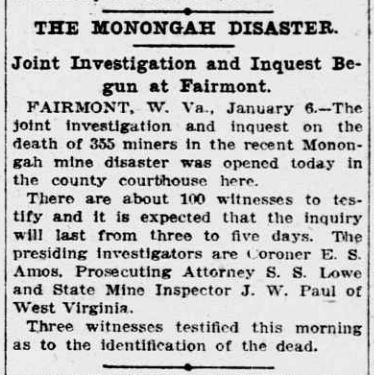
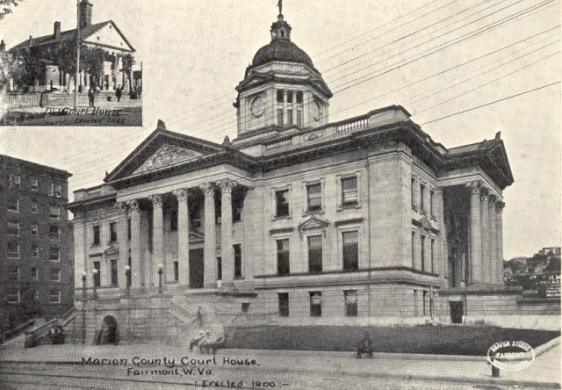
Testimonies continue in the Fairmont Courthouse. “The second day of the court inquiry was held in the Circuit Court room, where many listeners assembled eager to catch every word of evidence from the witness.” (FWV 01.07.08 pg. 1)
Fairmont - Old & OO_large

“William Vokolek, an attorney at law of Pittsburg, representative of the National Slavonic Society, is here to aid in any way that he can to arrive at the cause of the explosion. He is also settling claims of widows against the society. So far the society has distributed $250.” (FWV 01.07.08 pg. 1)

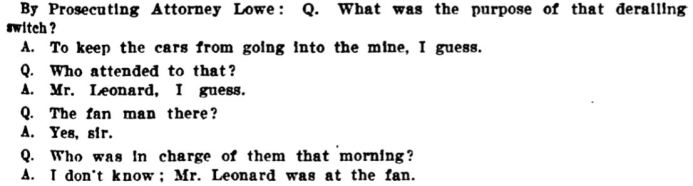
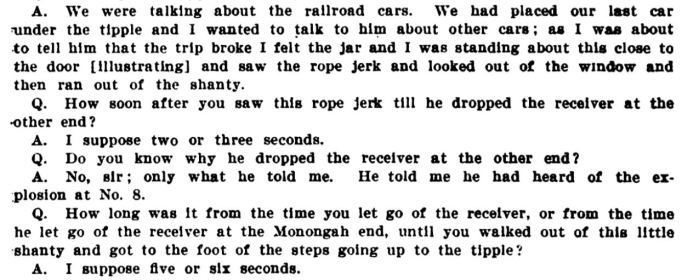
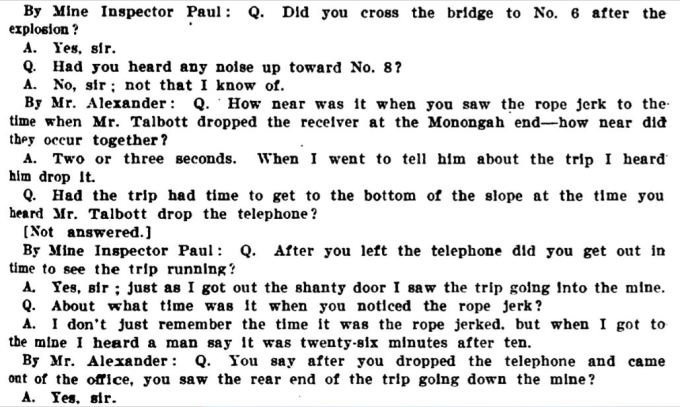
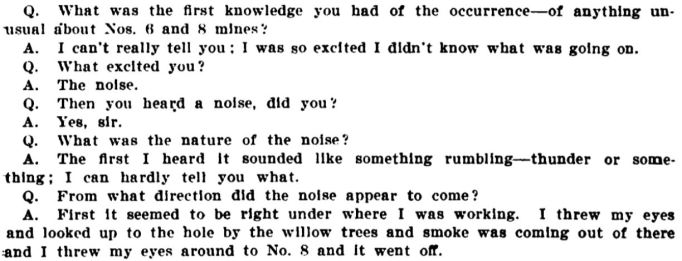
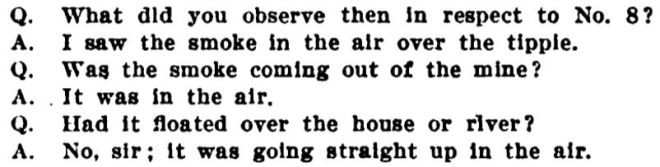
01.07.08 - Inquiry - Alonzo Shroyer

Alonzo Shroyer lives in Mill Fall, a hollow connected to Monongah, and works in the #6 blacksmith shop as a carpenter doing repair work. He is examined by Inspector Paul. (Inquiry)

Alonzo was only 50-60 feet from the mouth of #6 mine, closer to the fan and near the derailing switch, when the trip of cars broke loose. However, he did not actually see the trip until it was already passing him, so he made no attempt to throw the derailing switch. Once it passed him, he went “immediately to the mouth of the mine or near it.”
01.07.08 - Inquiry - Alonzo Shroyer 1

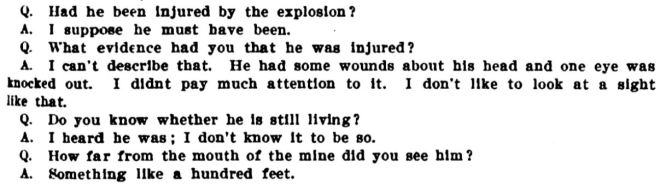
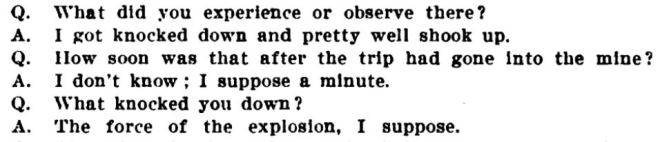
Alonzo thinks he was standing maybe 10 or 15 feet away from the mouth of the mine when the force knocked him down. His right ear was cut open in the fall “and a gash behind the ear to the bone”; he believes he was knocked against the derailing switch stand.

Alonzo also says that he thinks the runaway trip had time to get to the bottom of the mine slope.

01.07.08 - Inquiry - Alonzo Shroyer 2

Alonzo states that he heard no noises from the direction of #8. Once the trip passed, Alonzo intended to follow the trip into the mine and says he was on his way to the shop “to get a torch to follow the trip.”

He again estimates that it was around a minute from the time the trip passed him to the time of the explosion.


01.07.08 - Inquiry - Alonzo Shroyer 301.07.08 - Inquiry - Alonzo Shroyer 4

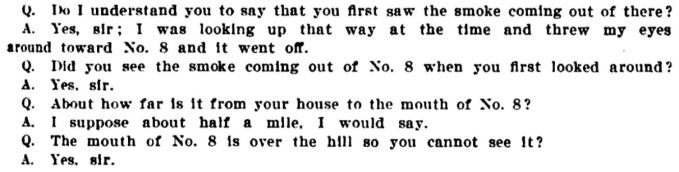
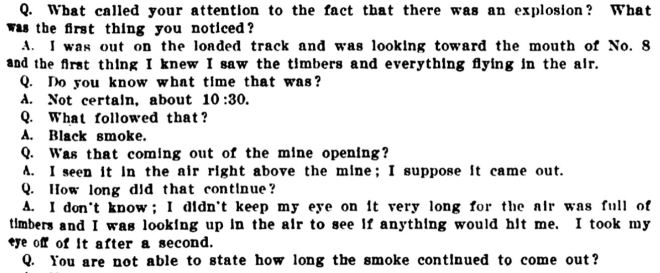
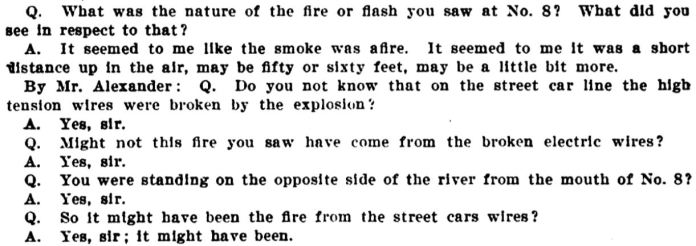
Alonzo states that he saw dark smoke coming from the mouth of the mine but neither saw nor felt signs of flame. Based on “the distance I went and where I went”, he estimates that the smoke must have continued coming out of the mine mouth for 4-5 minutes and agree that it could have been even longer than that.

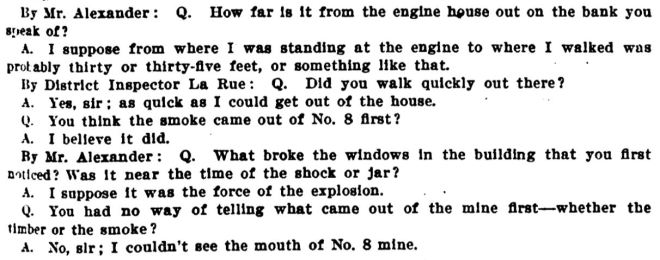
01.07.08 - Inquiry - J.H. Leonard

J.H. Leonard has lived in Monongah for 16 years and has been a fan operator at #6 for the past 6 or 7 years. He is examined by Inspector Paul.
01.07.08 - Inquiry - J.H. Leonard 1

Leonard was working on the 5th and confirms that the fan was running all day and hadn’t even been stopped “since the Sunday a week before” until that the evening of the 5th when it was stopped for 2 ½ hours.
01.07.08 - Inquiry - J.H. Leonard 2

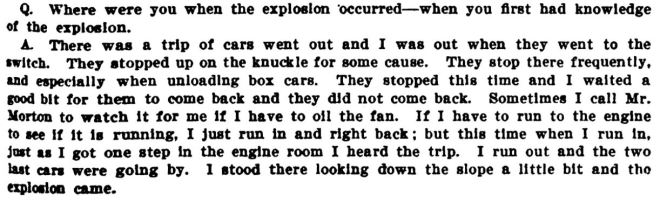
Leonard says the explosion knocked him down and bruised his arm and ankle. “I crawled around above to a pile of old stuff there and there was a hole there and I let myself through down under the trestle.”

Leonard says that, to him, the mouth of the mine looked “like a big steam pipe”.

Leonard had gone into the fan house and oiled the fan only a 15-20 minutes prior to the explosion. “The oil sometimes stops in the cups on the wrist pin and it only takes a couple of minutes to get it hot. I run in to see if the oil was running.”

01.07.08 - Inquiry - J.H. Leonard 3

Leonard confirms that the fan has a pressure gauge to indicate and record the pressure. He says that it is normally the night shift operator who changes out the indicator cards. Leonard got his first experience in changing the card when he was working the night shift on Wednesday, Dec. 4th.
01.07.08 - Inquiry - J.H. Leonard 4

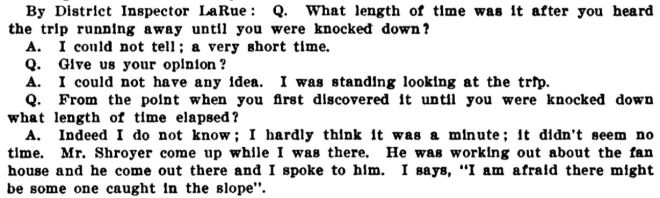
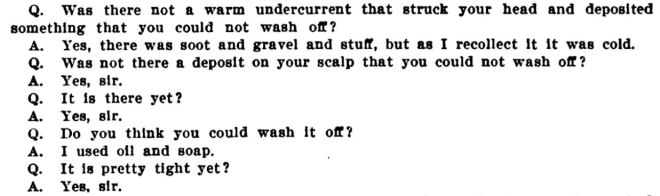
Leonard explains further that they feared someone, or perhaps a motor trip, was coming up the slope at the time the trip ran back into the mine on the very same track. He says he saw nor felt any sign of flame and the smoke was not hot.
01.07.08 - Inquiry - J.H. Leonard 5

Leonard does not believe that the smoke was blowing out for very long. “I crawled around there when it struck me and I was not long about it; I dropped down under the trestle and I don’t think I was there more than a minute until I came up and it was still blowing some.” He says there was no backward motion of the smoke getting sucked back into the mine, just a “continuous blow like a steam pipe.”

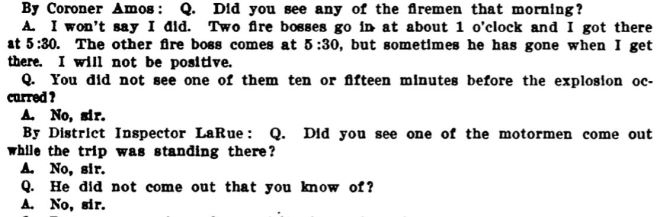
When he was hiding under the trestle, he pulled a piece of a coal car door over top of him; “I thought it would protect me.” He also saw Mr. Graves under there and says he was under there at the time of the explosion.”
01.07.08 - Inquiry - J.H. Leonard 6

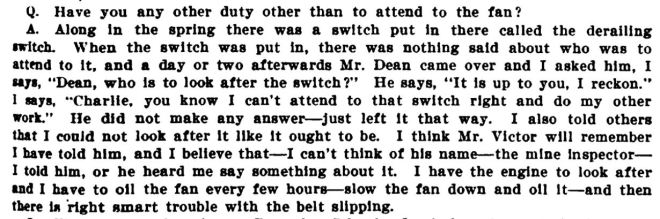
Inspector LaRue asks Leonard if he recalls LaRue’s visit to the mine and discussing the “matter of the throw-off switch”. Leonard recalls telling him that he could not properly attend to watching the derailing switch and that he had never received any orders from any “superior officers” to call someone over to watch the switch if he had to leave it unattended to tend to the fan engine. He did not call anyone over to watch the switch that morning as the “blacksmith was shoeing horses and I did not know there were two men there. There was only two carpenters there and they were both busy back of the fan house.”
01.07.08 - Inquiry - A.J. Ruckman 7

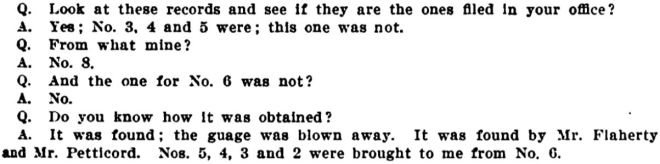
Leonard is not sure of the speed of the fan at the time of the explosion other than “it was the same all morning before that.” He remained at the mine in charge of the fan.

The fan did not shut off on its own, according to Leonard, but was shut down by orders of Mr. Dean so that certain repairs could be made as quickly as possible. “It was not very long until it was started; maybe a half hour.” He states that the fan “had not been shut down since the Sunday a week before, until some one ordered me to shut it down to make that repair.”

Leonard estimates that the derailing switch is about 25-30 feet from the mouth of #6 and possibly 75 to 100 feet away from the fan house, though he has never measured the distance.

01.07.08 - Inquiry - J.H. Leonard 8

Leonard again states that he did not call anyone on the day of the explosion because “there were only two men close and one was shoeing a horse and the other was working back of the fan house. I did not see him at that time but he was working there, I know.” And he thought he had time to get back to the switch if needed.

By the time Leonard reached the switch, however, the last two cars of the runaway trip were passing by him. He says that he does not know how many cars were part of that trip but the usual trip runs anywhere from 8-15 cars, nor does he recall seeing a water-car on that trip.

01.07.08 - Inquiry - J.H. Leonard 9

Leonard says that the normal fan engineer who runs the opposite shift is Michael McDonald but he was sick on that day, so it was run by Mr. Lambert.

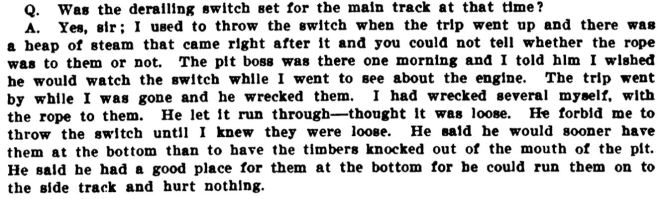
Leonard states that the runaway trip of 4 cars he had mentioned earlier happened possibly a “week or two before” the explosions and that they wee just 4 empty cars which had been accidentally shoved back over the knuckle.
01.07.08 - Inquiry - J.H. Leonard 10

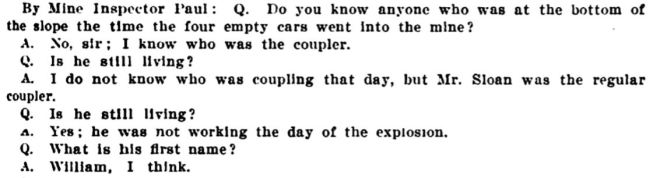
He goes on to say this pit boss was Mr. Donlin.

Leonard says that the mine foreman gives him “more instructions than anyone else, and about the fan, too. He always cautioned me to be very careful and keep it at a proper speed and see that nothing went wrong, regardless of anything else.” Leonard says that he obeyed the foreman’s orders about the switch and the fan.
01.07.08 - Inquiry - J.H. Leonard 11

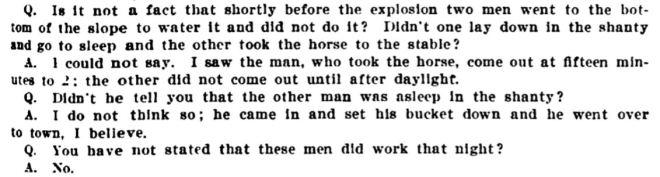
Inspector LaRue asks Leonard if he knows of anyone being sent into #6 to water the headings the night before the explosion (Dec. 5th) or coming out the morning of (Dec. 6th). Leonard responds that he worked the night of the 4th and on that night, “…there is a signal to let the men out of the pit, and a man came out. He was an Italian. He had a horse, and said he had been watering the track. Motorman Cooper came out in the morning.” Though he does not know what part of the mine was watered, he recalls this man came out around 1:45 a.m. because Mr. Donnelly “wanted to know the time the men came out. Mr. Cooper came out after daylight.”

Leonard can not testify to how frequently the tracks are watered because, “…I worked in the day time and they waster at night and on Sundays. Very frequently they water on Sunday. I think Saturday night and Sunday is the general time for watering.”
01.07.08 - Inquiry - J.H. Leonard 12

Leonard states that he knows that Fred Cooper watered the mines on the night of the 4th. He tells Inspector Paul that he had not seen any men or animals brought out that had been burnt by gas “for a good while”. He says that a year ago, “I saw a mule that had gotten its ears singed and they said it was by gas.”

Leonard tells Att. Lowe that he knows of no other explosions in the mine, big or small, prior to those on Dec. 6th.

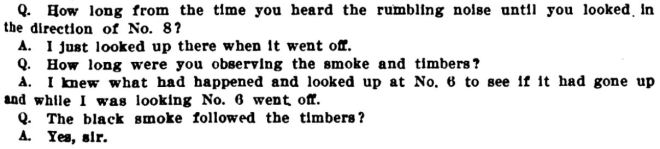
01.07.08 - Inquiry - Ed Fry

Ed Fry has been a stationary hoisting engineer at #6 “since it started”, about 6 years. He is examined by Inspector Paul.

Ed was working in the engine room on Dec. 6 and knew something occurred when the trip broke loose, left the rope which caused the hoisting engine to speed up. He says he had no knowledge of what had happened to the train before he actually left his post in the engine room.

01.07.08 - Inquiry - Ed Fry 1

However, Ed can not recall if he was still in the engine house or in the doorway when that light went off, but he knows that he heard no sound of the explosions and only felt the “jar” while standing in the doorway. He says he stayed within the doorway as the concussion continued and first learned of what happened when a fireman from the powerhouse “came across and told me that No. 6 had exploded.”

Ed says he then went to the power house, “the lower side there, next to the river” where he observed “smoke and dust coming out of the air shaft” of #6.

Ed is not sure how long it was between the time of the trip breaking loose and the fireman telling him of the explosion.

01.07.08 - Inquiry - Ed Fry 2

Ed says that if that light goes out while he is pulling a trip he stops pulling because it is “likely to have a wreck.” Ed does not really answer the question of what the light going out indicates other than it isn’t necessarily an indication that the wrecked trip tore down wires when it went back into the mine. “Sometimes the circuit breaker goes out frequently during the day” and turns the light off, he says, which could simply indicate some other kind of “heavy work” being done inside of the mine and not necessarily a wrecked trip.

Ed confirms that, if the trip breaks loose, the ropes which were attached to the train do not “rebound” back. Rather, the engine simply “speeds up and takes up the slack.”

Ed also believes that the trip was stuck at the knuckle for, “Probably ten minutes.” However, he does not know exactly how many were on the trip as, from his vantage point in the engine room, he could only see “one or two” once the train arrived to the tipple. He confirms that the entire trip broke loose and went back and says that “a minute” probably passed between the time the trip broke loose and when he was notified that the explosion occurred.

01.07.08 - Inquiry - Ed Fry 3

Ed does recall that some empty cars had gone back into the mine on a day he was working, but he can not recall how long ago this occurred or if that wreck caused the light to turn off in his engine room. He can confirm that those cars were not coming out of the mine, but were in preparation to be lowered into #6 when they went back.

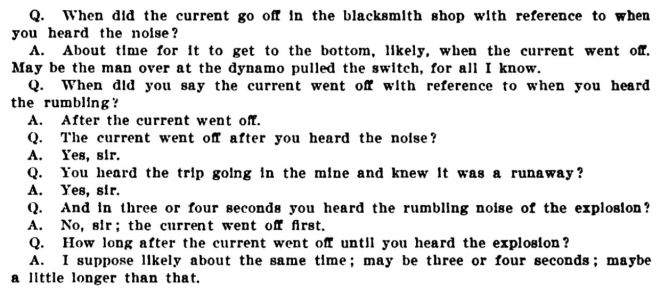
01.07.08 - Inquiry - A.H. Yost

A.H. Yost has lived in Monongah for 9 years and runs the fan on the night shift for #8. He is examined by Att. Lowe.

Yost confirms that William Bice runs the fan during the day shift and died in the disaster. He says that there was no one else who worked his night shift for the fan and that he did work on the night before the explosion and left his post around 5:30 or 6 o’clock a.m. on the 6th when Bice took his place.

Yost confirms that the fan ran “all night” without stopping. He states that the pressure gauge for the fan records the pressure and is changed “every twelve hours” when they change shifts. He states that the sheet was changed at 12 o’clock that night. He knows that night Pete McGraw and Patsy Kerns were the fire bosses on duty in #8 the night before the disaster, however, only McGraw is still alive. He says he only knew of two fire bosses for #8 and one foreman, John McGraw, though he assumes McGraw had an assistant.

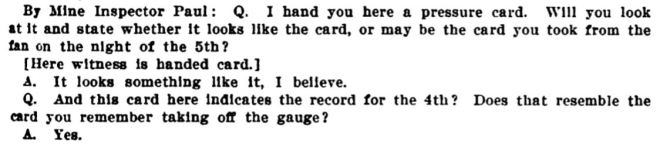
Yost says it was he who changed the gauge sheet on that night, as he “sometimes” would and that night he “hung it on a nail and the fire boss got it.” Yost presumes that the fire boss took the sheet to the office but he has not seen it since that night.

Yost is asked what the gauge was reading that night when he took it down, but he does not know nor does he know the average speed typically indicated on the card.

01.07.08 - Inquiry - A.H. Yost 1

Att. Lowe asks if #8 was working on the 5th, to which Yost responds that the fan was running but the mine itself was not. Yost says that he took over Bice’s place at the fan on the evening of the 5th and that the fan was indeed running at that time.
01.07.08 - Inquiry - A.H. Yost 2

Yost says that he was at home asleep at the time of the explosions and tells Mr. Alexander that fire boss Pete McGraw collected the fan records the morning of the explosion, “I suppose, about 2 o’clock.” He is then asked about the last time the fan was stopped at #8. “I could not tell you. They generally stopped it on Sunday, if they stopped at all, to do packing or something” but he does not believe it was stopped on the Sunday before the explosions.

It is reported in the Fairmont West Virginian on this same day by a courtroom reporter that, right after being asked about his whereabouts at the time of the explosion, “The witness said there was a large volume of smoke emitted from No 6 which lasted about 6 minutes. The smoke was continuous. There was no flame.”  (FWV 01.07.08 pg. 1)

However, this part of Yost’s testimony is absent from this author’s copy of the Inquiry. (Page 277 of Inquiry)

01.07.08 - Inquiry - A.J. Ruckman

A.J. Ruckman has lived in Monongah for 18 years and is the Superintendent for #6 & #8 mines. He is examined by Att. Lowe.

Ruckman was in his office with the outside foreman, Mr. Charlie Dean, at the time of the explosions and therefore did not see them occur. “The first thing we heard was the loud report and severe concussion.” Charlie Dean then stated, “There goes No. 8 boiler.” They then “went out on the porch and looked toward No. 8, as that is where the report sounded, but there was nothing visible—didn’t see any smoke or anything.” Ruckman and Dean were then “attracted to No. 6 by a loud noise and looked down and the smoke was coming out of the air-shaft pretty strong, under high pressure.” Ruckman says he turned to Dean and said, “From the appearance it looks like No. 6 fan house is damaged. Get the men and material there as soon as possible and I will go to No. 8, and if that fan is not damaged, we will reverse it.” Unfortunately, the fan at #8 was badly damaged.

01.07.08 - Inquiry - A.J. Ruckman 1

Ruckman says that the coal is hauled up the slopes and out of the mines in Monongah with “electric locomotives on the main haulway” then a stationary engine with a wire rope hauls it the rest of the way. He is asked about how long #6 & #8 have been in operation to which he replies that “No. 6 was started in 1900, and in No. 8 the ground was broken on the 12th day of May, 1905.”

01.07.08 - Inquiry - A.J. Ruckman 2

Ruckman says that a “great deal” of the mining is done with an electric mining machine; “A seven-foot undercut chain machine. Some of the work was done with a pick, in case of a bad roof where the machine couldn’t work, or pillar work.” He says that the part of the mining done by the chain machine produced “Small coal—dust in it,” and a “considerable” amount of it produced on the first cutting.
01.07.08 - Inquiry - A.J. Ruckman 3

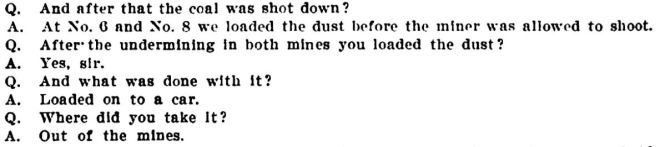
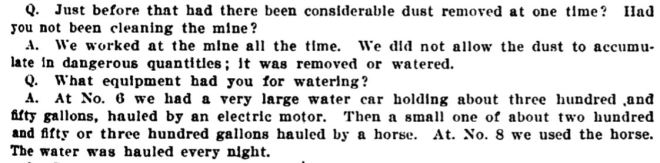
Ruckman states that no watering was done in the rooms before shots were fired, the dust was loaded and removed then the coal was shot and loaded by the miners.
01.07.08 - Inquiry - A.J. Ruckman 4

Ruckman can recall that Tony Pasquale is the “regular man” to water #8 mine and that he is still alive, but “at No. 6 it was a different motorman—whoever the pit boss would designate.” He says that there are no motormen from #6 who survived the explosions. He can not say how often or necessarily what part of the mines were watered as that is “the pit boss’s duty” and none of them survived either.

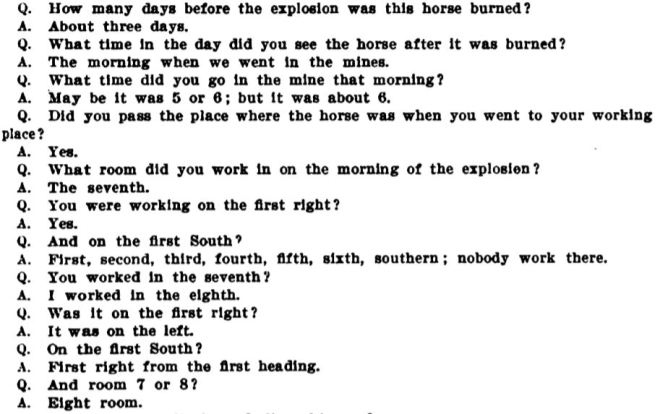
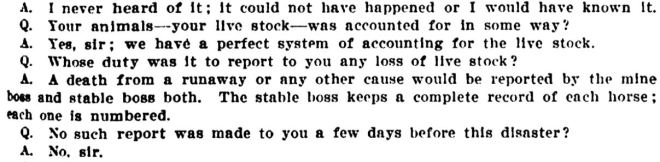
Ruckman says he neither knows nor has heard of any accident or explosion in either of the mine just prior to this one. He is asked about Peter Urban’s testimony of “a horse being killed by gas as short time before this in No. 8”, possibly just 3 days earlier.
01.07.08 - Inquiry - A.J. Ruckman 5

Ruckman states that Ben Coon was stable boss for #8 and Charlie Dean “has general supervision over the work.” He says that such an accident would have been reported by the pit boss and stable boss, including a description of the event. However, the pit boss for #8 is no longer living to account for this.

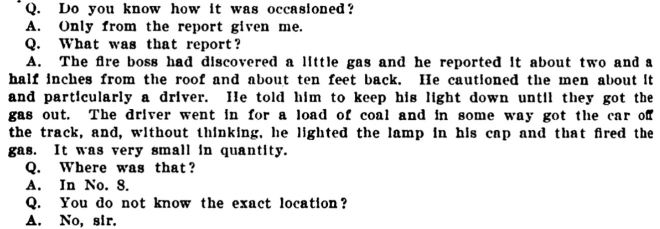
Ruckman confirms that there was a “small explosion of gas” in #8 which slightly hurt a horse “about two months” prior. He says the horse’s ears were burned but really no other damage and the horse was back to working inside again within “six or seven days”. This same horse was working on the day of the explosion and killed in the mine.
01.07.08 - Inquiry - A.J. Ruckman 6

Ruckman states that the employees were furnished with a copy of the mining laws in the form of a printed pamphlet. Att. Lowe hands Ruckman a pamphlet to which he confirms is the same pamphlet that was distributed to the miners about “two or three months” prior to the explosion. “They were given out as soon as we got them.” He confirms that the “card of instructions” was tacked up outside of the mine openings in seven different languages. “We had them up in different languages for several years, but after the change in rules they were put up immediately.”

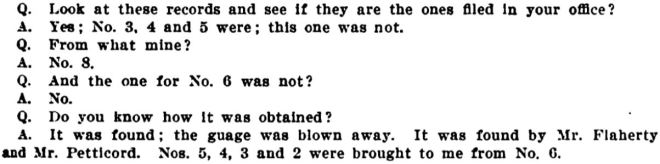
Ruckman believes he made it from his office to #8 in “possibly five minutes.” He found that the “danger signal”, which warns if the mine is in a dangerous state, at #8 had been “blown away”, along with the blackboard containing the report of the fire boss. He states that he did not go over to #6 “for some time” but can confirm that the blackboard at #6 was “out of the direct road of the explosion and was not blown away.” It is currently sitting in his office in Monongah. Att. Lowe asks him to “bring it down in the next day or so.”

Ruckman confirms the fan operators’ testimonies that the records for the fan house are taken by the fire boss to the Monongah office, however, he says that he only has the records for the 5th and prior, not for the 6th.
01.07.08 - Inquiry - A.J. Ruckman 7

Inspector Paul asks for the dimensions of the fan at #6 to which Ruckman replies that it was a “triple fan, made by Clifford” that measured 9 x11 feet with the larger dimension being the fan’s diameter. Ruckman gets weekly reports on the fans.

01.07.08 - Inquiry - A.J. Ruckman 8

He is asked the same question about the fan at #8. He says it was a “Connellsville fan made by Lepley—8 by 22.” He does not know of it’s capacity, however. “I never saw the rating. Whether if would hold up or not I don’t know, but it makes over 220 feet of cubic air per revolution.”

01.07.08 - Inquiry - A.J. Ruckman 9

Ruckman testifies that no dynamite was used for blasting in the mines, but rather “3F black powder” is used. He says that the drilling for the blasting is done manually by the miners themselves, “except one face at No. 8” (which one, he is not sure) where “A contractor by the name of Preston had a portable Jeffrey’s auger and he worked four or five men.”

Ruckman says that there are no regulations to the amount of powder to be used in the blasting; “only what instructions the pit boss would give the men.” He also states that they do not keep the records of the pressure charts from the fan but that they are mailed to the general superintendent in Fairmont. He states that the charts are “a record of whether the fan man is doing his duty.” Ruckman explains that, “if the engineer would allow his steam to go down or slow the engine down to take it easier; it would show instantly.”

Ruckman is not sure if the electric chain machines cause a “greater quantity of fine dust than would be made by pick mining”; he figures “that would depend on how it was run.”

01.07.08 - Inquiry - A.J. Ruckman 10

Ruckman presumes that shots are done in threes—“the same as the heading”. “One shot is placed in the center, shot out and loaded up, and the other shots are placed a foot or so from the rib.” The powder is issued in 5-pound cans and he does not know of any instance where men were burned by the ignition of gas prior to the explosions. He states that the driver of the horse that was burned some months prior, Fred Stubbs, was not hurt and is still living.
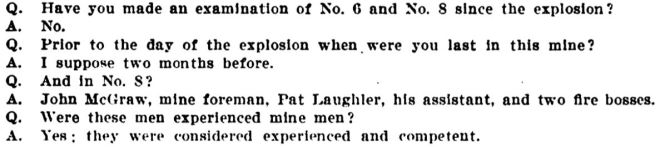
01.07.08 - Inquiry - A.J. Ruckman 11

Ruckman says that the foreman and fire bosses meet “once a week” to discuss the conditions and safety of the mines. He states that David Victor was the general mine foreman “until recently”. Victor is now an inspector for the company and there was no general foreman at the time of the disaster.

Ruckman recalls that Victor was in the mines about two weeks prior to the disaster and got a copy of his report which stated that the conditions of the mines were “good”.

Att. Lowe hands Ruckman a photograph “of a blackboard with some writing on it”, which Ruckman identifies as the “Fire boss’s blackboard on the morning of the 6th.” He is familiar with the name L.E. Trader as a fire boss and confirms that he still lives. The court room reporter for the Fairmont West Virginian points out that, “in three places there were traces of gas” marked on the board in the photograph. (FWV 01.07.08 pg. 1 & 4)

Lowe then asks if Ruckman has a copy of the inspection report. “No; not with me,” he replies, but expects that he can produce it if needed. Ruckman explains that he never actually sees the Inspector’s reports as they are given directly to the mine foremen.

01.07.08 - Inquiry - A.J. Ruckman 12

Ruckman explains that the cuttings and dust are loaded up before the coal is shot as it is dangerous if the dust is dry; “It is a matter of precaution.” He has charge of 2 other mines in town and says that the method of mining and shooting the coal is done “practically the same” in all.

Coroner Amos asks about what is done with the dust after it is loaded. Ruckman simply says it is loaded and “taken away”.
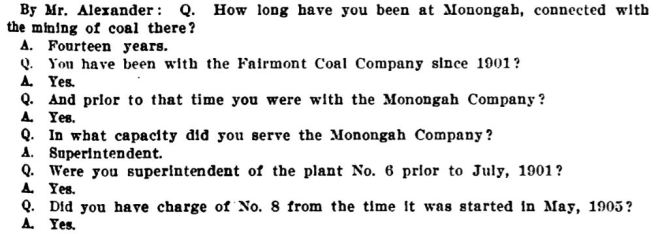
01.07.08 - Inquiry - A.J. Ruckman 13

Mr. Alexander wants to know how far #6 had been driven and developed when FCC took charge in 1901. Ruckman is not positive about the exact depth but acknowledges that it has increased significantly since. He says that the same exhaust system from the Monongah Company was used when FCC took over and is still used now, as well as how the coal is hauled; “The only change is the increased number of locomotives on account of the increase in the length of the haul.”

Ruckman states that the mines are watered with a 300 gallon car in #8 and with one large car, about 350 gallons, and one small car that holds around 275 gallons in #6. They are filled at one of the three pumps located through the mine and moved via electric locomotives. “The end of the car is perforated and filled with wooden plugs. They take them out and spray the track.” However, he confirms that this does not spray the ribs, just the tracks.

Ruckman states that it was up to the mine foreman to determine when watering needed to happen and where. His instructions on watering were just to “keep down the dust—not to allow it to accumulate—not to take any chances. ”He says it was watered “very often” in the colder months but the summer time doesn’t require as much watering.

A large iron gate is placed at the mouth of both mines so as not to “allow anyone in until the fire boss had completed his examination.” The fire bosses Ruckman knows of at #8 are “Kerns and McGraw”.
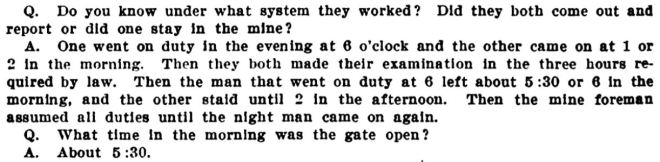
01.07.08 - Inquiry - A.J. Ruckman 14

Ruckman lists 3 fire bosses for #6: “Jim Lyden, Mr. Morris and L.E. Trader.” He says their system was the same as #8 and that at least one fire boss was there “practically all the time.”

He cites the foreman for #8 as John McGraw, his assistant as Mr. Laughler, and the foreman for #6 as Tom Donlin, his assistant as Mr. Rogers.

Ruckman has known John McGraw for 12 years or so and says that McGraw worked in Pennsylvania prior to Monongah. Though he is not sure of the experience McGraw had in Pennsylvania, he considered him “Good—well posted” in his capacity as mine foreman. He believes McGraw had been a foreman for about 2 years prior to the opening of #8 as he was transferred from foreman in #3 to foreman in #8.

He says that John McGraw “first started in Monongah, helping his father. He was then only fourteen or fifteen years old. After that he was driver boss and gradually worked up.” He had worked in almost every capacity, “from trapper boy up.” However, he was never a fire boss as “he never worked in #6 and that was the only place we had a fire boss until we opened No. 8.”

Ruckman says he has known Tom Donlin, foreman for #6, for “about the same length of time.” Donlin also worked his way around the mine as “a miner for a while, then a machine man, then assistant boss, then mine foreman.” Ruckman says that Donlin was “a man of considerable experience in Pennsylvania and all of the coal mines, I think, in this state.” Though Ruckman is not sure if Donlin had any formal training or instruction on mining, he knows that John McGraw received some “from this Scranton school.”

Ruckman says that he has known the fire bosses for #8—Pete Kerns and Pete McGraw—for 10 or 12 years. He says that Pete McGraw had been working there at least 14 years “in nearly every capacity.” Pete had been “a miner and a machine man and boss driver” but had taken a course at the Scranton school and this was his first fire boss position. He is not sure if Pete Kerns also took the course at Scranton but includes that he is “a man of considerable experience.” Likewise, he is sure that Trader has also taken the course, but is not sure if Morris did. Morris had been in Monongah around 4 years and worked in Pennsylvania prior to then.

Tim Lyden has also been there around 12-14 years but Ruckman only acknowledges that Lyden “had the same experience”. Ruckman is not sure if any of the men carried fire boss certification from Pennsylvania but he thought of them as competent and qualified. “I think they were—all five of them. They were very energetic and loyal.”
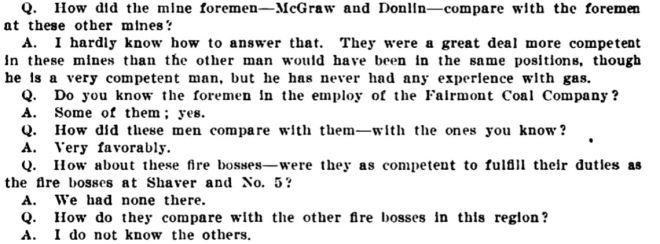
01.07.08 - Inquiry - A.J. Ruckman 15

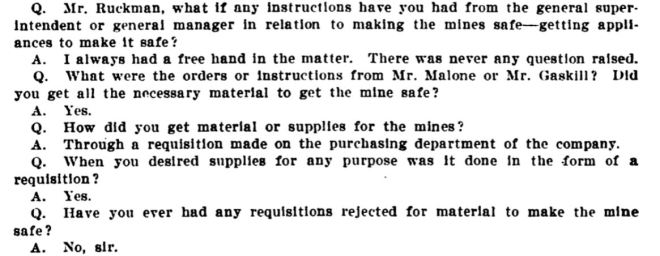
Ruckman cites L.L. Malone as general manager of FCC and J.C. Gaskill as general superintendent. When any inspectors visited the mines, they reported to Gaskill who in turn provides Ruckman with a copy with instructions as well as two more copies of the report—one for each mine foreman.
01.07.08 - Inquiry - A.J. Ruckman 16

Ruckman says these materials were furnished “very quickly” whenever requested and if needed in a hurry, they could be ordered by telephone “to be followed up by a requisition.”

He says that the Lepley fan at #8 “showed up in our test to be a very good fan”, one of the best in the U.S. and among the largest capacities available. It had been in use at #8 for about a year and they never had much difficulty with it.

J.H. Leonard was in charge of the Capell fan at #6 and Ruckman says he had been “since we started—six or seven years.” Ruckman says that Leonard was “put in charge” of the derailing switch “immediately” after it was installed by “Donlin’s track man”, “over a year ago.” Ruckman says he told Leonard “if a trip went in the mine and it was necessary for him to oil the fan for him to call a carpenter to attend the switch and not to leave it under any circumstances.” He acknowledges that Leonard “frequently got someone to take his place” at the switch when he had to leave.

01.07.08 - Inquiry - A.J. Ruckman 17

Ruckman is asked again about reports and records made about injured livestock. He says that these reports are “not necessarily” written reports from the start. Whoever is reporting the incident “comes in the office and reports it and we make a written report to the Fairmont Coal Company.” The stable boss “makes a monthly report of the stock and reports the loss of any” in the same manner.

Ruckman disputes Peter Urban’s testimony saying, “nothing of that kind happened. I heard that evidence yesterday. If there had been an explosion sufficient to kill a horse there must have been a man with the horse to set the gas off and it would have killed him, too.” Ruckman enforces that they have a “regular form for accidents and death reports” which must be made according to the law and no such report matching Urban’s testimony was made prior to the explosions.

01.07.08 - Inquiry - Recess


More on the Monongah Disaster of 1907

Introduction

Disclaimer and Guide

How Death Gloated!: A Timeline of the Monongah Disaster and Bloody December of 1907

Who is Guilty?: A Timeline of January 1908 and the Coroner’s Inquiry
Issues with the Monongah Timeline

Bibliography/Resources

About the Author

Contact Information

Monday, January 6, 1908, News Hour – Night

~6:00 pm, News Hour

Fairmont West Virginian:
FWV 01.06.08 - pg 1 - sub-headline
FWV 01.06.08 – pg 1

Secretary of State Swisher arrives for the Paint and Powder Club show. “Governor Dawson had also planned to come but was unavoidably detained at the last moment.” (FWV 01.06.08 pg. 1)

FWV 01.06.08 - pg 1 - headline 2
FWV 01.06.08 – pg 1
FWV 01.06.08 - pg 1 - miners body found via dream
FWV 01.06.08 – pg 1

FWV 01.06.08 - pg 5 - Hartleys ad - P.P. show attire

FWV 01.06.08 - PG 8 - COAL MEN METT
FWV 01.06.08 – pg 8

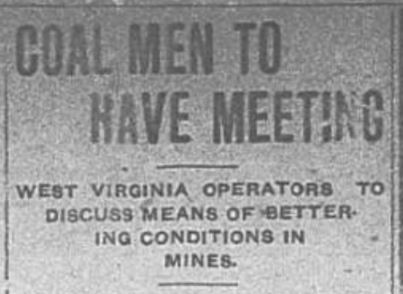
“Representative coal men from all the coal mining fields of West Virginia will meet at Washington this week for the purpose of discussing among themselves and the representatives of the United States Geological Survey, means for the betterment of the conditions of mines in West Virginia, in reference to legislation and regulations governing the mining industry in the State.” (FWV 01.06.08 pg. 8)

“Committees were appointed in the different coal fields who will make efforts to bring as many operators to the national capital as possible in order to discuss the conditions in general. The recent explosions occurring in West Virginia and other States have resulted in an agitation for better conditions in all the coal mining States.” (FWV 01.06.08 pg. 8)

The Committee for the Fairmont District: Ex-Governor A.B. Fleming, C.W. Watson and L.L. Malone (FWV 01.06.08 pg. 8)

Clarksburg Daily Telegram:
CDT 01.06.08 - pg 8 - Inqiury
CDT 01.06.08 – pg 8

“The coroner’s inquest to ascertain the cause of the Monongah mine disaster began at Fairmont this morning, and the sessions are being held in the circuit court room, on account of the large crowd in attendance.” (CDT 01.06.08 pg. 8)

“The inquest is attracting experts and mine officials from various parts of the country, Coroner E.S. Amos is conducting the investigation but the county and state officials are looking into the matter from the state’s interest. Every effort will be made to get to the very bottom of the situation and to ascertain if possible at all, the real cause of the disaster…” (CDT 01.06.08 pg. 8)

“The Polander, the only man who escaped alive, will give his testimony, but this will not likely be of much value, as he was in the mine only a short distance from the opening hen the explosion occurred.” (CDT 01.06.08 pg. 8)

“The testimony of expert and investigators will be of vast importance and several days will be required to hear this. The inquest will likely continue for a week or ten days and probably longer.” (CDT 01.06.08 pg. 8)

The Detroit Times in Michigan:
TDT 01.06.08 - pg 4 - Monongah
TDT 01.06.08 – pg 4
The Evening Star in D.C.:
ES 01.06.08 - pg 1
ES 01.06.08 – pg 1

Evening

In Clarksburg:

The West Virginia Joint Legislative Committee is called together by the chairman to the Hotel Waldo.

In Fairmont:

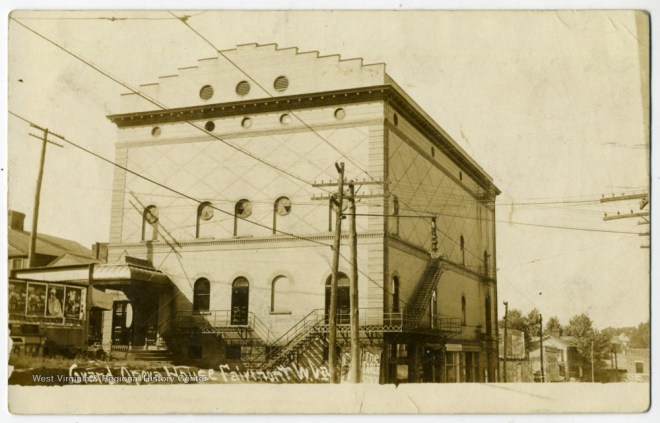
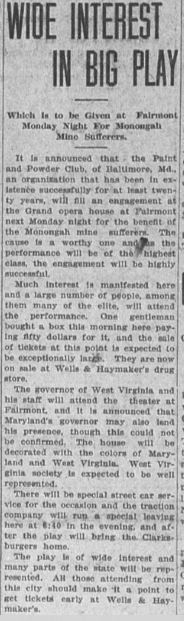
The Paint and Powder Company of Baltimore plays a benefit performance at the Grand Opera House for Monongah Relief sufferers. (FWV 01.02.08 pg. 1)

The Grand Opera House - Fairmont

Inside the opera house, “draperies are blended in the colors of the State of West Virginia – Old Gold and Blue – the State of Maryland, Orange and Black, Baltimore Athletic Club – Maroon and Blue, and Paint and Powder Club – Pink and White. The decorations are being carried out on an elaborate scale. Emblems of the two Sates and of the two clubs will be interspersed equal around the entire border of the house and curtain. When the lights are set aglow the color scheme presented will be as beautiful as any ever seen in this section. The intertwining of colors is a symbol of the closer tie that binds these two States…” (FWV 01.06.08 pg. 1)

“The general committee has had the eight colors…made into boutonnieres. All the men of the committee composed of the citizens and the ladies of the town who have offered and done much and are rooking towards the successful consummation of this entertainment have all donned these rosettes.” (FWV 01.06.08 pg. 4)

“Secretary Swisher’s box and Mr. C.W. Watson’s box were tastefully decorated in the colors of West Virginia with a sprinkling here and there of the State flower, rhododendron.” (FWV 01.07.08. pg. 5)

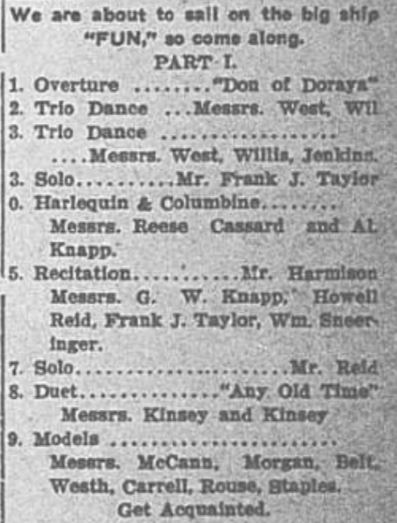
The P&P Club will be performing, “Don of Doraya”. (FWV 01.02.08 pg. 1)

FWV 01.06.08 - pg 1 - P&P show set 1FWV 01.06.08 - pg 1 - P&P show set 201.06.08 - pg 4 - P.P. show set list cont.

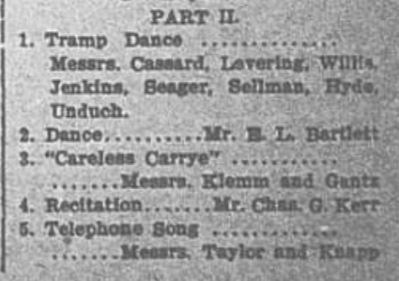
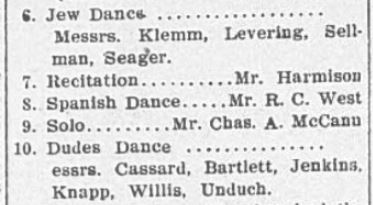
“The actors not only possessed talent along the lines assigned them so that they could perform their work well but by long, hard, careful, superior training and by faithful work they were able to bring out the best that was in them and they created and art eliminating all that was worthless and retaining all that was valuable. Truly the boys were there with the goods without one thread of shoddy in it.” (FWV 01.07.08 pg. 1)

“Program was a pleasing on throughout and was just the right length. It was not so short as to make the audience feel that it had been skimped nor was it so long as was thoroughly enjoyed by the large audience and the actors responded liberally to the encores.” (FWV 01.07.08 pg. 1)

“The clever impersonation of femininity by the whole cast was carried out to a high degree of perfection and to many they appeared as real girls.” (FWV 01.07.08 pg. 1)

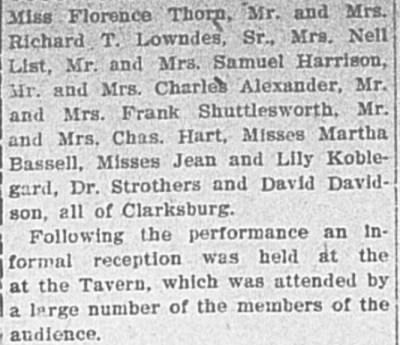
Some of the elite in attendance:

FWV 01.07.08 - pg 1 - P.P. Production - detail
FWV 01.07.08 – pg 1
FWV 01.07.08 - pg 5 - P.P show cont. - attendance detail;
FWV 01.07.08 – pg 5

Skinners tavern - fairmont - wvhistoryonview

“The Paint and Powder Club has been accustomed to playing in the east where art is amply rewarded by its favorable reception by the people, but since the boys have visited our city they are cognizant that our appreciation of their work is as keen as that displayed in the cities they play regularly.” (FWV 01.07.08 pg. 1)

Night

In Fairmont:

“The special mine investigating committee will arrive here tonight and will remain during the inquest.” (FWV 01.06.08 pg. 4)

The Paint and Powder Club performers are treated throughout the night. “Tonight after the show they will be entertained at the Elks’ Home on Main street.” (FWV 01.06.08 pg. 1)

FWV 01.04.08 - pg 1 - Paint and Powder lead
FWV 01.04.08 – pg 1
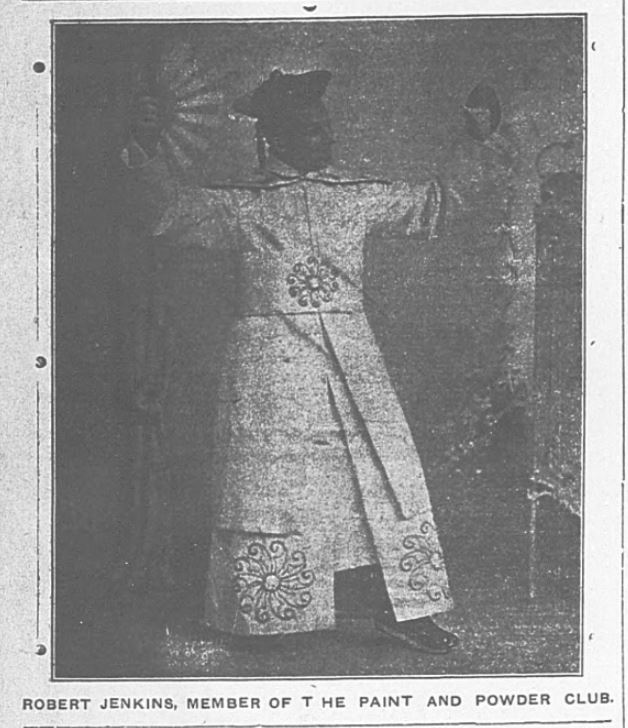
FWV 01.03.08 - pg 6 - Paint and Powder photo
FWV 01.03.08 – pg 6
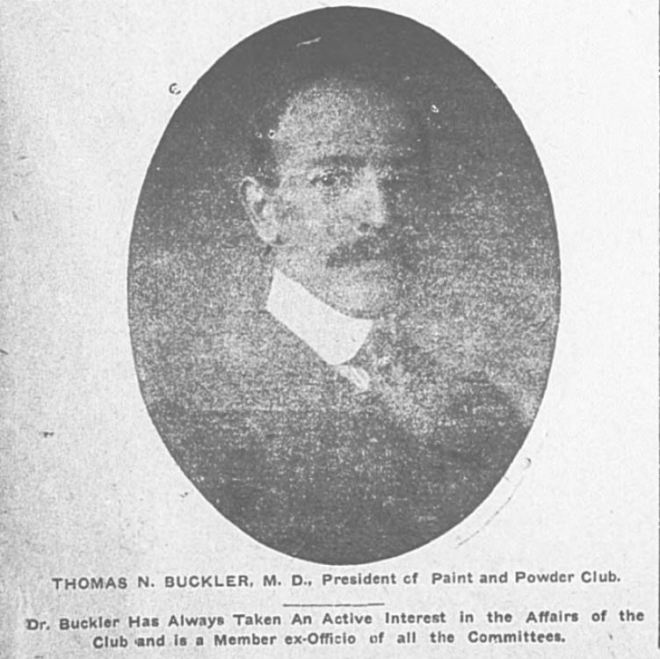
FWV 01.04.08 - pg 1 - Paint and Powder Pres
FWV 01.04.08 – pg 1
FWV 01.04.08 - pg 5 - P&P photo
FWV 01.04.08 – pg 5


More on the Monongah Disaster of 1907

Introduction

Disclaimer and Guide

How Death Gloated!: A Timeline of the Monongah Disaster and Bloody December of 1907

Who is Guilty?: A Timeline of January 1908 and the Coroner’s Inquiry

Issues with the Monongah Timeline

Bibliography/Resources

About the Author

Contact Information

Monday, January 6, 1908, Afternoon

Afternoon

In Fairmont:

“Mr. Zack Robertson on Monday afternoon in the Masonic hall will deliver the last of his series of lectures ‘No matter how many you skin alive just so the company gains.’” (FWV 01.02.08 pg. 5)

1:30 pm

In Fairmont:

The Paint and Powder Club performers are brought to the brewery where a dutch luncheon was served (FWV 01.06.08 pg. 1)

Upon arrival, “the boys will each have one of…the ribbons of different colors pinned on their coat, with the understanding that everyone who comes up to them and says, ‘Hello, Careless Karrie,’ they’ll know they are about to become acquainted with a part of the best this State is so proud of…” (FWV 01.06.08 pg. 4)

afternoon session

Testimonies resume at the courthouse. “This afternoon the evidence was taken down by Mr. E. C. Frame.” (FWV 01.06.08 pg. 4)

Fairmont - Old & OO_large

01.06.08 - Inquiry - Burrett

J.J. Burrett, a physician and surgeon in Fairmont, volunteered immediately after the explosion and worked at #6 most of the time. He is examined by Att. Lowe.

Burrett states that the victims he saw showed marks of violence such as bruises, contusions, broken bones, lacerations, and missing limbs. “I think a majority of the men had their hair singed and some had large burns on their bodies, faces and hands.” (Inquiry)

Burrett believes he saw the first three men taken out of #6 and that “there was one of these bodies that didn’t look so much like it had been subjected to so much violence, but the others did.” However, he also admits that he is not positive that these same bodies were those of Cooper, Hinerman, and Harriman as he was not constantly present and “there might have been a few bodies taken out that I did not see.” (Inquiry)

He did examine victims who seemed to show signs of suffocation but he does not know where any of the bodies were found within the mine. (Inquiry)

He is “theoretically but not practically” familiar with the gases found inside of mines and their effect on the human body. He states that is very difficult to determine specific gases without a spectroscope but, at his best guess, carbon monoxide was the mostly likely culprit. “…if an individual were exposed to air containing one per cent of carbon monoxide, he would become sleepy and would probably sit down and die.” (Inquiry)

01.06.08 - Inquiry - Burrett 1

01.06.08 - Inquiry - Lenardo Dominico

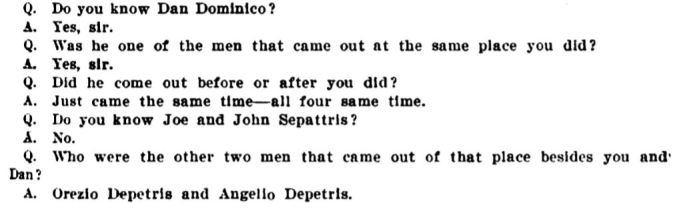
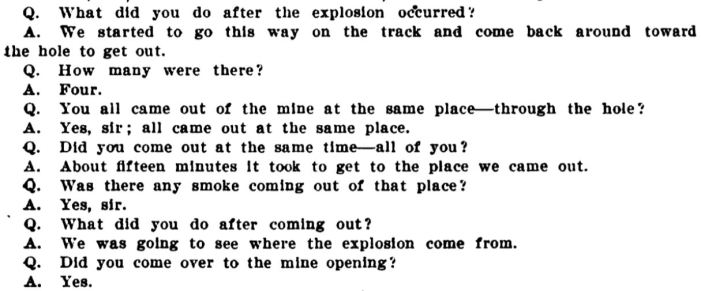
Lenardo Dominico, the son of Dan Dominico, is examined by Att. Lowe. They both escaped through the toad hole of #8.

Lenardo has worked in #8 mine since it opened, “about three years”. On the morning of the explosion, he says he went into work and found the mine open around 5:30 am. He worked alone on the 2nd right of 1st south in #8 then changed to 3rd left. He knows the fire boss that came in around 9 am, but he did not see any other bosses that morning. (Inquiry)

At the time of the explosion he states that “I never seen at all; I tried to get out, but couldn’t see—just knocked down.” He could only see smoke and heard “lots of noise” for about ten minutes. (Inquiry)

01.06.08 - Inquiry - Lenardo Dominico 1

He estimates that the toad hole was about 55 yards away from where he was working. Once he reached the surface, he and Jim Rogers went to the front of the mine. He states that Jim went in the mine again and brought out another victim around 11 am. Though he is not sure of the victim’s identity, the Fairmont West Virginian states it was the body of a Bice—more than likely William Bice, the fan engineer who was trapped beneath the wreckage of the #8 fan house. (Inquiry) (FWV 01.06.08 pg. 1)

01.06.08 - Inquiry - Lenardo Dominico 2

01.06.08 - Inquiry - Dan Dominico

Dan Dominico has lived in Monongah for 17-18 years and was working in #8 with his son, Lenardo, at the time of the explosion. His entire testimony is given through interpreter Joe Beradelli. (Inquiry)

Dan says he didn’t see anything either nor did he hear any noise, he was just thrown down by the shock. However, he was hurt on his ear and arm when thrown down. (Inquiry)

01.06.08 - Inquiry - Dan Dominico 1

Dan states that he didn’t see any gas in the mine before the explosion and when it comes to ventilation in the mine: “Sometimes plenty of it and sometimes less.” (Inquiry)

Dan says that he went into the mine “by myself” that morning but he is not sure of the time as, “I didn’t have any watch.” He is also not sure if there were any other men already in the mine by the time he went in to work nor of the name of the worker or fire boss who came into his work area that morning. He can only say that, whoever it was, “he went away right away.” (Inquiry)

Att. Lowe asks Dan if he is aware of any other men ever getting in or out of the mine via the hole from which he and the other three men escaped and he simply replies that, “I don’t know if the other people were there before or not.” (Inquiry)

He knows of no other explosion within these mines prior to that of Dec. 6, nor does he know the cause of the explosions on that day. (Inquiry)

01.06.08 - Inquiry - Dan Dominico 2

01.06.08 - Inquiry - Angelo DePetris

Angelo DePetris, brother of Crazic DePetris, is the last of the 4 men who escaped from #8 to be examined. Angelo has been in living and working Monongah “about eighteen or nineteen years” but had only been working in #8 for “about a month and a half” before the explosions. (Inquiry)

Almost right away, Angelo also encounters misunderstanding / misinterpretation issues with his testimony:

01.06.08 - Inquiry - Angelo DePetris 1

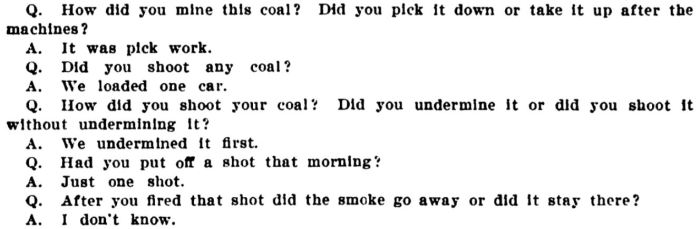
Att. Lowe moves on from that question and asks what type of work they were doing at the time of the explosion. “We had put a shot in and I was picking the coal down from the roof.” When asked about whether or not the smoke from the shot lingered in his area (a question of the ventilation), Angelo states that, “The smoke kind of went away; the air coming in the smoke kind of disappeared.” (Inquiry)

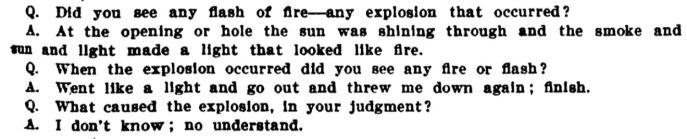
He says the explosion threw him down. He couldn’t find his cap or the light from it. His brother carried the matches and could not find them, so they were left in the dark. After that, they “Walked around to find a way to get outside.” (Inquiry)

01.06.08 - Inquiry - Angelo DePetris 2

01.06.08 - Inquiry - E.P. Knight

E.P. Knight has been the tipple foreman at #6 for “Three years in March.” He is examined by Att. Lowe. (Inquiry)

Knight tells the jury that, on the morning of the disaster, he “didn’t see anything of it,” and only saw a “good bit” dark brown smoke as it “came out of the air-shaft of No. 6. That was about 10:25.” (Inquiry)

He does not recall hearing any noise prior to the explosion but that the explosion itself sounded like “a dead shot some place—dynamite or something”. (Inquiry)

01.06.08 - Inquiry - E.P. Knight 1

Knight was not within sight of #8 mine as he was not on the tipple, but under it at the time of the explosions. He does recall the runaway trip of “About nineteen cars”, which he assumes were fully loaded, being around “50 feet beyond the knuckle” before they all fell back. (Inquiry)

01.06.08 - Inquiry - E.P. Knight 2

Inspector Paul asks if Knight feels that the trip had time to reach the bottom of the slope before he saw the smoke. He does not think it did. He also says he was not in a position to see any smoke coming out of the mouth of #6 because he started right up the steps of the tipple from which he could only see the smoke coming out of the air shaft.  He believes the smoke was coming out the air shaft for “five to eight minutes.” (Inquiry)

Paul also asks if Knight knows of any other time, prior to the explosions, when coal cars had broken loose and run back into the mines. Knight acknowledges that it has happened, though he cannot recall much about the last time it occurred other than going down into the mine and helping to clean it up. He guesses that it may have been 6 months prior to the explosions when this coupling hitch broke between the cars which sent them racing back into the mine though, “It didn’t do any damage; only broke some of the cars and tore up a little track.” However, the reporter in the courtroom for the Fairmont West Virginian includes that this runaway trip also tore down some wires. (Inquiry) (FWV 01.06.08 pg. 4)

In all he can only recall 2 loaded trips having broken loose and falling back into the mine, other than the train on the 6th. Other trips had broken loose but did not make it into the mine thanks to someone throwing the derailing switch. (Inquiry)

01.06.08 - Inquiry - E.P. Knight 3

Knight says he was able to look at the place where the cars broke “and saw the pin had broken.” (Inquiry)

He also states that he was on the phone with Mr. Talbott in the company shipping department when the trip broke loose. (Inquiry)

01.06.08 - Inquiry - E.P. Knight 4

01.06.08 - Inquiry - E.P. Knight 5

Knight is also asked if he recalls the last car on that trip being a water car, but he does not. He states that he did, however, find the broken coupling pin and saw no defect in it or its iron at a glance. (Inquiry)

Knight stated that Talbott had “dropped the telephone” before they could finish their conversation. (Inquiry)

01.06.08 - Inquiry - E.P. Knight 6

It was at the foot of this set of steps that Knight first saw the smoke coming from the air shaft. He is then questioned about distances, stating that he heard a foreman say it was 900 feet from the top of the knuckle on the tipple to the foot of #6 shaft; 400 feet from the top of the knuckle to the pit mouth; from his view under the tipple, the rear car of the trip “looked” to be about 50 feet from the knuckle. Meaning that the cars “would have to run then about 1250 feet to the bottom of the slope”. (Inquiry)

Knight is the presented with wit a portion of a coupling pin and asked to identify it as “a part of the pin that you picked up”. To which Knight replies that, “It looks very much like it.” Knight pocketed the pin on the day of the explosion and gave it to Frank Morris later. (Inquiry)

01.06.08 - Inquiry - E.P. Knight 7

Knight confirms that he was working the tipple on the day prior to the explosion and that, yes, the fans were running in the mines but he does not know which of the fan men, Mr. Lambert or Mr. Snider, was running it. (Inquiry)

01.06.08 - Inquiry - E.P. Knight 8

01.06.08 - Inquiry - Levi Martin

Levi Martin is a laborer outside #6 where he “repairs cars and different things”. He has lived in Monongah for 15 years and at the time of the explosions he was home “near what is called the Willow tree; it is due west” of the mines. He is examined by Chief Mine Inspector Paul. (Inquiry)

Levi is asked about what first alerted him to the explosions. (Inquiry)

01.06.08 - Inquiry - Levi Martin 1

Levi does not know where this hole by the willow trees is located in reference to the mine workings below—“I was never in there and I don’t know anything about it”—but believes he saw smoke rising out around 10:30. He could not see #8 directly but saw the smoke rising. He says he did not see or hear anything from the direction of #6 until after he started over to #8; “I looked down there and saw smoke, but never heard any report down there.” (Inquiry)

01.06.08 - Inquiry - Levi Martin 2

Levi was last at work on the 4th of December and has been working at the mines for about three years. He states that he has no knowledge of any explosions in the mines prior to those of the 6th or of dust ever being “inflamed by an explosion at any time a trip of cars might have run back into the mine”. (Inquiry)

Mr. Alexander asks Levi again about the toad hole. “I think that’s what it is—there by the school house; a drilled hole.” He includes that the hole was recently drilled and just beyond the school house.” (Inquiry)

01.06.08 - Inquiry - Levi Martin 3

01.06.08 - Inquiry - Carl Meredith

Carl Meredith is the foreman for #8 tipple. He is examined by Att. Lowe. (Inquiry)

Carl came into work at the #8 tipple, across the river from #8 mine, around 6:30 on the morning of the 6th but he did not notice if the fan was running in the mine. (Inquiry)

01.06.08 - Inquiry - Carl Meredith 1

He did not see anything from #6 nor is he sure he could even see #6 from his position on the #8 tipple. He states that he saw the timbers and debris flying in the air before he heard the report. He can also state that he did see fire among the smoke at #8. However, he never looked in the directions of #6; “I didn’t think anything about No.6”, so he can not say that he saw smoke coming from that mine. (Inquiry)

01.06.08 - Inquiry - Carl Meredith 2

Levi states that he first thought the boiler for #8 had blown up until he “saw the timbers and brick falling and it was only just an instant until I saw the smoke and knew it was the mine.” He has no knowledge of any prior explosions in the mine nor does he have any working association with #6, only #8. (Inquiry)

01.06.08 - Inquiry - Hyre Stalnaker

Hyre “Harry” Stalnaker is a laborer/carpenter for #6 who has lived in Monongah around 5 years. He was working in #8 shop, across the river from the mine “down toward the tipple from the barn”, on the day of the explosions. He is examined by Inspector Paul. (Inquiry)

Hyre is asked if he was looking at the mine at the time of the explosion. “Well, I can’t say I was, in the first place. I was in the shop not expecting anything like that; when I came to myself I was in line with the mouth of the pit.” The force of the explosion “shocked” him; “nearly stunned”. (Inquiry)

01.06.08 - Inquiry - Hyre Stalnaker 1

Hyre says that immediately following this, he rushed across the bridge to “rescue who might be over there. It was a very short while.” He also did not see or hear anything from the direction of #6 mine. (Inquiry)

Hyre states that he did find Joe Newton on the bridge to #8. (Inquiry)

01.06.08 - Inquiry - Hyre Stalnaker 2

Hyre found George Bice, fan engineer, trapped beneath debris “down next to the street car line. He was lying outside the wall.” Hyre did hear that George did not survive. (Inquiry)

01.06.08 - Inquiry - Hyre Stalnaker 3

Mr. Alexander asks if any of the stone, brick, or other debris from the explosion injured the carpenter shop in which he was working. (Inquiry)

01.06.08 - Inquiry - Hyre Stalnaker 4

He is asked if that occurred before or after he heard any noise or shock but he says it al seemed to happen “about the same time to me.” He says that the shock “caused the iron and everything to give in the shop and the widows to break out. Of course a person couldn’t realize the difference between the times.” (Inquiry)

Hyre confirms that a piece of the large fan at No. 8 was blown across to his side of the river. (Inquiry)

01.06.08 - Inquiry - Hyre Stalnaker 5

01.06.08 - Inquiry - Lee Curry

Lee Curry is the stationary engineer for #8 who was running the hoisting engine for the rail cars that morning. He has lived in Monongah since 1900. He is examined by Inspector Paul. (Inquiry)

Curry was in the engine house at the time of the explosion and could not see the mine but knew something was wrong when the glass broke out of the window “in the house next to the tipple”, but he thought something had occurred with the boiler. “I went out of the house and started around the house to go to the boiler house.” (Inquiry)

01.06.08 - Inquiry - Lee Curry 1

Though he did not hear anything from the direction of #6, he did see smoke coming out and going into the air. (Inquiry)

01.06.08 - Inquiry - Lee Curry 2

Lee figures that it was only five or six seconds between the time he felt the jar and saw smoke coming out of #6 mine as he “only had about twenty-five to thirty feet to go” to the boiler house. He saw the smoke from #8 “as soon as I could get out” from the carpenter shop. (Inquiry)

But Lee could not see #6 mine directly from his location, only “directly over the mine” and the area around 75 feet in front of the mine mouth. (Inquiry)

He states that he noticed smoke coming from the toad holes around St. Stanislaus Catholic church before seeing smoke at #6 but he thinks that smoke first came from #8. (Inquiry)

01.06.08 - Inquiry - Lee Curry 3

Lee tells Inspector Paul that he saw the smoke over the tipple first. “I ran out on top of the bank facing up toward the church and No. 6 and when I got out there I saw the smoke coming out of the hole and as I looked down at No. 6 the smoke whirled up in the air.” He estimates this bank was about 30-35 feet from the engine house by which he was standing. (Inquiry)

Lee says that the toad hole of which he is speaking is actually “a slope to take the horses in at” though he is not sure if it is supported with timbers. (Inquiry)

01.06.08 - Inquiry - Lee Curry 4

01.06.08 - Inquiry - Peddicord

George E. Peddicord has been the outside foreman for #8 for about 6 months and has never worked inside either of the mines. He is examined by Att. Lowe. (Inquiry)

George was on the approach leading to the East end of the Iron Bridge at the time of the explosions. “I had been down to the supply house for chain buckets, and was coming up to No. 8 on the west side of the river.” (Inquiry)

George first noticed the “earth shaking” but not a “loud report—a rumbling noise” from up river toward #8. He then saw timbers and debris in the air “right above” the area he knew was #8 mine, though he could not directly see the mouth. (Inquiry)

He looked at No. 6 “as soon as No. 8 went off” and saw smoke coming out of the air-shaft at #6. He can not say how long the smoke continued to pour out of the mine; “I didn’t look; I knew the mines had exploded and went across the river up to my home and then to No. 8 mine.” He did not notice any flame but did see a distinctive difference between the color of the smoke emitting from each mine— “The smoke that came out of No. 8 was black and that which came out at No.6 was a reddish brown.” (Inquiry)

George was within sight of the #6 tipple but did not see the runaway trip of cars. (Inquiry)

01.06.08 - Inquiry - Peddicord 1

Inspector La Rue asks about the length of time George estimates that he saw the smoke appear between the two mines to which he responds, “Not more than a second.” (Inquiry)

George restates that he did not see smoke coming from #6 mouth because he could not see the mouth, only the smoke coming from the air shaft and confirms that smoke from one mine was black and that from the other was brown in color. (Inquiry)

He estimates that he arrived back at #8 mine in about 10 minutes. There was no steam coming out of the boilers when he arrived. (Inquiry)

Att. Lowe inquires about any former explosions or accidents at these mines but George knows of none. “I had nothing to do with the inside; I was an outside man.” (Inquiry)

George states that he had been at #8 that morning and that Will Bice was running the fan; “the fan ran all the time.” He also states that, though #8 did not technically run the day before the explosions, he was at work on the 5th with many others, including William Bice who was running the #8 fan. “Alvy Yost worked the night shift.” (Inquiry)

Inspector Paul asks if George had charge of the livestock outside of the mine but George says those duties fell to the general foreman, Charlie Dean. (Inquiry)

01.06.08 - Inquiry - Peddicord 2

01.06.08 - Inquiry - Will Jenkins

Will Jenkins has been a blacksmith for FCC at the #6 mine for about “seventeen months”. He is examined by Att. Lowe. (Inquiry)

Will arrived at work around 6:40 am that morning. He had gone into the mine before the explosions occurred to shoe a horse. (Inquiry)

01.06.08 - Inquiry - Will Jenkins 1

Will estimates that he was inside the mine “about half an hour—a little bit longer than that probably.” He also estimates that he had only be out of the mine 15 or 20 minutes before the explosions occurred. While inside, he did not notice any evidence of gas and that the ventilation was “Good. I made a remark to myself about my lamp nearly blowing out two or three times.” (Inquiry)

Will says there was a horse waiting to be shod in the blacksmith shop, some 25-30 feet down river from the mine, so that is where he went after coming out. He had only gotten one shoe on and was reaching around to pick up the next shoe when the explosion happened. (Inquiry)

01.06.08 - Inquiry - Will Jenkins 2

Even though Will is not familiar with the exact numerical distance it is “from the bottom of the slope to the bottom of the mine” he believes that the trip of cars “must have gotten to the bottom, for the power went off at the blacksmith shop.” (Inquiry)

01.06.08 - Inquiry - Will Jenkins 3

Will confirms that he knew the trip of cars must have been a runaway trip and that it was accompanied by an “unusual noise”. (Inquiry)

01.06.08 - Inquiry - Will Jenkins 4

Will says it was about 2-3 seconds between the time the power went off in the shop and smoke started coming out of the mine and again confirms that he believes that the trip of cars had enough time to reach the bottom of the mine. (Inquiry)

01.06.08 - Inquiry - Will Jenkins 5

Will says he saw no flame, just a steady blow out of smoke with a “kind of sootish color” and no return. (Inquiry)

Inspector Paul asks how long it took Will to get from the blacksmith shop to the mouth of #6 mine. Will says he was “right over the mouth while it was still blowing” but he heard no other noise after the one he first heard in the shop. Inspector La Rue asks is the rumblings were steady or jerky “as if explosions were going on at different places”. But Will is not sure, he says he was pinned down under the horse and was struggling to get out at first. (Inquiry)

Will is asked about the quality of ventilation in the areas that he worked inside of #6 that morning, if it was “fully as good as at any time prior?” Will recalls it as being even better that morning, “I remember of pulling the wick up out of my lamp three or four times on account of the current.” (Inquiry)

He says he did not walk in and out of the mine that morning but, instead, took the motor. (Inquiry)

01.06.08 - Inquiry - Will Jenkins 6

Will states that based on “the way it was going past”, he figured the trip must have reached the bottom. He is not sure exactly how many feet it is to the bottom of the slope and he guesses 500 feet or more. (Inquiry)

01.06.08 - Inquiry - Will Jenkins 8

Will is asked if he stopped shoeing the horse when he heard the runaway trip go by but Will says he could not as he was already down under the horse. “The trip going by scared it. He was still tramping around over me when the explosion occurred. I didn’t see the first start of it, but felt the jar of it.” (Inquiry)

01.06.08 - Inquiry - William Finley

William Finley is the “Town Sergeant” for Monongah. He is examined by Inspector Paul.(Inquiry)

At the time of the explosions, Finley was “standing on the street by the coal company’s office, at the south side of it” where he could see # 8 mine. He says he “heard a report of some kind up the river like a heavy blast and I seen smoke coming up over the bridge at No. 8.” He noticed smoke coming out of #6 afterward, 4-6 seconds later “or something like that.” (Inquiry)

Finley did not see or hear the runaway trip of cars at #6. (Inquiry)

01.06.08 - Inquiry - Peter Urban

Peter Urban (Rosebeig) is the only man to survive rescue from the mines. He is examined by Inspector Paul. (Inquiry)

01.06.08 - Inquiry - Peter Urban 1

Peter has lived in Monongah on No. 3 hill for around 6 months. He went into work around 6 am on the morning of the explosions and began work in 1st Right off the 1st heading. He is asked if anything “unusual” occurred in the mine. “I know nothing what happened.” (Inquiry)

01.06.08 - Inquiry - Peter Urban 2

When asked if the force of the explosion extinguished his light he replies, “I don’t remember; I was so frightened I don’t remember anything.” However, his brother, Stan did have a light. (Inquiry)

01.06.08 - Inquiry - Peter Urban 3

Peter states that he does not know what caused the explosion. He says he has, however, encountered gas in the mine before, but not on the day of the explosion. “It was some time before. At this time we were driving a heading and gas and water came in. We were driving a hole—I suppose high up—and gas and water came.” (Inquiry)

01.06.08 - Inquiry - Peter Urban 4

Peter says that he encountered this gas no more than 3 days prior to explosions, but they were told to stay. He states that there was “bad air” on the heading they were working on and that gases were “allowed” to accumulate “after the firing; after we fired them there would be heat and here and there a little flame burning of the gas.” Peter says he has never been burned or harmed from the lighting of these gas traces. (Inquiry)

01.06.08 - Inquiry - Peter Urban 5

Peter says this occurred at the end of a North entry heading in the 7th room, though he is not sure exactly which heading as it is not one he goes to very often, but he did see the horse and aftermath in person as they came through, “…they said it had been killed by an explosion.” (Inquiry)

Peter states that no human was injured in the event and that the carcass was buried at night; “It happened about 8 o’clock in the morning, about in the evening.” (Inquiry)

01.06.08 - Inquiry - Peter Urban 6

Peter is not sure who exactly buried the horse other than “it was someone from the company pulled him out and buried him.” However, Peter says that no one told him the horse had been burned, he saw it with his own eyes. “I saw the horse that was burned and then I heard he was hurt from others; he was burned by gas. When I went down to the mine we passed the horse.” (Inquiry)

Mr. Alexander, a lawyer for FCC, asks about the color of the horse but Peter replies that he couldn’t really see the color of the horse in the mine, “and after he was buried I couldn’t tell.” When asked about why he knows that the horse was buried, Peter says that he also saw this with his own eyes as it was buried “near the No. 3 mine where they buried the other horses now”, meaning those who perished in the disaster. (Inquiry)

When asked if he could point out this grave, Peter says if he couldn’t, his wife probably could, and that “right next to this horse they buried the other horses.” (Inquiry)

01.06.08 - Inquiry - Peter Urban 7

Mr. Alexander makes Peter run through the questioning again:

01.06.08 - Inquiry - Peter Urban 8

Peter says that Stan told “John, the boss” about the gas and water they encountered the same week that it happened and that they couldn’t work in that area; “Not the old one—but the tall one—the big boss.” (Inquiry)

At some point, Italian Consulate, G.D. Caldera, storms out of the courtroom in protest of Mr. Alexander’s aggressive attacks against the witness. (McAteer)

01.06.08 - Inquiry - Peter Urban 9

COURT IS ADJOURNED UNTIL TOMORROW


More on the Monongah Disaster of 1907

Introduction

Disclaimer and Guide

How Death Gloated!: A Timeline of the Monongah Disaster and Bloody December of 1907

Who is Guilty?: A Timeline of January 1908 and the Coroner’s Inquiry
Issues with the Monongah Timeline

Bibliography/Resources

About the Author

Contact Information

Sunday, January 5, 1908

During the Day

The funeral for David Riggins is “largely attended”. (FWV 01.06.08 pg. 1)

~6:00 pm, News Hour

New York Tribune:
NYTb 01.05.08 - pg 5 - Darr
NYTb 01.05.08 – pg 5
Evening Star in D.C.:
ES 01.05.08 - pg 12 - Darr
ES 01.05.08 – pg 12

Night

In Baltimore:

The Paint and Powder Club performers leave for Fairmont.

“For the last three weeks the members of the Paint and Powder Club have been holding three rehearsals daily and took their parts up until time of the train’s departure from Baltimore and no part of the programme has been scamped” (FWV 01.06.08 pg. 1)

“President Murray, of the Baltimore and Ohio R.R., through his assistant, Mr. Geo. M. Shriver, has tendered to the committee free transportation and special cars, leaving Baltimore…Sunday night on No. 3 and arriving in Fairmont, Monday. Returning, leaving Fairmont on No. 14, Tuesday.” (FWV 01.02.08 pg. 5)

Instructions have been given to “division superintendents along the line of route to instruct their forces to do everything possible to make the trip pleasant, to even putting on extra air on the curves and not bantering loud words with passing crews as that tends to make the ‘girls’ hysterical and unfit for work.” (FWV 01.02.08 pg. 5)

FWV 01.04.08 - pg 1 - Paint and Powder lead
FWV 01.04.08 – pg 1
FWV 01.03.08 - pg 6 - Paint and Powder photo
FWV 01.03.08 – pg 6


More on the Monongah Disaster of 1907

Introduction

Disclaimer and Guide

How Death Gloated!: A Timeline of the Monongah Disaster and Bloody December of 1907

Who is Guilty?: A Timeline of January 1908 and the Coroner’s Inquiry
Issues with the Monongah Timeline

Bibliography/Resources

About the Author

Contact Information

Saturday, January 4, 1908

Morning

In Fairmont:

The Fairmont West Virginian reports the weather as: rain or snow and colder tonight; Sunday fair and colder

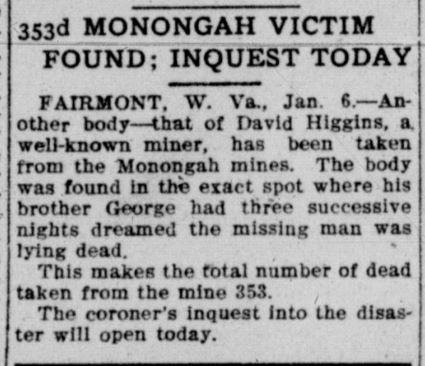
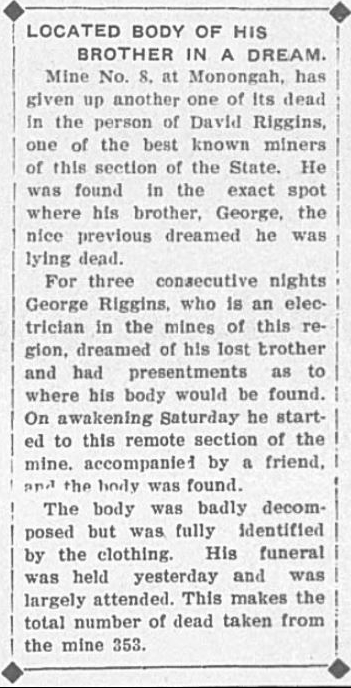
George Riggins, an electrician in the mines of the region, awakes after having dreamt for the past 3 nights about his brother, David, whose body is still in Monongah mines. David Riggins was one of the best-known miners of this section of the State. (FWV 01.06.08 pg. 1)

In Monongah:

George Riggins has some presentments as to where his brother’s body will be found. He starts to this remote section of the mine with a friend and the body was found in the exact spot where George dreamed David was lying dead. The body was badly decomposed but was fully identified by the clothing. (FWV 01.06.08 pg. 1)

This brings the number to 353. (FWV 01.06.08 pg. 1)

During the Day

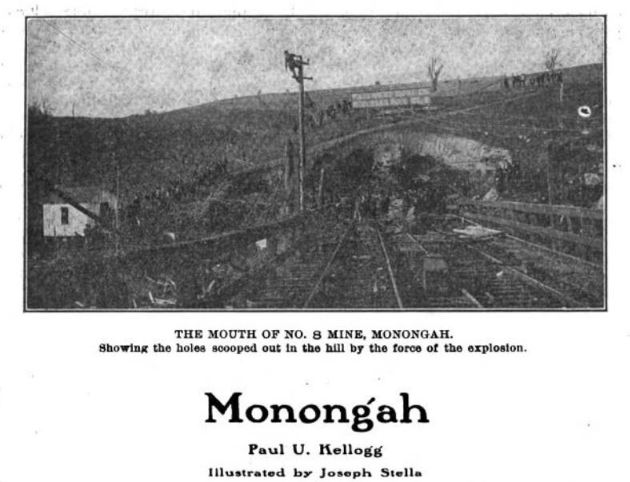
Paul U. Kellogg publishes his article on the days he spent in Monongah after the  disaster in the January edition of Charities and Commons.

title image

In Fairmont:

The Grand Opera House produces a Matinee performance of  “A Pair of Country Kids”; “…one of the best country comedies of the day…”.  (FWV 01.03.08 pg. 2 & 8)

The Grand Opera House - Fairmont

~6:00 pm, News Hour

Fairmont West Virginian:
FWV 01.04.08 - pg 2 - jokes
FWV 01.04.08 – pg 2
FWV 01.04.08 - pg 2 - nevada miners entombed
FWV 01.04.08 – pg 2
FWV 01.04.08 - pg 2 - P&P show
FWV 01.04.08 – pg 2

“By far the most pretentious entertainment ever attempted in this part of the State will be the performance of the Paint and Powder Club…The fact that Governor Dawson and the members of his staff are coming…and that tickets are being sold at most of the larger cities in the State is sufficient to prove the importance of it. With the box prices at $100 and the seats each $3, the P.P. Boys must put on a superb show or they could not get the patronage. Again, we all know that Mr. C.W. Watson, who spends much of his time in Baltimore, would not vouch for the show were it not strictly of high order; neither would the Baltimore and Ohio Railroad Company transport free of charge a troupe…” (FWV 01.04.08 pg. 4)

“There are hundreds of people in Fairmont who have not yet contributed anything for the relief of the widows and orphans of the near neighbors at Monongah and this will give them opportunity to aid the sufferers and at the same time spend a most enjoyable evening. The entire receipts of the performance above the actual expenses will be turned over for the relief of the unfortunate people at Monongah, so this is a good way to turn in a small amount for their assistance.” (FWV 01.04.08 pg. 4)

FWV 01.04.08 - pg 5 - P&P photo
FWV 01.04.08 – pg 5
FWV 01.04.08 - pg 8 - Cresko_Kresko Fudiciary - Hungarian
FWV 01.04.08 – pg 8
FWV 01.04.08 - pg 8 - Duresz_Durectz Fudiciary - Hungarian
FWV 01.04.08 – pg 8
FWV 01.04.08 - pg 8 - Ignocok_Ignacsak Fudiciary - Hungarian
FWV 01.04.08 – pg 8
FWV 01.04.08 - pg 8 - Stopiro_Stofira Fudiciary - Hungarian
FWV 01.04.08 – pg 8
Clarksburg Daily Telegram:
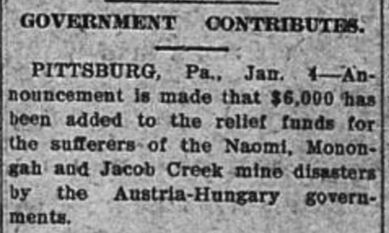
CDT 01.04.08 pg 1 - govt. contributes
CDT 01.04.08 pg 1
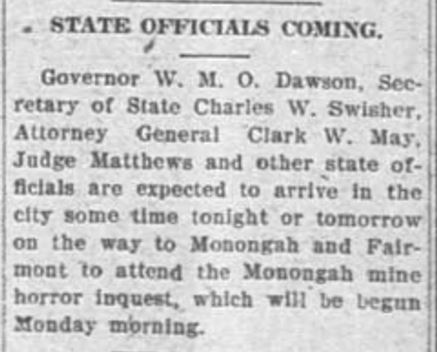
CDT 01.04.08 - pg 8 - officials coming
CDT 01.04.08 pg 8
The Socorro Chieftain in New Mexico:

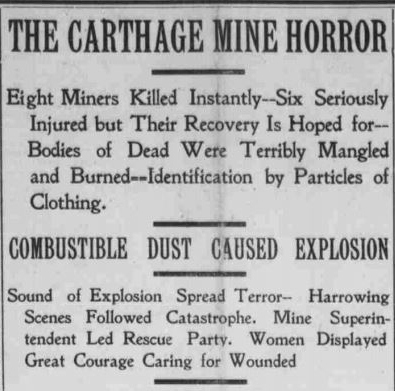
TSC 01.04.08 - pg 1 - Bernal - detail 1

“Death in one of its most gruesome forms lurked in the Bernal mine of the Carthage Fuel company at Carthage during the losing hours of the old year.” (TSC 01.04.08 pg. 1)

“The cause of the catastrophe is believed to have been what coal miners know as a ‘wind shot’. This means that a shot put in to break down a quantity of coal for removal later did not explode in the usual fashion but merely fizzled, raising a cloud of highly combustible coal dust. This dust was doubtless ignited by the explosion of another shot and instantly death had done its gruesome work.” (TSC 01.04.08 pg. 1)

“On every hand were abundant evidenced of the terrific force of the explosion. The bodies of some of the dead were blown against the walls of the mine with such a force as to flatten them almost beyond, recognition. In one instance, at least, a dead body was identified only by particles of clothing adhering to the mangled flesh. The body of one miner who was coming out of the mouth of the mine was shot a hundred yards into the air as from the mouth of a cannon and nearly all the bones in it were broken by the fall. In the case of some of the injured, small stones were driven into their flesh like bullets and had to be extracted with the surgeon’s knife.” (TSC 01.04.08 pg. 1)

“Even the sound of the explosion spread terror throughout the mining camp. It must be left to the imagination to picture the distressing scenes which followed. It was no time for the useless wringing of hands, however, for the living in the mine, if any, must be rescued from the jaws of death. Heroic rescue work was done by W.L. Weber, mine superintendent, and by many others. Doctor Bacon, company surgeon, worked like a Trojan to save and relieve the injured, and women were not lacking to aid him heroically at his task. Willing hands and sympathetic hearts were everywhere to care for the dead, and minister to the necessities of the living victims of the awful disaster.” (TSC 01.04.08 pg. 1)

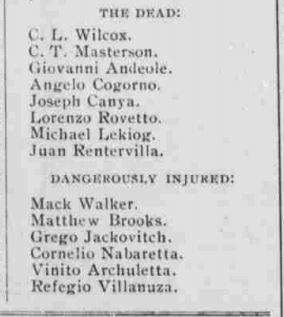
“The latest report from Carthage is to the effect that all the six injured miners will recover, except Villanuza, whose chances are not considered good. The company officials are doing all they can in caring for him and the other injured, and are sparing in no expense in providing for the future of the bereaved families. All the mines of the camp were shut down on New Year’s day on account of the funerals, but have since resume operations at the request of the miners themselves, who thin work the best means of relieving the nervous strain under which they have been since the disaster. The mine was not injured by the explosion.” (TSC 01.04.08 pg. 1)

TSC 01.04.08 - pg 1 - Bernal - detail 2
TSC 01.04.08 – pg 1
The Labor World in Minnesota:

TLW 01.04.08 - pg 1 - mines 1

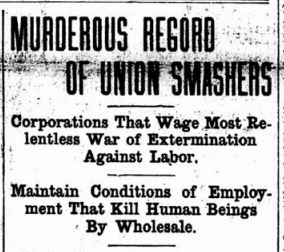
“During the month just closing two accidents about 100 miles apart, on the same river, fully 500 souls were launched into eternity in a twinkling of an eye by the lawlessness of mine authorities. There can be no doubt of this, the order of Inspector Louttit to Superintendent Morris of the Naoma mine proves one case and the fact that the mines at Monongah, W.Va., were operated without two openings, contrary to the laws of West Virginia, proves the other. In neither mine were the laws governing ventilation obeyed. On the contrary, the plainest and most self-evident necessities to secure proper ventilation were ignored. It proves nothing to say that the mines were finely equipped with machinery, etc. An elaborate and gorgeous palace is unsafe to live in when it has an open sewer in its cellar.” (TLW 01.04.08 pg. 1)

“The innocent public are called upon to succor the dependents of the unfortunate victims in every instance and especially is this so in the Monongah disaster. The public does not participate in the profits of this greatest of bituminous coal combinations. The Consolidation Coal company, the parent corporation of the Fairmont, Somerset combine, operates extensive mines in three states, under the fostering care of the Baltimore and Ohio Railroad company, all of these corporate combinations have waged a relentless war of extermination against individual coal operators and labor organizations since the early forties.” (TLW 01.04.08 pg. 1)

“It is high time some radical steps were taken to safeguard life in the more dangerous occupations. If the mine owners had spent half the time and money at Monongah, W. Va. In making reasonably safe conditions that they have spent in fighting the labor unions that were trying to give the miner a dog’s chance, this nation would not be a byword as it is. Extract the last dollar from the business, never mind the human heart!” (TLW 01.04.08 pg. 1)

The Detroit Times in Michigan:
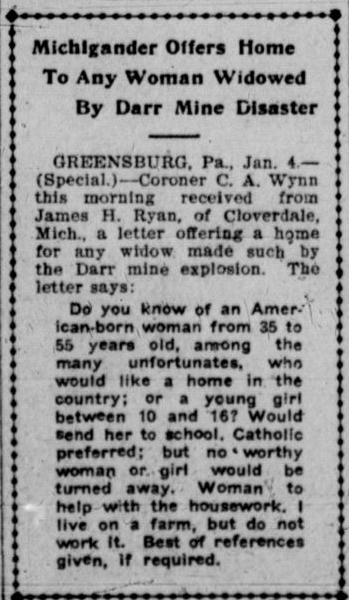
TDT 01.04.08 - pg 1 - Darr
TDT 01.04.08 – pg 1
Evening Star in D.C.:
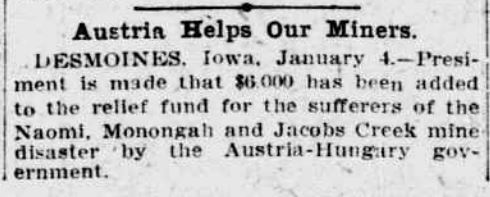
ES 01.04.08 - pg 9 - Austria donates
ES 01.04.08 – pg 9
ES 01.04.08 - pg 11 - Darr
ES 01.04.08 – pg 11

Evening

In Fairmont:

The Grand Opera House produces a Night performance of “A Pair of Country Kids”; “…one of the best country comedies of the day…”.  (FWV 01.03.08 pg. 2) (FWV 01.03.08 pg. 8)


The Electric Theater again presents “Passion Play”. “Misses Lula and Eva Barnes, of the Presbyterian Choir, will sing for this occasion.” (FWV 01.03.08 pg. 8)

Miss Zanie Martin, daughter of Mrs. Mary Martin, is seriously, possibly fatally, burned at her home on High Street by falling in the fire in a fainting spell. Miss Martin was subject to such spells and it had always been feared that she should fall into the fire at such a time. Medical assistance was rendered at once. (FWV 01.06.08 pg. 8)


More on the Monongah Disaster of 1907

Introduction

Disclaimer and Guide

How Death Gloated!: A Timeline of the Monongah Disaster and Bloody December of 1907

Who is Guilty?: A Timeline of January 1908 and the Coroner’s Inquiry
Issues with the Monongah Timeline

Bibliography/Resources

About the Author

Contact Information

Friday, January 3, 1908

12:30 am

In Fairmont:

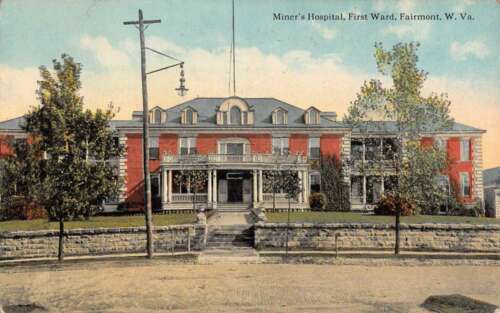
Jack Wilson, an employee at the round house, lights a match and carelessly throws it down. The match falls into a can of powder. Jack is severely burned and taken to the Miner’s Hospital. It is feared he will lose his eyes. (FWV 01.03.08 pg. 1)

miner's hospital - postcard

Early Morning

In Elwood City, PA:

The dead bodies of Chris Evans and Bertha Gordon are found along the track of the B&O railroad. “The couple were on their way to the woman’s house when they became confused, a fast freight train coming out of the tunnel and running them down before they had an opportunity to escape.” (FWV 01.03 08 pg. 1)

Morning

In New York:

7 men who survived the wreck of the Germanic arrive and “told the story of the wreck of the bark Germanic, the captain drowning, and the disappearance of eight crew members. The horrors endured were terrible.” (FWV 01.03.08 pg. 1)

In the Flemington/Grafton, WV area:

James Clevenger, of Flemington, is gradually losing his family to starvation. “It is said that the awful state of affairs was brought about by the extreme poverty of the family and the refusal of the father and husband to work.”  Miss Cleveland Clevenger (aged 18) and Julia Clevenger (aged 14) die of starvation while “another is critically ill and the other five are eking out a bare existence.” (FWV 01.03.08 pg. 1)

“The residents of the community in which the Clevengers live were ignorant of the awful state of affairs existing at their residence, which is a mere shanty, almost devoid of furniture, until the deaths occurred.” (FWV 01.03.08 pg. 1)

“Since, the charitably inclined neighbors have furnished food and clothing and medical attention, so the surviving members of the family will fare much better in the future.” (FWV 01.03.08 pg. 1)

In Fairmont:

The Fairmont West Virginian reports the weather will be: Fair tonight and Saturday; warmer Saturday

Misses Edith and Mabel Wise, sisters of Charles Wise, return to their home in Canton, Ohio. (FWV 01.03.08 pg. 8)

During the day

At the Alpha mine in Nevada:
AC 12.31.07 pg 1 - Trapped Gold miners 1
AC 12.31.07 pg 1

“Advices from Ely, Nev., state that probably ten days more will be required before the rescuers reach Brown, McDonald and Bailey, the three miners who have been imprisoned since December 1 in the Alpha shaft of the Giroux mine at Ely. It is likely that the men will have been six weeks in their tomb-like prison before they can be freed.” (FWV 01.04.08 pg. 2)

“They are able to talk with their rescuers over the mine telephone and declare that they are very well satisfied with their quarters and that there is no particular hurry about getting them out. Water and food is sent down to the men through a six-foot pipe, and they have considerable room for exercise. Air is constantly forced in to them. To while away the time the men occasionally hold vocal concerts, singing over the telephone wires for the benefit of those above.” (FWV 01.04.08 pg. 2)

At the Darr mines in PA:
Darr Mine Victims Now Number 226. Jacobs Creek, Pennsylvania., January 3rd. Two more bodies have been removed from the Darr mine here, bringing the total number of known victims of the recent disaster to 226, one more than was predicted. The rescuers believ there are more bodies under the debris that remains in the pit.
TDT 01.03.08 pg 2
Maryland Briefs. Among the victims of the Darr mine explosion was Joseph Murphy, fire boss, a son of Nicholas Murphy, the town sergeant at Grantsville, Garrett County. He was so badly burned that his body was scarely recognizable. The body of his brother Nicholas was still in the mines at last reports.
MJ 01.03.08 pg 3

~6:00 pm, News Hour

Fairmont West Virginian:
Standing Room Only Is Expected At The big Performance
FWV 01.03.08 – pg 1
FWV 01.03.08 - pg 1 - Baltimore troupe
FWV 01.03.08 – pg 1

“The Paint and Powder Club plays for charitable benefits only and its appearance here is for the benefit of the Monongah sufferers.” (FWV 01.03.08 pg. 1)

“This club is made up of the best talent in Baltimore. Its actors are artists and a first class show is assured.” (FWV 01.03.08 pg. 1)

“…almost decided that Parkersburg would get it. But when the Monongah explosion came, the members of the club desired to assist in raising the big relief fund that will be required to take care of the sufferers. They wired people here and the arrangements were made for their coming.” (FWV 01.03.08 pg. 1)

Avg. nightly receipts = $4,000 in most places (FWV 01.03.08 pg. 1)

“The general committee composed of Sprigg D. Camden, Walton Miller, J.O. Watson, Brooks Fleming and Geo. A. Alexander have enlisted the services of a number of young men and women who are selling tickets in Wheeling, Parkersburg, Clarksburg, Grafton and Morgantown.” (FWV 01.03.08 pg. 1)

Price of ticket = $3 (FWV 01.03.08 pg. 1)

FWV 01.03.08 - pg 6 - Paint and Powder photo
FWV 01.03.08 – pg 6
FWV 01.03.08 - pg 1 - Union Relief donation
FWV 01.03.08 – pg 1
FWV 01.03.08 - pg 1 - 1907 Lynchings
FWV 01.03.08 – pg 1
FWV 01.03.08 - pg 1 - Kids taught to steal
FWV 01.03.08 – pg 1

01.03.08 - pg 1 - middle headline

FWV 01.03.08 - pg 1 - Monongah elections
FWV 01.03.08 – pg 1
FWV 01.03.08 - pg 3 - recipe 2
FWV 01.03.08 – pg 3
01.03.08 - pg 3 - recipe
FWV 01.03.08 – pg 3
FWV 01.03.08 - pg 4 - Monongah likes liquor
FWV 01.03.08 – pg 4
FWV 01.03.08 - pg 2 - grand opera
FWV 01.03.08 – pg 2

01.03.08 - pg 8 - The Grand- Winkle - 101.03.08 - pg 8 - The Grand- Winkle - 2

01.03.08 - pg 8 - Jefferson - winkle sprit picture
FWV 01.03.08 pg. 8
FWV 01.03.08 - pg 6 - woman killers
FWV 01.03.08 – pg 6
FWV 01.03.08 - pg 8 - rent own house ad
FWV 01.03.08 – pg 8
Clarksburg Daily Telegram:
CDT 01.03.07 - pg 1 - Paint and Powder
CDT 01.03.07 – pg 1

CDT 01.03.08 - pg 7 - mining - detail

CDT 01.03.08 - pg 7 - mining - detail 2
CDT 01.03.08 – pg 7
The Washburn Leader in North Dakota:
TWL 01.03.08 pg 2 - mine events
TWL 01.03.08 pg 2
Topeka State Journal in Kansas:
TSJ 01.03.08 pg 1 - Monongah
TSJ 01.03.08 pg 1
The Bottineau Courant in North Dakota:
BCz 01.03.08 pg 3 - Little dead Miner
BCz 01.03.08 pg 3

Evening

At the Darr Mines in PA:
Recover More Bodies. List of Dead From the Darr Mine Now Numbers 231. Jacobs Creek, Pennsylvania, January. 3rd. - Five more bodies were recovered today from the Darr mine, bringing the list of dead up to 231.
ETR 01.03.08 pg 1
In Fairmont:

The young ladies of the city give a Leap Year dance at the Tavern. “The invitations to the young men were extended through the young ladies who called for them at their homes.” (FWV 01.03.08 pg. 5)

Skinners tavern - fairmont - wvhistoryonview

“The young ladies will do the Leap Year act from start to finish.” (FWV 01.03.08 pg. 5)

“At the dance, dances were engaged by the young ladies and all the little courtesies heretofore confined to the masculine sex were performed by the hostesses.” (FWV 01.04.08 pg. 5)

“The ballroom at the Tavern was in holiday attire and Omen’s Orchestral furnished an excellent program for the dancing.” (FWV 01.04.08 pg. 5)

This slideshow requires JavaScript.

The Electric Theater again presents “Passion Play”. “Misses Lula and Eva Barnes, of the Presbyterian Choir, will sing for this occasion.” (FWV 01.03.08 pg. 8)


More on the Monongah Disaster of 1907

Introduction

Disclaimer and Guide

How Death Gloated!: A Timeline of the Monongah Disaster and Bloody December of 1907

Who is Guilty?: A Timeline of January 1908 and the Coroner’s Inquiry
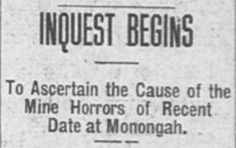
Issues with the Monongah Timeline

Bibliography/Resources

About the Author

Contact Information