Sunday, December 8, 1907, Afternoon, 12:00 pm – 5:00 pm

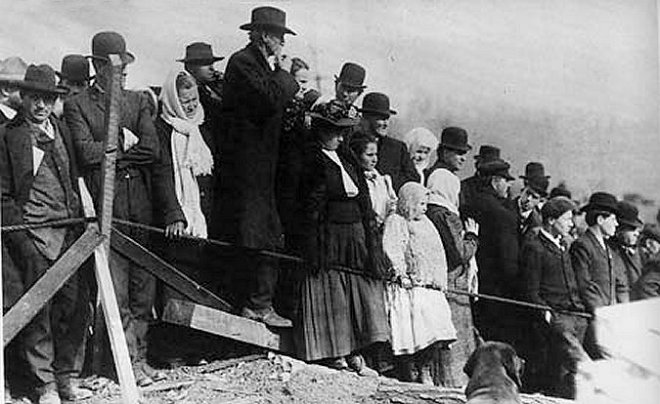
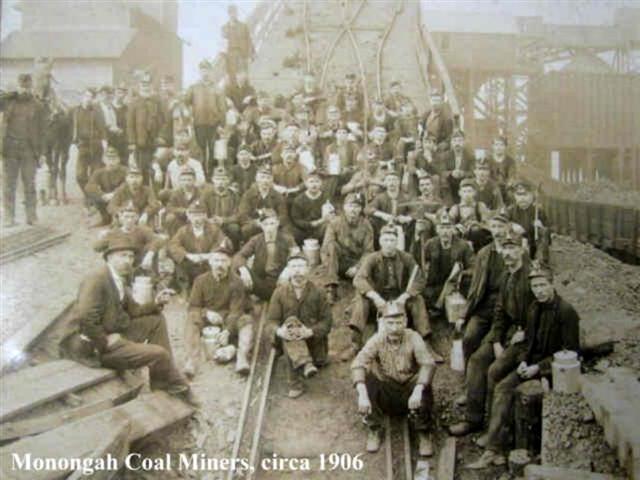
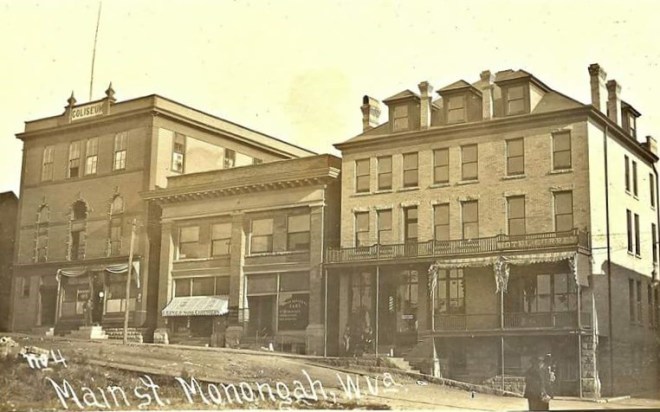
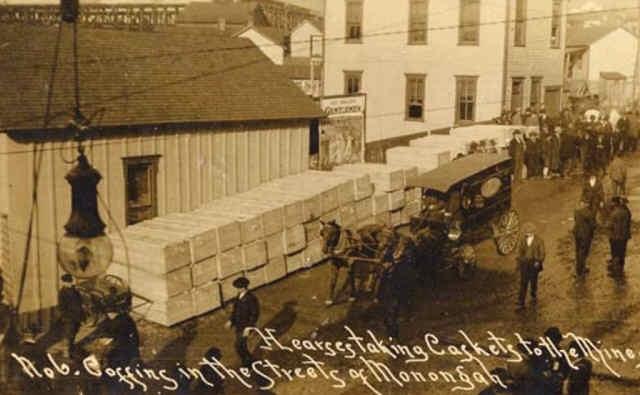
“75 men digging graves on the hillside, a depot platform piled high with pine boxes, a row of coffins in the main street stacked 3 high and nearly a block in length, a corps of undertakers as large as a regiment’s hospital corps, women whose eyes could weep no more, with orphaned children clinging to their skirts—these were some of the evidences that there would be no Christmas in Monongah for another year.” (Forbes)
m5

~ Noon

In Monongah:

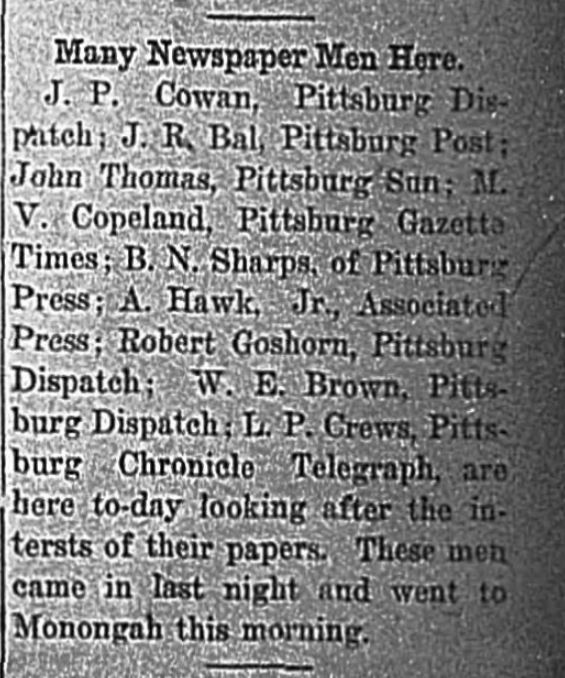
“Many newspaper men, including photographers, from all over the country are at Monongah. All of the nearby cities have special reporters on the scene and there are newspaper men from Pittsburg, Wheeling, Cincinnati, Cleveland, Washington and other cities.” (CDT 12.8.07 pg. 1)

“Probably never before on any occasion have the interurban cars carried as many people as they have in the last few days since the mine disaster. All along the line hundreds of anxious people are found at every station eagerly trying to get on a car to go to the scene of the disaster. Many of them are foreigners who had relatives working in the two mines. Sunday the interurban station in this city was crowded all day and many people visited the scene of the disaster. The street cars were run double all day and every one was crowded to its utmost. Many people took advantage of it being Sunday, to go to Monongah.” (CDT 12.8.07 pg. 1)
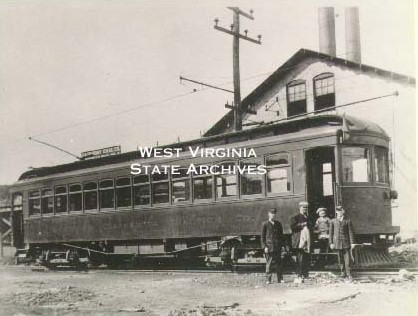
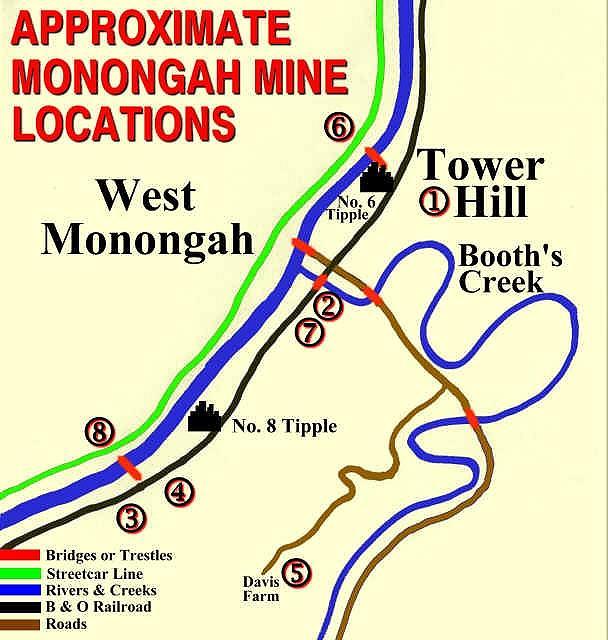
Fairmont and Clarksburg Traction Company streetcar in front of the Fairmont Coal Company Monongah Mine No. 8.jpg

Inside the mines:

“The farther into the mines the workers proceed the greater the destruction is found to be. Many side entries and rooms are completely blocked by falls of slate. One room where it was known two of the miners were working was entered but instead of finding the blackened bodies of the two miners tons and tons of slate were found burying them so that it will be several days before their bodies can be recovered. The same condition of affairs is reported at many other points in the mine.” (US Dept of Labor-mine disasters-Dispatch article)

Outside the mines:

“Finally, a horse came out of the hill and behind it a train of empty mine cars but the last car was loaded and covered with stained canvas and blankets. The coverings were thrown off and one by one the blackened and mutilated bodies of what had once been men were carried to the waiting wagons to be hauled over the bridge into the town and delivered to the undertakers.” (Forbes)

“They all looked as if they had been par-boiled, they were so red. Many of them were mutilated and in several cases the eyeballs had been split by the force of the explosion. The bodies were beginning to decompose.” (CET 12.10.07 pg. 6)

~2:00 pm

Col. J. H. McDermott arrives in Fairmont as representative of Gov. Dawson, who was unable to come to the scene of the Monongah disaster. Judge J.W. Mason and Clerk W.T. Black met him at the train station. (FWV 12.9.07 – pg. 1 – extra) (FWV 12.9.07 pg. 1)

“I am here to look over the situation,” said Col. McDermott, “and will advise Gov. Dawson from time to time what I learn. I am not here to interfere with any department of the mines, as each representative of every department will adhere strictly to his own work.” (WH 12.9.07 pg. 1)

“At the last meeting of the State legislature Col. McDermott, in his capacity as President of the Senate, appointed a committee to investigate the mines of West Virginia and the mine disasters. This committee had visited both the mines at which the explosion took place, about two months ago, and pronounced them as being as finely equipped and managed as any they had ever seen. It is quite probable that this same committee will arrive here shortly for another examination of the Monongah mines.” (WH 12.9.07 pg. 1)

At some point during the afternoon

In Fairmont:

“This town has some plucky girls, and it is a question as to whether their equal can be found. …Sunday there were 4 of them walked to Monongah, across the hill, taking all the near cuts and making the distance as short as possible. That’s game, that is.” (FWV 12.16.07 pg. )

“Headed by the churches, relief work was well started yesterday and a general appeal to the public is being made. Many West Virginia towns have already acted and others are ready to do so. The work will be thoroughly organized and systemized.” (ES 12.9.07 pg. 1-2)

“Relief corps were organized by the women of Fairmont today. Already hundreds of dollars are pouring in.” (WH 12.9.07 pg. 1)

In Morgantown:

Collections from all Morgantown churches are handed over to relief funds. (FWV 12.9.07 pg. ?)

At the morgue in Monongah:

“R.L. Cunningham, of Fairmont, who is one of the undertakers who have charge of the band of fifteen caring for the bodies brought out of the mines, preparing them for burial and placing them in coffins, met with an accident that has laid him up. While hurrying from the morgue in the First National Bank building on Main street to one of the branch morgues, he slipped and fell, spraining a weak knee joint so badly that he cannot walk. He is confined to his room in the Curry hotel under care of a physician and his work has devolved upon another undertaker. Messrs. W.G. Osborn and Sleppy & Warne, of this city, are still with the undertakers assisting in the work of taking care of the dead.” (CDT 12.8.07 pg. 1)
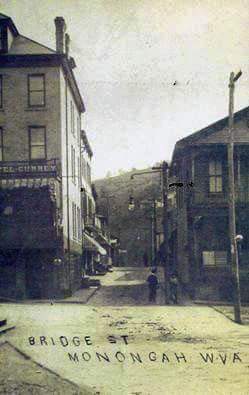
Intersection of Bridge St and Main street

At the cemeteries:

“About twenty victims were buried today in the three cemeteries near the town.” (AMJ 12.9.07 pg. 1)

“The bodies of fifteen Italians were buried in Holy Cross cemetery Sunday afternoon. The cemetery is located on the hill over the mines. The bodies of two Polanders were also buried the same afternoon in the Polish cemetery which is on the same hill adjoining Holy Cross cemetery. The bodies of two Polanders are lying in the Polish church where services will be held over them.” (CDT 12.9.07 xtra pg. 1) (CDT 12.9.07 xtra pg. 10)
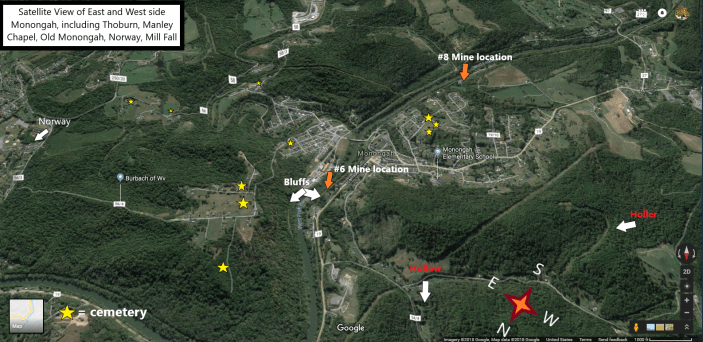
draft 1

In Monongah:

“Another woman, the mother of five little children, whose husband was killed in mine No. 8, became so distracted at her home that she began throwing household articles about the house and then to tear her clothing from her. She became so violent that friends had to tie her to a chair and stand watch over her until she became quieted.” (CDT 12.8.07 pg. 1)

“The body of Fred Rogers was taken to Fairchance Sunday afternoon and buried there.” (CDT 12.9.07 xtra pg. 1) (CDT 12.9.07 xtra pg. 10)

“…3 men who were thought to be victims but escaped are Ross Morka, Marie Bagenealla and Anebra Spaw. The 2 former went to Clarksburg to visit some friends early in the morning of the explosion but did not notify their boarding boss of their intentions. They were given a royal reception when they appeared today. Spaw, one of the men supposed to have been blown into the river at the entrance of No 6 was not at work that fateful morning. When he learned that his friends were mourning him as dead he lost no time in returning from a visit to Grafton.” (US Dept of Labor-mine disasters-Dispatch article)

At the mines:

“But 3 bodies have been removed from No 8 mine this afternoon, two being those of a motorman and a brakeman found near their car at the first left entry of the north heading near where the third body was found. All were badly burned about the face and hands but friends were able to recognize them at the morgue.” (US Dept of Labor-mine disasters-Dispatch article)

“A thrilling incident occurred on the bridge on which the mine cars were pulled from mine No. 8 in which an aged Polish woman nearly lost her life. Her only son, and the bread winner of the family, was killed in the awful explosion. She wandered out on the bridge and was climbing on some planks used as a temporary walk and was viewing the workers about the wreckage in front of the mine. Suddenly she staggered and fell. Several men ran to her side and caught her just as she was falling into the river. Friends carried her away in hysterics.” (CDT 12.8.07 pg. 1)
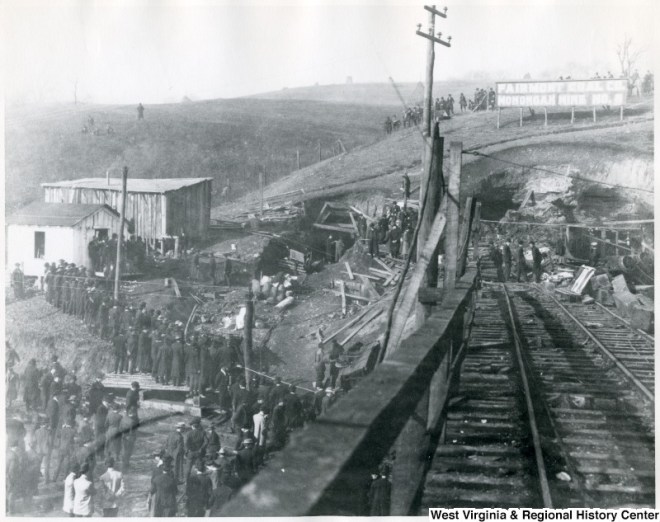
WVC 8

In McKeesport, PA:

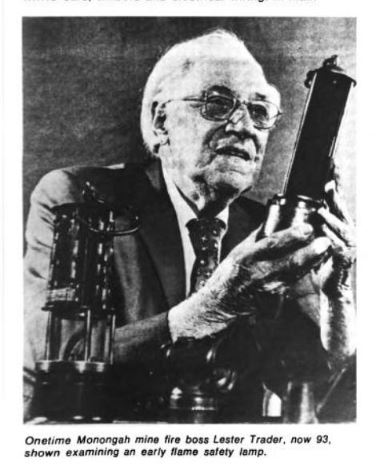
Lester E. Trader and his brother are at their father’s home in McKeesport when General Manager Frank Haas “… called up and said he wants us to get back here. Frank and I couldn’t leave the company that way. I went back and they gave me a job in the auditor’s office in Clairmont.” (McAteer)

Victor told Trader that in return for being given an office and a job in the accounting department, he would be quoted as official spokesperson for company. (McAteer)
Trader - mine safety & health - ebook

In Fairmont:

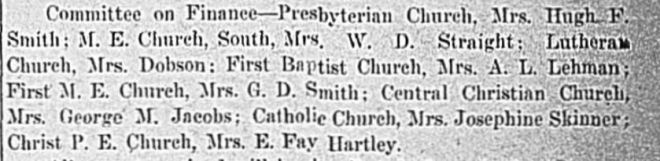
The Union Relief Association is organized at the Methodist Protestant Temple for the purpose of receiving and distributing aid of all kinds to the stricken families in and about Monongah and is rapidly shaping plans through the various committees, to do the necessary work in a thoroughly business-like way. (FWV 12.9.07 pg. ?)

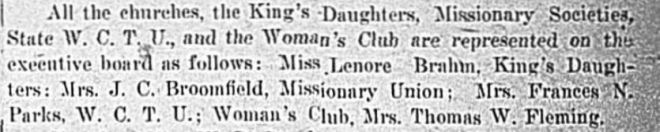
Collections from the morning’s church services are turned over to Mrs. Thomas W. Fleming, “who will see that it does the most possible good to lessen burdens that the grief-stricken ones are bearing.” (FWV 12.9.07 – pg. 1 – extra)

“Donations of money can be handed to any member of the following committee and receipt for the same will be sent to the donor by Mrs. Thomas W Fleming, chairman.”
12.9.07 - pg - Union relief organized - names detail 112.9.07 - pg - Union relief organized - names detail 212.9.07 - pg - Union relief organized - names detail 312.9.07 - pg - Union relief organized - names detail 4

~2:30 pm

Chief Mine Inspector J.W. Paul goes into #6 to inspect conditions. (McAteer)

“At both mines members of rescuing parties are being taken from the mines weakened and unconscious condition but after being out for a few hours they have fully recovered. None of the rescuers who have been overcome is now in serious condition.” (US Dept of Labor-mine disasters-Dispatch article)

At the morgue:

“One thing that is considered strange is that few things of value are being found among the effects of the dead. From information received from the company officials Coroner Amos was of opinion that large sums of money would be found in the clothes of the foreign miners and working upon this supposition a careful search was made of every garment removed from the body. It was known to be a custom of the foreigners to carry their money with them, but the most valuable article so far found was a silver watch in the pocket of Peter Alexander, who was removed to the morgue Sunday afternoon.” (CDT 12.9.07 pg. 1)

~3:00 pm

At #8:

“All Sunday until 3 o’clock in the afternoon, when the searching parties were ordered out so that the mine inspectors make a test and experiment with the new fan at No. 8, there were sixty men engaged in the work of recovering bodies and nearly a score were taken out during the day.” (CDT 12.9.07 xtra pg. 1) (CDT 12.9.07 xtra pg. 10)

*For the past 32 hours or so, all of the local mines owned by Fairmont Coal Company have been shut down and those miners have been reporting to Monongah for work. 2 small fans on loan from local smaller mines have been circulating air into #8. With rescue and recovery work now formally systemized under Inspector Paul and the other state inspectors and a plan to regularly change out volunteer crews, Fairmont Coal Company intends to restart regular work in their other local mines tomorrow.

*A replacement fan is currently is on its way from Pittsburg and scheduled to arrive on a special train around 4 pm. One of the fans is to be switched out and sent back to its original mine so that regular work may resume there tomorrow.

*Around 3 pm General Manager Frank Haas, who has been in charge of overseeing work at #8, begins to put their devised plan for switching out the fans into action. A majority but not all miners are ordered out of #8 just before one of the 2 fans is switched off. The outside crews are prepared to begin unmounting the fan from its temporary housing and get it across the trestle to the railroad line.

*Inside #8, small “hot spots” in explored and still unexplored areas of the mine (where coal is smoldering and radiating heat but there is not enough oxygen to ignite flame or smoke) become fully deprived of air. As the coal burns, it continues to release methane gases, but the air circulation is not powerful enough anymore to disperse or dilute these gases. Those who are permitted to remain in the mine during the fan switch are more than likely those who are working near or in the direct path of the 2nd fan which is not turned off.

*At #6, men are also ordered out at this time as the air current from #8 will likely push dangerous gases into the workings of #6.

“The work at No 6 progressed rapidly owing to the conditions of the powerful fan there, until the rescuers were ordered from the mine because of the temporary cessation at No 8.” (US Dept of Labor-mine disasters-Dispatch article)

“After the men were ordered to cease temporarily from the rescue work at No. 6 the opening was closed and late in the day the big new fan was set to work at No. 8. One reason for the ordering of the men out was the discovery of some gas at the connection of the two mines, and another was that it was the purpose to divert the air-course from No. 8 into No. 6, thus making it dangerous for men to work in No. 6. While this was going on a heavy guard was placed on the city side of the bridge running across the river to the tipple and no one was allowed to cross there, lest there might be a deadly current of air out of No. 6 at any moment.” (CDT 12.9.07 xtra pg. 1) (CDT 12.9.07 xtra pg. 10)

~4:00 pm

In Monongah:

The Company hires 3 Fairmont undertakers to manage the bulk of transporting the dead: Musgrove & Sons, R.I. Cunningham, and Jones & Co.; these 3 hire on 20 more undertakers from Fairmont and surrounding towns. (McAteer)

Unfortunately, the undertaker transport drivers are not very familiar with area of Monongah. Much confusion occurs over the next days in the transport of bodies to the correct homes. Priests will end up helping with most. (McAteer)

“The rapidity with which the remains began to be recovered late this afternoon and evening necessitated the coal company pressing into service a number of transfer wagons. These were filled with straw and the gruesome work of carting the charred remains across the river through the dense crowd began. Scenes that were sublimely pathetic transpired. The weeping of the bereaved ones as they madly chased after the vehicles was heartrending. They overwhelmed the morgue in their clamors for a look at the dead and it was necessary to drive them back by force and draw ropes across the main street. Pickets were stationed and the crowd thus held in check. It would only separate when the carriages of death were forced through to take the bodies to the cemeteries.” (US Dept of Labor-mine disasters-Dispatch article)

At #8:

*The anticipated 4 o’clock B&O special train arrives carrying very important materials for the rescue efforts and, more than likely, Paul U. Kellogg and several others who will become key figures over the next few days

“The victims at Monongah were working with open lamps on their caps; it was 2 days after the explosion before a supply of safety lights sufficient even for the exploring parties reached the mine.” (Forbes)

“A big mine fan, with auxiliary machinery arrived here on a special train from Pittsburg this afternoon at 4 o’clock, for use at the opening of Mine No. 8. Machinists and other workmen at once began work on installing it at the mine entrance and as soon as possible the machinery was in operation.” (CDT 12.8.07 pg. 1)

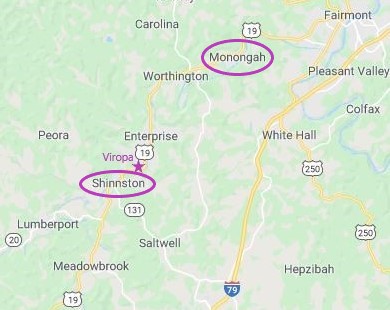
*When the train arrives, crews load the uninstalled fan onto an empty car or flat bed. The train pulls up slightly and crews unload the new fan and begin to haul it back across #8 trestle. The train continues on southbound to return the old fan to its proper mine in the Shinnston area.

*It takes approximately 45 minutes for this very experienced and driven crew to complete this task and get the fan running ventilation through #8 again. As far as Haas and the other onlooking reporters who may have known of this plan in advance, everything is going splendidly. Once ventilation has had some time to work its way through the mine, the state inspectors will perform the first formal fire and air check of #8.

“As soon as the fan was in operation the work of rescue was stopped at both Mine No. 6 and at Mine No. 8 for the purpose of testing the fan and ascertaining the result of the air current it would make.” (CDT 12.8.07 pg. 1)

*It does not take long for the new burst of air flowing through #8 to begin feeding these small “hot spots” throughout the mine. Smoke begins to fill the galleries and headings of the mine.

“New difficulties and complications have confronted the rescuers on every hand, but with only brief interruptions the work was continued until 3 o’clock yesterday afternoon. Then the fire drove all from the unexplored regions and the search had to be abandoned for the remainder of the day and for the night.” (TEW 12.9.07 pg. 7)


* = Author’s description of events. There is much conflicting information over the next 24 hours for several reasons and there will be an “Issues” post about this event and this author’s choices in the future. See ‘Dislaimer and Guide’ for more insight on this process.


More on How Death Gloated!

Bibliography

Disclaimer and Guide

Introduction

About the Author

Contact Information

Saturday, December 7, 1907, News Hour, 6:00 pm

“Today it seemed like a continual procession of men carrying out corpses. The bringing up of each mangled form would be followed by a rush from women and men around the mines looking for their dead ones.” (TEP 12.7.07 pg. 1)

~6:00 pm

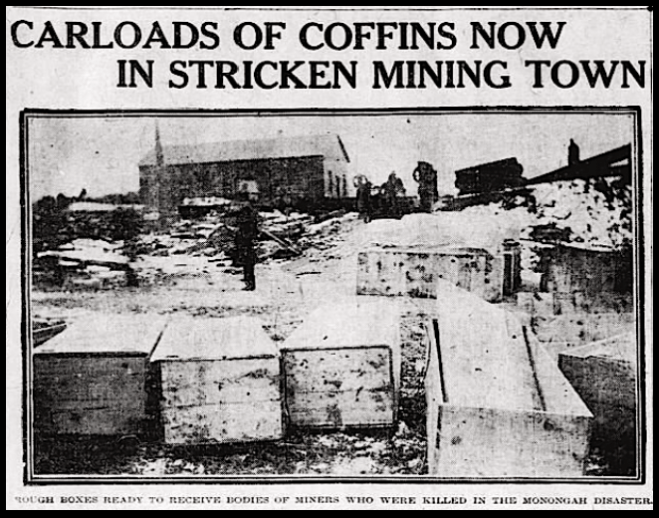
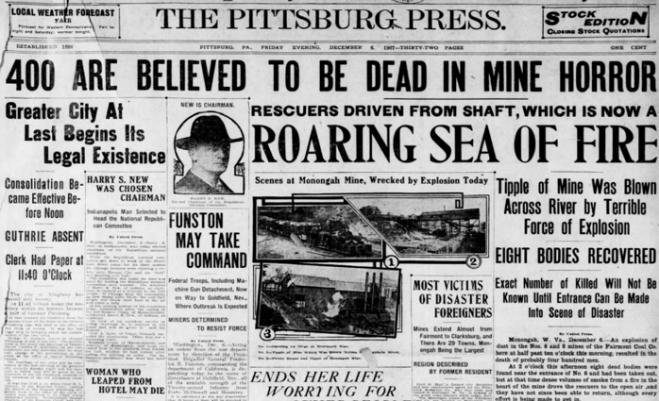
Monongah-Mine-Disaster-Carloads-of-Coffins-Ptt-Prs-Dec-7-1907
PP 12.7.07 pg 1

“All day long today little groups of men brought dead bodies from the mines…” (TEP 12.7.07 pg. 1)

“Five additional bodies were taken out of the mine at 6 o’clock tonight, making twenty up to date.” (WH 12.8.07 pg. 1)

“The rescuers say they have about seventy others in sight, which they will bring out within the next few hours. All of these are in No. 6 and so far, nothing has been done toward recovering the dead in No. 8, where the gases are strongest.” (WH 12.8.07 pg. 1)

“The fumes from the explosion and decomposition of bodies has greatly hampered the work.” (WT 12.7.07 pg. 1)

“…the shafts and tunnels are still filled with smoke and gas.” (WT 12.7.07 pg. 1)

“Although there are great crowds about the mine entrance there are innumerable women and children crouching in modest homes awaiting what they know must come—the blackened remains of a husband, of a father, of a brother.” (WT 12.7.07 pg. 1)

Governor Dawson has arrived in Charleston from Washington D.C. (FWV 12.7.07 – pg.1)

Newspapers

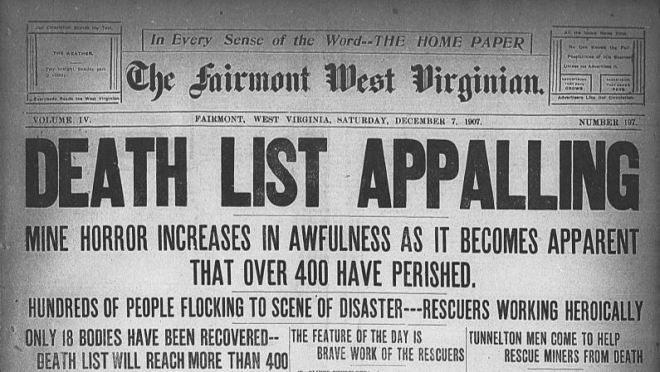
12.7.07 - pg 1 - Major headlines

The Ladies’ Auxiliary of Christ Protestant Episcopal Church is the first social organization in city to offer financial aid. They announce that they will be giving proceeds from their musical planned for Dec. 11 to the Monongah relief aid. (McAteer)

12.7.07 - pg 1 - Ladies Guild show

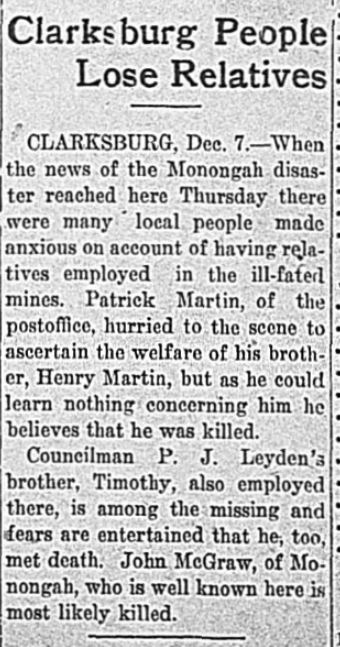
The paper also informs the Fairmont populace of just a few miners who regularly traveled from Clarksburg to work in the mines.

12.7.07 - pg 1 -Clarksburg relatives

The Clarksburg Daily Telegram startles the public with its evening headline:

“President C.W. Watson in a brief interview stated that he had nothing definite to give out as to the cause, but from the small amount of smoke, he judged it was caused by dust, which ignited from a small pocket of gas, or a blown out shot.” (CDT 12.7.07 pg. 1)

“Mr. Watson explained that the two mines were connected for the purpose of giving more openings.” (CDT 12.7.07 pg. 1)

“General Manager Lee Malone of the Fairmont Coal Company in an interview at the scene of the horror, given to the Telegram representative, stated that there were 450 men in the mine at the time of the explosions and that he was of the firm belief that all were dead.” “He pointed out that there was nothing particularly strange about there being an explosion in both mines at once, one immediately after the other, as the two mines are on the same side of the river instead of opposite side, as first reported,…” (CDT 12.7.07 pg. 1)

They report that on the 6th: “George Bice, a member of the rescue party at mine No 8 was overcome by the afterdamp, brought to the surface unconscious and died shortly afterward.” And that, “A man named Stuart of the rescue party was also overcome by the afterdamp. He was brought above unconscious but soon revived and will doubtless recover.” (CDT 12.7.07 pg. 1)

Luckily, the George Bice did not die. In fact, he may have never been overcome with gas at all. There were, however, 3 men among the rescue crews who will die in the process, more than likely from inhaling too many toxic fumes: John Neary, and brothers Maurice and Richard Beedle.

When it comes to publishing the names of the dead, the Telegram focuses entirely on the names of known Americans.

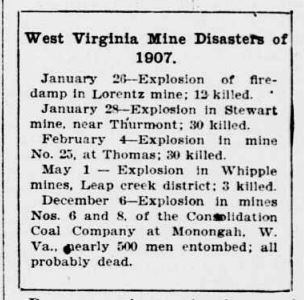
The D.C. Evening Star publishes a list of just the West Virginia Mine Disasters of 1907.

12.7.07 - pg 1 - Monongah 2
ES 12.7.07 pg 1

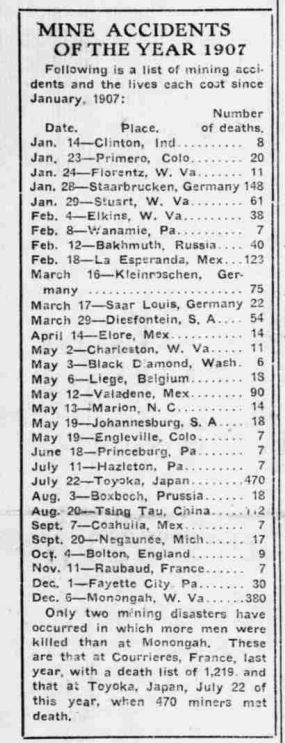
The Rock Island Argus of Illinois published a list of all mining disasters in 1907:

12.7.07 - pg 1 - Monongah 2

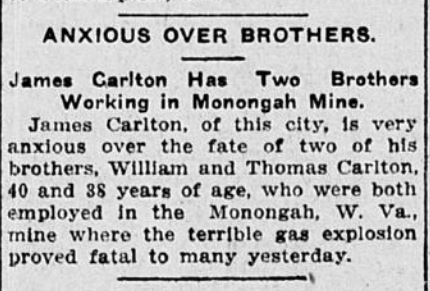
In Iowa, the Evening Times Republican informs their readers that:

12.7.07 - pg 7 - Brothers in mines
ETR 12.7.07 pg. 7

The Times Dispatch in Virginia publishes a (very) rough map of where Monongah lies in the state:

12.7.07 - pg 2 - Monongah cont. 4
TD 12.7.07 pg. 2

The Cumberland Evening Times is already trying to clear up confusion and rumors:

“The terrible mine disaster at Fairmont, W.Va., caused unusual excitement up along the George’s Creek region, due to the fact that a number of miners in that section had sought employment in the West Virginia territory.” (CET 12.7.07 pg. 1)

“At this writing, however, but one miner from this county is known to have been killed by the explosion. He was John Herman, who resided at Eckhart until about two years ago, when he removed to Fairmont, and was employed in mine No. 8 when the explosion occurred.” (CET 12.7.07 pg. 1)

“A sister of the unfortunate man, living at Eckhart, was notified by wire yesterday afternoon that her brother had been killed and last evening three other brothers, John, Jacob and Frank Herman, all of whom live at Eckhart, went to Fairmont to recover the body.” (CET 12.7.07 pg. 1)

“The deceased was 37 years of age, and leaves a wife and one child.” (CET 12.7.07 pg. 1)

“Joseph Milkowsy, another miner formerly residing at Eckhart, is also employed at one of the mines at Fairmont, but whether he was one of the victims of the terrible disaster could not be learned.” (CET 12.7.07 pg. 1)

They also report that, “Messrs. Philip Jenkins, Sr., Philip Jenkins, Jr., Edward Jenkins, E.T. Thomas, William Hensell, Alex Crawford, and Andrew Crawford, left today for Fairmont, W.Va., to assist in the work of rescuing the miners who were killed in the mine disaster at Fairmont yesterday.” (CET 12.7.07 pg. 1)

“The above relief corps will remain at the scene of the horrible calamity until the last victim has been taken out of the mines.” (CET 12.7.07 pg. 1)

“This action on the part of the Frostburg contingent is purely for sympathy’s sake.” (CET 12.7.07 pg. 1)

Like several other papers, The Buffalo Enquirer of New York is not only reporting that, at noon, workers are still battling the early morning fire from #8, they are already telling their populace, “Yesterday the company officials endeavored to keep the number of men in the ill-fated mine down as much as possible.” (TBE 12.7.07 pg. 1)

The Evening Star in Washington D.C. reports:

“It is thought that by tonight the full extent of the horror will be known, and it is feared the knowledge of this will precipitate even more pitiful scenes than those of today, with hysteria in all of its devious forms rampant among the populace. Precautions have already been taken to prevent these harrowing manifestations of grief, but there is little hope that they will avail.” (ES 12.7.07 pg. 1 – 2)

C.W. Watson, president of the Consolidation Coal Company, dictated the following statement to the Associated Press:

“The accident is deplorable from any standpoint. It was entirely unexpected. As yet we do not know the exact cause of the explosion.

“It might have resulted from a blown out shot igniting a pocket of gas. About 50 per cent of the mine accidents of the country are caused in this manner. It is probable the present one resulted from the same cause. We will conduct a rigid investigation. Investigations, however, will not benefit the dead miners. Their families will be looked after. The company will bury all the dead. Every facility within the power of the company is being extended to all newspapermen in order that the general public may be accurately informed as to the disaster. We have nothing to conceal and are pleased to give whatever information we can.”  (ES 12.7.07 pg. 2)

~6:30 pm

In Monongah:

“Up to 6:30 o’clock tonight twenty-two bodies had been brought to the surface from mines Nos. 6 and 8… Over 100 bodies have been found.” (ODB 12.8.07 pg. 1)

“President C.W. Watson of the mining company in a statement to the Associated Press today said every possible investigation would be made of the disaster to ascertain its cause and fix responsibility.” (ODB 12.8.07 pg. 1)


More on How Death Gloated!

Bibliography

Disclaimer and Guide

Introduction

About the Author

Contact Information

Saturday, December 7, 1907, Early Afternoon – Dusk, 1:00 pm – 6:00 pm

12.9.07 - pg - Monongah 112.9.07 - pg - Monongah 212.9.07 - pg - Monongah 3

At the morgue:

“Nearly 400 coffins reached Monongah today from Pittsburg and from West Virginia cities.” (ES 12.7.07 pg. 1)

“Many coffins have arrived and more have been ordered and as fast as identification is made sure the bodies are being taken away by their friends for burial.” (FWV 12.7.07 – pg.1)

At the mines:

“The galleries are still filled with poisonous gases and it is impossible to open them till the main entries are opened and the fans can clear them.” (TBE 12.7.07 pg. 1)

“Working conditions are terrible, owing to gas and the wrecking, shifts can work less than an hour at a time.” (ES 12.7.07 pg. 1)

“While only sixteen bodies have been recovered or brought out of the mine, members of the rescuing parties stated that eighty bodies have been located.” (ES 12.7.07 pg. 1)

“Only sixteen of the dead bodies have been removed from the shaft entrance of No. 6, but 100 others are in the first level and are being kept in the mine until the authorities can get the half-crazed people away from the entrance.“ (TBE 12.7.07 pg. 1)

“Preparations are being made to bring the bodies from the mines in electric cars, with which the mines were equipped.” (WT 12.7.07 pg. 1)

“The rescuers in mine No. 6 report so many bodies that it will take hours to get them all out. In No 8 mine the rescuing parties are just getting started as poisonous gases there were worse than in No 6 mine.” (TEP 12.7.07 pg. 1)

~1:00 pm

At the mines:

“Up to 1 o’clock today but sixteen bodies have been brought to the surface…” (ES 12.7.07 pg. 1)

“A dozen undertakers are also in waiting in one of the buildings near the entrance to take charge of the bodies as soon as they are brought out and make them as presentable as possible.” (WT 12.7.07 pg. 1)

“A thousand men are working…” “About 130 corpses had been found in the wrecked Monongah mines here at 1 o’clock this afternoon.” (Pitt. Press. 12.7.07, Sparks)

In Monongah:

The body of Fred Cooper (one of first men found in the shanty of #6 mine) has been fully processed through the morgue and his body is brought into Fairmont on the one o’clock car. He is taken to his father-in-law’s home, Mr. Shingleton, at the corner of Locust Ave and 11th St. (FWV 12-7-07, pg. 1)

~1:30 pm

Clarksburg Daily Telegram puts out a special, extra edition:

The local newspapers are correcting their previously published information on the location of the mines. Though the Clarksburg Daily Telegram puts out far more accurate information now that they have their own reporters on the scene, their original source—the Associated Press—never corrects their original inaccurate information at any point and it continues to circle around the country for the next several weeks.

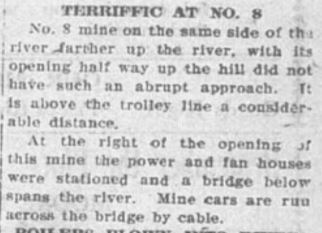
12.7.07 - pg 1 - #612.7.07 - pg 1 - #8

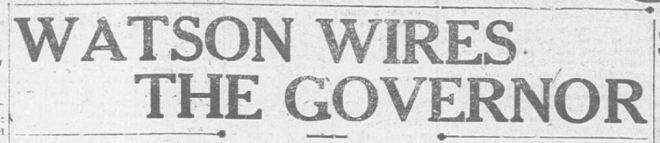
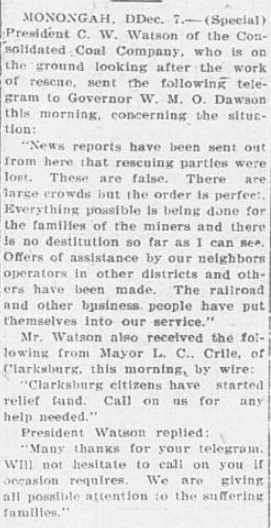
The results of just some of these inaccurate reports have already made their way back to Monongah. For the next several days, Watson and other officials will struggle with the press. They have little to no experience with mass swarms of reporters nor with managing a catastrophe of such magnitude. They will make several mistakes in their attempt to control the release of information over the next week, including the most devastating mistake of making it obvious to the press that information is being controlled.

12.01.07 - pg 1 - Xtra - sub-headline 212.7.07 - pg 1 - Xtra - watson telegram

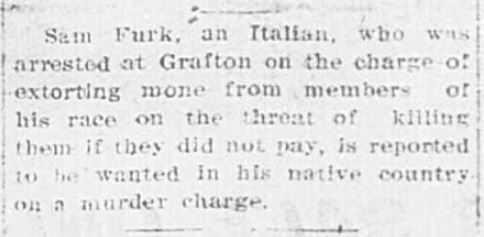
Quietly tucked away on page 3 is an update on Sam Furk, reported leader of the local Black Hand, which would have taken front page status had the disaster in Monongah not occurred:

12.07.07 - pg 3 - Xtra - Furk Black Hand

~2:00 -2:30 pm

Inside #6:

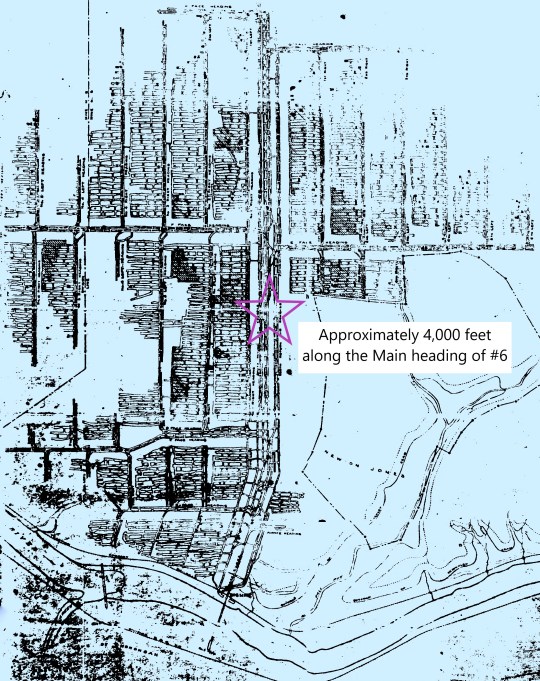
Search parties find only 5 men between the bottom of the slope of #6 to the connection of the 2 mines – distance of about ¾ of a mile, over 4,000’. Only the main heading has proper ventilation and cleared wreckage that far back, but not the rest of the mines proper (rooms, hallways, etc.) where most of the victims surely lay. Ventilation systems “will have to be rebuilt throughout the mine” starting “this afternoon”.  (FWV 12.7.07 – pg.1)

4,000 feet into #6

“The resources are being reinforced as men are needed, so that as soon as one man is overcome his place is taken by another.” (FWV 12.7.07 – pg.1)

Though it is quite clear that the town is teaming with news reporters all day based on the sheer number of events accounted throughout the afternoon, few reporters managed to note the time of when certain events occurred. The best this author can provide at this moment is a list of these events in what is the most likely order in which they occur, trying to keep in mind that some of these may have been occurring simultaneously.

At some point during the afternoon,

“…with hysteria in all its devious forms rampant among the populace.” (RIA 12.7.7 pg. 1)

At the mines:

Several rescuers enter the mines “only to return to the open much more dead than alive.” (CDT 12.7.07 pg. 1)

“The first emergency hospital is crowded with men who have been overcome with the mine gas…” (FWV 12.7.07 – pg.1)

“The rescuers as they come out report that men to the right and left of them are lying all about the mine…” (FWV 12.7.07 – pg.1)

“A foreign woman whose husband was in the mine, rushed to the entrance but the gas forced her back. Realizing that she could do nothing toward aiding her husband, she tore the skin off her face with her finger nails and pulled out large twists of hair.” (WT 12.7.07 pg. 1)

At the morgue:

“The following bodies were identified in the morgue today: DOMINICK, who worked for John Preston. MIKE ____, also one of Preston’s men. FRANCISCO LORIA, who is horribly mangled. CARMO ZEVOLA, who was identified after some time by his [whole line of text is missing]. Much doubt existed in the authenticity of her identification but the small tobacco sack which he carried was the means of making the identification sure.” (FWV 12.7.07 – pg.1)

“Another body that has been positively identified is a man who is known as Louis, his other name not being known. Mr. Caldara says he is from Naples.” (FWV 12.7.07 – pg.1)

In Monongah:

Lorin Wise, brother of Charlie Wise, and Mabel & Edith Wise, his sisters, arrive from Canton, OH. (FWV 12.12.07 pg. 1)

A wagon load of bodies is trying to get from #6 mine across the Iron Bridge and to the morgue. Before it reaches the bridge, the crowd rushes the cart from all angles, pinning in and frightening the horses. The horses panic and bolt, racing through the crowd, overturning the cart, and dumping the bodies onto the ground before running over the embankment. The crazed horses continue down the river bank and run straight into the icy waters of the West Fork River, taking along the driver and his assistant. As the cart hits the water, the driver is violently thrown out and seriously injured. (McAteer)

“As the day advanced, [the widows] became almost crazed through grief and suspense. One pulled out her hair in handfuls at a time and another tore all the skin from both cheeks with her fingernails. Some lay down on the frozen ground and cried themselves asleep, and in this condition, many were carried to homes nearby without awakening.” (RIA 12.7.07 pg. 1)

“The company has provided clothing, food, and supplies for all who are in need and charity on every hand is being observed.” (CDT 12.7.07 pg. 1)

The body of a young man is brought to his home and placed inside. 2 hours later and one room away, his wife gives birth to their child. (FWV 12.9.07 – pg.8)

At the mines:

“The workers at both pits are being cheered and helped in their heroic task by the presence and good words of their bosses.” (FWV 12.7.07 – pg.1)

“Everything possible has been and is being done to recover the bodies of the dead miners and to take out any who might be alive. The coal company officials have given their best energies to the work and are yet grimly at work sleepless and hungry without thought of rest until all has been done to reach any miner possibly alive and to recover the bodies of the dead ones.” (CDT 12.7.07 pg. 1)

“Late today the deadly blackdamp became more pronounced as the more farther recesses of the mines were approached…” (DASB 12.8.07 pg. 1) (LODD 12.12.07 pg. 1)

ME46.JPG
History Inside Pictures (Radka)
At #8:

“One hundred men are working in mine No 8, where the damage was greatest…” (WT 12.7.07 pg. 1)

In Charleston, WV:

Gov. William M.O. Dawson calls out the National Guard: Company H of First Infantry under the direction of Col. M.M. Neely. Despite Watson’s telegram earlier in the day, the Governor is concerned about potential disturbances among immigrant families and the throngs of sightseers. (McAteer)

At #6:

“Some bodies have been brought to the mouth of #6 but have not yet been made known.” (FWV 12.7.07 – pg.1)

“In No. 6 there are 150 workers. Though the interior of this mine is not so badly damaged as the other, the gas in the tunnels is more troublesome, and it is necessary to come frequently to the surface for fresh air.” (WT 12.7.07 pg. 1)

“As the rescuers groping and dazed came from the mouth of the mine they were besieged by anxious ones and bringing no tidings or news of the unfortunate men below there were fresh outbursts of sobbing and cries of grief went up for their loved ones.” (CDT 12.7.07 pg. 1)

“Now and then rescuers came staggering forth, gasping for fresh breath but to hear from the women gathered near the pit renowned cries of distress and sorrow.” (CDT 12.7.07 pg. 1)

“And to add further to the mine horrors the wails and moans of the wives and daughters of the entombed miners were heartrending.” (CDT 12.7.07 pg. 1)

“In the great crowd one or two women would scream, perhaps faint, and be carried to their homes while the undertakers put the bodies in coffins and followed the bereaved ones to the little miners’ cottages. This scene was repeated again and again all day.” (TEP 12.7.07 pg. 1)

~4:00 pm

All saloons and bars in Marion county are closed by order of the mayors and the Marion county Sheriff and no liquor sales, anywhere, are permitted. “The saloon keepers willingly consented and will not open their places again until Monday.” (FWV 12.7.07 – pg.1)

As the main morgue in the bank overflows, bodies are taken directly from the mouth of mine to tent morgues at the cemetery or to church basements (McAteer)

If no ID has been made on a body within several hours, the dressed body is placed in a coffin and buried in the potter’s field as unknown.

“Foul gases in the No. 8 mine prevented any attempt at rescue until late this afternoon and even now it is impossible to make any headway. At this time the force of the explosion was so great that holes were blown through the side of the hill in several places along the river bank.” (TBE 12.7.07 pg. 1)

~5:00 pm

Newspapers are just beginning to hit the streets and stands. A majority will sell out within the hour.


More on How Death Gloated!
Bibliography

Disclaimer and Guide

Introduction

About the Author

Contact Information

Saturday, December 7, 1907, Midday

In Pennsylvania:
12.7.07 - pg 1 - Naomi
CET 12.7.07 pg 1
In Baltimore:

“A dispatch from Vice President Jere H. Wheelwright, of the Consolidation Coal Company, was received at the offices in Baltimore yesterday.” (TBS 12.8.07 pg. 2)

“Mr. Wheelwright has been at the Monongah mine since Friday…”(TBS 12.8.07 pg. 2)

“His dispatch, which was sent to Mr. A.G. Dunham, the general auditor, was brief. It merely said that his worst fears had been realized and that the dead miners would number between 350 and 400.” (TBS 12.8.07 pg. 2)

“Further than this the officials here knew nothing more of the disaster than was told in the press dispatches.” (TBS 12.8.07 pg. 2)

Wheelwright-findagrave
J.H. Wheelwright
In Clarksburg:
12.01.07 - pg 1 - Xtra - disaster 13
CDT 12.7.07 pg 1 – 1:30 extra

Noon

In Monongah:

“Even nature seems to dumbly feel the horror of the day and the sun has held its face behind leaded clouds since the fire damp did its fatal work.” (EO 12.7.07 pg. 1)

“There is no home in the village that is not stricken. Each one will harbor a dark coffin if not several after the last body is extricated from the covering of earth and bodies of fellow victims.” (EO 12.7.07 pg. 1)

In Fairmont:

A Fairmont undertaker places order for 100 coffins with Muskingum Coffin Co. in Ohio.  The company goes into emergency production, working around the clock. (McAteer)

“The newspaper offices are kept busy answering specials in all directions.” (FWV 12.7.07. pg. 1 – noon)

The Fairmont West Virginian releases a special, 14-page, Noon edition:

12.7.07 - pg 1 - headlines
FWV 12.7.07. pg. 1 – noon
In Monongah:

“The four hundred and twenty-five checks that were given out yesterday morning hardly represent all the men that were in the mines at the time their ill fate overtook them. Other men not having checks likely to have been ushered into eternity by the same cause.” (FWV 12.7.07. pg. 1 – noon)

“Yesterday the people of this city and of Monongah were sort of dazed but today the realization of the enormity of the explosion and the terrible results following it.” (FWV 12.7.07. pg. 1 – noon)

“The women whose husbands and near relatives are among the entombed are taking it as cooly as possible. There is little excitement and all that there is to see today is the removing of the bodies.” (FWV 12.7.07. pg. 1 – noon)

“The number at the morgue up to this time is 12.” (FWV 12.7.07. pg. 1 – noon)

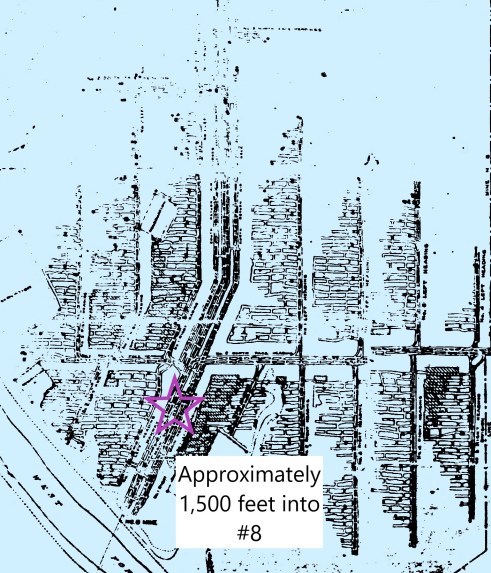
A new force of workers makes a new opening at #8 and “have now gone to a distance of 1500’ in the mine, or about half the distance to where the 2 pits, 6 and 8, meet.”  (FWV 12.7.07 – pg.1)

1500 feet into #8

In Fairmont:

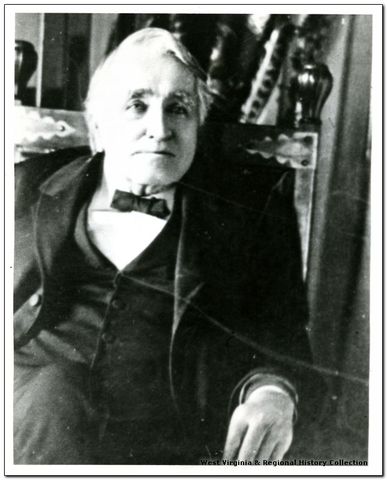
“Photographer Busy: Mr. Marvin D Boland has been one of the busiest men in town since yesterday. City papers in all parts of the country are calling for photographs. In the absence of a picture of the fated mines a Pittsburg afternoon paper ran a stock cut of Otis Watson, the original coal operator of the Fairmont region.” (FWV 12.7.07 pg. 1 – noon)

James Otis Watson
James Otis Watson

“All day today knots of people have been on the street discussing the scenes of the disaster. At the corner of Jefferson and Main streets there was a big group of men and women all day who with eager ears tried to catch every syllable of news…the whole city has been listening, every scrap of news was gobbled up with a craving almost insatiable.” (FWV 12.7.07. pg. 1 – noon)

12.7.07 - pg 1 - media list
FWV 12.7.07. pg. 1 – noon
In Monongah:

“About 50 newspaper men are on the ground today many from Pittsburg, Cleveland, Baltimore, and New York.”

“G. Girosi of the Italian New York Herald is one among the number as well as L. Friedel, of the Cleveland Zabadsag, a Hungarian paper.” (FWV 12.7.07 – pg.1)

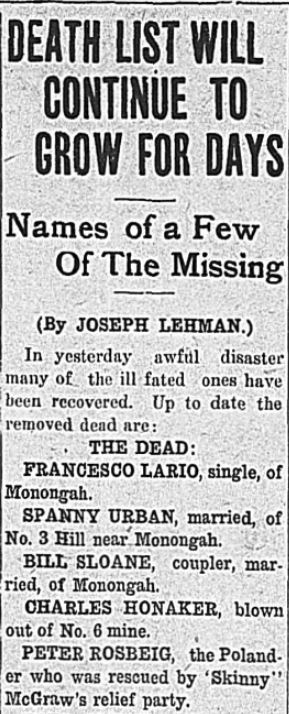
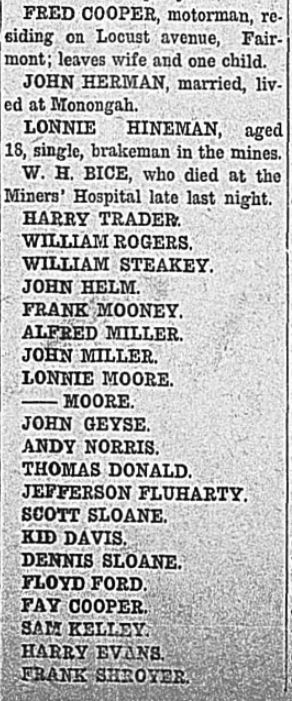
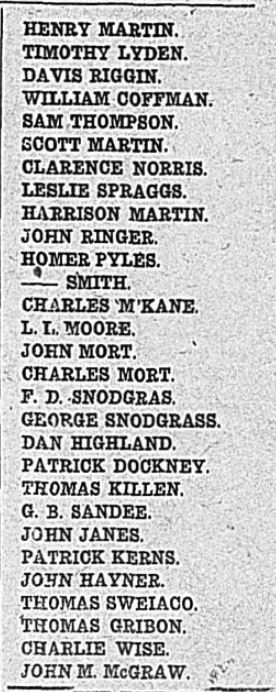
A list of the dead and suspected dead is also published to the public but it is purely American miners only, with the exception of Francesco Loria and Stan Urban who were taken from #8. The list contains about 50 – 60 names though it is not known yet if these men are dead or simply missing, including the name of coupler, Bill Sloane. Bill’s two sons, Scott and Dennis Sloane, are also included in the list though neither has likely been found and identified as of this point.

12.7.07 - pg 1 -list - detail 112.7.07 - pg 1 -list - detail 212.7.07 - pg 1 -list - detail 312.7.07 - pg 1 -list - detail 4


More on How Death Gloated!
Bibliography

Disclaimer and Guide

Introduction

About the Author

Contact Information

Saturday, December 7, 1907 Dawn – Late Morning (6:00 am – 11:00 am)

“Stunned by the terrible swiftness of the wings of the angel of death over the little coal mining village, Monongah is today dumbly counting its dead.” (EO 12.7.07 pg. 1)

Dawn

In Monongah:

“The excitement of the day was no less keen, but not of the noise and demonstration of the morning, the people awakening to the awful loss of life and being ready to offer everything within their power to aid the work of rescue.” (CDT 12.7.07. pg. 1)

“With the dawn of day there began a heartrending march up and down the aisles along which these bodies have been laid, by sobbing wives and mothers and sweethearts, orphaned children and strong men, each seeking a near relative or beloved friend.” (News)

“Tomorrow or the next day the numbed nerves may again perform their functions and in the reaction the survivors may writhe in grim agony and grief, but today there is no sorrow—only dull interest that lights up eyes of mothers, wives, and brothers as each limp and blackened form is tenderly passed up from out of the hell pit, where in one brief moment 400 lives were snuffed out as a candle light in a gale.” (EO 12.7.07 pg. 1)

“All with the exception of a few have given up hope and accept it as a foregone conclusion that none survive the disaster. Relatives still cling to the ray of hope, however, that their loved ones may have been spared and eagerly seek the reports of the searchers as they come above to get fresh air.” (CDT 12.7.07 pg. 1)

~6:00 am – ~ 8:00 am

At #8:

“Fire…in south side of #8 was extinguished about 6 o’clock this morning.” (FWV 12.7.07 – pg.1)

Rescue and recovery work can finally begin in #8.

At the mines:

Rescue work has become thoroughly systemized and progresses rapidly. “Hundreds of men are at work this morning clearing away the debris for the removal of the 425 unfortunate men whose lives were snuffed out without a moment’s warning.” (FWV 12.7.07 pg. 1 – noon)

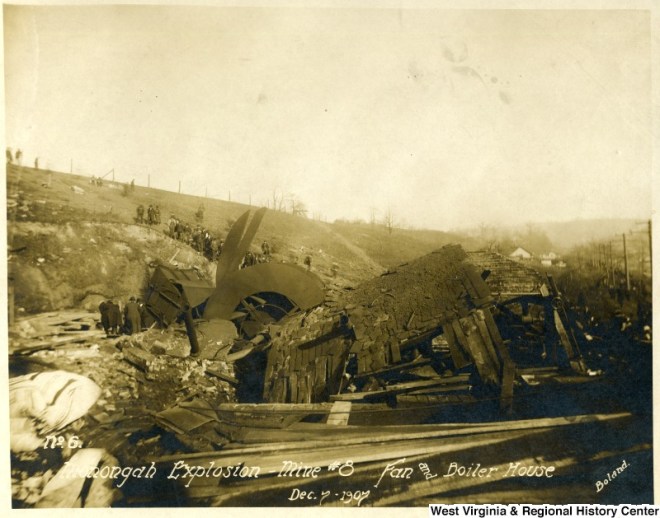
8-fan

“With unabated energy, five rescuing parties, working from every possible point to enter and explore mines numbers 6 and 8…are this morning putting forth every effort to reach, dead or alive, the remainder of the 400 or more men who went into the mine yesterday morning. There is little hope that any have survived the terrific explosion and the resultant poisonous gas…” (WED 12.7.07 pg. 1) (ES 12.7.07 pg. 1)

“Near the mine entrance, when the rescue work began, were nearly 300 caskets indicating the least extent to which the company believe the loss of life in the mine will reach.” (TEP 12.7.07 pg. 1)

In Monongah:

“Men are now working in relays to reach the miners entombed in the two great shafts. On the hills overlooking their work are the weeping wives and other relatives of the imprisoned men. Among them are the three women whose husbands lie in the improvised morgue.” (WED 12.7.07. pg. 8)

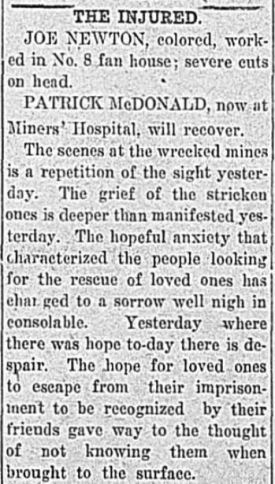
“The scene at the wrecked mines is a repetition of the sight yesterday. The grief-stricken ones is deeper than manifested yesterday. The hopeful anxiety that characterized the people looking for the rescue of loved ones has changed to a sorrow well-nigh inconsolable. Yesterday there was hope today there is despair. The hope for loved ones to escape from their imprisonment to be recognized by their friends gave way to the thought of not knowing them when brought to the surface.” (FWV 12.7.07 pg. 1 – noon)

~8:00 am

In Monongah:

“Hundreds of people have been attracted here from Fairmont, Clarksburg and other places in the valley, many of them having friends and relatives among the ill-fated miners and at the scenes of the horrors are seething masses of people.” (CDT 12.7.07 pg. 1)

“Mine officials, railroad men, newspaper men of the big city dailies, craftsmen of every trade are mingling with those who are anxious about those whose lives are sure to have been snuffed out.” (FWV 12.7.07 pg. 1 – noon)

“Hundreds of visitors are at Monongah today viewing the wreckage and watching the bringing of bodies to the surface…” (FWV 12.7.07 pg. 1 – noon)

~8:30 am

“Mr. R.M. Hite offers services of a large number of experienced miners from Kingmont mines (operated by the Virginia and Pittsburg Coal Company). This was a very kind offer…for the men who have long searched for the missing are getting weary. They have searched diligently and there is an end to their endurance.” (FWV 12.7.07 pg. 1 – noon)

~9:00 am

At #6:

Another rescue party including John Hallan and Carl Tarlton enter #6, still hoping to find survivors in the very recesses of the mine.

Not long into their exploration, Hallan and Tarlton find the body of a motorman, “jammed back in the motor where he had been sitting with one arm thrown about 30’ away” (McAteer). As this motorman was clearly dead, they did not stop for long to examine him and continued on their search, looking for any dangerous gases and any signs of life.

At #8:

Rescue parties also prepare to enter #8 with the same purpose: find survivors.

“In mine number 8 the rescuers are just getting to work as gasses have delayed them.” (EO 12.7.07 pg. 1)

mc6

“Six bodies are all that had been found in No 8 until this morning. One man was found in the manway.” (FWV 12.7.07 pg. 2 – noon)

In Monongah:

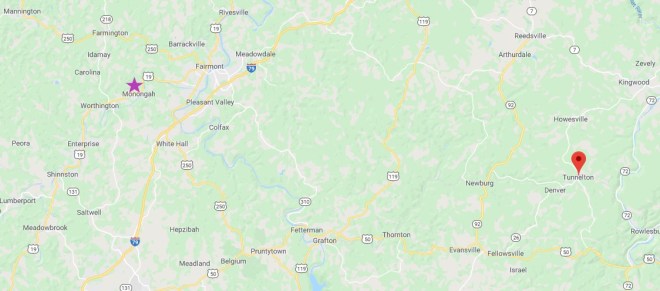
25 more miners arrive in Monongah from the Tunnelton mines to help rescue efforts. (FWV 12.7.07 pg. 1)

“The King’s Daughters and committees of women started a work of visiting homes of the miners, leaving baskets of food where needed…” (Kellogg)

Restaurants in Fairmont and Clarksburg made soups and sandwiches for rescue workers and victim’s families “…and two blacksmith shops were turned into kitchens where great pots of stew and coffee were set boiling.” (Kellogg) People from all around have been bringing whatever they have for donations.

Father D’Andrea of the Italian Catholic Church, Our Lady of Pompeii, is certain by now that his own brother, Victor D’Andrea, is among the victims of the disaster. However, he gets no time to mourn as he and other religious leaders have been overwhelmed with the grief-stricken families for the last 24 hours. Father D’Andrea is only now beginning to survey victims among his parishioners while Father Lekston of St Stanislaus Catholic church has already counted at least 110 victims from his Polish congregation.

In Fairmont:

A little after 9 am, C.W. Watson telegraphs J.N. Camden, “…have lost all hope of finding any men alive.”

~10:00 am

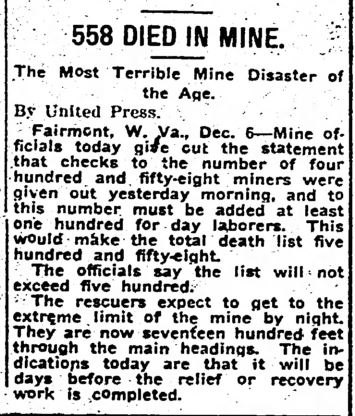
“At ten o’clock today, a total of one hundred bodies had been found in the Monongah mines. These will be removed to morgues at once. Four hundred coffins have been ordered by the Fairmount Coal company. All will be used sooner or later, as it may be weeks before all victims of the explosion are recovered.” (RP 12.7.07 pg. 1)

“The remains of the dead are being carefully handled and prepared for burial in the most decent way even as well as could be done at a well-regulated undertaking establishment.” (FWV 12.7.07 – pg.1)

~11:00 am

In Monongah:

“The eleven o’clock car was one hour getting through the dense crowd between Nos 8 & 6.” (FWV 12.7.07 – pg.1)

“There is an immense concourse of people all anxious to see what there is to be seen. While the situation has not reached that point yet it may be possible that it will have to be brought under military control.” (FWV 12.7.07 – pg.1)

“President C.W. Watson wired Gov. Dawson this morning that he did not think military control would be necessary as the crowd is a very orderly one.” (FWV 12.7.07 – pg.1)

Outside the mines, Doctors Hill and Cook along with a few dozen nurses realize their services won’t be needed for survivors but for the rescuers instead. A second emergency hospital is set up by #8 and equipped “at 11 o’clock today with cots, bedding, and etc.” (FWV 12.7.07 – pg.1)

At #6:

“Up to 11 o’clock today sixteen bodies had been removed…Four are Americans. About eighty bodies have been found, but only sixteen have been brought to the surface.” (WED 12.7.07 pg. 1) (RIA 12.7.07 pg. 1)

“The rescuers are now within 1,500 feet of the end of the mine. They are working in two parties of about thirty men each with reliefs every hour.” (WED 12.7.07 pg. 1) (RIA 12.7.07 pg. 1)

Outside #8:

2 members of rescue crews, Milton Coburn and James Kane, are taken out of #8 to the emergency hospital set up just below the opening of the mine. Both were overcome by the gasses they inhaled while inside. (FWV 12.7.07 pg. 1)

ME13


More on How Death Gloated!
Bibliography

Disclaimer and Guide

Introduction

About the Author

Contact Information

Saturday, December 7, 1907 Midnight – 5:00 am

“Through the night the vigil of a large crowd of people did not lag from that during the day. Forbidden to approach near the opening because of the barriers and ropes and heavy guard, they waited on the trolley embankment anxiously awaiting above the opening and watching the work of those on the outside of the mine who assisted the rescuing party. Here the crowd is thick with the wives and daughters of the hundred entombed fifteen hundred to two thousand feet beneath the surface, and with tear-stained and drawn faces watch with unbroken gaze the opening.” (CDT 12.7.07 pg. 1)

Midnight

12.7.07 - pg 1 - disaster 2
CDT 12.7.07 pg. 1
At #6:

“Of these victims six dead bodies had been taken from mine No 6 and sixty-five others were piled up in the entry awaiting the completion of facilities for bringing them to the surface.” (WED 12.7.07 pg. 8)

At #8:

“Deputy Mine Inspector F.E. Parsons, of Clarksburg, and General Superintendent John Brooks, of the Clarksburg Fuel Company, are leading the rescue work at this mine and are assisted by Superintendent Albert J. Ruckman and John Brennen, Superintendent of the West Fairmont shaft, with a squad of some twenty men.” (CDT 12.7.07 pg. 1)

The Morgues:

As the bodies arrive on the surface, they are examined right at the mine by Dr. F.W. Hill and other medical volunteers.

In one of the nearby emergency hospitals at the mine mouth, now a temporary morgue, one of the dozens of volunteer undertakers from the area will search any remaining clothing pockets for personal items and make any notation possible of the body and its discovered location in hopes it will aid in identification.

In these first hours of systematically managing the dead, physicians require little time to ascertain how several met their death based on nothing more than their burnt and/or mangled bodies. Those in these conditions, like a brakeman who was found in one of the mines as nothing more than a headless and limbless torso, will be impossible to embalm and display for identification.

After each one is quickly checked for cause of death it is placed in a casket on hand or shrouded as best as possible. Several bodies are placed on a horse-drawn wagon filled with straw and carried across the river to east side of town where the temporary morgue in the First National bank is finally prepared to start accepting, washing, embalming, and dressing the victims.

Throughout the night and following day, throngs of families and onlookers crowd around the carts as they travel across the river. They frequently block the forward path and frighten the horses, making the transport slow and difficult.

“The bodies brought to the surface during the night were washed and made as presentable as possible by a dozen undertakers from this and surrounding towns and placed in one of the mine buildings which was converted into a temporary morgue.” (RIA 12.7.07 pg. 1) (ETR 12.7.07 pg. 1)

~1:00 am

At #8:

J.C. Gaskill moves from mine #6 to #8 and remains there “recovering bodies” (Inquiry)

Fire discovered once again in #8, this time in the 1st north heading about 450’ from the pit mouth. However, more brattice work will need to constructed in the area before the workers can actually reach the location of the fire.

“The openings in the ground were all covered with canvass to shut off the draft and the hose was turned on the fire soon after it was discovered.” (FWV 12.7.07 – pg.1)

~2:00 am

“…near No. 8 Howard Preston, colored, of Monongah, was taken out, and also four Italians, names unknown.” (CDT 12.7.07 pg. 1)

~3:00 am

At #8:

#8 is still burning “…with no prospect of extinguishing the blaze and hundreds of dead miners will be burned. Excitement is intense and the whole town is out fighting the flames.” (CDT 12.7.07 pg. 1)

Dozens line up down the bank to the river and haul water brought in buckets to the mine mouth. Fire extinguishers have also been brought in from Fairmont.

At the mines:

“During the night few women were to be seen, but all day yesterday the women were the chief actors in most pathetic and heartrending scenes.” (WED 12.7.07 pg. 1) (ES 12.7.07 pg. 1)

Throughout the night, men stood about the mouth of the mines. “They said nothing but when approached and asked questions they would give way to their emotions, often to tears.” (RIA 12.7.07 pg. 1)

~3:20 am

The body of Charles Honaker is brought to the morgue. (CDT 12.7.07 pg. 1)

~3:30 am

At the mines:

“…eleven bodies had been brought from mine Nos 6 and 8 and placed in the temporary morgue.” (CDT 12.7.07 pg. 1)

“To date eleven bodies have been taken out of #6 opening and two from a small opening about a quarter mile from #8 opening. All available means are being used to hasten an entrance into the mines where dead bodies are now entombed.” (FWV 12.7.07 – pg.1)

~4:00 am

“The officers of the company checked up their list of employees so far as possible, and later stated that at least 380 men were in the mine when the disaster occurred. Their list, they admit, is not complete, and statements that 500 men were caught by the explosion go unchallenged.” (TBE 12.7.07 pg. 1)

“It is given out by officials of the two wrecked mines that the number of entombed miners will reach 450. Mine officials have these classed as follows: Americans,100; Polanders, 150; Italians 275; Total, 450.” (CDT 12.7.07 pg. 1)

“The mine records, time books and other information lead to the conclusion that 450 will cover the number completely, but it is not thought the number will fall under that and there exists the firm belief with the officials that all have perished.” (CDT 12.7.07 pg. 1)

“There is no question whatever but that four hundred, possibly more, are dead, said Superintendent Malone this morning.” (RP 12.7.07 pg. 1)

“President Watson of the mining company stated this morning every possible investigation will be made to ascertain the cause and fix the responsibility.” (RIA 12.7.07 pg. 1)

~5:00 am

At #6:

“At 5 o’clock this morning seventy-nine blackened bodies had been recovered. Six bodies were brought from No. 6 mine.” (TBE 12.7.07 pg. 1)

Inside #8:

Workers are winning the battle with the fire in #8.

In Monongah:

“The wives and children of many of the entombed men have not left the mouths of the shafts since the first alarm was given. The night was a cold one and the mourners suffered intensely, but few heeded the offers of shelter from their friends. Several of the women fell unconscious or went temporarily mad from grief and exposure and had to be carried or forcibly removed from the scene of the disaster.” (WT 12.7.07 pg. 1)

mmd-mining3

In Fairmont:

FCC suspends operations in all mines today and Malone orders all experienced supervisors and craftsmen from surrounding mines to come and help speed the rescue. (FWV 12.7.07 – pg. 1 – noon)

Every undertaker in Fairmont is contracted and the supply of readily available coffins in the area is immediately exhausted.

“The company has sent rush orders for coffins to Pittsburg, Zanesville, and other towns, the total number ordered up to this time being 380.” (WED 12.7.07 pg. 1)

“Four hundred coffins have been ordered by the Fairmont Coal Company. All of these boxes will be used—sooner or later—for it may be weeks before all of the victims of the mine explosion are recovered. Possibly the order will be increased.” (WT 12.7.07 pg. 1)

In Monongah:

“Gloom possesses the entire town as never before in the history of Marion county and excepting the piteous cries of bereft families,…the town was wrapped in death-like stillness last night.” (CDT 12.7.07 pg. 1)

frontThumbnail (10)

Friday, December 6, 1907 11:00 pm – Midnight


12.7.07 - pg 1 - Monongah
TBD 12.7.07 pg. 1
12.7.07 - pg 1 - Monongah 7
CET 12.7.07 pg. 1

“It is believed that the shock of the explosions displaced many of the heavier timbers in the galleries and whole rows where the unfortunate men were working collapsed upon them. In this case the work of reaching the entombed men will be infinitely greater. Some of them are now believed to be separated from the outer world by many tons of earth.” (WED 12.7.07 pg. 8)

“The hope that they are alive lies in the possibility that enough pure air remained in the mine to supply those who were not crushed outright until they can be reached by the rescuers.” (WED 12.7.07 pg. 8)

In Monongah:

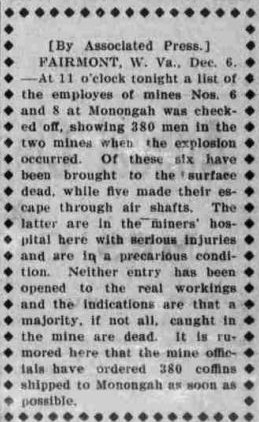
“At eleven o’clock tonight the list of employees had been checked off, showing that 380 were in the two mines when the explosion occurred. Of these six had been brought to the surface dead and five escaped through air shafts. The latter are in the miner’s hospital here in a precarious condition.” (DASB 12.07.07 pg. 1)

For hours now, more than likely since the meeting with Pres. C.W. Watson, General Manager Malone has been sorting through the payroll lists for Monongah mines #6 and #8 to get a better idea of just how many fatalities they are facing. By 11:00 pm, he is as finished as he can be with this aspect of his research. However, he does not deny that this list of around 380 payrolled names does not include any non-payrolled workers (such as B&O railroad workers on loan or those hired and paid by the miner personally—what we would consider an Independent Contractor today), younger trapper boys, or those who have been hired since the last time this list had been updated some two weeks prior, nor will it include those who were known to have been hired the morning of the explosion.

ME18

None the less, the press and public will become fixed with this very first “official” number of 380 and begin to speculate on their own.

“Six charred bodies lying in the improvised morgue, five men near death in the hospital and 369 men imprisoned by tons of coal, rock and mine debris in the depth of the hills surrounding this mining town with chances all against a single one of them being alive is the most accurate summary obtainable at 11 o’clock tonight…” (SFC 12.7.07 pg. 1)

The company nor the press is yet aware of just how many workers, like Bill Sloane and this author’s own great-grandfather, did not go into work that morning. As each one begins to turn up alive over the next several days, the overall number of potential corpses continues to be lowered rather than a name simply getting checked off the potential identity list. Though the extra off-payroll workers are acknowledged by company, they are not included in their factors.

In Fairmont:

“Late in the night…the streets of the city were crowded with anxious people eager to snatch any news that came from the disaster. Every car that came from Monongah, the passengers were stopped while inquiry about the news was made by the waiting crowd but the passengers had little to satisfy the hungering ones.” (FWV 12.7.07 pg. 2 – noon)

At some point during the night at the Miner’s Hospital, William H. Bice, the fan engineer who was blown through the walls of the #8 fan house, dies of his injuries. Though many doctors and nurses have returned to the Miner’s Hospital, the morticians and undertakers are still in Monongah. As a result, Bice had plenty of care in his final hours of life, but in death there is no one on hand to care for his body at the hospital. His body, along with others, is simply left in the hospital morgue.

In Pennsylvania:
12.6.07 pg 5 - Naomi
FWV 12.6.07 pg 5

Clarence Hall has been on the site of the Naomi mine disaster for days, but now he boards a train and heads straight for Monongah. He is considered U.S. President Theodore Roosevelt’s personal representative as one of the few federal government agents attempting to remedy the ever-growing mortal cost of the mining industry in the country.

In Monongah:

Before the midnight hour, rescue work transitions into recovery work as the long process of removing bodies from the mines begins. As #6 mine was not as badly damaged as #8 and workers have been able to restore enough ventilation for rescue crews, the process begins there.

As each body is brought to the surface, Dr. F.W. Hill and several other medical volunteers briefly examine the bodies in hope to quickly determine the true cause of death before sending them over to the temporary morgue. Though Coroner Amos and many other morticians are expecting to have the chance to perform autopsies, they simple become too overwhelmed too quickly and decide against doing so. Due to the conditions of many bodies, it is impossible to embalm them and they must be prepared for burial and identified as quickly as possible.

~Midnight

“Of the victims six dead bodies had been taken from mine Nos 6 at midnight and six others were piled up in the entry awaiting the completion of facilities for bringing them to the surface. From mine No 8 at the same hour, fourteen bodies had been removed, and a number of others are ready to be brought out as soon as arrangements can be completed.” (LAH 12.7.07 pg. 1)

Outside #8:

Once the small fires in #8 are subdued, the temporary 8’ wide fan on loan from a local mine in Shinnston is started up once again. Though they manage to recover some bodies near the mouth and along the main shaft of the mine, the temporary fan is simply not powerful enough to purify the air in the mine and rescue crews only make it around 700 feet beyond the main entrance before they are once again driven out by toxic gases. However, this does not stop the rescue and recovery efforts. A fresh crew replaces those who came in contact with the gases and a round-robin system of smaller crews and shorter trips into the mine takes hold at #8.

In Monongah:

A large number of lingering physicians are “ordered out” of the town; “At midnight these messengers of mercy with pity and patience were on the scene ready to minister to the maimed and moaning, but there was little need for their services.” (FWV 12.7.07. pg. 1 – noon)

wv state archives - CL060064


Previous Post

Next Post


More on How Death Gloated!
Bibliography

Disclaimer and Guide

Timeline

Introduction

About the Author

Contact Information

Friday, December 6, 1907, Evening into Night, 7:00 pm – 10:00 pm

“Tonight, thousands are gathered at …No 6 and 8, aghast of the horror of the explosions…in fact, the entire town of several thousand people are crowded about the mine openings anxiously awaiting the work of the rescue party, but without even the slightest hope of seeing any of their loved ones alive.” (CDT 12.7.07 pg. 1)

~7:00 pm

In Monongah:

“Trolley cars and trains over the Baltimore and Ohio brought great crowds of people from Clarksburg and Fairmont, many of whom have relatives in the terrible catastrophe, all anxious to learn the worst, as all hope had been abandoned that any survived and the only hope that remained was that the bodies at least might be recovered.” (CDT 12.7.07 pg. 1)

Vice President Potter, General Manager Thomas Fitzgerald and Division Superintendent and other officials of the Baltimore and Ohio Railroad Company heard of the horrible disaster and arrive to offer their services.

14 miners also arrive from Tunnelton, WV, to aid in the rescue (FWV 12.7.07 pg. 1)

map - tunnelton

“The general opinion in the town is that the number of dead and imprisoned will reach 500. A few persons believe this number will be exceeded, claiming that more than half the total force worked during the day, while on the other hand some think the number will be smaller. The most conservative estimates place the number of victims at 300 or more.” (DASB 12.07.07 pg. 1)

~7:30 pm

At #8:

Superintendent A.J. Ruckman finds the body of Charles Honaker. “…it was thought that Honaker had been blown in the river but he had not. He was lying about 70ft from the mouth of No 8. When he was found his watch was still keeping time and this property was the means of his identification. Mr. Ruckman still has his watch.” (FWV 12.7.07 pg. 2 – noon)

“Undertakers on the scene have converted the First National bank building into a morgue to take care of the bodies and all the caskets possible have arrived from Clarksburg and Fairmont with a special order on the way from Wheeling.” (CDT 12.7.07 pg. 1)

~8:00 pm

At the mines:

“At this time the rescuers are hard at work digging debris, dirt, coal, timbers, and the like away so as to get further into the mine. The efforts are to rescue any live men who may possibly be in the mine and dead bodies are now being removed.” (CDT 12.7.07 pg. 1)

“The chief efforts of rescue are at mine No 6, where the explosion was not so terrific.”  “At No 8 the rescue work is difficult and proceeding very slowly on account of the afterdamp.” (CDT 12.7.07 pg. 1)

In Monongah:

“The saloons have all been closed by order of the mayor. The great crowds still linger at the mines. The order is good.” (CDT 12.7.07 pg. 1)

West Virginia Governor Dawson wires a message to Pres. C.W. Watson: “Inspector to arrive tomorrow. Do not hesitate to call upon me for assistance.” Watson replies, “Our accident was deplorable indeed. Very much obliged for your offer…glad to know Chief Mine Inspector Paul will be here in the morning. Impossible to tell extent of fatalities at this time. Will advise you early tomorrow.” (FWV 12.7.07 pg. 1 & 2 – noon)

 ~8:30 pm

Evening presses from major papers across the country are putting out some of the first words the country will read about the disaster in Monongah. At some point during the day, either General Manager Malone or someone who had talked with Malone had a telephone conversation with a reporter at the Associated Press. As a result of this too early conversation which will be reprinted again and again nationwide, much of the first and perhaps only words many people will read about the disaster over the next month are highly inaccurate.

~9:00 pm

Inside #6:

Rescuers begin investigating side entries and rooms further from explosions. As each crew moves forward, they stumble over material debris as well as dead bodies of miners and horses.

“Relay parties bring no work of encouragement, to the contrary their only report is the finding of dead bodies piled up in the mine pits in heaps of twenty, indicating that when the explosion occurred, many of them rushed to the openings and perished on the way—overcome by gas.” (CDT 12.7.07 pg. 1)

In Monongah:

Another special train arrives, this one from Baltimore carrying V.P. Wheelwright of Consolidated Coal Company, President Oscar G Murray and General Manager Thomas Fitzgerald from the B&O railroad company along with more company officials, volunteers, newspaper reporters, and sightseers.

It becomes clear to company officials that many burial sites will be needed, and the existing potter’s field is insufficient.

“C.W. Watson, president of the company, is deeply affected by the accident and refused to give out a statement tonight. He only observed that it was ‘Too bad! Too bad!’” (TS 12.7.07 pg. 1)

Outside #8:

“The deadly fire damp made it impossible to do much rescue work early in the day, especially at Mine No. 8, where the explosion had completely wrecked the fan, until another fan could be brought from Shinnston, twelve miles away, and put in working order, the men labored at a disadvantage…” (WH 12.7.07 pg. 1)

map 1 - Viropa crop

Relief crews have managed to create a stable air hole about a half mile from the mine mouth. A temporary 7-foot-wide fan has arrived from Shinnston and put into place at #8 mine. But, “When the fan that was installed at the mouth of mine No 8 was started…it caused a small fire.” (FWV 12.7.07 pg. 1 & 2 – noon)

Inside #8:

“One fire was discovered to the right of the main entry in No. 8 and a pipeline was immediately laid into the mine and the fire extinguished.” (FWV 12.10.07 pg. 2 – Floyd Parsons)

WVC 8

~9:30 pm

“Up to 9:30 Peter Roisberg is the only man brought out alive.” (TS 12.7.07 pg. 1)


Previous Post

Next Post


More on How Death Gloated!

Bibliography

Timeline

Disclaimer and Guide

Introduction

About the Author

Contact Information

Friday, December 6, 1907, Mid-Afternoon – Dusk, 3:00 pm – 7:00 pm

“Not less than 400 are dead and the number may run to 700, as officials have been keeping down the number as much as possible.” (FWDN 12.6.07 pg. 1)

~3:00 pm

“At 3 o’clock this afternoon it is known that the mine disaster is the worst in the history of the country.” (FWDN 12.6.07 pg. 1)

In Parkersburg:

“Mr. Watson was in Parkersburg at the time of the accident and went at once to the scene.” (TBS 12.7.07 pg. 2)

map - parkersburg

In Baltimore:

“Mr. Wheelwright left here at 3 pm over the Baltimore and Ohio for the mines. He was accompanied by Mr. J.R. Buckingham, his secretary, and some of the others of the company’s officers.” (TBS 12.7.07 pg. 2)

map - baltimore and DC

“Mr. Clarence W. Watson is the president and Mr. Jere H. Wheelwright the vice-president, both of whom spend most of their time here in directing the executive affairs of the corporation. Mr. Watson has a home at Fairmont, where he spends the summer. On this estate, which is just on the outskirts of that city, he has recently built a magnificent stable for his famous show horses and also a half-mile track for their exercise.” (TBS 12.7.07 pg. 2)

FB_IMG_1516709527023

In Monongah:

It is “Press Time” and some of the reporters are in line to use the telegraph or telephone in the company store post office or the company office just across the river from #6 to submit their reports in time for the evening papers. A majority have had to go into Fairmont to find more communication resources. (News)

Outside #6:

Carl Tarleton arrives from the mines just down the tracks in Enterprise to help with the recovery. He works personally with David Victor on restoring proper ventilation to the mines, despite only having one working fan. By this point they have only achieved breathable air in most of the main shaft of #6, but they are almost to the area where the two mines are conjoined. David Victor decides to go ahead and make an attempt at a fire examination of #6. (Inquiry)

~3:30 pm

The two staff writers for The Clarksburg Daily Telegram make “fast time” despite taking the back roads to Monongah. “…they arrived some time before the first train and about two hours before the first trolley car arrived from Clarksburg, beating other newspaper representatives.” (CDT 12.8.07 pg. 1)

Outside #6:

The second round of rescue crews is starting to be organized just as several experienced miners arrive from the Montana mines just outside of Fairmont. As these men already work together as a congruent team underground, they are formed into a rescue crew all their own. (FWV 12.7.07 pg. 1 – noon)

Outside #8:

Someone standing near a toad hole, possibly a company watchman, happens to hear a sound like moaning coming from the ground. He calls out to nearby work crews for help. Several run off to a nearby supply house to collect materials.

miners-monongah

~3:33-3:35 pm

Outside #8:

The rescuers have returned quickly from the supply house with armloads of rope and begin tying critical hitch and harness knots in one end to safely support the men who will be lowered down through the toad hole.

~ 3:40 – 3:45 pm

Inside #8:

The first rescuer, a long slender rail worker in the mines named Charlie “Skinny” McGraw, has been lowered over 100 feet before getting to the floor of the mine. He unties himself from the lowering lines so they can be raised back to the surface for the next man to follow down and help.

He follows the moans through the dark and soon finds the Urban brothers. Stan is lying face down in a puddle of water and Peter is sitting atop Stan’s back sobbing uncontrollably, simply staring ahead into the dark space with wide glassy eyes.

~3:45 – 3:50 pm

Inside #8:

The second rescuer, Tom Weeks, has been lowered into the room with McGraw and the Urbans. As they come upon Peter and Stan, Peter begins to shout at them and protect his nonresponsive brother. The Urbans are from Poland (their original last name is Rosebeiq) and, unfortunately, Stan knew more American English than Peter and neither of the two rescuers speak or understand Polish. (News, Ancestry, Inquiry, McAteer)

Absolutely crazed by the trauma, fear, and utter darkness he has endured for the past 5-6 hours, Peter begins to aggressively fight with McGraw and Weeks to keep them away from his brother. He shouts at them but they do not understand him and again try to grab Peter and force him away from his brother. A full-on struggle ensues.

~3:50-3:55 pm

Inside #8:

Weeks and McGraw have managed to wrangle Peter into submission. They tie him into the rope hitch and give a signal to the men on the surface to start pulling. The workers on the surface grapple with the line as Peter continues reaching and screaming for his brother on his way back up the 100’ ascent to the surface

As Tom Weeks keeps an eye on Peter from below, Charlie McGraw rushes back to check on Stan’s condition. Despite the severe head injury and 5 hours face down in a puddle, Stan is still breathing but barely hanging on to life.

~3:55 – 4:00 pm

Outside #8:

Several people grab a hold of Peter as he nears the surface and assist in pulling him out. They get him safely out of the hole, pull him away to solid ground and untie his rope when, again, Peter begins to fight off the rescuers around him. The rope is dropped back into the toad hole again as Peter continues to struggle against those trying to help him.

Inside #8:

McGraw and Weeks have moved Stan out of the puddle and closer to the toad hole. They begin to tie him into the rope harness, just as they did with Peter. Stan is still breathing but unconscious.

~4:00 – 4:10 pm

Inside #6:

“For fully two hours nothing but wreckage, such as blocks of coal mine timbers and machinery rewarded the search, but at 4 o’clock in mine No. 6, twenty bodies were found in a heap a short distance from the opening. These were not brought out at the time as the purpose of the searches was to find if any survived the awful disaster and to bring them out first.” (CDT 12.7.07 pg. 1)

MT6

“Men who entered the mine say there are twenty dead men sitting on one bench, where they were awaiting their turns to take cars.” (TS 12.7.07 pg. 1)

Outside #8:

Peter Urban manages to break free from the rescuers. He tears through the crowd of onlookers, screaming and crying, sprints down the bank towards the river but crashes full-force into a fence. Rescuers follow and though Peter gives them quite the chase he begins to put up another brief fight as they catch up with him. Peter is simply too exhausted by this point and they manage to subdue him again with little issue.

Inside #8:

At some point during the ascent back to the surface, Stan Urban dies.

~4:10 – 4:15 pm

Outside #8:

Dr. F.W. Hill quickly looks over Peter Urban for any sign of significant injury or need for hospitalization. Though Peter is so distressed and upset that he can not even give the doctor his own name, Dr. Hill finds no reason to hospitalize him and sends Peter home to his family to rest.

At the toad hole, Stan is pulled out and taken to the side. Though he shows no signs of life, the warmth coming off his body gives them hope. Resuscitation is attempted but soon it is accepted that they are too late.

Stanislaus Urban is put onto a horse drawn cart, sent across the river to the morgue.

~4:30 pm

Word has already begun to spread through town and reaches #6 that at least one man has been found alive and rescued from #8.

MT39
Peter Urban
Outside #6:

Crowds swarm in the direction of #8. For some, especially many newspaper reporters who have arrived from out of town, this is the first notice they get that the #8 mine they have just submitted reports on isn’t actually #8 mine at all. Dozens of reporters who have been on or around the Iron Bridge all day have already gone to print and have mistakingly identifyied either #1 or #2 mine, which are across the river from #6, as being mine #8 simply because they can see smoke coming out of this mine from their vantage point.

Outside #8:

Despite the lack of ventilation and being driven out hours earlier by toxic gases, the discovery of Peter Urban alive and relatively well encourages another round of rescue crews to prepare to attempt another tour into #8. John C Thompson is in charge of one of those crews. (News, Inquiry)

Inside #6

By late afternoon, part of the broken trip that clogged the heading of mine #6 was removed and the entrance to the mine proper was clear enough to allow for the removal of bodies. “It was the blockade of broken cars that made it so difficult to get the work started.” (FWV 12.7.07 – pg. 1 – noon)

“The entry of No 6 mine, 300 feet from the mountain is piled high with wreckage of two strings of cars and two electric motors. Some of the rescuers have climbed over this and found dead bodies beyond, but have made no attempt to remove these to the surface, partly because it would be almost impossible to carry the bodies over the debris, but more particularly because they do not want to lose any time in reaching other sections of the mine where it is possible men still living may be imprisoned.” (ES 12.7.07 pg. 2)

~5:00 pm

At the mines:

By now, it has become very clear to the physicians and nurses who rushed to the scene that their services will not be needed. Some stay for the night to care for the rescue workers who are injured or overcome by the gases. Many leave on the 5 o’clock trolley car as a 3rd round of rescue crews gets organized.

~6:00 pm

In Monongah:

By this time, only Stan Urban has been recovered from the inside of #8 mine and arrangements are being made to begin bringing bodies out of #6.

Dr. Hill calls on Peter Urban at his house just to check on his condition. Peter can finally tell the doctor his name and now that Peter is around those who can understand him, he tells them that not far from where he and Stan were found, another man was also trapped but still alive.

A special train arrives on the main B&O line from Parkersburg and pulls into the center of Monongah carrying C.W. Watson, president of Consolidated Coal Company and its subsidiary Fairmont Coal Company, along with his private secretary.

ME56

In Fairmont and other cities around the country:

Newspapers are already publishing reports in their evening editions which have been circulating for about an hour now. Local papers from Monongah’s neighboring cities will put out several special extra additions over the next few days in an attempt to keep the local populace as updated as possible.

The Fairmont West Virginian publishes these headlines along with an article written by reporter L.M. Davis who was on the very first trolley to Monongah and got the opportunity to watch the action go down all day long and speak directly to some rescue workers like Fred Shaver.

12.6.07 - pg 1 - headline

They also publish a list of those “known” to be dead or injured based solely on what little information they have received from rescuers like Fred Shaver and officials who are simply too busy at the time to give in depth, detailed statements.

12.6.07 - pg 1 - Davis article - detail 2

In the next city south of Monongah, the Clarksburg Daily Telegram publishes slightly different information.

12.06.07 - pg 1 - headline


Unlike the Fairmont West Virginian, The Clarksburg Daily Telegram is not yet publishing personal reports from those directly on the scene, though they do include a small announcement that they have reporters on the scene and will put out a special evening edition with those updates. Rather, for this first printing they rely on an article created by the Associated Press after a candid conversation with an official from either the Consolidated Coal Company or Fairmont Coal Company, or possibly a combination of both.

At this point in U.S. history, the Associated Press has a practical monopoly over the spread of news across the country and a majority of U.S. papers rely almost entirely on the Associated Press for national news at this time. To battle what many saw as a corrupt control of information, The United Press formed earlier in the year to challenge that hold. Over the next month they will both make drastic, lingering mistakes in the mad dash to be the first to publish the latest information to the country.

The Pittsburg Press is just one of the many papers that uses the United Press to collect their information. On the evening of Dec. 6, it publishes what will become one of the most notorious headlines associated with the disaster, some of the first photos of Monongah, and several articles detailing events that have taken place through the day.

Almost all of it is wrong.

Monongah-MnDs-HdLn-Ptt-Prs-Dec-6-1907

The Cumberland Evening Times in Maryland also uses the United Press as a primary source and reports that, “The accident happened in Monongahela mines Nos 6 and 8 and was caused by the fan house, which supplied the miners with air, failing to work.” They follow, “The mines were idle yesterday and that is why it is thought that the fans failed to work this morning.” They will also, unfortunately, report that “Over one hundred men are known to have escaped.” (CET 12.6.07 pg. 1)

~6:30 pm

In the Monongah offices:

C.W. Watson and several other company officials hold a meeting to bring the president up to date with events. Watson decides that, “the bodies of the miners, so far as could be reached should be taken out during the night.”  From here, Watson personally supervises all rescue work aided by General Manager Malone. (CDT 12.7.07 pg. 1)

At #8:

Word makes it back to #8 mine that Peter Urban has revealed that another man was still trapped in the mine, not far from where he and his brother were found.

General Manager Frank Haas is personally overseeing the rescue work at #8 but little progress has been made compared to #6. Nonetheless, rescue crews, again led by “Skinny” McGraw, reenter #8 through the toad hole. True to Peter’s word, 20-year-old Francisco Loria is found nearby, but it is too late.

Francisco will be the 5th body to enter the morgue.

At the mines:

By dusk, rescue crews are once again pushed out of the mines by gases but it is confirmed to those on the surface that there is no hope of finding any survivors inside of #6.

“Men and women who had congregated around the mine knelt down in the falling snow and prayed, offering a miner’s benediction.”

me6


Previous Post

Next Post


More on How Death Gloated!

Bibliography

Timeline

Disclaimer and Guide

Introduction

About the Author

Contact Information

Friday, December 6, 1907, Early Afternoon, 1:00 pm – 3:00 pm

Early Afternoon

In Monongah:

“The women around the mine entrance are going crazy with grief and can hardly be handled.” (FWDN 12.6.07 pg. 1)

Crowds are growing to uncontrollable numbers. (News)

Agents for the company begin to prepare for the worst.

~1:00 pm

On the east side of Monongah:

“At one o’clock this afternoon the officials of the Fairmont Coal Co. revised their figures as to the number of men at work in the mines, making it three hundred, instead of five, and they do not believe any have escaped death or injury of a serious nature.” (CET 12.6.07 pg. 1)

Coroner E.S. Amos prepares to set up a temporary morgue inside the unfinished First National Bank of Monongah (a new institution owned by the Watsons and others).


“The First National bank building…has been rigged up for a morgue and the dead will be taken there as soon as recovered.” (FWDN 12.6.07 pg. 1)

theater, bank,hotel

E.P. Knight brings the piece of broken coupling pin to Frank Morris in the office of the company store for safe keeping then returns to the relief work. (Inquiry)

~1:30 pm

Outside #6:

Dr. Cook sees first 3 bodies brought out of #6; the 3 men who were found in the shed at the foot of #6 slope. (Inquiry)

~2:00 pm

Outside #6:

8 bodies found near entrance of #6 “and had been taken out, but at that time dense volumes of smoke from a fire in the heart of the mine drove the rescuers to the open air and they have not since been able to return, although every effort is being made to get in.” (Pitt. Press Evening, 12.6.07 – pg.1)

“The fans were all blown out of mine No. 8 and it was the belief of some that the mine was afire.” (CDT 12.7.07 pg. 1)

At the mines:

“Little was done…until after three o’clock when several men were rescued.” (FWV 12.7.07 pg. 1 – noon)


Previous Post

Next Post


More on How Death Gloated!

Bibliography

Disclaimer and Guide

Timeline

Introduction

About the Author

Contact Information