“…a loud explosion at the home of R. Frediani tore out the front of his house but luckily none of the family were injured. The cause of the explosion is attributed to the Black Hand, as Frediani received several demands and letters for money but paid no attention to them. The police found a large quantity of dynamite. So far no arrests have been made.” (FWV 12.28.07 pg. 1)
Morning
In New York City:
FWV 12.28.07 – pg 1
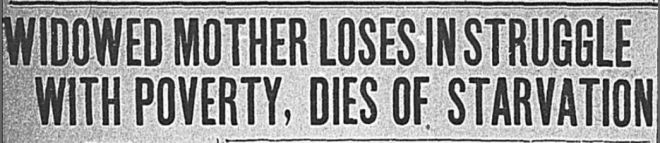
“Happy that her children, for whom she had sacrificed everything, even the last scraps of food, had at last found friends, Mrs. Phyllis Prisco died at a Brooklyn hospital today of starvation. Mrs. Prisco’s husband has been dead for some months and four little ones, the eldest four years, the youngest four months old, to care for, she labored day and night until she was taken ill.” (PDP 12.29.07 pg. 5)
“Her pride prevented her from asking for aid so she saved what bits of food she could obtain for her little ones, while she gradually grew weaker and weaker from the lack of food. The last bits of crusts went for the children’s Christmas dinner and the next morning neighbors heard the crying of the little ones in the unfurnished room in which the mother and children lived. They entered and found Mrs. Prisco dying the children weak from the lack of food and from the cold. The police removed the mother to a hospital and the Children’s society took care of the little ones.” (PDP 12.29.07 pg. 5)
“When the physicians found that all hope for the mother was gone, the little ones were sent for and Mrs. Prisco was assured that they would be cared for. They were happy again for they had had plenty of food and toys. Rosie and Katherine cooed over pretty dolls. Sam’s eyes glistened at a furry horse and baby Angeline clutched in her chubby hands a wooly lamb.” (PDP 12.29.07 pg. 5)
“Their troubles were forgotten in their new found happiness and as they played with their treasures on the floor beside the hospital cot the tired woman realized that their sufferings were over. And as she watched them playing there, the mother smile faded out of her eyes, the mother heart was stilled and the mother’s sacrifice was complete.” (PDP 12.29.07 pg. 5)
At the Darr Mines in PA:
“During the work last night the removing of corpses from the fatal entry No. 27, which held 74 bodies, was accomplished and the total death list was swollen to 220.” (PDP 12.29.07 pg. 4)
“The excact number of victims will not be known until the last vestige of wreckage is removed, but developments show the estimate of 225 dead was nearly correct.” (PDP 12.29.07 pg. 4)
“Some of the bodies last removed were in better shape than those taken out earlier. They had fewer burns and were less mutilated.” (PDP 12.29.07 pg. 4)
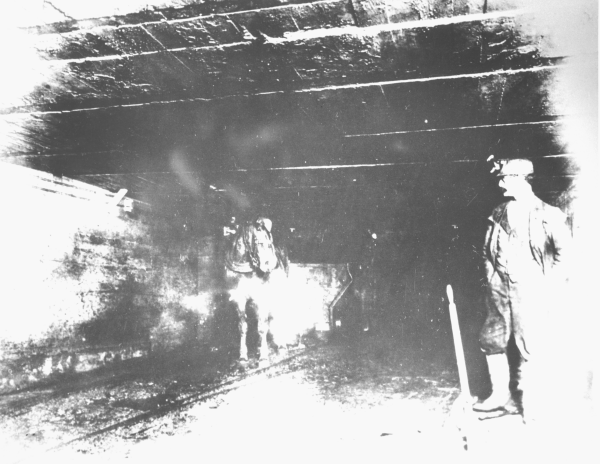
The “task of clearing up the workings” begins. “The dead horses, of which there are 20 in the mine, will first be hauled out. This will be a difficult task because of the limited space and the numerous falls which are encountered.” (PDP 12.28.07 pg. 3)
Afternoon
In Baltimore, MD:
BS 12.28.07 pg 7
In Parkersburg, WV:
Charles Huffman is dead, Orland Bennett will lose his eye sight and Ruday Backman will lose a leg as the result of hunting accidents near Wadesville over Christmas. (FWV 12.28.07 pg. 1)
“Huffman was killed by a discharge from a shotgun when he had been holding on his lap while sitting on a fence. The gun fell from his grasp and the hammer struck the fence and the content of the shell entered the stomach of Huffman. His funeral will be held this afternoon…” (FWV 12.28.07 pg. 1)
At the Darr mines in PA:
“Workmen this afternoon removed the carcasses of 20 horses and mules.” (PDP 12.29.07 pg. 4)
“Attention will now be directed toward clearing away the piles of debris. Under this, according to the company officials, probably six or eight more bodies will be found, but others think 20 to 30 corpses will be located beneath the masses of wreckage.” (PDP 12.29.07 pg. 4)
“Coroner Wynn has set the date of the inquest for January ninth and he will hold it at Smithton at two p.m.” (FWV 12.28.07 pg. 1)
“By that time all the bodies will have been recovered.” (PDP 12.29.07 pg. 4)
“George A. Campsey, representing the Carnegie Hero Fund commission, which gave $35,000 to the Monongah sufferers, was at Jacobs Creek yesterday investigating the conditions of stricken families. It is expected that the commission at its January meeting will take action similar to that in the Monongah disaster.” (PDP 12.29.07 pg. 4)
“At noon today no additional bodies had been recovered from the mines…” (WT 12.13.07 pg. 8)
John Graham Smyth, assistant chief engineer, is placed in charge of recovery efforts underground. (McAteer)
Smyth reports to E. Scott outside. (McAteer)
E. Scott reports to Ruckman and Malone. (McAteer)
~2:00 pm
In Fairmont:
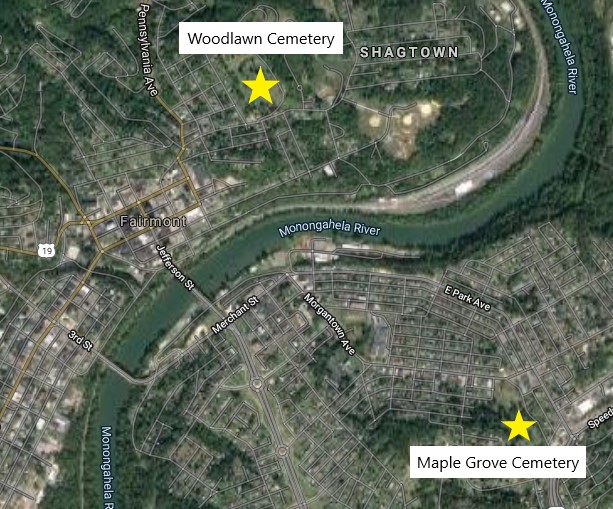
Jess Severe is buried at Woodlawn Cemetery. The Improved Order of Red Men is in charge of the funeral. (FWV 12.13.07 pg. 1)
In Monongah:
“The work in the mine was resumed this afternoon, but the men are engaged in cleaning out the debris. In this manner they may run across more bodies.” (CDT 12.13.07 pg. 1)
“A census taken of the town shows three hundred and thirty-eight men missing, which leaves eighteen bodies still in the mines.” (CDT 12.13.07 pg. 1)
“In addition, however, there was a number of contractors and men hired by these contractors are believed to have been in the mines when the explosions occurred.” (CDT 12.13.07 pg. 1)
At some point during the afternoon:
In Fairmont:
The Fairmont West Virginian receives a letter from Elkins post office employees with a donation of $50 included. (FWV 12.14.07 pg. 1)
In Monongah:
One body is recovered from #6. (FWV 12.13.07 pg.1)
“One more body was found in the Monongah mine disaster this afternoon, bringing the total number of bodies recovered up to 321. The last body is that of a man named Burt. It is at the mouth of Mine No. 6, in which mine it was found.” (CDT 12.13.07 pg. 1)
Frank H. Wilmot and George A Campsey, representatives of Carnegie Hero Fund Commission of Pittsburgh are still in town “to find out the progress made in relieving the sufferers and in what way the commission could best serve the needs.” (FWV 12.14.07 pg. 2)
J.H. Wheelwright makes a statement speaking of the difficulties that the searching parties had to encounter: “The difficulties the rescue parties have undergone cannot be realized or appreciated by those outside the mines. It is necessary to make an inspection inside to know the actual conditions.” (FWV 12.13.07 pg. 1)
~3:00 pm
In Fairmont:
Union Relief Association holds a meeting in the M.P. Temple in order to get “As full a report of committee as possible…” (FWV 12.13.07 pg. 1)
Coroner Amos deposited the sum of $367.12 in the People’s Bank of Fairmont to go toward the relief fund. This was all the money found except $23.19 found on the body of Andy Morris which was turned over to the proper relative. (McAteer) (FWV 12.13.07 pg. 1)
Mr. George Linn and daughter, of Benton’s Ferry, attend the funeral of J.H. Mort, member of Marion Lodge No. 27 R.P. (FWV 12.14.07 pg. 2)
The remains were taken across the river in a boat and interred at Maple Grove cemetery. He leaves a wife and four children. (FWV 12.13.07 pg.1)
In Monongah:
Coroner E.S. Amos and Prosecuting Attorney Scott C. Lowe went to Monongah to confer with State Mine Inspector J. W. Paul in regard to the time of holding the inquest. “It is not known at this time if the jury will be taken through the mines or not. If the jury does go through the mines it will likely be after the evidence is taken.” (FWV 12.13.07 pg.1)
~3:30 pm (Press Time)
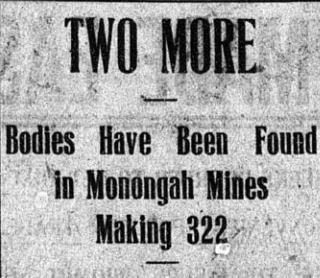
“Although search was abandoned last night, two more victims…were found today. This makes the total number recovered three hundred and twenty-two.” (BDT 12.14.07 pg. 1)
“Two bodies were taken out of the wrecked No. 6 mine…making the total of recovered bodies 322, of which number 96 were unidentified.” (CET 12.16.07 pg. 1)
“One body taken out of No 6…was identified as Nick Tertza, a Greek, aged 29, single, of West Monongah, and another body was taken from the same mine the same afternoon and has been identified as Henry Burke, an American, aged 69, of East Monongah.” (CDT 12.14.07 pg. 1)
“The census takers made another report, which increases their list from 338 to 344, and it is now predicted that the fatalities all told will number nearly 350. The bodies taken out…were in a bad state of decomposition and identification was made from their mine checks.” (CET 12.16.07 pg. 1)
~4:00 pm
State Mine Inspector J.W. Paul leaves Monongah and travels to the Naomi Mines in Pennsylvania. (FWV 12.14.07 pg.1)
By Late Afternoon
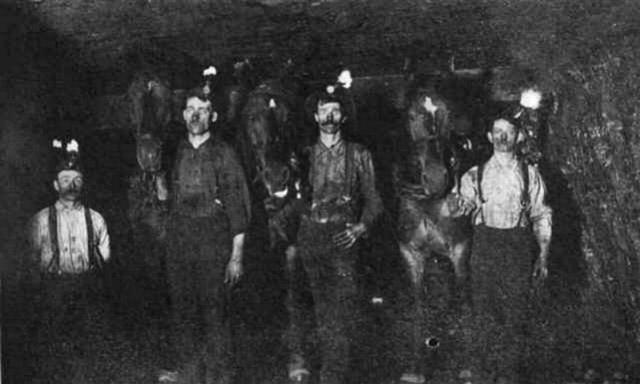
Some 40-50 horses have been removed over the past few days. (McAteer)
The matter of dealing with carcasses was put off for some time in favor of corpses and these carcasses had merely been covered with canvas tarps until all corpses had been found and mostly recovered. (Haas) (McAteer) (News)
Information on the conditions of these animals is included in the formal report made by General Manager Frank Haas for the Fairmont Coal Company:
“One driver was found beneath a loaded car completely covered, only one foot sticking out, his horse lying nearby, stripped completely of harness, which was found 100 yards up the heading lodged in a pile against a pillar fall.” (Haas)
“On another heading, pieces of horse were scattered for a distance of 500 feet, torn so badly that the remains had to be gathered with a shovel, while in a small hole in the rib of this heading the body of a trapper boy was found in a sitting posture without a mark or scratch of any kind.” (Haas)
This slideshow requires JavaScript.
“Tracks had to be thoroughly cleaned up to the carcass which after being thoroughly disinfected, were pulled on trucks by block & tackle, wrapped in canvas and hauled outside.” (Haas)
“Where roof falls made it impractical to clean up tracks to get trucks to livestock, block & tackle was attached and they were skidded for hundreds of feet, sometimes over falls and through crosscuts, to the track, occasionally necessitating the sawing off of a leg or head in order to make progress possible.” (Haas)
One of the most notorious and lingering ghost tales about the Monongah Mine Disaster includes this information about the horses:
“In just one crosscut, in one section halfway up 3rd Right of Old #6, at least 12 horses perished-and some said many more.” (Coffin Hollow, Musick)
“When the explosion came, the pressure from both ends of the crosscut pressed and squeezed the horses into one solid mass of flesh and bone.” When rescue/clean up crews came upon the pile, they decided “the best and quickest disposal that could be made was to gob their remains into an old working area and seal it off.” (Coffin Hollow, Musick)
“This is the day of ‘little mothers’ in Monongah. The little girls tend the babies, wait on the sick and get what bits of food there are.” (NCH 12.10.07 pg. 1)
~7:30 am
The Fairmont West Virginian predicts even more rain for today and tonight, followed by snow and slightly cooler weather (12.10.07 pg. 1)
“It has been raining here steadily since last evening and wretched conditions prevail throughout this section today.” (WED 12.10.07 pg. 1) (ES 12.10.07 pg. 1)
At the mines:
“The stench from decomposed bodies in the mines is becoming almost unbearable to rescuers. The stench is made worse because thirty-six horses were also killed in the mines.” (GWA 12.12.07 pg. 7)
“Many rescuers have become sick. One hundred and fifty miners from the mines in George Creek district have been summoned here to assist in the rescue work.” (GWA 12.12.07 pg. 7)
“The health officers fear an epidemic of fever, due to the decaying bodies of the men and the animals caught in the mine, and have prepared to enforce heroic measures if it becomes necessary. Quicklime will be taken into the mine and scattered over the bodies if conditions become much worse.” (ES 12.10.07 pg. 1)
“The crowds of idlers who surged about the pit entrances…have been dwindling ever since the rainstorm last night…” (AR pg. 1) (LAH 12.11.07 pg. 2) (SFC 12.11.07 pg. 1)
“The mud at the opening of the mines is several inches deep and has been trodden by the great crowds into a perfect quagmire, through which the men with the stretchers have to carry the dead. In conveying one of the recovered bodies down to the railroad tracks this morning a stretcher bearer slipped and the inanimate burden, which was wrapped in a blanket, was thrown into the mud. The sight of it gave the crowd a convulsion.” (RP 12.10.07 pg. 1)
At the morgues:
“Bodies brought from mines Nos 6 and 8 …during last night carried the list of victims beyond the hundred mark, and others are being carried into the morgue in intervals.” (WED 12.10.07 pg. 1)
2 men taken out this morning had some money on them: #101 – Salvadore Lobbs had $150 in a belt strapped around his leg and #110 – Andy Morris had $23.19 in his pocket-book. This brings the total amount of money found on the miners to $200.19. Money is in the hands of the coroner as are all other things that are found. (FWV 12.10.07 pg. 1)
In Fairmont:
J.E. Sands, cashier of First National Bank, receives a check for $500.00 from the City Bank of Wheeling and a check for $100.00 from the Second National Bank of Cumberland, MD and $100 through Mr. Zack Robertson from a friend in Wheeling. (FWV 12.10.07 pg. 1)
In Grafton:
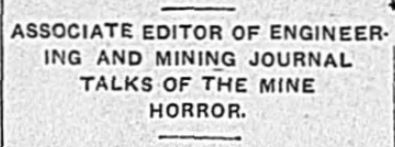
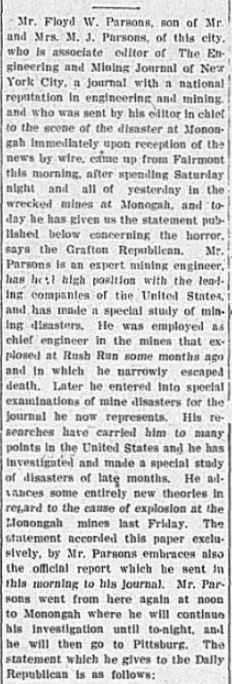
Floyd Parsons “came up from Fairmont” and gives the Grafton Republican newspaper his statement “concerning the horror…”. Floyd was employed as chief engineer in the mines that exploded at Rush Run some months ago and in which he narrowly escaped death. Later he entered into special examinations of mine disasters for the journal he now represents. (FWV 12.10.07 pg. 2)
~8:00 am
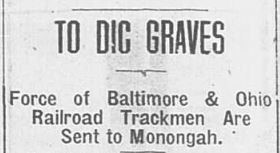
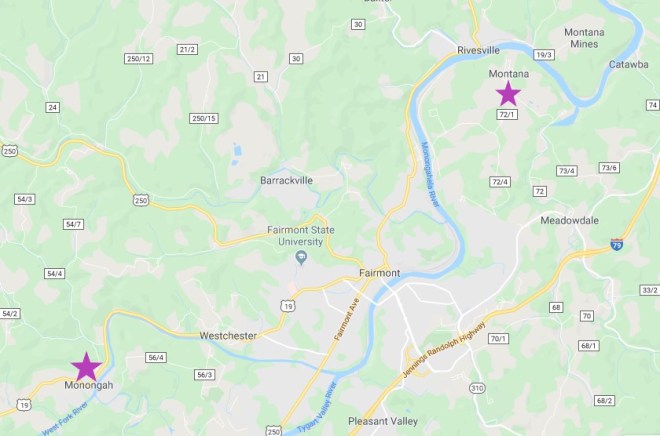
“Carrying out orders from officials of the Baltimore & Ohio railroad, a force of between forty and fifty trackmen that have been working on the railroad between this city and Parkersburg, left Clarksburg Tuesday morning on the interurban trolley line for Monongah to assist in digging graves for the dead that are taken from Monongah mines Nos 6 and 8. The men took picks, shovels and other tools with them and as soon as they arrived at Monongah they proceeded to the cemeteries and began work digging graves. The men were called to this city from various points along the railroad between Parkersburg and this city where they had been working.” (CDT 12.10.07 pg. 1)
In Monongah:
Milroy “Toy” Watkins is taken from Monongah to Montana for burial. The brother of Will Watkins, “…hearing that his brother was in No 6 mine went to work to help find him and he did not give up until he had found him and recognized him by a pair of black patent leather shoes and a black sateen shirt.” (FWV 12.12.07 pg. 2)
The Marion County Board of Health issues an order to advance the burial procedures. Viewing and ID opportunities for families and friends are limited to 4 hours maximum, no matter the condition of the body. The new accelerated ID and burial process cause many burials to occur immediately, without funeral masses. Catholic parishes hold whatever services they can at graveyards. (McAteer)
~9:00 am
On the far east side of Fairmont:
“Impressive were the services conducted by Rev. Hess” for Toy Watkins which takes place at the United Brethren church at Montana. He was the son of Mr. Willis Watkins and was a grandson of Mr. and Mrs. John Freeman, “an aged and respected couple residing at Montana and was related to many people living in and around Hoult and Montana.” Toy is survived by “4 brothers and 2 sisters; his mother having died about one year ago.” He is also survived by wife, Gettie Hyson Watkins, of Simpson, “who is very poorly in Cook Hospital, she being almost prostrated by the awful shock and untimely end of her husband.” (FWV 12.11.07 pg. 2)
In Monongah:
“Shock and grief have already destroyed many of the little unborn lives. Many women are so distraught with suffering that they forget all about their children.” (NCH 12.10.07 pg. 1)
“Funeral after funeral is being held at the churches in Monongah. The funeral cars are on the move most of the time. The unknown dead are being buried in the potter’s field near the Polish Catholic church.” (FWV 12.10.07 pg. 1)
Over 70 bodies are interred throughout the day. Some of them get funerals at the church, particularly those who could be preserved, but due to the condition of so many of the bodies brought out in the past hours, more frequently they are simply taken to one of the cemeteries. If identified, a small prayer is said; if not they are just buried. (McAteer) (news)
“The relief work is well under way and will soon be systemized. There is now plenty of food but there is urgent need of clothing in many families. Cash funds are being raised in many places and installments have already been forwarded from some points. The coal companies of this district have contributed $20,000 cash.” (WED 12.10.07 pg. 1)
“Thirty-seven funerals were held Monday and a number today. One body was sent to the cemetery followed by one lone woman, the widow, who had stood for days at the mines waiting for it.” (GWA 12.12.07 pg. 7)
At the mines:
“Every day since the explosion, hands, legs and arms have been removed. The stench from the decomposed bodies in the mines is becoming almost unbearable. This is one of the greatest difficulties which the rescuers have to overcome.” (RP 12.10.07 pg. 1)
“Up to nine o’clock this morning one hundred and one bodies have been removed from the Monongah mines, thirty-one having been taken out since midnight.” (CET 12.10.07 pg. 1)
~10:00 am
In Clarksburg:
“Charles McKane, aged 28 years, one of the Monongah mine victims, was buried in Holy Cross cemetery here at 10 ‘clock Tuesday forenoon. McKain’s body was found in one of the rooms of No. 8 mine and was taken from the mine shortly after midnight. With others it was conveyed to the morgue at Monongah and prepared for burial. It was then sent to his late home in that town arriving there at 2:30 o’clock, and Tuesday morning it was brought up on the interurban and buried. Relatives and friends accompanied the body. Mr. McKain’s body was not mutilated. It is evident he smothered to death. He leaves a wife and one child.” (CDT 12.10.07 pg. 3)
“Mayor L.C. Crile announced Tuesday morning that all moneys received at the council chamber in response to his proclamation calling for donations for the relief of the Monongah mine suffered, would be turned over to the Telegram relief fund, and due credit will be given to each donor. The donations will be published in the Telegram daily. A list of all the donors who leave supplies, provisions, clothing, etc., at the mayor’s office for the Monongah mine sufferers will be published each evening in the Telegram also. Donations are coming in freely and they should continue so for there are many unfortunate women and children left in destitute circumstances by the awful disaster.” (CDT 12.10.07 pg. 1)
In Monongah:
“Quite a number of Bridgeport people today went to the scene of the great mine disaster at Monongah. Some went for the mere sake of seeing, while others went with the hope of getting tidings from relatives and friends who were employed at the ill-fated mines.” (CDT 12.10.07 pg. 7)
“There is no change in the demeanor of the people of the stricken town except that the gloom of sadness and sorrow deepens all the time. Funeral after funeral was held today, mostly at the Catholic cemeteries, where scenes are most sad. After loved ones have been identified at the morgue and prepared for burial, hundreds of women and children gather at the cemeteries on the hill instead of going to the churches and await the arrival of the dead.” (CDT 12.10.07 pg. 1)
“Women were found today weak from pain, who are also suffering from lack of proper nourishment. Some of the Fairmont women have depleted their own stores of winter supply food in relieving the distress.” (RP 12.10.07 pg. 1)
“Ever since the explosion the most heroic action has been displayed on all sides by the women who despite their great stress and suffering, clung to their children. From the start they realized that the little tots were to becomes a serious burden, but on all sides could be heard the same sentiment, they would rather die than give up their children.” (CET 12.10.07 pg. 1)
“Some of the widows have no relations in America, for many came to Monongah with their husbands from the old country. Others came as sweethearts, years ago, after the lovers had made enough money to send for them. And while their married lives began here, they apparently prefer, in their distress, the old homes far away.” (CET 12.10.07 pg. 1)
“There are not many of the women who can now find any charms about Monongah, and although foreigners, most of them want to return to their native country, feeling that the few short years of the country of liberty has brought them nothing but grief and suffering.” (CET 12.10.07 pg. 1)
Special correspondent for the United Press, Dorothy Dale, and her photographer are approached by “the brightest Italian girl in the settlement”, Faustina Davia (last name reported as “Daria”).
Faustina Davia
Faustina is the oldest child and only daughter of Victor and Catherina Davia (DaVia). Victor was a “day man” working in #6 at the time of the explosion and was recorded as the 15th body recovered from the mines and to go through the morgue. He was identified by George Gibbons at the Italian Catholic church in Monongah sometime on Monday, though it is generally known that none of the family got to actually view and confirm that the body which was buried in Row A Grave 9 of the Italian Catholic cemetery contained Victor’s actual remains. (Tropea) (News) (McAteer) (Loss) (Amos)
“’Please you get something for me, I can do.’ A little hand touched my arm. A curl-framed face of a girl of 10 looked into my face. ‘You know mans all dead. Boys all dead. Only girls left to work.’ Do you know the half apologetic half appealing look of the trembling old man who shoved out of his life’s track by younger men—the man who begs you to buy matches or shoestrings? Well, that was the expression in the old young eyes of little ten-year-old Faustina Daria. Faustina was in the sixth grade the day before the explosion. That is ages ago to her.” (NCH 12.10.07 pg. 1)
At the mines:
“With 112 bodies on the surface at 10 o’clock today, 25 more ready to be brought out of Mine No 6 and 4 awaiting removal from Mine No 8. It was expected that the total number of bodies recovered from the wrecked mines by noon would be 140.” (CDT 12.10.07 pg. 1)
“The rescuers are working the right side of mine No. 8, where, it is thought, a majority of the bodies yet in the mine will be found.” (ES 12.10.07 pg. 1) (RIA 12.10.07 pg. 1)
“The rescue work is being pushed and before night it is expected that most of the bodies will have been taken out.” (WED 12.10.07 pg. 1) (ES 12.10.07 pg. 1)
~11:00 am
In East Monongah:
The General Relief Committee holds a meeting at the First National bank, which is currently operating as the primary morgue, and passes an order that the receipts and disbursements of the committee be published in the Fairmont papers from day to day. (McAteer)
Bishop Donahue of Wheeling and Judge Mason are added to the General Relief Committee. (FWV 12.10.07 pg. 1)
Donahue has “visited many of the homes of miners and found so many children made orphans by the disaster that he immediately took up the work of providing homes for them. He will arrange to have as many as can be accommodated sent to the orphanages maintained by the church at Huntington and Wheeling.” (WED 12.10.07 pg. 1)
In West Monongah:
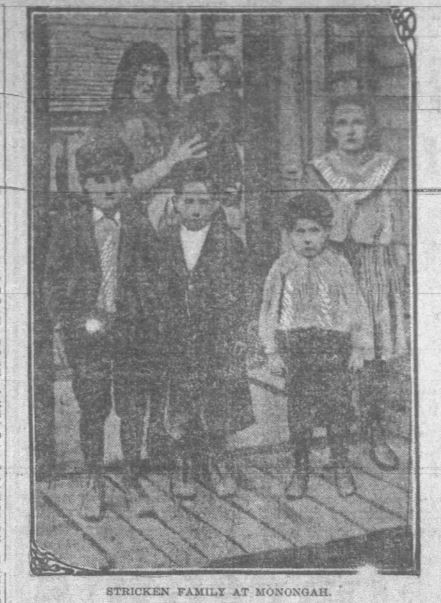
Faustina Davia has taken Dorothy Dale and her photographer to her family’s three-room house on Walnut Avenue.
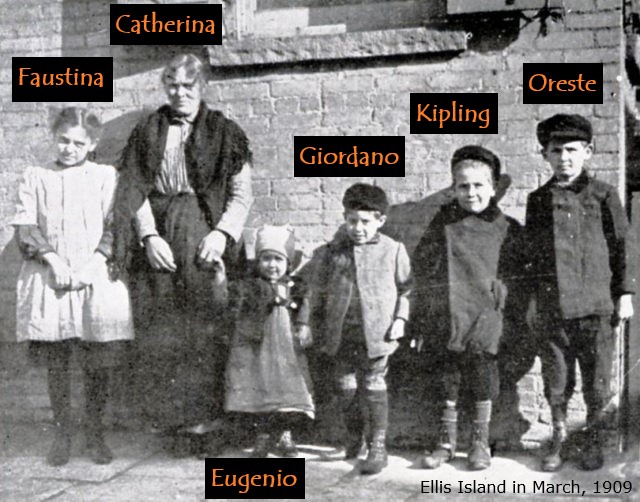
“‘See my Ma, Resta, Kipling, Georda and Ojgenia to work for,’ as she pointed at the group on the steps. ‘My pa make $2 a day,’ she explained. ‘And wasn’t it awful; three days he was home with a hurt on his back, and Friday he went in again and—and—’. But even the brave lips of strong hearted women of ten sometimes give way. The little figure crouched against the wall and quivered with sobs. ‘You know we paid $5 rent and had lard and cheese and bologna,’ she said with pride. The child spoke as rich people spoke of automobiles and theatre parties. And there was little Faustinas in almost every house in Monongah.” (NCH 12.10.07 pg. 1)
“I tell you there is nothing that makes one’s heart go out more to that stricken people than the way tiny girls put their little shoulders to the burdens that their mothers can not bear.” (NCH 12.10.07 pg. 1)
Photo taken of the Davia family on the porch of their home.Photo of Davia family at Ellis Island. Catherina and her family is the focus of this author’s historic fiction, therefore, there will soon be areas of this site which will be dedicated solely to her story.
~11:30 am
“At eleven thirty, one hundred and thirteen bodies have been taken from the mine by rescuers. The bodies of those taken out since daylight are in good condition, and many were identified.” (CET 12.10.07 pg. 1)
“Every decade has had its horrors and every decade will have them until the end of time. It seems sometimes that the decades that have passed and gone were angelic compared to the present, but such is not the case.
“The terrible mine disaster at Monongah is still fresh in our minds, and it will remain fresh for many days for the parties of rescuers have scarcely begun to find the bodies of the victims of that catastrophe.” (AC 12.10.07 pg. 4)
~12:00 am
At the mines:
“At midnight a total of sixty-six bodies had been brought from the two wrecked mines at Monongah.” (BEB 12.10.07 pg. 7)
“The bodies taken out…were for the most part in bad condition, being maimed and blackened, and besides, many of them were far advanced in decomposition.” (ES 12.10.07 pg. 1)
“The work of rescue is daily becoming more difficult and dangerous. To the dangers of fire damp and explosive gases generated by the fire in Mine No 8 are now added the odors peculiar to decomposing bodies. The health of the rescue parties is endangered, and it is with the utmost difficulty that they are able to face these new terrors of the mines.” (LCT 12.10.07 pg. 8) (RP 12.10.07 pg. 1)
“…men who were unafraid to work 12, 24, 48, or 72 hours at a stretch if there were hope or help in it. This mustering of the minute men of the coal pits is one of the finest things in industrial life in America today. Some come because of the good pay there is in it, and some because of the adventure, but for many it is the response of working men to a human call stronger and more stirring than either of these.” (Kellogg)
“Now, it having been determined that there can be no living men in the mine, the state and federal authorities have ordered a cessation of the rescue work. They rightly cannot see the necessity of sacrificing the living for the dead. But it is a notable fact that the work would have gone on, regardless of danger, if the authorities had not intervened. The men were willing and anxious to risk their lives, even though they knew they could not save lives by so doing.” (SLH 12.10.07 pg. 4)
“The coroner and his deputies remain constantly upon the scene, viewing the bodies as they come out, but no date has been set or other arrangements made for taking testimony or other features of the inquest.” (ES 12.10.07 pg. 1)
Inside the mines:
“Men are working incessantly.” (WH 12.11.07 pg. 3)
“They carried pick and shovel, but the weapons that for the most part they had to rely on were boards and canvas and cement and a spinning fan at the mine mouth.” (Kellogg)
These men “…must go ten feet ahead and try; must hold canvas barricades against the after-damp till their arms ached, while the brattices slowly went up; and all the time must forage for death in that breathless sweater, finding it in a disemboweled mule, or the charred, crushed thing that had been a miner, or a headless trapper boy, or an empty shoe.” (Kellogg)
“After the bodies are located, the rescuers say the most difficult part of the work is encountered. The bringing out of the bodies, a distance of a mile or more through the underground workings, it is tedious on account of meager facilities.” (WH 12.11.07 pg. 3)
“There has been considerable apprehension that the work of rescue might be stopped on account of the many carcasses of horses and mules in mines Nos 6 and 8, but so far there has been little trouble from this source, and the stench has not been sufficient to overcome the workers.” (CDT 12.10.07 pg. 1)
“The official reports show that there were eleven horses and mules in No 6 mine and 38 in mine No 8. All were killed.” (CDT 12.10.07 pg. 1)
“Health authorities fear an epidemic of fever due to the decaying bodies of the men and the animals caught in the mine and have prepared to enforce heroic measures if it becomes necessary.” (WED 12.10.07 pg. 1)
At the morgues:
By an order of the County Board of Health, mutilated bodies are to be kept 3 hours for ID and at the expiration of that time shall be interred. The order has increased the anxiety of relatives of the victims who are eager for the news concerning the recovery of bodies. (FWV 12.10.07 pg. 1)
At #6:
“There was pathos enough in the scenes at the mines while the bodies were taken out to make a nation weep.” (AC 12.10.07 pg. 1)
“Early in the morning they took the body of a small boy about eleven years old from Mine No. 6. He bore on his begrimed little face a look of peace and happiness that doubtless never marked it in life.” (LCT 12.10.07 pg. 8) (RP 12.10.07 pg. 1)
“The little body they took out was that of a weakling, a mere child, who in life probably did not possess enough strength to lift a bushel of coal. But his hands were knarled and his shoes were those of a man laborer, rough and tough and hobnailed.” (LCT 12.10.07 pg. 8) (RP 12.10.07 pg. 1 & 2)
“It was identified as John Yaconis, and taken to the tumble-down shack up in Red Row over the mine, where a stony faced little woman kissed it till her face was black from the charred flesh.” (NCH 12.10.07 pg. 1)
“’Devil Johnny’ they called him, but there was nothing devilish about him. At 12 the stunted little overalled figure trudged every morning to the mines where he was a trapper. At 13 he died in those mines.” (NCH 12.10.07 pg. 1)
“Another body, that of the boy’s father, Franco Yaconis, is still concealed in one of those underground rooms.” (NCH 12.10.07 pg. 1)
“There are other little trapper boys, they say, in the hideous catacomb back under the hills, boys that have never known the delight of tops and marbles, and whose best comrades are the slow and patient mules that haul the black cars down the drifts.” (LCT 12.10.07 pg. 8) (RP 12.10.07 pg. 1)
“’My man ask for boy getta job. Company give it even to so little boy.’ Said the mother. The labor law of West Virginia requires a child to be 14 before he may work, and the white faced Monongah woman says that Johnny’s case was many a boy’s case. At any rate there are no boys of that age on the Monongah streets.” (NCH 12.10.07 pg. 1)
~6:00 am
At the mines:
“Seventy-six dead bodies had been taken from the ill-fated Monongah mines when work was resumed today.” (WT 12.10.07 pg. 11)
“Mothers, wives, sisters, and children gathered at the entrance of the mines until driven away by the company’s police.” (AC 12.10.07 pg. 1)
“It is believed that the preliminary work of the rescuers has at last been completed…brave fellow workingmen to the number of hundreds have been risking their lives for nearly 96 hours.” (WED 12.10.07 pg. 1)
“There is now no fire in either mine and the air is such as not to materially interfere in the work. The order at the mines is perfect and the rescue work goes systematically on, notwithstanding the steady downpour of rain and deep mud.” (CDT 12.10.07 pg. 1)
“The company issued a statement yesterday saying later developments lead them to believe only 260 men were in the mines when the explosion occurred, but the miners insist that 406 men were checked…besides many having duties in the mine who are not under the checking system.” (OES 12.10.07 pg. 4)
“No man can write down in words the story of the pitiful grief and mental suffering that was witnessed during the hours I stood surrounded but those whose loves ones lay cold in death far beneath their feet in the workings of those wrecked mines.” (AC 12.10.07 pg. 1)
“Monongah is today a fatherless, husbandless village. In a moment the largest mining village in West Virginia was shorn of its bread-providing population as lint is swept by a white hot tongue of flame.” (AC 12.10.07 pg. 1)
~7:00 am
“Today dawned with the bright prospects for bringing to the surface a majority of those still in the workings, deep in the bowels of the hills and far from the entrances.” (WED 12.10.07 pg. 1)
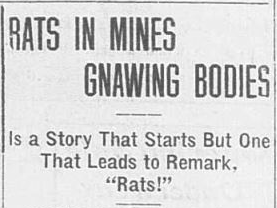
“A story started last night that rats were in the mines gnawing the bodies of victims, but it was too ridiculous to receive much credit. Doubtless there were numerous rodents in the mines at the time of the accident, as there always are in mines, but that even a rat escaped the awful death strike, when the explosion came is not at all possible. There has not been any opportunity since for rats to get into the mines as the entrances have had men constantly at them and hence there could be none within. Besides the bodies recovered shows no sign of the presence of rats in the mines.” (CDT 12.10.07 pg. 3)








 The Monongah Disaster