Saturday, December 7, 1907 Dawn – Late Morning (6:00 am – 11:00 am)

“Stunned by the terrible swiftness of the wings of the angel of death over the little coal mining village, Monongah is today dumbly counting its dead.” (EO 12.7.07 pg. 1)

Dawn

In Monongah:

“The excitement of the day was no less keen, but not of the noise and demonstration of the morning, the people awakening to the awful loss of life and being ready to offer everything within their power to aid the work of rescue.” (CDT 12.7.07. pg. 1)

“With the dawn of day there began a heartrending march up and down the aisles along which these bodies have been laid, by sobbing wives and mothers and sweethearts, orphaned children and strong men, each seeking a near relative or beloved friend.” (News)

“Tomorrow or the next day the numbed nerves may again perform their functions and in the reaction the survivors may writhe in grim agony and grief, but today there is no sorrow—only dull interest that lights up eyes of mothers, wives, and brothers as each limp and blackened form is tenderly passed up from out of the hell pit, where in one brief moment 400 lives were snuffed out as a candle light in a gale.” (EO 12.7.07 pg. 1)

“All with the exception of a few have given up hope and accept it as a foregone conclusion that none survive the disaster. Relatives still cling to the ray of hope, however, that their loved ones may have been spared and eagerly seek the reports of the searchers as they come above to get fresh air.” (CDT 12.7.07 pg. 1)

~6:00 am – ~ 8:00 am

At #8:

“Fire…in south side of #8 was extinguished about 6 o’clock this morning.” (FWV 12.7.07 – pg.1)

Rescue and recovery work can finally begin in #8.

At the mines:

Rescue work has become thoroughly systemized and progresses rapidly. “Hundreds of men are at work this morning clearing away the debris for the removal of the 425 unfortunate men whose lives were snuffed out without a moment’s warning.” (FWV 12.7.07 pg. 1 – noon)
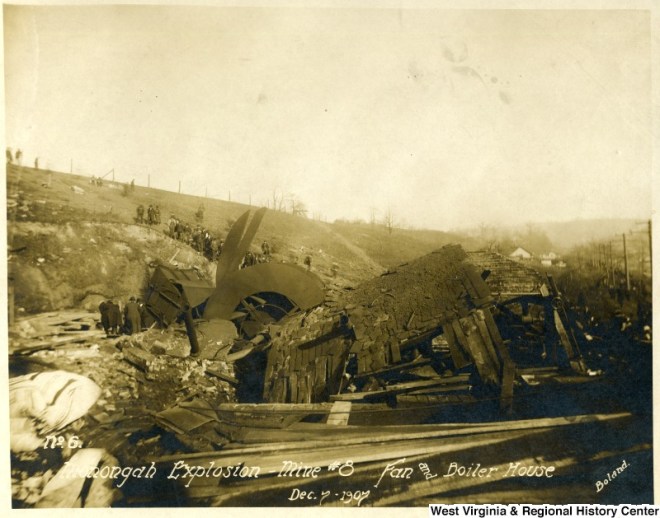
8-fan

“With unabated energy, five rescuing parties, working from every possible point to enter and explore mines numbers 6 and 8…are this morning putting forth every effort to reach, dead or alive, the remainder of the 400 or more men who went into the mine yesterday morning. There is little hope that any have survived the terrific explosion and the resultant poisonous gas…” (WED 12.7.07 pg. 1) (ES 12.7.07 pg. 1)

“Near the mine entrance, when the rescue work began, were nearly 300 caskets indicating the least extent to which the company believe the loss of life in the mine will reach.” (TEP 12.7.07 pg. 1)

In Monongah:

“Men are now working in relays to reach the miners entombed in the two great shafts. On the hills overlooking their work are the weeping wives and other relatives of the imprisoned men. Among them are the three women whose husbands lie in the improvised morgue.” (WED 12.7.07. pg. 8)

“The scene at the wrecked mines is a repetition of the sight yesterday. The grief-stricken ones is deeper than manifested yesterday. The hopeful anxiety that characterized the people looking for the rescue of loved ones has changed to a sorrow well-nigh inconsolable. Yesterday there was hope today there is despair. The hope for loved ones to escape from their imprisonment to be recognized by their friends gave way to the thought of not knowing them when brought to the surface.” (FWV 12.7.07 pg. 1 – noon)

~8:00 am

In Monongah:

“Hundreds of people have been attracted here from Fairmont, Clarksburg and other places in the valley, many of them having friends and relatives among the ill-fated miners and at the scenes of the horrors are seething masses of people.” (CDT 12.7.07 pg. 1)

“Mine officials, railroad men, newspaper men of the big city dailies, craftsmen of every trade are mingling with those who are anxious about those whose lives are sure to have been snuffed out.” (FWV 12.7.07 pg. 1 – noon)

“Hundreds of visitors are at Monongah today viewing the wreckage and watching the bringing of bodies to the surface…” (FWV 12.7.07 pg. 1 – noon)

~8:30 am

“Mr. R.M. Hite offers services of a large number of experienced miners from Kingmont mines (operated by the Virginia and Pittsburg Coal Company). This was a very kind offer…for the men who have long searched for the missing are getting weary. They have searched diligently and there is an end to their endurance.” (FWV 12.7.07 pg. 1 – noon)

~9:00 am

At #6:

Another rescue party including John Hallan and Carl Tarlton enter #6, still hoping to find survivors in the very recesses of the mine.

Not long into their exploration, Hallan and Tarlton find the body of a motorman, “jammed back in the motor where he had been sitting with one arm thrown about 30’ away” (McAteer). As this motorman was clearly dead, they did not stop for long to examine him and continued on their search, looking for any dangerous gases and any signs of life.

At #8:

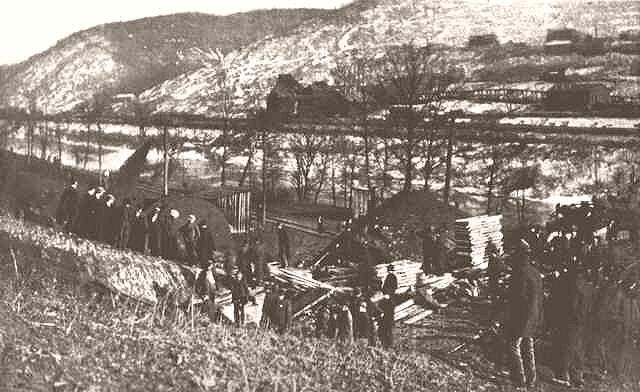
Rescue parties also prepare to enter #8 with the same purpose: find survivors.

“In mine number 8 the rescuers are just getting to work as gasses have delayed them.” (EO 12.7.07 pg. 1)
mc6

“Six bodies are all that had been found in No 8 until this morning. One man was found in the manway.” (FWV 12.7.07 pg. 2 – noon)

In Monongah:

25 more miners arrive in Monongah from the Tunnelton mines to help rescue efforts. (FWV 12.7.07 pg. 1)

“The King’s Daughters and committees of women started a work of visiting homes of the miners, leaving baskets of food where needed…” (Kellogg)

Restaurants in Fairmont and Clarksburg made soups and sandwiches for rescue workers and victim’s families “…and two blacksmith shops were turned into kitchens where great pots of stew and coffee were set boiling.” (Kellogg) People from all around have been bringing whatever they have for donations.

Father D’Andrea of the Italian Catholic Church, Our Lady of Pompeii, is certain by now that his own brother, Victor D’Andrea, is among the victims of the disaster. However, he gets no time to mourn as he and other religious leaders have been overwhelmed with the grief-stricken families for the last 24 hours. Father D’Andrea is only now beginning to survey victims among his parishioners while Father Lekston of St Stanislaus Catholic church has already counted at least 110 victims from his Polish congregation.

In Fairmont:

A little after 9 am, C.W. Watson telegraphs J.N. Camden, “…have lost all hope of finding any men alive.”

~10:00 am

“At ten o’clock today, a total of one hundred bodies had been found in the Monongah mines. These will be removed to morgues at once. Four hundred coffins have been ordered by the Fairmount Coal company. All will be used sooner or later, as it may be weeks before all victims of the explosion are recovered.” (RP 12.7.07 pg. 1)

“The remains of the dead are being carefully handled and prepared for burial in the most decent way even as well as could be done at a well-regulated undertaking establishment.” (FWV 12.7.07 – pg.1)

~11:00 am

In Monongah:

“The eleven o’clock car was one hour getting through the dense crowd between Nos 8 & 6.” (FWV 12.7.07 – pg.1)

“There is an immense concourse of people all anxious to see what there is to be seen. While the situation has not reached that point yet it may be possible that it will have to be brought under military control.” (FWV 12.7.07 – pg.1)

“President C.W. Watson wired Gov. Dawson this morning that he did not think military control would be necessary as the crowd is a very orderly one.” (FWV 12.7.07 – pg.1)

Outside the mines, Doctors Hill and Cook along with a few dozen nurses realize their services won’t be needed for survivors but for the rescuers instead. A second emergency hospital is set up by #8 and equipped “at 11 o’clock today with cots, bedding, and etc.” (FWV 12.7.07 – pg.1)

At #6:

“Up to 11 o’clock today sixteen bodies had been removed…Four are Americans. About eighty bodies have been found, but only sixteen have been brought to the surface.” (WED 12.7.07 pg. 1) (RIA 12.7.07 pg. 1)

“The rescuers are now within 1,500 feet of the end of the mine. They are working in two parties of about thirty men each with reliefs every hour.” (WED 12.7.07 pg. 1) (RIA 12.7.07 pg. 1)

Outside #8:

2 members of rescue crews, Milton Coburn and James Kane, are taken out of #8 to the emergency hospital set up just below the opening of the mine. Both were overcome by the gasses they inhaled while inside. (FWV 12.7.07 pg. 1)

ME13


More on How Death Gloated!

Bibliography

Disclaimer and Guide

Introduction

About the Author

Contact Information

Saturday, December 7, 1907 Midnight – 5:00 am

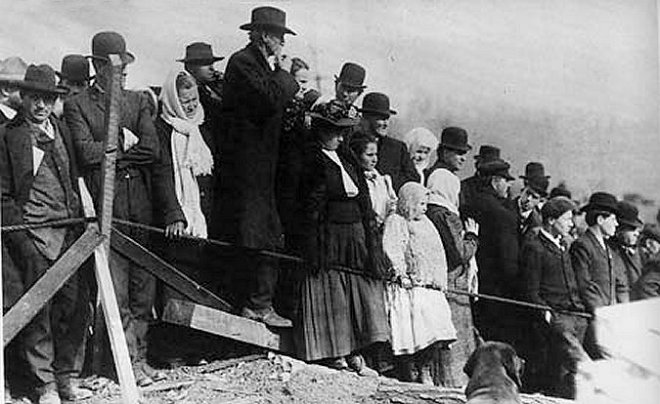
“Through the night the vigil of a large crowd of people did not lag from that during the day. Forbidden to approach near the opening because of the barriers and ropes and heavy guard, they waited on the trolley embankment anxiously awaiting above the opening and watching the work of those on the outside of the mine who assisted the rescuing party. Here the crowd is thick with the wives and daughters of the hundred entombed fifteen hundred to two thousand feet beneath the surface, and with tear-stained and drawn faces watch with unbroken gaze the opening.” (CDT 12.7.07 pg. 1)

Midnight

12.7.07 - pg 1 - disaster 2
CDT 12.7.07 pg. 1
At #6:

“Of these victims six dead bodies had been taken from mine No 6 and sixty-five others were piled up in the entry awaiting the completion of facilities for bringing them to the surface.” (WED 12.7.07 pg. 8)

At #8:

“Deputy Mine Inspector F.E. Parsons, of Clarksburg, and General Superintendent John Brooks, of the Clarksburg Fuel Company, are leading the rescue work at this mine and are assisted by Superintendent Albert J. Ruckman and John Brennen, Superintendent of the West Fairmont shaft, with a squad of some twenty men.” (CDT 12.7.07 pg. 1)

The Morgues:

As the bodies arrive on the surface, they are examined right at the mine by Dr. F.W. Hill and other medical volunteers.

In one of the nearby emergency hospitals at the mine mouth, now a temporary morgue, one of the dozens of volunteer undertakers from the area will search any remaining clothing pockets for personal items and make any notation possible of the body and its discovered location in hopes it will aid in identification.

In these first hours of systematically managing the dead, physicians require little time to ascertain how several met their death based on nothing more than their burnt and/or mangled bodies. Those in these conditions, like a brakeman who was found in one of the mines as nothing more than a headless and limbless torso, will be impossible to embalm and display for identification.

After each one is quickly checked for cause of death it is placed in a casket on hand or shrouded as best as possible. Several bodies are placed on a horse-drawn wagon filled with straw and carried across the river to east side of town where the temporary morgue in the First National bank is finally prepared to start accepting, washing, embalming, and dressing the victims.

Throughout the night and following day, throngs of families and onlookers crowd around the carts as they travel across the river. They frequently block the forward path and frighten the horses, making the transport slow and difficult.

“The bodies brought to the surface during the night were washed and made as presentable as possible by a dozen undertakers from this and surrounding towns and placed in one of the mine buildings which was converted into a temporary morgue.” (RIA 12.7.07 pg. 1) (ETR 12.7.07 pg. 1)

~1:00 am

At #8:

J.C. Gaskill moves from mine #6 to #8 and remains there “recovering bodies” (Inquiry)

Fire discovered once again in #8, this time in the 1st north heading about 450’ from the pit mouth. However, more brattice work will need to constructed in the area before the workers can actually reach the location of the fire.

“The openings in the ground were all covered with canvass to shut off the draft and the hose was turned on the fire soon after it was discovered.” (FWV 12.7.07 – pg.1)

~2:00 am

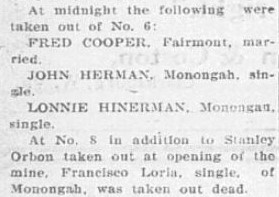
“…near No. 8 Howard Preston, colored, of Monongah, was taken out, and also four Italians, names unknown.” (CDT 12.7.07 pg. 1)

~3:00 am

At #8:

#8 is still burning “…with no prospect of extinguishing the blaze and hundreds of dead miners will be burned. Excitement is intense and the whole town is out fighting the flames.” (CDT 12.7.07 pg. 1)

Dozens line up down the bank to the river and haul water brought in buckets to the mine mouth. Fire extinguishers have also been brought in from Fairmont.

At the mines:

“During the night few women were to be seen, but all day yesterday the women were the chief actors in most pathetic and heartrending scenes.” (WED 12.7.07 pg. 1) (ES 12.7.07 pg. 1)

Throughout the night, men stood about the mouth of the mines. “They said nothing but when approached and asked questions they would give way to their emotions, often to tears.” (RIA 12.7.07 pg. 1)

~3:20 am

The body of Charles Honaker is brought to the morgue. (CDT 12.7.07 pg. 1)

~3:30 am

At the mines:

“…eleven bodies had been brought from mine Nos 6 and 8 and placed in the temporary morgue.” (CDT 12.7.07 pg. 1)

“To date eleven bodies have been taken out of #6 opening and two from a small opening about a quarter mile from #8 opening. All available means are being used to hasten an entrance into the mines where dead bodies are now entombed.” (FWV 12.7.07 – pg.1)

~4:00 am

“The officers of the company checked up their list of employees so far as possible, and later stated that at least 380 men were in the mine when the disaster occurred. Their list, they admit, is not complete, and statements that 500 men were caught by the explosion go unchallenged.” (TBE 12.7.07 pg. 1)

“It is given out by officials of the two wrecked mines that the number of entombed miners will reach 450. Mine officials have these classed as follows: Americans,100; Polanders, 150; Italians 275; Total, 450.” (CDT 12.7.07 pg. 1)

“The mine records, time books and other information lead to the conclusion that 450 will cover the number completely, but it is not thought the number will fall under that and there exists the firm belief with the officials that all have perished.” (CDT 12.7.07 pg. 1)

“There is no question whatever but that four hundred, possibly more, are dead, said Superintendent Malone this morning.” (RP 12.7.07 pg. 1)

“President Watson of the mining company stated this morning every possible investigation will be made to ascertain the cause and fix the responsibility.” (RIA 12.7.07 pg. 1)

~5:00 am

At #6:

“At 5 o’clock this morning seventy-nine blackened bodies had been recovered. Six bodies were brought from No. 6 mine.” (TBE 12.7.07 pg. 1)

Inside #8:

Workers are winning the battle with the fire in #8.

In Monongah:

“The wives and children of many of the entombed men have not left the mouths of the shafts since the first alarm was given. The night was a cold one and the mourners suffered intensely, but few heeded the offers of shelter from their friends. Several of the women fell unconscious or went temporarily mad from grief and exposure and had to be carried or forcibly removed from the scene of the disaster.” (WT 12.7.07 pg. 1)

mmd-mining3

In Fairmont:

FCC suspends operations in all mines today and Malone orders all experienced supervisors and craftsmen from surrounding mines to come and help speed the rescue. (FWV 12.7.07 – pg. 1 – noon)

Every undertaker in Fairmont is contracted and the supply of readily available coffins in the area is immediately exhausted.

“The company has sent rush orders for coffins to Pittsburg, Zanesville, and other towns, the total number ordered up to this time being 380.” (WED 12.7.07 pg. 1)

“Four hundred coffins have been ordered by the Fairmont Coal Company. All of these boxes will be used—sooner or later—for it may be weeks before all of the victims of the mine explosion are recovered. Possibly the order will be increased.” (WT 12.7.07 pg. 1)

In Monongah:

“Gloom possesses the entire town as never before in the history of Marion county and excepting the piteous cries of bereft families,…the town was wrapped in death-like stillness last night.” (CDT 12.7.07 pg. 1)

frontThumbnail (10)

Friday, December 6, 1907, Early Afternoon, 1:00 pm – 3:00 pm

Early Afternoon

In Monongah:

“The women around the mine entrance are going crazy with grief and can hardly be handled.” (FWDN 12.6.07 pg. 1)

Crowds are growing to uncontrollable numbers. (News)

Agents for the company begin to prepare for the worst.

~1:00 pm

On the east side of Monongah:

“At one o’clock this afternoon the officials of the Fairmont Coal Co. revised their figures as to the number of men at work in the mines, making it three hundred, instead of five, and they do not believe any have escaped death or injury of a serious nature.” (CET 12.6.07 pg. 1)

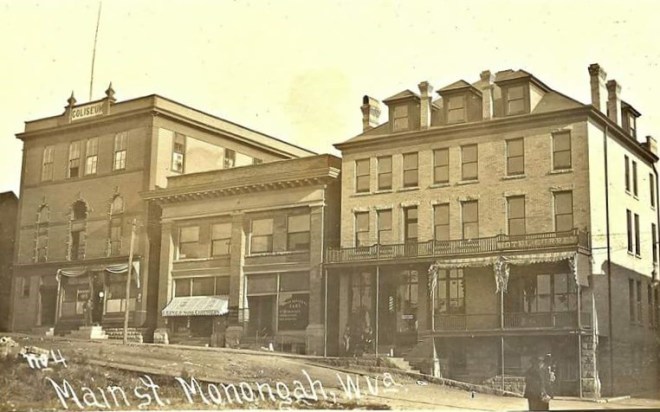
Coroner E.S. Amos prepares to set up a temporary morgue inside the unfinished First National Bank of Monongah (a new institution owned by the Watsons and others).


“The First National bank building…has been rigged up for a morgue and the dead will be taken there as soon as recovered.” (FWDN 12.6.07 pg. 1)

theater, bank,hotel

E.P. Knight brings the piece of broken coupling pin to Frank Morris in the office of the company store for safe keeping then returns to the relief work. (Inquiry)

~1:30 pm

Outside #6:

Dr. Cook sees first 3 bodies brought out of #6; the 3 men who were found in the shed at the foot of #6 slope. (Inquiry)

~2:00 pm

Outside #6:

8 bodies found near entrance of #6 “and had been taken out, but at that time dense volumes of smoke from a fire in the heart of the mine drove the rescuers to the open air and they have not since been able to return, although every effort is being made to get in.” (Pitt. Press Evening, 12.6.07 – pg.1)

“The fans were all blown out of mine No. 8 and it was the belief of some that the mine was afire.” (CDT 12.7.07 pg. 1)

At the mines:

“Little was done…until after three o’clock when several men were rescued.” (FWV 12.7.07 pg. 1 – noon)


Previous Post

Next Post


More on How Death Gloated!

Bibliography

Disclaimer and Guide

Timeline

Introduction

About the Author

Contact Information


Friday, December 6, 1907 12:00 pm – 1:00 pm

12:00 pm – Noon

In Fairmont:
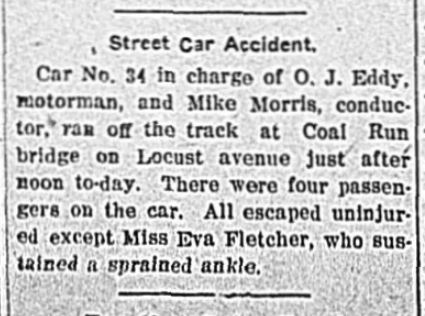
12.6.07 pg 5 - street car accident on Coal RUn in Fairmont
FWV 12.6.07 pg 5

Within the next few days, this event will gradually become entangled in the news coming out of Monongah. With so many people and newspaper reporters in and out of Fairmont, entirely unfamiliar with the area, this is more than likely how various reports begin to spread across the country that the trolley which ran passed #8 coal mine just before the explosion was blown off of its tracks, wrecked, and that a young female passenger was injured in the process. Though there is no information about what happened to the trolley after it passed #8 nor are there personal accounts from any of its passengers, the trolley at Monongah was not thrown from its tracks and wrecked.

At the company offices, “Mr. S.L. Watson was called up by many newspaper men but was unable to accommodate them because of lack of news.” (FWV 12.7.07 pg. 2 – noon)

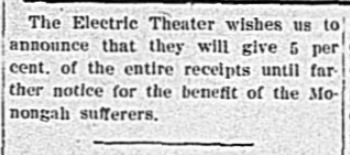
The Electric Theatre calls the Fairmont newspapers to make the announcement that they will give 5 percent of the entire receipts until further notice for the benefit of Monongah sufferers. (FWV 12.6.07 pg. 5)

12.6.07 pg 5 - Thater offers proceeds to Monongah
FWV 12.6.07 pg 5
Inside the mines of Monongah:

Localized explosions, ignitions, and fires continue consuming the oxygen throughout the mines. Afterdamp has had over hour and half to work through the mines and has already suffocated many. Some miners who survived the initial explosions are putting jackets over their heads or napkins over their mouths to try and prevent breathing in gases. (McAteer, News)

In the town of Monongah:

Monongah is getting positively ambushed with all varieties of people from the area. Train/Trolley loads of volunteers, mourners, amateur photographers and macabre sightseers start pouring in from Fairmont and surrounding areas.

Undertakers begin pouring into town, ”from Fairmont, Shinnston, and Clarksburg among whom are Clifford & Osborn, Sleppy & Warne, of Clarksburg, Harmer of Shinnston, and Musgrave and Bunningham*, of Fairmont, summoned at the instance of the coal company to take charge of the frightful morgue that will present itself when all the bodies are recovered.” (CDT 12.7.07 pg. 1) (*should be “Cunningham”)

Transport wagons and crews are hired. W.S. Thomas Transfer Co. (Fairmont firm) sends all available wagons and teams to Monongah. (News)

Communications within town, let alone outside of town, are extremely limited and reports about the events going on in the area begin to conflict from the very start. (News)

“The bodies of three miners were recovered near the mouth of Mine No. 6 at 12 o’clock.” (CDT 12.6.07 pg. 1)

“Up to noon four bodies had been recovered. These were found at the entrance of the mine.” (CDT 12.6.07 pg. 1)

Inside #6:

“Besides the broken cars that clogged the heading much of the brattice work was demolished and this too added to the delay in bringing bodies out. Many of the brattices were constructed of brick and were supposed to be permanent, thought to be sufficiently strong to withstand any concussion that might arise from an explosion; but these went down and were but a mass of debris.” (FWV 12.7.07 pg. 1 – noon)

The rescue crew headed by Supt. Gaskill continue exploring beyond the shanty at the foot of #6. They find another body, one they assume must belong to the car coupler, Bill Sloane, based on its location. There’s just one little problem; unknown to everyone else, Bill Sloane is at home sick in bed. Fred Shaver will later tell L.M. Davis of the Fairmont West Virginian about the four men he recognized, including Bill, and all four names will be published as the first identified dead. (News)

Not far beyond here, the crew encounters more afterdamp and are forced to turn back until proper ventilation is restored to these areas. They do not take any of the discovered victims with them. (Inquiry)

Outside #8:

Someone coming across #8 trestle finds Joe Newton among the debris “more dead than alive”, gets him up, and rushes him over to the interurban car.

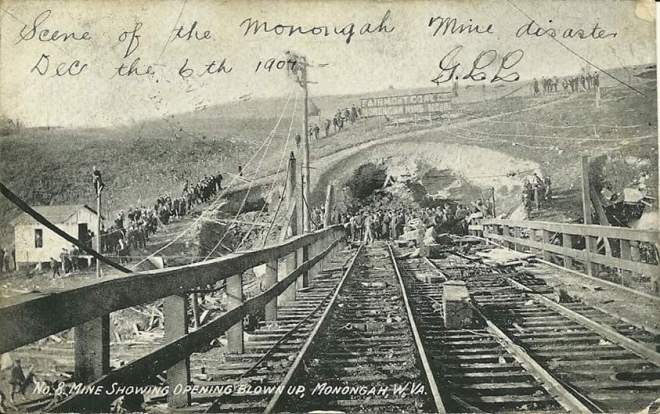
postcard - 8

~12:30 pm

Outside #6:

Pat McDonald is found unconscious on the #6 trestle walkway covered with severe burns and lacerations all over his face and torso. The interurban car carrying Joe Newton is stopped just above #6. Pat McDonald is quickly placed aboard and the two are rushed to the Miner’s Hospital in Fairmont.

On the east side of Monongah:

#6 tipple foreman E.P. Knight finds a piece of the coupling pin that broke away from the train of cars and puts it in his pocket.

In Monongah:

“The first dispatches told of women who tore their hair, or clawed their nails into the flesh of their cheeks or threatened to throw their babies into the river. The wife of the Presbyterian minister told me that she saw these things. Such a woman had run back along the railroad tracks tearing at her face and hair. They quieted her. 3 sons, 3 brothers, and a husband—all were in the mines she said.” (Kellogg)

women - zoom


Previous Post

Next Post


More on How Death Gloated!

Bibliography

Disclaimer and Guide

Timeline

Introduction

About the Author

Contact Information