“Worthington being so near the scene of the late disaster shares in a closer manner the sadness which must overshadow the community for many months to come. Many of our people have been untiring in their heroic efforts to afford aid to the sufferers, in many cases walking miles to help in the arduous labors without a thought of compensation. Truly it strengthens ones faith in human nature when we so often find the hero hidden under the everyday exterior. For many days life seemed at a standstill in Worthington but living people must work to live and the customary vocations and avocations are beginning to rally from the shock.” (FWV 12.18.07 pg. 2)
Late Evening
In Monongah:
One more body is found making a total of 338 bodies recovered. (FWV 12.19.07 pg. 1)
“State Mine Inspector Paull is still at work collecting evidence.” (CDT 12.18.07 pg. 1)
The members of the Joint Legislative Committee retire their examination for the night and head back to Fairmont.
7:30 pm
In Fairmont:
First M.P. Church holds a Prayer meeting (FWV 12.14.07 pg. 2)
Diamond St. M.E. Church service observing the anniversary of birth of composer Charles Wesley. “The first hymn he composed was ‘Oh, for a thousand tongues to sing”. This hymn with several others which he composed will be sung…at the prayer meeting…” (FWV 12.14.07 pg. 2) (FWV 12.16.07 pg. )
The members of the Joint Legislative Committee stay at the Tavern in Fairmont tonight. (Inquiry)
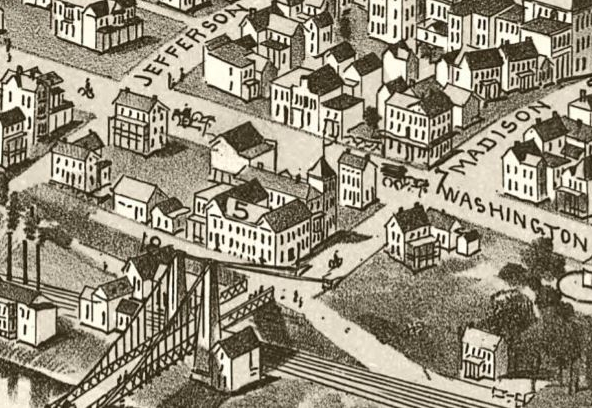
Building 5 is “The Tavern” aka Skinner’s Tavern
Night
In Monongah:
“No more bodies have been recovered…and the total number of the ones recovered remains at 338.” (CDT 12.18.07 pg. 1)
2 gangs of 30 men work during the night. No more bodies are found. (FWV 12.19.07 pg. 1)
Some more carcasses of horses and mules were removed. (FWV 12.19.07 pg. 1)
“Mr. James Davis of Helen’s Run has accepted the position of principal of the Monongah school for the remainder of the term.” (FWV 12.18.07 pg. 2)
Clarksburg Daily Telegram:
On page 4, an editorial confronts and criticizes the Wheeling Intelligencer:
“It goes off half-shot, really drunken in its gibbering about the terrible disaster at Monongah.” (CDT 12.18.07 pg. 4)
“…to state to the public that Governor Dawson and his mine inspection in this state is lax, and just as insistent is it that it absolutely controls Governor Dawson and that he shall not turn a hand without its approval.” (CDT 12.18.07 pg. 4)
“Produce the goods upon which you make your assertions and charges, else keep your mouth shut. Down this way we are not taking things for granted and you can not fool us.” (CDT 12.18.07 pg. 4)
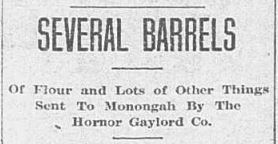
“Mention was made in the list of contributors who sent supplies for the Monongah mine sufferers to the mayor’s office of the Hornor-Gaylord Company with credit for a barrel of flour. This was a mistake as the Hornor-Gaylord Company sent a large quantity of supplies direct to Monongah immediately after the disaster, included in them being six or seven barrels of flour and many other things.” (CDT 12.18.07 pg. 6)
“The barrel of flour sent to the mayor’s office was likely sent by some one else and credit was given to the Harnor-Gaylord Company probably because the firm’s name was the only one on the barrel.” (CDT 12.18.07 pg. 6)
“The company is preparing 1,000 sack of candies and other goodies to be sent to the children of the mine sufferers for Christmas.” (CDT 12.18.07 pg. 6)
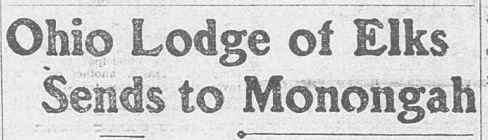
“…J.J. Connell was appointed by the lodge to look after the distribution of a shipment of clothing and supplies to Monongah…” (CDT 12.18.07 pg. 6
“…so we have this day started forward the boxes of clothing of different descriptions (a list of same is here attached), billed to the Mayor of Monongah and realizing that both the mayor and relief committee have all they can attend to and desiring our mite to do as much good as possible, we hereby ask 182 to send a brother to Monongah to look after this contribution and to use his own judgement as to the proper course to pursue.” (CDT 12.18.07 pg. 6)
“Mr. Connell has been at Monongah nearly every day since the accident occurred and is familiar with the relief work being done there.” (CDT 12.18.07 pg. 6)
“The shipment of goods has not arrived at Monongah from New Philadelphia you but Mr. Connell will attend to its distribution as soon as it arrives.” (CDT 12.18.07 pg. 6)
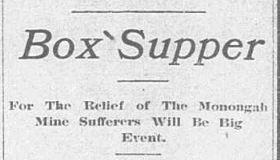
“The box supper to be given in the school house in the Industrial addition Saturday night of this week at 7:30 o’clock will be under the auspices of the Union Sunday school there, the Young People’s Christian Union and the Epworth League of Ash chapel.” (CDT 12.18.07 pg. 12)
“The various denominations there are urged to take part in the supper and every one is cordially invited.” (CDT 12.18.07 pg. 12)
“The young ladies will prepare dainty boxes of eatables and these will be auctioned to the highest bidders and after the sale is completed the supper will be indulged in.” (CDT 12.18.07 pg. 12)
Washington Times in D.C.:
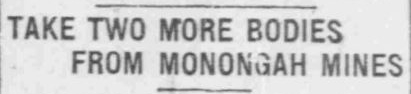
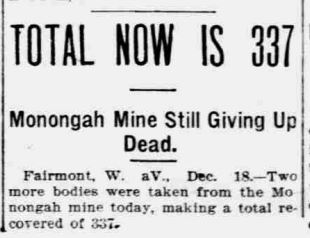
“Two more bodies have been taken from the Monongah mines, making the total list of bodies recovered 337.” (WT 12.18.07 pg. 11)
Gainesville Daily Sun in Florida:
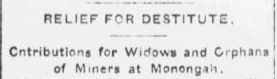
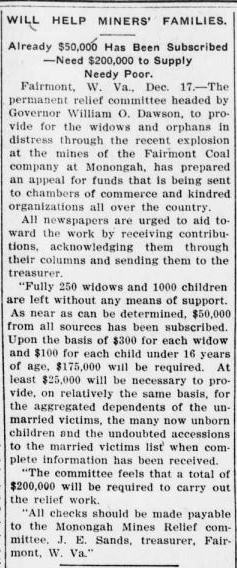
“The permanent relief committee, headed by Governor William O. Dawson, to provide for the widows and orphans in distress through the recent explosion at the mines of the Fairmont Coal company at Monongah has prepared an appeal for funds that is being sent to chambers of commerce and kindred organizations all over the country.” (GDS 12.18.07 pg. 1)
Richmond Palladium in Indiana:
“Two more bodies were taken from the Monongah mine today, making a total recovered of 337.” (RP 12.18.07 pg. 1)
Senators Thomas C. Gartlan and R.F. Kidd and Hon. GA. Mitchell, accompanied by D.E. Matthews and Mr. John Marshall, arrive to investigate the Monongah mine explosion. (FWV 12.18.07 pg. 1)
They came from Clarksburg over the interurban line and “went immediately to the Tavern, being escorted by Host Williams.” (FWV 12.18.07 pg. 1)
Building 5 is “The Tavern” aka Skinner’s Tavern
The committee will check into Skinner’s Tavern then continue on to Monongah where they “will investigate conditions as thoroughly as possible but will not take particular action until the evidence before the coroner’s jury has been given.” (FWV 12.18.07 pg. 1) (Inquiry)
1:30 pm
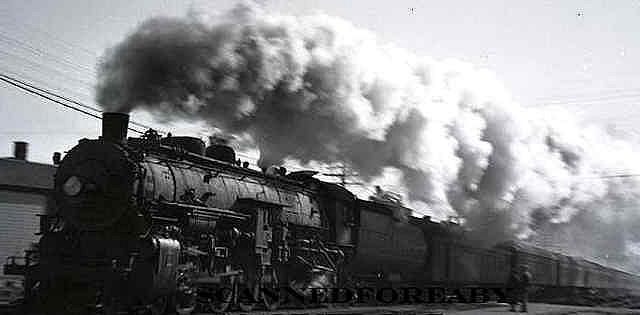
Mr. Newton Rice, of Pharaoh’s Run had a narrow escape from death at the B&O depot when train No 71 was passing through the station at an unusual rate of speed and Mr Rice was struck by the cylinder on the engine and hurled to the platform. Bystanders assisted him to his feet and after a few minutes he was able to go his way. Beyond a few bruises he was apparently unhurt.” (FWV 12.18.07 pg. 1)
During the Afternoon
In Fairmont:
Union Relief Association holds a meeting of the executive board the in lecture room of the M.P. Temple in order to make a report of funds collected. “Mrs. A.J. Ruckman, of Monongah, was present at the meeting by special invitation, and in a short talk told of the needs at Monongah and expressed the gratitude the Monongah people felt towards the citizens of Fairmont for the aid they had given and were still giving them. It was agreed that the Relief Association at Monongah and the Union Relief Association should work together and 6 Fairmont women went to Monongah today to assist in the distribution of clothing…(missing)…Relief Fund to be distributed at Monongah, it being a yearly institution for Hartley’s to distribute the Christmas baskets among the poor of the city. The remaining baskets as usual will be distributed among the poor by the King’s Daughters. A meeting which was called for Saturday has been postponed, date to be announced later.” (FWV 12.19.07 pg. 5)
“Damage suits are expected to come on behalf of the dead Italians. G.D. Caldara, the Italian consul here, said that personally he would prefer to settle all claims possible out of court but he could not say what his government would do.” (CET 12.18.07 pg. 1)
In Monongah:
“…the rescuing parties did not operate today.” (CET 12.18.07 pg. 1)
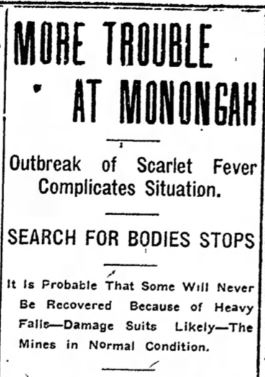
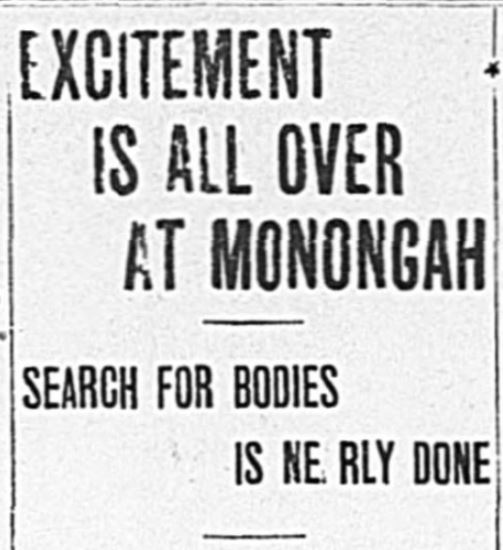
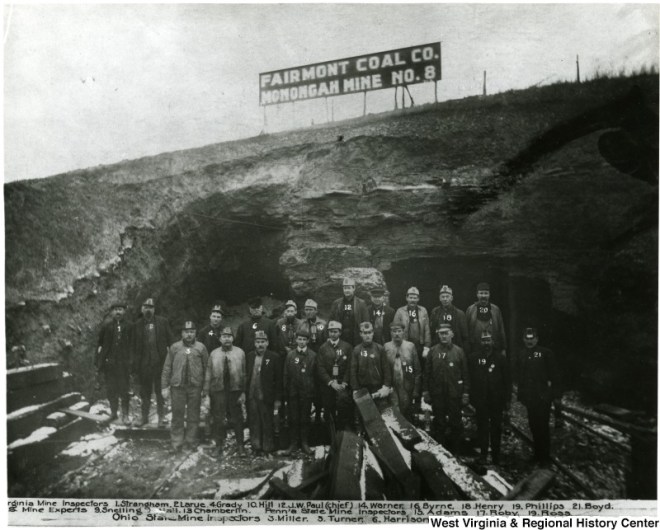
“The search for dead bodies has ended in Mine No 6 and but little more is to be done in No 8. “ (CET 12.18.07 pg. 1)
“It is thought that not much more work can be done in this direction without moving a lot of debris, which the rescuers say falls in some parts of the mines, particularly in No 8, are so bad that little or no progress can be made.” (CET 12.18.07 pg. 1)
“Some falls in different rooms reach to the extent of 200 feet and the interior of the mine is in a badly torn-up condition. It is not likely that some of these falls will ever be cleared up, as it will necessitate a great amount of work and labor, and the rooms are practically exhausted of coal.” (CET 12.18.07 pg. 1)
The West Virginia Legislative Joint Committee visits the disaster site and does an inspection of the outside conditions of the mines. They “consulted State Mine Inspector James Paul regarding the explosion and its cause.” (CDT 12.18.07 pg. 1) (McAteer) (Inquiry)
Paul reports to the committee that though they have finished their inspection of #6, they have not finished their inspection of #8 due to the condition of the mine, and therefore could not give any insight on the cause of the disaster. (McAteer) (Inquiry)
“Of the committee that went to Monongah, Senator Kidd was the only one who entered the mines. He accompanied the Inspectors into No.8. Speaking of this, Senator Kidd said the explosion must have been terrific as the wreckage in the mine is unconceivable.” (CDT 12.19.07 pg. 1)
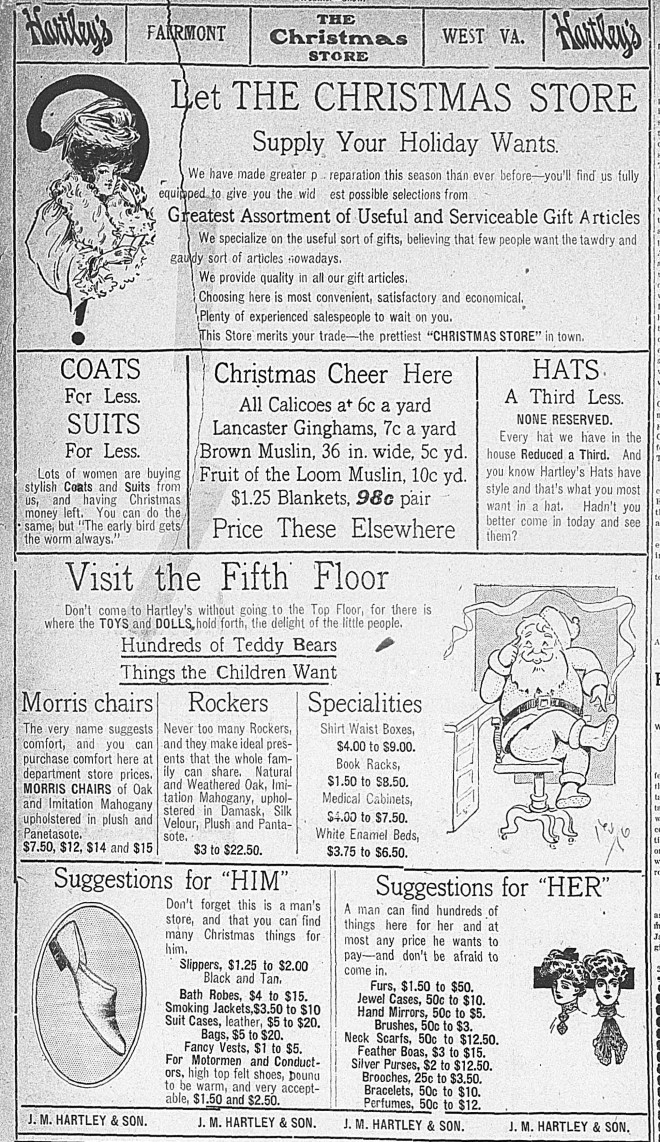
Hartley’s Department Store advertisement in the Fairmont West Virginian 12.18.07 page 5
“There are no new developments at Monongah today. A rescue party worked last night but found no more bodies, the total remaining at 337.” (FWV 12.18.07 pg. 1)
Morning
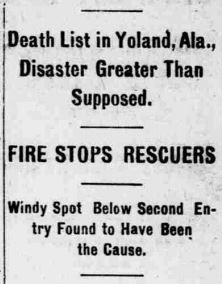
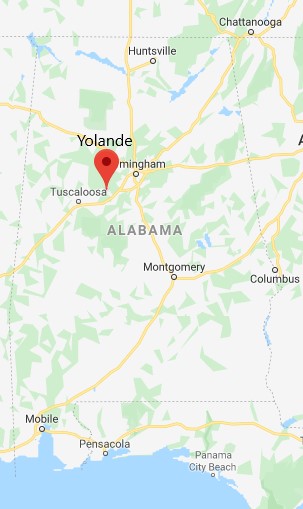
In Yolande, AL:
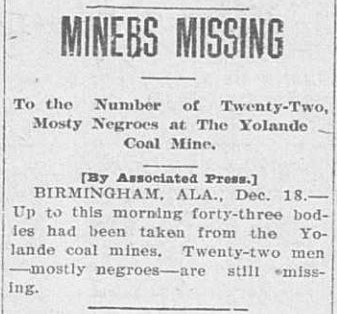
CDT 12.18.07 – pg 1
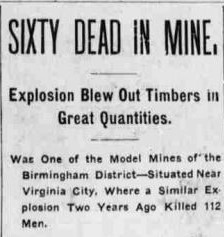
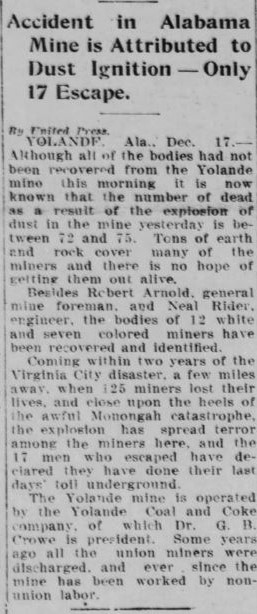
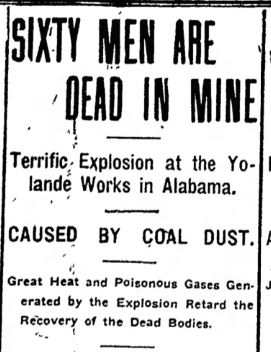
“The Yolande mines were among the model collieries of the Birmingham region. Non-union men were employed exclusively, but everything possible had been done to insure the contentment of employees. Yolande is situated on a beautiful hill and all the houses are painted white with green trimmings, giving it an air of picturesqueness and healthfulness unusual in mining quarters.” (TFR 12.18.07 pg. 1)
In Clarksburg:
Manager of Clarksburg Amusement Company, George A Murray, turns over to Rev. Father Reynolds a check for the sum of $25 to go to Monongah relief. “It will be remembered that the company volunteered to give the net proceeds of the Odeon and the Bijou Family Theater during last week to this worthy cause.” (FWV 12.18.07 pg. 2)
“By reason of the inclement weather which prevailed last week the proceeds of the popular play houses were not nearly so much as the company hoped to tender for this worthy cause.” (FWV 12.18.07 pg. 2)
A meeting of the Joint Legislative Committee has been called to gather at the Hotel Waldo in Clarksburg by Senator Thomas C. Gartlan of Parkersburg for the purpose of making an investigation into the Monongah disaster. The Joint Legislative Committee “made a tour of the coal fields of the State and visited the Monongah mine in October and were seemingly impressed with the good and favorable conditions that obtained there.” (FWV 12.14.07 pg. 8)
This Committee, appointed by Sen. McDermott, is composed of Senators Gartlan and Kidd, Delegates Duty, Strickling and Mitchell as well as John Marshall, Sargent at Arms, and John T Harris, secretary and stenographer. (Inquiry) (FWV 12.14.07 pg. 8)
However, Harris as well as Delegates Duty and Strickling have not arrived and, therefore, do not attend. (Inquiry) (CDT 12.19.07 pg. 1)
Committee members Gartlan, Kidd, Marshall, and Mitchell depart Clarksburg for Fairmont on the interurban line. (CDT 12.18.07 pg. 1)
In Fairmont:
The Fairmont West Virginian reports that the weather will be: Light snow, colder; Thursday, fair.
CDT 12.18.07 – pg 1
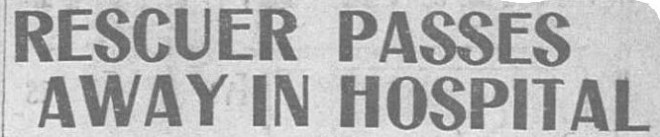
“John Neary, a miner of Uniontown, Pa., who helped with the rescuing parties at Monongah after the mine disaster died in Cook’s hospital here this forenoon.” (CDT 12.18.07 pg. 1)
“He contracted pneumonia while working with the rescuers and this caused his death.” (CDT 12.18.07 pg. 1)
“Neary went to Monongah as a volunteer to help in the rescue work and assisted at both mines No 6 and 8. He was a middle-aged man.” (CDT 12.18.07 pg. 1)
“Mr. Neary’s home was Latrobe, PA, and relatives will arrive from here today to take the remains home for burial.” (FWV 12.18.07 pg. 1)
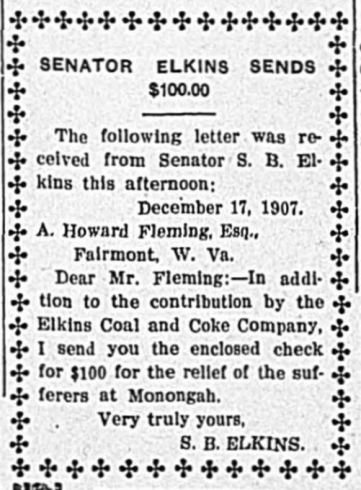
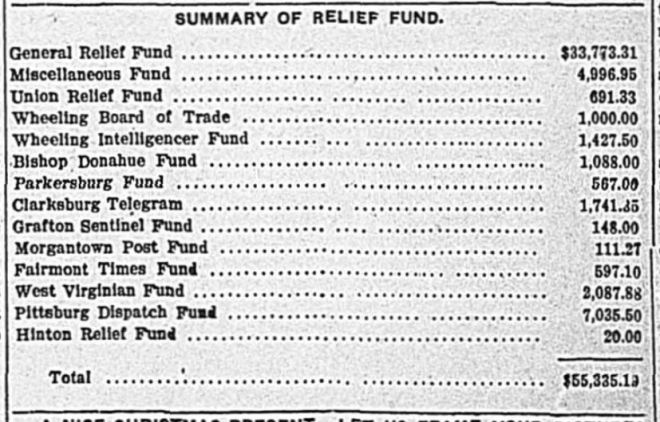
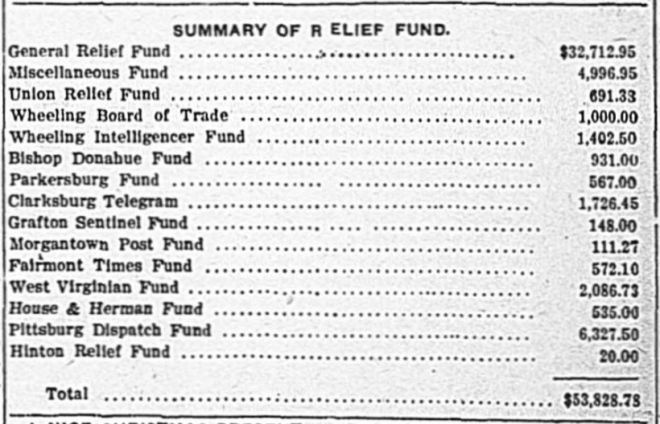
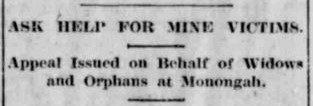
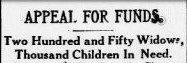
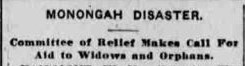
Monongah Mines Relief Association begins operation in the Masonic Temple under direction of Frank P. Hall. Postmaster A. Howard Fleming is secretary of the Association and will have oversight in the work. 4 stenographers are employed to send out 50,000 copies of an appeal for aid for the miners’ widows and orphans; “The stenographers are Misses Walsh, Gaskins, Leora Abbott and Elizabeth Stone.” (FWV 12.18.07 pg. 1)
In Monongah:
“Conditions at the mines are becoming normal.” (CET 12.18.07 pg. 1)
“The mine inspectors spent another day in their investigation.” (WT 12.18.07 pg. 11)
“Chief Paul and his force of investigators are continuing their work of gathering data to present before the coroner’s jury.” (FWV 12.18.07 pg. 1)
“The slowness with which the work is proceeding makes it likely that the coroner’s inquest, which will take the added importance of a State investigation, will not begin until after Christmas.” (WT 12.18.07 pg. 11)
Mr. M.D. Toothman walked to the cut near Barrackville which has been made by the street car company and, in some manner, slips and falls 25-35 feet down an embankment. Toothman sustained serious injuries but no bones were broken and he managed to remarkably narrowly escape instant death considering the distance he fell and the fact that his head missed two big rocks but by a few inches. (FWV 12.18.07 pg. 1)
In Clarksburg:
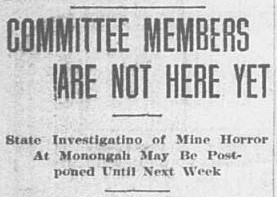
“The legislative mine investigating committee called by Chairman Thomas Gartlan to meet here today to investigate the mine horror at Monongah has not yet come together, the members not having arrived.” (CDT 12.17.07 pg. 1)
“Judge D.E. Matthews, of Charleston, assistant attorney general, and John Marshall, of Parkersburg, committee clerk, arrived last night and today and Senator Gartlan this evening from Grafton but the majority of the members of the committee have not arrived.” (CDT 12.17.07 pg. 1)
“It may be the meeting will be called off until next week as the coroner will not begin his work until next week according to advices of the hour.” (CDT 12.17.07 pg. 1)
In Fairmont:
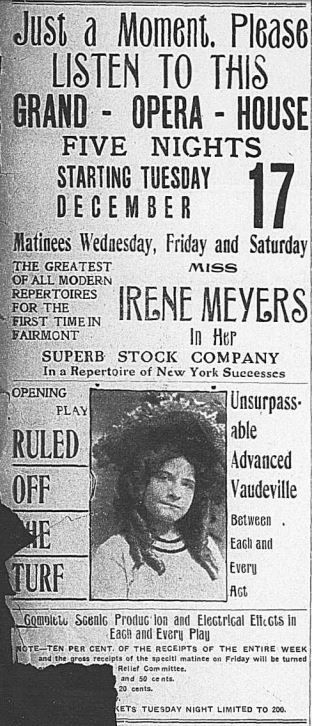
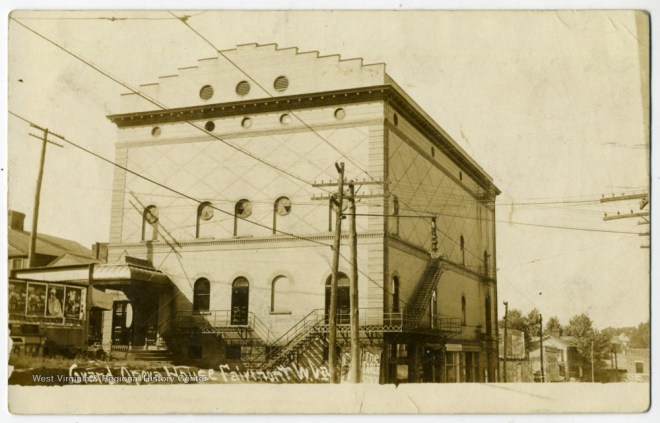
Irene Meyers & Company opens at the Grand Opera House with “Ruled Off the Turf”. (FWV 12.17.07 pg. 1)
FWV 12.17.07 – pg 6
During the first week of the disaster, a regular performance of “The Arrival of Kitty” had been cancelled early and rescheduled for the spring on account of low attendance. This low attendance wasn’t due to the quality of the show, nor directly to the disaster, but rather due to the venue’s delay in offering to contribute some of their proceeds to the relief fund; patrons had chosen to spend their time and money at other venues through the week which were donating to the fund.
“Mr. J.E. Powell, manager of the Grand Opera House, and Mr. Will H. Meyers, manager of the Irene Meyers Stock Company, have kindly volunteered to contribute to the relief committee 10 per cent of the gross receipts on the week, and also the entire gross amount of a special matinee to be given on Friday afternoon.” (FWV 12.17.07 pg. 1)
“The theater management and Mr. Myers requested the committee to have someone present to look after its interests and Col. W.H. Brand has kindly offered his services in this capacity.” (FWV 12.18.07 pg. 8)
“The theatre goers of Fairmont will be given opportunity of not only witnessing first class plays produced by an unusually good company, but will be contributing their mite to a good and needy cause.” (FWV 12.17.07 pg. 1)
“…all who were present were a unit in agreeing that Miss Myers is entirely worthy of all of the good things that were said about her in advance of her coming.” (FWV 12.18.07 pg. 8)
“Her style is highly pleasing and the role of jockey which she assumed last night was interpreted in a most intelligent and natural manner. Besides her really clever acting she sang some good songs which were enthusiastically encored.” (FWV 12.18.07 pg. 8)
“Her supporting company is the strongest ever seen here in a repertoire organization.” (FWV 12.18.07 pg. 8)
J.E Lessig, the heavy, came in for much favorable criticism. Marty Woodworth furnished some good comedy while Joseph Lawrence was very clever as was also Miss Edna Macbeth. “Notwithstanding the excellent cast the vaudeville features were highly entertaining.” (FWV 12.18.07 pg. 8)
“The Century Comedy Four was the best male quartette ever heard on the local stage…” (FWV 12.18.07 pg. 8)
“…the Marvelous Vade, the magician, put on some exceedingly clever tricks which were done with a neatness that is rarely seen.” (FWV 12.18.07 pg. 8)
“Marty Woodworth’s black face specialty was also very good.” (FWV 12.18.07 pg. 8)
Night
In Monongah:
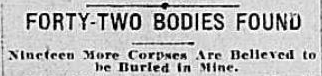
“No bodies were recovered today and with the two taken out last evening late, the number recovered to date is 336. Those taken out last evening were beyond identification.” (CDT 12.17.07 pg. 1)
“The carcasses of several horses and mules have been brought out of the mines during the past few days. There was a report current that no horses or mules had been found, but that was false.” (FWV 12.17.07 pg. 1)
Rescue crews work but find no new bodies. (FWV 12.18.07 pg. 1)
Ohio Inspector George Harrison publishes his statement after returning to Columbus. “Notwithstanding that conditions point to a coincidence of peculiar circumstances as leading to the explosion it seems premature to form any final opinion of the cause until a thorough investigation has been made in all parts of the mines.” (FWV 12.17.07 pg. 2)
FWV 12.17.07 pg. 7
Clarksburg Daily Telegram:
CDT 12.17.07 pg. 1CDT 12.17.07 pg. 3
“There has been a persistent knock here against the raising of funds for the Monongah sufferers. This should not be so. The Telegram has a supreme faith in humanity and believes that the families of the victims of the mine horror will be as treated as the funds and donations justify. Honorable men and women have enlisted in the great cause with a single end in view—that of aiding and comforting the distressed.” (CDT 12.17.07 pg. 4)
“The relief committee has invited the newspapers, even appealed to them to come to the aid of the mine sufferers at Monongah. The Telegram volunteered its services the night after the awful disaster and it assures the public that it is still earnestly enlisted in that service. Other papers may hold aloof, but not so with this paper, when it sees a chance to help humanity.” (CDT 12.17.07 pg. 4)
“Senator McDermott is of the opinion that the trip of cars breaking loose caused the mine horror at Monongah. Who knows that he is not right?” (CDT 12.17.07 pg. 4)
“Our people should not forget that anything they have of value at all the humanity will be cheerfully and thankfully accepted by the mine sufferers at Monongah.” (CDT 12.17.07 pg. 4)
“Two hundred thousand dollars is the amount the relief committee at Monongah appeals for. That means that much more money must be raised. Clarksburg has done well so far but there are thousands in the city who have not given to the fund. Think it over. Give something if you can.” (CDT 12.17.07 pg. 4)
CDT 12.17.07 pg. 8
“In this report Senator McDermott endeavors to relieve the Fairmont Coal Company of any responsibility for the explosion which snuffed out the lives of approximately 500 men and boys. Neither does he attribute it to any carelessness on the part of the miners. This is the first official statement made relative to the cause of the disaster.” (CDT 12.17.07 pg. 10)
Washington Herald in D.C.:
(WH 12.17.07 pg. 12)
Washington Times in D.C.:
“C.L. Magee, secretary of the National Red Cross, has received over $500 for the benefit and relief of the sufferers…” (WT 12.17.07 pg. 14)
“Contributions have come from all sections of the country and many of the State branches making collection have not yet reported to the headquarters here. Consequently, it is expected this sum will be greatly increased.” (WT 12.17.07 pg. 14)
Rock Island Argus in Illinois:
RIA 12.17.07. – pg 1
The Interior Journal in Kentucky:
IJ 12.17.07 pg 2
The Paducah Evening Sun in Kentucky:
PES 12.17.07 pg 7
The Caucasian in Louisiana:
TC 12.17.07 – pg 4
Bennington Evening Banner in Vermont:
BEB 12.17.07 – pg 7
The Evening Statesman in Washington:
TES 12.17.07 – pg 1
Bluefield Evening Leader in West Virginia:
“Sometimes a frightful shock is necessary to impel proper legislation. This would seem to be the case with the recent Monongah mine disaster,…” (BEL 12.17.07 pg. 2)
“West Virginia has had an unusual number of casualties within the past year, and our legislators should hasten some method which will prevent a repetition of the horrible affair at Monongah.” (BEL 12.17.07 pg. 2)
“Mining is one of the most dangerous industries in which labor is engaged and every possible means should be adopted to protect the lives of those who toil in the mines.” (BEL 12.17.07 pg. 2)
Wausau Pilot in Wisconsin:
WP 12.17.07 – pg 3WP 12.17.07 – pg 3
The Dectaur Herald in Illinois:
TDH 12.17.07 – pg 3
The Evansville Press in Indiana:
TEP 12.17.08 – pg 1
Cumberland Evening Times in Maryland:
“A reorganization of the relief committee in charge of relief work for the families affected by the Monongah mine disaster has been effected and now the new committee will push the work of providing relief for the needy.” (CET 12.17.07 pg. 1)
“Of the dozen or more miners from Clarksburg who perished in the Monongah mine horror the bodies of all have been recovered except that of a man named Hyland. If his body has been taken out it has not been identified. It is more than likely that it never will be identified and will be buried with the unknown.” (CDT 12.17.07 pg. 5)
~ 12:00 pm
At No. 1 mine in Yolande, AL:
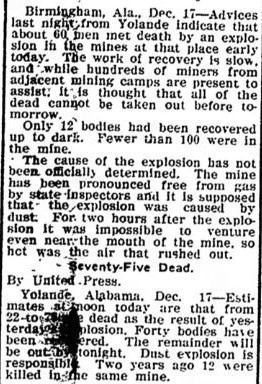
“40 bodies now recovered. The remainder will be out by tonight.” (FWV 12.17.07 pg. 1)
“The mine has been pronounced free from gas by State Inspectors and it is supposed that the explosion was caused by dust.” (FWV 12.17.07 pg. 1)
The explosion is now known to have occurred in either the 5th or 6th right entrance. All of the bodies have been recovered from those entries and some of them are so horribly mutilated that identification is almost impossible. (FWV 12.17.07 pg. 1)
At the mines in Monongah:
One body is found in No. 8 by Chief Paul’s inspecting committee. The inspection committee is working “through No 8 toward No 6”. (FWV 12.17.07 pg. 1)
~2:30 pm
Women’s Christian Temperance Union holds a meeting in the Library parlors. (FWV 12.16.07 pg. 5)
~3:00 pm
The Arts and Arts & Crafts Dept. of the Woman’s Club holds its regular meeting at the public library in Willard Hall. A special program is given, in charge of Mrs. U.A. Clayton, to which the public is invited. Admission is 35 cents and the proceeds will go to the Monongah relief fund. The subject of the programs is “The Madonna” (FWV 12.13.07 pg. ) (FWV 12.14.07 pg. 5)
“The entertainment was a success from a financial stand point as well as a literary and musical treat the sum of $35 being realized.” (FWV 12.18.07 pg. 4)
At some point during the afternoon
In Washington D.C.:
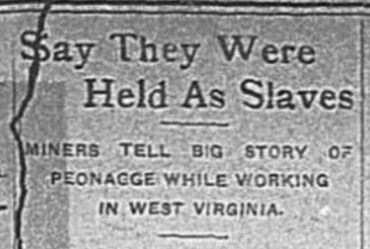
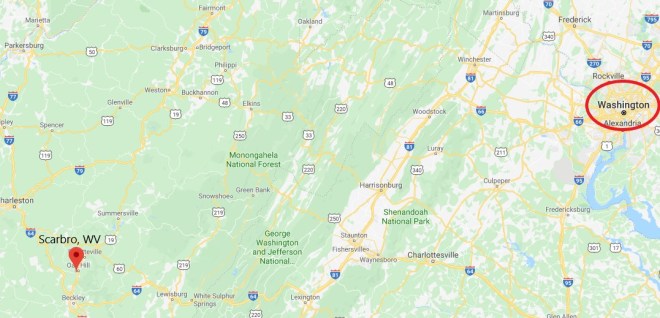
William Griffith and John J Payton, of Scranton PA, arrive in D.C. “in an almost famished condition” after walking almost 200 miles to Washington from Scarbro, WV. (FWV 12.18.07 pg. 7)
Both were induced to leave their work in Scranton “some months ago” by advertisement of the White Oak Coal Company offering to pay wages at which they could have earned from $5-$6 a day. When they got to work they were paid $.48 for the work in which they received $1.10 at the Scranton mines, and $.50 for what they received $1.29. (FWV 12.18.07 pg. 7)
“If stories told…are true, the laborers at the mine of the White Oak Coal Company at Scarborough, WV are virtually slaves.” (FWV 12.18.07 pg. 7)
Their wages are paid in scrip good only at company store and they were often forced to discount their checks even at the stores. The longer they worked at the mines the deeper they became indebted to the company. (FWV 12.18.07 pg. 7)
They would have left there at the end of the first week if they had not virtually been imprisoned by the detectives and guards of the company. Every day, they claim, the miners are marched to and from work under guard. (FWV 12.18.07 pg. 7)
After 3 or 4 unsuccessful attempts, they managed to escape with $1.50 as the result of their 3 months labor. (FWV 12.18.07 pg. 7)
They are asked to present their grievances to the Assistant Attorney General Russell with a view of securing evidence for the prosecution of the coal company. (FWV 12.18.07 pg. 7)
In Monongah:
Chief Mine Inspector Paul is still on the ground with district inspectors making an examination of the mines.
“News from the mine explosion so far as the Monongah end of the line is concerned will not amount to much any longer. The search for bodies has ended in No 6 and not much more will be done in No 8.” (FWV 12.17.07 pg. 1)
Morning
In Yolande, AL:
In Fairmont:
The Fairmont West Virginian reports the weather as: Cloudy tonight. Wednesday, snow.
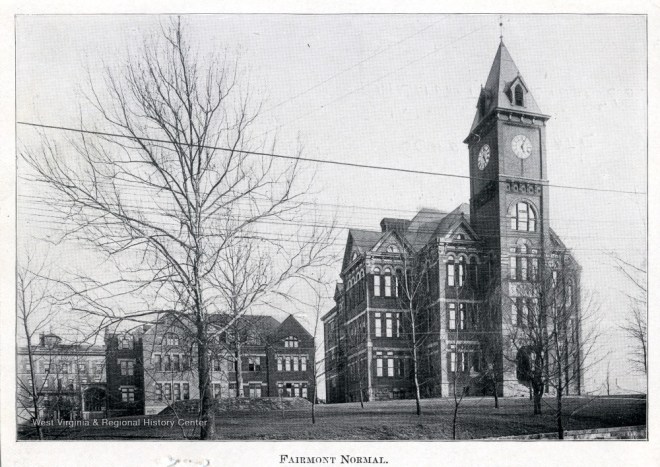
Prof. Schef gives a talk on “Mine Explosives” at Fairmont Normal School. He discussed “at first, the chemical relationship of one element to another and then spoke of the recent mine disaster at Monongah and the one in the Birmingham field. He advanced many ideas which were new to the students and as he continues his remarks he will have a question box.” (FWV 12.17.07 pg. 4)
In Monongah:
TD 12.18.07 – pg 1
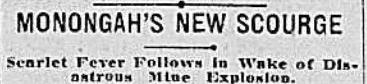
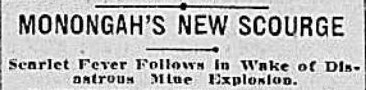
“Several cases of scarlet fever are reported among the children at Monongah, but the best of medical attention will be given them and a spread of the disease is not anticipated.” (FWV 12.17.07 pg. 1)
At the mines:
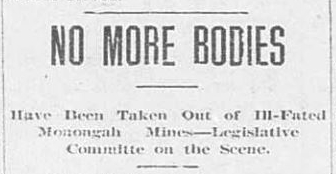
Most of the recovery efforts which can be done are done. Rescue crews are not working today. (FWV 12.17.07 pg. 1)
“At the instance of State Mine Inspector James W Paul the work of cleaning out the mines that were wrecked week before last by explosions was virtually suspended today, though a small amount of work was done in No. 6.” (CDT 12.17.07 pg. 1)
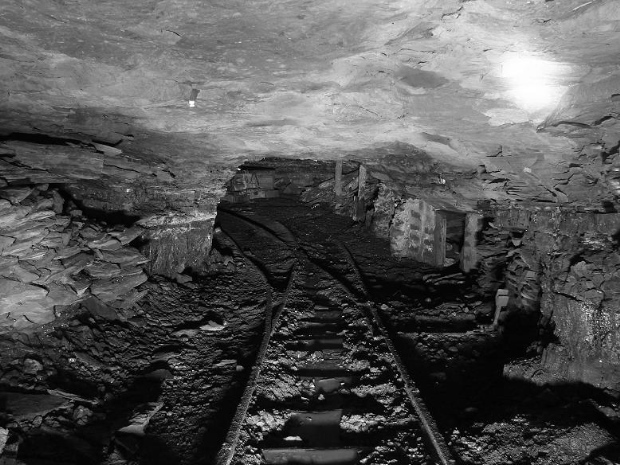
“Mr. Paul finds the condition of No. 8 so bad that further work might destroy the evidence that the mine inspectors seek and for that reason the work has been entirely suspended there.” (CDT 12.17.07 pg. 1)
“State Mine Inspector Paul doesn’t want any more done than just has to be until he had made a thorough investigation, and for that reason the rescue crews are not working today.” Only 2 bodies have been found since Monday and “it is not thought any more can be found without removing much debris. (FWV 12.17.07 pg. 1)
“One of the rescuers had a narrow escape from death and he hardly knows why he was saved. He was standing at one place directing the work and for some reason stepped away a short distance when a 2 ton fall came down at the exact spot where he had been standing. It almost makes the cold chills run over one to hear of such experiences.” (FWV 12.17.07 pg. 1)
One of rescue workers from No 8 “says falls 200 feet long have occurred in some of the rooms which are nearly worked out and that it is not likely that they will ever be cleaned up. Should there be bodies under those large falls they would be beyond recognition and the work would be useless.” (FWV 12.17.07 pg. 1)
“Farmington was well represented at Monongah during the days when that unfortunate city needed so much assistance in rescuing the ill-fated miners from that death trap. No one thought of pay for his services, but boldly faced the rescuing of those who were buried under the hills. Several of our men were there for four days and at work every day and sometimes all night. They tell some gruesome tales of the things they saw and did.” (FWV 12.16.07 pg. )
Evening
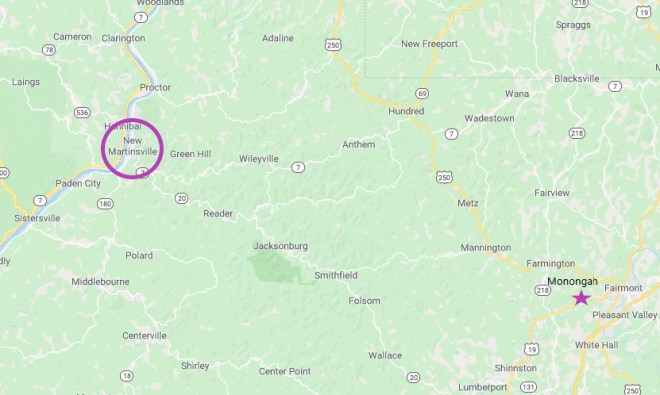
In Brooklyn, WV (a suburb of New Martinsville):
An overheated stove causes a fire in the Wetzel Cigar company factory and burns it to the ground. “The New Martinsville and Brooklyn fire departments did good work in preventing the spread of the fire.” (FWV 12.17.07 pg. 8)
Luckily, no one is injured but 75 workers are now out of a job. The company promises it will rebuild at once. (FWV 12.17.07 pg. 8)
In Clarksburg:
The West Virginia Joint Legislative Committee is called to meet at the Hotel Waldo by its chairman, Thomas Gartlan for the purpose of collectively visiting the scene of the disaster. (Inquiry)
Those in attendance are: Chairman Gartlan, Senator R.F. Kidd, Senator A.J. Mitchell, and John Marshall (Sargent at Arms). (Inquiry)
These committee members spend the night at the Hotel Waldo and plan to visit Monongah tomorrow, once more members have arrived. (Inquiry)
In Fairmont:
A group that has been significantly active in the relief work, the Isabella Davis Circle of King’s Daughters, meets at M.E. Church. “This is the last meeting of this year and a large attendance is urged.” (FWV 12.16.07 pg. 5)
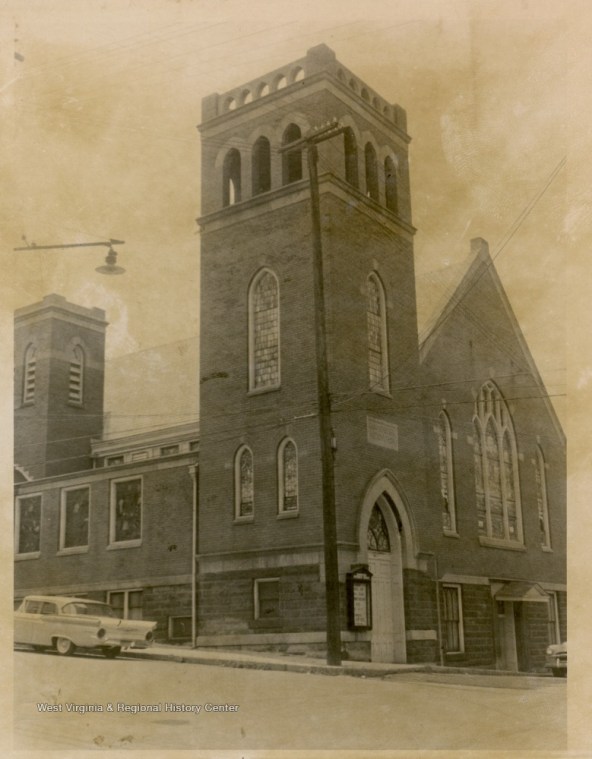
M.E. Church on east side in Fairmont from 1897 map
~7:30 pm
In Clarksburg:
A joint meeting of Executive and Subscription committees of MMRC is held at the Hotel Waldo. (FWV 12.16.07 pg. 1)
At the mines in Monongah:
The 2nd search still on going as workers continue to clean up roof falls in #8. (McAteer)
Night
In Yolande, AL:
Rescue work continues slowly because of the debris in the mines and large crowd of women and children at the opening. (FWV 12.17.07 pg. 1)
“The scenes at the mines are descried as being pathetic in the extreme. All the horrors familiar in old mine explosions are being reenacted at Yolande, and the members of miners’ families are almost paralyzed with grief.” (JVC 12.19.07 pg. 1)
“Men from mines all over Jefferson and Tuscaloosa counties, especially those in the vicinity of the disaster, have rushed to aid their fellow unfortunates and a gallant fight will be made for the life of every living man.” (JVC 12.19.07 pg. 1)
There are several reasons why Appalachians have their own special language about their land. The most prominent reason is that ‘proper’ English simply isn’t good enough to help with navigation. Those basic terms work just fine in the foothills and the flatlands, but deep in these ranges and forests we need to get a little more specific so we don’t end up on the wrong side of the mountain. So, we tend to make up our own words or adapt existing words to take on a new or more specific meaning which is why terminology will differ depending on where you go in Appalachia.
Terminology matters just as much today as it did in the times before GPS and vehicles. Mostly because this terminology is included in the names of many places, like Mill Fall Run, and if you lose your satellite reception (which will happen in certain parts) knowing your terminology can help you “get to where you need to get” all on your own just like the early settlers or those on the Underground Railroad.
The layout of Monongah and its surrounding area is a perfect example of the terminology and its relevance. I am a ‘visual’ person so I will use lots of pictures to get you familiar with our terminology as it applies to this little town, its people and the surrounding areas.
GEOGRAPHY
Land
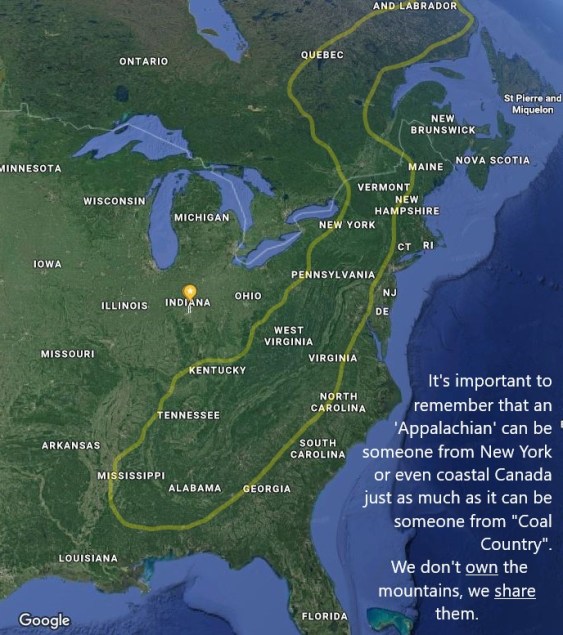
Well, just in case you didn’t already know, we are located in the Appalachian Mountain range which extends from the deep south all the way up into Canada on the east coast. West Virginia is the only state completely engulfed by this range. Even when we were part of Virginia, they still referred to us as “Western Virginia” and, basically treated us with the same indigence. We were those rugged, backwoods “Mountaineers” who lived off the land with only the very basics and enough to ‘care for our own’. The proper English folk of the Colonies had no use for us if they couldn’t profit from us so, the area was mostly neglected and remained severely isolated from ‘society’ until coal was discovered. By that time, we had developed our own complex language and various dialects to accommodate our environment. Despite the best efforts of the “Americanization” process of the early 20th century, that language still thrives today and it helps to know the very basics.
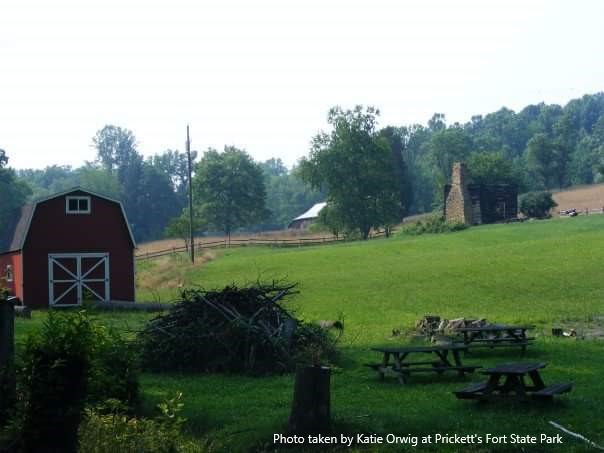
This photo is of the Morgan Cabin at Prickett’s Fort State Park only a few days after an arson incident when the old pioneer house was set on fire.
The Valley
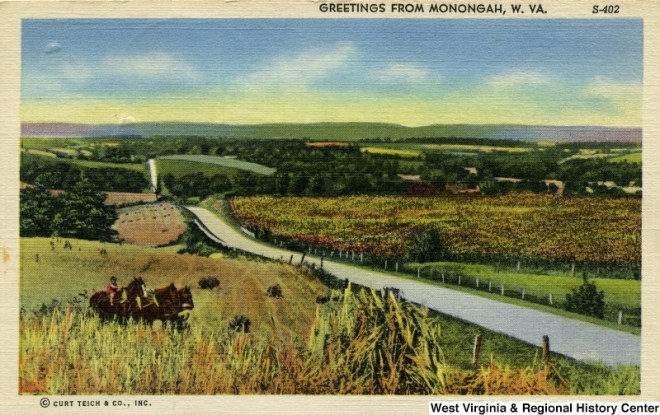
Valleys are elongated lowlands between other uplands along major waterways and typically play permanent host to major cities or towns. Therefore, they are more populated and hold most of the resources for the area. Monongah sits in a valley along the West Fork River. At the time all of the ‘official’ mapping and naming was going on, we were included as part of the Monongahela/Tygart Valley Region. This probably explains why most of Monongah’s earliest settlers got their land by tomahawk rights.
If you love history and old photos, I highly suggest browsing the extensive online collection of the West Virginia & Regional History Center at WV Dept. of Arts, Culture, and History
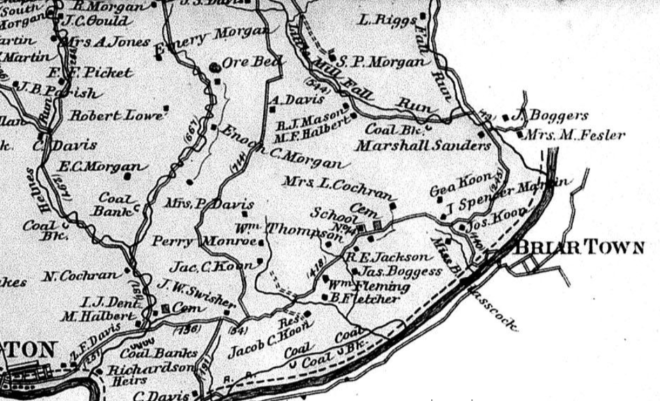
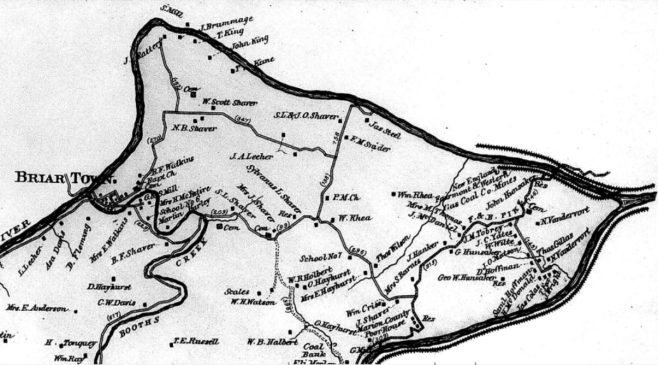
When it comes to the time of tales like ‘Coffin Hollow’, this place was still just a collection of isolated farmers in a small hollow known as Briar Town. Once transport to and from the hollow was established via railroad, bringing industry and a population boom to the area, her status was upgraded to valley and the hollow known as Briar Town became the town of Monongah – a suburb of the city of Fairmont.
These are screenshots of a map of the area from 1886. The East side of Briar Town is in the Grant District. The West side of Briar Town is in the Lincoln District. Link to the website where these maps can be viewed or purchased are in description
The Hollow
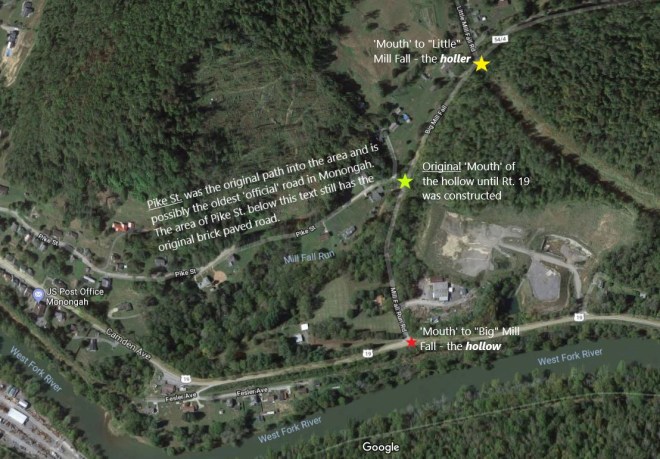
Hollowsarevalleys – an area of land that has been drained or irrigated over time by a water system which may or may not still exist; the second definition of the word valley. The key difference is that a hollow is located on higher ground within the landscape surrounding what is considered to be THEvalley. Though the ‘mouth’ of the hollow may be located in thevalley, it’s typically not the only way in or out. It’s simply the most direct way into the hollow from the main road or path which almost always follows along the main valley and its waterway, hence the term ‘mouth’.
It’s all about navigation.
The most important thing to know about what constitutes a hollow these days, is its road system. In a city, rather than walking all around the block to get to the next street, you may try to cut through an alley or ‘backstreet’ because the shortest distance between two points is a straight line, right? But, you will use caution because alleys are notorious for their potential dangers and a wrong turn can send you in the worst direction. Hollows are just like alleys.
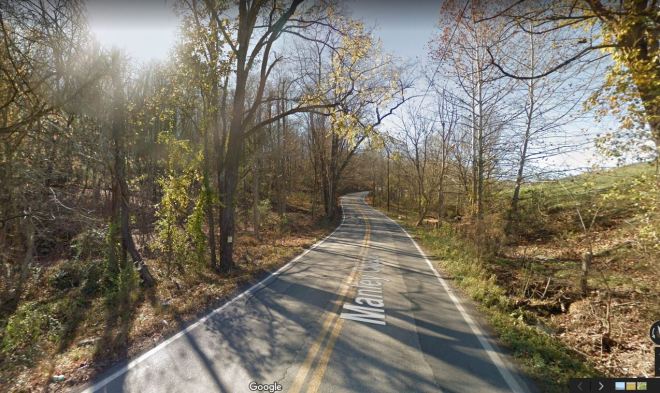
Hollows can usually be determined by the width and conditions of their roads. An existing and mapped road wide enough for two cars to pass side by side, though it may be a tight squeeze, is your typical hollow road. The ‘mouth’ of the hollow is often paved but it doesn’t always stay that way throughout. Main routes which pass through hollows are paved, painted, and mapped by Google Earth like any typical road these days.
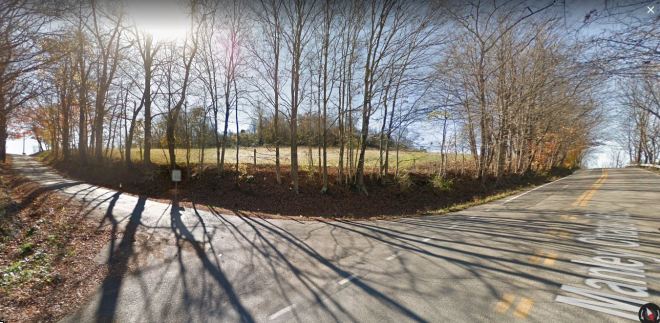
Manley Chapel Rd. is a hollow road which also functions as a main route.
However, Country Roads, like the CR56s in and around Monongah, are a hit-or-miss; if they are paved, they probably don’t have lines as they typically get the most minimal of maintenance and the Google Maps car probably can’t get clear pictures on such bumpy roads. A real Country Road is more like a permanent scab of compressed dirt and gravel where the space for 2 cars means someone’s tires are riding the ditch.
If you watch this YouTube video of Hall Family Roadtrips you can see first hand how easy it is to get mixed up on these roads without some kind of navigating system or existing knowledge. I love this video for so many reasons:
Being from this area, the first part of this video pleases me so much as the driver ‘hits every light’ at just the right time along Fairmont Ave. You don’t realize how rare that is until you’ve worked food delivery service in that place.
It is a brilliant live example of what I’m trying to explain. If you look at the far right of the map above, where the yellow line turns over the word “Fairmont”, and start this video at 2:06 you can follow along on the map as they drive. Except…
This poor driver gets sucked into the “Country Club Trap” at 3:28. Now, this is great for you and me because it gives you a glimpse of what I mean by “hollow-holler-hollow” road systems. Notice how the road changes with its surroundings. The deeper you get into the hollow the more it starts to resemble a holler as the road narrows, the lines go away, and forest surrounds you more than residences.
Snapshot from the Hall Family video
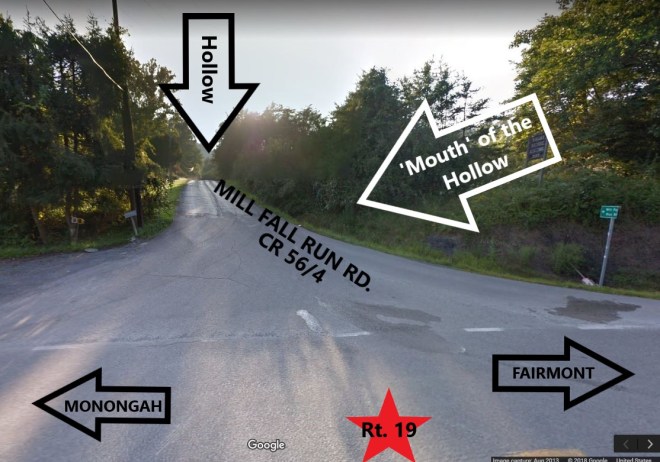
Then, at 4:40, we get dropped back out next to the West Fork River on Rt. 19, exactly where we would have ended up minutes earlier if the driver had just stayed straight at the light and not turned right onto a hollow/holler road.
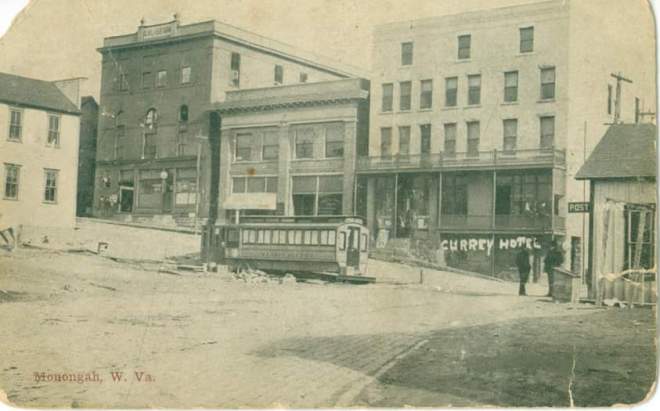
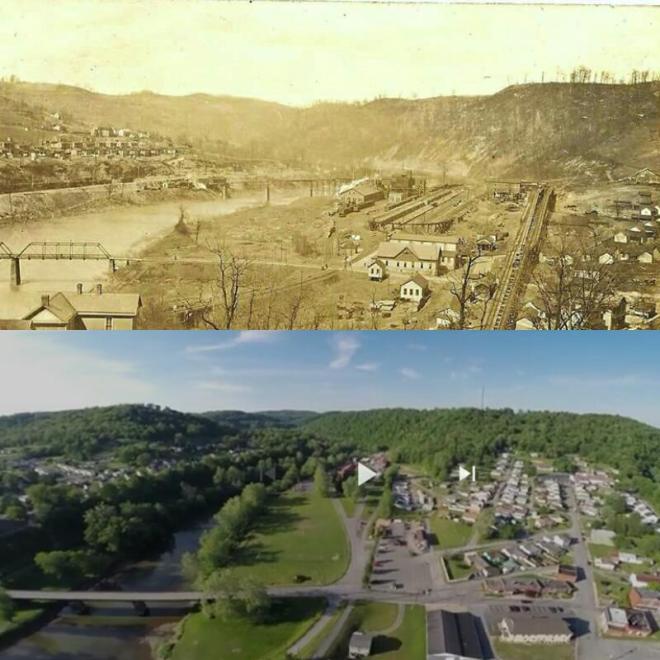
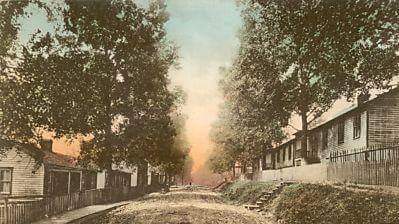
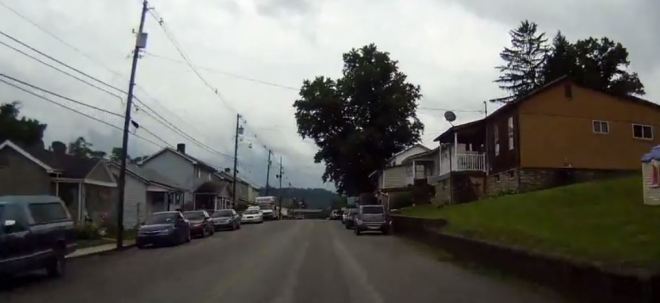
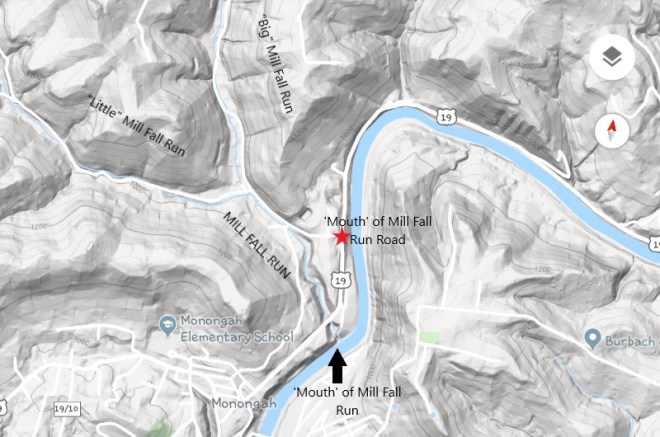
From there, you are on your way into the west side of Monongah. At 5:20, the driver passes the ‘mouth’ of Mill Fall Run on the right. At 5:32 of this video, you pull into Monongah where Rt. 19 is known as Camden Ave (because it predates the existence of Rt. 19) and it really is a blast from the past. Below is a postcard of Camden Ave around the turn of the 20th century on top of a snapshot of Camden Ave today.
Snapshot from Hall Family video
At 5:50, the driver stops to turn on GPS or at least check a map right smack in the middle of Monongah, which isn’t uncommon. Monongah itself is so twisty and turny with so many ins and outs that travelers tend to get wary about making another wrong turn beyond this point. We have a saying that, “all roads lead to Monongah; you just gotta know where to turn”.
Hollow roads are sometimes several miles long and if you can navigate these Country Roads just right they can be a shortcut to the other side of the county, they can connect to other hollows, or they can take you to someplace even more awesome…
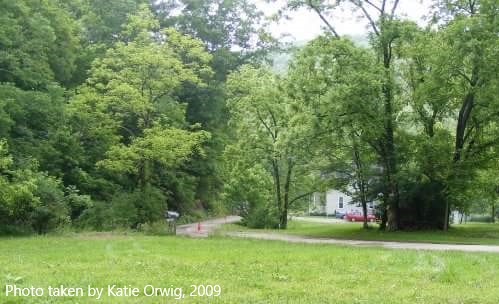
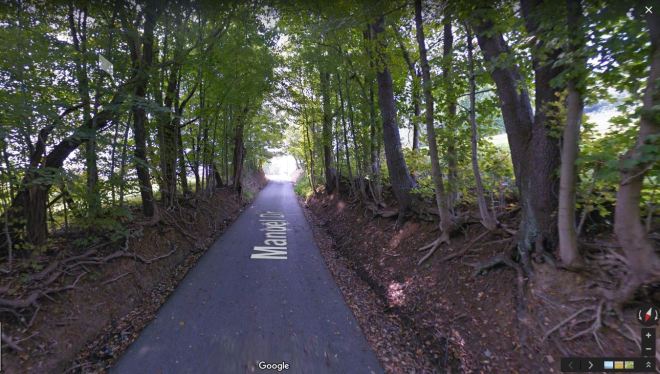
Along Manley Chapel Rd., another road branches off to the left. This is Manuel Dr. – a holler road.
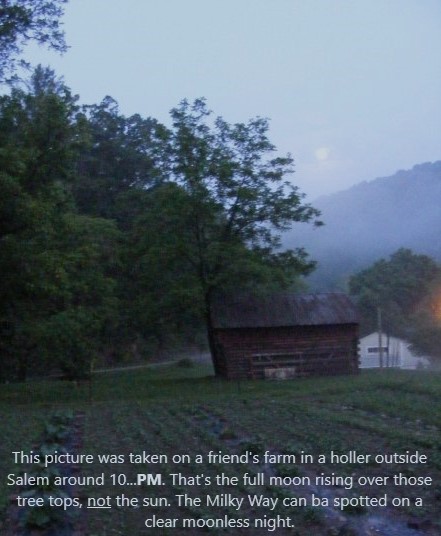
A holler is a very special place. One can only get to a real holler in a vehicle by correctly navigating the hollow. Sometimes you can only find the holler if you have been personally invited by its occupants as only they know the ways in and out. Other times, you may need to hike, bike, and/or boat your way there.
The holler is just an area past the hollow. The holler is a far more isolated place because it sits deeper in the mountains, typically below the hollow but still above the valley and can be impossible to navigate. In the right areas of the state, you can find hollows or hollers with a full rapid river, like Ten Mile in Buckhannon. In the greater Monongah area, our hollers are more likely to have nothing more than a crick which may be elevated to creek status only after heavy rains.
Where valleys typically have rivers or streams, a hollow may have nothing more than a run or brook/creek, and a holler will usually only have a crick– which, in some cases, is only around after heavy rains as it is nothing more than a natural drainage path for runoff rainwater.
Manuel Dr. is a beautiful example of a holler road
You may have heard that the holler gets its name from the fact that all one must do to talk to your neighbor on the adjacent hill is simply “holler” at them. Well, that can happen in hollows too. That factor is more of a coincidence which just helped the term stick as a general title. True, in the average holler you can talk to a neighbor over hundred of yards away as if they were on your own porch, but this isn’t true for all hollers or hollows.
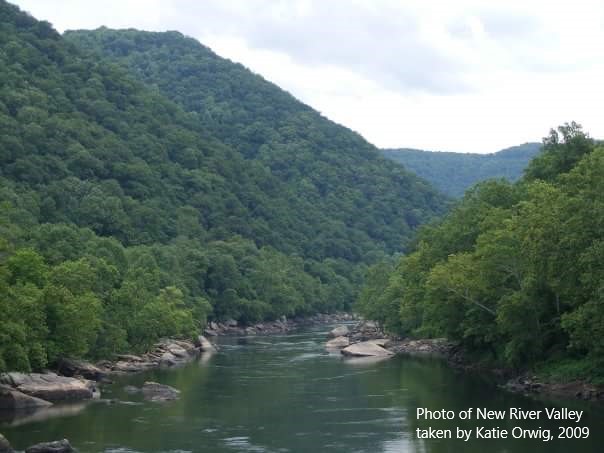
In a steep valleyholler with a large waterway, like those in the southern part of the state near the New River Gorge, it doesn’t work as well. The white noise of the flowing river paired with the air currents of the valley can ‘take your words with the wind’. However, in small ‘backwoods’ hollers where the natural landscape mimics that of a Greek or Roman amphitheater, voices or other sounds can carry with such ease that hollerin’ is unnecessary overkill.
In the early years of my childhood, before the days of 24 hour news channels and shows like America’s Most Wanted and Unsolved Mysteries, being a kid meant being home by the time the streetlights came on and always staying within “hollerin’ distance”. The landscape of any area will determine what counts as “hollerin’ distance” – the distance a good hearty shout will travel across the landscape to the ears of another person. Basically, if the adults couldn’t hear you and you couldn’t hear them, then you were out of “hollerin’ distance” and you were in real trouble.
The Waterways
We have the same types of terms everyone else has for their natural water systems. But, naturally, we have a hierarchical system in place so we can get quite specific with them too as it is another special part of our navigation system.
Though West Virginia can boast many lakes, both natural and man-made, our most important water sources are our rivers.
The River
Rivers were the main navigation tool in the mountains from the earliest days. The Ohio River makes up our western most border, the Potomac defines our eastern panhandle, but it is the Monongahela River which is believed to have flowed the first of the indigenous groups (Native Americans) into the north central mountain area from the Delaware region centuries, possibly even thousands, of years ago.
Monongahela is a very specific and descriptive word on its own. Surprisingly, Wikipedia has the best and most concise description of this word:
The Unami word Monongahela means “falling banks”, in reference to the geological instability of the river’s banks. Moravian missionary David Zeisberger (1721–1808) gave this account of the naming: “In the Indian tongue the name of this river was Mechmenawungihilla (alternatively spelled Menawngihella), which signifies a high bank, which is ever washed out and therefore collapses.”[11]
The Lenape Language Project renders the word as Mënaonkihëla (pronounced [mənaoŋɡihəla]), translated “where banks cave in or erode”,[12] from the verbs mënaonkihële “the dirt caves off” (such as the bank of a river or creek, or in a landslide)[13] and mënaonke (pronounced [mənaoŋɡe]), “it has a loose bank” (where one might fall in).[14]
Monongalia County and the town of Monongah, both in West Virginia, are named for the river, as is the city of Monongahela in Pennsylvania. (The name “Monongalia” is either a Latinized adaptation of “Monongahela” or simply a variant spelling.)
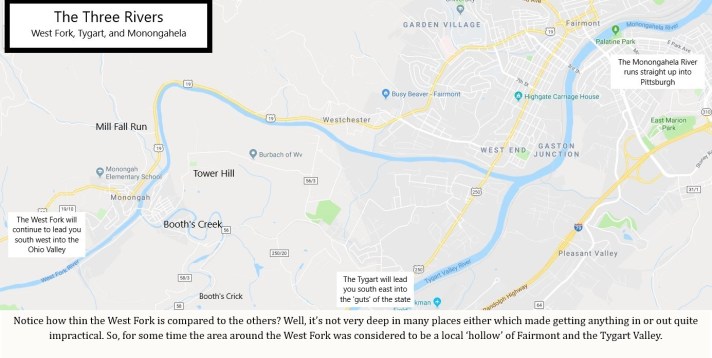
A “high” “loose” “falling” bank along a river where the dirt “is ever washed out” and therefore “caves in” and one treading along it “might fall in” to the river below. Yep, sounds like the West Fork in Monongah!
Oddly, Monongah does not sit along the Monongahela River. She is tucked away in a little and hard to access valley along the West Fork River which was only passable by anything more than a small boat during flood seasons until the railroad came along. However, her luck of having such abundant coal reserves and being so close to the Monongahela River, yet still so very isolated from ‘society’ in Fairmont, made her the “gem” of the Fairmont coal field.
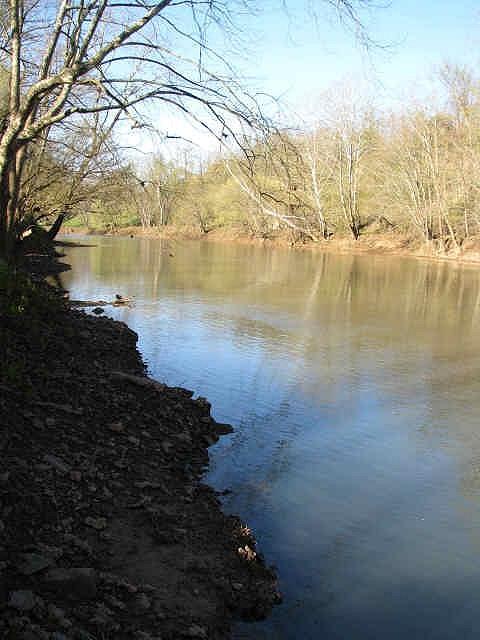
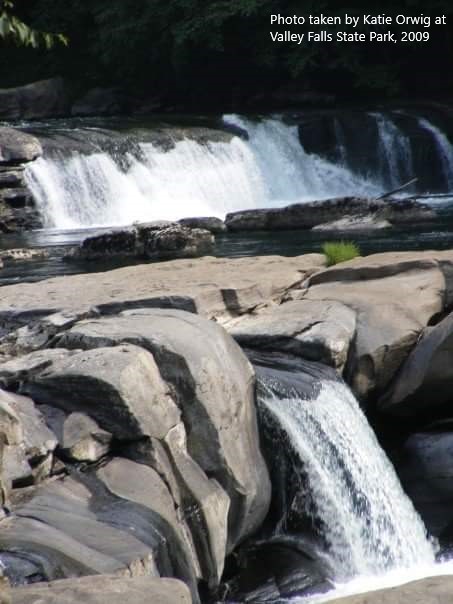
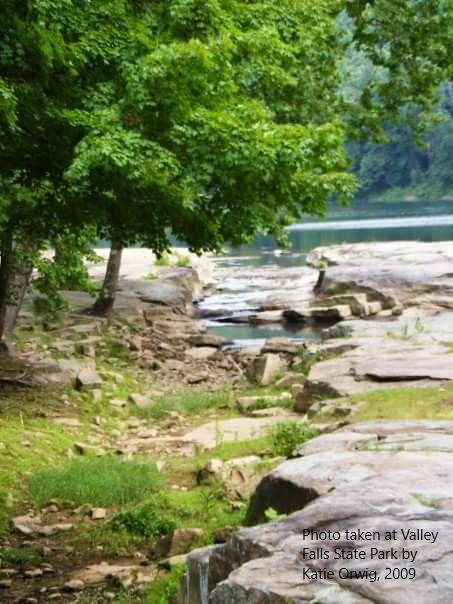
Some rivers are calm, others are rapid like parts of the Tygart Valley River which flows through and continues to carve the falls at Valley Falls State Park
The Stream
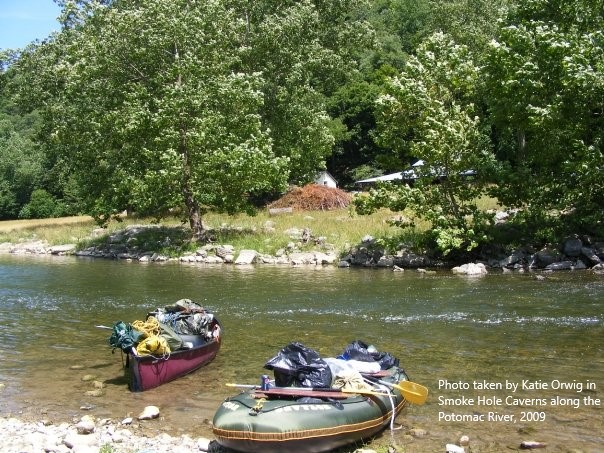
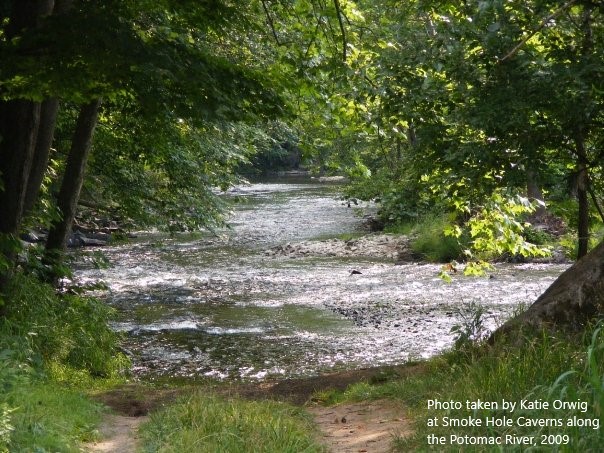
Streams are just smaller and more narrow rivers. In the mountains, a stream could be a few different things. It could be the classification given to a section of a major river which is just so low at a certain point that the river bed can be seen and the water literally streams at a slower rate, causing the river rocks to create tiny rapids, like in the photo of a section of the Potomac River above. This could be the norm for certain parts of rivers due to their natural elevation or it could just be as a result of drought and, therefore, only temporarily low.
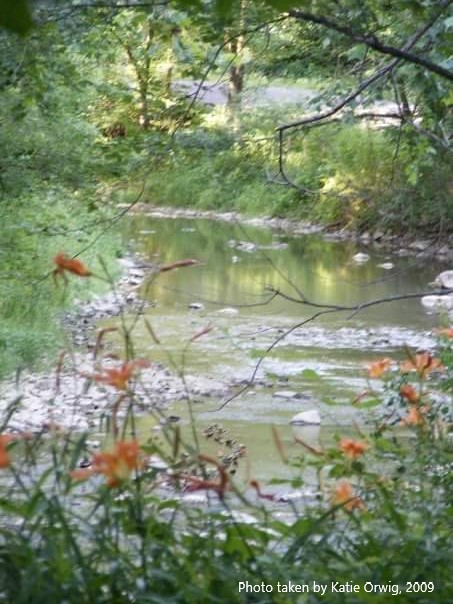
The photos above are an example of a stream being a small runoff branch of a larger and more powerful river nearby. In areas around the Valley Falls portion of the Tygart Valley River, these little streams can be found cutting into the landscape here and there along the banks. They often have a steady supply of water but some will travel up the landscape and then they could turn out to be something else…
The Run
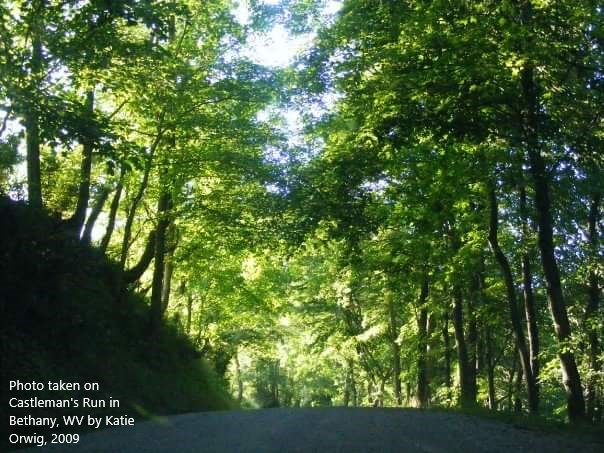
Castleman Run branches off of Buffalo Creek in Bethany, WV. This is where I would come to study while attending Bethany College.
A run is a just a small stream which holds a very special quality: its path stretches up from the main river into the higher landscape surrounding the main valley. A run is sort of half stream-half brook; it has a ‘mouth’ in the valley fed by the flow of the river like a stream but, it’s areas of higher elevation are natural rainwater runoff paths which act more like brooks carrying rain water down to the ‘mouth’ to be dumped back into the river. As a result of this natural drainage system, runs can be notorious for flash floods.
A run can take you deeper into the landscape or lead you out which explains why many hollows follow along runs- it runs water in a more direct path from higher elevations to the valley below. That is also why the word “run” is typically included in the names of places like this but, at one point, runs in these mountains took on a very special alternative meaning to certain people.
Due to their nature, runs were very significant in the times of the Underground Railroad when survival or freedom meant knowing that you need to follow the brook to the run through the hollow then wait at the ‘mouth’ to the river in the valley. Follow the creek or crick by mistake and you could end up going deeper into the landscape and fall into the hands of the wrong neighbor who will have no qualms about letting bounty hunters know about this secret little ‘through-way’ for escaped slaves.
The Brook/Creek
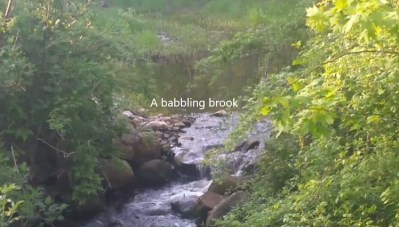
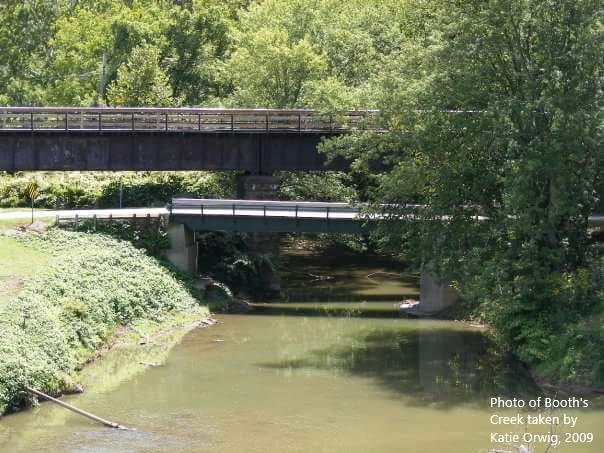
Brook is often interchangeable with creek but, again, in the mountains we have to be a little more specific sometimes. Brooks and creeks are just small streams. They can be their own entity and carry water from a highland directly down to the valley below or they can feed into a run or stream. There is no exact science in determining the difference between a brook and a creek other than observing elevation and even that is hit-or-miss depending on the landscape.
However, if you had to try and take a guess and determine if you are beside a creek or a brook the first thing to do is look and listen to the water. Does it look like it is flowing with gravity? Does it sound like a cup that’s slightly overflowing in your sink, the little trickle of water falling down sort of ‘babbles’ as it runs down and hits the bottom? Then it’s a probably a brook.
Or, is the waterway rather level for the most part? Does it serpentine through the landscape, occasionally rising and falling while it twists and turns? Does it sound a little more like water pouring out of a hose than a container overflowing? Then it’s probably a creek which is typically found on slightly lower elevations and it’s flow has less to do with gravity and more to do with water pressure.
The Crick
Last but not least we have the crick. Now, cricks aren’t always there in the form of water but their path is still a permanent gouge in the landscape. More often than not, cricks only really flow after heavy rains.
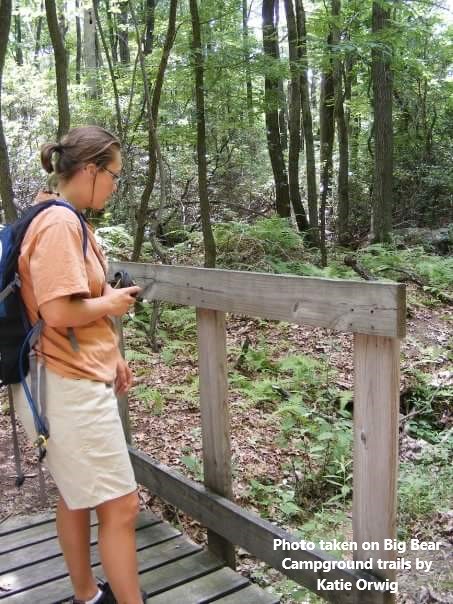
My friend, Becky, evaluating the crick below. If you look closely, you can see there is some water in there but the gap that remains in the land is the real reason for the footbridge


























 The Monongah Disaster