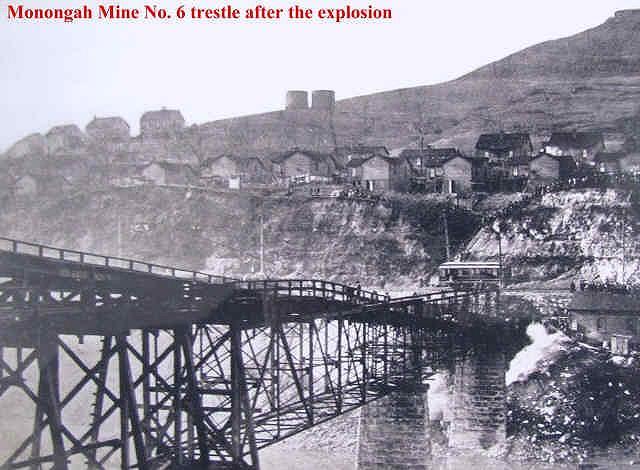
11:00 am
“The American miners of the town have been placed in charge of the relief work but the Italians and other foreigners are working under them most faithfully.” (ES 12.7.07 pg. 2)
“Monongah…has a population…, most of whom are foreigners although there is a larger proportion of American miners in this district than in most of the other bituminous fields. Until about ten years ago the mines were operated almost exclusively by Americans, but during a general strike of Miners in the Pennsylvania and Ohio fields many of these West Virginia miners went out in sympathy to prevent the filling of contracts at lake ports and elsewhere with West Virginia coal by the companies in Ohio and West Virginia against which the strike was directed. At that time the mine owners brought a large number of foreigners into the field to take the places of the strikers and ever since the foreigners have been displacing Americans until they are now the majority.” (ES 12.7.07 pg. 2)
In the town of Monongah:
“The banks and hills surrounding the mine are literally crowded with anxious people, many women and children who are weeping and crying hysterically for love of their fathers, husbands and brothers known to be entombed. The foreign women are indeed to be pitied for their great sorrow and their way of expressing it by tearing their hair, scratching their faces with their finger nails until the blood runs down their cheeks. Several were witnessed in this condition leading their little children around through the mud and cold not noticing either in face or their great sorrow.” (FWV 12.6.07 pg. 1)
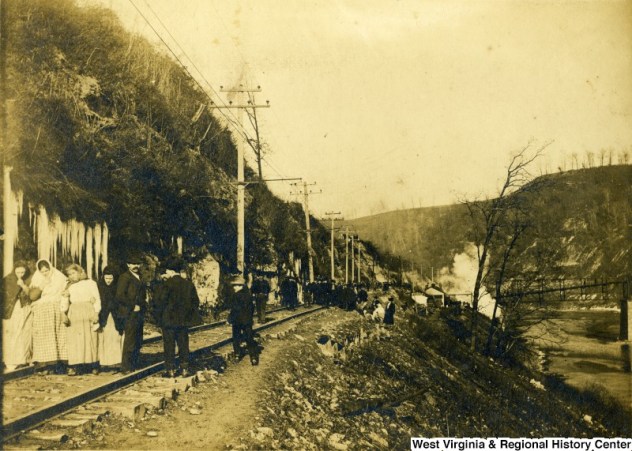
Company officials Frank Haas and J.J. Burrett arrive from Fairmont as well as the representative of the Italian consulate, G.D. Caldara, who “was doing much to pacify the women of his country, who were most loudly giving vent to their terrible feelings.” (FWV 12.6.07 pg. 1)
Over a dozen physicians are now on the scene: Dr. D.P. Fitch, Dr. John R. Cook, Dr. Brownfield, Dr. Jesse A Jamison, Dr. W.C. Jamison, Dr. Graham, Dr. Reidy, Dr. Bowcock, Dr. Durrett (mine physician of the New England mines), Dr. Howard, Dr. Carr, Dr. L.N. Yost, Dr. Sands, Dr. Nutter, and Dr. Hal Hall accompanied by nurses from the various hospitals in Fairmont. They begin to establish an emergency hospital in the blacksmith shop of #6. They have also arranged for the interurban trolleys and railroad companies to transport survivors to the Fairmont hospitals once they are tended and stabilized at the make-shift ER in the blacksmith shop (FWV 12.6.07 pg. 1) (Nurses on Front Lines)
“Medical men who came on the scene after…were: Dr. F.W. Hill, B.F. Bone of Fairmont, Drs. Culp and Thrash of Farmington, Dr. Falconer of Everson and Dr. Alkire of Chiefton.” (FWV 12.7.07. pg. 1 – noon)
Marion County Coroner E.S. Amos also arrives in Monongah.
Dr. Durrett of the New England mines tells a reporter with the Fairmont West Virginian that there is little hope for the men trapped in both mines; “He says that the force of the explosion traveled with the air courses and only those men who were in this air course were killed by the explosion or from the debris thrown in its wake.” (FWV 12.6.07 pg. 1)
Outside #6:
Carpenters are putting the last support boards along the roof of the approach which connects the mine shaft to the fan. It is just a temporary fix, but it is good enough to warrant restarting the fan.
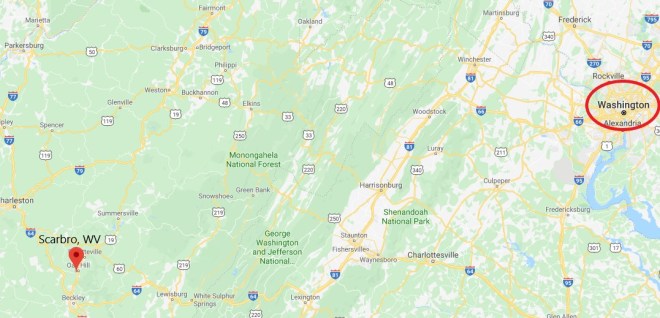
In Washington D.C.:
Governor Dawson, A.B. Fleming, and a few other state/company officials receive word about the disaster. Gov. Dawson immediately telephones certain state officials while former Gov. Fleming immediately leaves D.C. for Monongah after sending word ahead to the sheriff to “preserve order”. (News, McAteer)
11:05 am
Outside #6:
35 minutes after the explosion, #6 fan is restored and started. However, the gage only rises “a little above 2” which is lower than prior to the explosion. This means that air is still not able to properly circulate through #6 because the partition which once divided the two mines has been destroyed by the explosion, allowing air to flow into #6 from #8. This needs to be a closed system in order to properly circulate breathable air and it will be impossible to close this system without getting to one of the deepest parts of the two mines. (Inquiry)
11:30 am
Outside #6:
“The rescue was started in mine No 6 about 11:30 after the fan was again put in running order and the rescue work is being vigorously pushed by Mr. J.C. Gaskill and other mine officials.” (FWV 12.6.07 pg. 1)
“As soon as the men could be organized for a plan of action forty rescuers began the work.” (CDT 12.7.07 pg. 1)
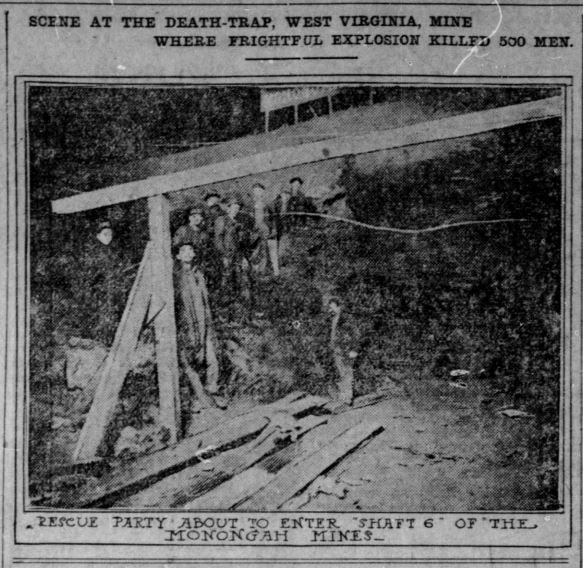
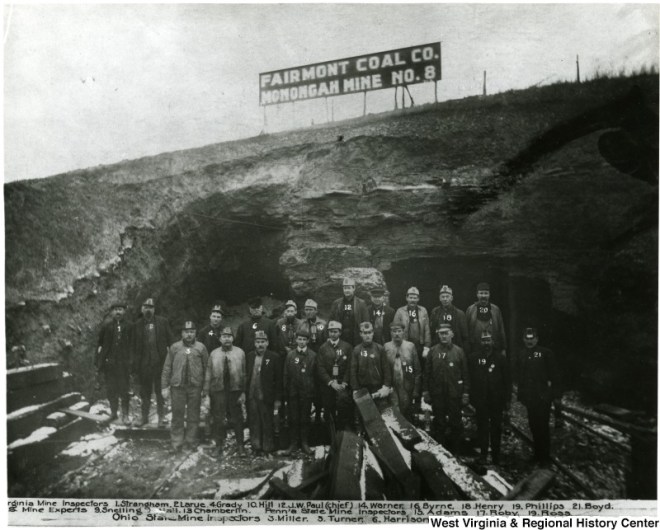
Three teams were organized: one headed by #6 foreman Charlie Dean, another by Supt. Brennon of #8, and the other by Supt. J.C. Gaskill.
The first party to enter #6 was “composed of Messrs. D.C. Dean,—Toothman, — Nichols, —Graham, —Clayton, J.G. Smith, —Clayton, … these men, armed with all the available necessary tools and safety lamps marched undaunted back into the scene of carnage…” This is an excellent choice crew. Being outside foreman of #6 mine, Charlie Dean still had plenty occasions when he had to go inside #6. He is the most ideal person available at the time to head the first relief crew and give instruction about what is and isn’t right about the conditions inside of #6 and what needs to be done to correct those conditions in order to get relief efforts underway. (FWV 12.6.07 pg. 1) (Inquiry) (News)
Dean and his crew have a primary goal—determine how far rescuers can get into the mine safely and if any victims can be reached. It is presumed that Dean and his crew are aware of the runaway trip which should most certainly be a pile of wreckage somewhere along the main shaft. Hopefully, they can reach this point and determine if the wreck and/or the explosion have caused any blockages of potential exits before they personally encounter any deadly gasses. (Inquiry, News)
~11:33-11:35 am
Inside #6
As these men steadily work their way down the #6 shaft portal, a second party of ten men headed by West Fairmont mine Supt. John Brannon prepare themselves for the decent. They enter #6, following along and continuing to clean the path already partially cleared by Charlie Dean’s crew. Naturally, Dean and his crew only cleared what was necessary for them to pass so they can survey conditions and try to reach survivors as quickly as possible. As these rescuers expect to find survivors inside of the mine, they must also make as clear and safe a path through and out of the mine as they can while still constantly pushing forward, knowing that more crews will be following to pick up where they left off. (Inquiry, News)
~11:38-11:40 am
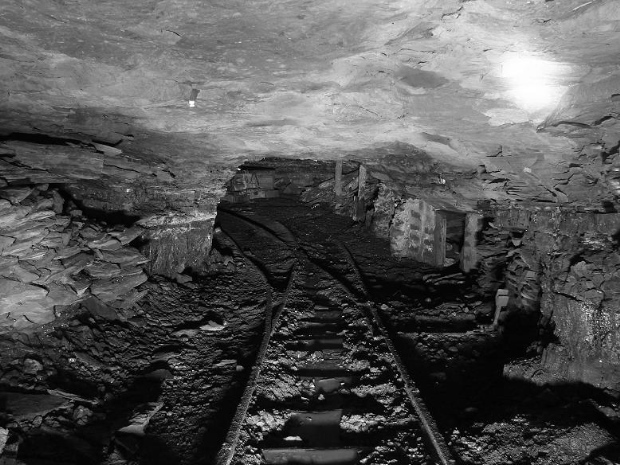
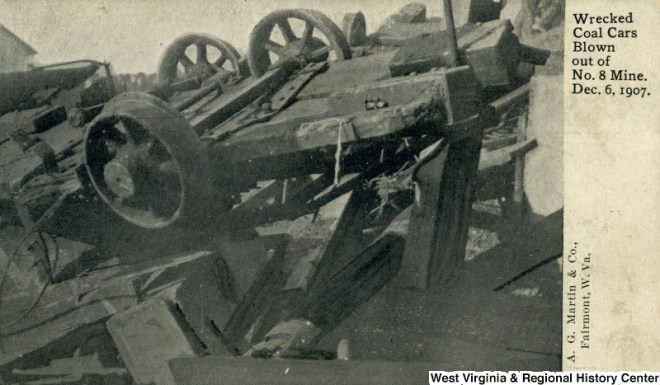
Supt. John Brannon and his team catch up with Charlie Dean and his crew near B face entry, where the slope of the portal changes to a more gradual angle. It is here, at B face, that several other track lines which branch out to the rest of the inner workings of the mine intersect with the main shaft line. At this spot they discover one of their worst fears to be confirmed: the only true way in and out of #6, the main shaft line just before B face, is entirely blocked with wrecked coal cars and debris at the worst possible point, literally entombing every miner—dead or alive—inside with no chance of escape. (Inquiry)
Dean’s crew has already begun to tear away what debris they can to create at least enough space for one man to cross the wreckage. Charlie Price, a member of Supt. Brannon’s crew, also begins working on clearing a way through the debris. After only a few more minutes, they successfully break through near the top left of the pile. Charlie Price is the first to take in the air coming out from the enclosed workings behind the debris pile. In a matter of moments, he collapses. (Inquiry, News)
~11:45-11:50 am
Outside #6
Gen. Supt. J.C. Gaskill has assembled his own relief crew on the surface and they are preparing to enter #6 when Supt. Brennon’s crew resurfaces from the mine shaft. A few of the rescuers are carrying Charlie Price. He was overcome by the fire damp which escaped from the inner workings. At this, both crews fled #6 to avoid the same fate. Charlie is in serious condition and taken to the make-shift hospital in the #6 blacksmith shop which is still being set up by the physicians and nurses which have since arrived on the scene. (Inquiry, News)
Inside #6
“When the Brennon forces returned C.E. Gaskill headed another relief party, which continued the work.” (WH 12.7.07 pg. 1)*
Despite the knowledge that toxic gases have been released, Gaskill and his team consisting of mine foreman PJ McGraw, #6 fire boss Lester Trader, and an extended crew of carpenters like Fred Shaver press back into #6. They continue to clear away debris along the main shaft until they reach the wreckage pile by B Face. Gaskill notes that the wreckage is, “piled up pretty bad—a lot of cars piled up just like any wrecked trip…crossways and piled up generally.” However, it was “not so bad but we could pass…by climbing over…”. (Inquiry)
~11:50 am-12:00 pm
Outside #6
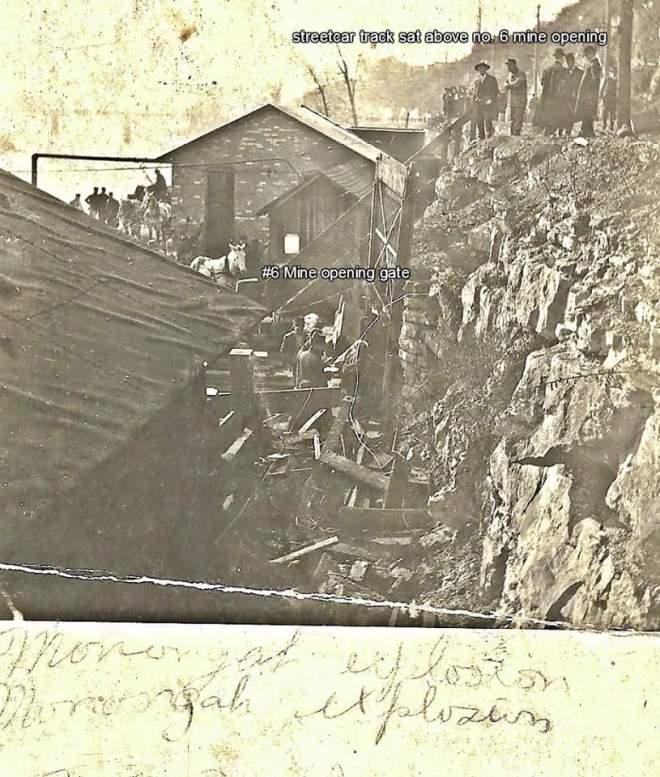
A key official of the Fairmont Coal Company, Supervisor and Chief Mine Inspector David Victor arrives in Monongah from the New England mines in Fairmont and immediately goes inside #6. He is aware that other crews of men are already working, including John Smith from Charlie Dean’s crew and Supt. Gaskill & crew, though he is not sure how much farther ahead they are at this point. (Inquiry, Victor)
Inside #6
“All of the headings leading off from the main entry are being cut off by canvas and barricaded as fast as they are reached by the relief workers, so that the inner most workings of the mine may be given the benefit of the ventilating system…” (ES 12.7.07 pg. 2)
Beyond the wreckage:
“The rescuing parties penetrated mine No 6 about 3500 feet before they came upon the first of the dead. A majority of the corpses will be found about a mile further back.” (LAH 12.8.07 pg. 1) (WED 12.7.07 pg. 1)
Supt. Gaskill and his team have successfully crossed over the wreckage pile and are now continuing along the main track into #6. At the very base of the slope, where the more gradual angle of the slope finally levels out to match the rest of the working areas, the team comes across a small shanty. Inside they find 3 men—all are dead. (Inquiry, News, McAteer)
The first is 23-year-old husband, father, and motorman Fred Cooper. He is lying on the ground, on his back, his head near the shanty door, his mouth wide open.
Another, 21-year-old brakeman Laurence “Larney” Hindman, is also on the floor lying face down with his feet toward the shanty door, the opposite direction as Fred.
The last man is still sitting upright on a bench, holding his opened dinner bucket between his legs, though his head and arms are drooped down. Lester Trader steps into the shanty and lightly pushes his head back to see the face. Coffee dribbles out of the lifeless mouth and Trader can tell it is 36-year-old driver John Herman.
This rescue crew of Gaskill, Trader, McGraw, Fred Shaver and others will not linger at the shanty long—their primary goal is to find survivors—though they do take a few solemn moments to examine and observe that not one of these men shows a single sign of traumatic impact to their bodies and yet their positions, paired with John Herman’s mouthful of unswallowed coffee, indicate an instantaneous death for them all. (Inquiry)
At the wreckage site:
David Victor makes it to the general area known as the ‘foot’ of the slope and sees the “badly wrecked” trip on the main track. He counts 14 loaded cars wrecked on the middle track but, “The fellow who had been cleaning up the cars told me that he had taken two off the trip that had come back down the slope.” As David Victor begins to examine the area “to a certain extent”, he notes that there is another trip with a motor about 20 feet away “standing on the side track of about the same number of cars, 2 or 3 of the first cars had been wrecked…”, behind that was another trip of coal cars. (Inquiry, Victor)
One of the first concerns relating to the cause of the explosion circles around the new addition of electricity and the relatively recent introduction of live, uninsulated wires inside the mines. Victor examines for any evidence of a short circuit in these wires which could have sparked a fire or explosion, but he finds that the wires are surprisingly still intact, hanging along the roof of the mine and no such evidence these wires fusing or burning at the foot of the slope or on any wires, the mine roof, or walls. He decides to move on. (News, Inquiry)
“I remember climbing over the wrecked cars but had plenty of room to go over. I remember the wrecked trip happened right on the switch where there were 3 entries opened up. The wreck had happened in the middle entry and that entry was closed. The entry to the left was not closed. I remember climbing over the empty cars in order to get through to build brattices.” (Inquiry)
Not far beyond the wrecked pile, Victor sees a coal car laying “crossways of the track” and just beyond that, the shanty at the bottom of #6 slope. He does not go in nor does he take any time to examine the 3 dead men other than to acknowledge their positions. (Inquiry)

Previous Post
Next Post
More on How Death Gloated!
Bibliography
Disclaimer and Guide
Timeline
Introduction
About the Author
Contact Information






















 The Monongah Disaster