Monday, December 16, 1907, Afternoon

“Uncle Jack Cutright started to Monongah, but played out when he got to the top of the hill and turned back. Too much for Uncle Jack.” (FWV 12.16.07 pg. )

~12:30 pm

At the Yolande mines in Alabama:
headline - yolande - jones valley times - alabama Dec 19 1907
JVC 12.19.07 pg 1

“For two hours after the explosion it was impossible to venture even near the mouth of the mine, so hot was the air that rushed out.” (FWV 12.17.07 pg. 1)

“The number of men employed should be between fifty and seventy-five, but this being Monday after pay day it is doubtful if the full force was at work.” (JVT 12.19.07 pg. 1)

“The first men who got out, fourteen in number, were working at the time on sub-entry No. 2. The belief of many was that the men still under them were either dead or would die before relief could reach them.” (JVT 12.19.07 pg. 1)

~2:00 pm

In Yolande, AL:

“At 2:20 o’clock Monday afternoon four dead bodies are known to have been taken from the mines of the Yolande Coal and Coke Company, at Yolande, Ala., and it is not known how many more there are inside the mines. The odds seem to be, however, that many of the remaining fifty or so are dead.” (JVC 12.19.07 pg. 1)

“Matthew Humphrey, John Smedley and Harris Hall are said to be the three first victims, and it is understood that their were the bodies first brought out.” (JVC 12.19.07 pg. 1)

 ~ 3:30 pm, Press Time

In Fairmont:

FCC announces it will pay people on Saturday to give them some Christmas money. “The pay will be a very good one.” (FWV 12.16.07 pg. 1)

In Monongah:
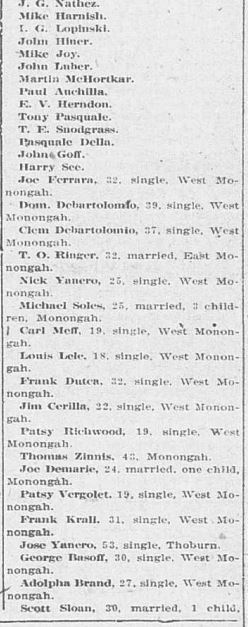
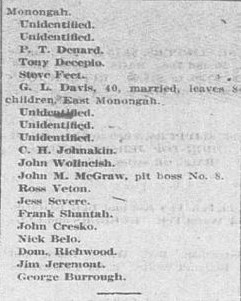
CDT 12.16.07 - pg 1 - Monongah 1
CDT 12.16.07 – pg 1

“No bodies were recovered from the mines today.” (CDT 12.16.07 pg. 1)

“According to the census reports of the company there are but ten bodies yet undiscovered. The census shows 344 persons unaccounted for. Of this number 334 bodies have been buried except Mike Savi, the last man to be taken out.” (CDT 12.16.07 pg. 1)

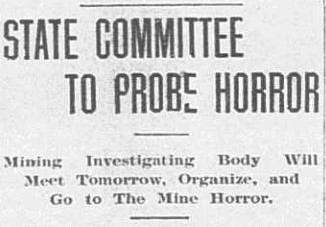
CDT 12.16.07 - pg 1 - State Committee
CDT 12.16.07 – pg 1

“The mining investigation committee of West Virginia has been called to meet here tomorrow for the purpose of probing the mine horror at Monongah. The committee will organize here and may have most of its sittings at the Waldo, but it will visit the scene of the disaster and make a thorough investigation.” (CDT 12.16.07 pg. 1)


During the afternoon

In Yolande, AL:

“Coffins and surgeons, the latter equipped with supplies of all sorts, were rushed from Birmingham on the afternoon Birmingham Mineral train.” (JVC 12.19.07 pg. 1)

“The men who escaped got away through what some describe as a fiery furnace, and it is hinted that some of the victims may possibly be neither suffocated nor killed by the shock, but may be burned alive before aid can reach them.” (JVC 12.19.07 pg. 1)

In Clarksburg:

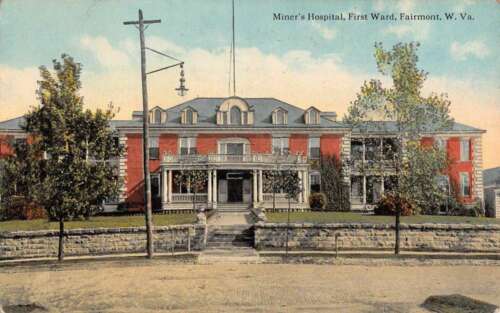
“Patrick McDonald, who was injured in the Monongah explosion, has been discharged from the Miners’ hospital at Fairmont and brought to this city, where relatives are looking after him.” (CDT 12.16.07 pg. 8)

miner's hospital - postcard

In Fairmont:

The Jenny Wren Club meets at the home of Miss Amy Williams. “The members are busy making Christmas gifts for the little orphans at Monongah…” (FWV 12.16.07 pg. 5)

At #8 in Monongah:

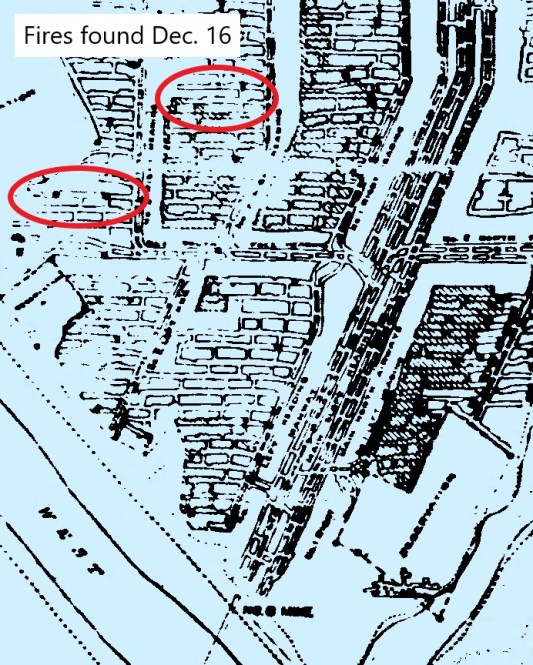
Fires are discovered in #8 mine. (McAteer)

One is “burning fiercely” when found on the 1st south face, 2nd right, room #10. It is fought with a brigade of water carried in buckets from the end of the water line which had been laid in the mine a week prior. (McAteer)

Another fire is discovered on the left rib of room #3 in the 3rd right room heading. It had been smoldering for 5 days & nights but the introduction of fresh circulating air finally got it burning hard. (McAteer)

Both fires are extinguished quickly, and there are no more interruptions of this sort. (McAteer)

fires in #8.jpg


More on How Death Gloated!

Bibliography

Disclaimer and Guide

Introduction

Issues with the Monongah Timeline

About the Author

Contact Information

Friday, December 13, 1907 – Afternoon

~Noon

At the mines:

“At noon today no additional bodies had been recovered from the mines…” (WT 12.13.07 pg. 8)

John Graham Smyth, assistant chief engineer, is placed in charge of recovery efforts underground. (McAteer)

Smyth reports to E. Scott outside. (McAteer)

E. Scott reports to Ruckman and Malone. (McAteer)

~2:00 pm

In Fairmont:

Jess Severe is buried at Woodlawn Cemetery. The Improved Order of Red Men is in charge of the funeral. (FWV 12.13.07 pg. 1)

In Monongah:

“The work in the mine was resumed this afternoon, but the men are engaged in cleaning out the debris. In this manner they may run across more bodies.” (CDT 12.13.07 pg. 1)

“A census taken of the town shows three hundred and thirty-eight men missing, which leaves eighteen bodies still in the mines.” (CDT 12.13.07 pg. 1)

“In addition, however, there was a number of contractors and men hired by these contractors are believed to have been in the mines when the explosions occurred.” (CDT 12.13.07 pg. 1)

At some point during the afternoon:

In Fairmont:

The Fairmont West Virginian receives a letter from Elkins post office employees with a donation of $50 included. (FWV 12.14.07 pg. 1)

In Monongah:

One body is recovered from #6. (FWV 12.13.07 pg.1)

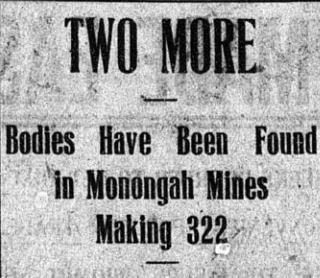
“One more body was found in the Monongah mine disaster this afternoon, bringing the total number of bodies recovered up to 321. The last body is that of a man named Burt. It is at the mouth of Mine No. 6, in which mine it was found.” (CDT 12.13.07 pg. 1)

Frank H. Wilmot and George A Campsey, representatives of Carnegie Hero Fund Commission of Pittsburgh are still in town “to find out the progress made in relieving the sufferers and in what way the commission could best serve the needs.” (FWV 12.14.07 pg. 2)

J.H. Wheelwright makes a statement speaking of the difficulties that the searching parties had to encounter: “The difficulties the rescue parties have undergone cannot be realized or appreciated by those outside the mines. It is necessary to make an inspection inside to know the actual conditions.” (FWV 12.13.07 pg. 1)

~3:00 pm

In Fairmont:

Union Relief Association holds a meeting in the M.P. Temple in order to get “As full a report of committee as possible…” (FWV 12.13.07 pg. 1)

Coroner Amos deposited the sum of $367.12 in the People’s Bank of Fairmont to go toward the relief fund. This was all the money found except $23.19 found on the body of Andy Morris which was turned over to the proper relative. (McAteer) (FWV 12.13.07 pg. 1)

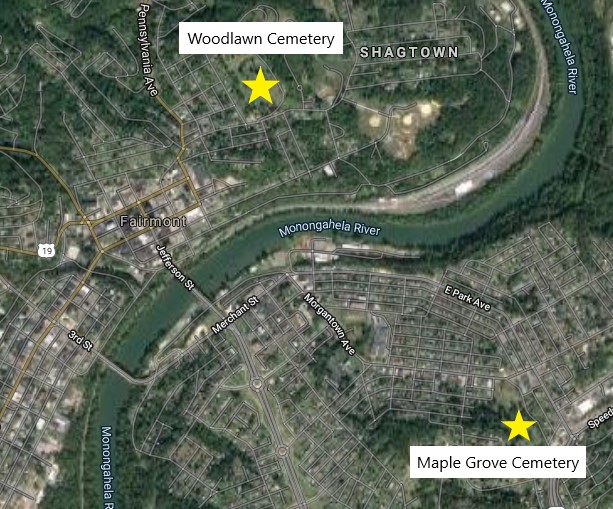
woodlawn and maple grove cdemeteries

Mr. George Linn and daughter, of Benton’s Ferry, attend the funeral of J.H. Mort, member of Marion Lodge No. 27 R.P. (FWV 12.14.07 pg. 2)

The remains were taken across the river in a boat and interred at Maple Grove cemetery. He leaves a wife and four children. (FWV 12.13.07 pg.1)

In Monongah:

Coroner E.S. Amos and Prosecuting Attorney Scott C. Lowe went to Monongah to confer with State Mine Inspector J. W. Paul in regard to the time of holding the inquest. “It is not known at this time if the jury will be taken through the mines or not. If the jury does go through the mines it will likely be after the evidence is taken.” (FWV 12.13.07 pg.1)

~3:30 pm (Press Time)

BDT 12.14.07 - pg 1 - Monongah

“Although search was abandoned last night, two more victims…were found today. This makes the total number recovered three hundred and twenty-two.” (BDT 12.14.07 pg. 1)

“Two bodies were taken out of the wrecked No. 6 mine…making the total of recovered bodies 322, of which number 96 were unidentified.” (CET 12.16.07 pg. 1)

“One body taken out of No 6…was identified as Nick Tertza, a Greek, aged 29, single, of West Monongah, and another body was taken from the same mine the same afternoon and has been identified as Henry Burke, an American, aged 69, of East Monongah.” (CDT 12.14.07 pg. 1)

“The census takers made another report, which increases their list from 338 to 344, and it is now predicted that the fatalities all told will number nearly 350. The bodies taken out…were in a bad state of decomposition and identification was made from their mine checks.” (CET 12.16.07 pg. 1)

~4:00 pm

State Mine Inspector J.W. Paul leaves Monongah and travels to the Naomi Mines in Pennsylvania. (FWV 12.14.07 pg.1)

By Late Afternoon

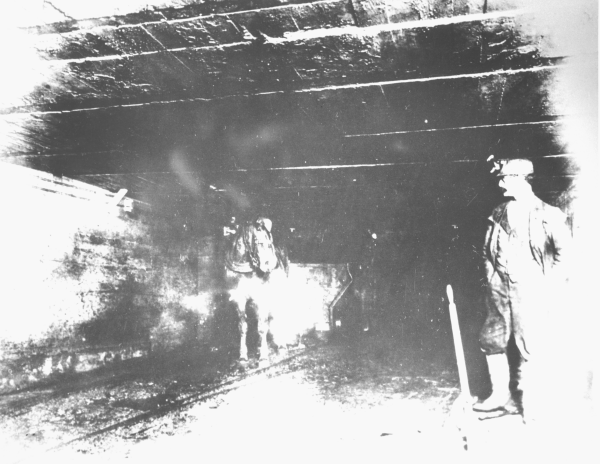
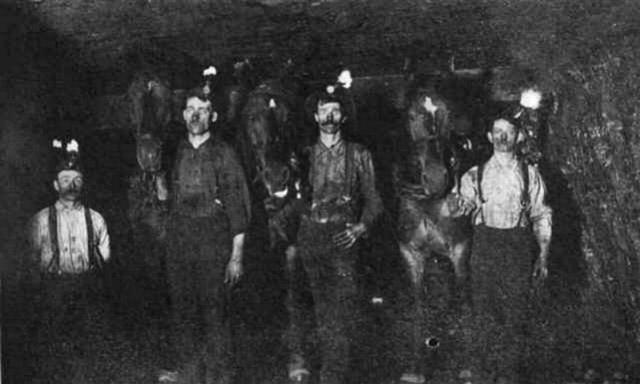
Some 40-50 horses have been removed over the past few days. (McAteer)

The matter of dealing with carcasses was put off for some time in favor of corpses and these carcasses had merely been covered with canvas tarps until all corpses had been found and mostly recovered. (Haas) (McAteer) (News)

MON18LG

Information on the conditions of these animals is included in the formal report made by General Manager Frank Haas for the Fairmont Coal Company:

“One driver was found beneath a loaded car completely covered, only one foot sticking out, his horse lying nearby, stripped completely of harness, which was found 100 yards up the heading lodged in a pile against a pillar fall.” (Haas)

“On another heading, pieces of horse were scattered for a distance of 500 feet, torn so badly that the remains had to be gathered with a shovel, while in a small hole in the rib of this heading the body of a trapper boy was found in a sitting posture without a mark or scratch of any kind.” (Haas)


This slideshow requires JavaScript.

“Tracks had to be thoroughly cleaned up to the carcass which after being thoroughly disinfected, were pulled on trucks by block & tackle, wrapped in canvas and hauled outside.” (Haas)

“Where roof falls made it impractical to clean up tracks to get trucks to livestock, block & tackle was attached and they were skidded for hundreds of feet, sometimes over falls and through crosscuts, to the track, occasionally necessitating the sawing off of a leg or head in order to make progress possible.” (Haas)

ME13

One of the most notorious and lingering ghost tales about the Monongah Mine Disaster  includes this information about the horses:

“In just one crosscut, in one section halfway up 3rd Right of Old #6, at least 12 horses perished-and some said many more.” (Coffin Hollow, Musick)

“When the explosion came, the pressure from both ends of the crosscut pressed and squeezed the horses into one solid mass of flesh and bone.” When rescue/clean up crews came upon the pile, they decided “the best and quickest disposal that could be made was to gob their remains into an old working area and seal it off.” (Coffin Hollow, Musick)

coffin hollow- mine horeses image
Image from Coffin Hollow and Other West Virginia Ghost Tales, pg. 78


More on How Death Gloated!

Bibliography

Disclaimer and Guide

Introduction

About the Author

Contact Information

Thursday, December 12, 1907 Afternoon

“No accident in the entire history of coal mining in America compares with this holocaust. It would be hard to picture a more complete scene of sorrow and desolation than that about the pit mouth. Everywhere are the blown and broken timbers, everywhere the blackened wreckage, showing the fearful force of the explosion. And over the wailing, desolate women and the gaunt, hard featured men working about the ruins, the black smoke hangs like a pall.” (TLA 12.12.07 pg. 1)

~Noon

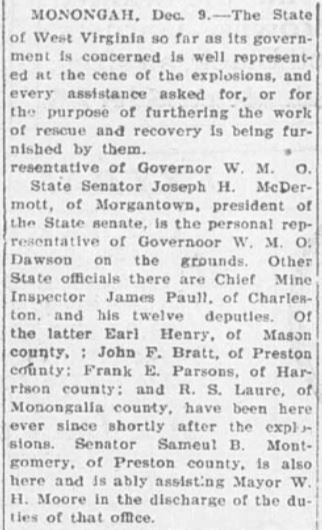
“Governor Dawson today announced that he will personally attend the inquiry…” (CDT 12.12.07 pg. 1)

Gov. Dawson - wikipedia
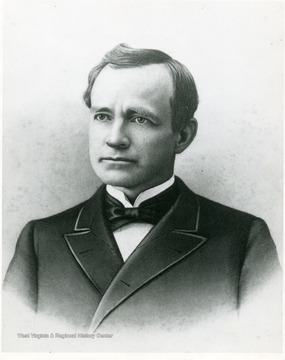
Governor W.M.O. Dawson

In Monongah:

12.13.07 - pg 1 - Monongah 2
CET 12.13.07 pg 1
At the mines:

“Two hundred and eighty-five bodies were recovered at noon from the Monongah mines and twenty-five more were ready to be brought to the surface.” (CDT 12.12.07 pg. 1)

“Up to noon today 285 bodies had been recovered from the Monongah mines. They are being brought out more rapidly now and many more will have been recovered by night.” (ES 12.12.07 pg. 2)

“More than 400 bodies, it is expected, will have been recovered by Saturday night, by which time the rescuers hope to have found every body.” (ES 12.12.07 pg. 2)

2:22 pm

In Monongah:

The body of Timothy Lyden was taken from the morgue “to his home at Monongah to remain three hours and at 2:22 this afternoon accompanied by relatives and friends it was shipped to [Clarksburg] for burial.” (CDT 12.12.07 pg. 4)

“Mr. Lyden’s body will be at the home of his mother, Mrs. Ellen Lyden, on Jackson street tonight and until 10 o’clock tomorrow morning, when it will be taken to the Catholic church where funeral services will be held and interment will be in Holy Cross cemetery.” (CDT 12.12.07 pg. 4)

During the Afternoon

In Pittsburgh:

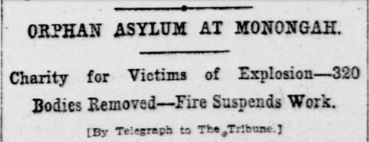
“Officials of the coal company were in Pittsburgh this afternoon, conferring with those familiar with hospital maintenance, and it is understood that $50,000 will be spent by the coal company in erecting a suitable orphan asylum building. After it is finished, the children will be taken care of and educated. It is understood that certain wealthy men have expressed a desire to assist in endowing such an asylum, making it permanent for use of orphans of those who lose their lives in the mines of the company.” (WH 12.13.07 pg. 1)

“A woman’s sympathetic heart coupled with her ability to accomplish her purposes has solved the distressing problem of the thousand children who have been made orphans by the mine explosion at Monongah, in which several hundred lives went out. The woman is Mrs. Clarence W. Watson [Minnie Owings Watson], wife of the president of the Fairmont Coal Company which owns the property in which the calamity happened. She is a social leader in Baltimore and New York, but since the explosion she has demonstrated that she can be notable for other things besides driving fine horses for prizes in show rings and planning cotillons. Acting on Mrs. Watson’s suggestion her husband came to Pittsburg today to make contracts for the erection of a $50,000 asylum for the homeless little ones at Monongah. Mr. Watson said that it was the one practical suggestion which had come to him or any of the members of the Fairmont Company.” (RP 12.14.07 pg. 4)

“Mrs. Watson took a prominent part at this season’s horse show in New York. She was a prize winner, carrying off ribbons with her famous Lord Baltimore and My Maryland. Lord Baltimore is considered one of the finest harness horses in America. Mrs. Watson and her millionaire husband carried off several prizes with them in the international show in London.” (RP 12.14.07 pg. 4)

“Bishop Donoghue, of the Wheeling district has been at Monongah leading in the relief work, and Mrs. Watson has been, perhaps, his most able assistant.” (RP 12.14.07 pg. 4)

minnie_2__large
Minnie Owings Watson

“The day of the explosion Mrs. Watson hurried to Monongah with her husband. She plunged into the work of relief with her heart open for the suffering and destitute. In a few hours she was recognized as good spirit of the place. Wherever she goes in the stricken town she carried light with her.” (RP 12.14.07 pg. 4)

“It was the children who made a special plea to her sympathy. Their helplessness, their absolute dependence overwhelmed her. After the first couple of days she went to her husband and demanded that he do something. He was at a loss and asked her for her suggestions. She said that the one thing for him and his company to do was build and asylum for the little ones.” (RP 12.14.07 pg. 4)

“How to care for the children of the explosion victims has been and will be a problem until Mrs. Watson’s home for them is built.” (RP 12.14.07 pg. 4)

In Fairmont:

“The body of Charles Wise of Fairmont, one of the best known men, was…brought here for interment this afternoon.” (ES 12.12.07 pg. 2)

Frank A. Wilmot and George A. Campsey from the Carnegie Hero Commission arrive in Fairmont. “After looking over the ground a while Mr. Wilmot decided to go to the Fairmont Coal Company offices at Monongah and make known his mission. Before going, however, he met Col. A.H Fleming of Fairmont whom he knew personally…” (FWV 12.23.07 pg. 1 – extra)

A.B. Fleming
A.B. Fleming

Mr. Harry H Stock, E.M. editor of “Mines and Minerals” of Scranton PA is visitor in the city. He procured copies of the West Virginian for every day since the mine disaster. (FWV 12.12.07 pg. 5)

In Monongah:

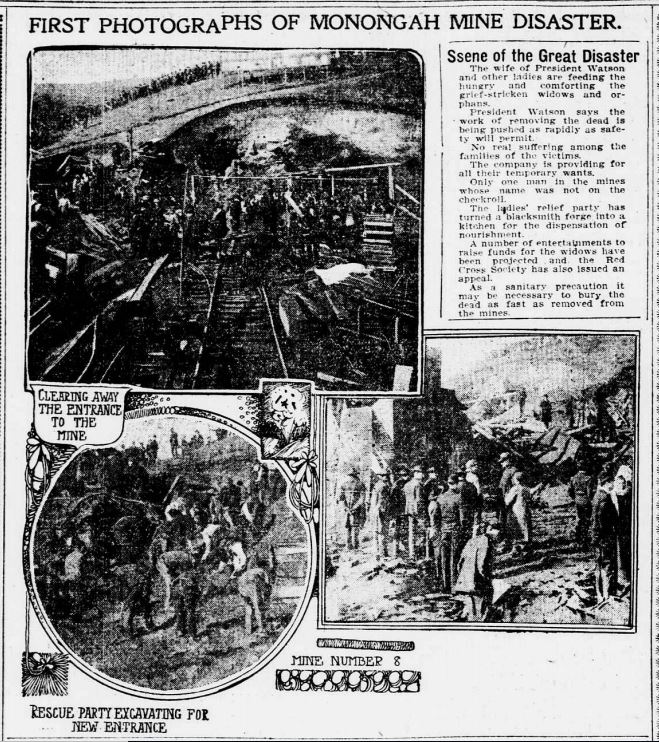
“The ladies of the relief corps are continuing their noble work and much food is being dispensed to the workers. Soups, meats, sandwiches, vegetables pie and coffee constitute the mean which is served night and day in a little building near the company office. Hundreds are thus fed every day.” (CDT 12.12.07 pg. 1)

C.W. Watson will not give a statement about the number of victims to the press until the “total number of miners is known…census of miners had not yet been completed. Three or four miners lived in the country and their families would have to be seen before the statement could be made. Mr. Watson said that the number would be between 328 and 334.” (FWV 12.12.07 pg. 1) (FWV 12.13.07 pg. 1)

He provides this statement instead:

“The work of removing bodies from the mines progressed very rapidly today and at the rate that the dead are brought out now the search work will be completed sooner than it was thought. The work in mine No 6 is practically done. The searchers have explored all the rooms of that mine.” (FWV 12.12.07 pg. 1)

Rumors of epidemic begin to surface and are attributed to the many maimed and decomposing bodies and carcasses about the town and still inside the mines. (McAteer) (News)

Mr. Fleming and Wilmot arrive in Monongah and go to the office where Wilmot is introduced to General Manager Lee. L Malone. “Mr. Malone at once placed the records of the company relative to the census of miners being taken at Mr. Wilmot’s disposal and after verifying the newspaper reports he hunted Mayor Moore to take some active steps for relief work.”

“Mr. Wilmot found Mayor Moore surrounded by a crowd of about 50 people engaged in relief work, but he gave Mr. Wilmot a hearing and very kindly consented to do whatever was thought best in the matter of organizing the committees.” (FWV 12.23.07 pg. 1 & 4 – extra)

At the mines:

The removal of livestock begins.

drivers - 1908

Marion County Board of Health issues a 2nd order: “…imminent danger of epidemic of disease breaking out…scores of men working in recovering dead are prostrated…so urgent…all of the streets of Monongah were heavily sprinkled with lime…odors emanating…unbearable.” (McAteer)

At #8:

1st full search is completed in #8 and a second search immediately begins. (McAteer) (Inquiry)

“Patrick Louchney’s remains were found in mines No. 8 and taken to the morgue this afternoon. His body was terribly mangled and mutilated. It will be taken to Clarksburg for burial.” (CDT 12.12.07 pg. 1)

~3:30 pm

12.12.07 - pg 1 - Monongah 212.12.07 - pg 1 - Monongah 3

CDT 12.12.07 - pg 1 - Monongah 4
CDT 12.12.07 pg 1

“A great many bodies remain unidentified as yet and probably most of these will never be identified or claimed by relatives. The number of the unidentified reached fully sixty so far and doubtless many of those yet to be recovered will be in the same class.” (CDT 12.12.07 pg. 1)

~4:00 pm

In Fairmont:

The 24 members and 2 guests of the Ladies Aid Society of the Diamond Street M.E. Church complete “40 pieces of clothing” and enjoy a dinner “for the small sum of $.15”, the proceeds intended to go to the relief fund. (FWV 12.12.07 pg. 2) (FWV 12.13.07 pg. 2)

~4:30 pm

In Wheeling:

The Wheeling Board of Trade holds special meeting of directors about the Monongah relief fund. Labor Commissioner I.V. Barton (who went to Monongah shortly after the disaster and stated he would bring a report of conditions to Board of Trade) “spoke at some length”.

“There are, Mr. Barton stated, from a thousand to twelve hundred orphans and at least 350 widows it has been estimated. The children have been born since the disaster and there are 60 expectant mothers among the widows. The Fairmont Coal Co. and the local relief committees are doing nobly, and are caring for the situation.” Mr. Barton stated that if the Board of Trade was to contribute, now is the time to do it. “The aid is not necessary now but in the future relief will be needed.”

The Board of Trade contributes $1,000.00 to the relief fund. (FWV 12.13.07 pg. 1)

In Monongah:

In the earliest days after the disaster, various relief committees were formed by well-meaning individuals and groups but there is no representation for the immigrants and their various nationalities among them. Bishop Donahue was added to the initial general relief committee when he pointed out a lack of representation for the Italian and Polish-Slavic Catholic churches and the committee expanded to incorporate immigrant representation. (McAteer) (News)

Manager/Secretary of Carnegie Hero Fund Commission Frank M Wilmot combines the majority of these relief committees into one: the Monongah Mine Relief Committee. (McAteer)

The Carnegie Hero Fund donates $35,000 to this relief committee and takes charge of the organizing.  (McAteer) (News)

Wilmot then has a meeting with Watson, Fleming, and other company officials to discuss their role in the relief efforts. Watson and Fleming are cautious about endorsing notion of public appeal for funds. They are concerned about the effect such an appeal would have politically, particularly on the general public. Wilmot convinces them the response would be well received. Following the meetings with Wilmot and others they soon became supportive of the relief committees and assigned “various employees in the offices of FCC & others to work nights, Sundays, and other extra time helping the Subscription Committee to address envelopes and send out appeals”. Eventually, officials of mine, like Cunningham, serve as members of committee. (McAteer)

The Union Relief Association Committee, made up entirely of women from Fairmont and surrounding areas, is the only one not included into the MMRC.

~5:00 pm

Cunningham sends Watson a list of names along with morgue numbers. Bossilo Pillelo and Petro Frediro are listed with a note: “Italians were in #8. Selecting place to work. Chief Paul found their order copy x of mine laws.” (McAteer)

Andrew_Carnegie,1913
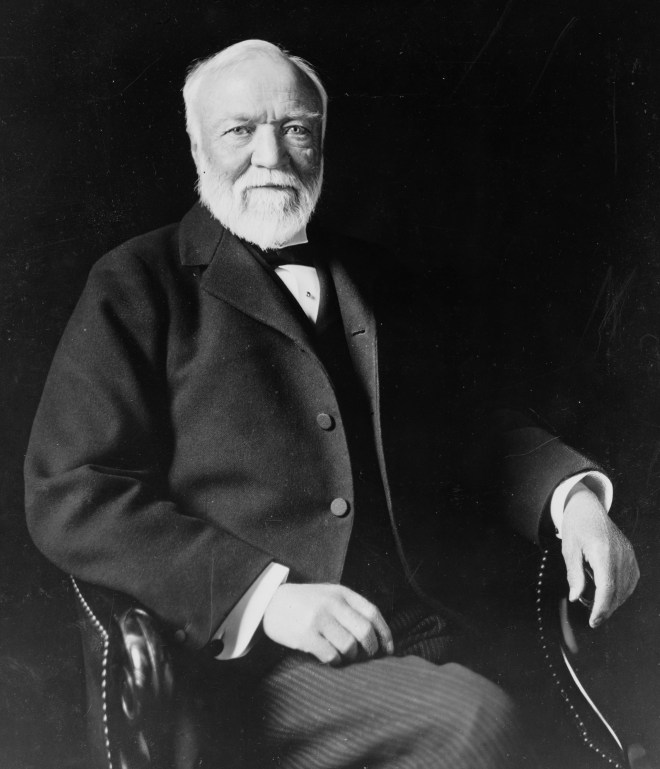
Andrew Carnegie


More on How Death Gloated!

Bibliography

Disclaimer and Guide

Introduction

About the Author

Contact Information

Thursday, December 12, 1907 Midnight – Morning

CDT 12.12.07 - pg 1 - Monongah 5
CDT 12.12.07 pg 1

In the early hours of the morning

12.12.07 - pg 6 - Monongah
TMDM 12.12.07 pg 6
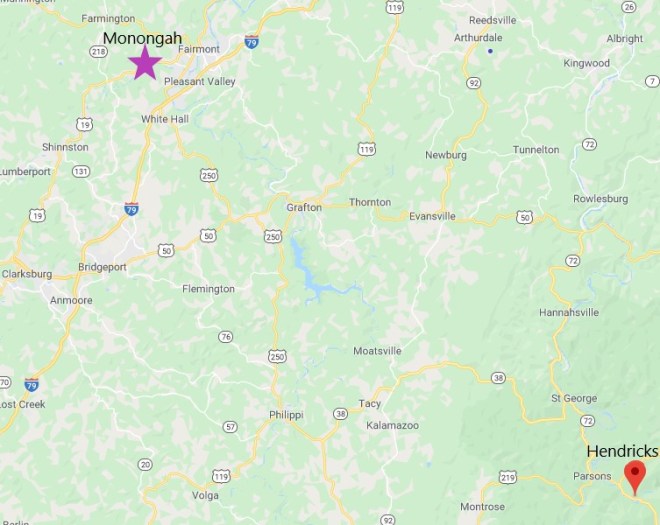
In Hendricks, WV:

Roy Yaeger, 28 year old engineer for Western Maryland railroad, detects an odor of gas in his home and starts to investigate. He quickly finds that a rubber hose has come loose from a stove and “just as he was in the act of turning the gas off the gas was ignited from an oil lamp in another part of the house and the explosion followed.” (FWV 12.13.07 pg. 2)

“Yaeger was ablaze in an instant and jumping out of a window he rushed up street, his clothes burning fiercely. Before he could be succored his clothes were all burned off and was a mass of charred flesh.” (FWV 12.13.07 pg. 2)

Yeager “met with a terrible death”. His wife and little child were severely burned and the home in where they lived was practically blown to pieces. (FWV 12.13.07 pg. 2)

hendricks

~3:00 am

CDT 12.12.07 - pg 4 - Lydens Body“The body of Timothy Lyden was found in mine No. 6 at Monongah at 3 o’clock this morning, taken to the morgue and prepared for burial.” (CDT 12.12.07 pg. 4)

“Relatives identified the body by his clothes and the back of his head. The body was well preserved but the face was badly mutilated.” (CDT 12.12.07 pg. 4)

“Mr. Lyden was 38 years of age and leaves a widow and five children. He was a brother of Patrick J., Michael and Margaret Lyden and Mrs. P.F. Tiernery.” (CDT 12.12.07 pg. 4)

~3:30 am

CDT 12.12.07 - pg 1 - Henry martin

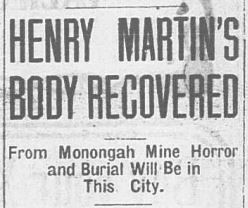
“Henry Martin’s body was found in mine No. 6 at Monongah at 3:30 o’clock this morning and identified by his brother, Patrick Martin, of this city. Mr. Martin has another brother here, too, Thomas Martin.” (CDT 12.12.07 pg. 1)

“Mr. Martin was 42 years of age.” (CDT 12.12.07 pg. 1)

“Mr. Martin leaves a wife and five children making his death particularly sad, as they were dependent upon him for support.” (CDT 12.12.07 pg. 1)

“Accompanied by relatives and friends, the body will leave Monongah at 8:22 o’clock tomorrow morning for Clarksburg, and will be taken to the Catholic church, where at 10 o’clock funeral services will be held at the same time that the Timothy Lyden obsequies are held. It will be a double funeral at the church—all at the same mass. Interment will be in Holy Cross cemetery.” (CDT 12.12.07 pg. 1)

At some point during the early morning hours

The body of John T. McGraw, pitt boss at Monongah mine No. 8, “was recovered from the mine early Thursday morning”. (CDT 12.13.07 pg. 1)

~4:30 am

“The body of Charles Wise of Fairmont, one of the best known men, was recovered at 4:30 o’clock…” (ES 12.12.07 pg. 2)

Wise was personal surveyor for Senator J.N. Camden. He surveyed inside of mines to ensure Camden and others were properly paid by Consolidated Coal Company. (FWV 12.12.07 pg. 1)

The 37 year old Chief Engineer “went into the ill-fated mine only a short time before the explosion.” (ES 12.12.07 pg. 2) (FWV 12.12.07 pg. 1)

Despite early reports announcing that only his jack and shoes had been found, leading people to believe Charles had been “blown to atoms”: “The body was in a good state of preservation and easily recognized. Besides in his pockets were his B&O mileage book, street car book, watch, ring and pipe, which were means to identify him.” (FWV 12.12.07 pg. 1)

Wise was found in #6 near the main heading, in a sitting position ½ mile away from his jacket. He had wrapped his waistcoat around his head indicating that he had survived the explosion and attempted to find his way out but got lost in the darkness and was eventually overcome by afterdamp. (FWV 12.12.07 pg.1)

Charles becomes body #258 to pass through the morgue. (Amos)

He leaves a widow, Pearl Reed Wise, and 2 sons: Thomas Reuben, 2 years, and Lorin Turney, 2 months old. (McAteer) (FWV 12.12.07 pg. 1)

~6:00

In Fairmont:

All mines in the Fairmont Coal Field are up and running to almost full capacity except those in Monongah. (FWV 12.11.07 pg.1)

The Fairmont West Virginian reports the weather as: Partly cloudy tonight and Friday, nearly stationary temperature (FWV 12.12.07 pg. 1)

In Monongah:

The remains of Charles D. Wise are taken to Musgrave’s undertaking parlors “just as they were taken from the mine” on 6:15 street car. (FWV 12.12.07 pg. 1)

At the mines:

“Officials…feel hopeful that the large force of rescuers, entering the mines at Monongah this morning will be the last necessary to send into the workings to recover the bodies…” (ES 12.12.07 pg. 2)

~8:00 am

In Clarksburg:

“The body of Thomas Killeen was brought here Thursday morning from the Monongah mine horror. The funeral was held in the Catholic church and burial in Holy Cross Cemetery.” (CDT 12.12.07 pg. 5)

In Fairmont:

Tom Donlin’s funeral is held at St. Peter’s Catholic church under the direction of the Ancient Order of Hibernians. Services are largely attended by friends and relatives following with interment at Holy Cross cemetery. Pallbearers were: Messrs. M.J. O’Neil, Anthony McDonough, John Kelley, John D Barry, Michael Ford and Jas. Erwin. (FWV 12/12/07 pg. 5)

In Monongah:

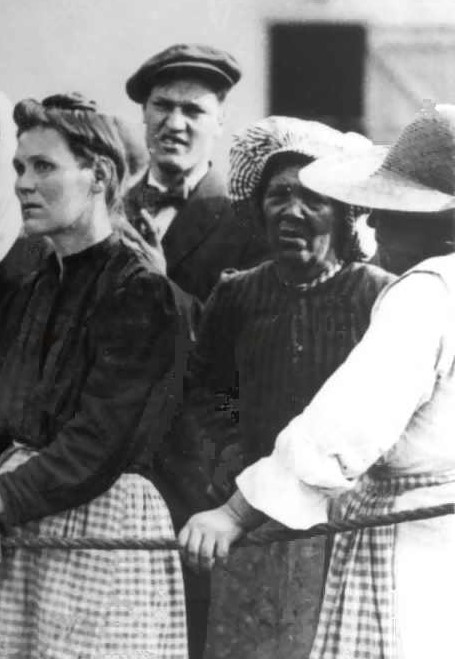
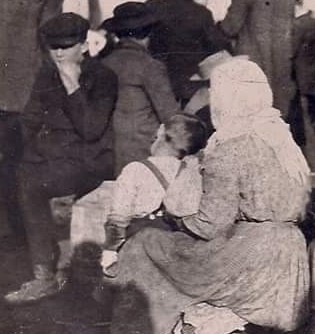
Women and children are still standing guard by the morgue.

women

At the mines:

Ventilation is restored to 8 miles of room headings, 550 rooms have been explored and tracks in 5.5 miles of main headings are cleaned up enough to allow hauling of bodies and materials. (McAteer)

1st full search completed in #6. The search parties have explored all the rooms of the mine and 20 searchers transfer from No 6 to No 8. “…the work in No 8 will be practically completed tonight when all the men will have been removed except those under falls.” (McAteer) (FWV 12.12.07 pg. 1)

The bodies taken out this morning are in “pretty good condition” so as George Gibbon, who has been able to identify most of the miners, was very successful. (FWV 12.11.07 pg.1) (FWV 12.12.07 pg. 1)

Among them is body #287—Ellis V. Herndon, this author’s great-great grandfather. Ellis’s son, Ira Herndon, was unable to go to work Friday morning due to his wet boots, and has had no need to take part in the rescue efforts as “they had other people who did that”.  Ira is able to stay with his family throughout the whole ordeal and mourn their elder. Ellis was found in excellent condition and buried in the cemetery “on the back of Tower Hill, in the hollow.” (Loss)

cemeteries
The mass grave donated earlier this week due to inclement weather is by the Catholic cemetery. However, the original potter’s field, which was used and became full within the first few days after the disaster, is currently unknown/lost. This author has quite the theory as to its potential location and this will be discussed later in an “Issues” post.

~9:00 am

In Belle Vernon, PA:

Coroner Hagan commences the official inquiry into the December 1st Naomi mine explosion. A number of officials testified and it was heavily discussed whether or not electricity should be used in mines.

In Fairmont:

Ladies Aid Society of the Diamond Street M.E. Church meets at the home of Mrs. Priscilla Merrifield on Wilson St. between 9am-4pm. 24 members and 2 visitors spend the day “sewing or doing any other work that may be done for the Monongah sufferers. Clothing or anything which will be donated for the cause will be gladly received by the ladies.” (FWV 12.10.07 pg. 2) (FWV 12.12.07 pg. 2)

old-woman-sitting-by-a-window-sewing-anonymous-artokoloro

“A Pittsburgh man said this morning that he was surprised at the small contributions being sent in for the Monongah relief fund. He thought the big cities were taking too little interest in the matter and that the papers ought to take the question up with a view to creating a larger fund. He thinks there ought to be a fund of at least $200,000 to properly care for 300 widows and 1,000 orphans.” (FWV 12.12.07 pg. )

In Monongah:

2 men try the same trick from day before of posing as workmen to get food and goods. They are caught, arrested, and put in the Monongah jail. (FWV 12.11.07 pg.1)

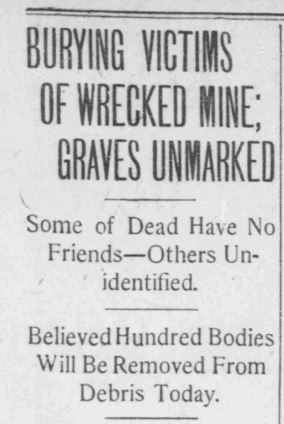
“About 100 men are digging graves for the dead and as fast as the bodies are prepared and identified they are taken to the cemeteries or shipped to the places designated by friends.” (FWV 12.11.07 pg.1)

Messrs. S.E. Jenkins and J.A.C. Prickett, representatives of the Setting Sun Tribe of the Improved Order of Red Men, accompanied the body of one of the Monongah victims to the home at Connellsville, PA. (FWV 12.12.07 pg. 2)

~10:00 am

“Two hundred and eighty-five bodies were recovered at 10 o’clock today, and 25 more were ready for removal to the surface.” (LET 12.12.07 pg. 1)

~11:00 am

In Pittsburgh, PA:

NYTb 12.13.07 - pg 5 - Monongah

“C.W. Watson…will, in the name of his wife, erect an orphan asylum at Monongah in which will be cared for and educated the children of the men who lost their lives in the disaster. Today representatives of Mr. Watson visited this city, where they inspected various orphan asylums, and announced that work on the new asylum at Monongah will be started at once.” (NYTb 12.13.07 pg. 5)

In Charleston, WV:

TA 12.12.07 - pg 1 - Ohio Relief Fund

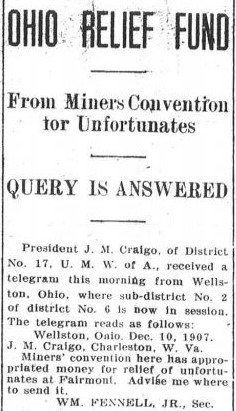
“President Craigo called at the office of the Mail, where a relief fund is being collected and was advised that it would be better to have the contribution from the Wellston miners sent direct from that point to Mayor Moore, at Monongah, rather than have it come to Charleston and then be remitted from here to Monongah. Mr. Craigo adopted the suggestion and wired the convention to the that effect.” (TA 12.12.07 pg. 1)

In Monongah:

“R.H. Spahr went to Monongah this morning and spent a few hours viewing the mine horror.” (CDT 12.12.07 pg. 8)

“At 11 0’clock this morning 256 bodies have been waiting for transportation. It is estimated that there are still 145 bodies in the mines. Eighty-five bodies are unidentified. The greater number of these have already been buried.” (WT 12.12.07 pg. 3)

mmd-mining2


More on How Death Gloated!

Bibliography

Disclaimer and Guide

Introduction

About the Author

Contact Information

Wednesday, December 11, 1907 – Afternoon

“Although rain is increasing the work of the rescue parties, it brought a merciful relief from the pitiful scenes at the exits in the last few days. It drove indoors many of the grief-stricken relatives and friends of the victims who crowded about the mouths of the shafts waiting for the bodies of the loved ones to be restored to them. All the soft earth about the mines was turned into a thin mud by the downpour, and although some of the stronger of the watchers remained through the forenoon, nearly all sought shelter later and awaited in their homes the summons to come and claim their own.” (RP 12.10.07 pg. 1)

~12:00 pm

At the mines:

Recovery is becoming more horrific and tedious as bodies now have to be carried a distance of a mile or more underground just to get to mine mouth. As recovery of bodies gets swifter, the system of identifying and counting the deceased leads to more confusion over the total number of bodies “found” and those actually “recovered” and when. (McAteer)

Between 170-180 bodies total have been taken out by noon, “…all of them except thirteen having been recognized and were either buried immediately after coming out or turned over to relatives where the corpse was in shape to be seen.” (CET 12.11.07 pg. 1) (News)

“…with large additions to the rescuing force it is hoped to have the mines cleared very soon.” (ES 12.11.07 pg. 1)

“It is stated today that there is every reason to believe the number of the dead will reach four hundred.” (CET 12.11.07 pg. 1)

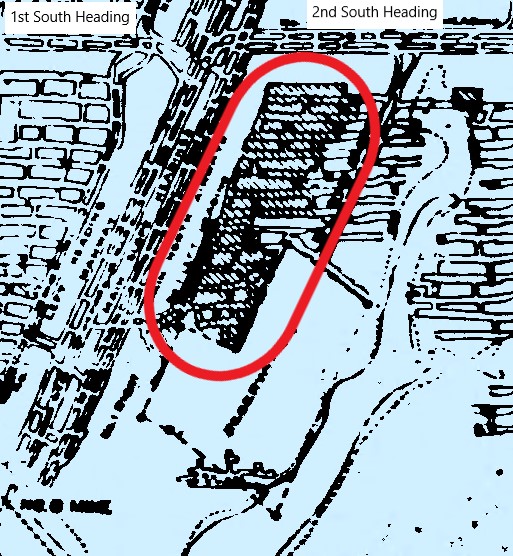
In an interview, the head of a rescue crew tells the Fairmont West Virginian: “#8 main from the opening to the bottom, a distance of about 1 mile in the mine, is absolutely clear of wreckage or falls. About the only obstruction of any amount in this mine is quite an extensive fall in the first left of the second south main working. This fall is about 100’ in length and about 4’ deep. Quite a few rooms were discovered with falls.” (FWV 12.11.07 pg.1)

map - 8 - 2nd south, 1st left cave in

In Fairmont:

Tom Donlin’s mother (who lives on Gaston Ave between 3rd and 4th street) knows nothing of the disaster. Her friends have kept her at home and kept all news from her “but in spite of all of this care Mrs. Donlin knew there was something wrong.” Her son usually came to visit every few days and was due for his visit on Friday. Since he didn’t show up, she was suspicious that something was not right. Father Boutlou informed her of the death of her son at noon. 2 years ago, another of her sons, John, was killed in a railroad wreck near Buckhannon. (FWV 12.12.07 pg.1)

At some point during the afternoon

In Monongah:

5 men showed up in town and “represented that they were workmen; they were supplied with rubber boots…and some other things that they needed to make up a fair disguise. These men then started to see how much good victuals they could consume. They were so successful with their scheme they began to boast about it. They did not stay long in Monongah after they were found out. They were given the grand bounce.” (FWV 12.12.07 pg.1)

Francesco A Cirmo, clerk at the local post office in Fairmont, is at Monongah participating “…in taking the census…” (FWV 12.11.07 pg. )

“Fifty-seven more bodies were taken out of the ill-fated Monongah mines 6 and 8 today; the larger number of these having been recovered from No. 8. This brings the total number recovered up to 184.” (CDT 12.11.07 pg. 1)

“These bodies many of which are badly burned and some mangled, have not all been identified as yet. The undertakers are working hard in preparing the corpses for burial and placing them in caskets. Those not identified are placed in the rooms provided for unidentified bodies where they are viewed.” (CDT 12.11.07 pg. 1)

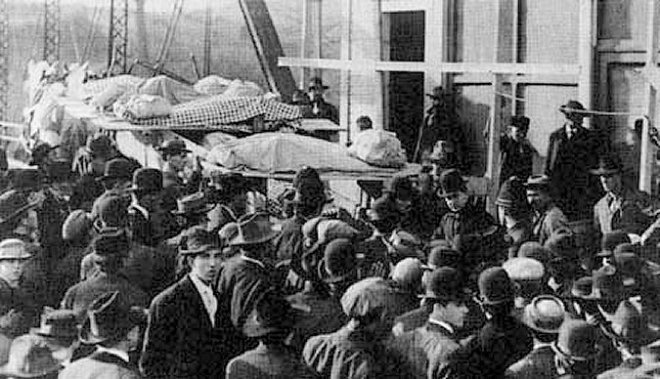
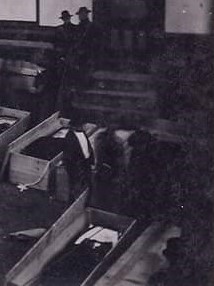
zoom - coffins


In Fairmont:

“It is now quite apparent that a large amount of money will be sent to Fairmont for the relief of the Monongah sufferers. Many thousands of dollars have already been deposited for this purpose and word comes from various cities of donations in large and small amounts.” (FWV 12.11.07 pg. )

“The Union Relief Association, an organization of Fairmont women from the various churches of the city, is doing noble work in providing for immediate needs of the wives and children of the victims and the General Relief Committee will use the larger sums of money in making provision for the families in a more comprehensive manner a little later on.” (FWV 12.11.07 pg. )

“This is a great work and ought not be done in a hurry. Needs not now thought of will probably develop a little later and then it will be a good thing to have some money to meet them. Let the gifts continue to be made for remember the needs of 300 widows and 1,000 orphans are great.” (FWV 12.11.07 pg. )

Dr. D.C. Duncan of Cameron informs Mayor Arnett of Fairmont that he offers 2 houses, rent free, to Monongah sufferers: “I have two small houses of two and three bedrooms that I will let some poor woman that has one or two children have to live in two or three months free of rent to help them along till spring. If they are able and willing to work they can get lots of common work such as washing to do to help them along. You will please let me hear from you if there is that would accept the offer.” (FWV 12.13.07 pg. 1)

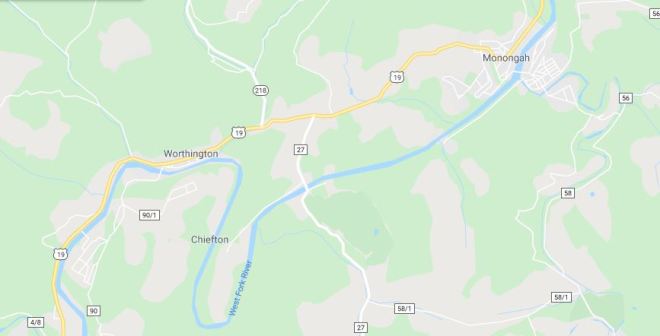
In the next town south of Monongah:

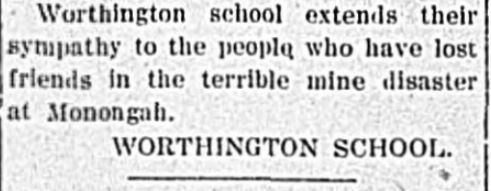
map worthington12.11.07 - pg 2 - Worthington kids send sympathies

South east on the state border:

The Watson school in Pendleton County donates the proceeds from a box dinner they held Friday evening. “The proceeds though needed for the school’s new library was given to the Monongah sufferers by a unanimous vote of the pupils. An openhearted, willingness to relieve want and help the distressed has become a prominent characteristic of our civilization. No better place to teach the brotherhood of man than in the public schools.” (12.11.07 pg. 2)

Further south in Charleston, WV:

The Children’s Home Society of WV, located at Charleston, announce they “will care for all homeless children and orphans that may be committed to their care.” (FWV 12.11.07 pg. )

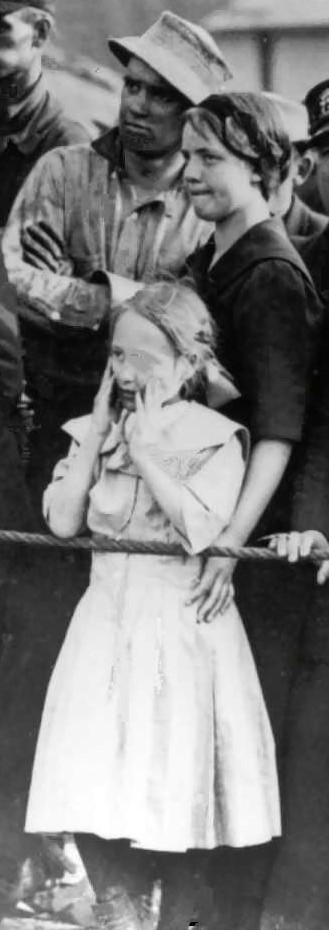
girls

~2:00 pm

“At 2 o’clock, 212 bodies had been recovered.” (ETR 12.11.07 pg. 1)

“Of forty-four bodies taken to the morgue about 2 o’clock this afternoon, none have been identified.”  (CDT 12.11.07 pg. 1)

~3:30 pm

In Fairmont:

“The cash contributions up to this time total $40,000.” (ES 12.11.07 pg. 1)

At the mines:

At Press time today there were 197 bodies that had been brought to the morgue and 25 bodies were ready at the mouth of the mines to be brought over. This makes 222 bodies that have been taken out of #6 & #8. (McAteer)

“Of the fifty bodies taken from the mines in the past twenty-four hours a majority are so mangled and decomposed as to render preparations for immediate burial imperative and many were sent direct from the mines to the graveyard in compliance with the order of the county board of health to prevent disease.” (BDP 12.11.07 pg. 4)

Rescue teams have not yet made any extensive efforts to clear the many roof falls in the mines and many bodies still remain trapped underneath. (McAteer)

Inspectors sent from Ohio, George Harrison and Ebenezer Jones, go into the mines for the first time. (McAteer, Inquiry)

Inside #6:

The bottom of #6 slope has been mostly cleared of debris from the wrecked coal cars and repeatedly examined. The line to the left of the main heading has also been cleared but men are still working on cleaning up wreckage in other areas of the mine. (McAteer) (News)

~5:00 pm

“A steady rain has been falling here all day, adding to the discomfort of the rescuers and making the recovery of the bodies more difficult.” (BDP 12.11.07 pg. 4)

Inside #8:

The body of John M. McGraw, pit boss in #8, is found in F Face, where the mines connected – “evidently going from one mine to the other.” (FWV 12.12.07 pg.1)

~5:30 pm

At the morgue:

John McGraw’s identity is confirmed by friends and by papers in his pocket. “Body was in fairly good state of preservation. Remains taken to Clarksburg for interment.” McGraw was well known and the president of First Regiment Band and had been a member since its organization. (FWV 12.12.07 pg.1)

~6:00 pm

In Monongah:

Bishop Donahue has “instructed the various priests ordered to the scene to remain on the ground until all the bodies have been recovered.” He returns to Wheeling where he will begin working on plans to assist placing the children in orphanages if necessary. (FWV 12.12.07 pg. 1) (News)

Donahue makes a statement that he is still uncertain how many orphans will be put into his care “owing to the grief and prostration of so many widowed mothers and his reluctance to as if they will part with them. He thinks however the number will be large.” Should there be more children in need than the current facilities can handle, Donahue says he “will lease a separate home for them and later build.” (FWV 12.12.07 pg. 1)

widows at 8 - zoom


More on How Death Gloated!

Bibliography

Disclaimer and Guide

Introduction

About the Author

Contact Information

Tuesday, December 10, 1907, Evening – Night

“Death came suddenly to the Monongah miners, and it is probable that many of them were taken off without bodily pain. The greatest sufferers were and are the women who are left behind. The anguish of their hearts as they waited in awful suspense between hope and dread, only to realize at the last that their loved ones had perished, is known only to themselves and to the pitying God, who alone can give consolation. And they must suffer on haunted forever by the recollection of the terrible ordeal. This case is not exceptional. When the men are in peril, the women must agonize. Theirs but to wait and mourn…‘For men must work and women must weep.’” (TD 12.10.07 pg. 6)

Evening

At the mines:

Both mines are sufficiently cleared of foul gasses that recovery work progresses at a faster rate.

“Until Tuesday evening 142 bodies of the victims of the Monongah, W. Va., mine explosion had been rescued.” (CC 12.12.07 pg. 2)

In Monongah:

Several different parties of inspectors are formed to begin determining the cause of the explosion. One of the inspectors from Pennsylvania spends an entire week surveying and examining the mines. (McAteer)

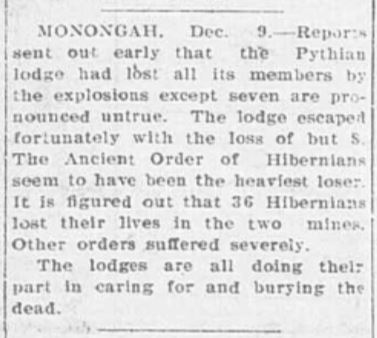
“The various lodges and churches of Monongah have sustained heavy loss.” (FWV 12.10.07 pg. 6)

During the night:

In Iowa:

Evening Times Republican in Iowa

In Morgantown:

Mayor I.N. Lucas holds meeting for the citizens of Morgantown to render assistance to Monongah victims. (FWV 12.9.07 pg. ?)

N.C. Prickett, Grand Chancellor of the Knights of Pythias of West Virginia is in Monongah making arrangements for the relief of the distressed families of the order. The local lodges are working to relieve the sufferers. (FWV 12.11.07 pg. 8)

In Fairmont:

CET 12.11.07 - pg 1 - Monongah 1

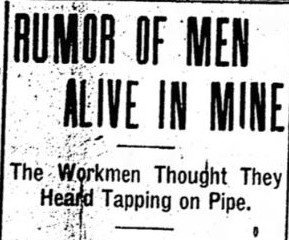
“There was a rumor about Fairmont last night to the effect that some of the miners might be alive in the mines. The gossip was that a workman had heard rapping noises on a pipe. J.H. Wheelwright, who has been at the mines since the explosion, declared he had heard none of the supposed rappings and that it was ridiculous to suppose that anyone within the mines could be alive.” (CET 12.11.07 pg. 1)

At the mines:

“When darkness fell tonight 141 bodies had been brought to the surface while many more were located with every prospect of the rapid work of recovery of the past twenty-four hours continuing throughout the night.” (News)

23 bodies are removed tonight. (FWV 12.11.07 pg.1)

“Owing to the inclement weather it was impossible to bury bodies in the regular Potter’s Field, on the top of a steep hill, and when this became known the Fairmont Coal Company turned over an acre of ground just behind the Polish church of Monongah and this is being used as a Potter’s Field.” (NYTb 12.11.07 pg. 11)

“The crowds of idlers who surged about the pit entrances…have been dwindling ever since the rainstorm last night until tonight there only remained the forces employed in the rescue work, the newspaper workers and the inconsolable near relatives of victims who have remained faithful in the vigil during the downpour all night and all day, still shivering and enduring the physical discomfort in the wet snow that succeeded the rain.” (AR 12.11.07 pg. 1) (LAH 12.11.07 pg. 7)

mmd-mining3

“The bad weather did not stop the grave-diggers for they toiled from morning until night. It was found that the wagons could not make the trips up the steep hills to the regular Potter’s Field, so the company donated an acre of ground near the Polish and Italian Catholic cemetery. Several of the unknowns were buried there but the first body interred was that of John A. Ringer, an American. His widow brought her child to the morgue and identified the body. She said she had no money to pay the burial expenses and that the body would have to be placed in the Potter’s Field.” (CET 12.11.07 pg. 1)

“Another pathetic incident was the saving of the remains of Tom Donlin from the potter’s field by Mrs. A.J. Ruckman. The body was found on Tuesday night and passed by unidentified; his own little girl had looked at almost every body brought out, saying, ‘That’s not my papa.’” Luckily, Mrs. Ruckman manages to somehow recognize and identify Tom’s body, despite it being “mutilated”, before he is sent off with the others. (FWV 12.12.07 pg. )

“Mr. Wheelwright said the rescuing squads were working close to the underground passageway which connects the two mines and that the men hope to be working in the passageway and will work toward each other.” (CET 12.11.07 pg. 1)

mine map connection point


More on How Death Gloated!

Bibliography

Disclaimer and Guide

Introduction

About the Author

Contact Information

Tuesday, December 10, 1907, Morning

“This is the day of ‘little mothers’ in Monongah. The little girls tend the babies, wait on the sick and get what bits of food there are.” (NCH 12.10.07 pg. 1)

~7:30 am

The Fairmont West Virginian predicts even more rain for today and tonight, followed by snow and slightly cooler weather (12.10.07 pg. 1)

“It has been raining here steadily since last evening and wretched conditions prevail throughout this section today.” (WED 12.10.07 pg. 1) (ES 12.10.07 pg. 1)

At the mines:

“The stench from decomposed bodies in the mines is becoming almost unbearable to rescuers. The stench is made worse because thirty-six horses were also killed in the mines.” (GWA 12.12.07 pg. 7)

“Many rescuers have become sick. One hundred and fifty miners from the mines in George Creek district have been summoned here to assist in the rescue work.” (GWA 12.12.07 pg. 7)

“The health officers fear an epidemic of fever, due to the decaying bodies of the men and the animals caught in the mine, and have prepared to enforce heroic measures if it becomes necessary. Quicklime will be taken into the mine and scattered over the bodies if conditions become much worse.” (ES 12.10.07 pg. 1)

“The crowds of idlers who surged about the pit entrances…have been dwindling ever since the rainstorm last night…” (AR pg. 1) (LAH 12.11.07 pg. 2) (SFC 12.11.07 pg. 1)

“The mud at the opening of the mines is several inches deep and has been trodden by the great crowds into a perfect quagmire, through which the men with the stretchers have to carry the dead. In conveying one of the recovered bodies down to the railroad tracks this morning a stretcher bearer slipped and the inanimate burden, which was wrapped in a blanket, was thrown into the mud. The sight of it gave the crowd a convulsion.” (RP 12.10.07 pg. 1)

At the morgues:

“Bodies brought from mines Nos 6 and 8 …during last night carried the list of victims beyond the hundred mark, and others are being carried into the morgue in intervals.” (WED 12.10.07 pg. 1)

2 men taken out this morning had some money on them: #101 – Salvadore Lobbs had $150 in a belt strapped around his leg and #110 – Andy Morris had $23.19 in his pocket-book. This brings the total amount of money found on the miners to $200.19. Money is in the hands of the coroner as are all other things that are found.  (FWV 12.10.07 pg. 1)

In Fairmont:

J.E. Sands, cashier of First National Bank, receives a check for $500.00 from the City Bank of Wheeling and a check for $100.00 from the Second National Bank of Cumberland, MD and $100 through Mr. Zack Robertson from a friend in Wheeling. (FWV 12.10.07 pg. 1)

In Grafton:

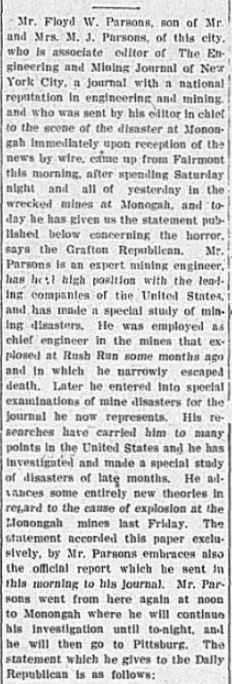
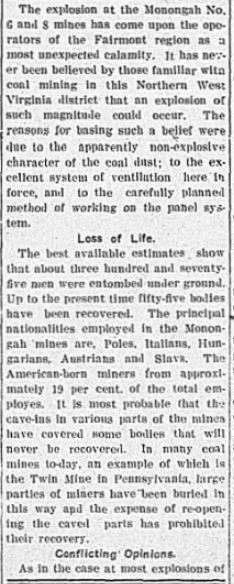
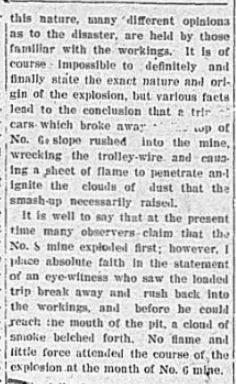
Floyd Parsons “came up from Fairmont” and gives the Grafton Republican newspaper his statement “concerning the horror…”. Floyd was employed as chief engineer in the mines that exploded at Rush Run some months ago and in which he narrowly escaped death. Later he entered into special examinations of mine disasters for the journal he now represents. (FWV 12.10.07 pg. 2)

12.10.07 - pg 2 - Floyd J Parsons opinion on cause 1

12.10.07 - pg 2 - Floyd J Parsons opinion on cause 2

12.10.07 - pg 2 - Floyd J Parsons opinion on cause 312.10.07 - pg 2 - Floyd J Parsons opinion on cause 412.10.07 - pg 2 - Floyd J Parsons opinion on cause 512.10.07 - pg 2 - Floyd J Parsons opinion on cause 612.10.07 - pg 2 - Floyd J Parsons opinion on cause 712.10.07 - pg 2 - Floyd J Parsons opinion on cause 812.10.07 - pg 2 - Floyd J Parsons opinion on cause 9

~8:00 am

CDT 12.10.07 - pg 1 - BandO to Monongah

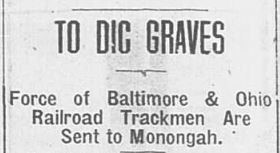
“Carrying out orders from officials of the Baltimore & Ohio railroad, a force of between forty and fifty trackmen that have been working on the railroad between this city and Parkersburg, left Clarksburg Tuesday morning on the interurban trolley line for Monongah to assist in digging graves for the dead that are taken from Monongah mines Nos 6 and 8. The men took picks, shovels and other tools with them and as soon as they arrived at Monongah they proceeded to the cemeteries and began work digging graves. The men were called to this city from various points along the railroad between Parkersburg and this city where they had been working.” (CDT 12.10.07 pg. 1)

In Monongah:

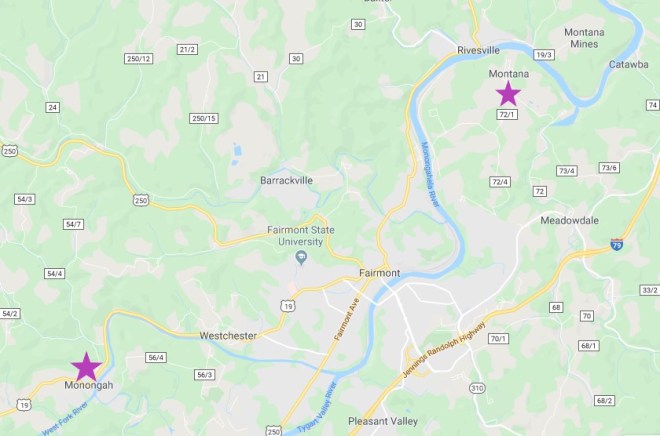
Milroy “Toy” Watkins is taken from Monongah to Montana for burial. The brother of Will Watkins, “…hearing that his brother was in No 6 mine went to work to help find him and he did not give up until he had found him and recognized him by a pair of black patent leather shoes and a black sateen shirt.” (FWV 12.12.07 pg. 2)

The Marion County Board of Health issues an order to advance the burial procedures. Viewing and ID opportunities for families and friends are limited to 4 hours maximum, no matter the condition of the body. The new accelerated ID and burial process cause many burials to occur immediately, without funeral masses. Catholic parishes hold whatever services they can at graveyards. (McAteer)

~9:00 am

On the far east side of Fairmont:

“Impressive were the services conducted by Rev. Hess” for Toy Watkins which takes place at the United Brethren church at Montana. He was the son of Mr. Willis Watkins and was a grandson of Mr. and Mrs. John Freeman, “an aged and respected couple residing at Montana and was related to many people living in and around Hoult and Montana.” Toy is survived by “4 brothers and 2 sisters; his mother having died about one year ago.” He is also survived by wife, Gettie Hyson Watkins, of Simpson, “who is very poorly in Cook Hospital, she being almost prostrated by the awful shock and untimely end of her husband.” (FWV 12.11.07 pg. 2)

montana map

In Monongah:

“Shock and grief have already destroyed many of the little unborn lives. Many women are so distraught with suffering that they forget all about their children.” (NCH 12.10.07 pg. 1)

“Funeral after funeral is being held at the churches in Monongah. The funeral cars are on the move most of the time. The unknown dead are being buried in the potter’s field near the Polish Catholic church.” (FWV 12.10.07 pg. 1)

Over 70 bodies are interred throughout the day. Some of them get funerals at the church, particularly those who could be preserved, but due to the condition of so many of the bodies brought out in the past hours, more frequently they are simply taken to one of the cemeteries. If identified, a small prayer is said; if not they are just buried. (McAteer) (news)

“The relief work is well under way and will soon be systemized. There is now plenty of food but there is urgent need of clothing in many families. Cash funds are being raised in many places and installments have already been forwarded from some points. The coal companies of this district have contributed $20,000 cash.” (WED 12.10.07 pg. 1)

“Thirty-seven funerals were held Monday and a number today. One body was sent to the cemetery followed by one lone woman, the widow, who had stood for days at the mines waiting for it.” (GWA 12.12.07 pg. 7)

At the mines:

“Every day since the explosion, hands, legs and arms have been removed. The stench from the decomposed bodies in the mines is becoming almost unbearable. This is one of the greatest difficulties which the rescuers have to overcome.” (RP 12.10.07 pg. 1)

“Up to nine o’clock this morning one hundred and one bodies have been removed from the Monongah mines, thirty-one having been taken out since midnight.” (CET 12.10.07 pg. 1)

~10:00 am

In Clarksburg:

“Charles McKane, aged 28 years, one of the Monongah mine victims, was buried in Holy Cross cemetery here at 10 ‘clock Tuesday forenoon. McKain’s body was found in one of the rooms of No. 8 mine and was taken from the mine shortly after midnight. With others it was conveyed to the morgue at Monongah and prepared for burial. It was then sent to his late home in that town arriving there at 2:30 o’clock, and Tuesday morning it was brought up on the interurban and buried. Relatives and friends accompanied the body. Mr. McKain’s body was not mutilated. It is evident he smothered to death. He leaves a wife and one child.” (CDT 12.10.07 pg. 3)

holy cross map

“Mayor L.C. Crile announced Tuesday morning that all moneys received at the council chamber in response to his proclamation calling for donations for the relief of the Monongah mine suffered, would be turned over to the Telegram relief fund, and due credit will be given to each donor. The donations will be published in the Telegram daily. A list of all the donors who leave supplies, provisions, clothing, etc., at the mayor’s office for the Monongah mine sufferers will be published each evening in the Telegram also. Donations are coming in freely and they should continue so for there are many unfortunate women and children left in destitute circumstances by the awful disaster.”  (CDT 12.10.07 pg. 1)

In Monongah:

“Quite a number of Bridgeport people today went to the scene of the great mine disaster at Monongah. Some went for the mere sake of seeing, while others went with the hope of getting tidings from relatives and friends who were employed at the ill-fated mines.” (CDT 12.10.07 pg. 7)

“There is no change in the demeanor of the people of the stricken town except that the gloom of sadness and sorrow deepens all the time.  Funeral after funeral was held today, mostly at the Catholic cemeteries, where scenes are most sad. After loved ones have been identified at the morgue and prepared for burial, hundreds of women and children gather at the cemeteries on the hill instead of going to the churches and await the arrival of the dead.” (CDT 12.10.07 pg. 1)

“Women were found today weak from pain, who are also suffering from lack of proper nourishment. Some of the Fairmont women have depleted their own stores of winter supply food in relieving the distress.” (RP 12.10.07 pg. 1)

“Ever since the explosion the most heroic action has been displayed on all sides by the women who despite their great stress and suffering, clung to their children. From the start they realized that the little tots were to becomes a serious burden, but on all sides could be heard the same sentiment, they would rather die than give up their children.” (CET 12.10.07 pg. 1)

“Some of the widows have no relations in America, for many came to Monongah with their husbands from the old country. Others came as sweethearts, years ago, after the lovers had made enough money to send for them. And while their married lives began here, they apparently prefer, in their distress, the old homes far away.” (CET 12.10.07 pg. 1)

“There are not many of the women who can now find any charms about Monongah, and although foreigners, most of them want to return to their native country, feeling that the few short years of the country of liberty has brought them nothing but grief and suffering.” (CET 12.10.07 pg. 1)

Special correspondent for the United Press, Dorothy Dale, and her photographer are approached by “the brightest Italian girl in the settlement”, Faustina Davia (last name reported as “Daria”).

Faustina close up Wilkes-Barre Times - 12.14.07 pg 1
Faustina Davia

Faustina is the oldest child and only daughter of Victor and Catherina Davia (DaVia). Victor was a “day man” working in #6 at the time of the explosion and was recorded as the 15th body recovered from the mines and to go through the morgue. He was identified by George Gibbons at the Italian Catholic church in Monongah sometime on Monday, though it is generally known that none of the family got to actually view and confirm that the body which was buried in Row A Grave 9 of the Italian Catholic cemetery contained Victor’s actual remains. (Tropea) (News) (McAteer) (Loss) (Amos)

“’Please you get something for me, I can do.’ A little hand touched my arm. A curl-framed face of a girl of 10 looked into my face. ‘You know mans all dead. Boys all dead. Only girls left to work.’ Do you know the half apologetic half appealing look of the trembling old man who shoved out of his life’s track by younger men—the man who begs you to buy matches or shoestrings? Well, that was the expression in the old young eyes of little ten-year-old Faustina Daria. Faustina was in the sixth grade the day before the explosion. That is ages ago to her.” (NCH 12.10.07 pg. 1)

At the mines:

“With 112 bodies on the surface at 10 o’clock today, 25 more ready to be brought out of Mine No 6 and 4 awaiting removal from Mine No 8. It was expected that the total number of bodies recovered from the wrecked mines by noon would be 140.” (CDT 12.10.07 pg. 1)

“The rescuers are working the right side of mine No. 8, where, it is thought, a majority of the bodies yet in the mine will be found.” (ES 12.10.07 pg. 1) (RIA 12.10.07 pg. 1)

 “The rescue work is being pushed and before night it is expected that most of the bodies will have been taken out.” (WED 12.10.07 pg. 1) (ES 12.10.07 pg. 1)

~11:00 am

In East Monongah:

The General Relief Committee holds a meeting at the First National bank, which is currently operating as the primary morgue, and passes an order that the receipts and disbursements of the committee be published in the Fairmont papers from day to day. (McAteer)

Bishop Donahue of Wheeling and Judge Mason are added to the General Relief Committee. (FWV 12.10.07 pg. 1)

Donahue has “visited many of the homes of miners and found so many children made orphans by the disaster that he immediately took up the work of providing homes for them. He will arrange to have as many as can be accommodated sent to the orphanages maintained by the church at Huntington and Wheeling.” (WED 12.10.07 pg. 1)

In West Monongah:

Faustina Davia has taken Dorothy Dale and her photographer to her family’s three-room house on Walnut Avenue.

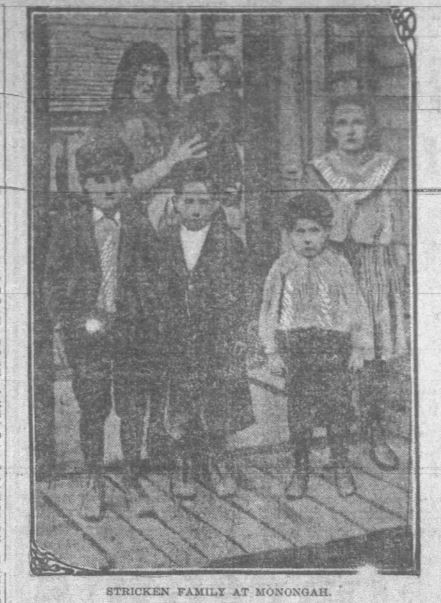
“‘See my Ma, Resta, Kipling, Georda and Ojgenia to work for,’ as she pointed at the group on the steps. ‘My pa make $2 a day,’ she explained. ‘And wasn’t it awful; three days he was home with a hurt on his back, and Friday he went in again and—and—’. But even the brave lips of strong hearted women of ten sometimes give way. The little figure crouched against the wall and quivered with sobs. ‘You know we paid $5 rent and had lard and cheese and bologna,’ she said with pride. The child spoke as rich people spoke of automobiles and theatre parties. And there was little Faustinas in almost every house in Monongah.” (NCH 12.10.07 pg. 1)

“I tell you there is nothing that makes one’s heart go out more to that stricken people than the way tiny girls put their little shoulders to the burdens that their mothers can not bear.” (NCH 12.10.07 pg. 1)

Wilkes-Barre Times - 12.14.07 pg 1
Photo taken of the Davia family on the porch of their home.
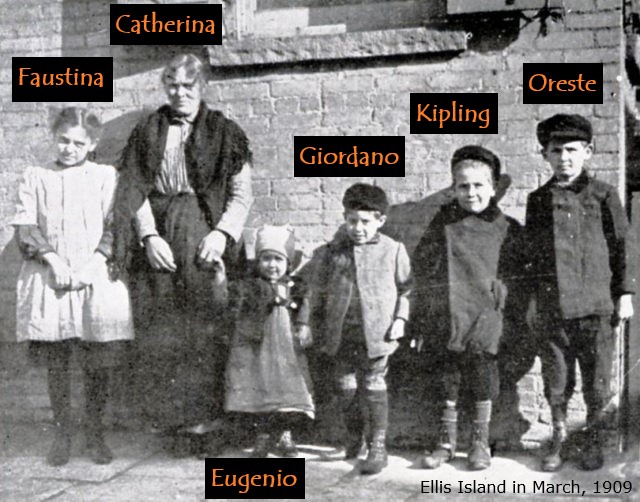
1909 ID photo
Photo of Davia family at Ellis Island. Catherina and her family is the focus of this author’s historic fiction, therefore, there will soon be areas of this site which will be dedicated solely to her story.

~11:30 am

“At eleven thirty, one hundred and thirteen bodies have been taken from the mine by rescuers. The bodies of those taken out since daylight are in good condition, and many were identified.” (CET 12.10.07 pg. 1)


More on How Death Gloated!

Bibliography

Disclaimer and Guide

Introduction

About the Author

Contact Information

Monday, December 9, 1907, Afternoon – Evening

The utterness of that desolation seemed by sheer force of numbers to overshadow anything else she had to tell—the children of the McFeeleys, “all little ones and not a bite to eat yesterday and him home dead”—(in some cases the women were so broken as to be unable to prepare food for their children, even if they had it)… What the housewives said as they met on the narrow walks or rocked at each other’s door sills was after all close to the pith of the matter…The Italian mother, “where I got the peppers,” with no money and no English and “2 little bits of children”…The Slavish wife who “tore blood out of her face”…The two crazed women on the hill who, rumor had it, had to be tied down to their beds…The young widow of the English machine man who lived just over No 8 mine, “who tore out her beautiful yellow hair in grabs,”… (Kellogg)

~12:00 pm

At the mines:

“Fire which caused a suspension of rescue work yesterday and early today in Mine No. 8 was extinguished, it was said, at noon today.” (News)

At noon the body of Mike Cosic was taken out of Mine No. 8. (CDT 12.9.07 pg. 1)

“No identification has been made of the eight unknown men taken out Sunday.” (CDT 12.9.07 pg. 1)

carnations

“A pathetic incident of the day occurred at Mine No. 6. A foreign woman whose husband had been killed stood near the mine all day with a half dozen carnations in her hand. The little floral tribute was wrapped with white ribbons.  Shortly after noon her husband’s body was recovered in such condition that burial was necessary at once. She followed the wagon to the temporary morgue where the body was placed in a box, and then to the cemetery near by.” (NYTb 12.10.07 pg. 14)

In Monongah:

C.W. Watson gives the following statement:

12.9.07 - pg 1 - Watson statement
FWV 12.9.07 pg 1

“Senator J.A. McDermott, of Morgantown, president of the State senate, who was requested by Governor W.M.O Dawson to go to the scene of the mine horror, gave the Telegram representative the following statement at noon today:

‘I consider that the resolution passed by the legislature gives the mine investigating committee the power to investigate all mine horrors that occur during the existence of the committee. The coal company wants a most thorough investigation by that committee or by any other committee. I have been at both mines and looked over the whole situation. I notice a fine organization and a systematic plan of rescue work and everything possible is being done promptly. The number in the mines as given out is considerably overestimated. I am here for no special purpose but it is possible that this disaster might come before the legislature or come up in some other way and therefore desired to be personally informed.’” (CDT 12.9.07 pg. 1)

“There has been no change in the situation at Monongah today except that it is very probable that the death list is not so large as was first thought. According to a telegram sent to the Governor by Watson the dead number almost a hundred fewer than given out.” (FWV 12.9.07 pg. 1)

“When the explosion occurred the town officials ordered the saloons closed…there is no drinking and among the thousands of people who have flocked to Monongah to witness the grave disaster not one disorderly act has been committed…” (FWV 12.9.07 – pg. 7)

Fairmont West Virginian puts out an extra Noon paper. Bill Sloane is no longer included on the list of the dead.

12.9.07 - pg 1 - headline

12.9.07 - pg 1 - letter for aid from Moore

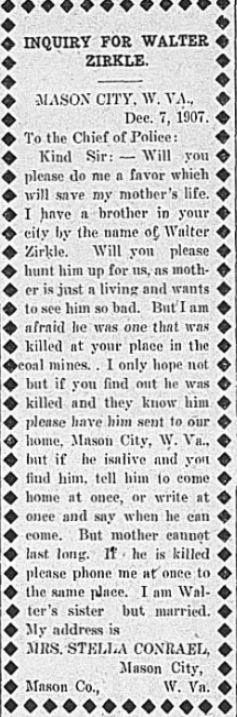
Chief of Police Shumaker received letter asking him for assistance to locate Walter Zirkle. (FWV.12.10.07 pg. 2)

12.9.07 - pg - missing man

~2:00 pm

12.10.07 - pg 6 - funeral 1
CET 12.10.07 pg 6

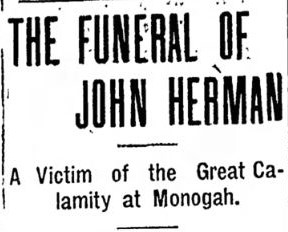
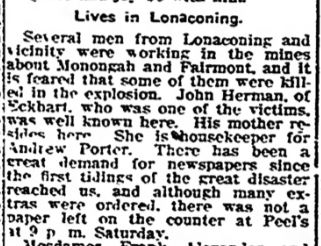
“The funeral of Mr. John Herman…whose remains were brought to Eckhart Mine for interment took place on Monday afternoon at 2 o’clock from the Jr. O.U.A.M. hall, as the church to which the deceased belonged is undergoing repairs.” (CET 12.10.07 pg. 6)

“The services were conducted by Rev. Edwards, pastor of Methodist Episcopal church, who spoke in a very beautiful and touching manner of the deceased’s past and of his terrible end. At the conclusion of the services the remains were taken to the Allegany cemetery at this place, where they were laid to rest, attended by a large concourse of friends and relatives.” (CET 12.10.07 pg. 6)

“The deceased was about thirty-eight years of age and is survived by his wife and several children, also his mother and several brothers and sisters residing in this vicinity. The floral offerings were very beautiful.” (CET 12.10.07 pg. 6)

~2:30 pm

“Five more bodies were removed from the mines today, making the total 58 up to 2:30 o’clock.” (ETR 12.9.07 pg. 1)

During the Afternoon

“A foreigner who is employed at the Riverdale Mine, ten miles above Monongah, lost a brother and thirteen other relatives in the catastrophe, and he is left alone in this country. Today he came to the offices of the coal company and reported that he wanted to remain at the mines until the bodies were recovered. He asked whether he would get his job back at Riverdale should he stay away from it for several days. He was assured he would not lose his place and became happy in the fact that he could assist in finding the bodies of fourteen loved ones.” (NYTb 12.10.07 pg. 14)

In Monongah:

“General Manager L.L. Malone told the Telegram representative this afternoon that likely all of the bodies, with perhaps the exception of a few in the remote parts of the mines, will be brought out within two or three days.” (CDT 12.9.07 pg. 1)

Fred Cooper’s funeral services held at the home of his uncle, Mr. Boggess, near Monongah. Rev. R.T. Webb of the M.E. Church South, pastor of the deceased, conducted the services, which were largely attended by friends of the deceased. Younger brother, Fay Cooper, also lost his life in the disaster but his body has not yet been found. Fred’s wife who survives him with one child has in the past 2 years lost 2 brothers, Fred Shingleton and an infant brother. Mr. Cooper’s mother, Mrs. Jerome Hobbs, who today mourns the loss of two sons, yesterday received announcement of the death of her husband, but today another message has corrected that statement. Mr. Hobbs is at Hot Springs, Arkansas, on account of rheumatism. (FWV 12.9.07 pg. ?)

“Considerable excitement was caused late this afternoon when rumors were current that a second explosion had occurred in the mines. An investigation made immediately by the company showed the reports had reached this vicinity from the East. There was absolutely no truth in the statement, and it was not necessary for the company to deny the report in this section.” (NYTb 12.10.07 pg. 14)

In Clarksburg:

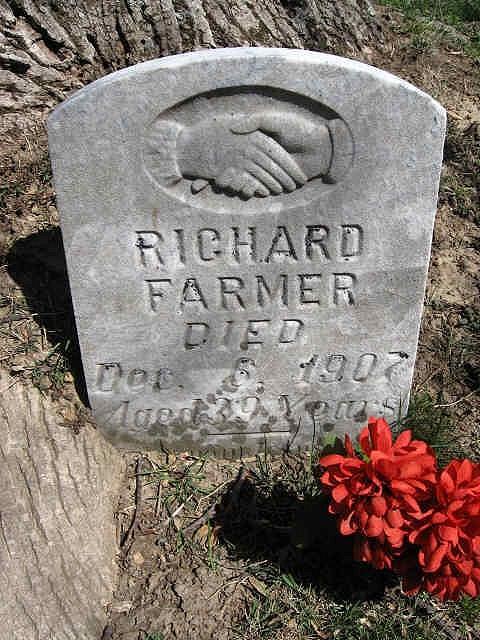
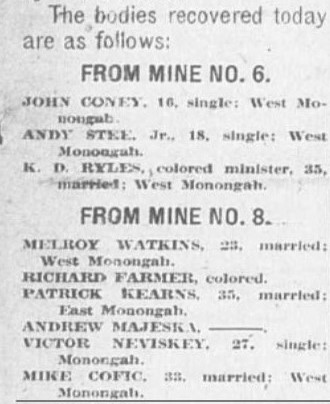
“The Richard Farmer, whose body was taken out of Mine No. 8, is a cousin of Policeman Farmer, of Clarksburg. His body was buried here this afternoon.” (CDT 12.9.07 pg. 1)

Grave of Richard Farmer on Tower Hill

In Fairmont:

The remains of Charles Honaker are brought to the city and buried at Woodlawn cemetery. The funeral was under the direction of the Improved Order of Red Men and the Degree of Pocahontas. (FWV 12.10.07 pg. 1)

“The work of caring for the widows and orphans has been entrusted to a committee headed by Rt. Rev. P.J. Donahue of the Catholic diocese of Wheeling.” Bishop Donahue estimates over 80% of dead were members of the Polish or Italian parishes. (Wash. Times 12.9.07 pg. 5) (McAteer)

In the cemeteries:

Burials are continual throughout the day. At the Catholic cemetery, there is great concern of bodies being buried in their proper ethnic graveyards; Polish on the Left, Italians on the right.

“Scenes of touching sadness were caused throughout the day by the burial of the recovered dead and the pitiful actions of relatives of the entombed victims.” (LODD 12.13.07 pg. 3)

Following the custom of old country, each family member would throw a handful of earth into the grave and say a final prayer.

Near Grant Town, WV:

The home of Mr. and Mrs. John Collins of Gray’s Flats is destroyed by fire while Mr. Collins is at work in mines and Mrs. Collins is at Monongah on account of the death of relatives caused by the great explosion. The fire was caused by the children knocking a stove leg off. There were 3 children in the house but they escaped. (FWV 12.10.07 pg. 8)

grey flats

At the mines:

“Nine more bodies were brought out of Monongah Mines Nos. 6 and 8 today. There are ten more bodies near the opening of No. 6 and they will be brought out by 5 or 6 o’clock.” (CDT 12.9.07 pg. 1)

~6:00 pm

Newspapers

Fairmont West Virginian:

Weather predicts more rain tonight; Tuesday, rain or snow; much colder (FWV 12.9.07 pg. 1)

12.9.07 - pg 1 - splash

Clarksburg Daily Telegram:

12.9.07 - pg 1 - headline

12.9.07 - pg 1 - list

“…the Clarksburg Amusement Company has decided to give the net receipts of both the Odeon and Bijou family theatres all of next week to the relief fund for the sufferers. The regular performances with vaudeville specialties will be given and all who wish to lend a little aid to the unfortunate people of Monongah should attend the theatres.” (CDT 12.9.07 pg. 1)

“The proceeds of the Dreamland theatre this week will also be for the miner’s relief fund. A National cash register will be placed in the ticket office and all the monies taken in will be put in this register. The key of the register will be given to Chief of Police Richard Scott, who will count the money every morning and announcement will be made in the Telegram of the amount taken in every day. All above, the running expenses will go to the miner’s relief fund.” (CDT 12.9.07 pg. 1)

12.9.07 - pg 3 - lodges and orders12.9.07 - pg 3 - officials 2

12.9.07 - pg 5 - Shinnston 1

“The Monongah mine horror is still the all-absorbing topic of interest to everyone here, many of our people having relatives or friends who were victims of that awful explosion, the concussion of which was plenty felt here, and telephone messages came from as far away as H.R. McCord’s on Simpson Creek, inquiring if there had been an explosion here. Relief parties were formed here, headed by Superintendent Thomas Jarrett and Mine Foreman E.P. McAlvin and O. Bush, of the local mines and hurried to the scene on a freight train and have been working there since. Superintendent Jarrett was twice very nearly overcome with the gaseous fumes, but each time after recovery he returned to the work of rescue.” (CDT 12.9.07 pg. 5)

Washington Times, page 5:

12.09.07 - pg 5 - Monongah 1

The D.C. Evening Star, page 12:

12.9.07 - pg 12 - photos of Monongah

Evening Journal in Deleware:

12.9.07 - pg 1 - Monongah 1

The Evansville Press:

12.9.07 - pg 1 - Monongah 1

Evening:

In Fairmont:

Mayor Arnett is strongly considering closing the saloons again tonight. (FWV 12.9.07 pg. 1)

The list of 406 dead published on Monday is “not complete”.  “Mr. Harry Dawson of Woodsfield, OH was in the office yesterday evening looking over the list for the name of his brother, Fred Dawson, who was employed at Monongah and is known to be lost but his name was not found. Mr. Dawson also says that J.L. Hunsaker was also employed with his brother and his name is not on the list. These were both young unmarried men and were machine men.” (FWV 12.10.07 pg. 7)

“So this proves that the list is not near large enough and how many more instances of this kind will appear will only be known by waiting.” (FWV 12.10.07 pg. 7)

In Monongah:

Jury and court of inquiry adjourn “but will be recalled by the Coroner.” (FWV 12.10.07 pg. 1)

“The company issued a statement today in which the claim is made that later developments lead the officials to believe that there were only 260 men in the mine when the explosion occurred. It is insisted by the miners that 406 men were checked off as entering…” (CB 12.10.07 pg. 1)


More on How Death Gloated!

Bibliography

Disclaimer and Guide

Introduction

About the Author

Contact Information

Sunday, December 8, 1907, Afternoon, 12:00 pm – 5:00 pm

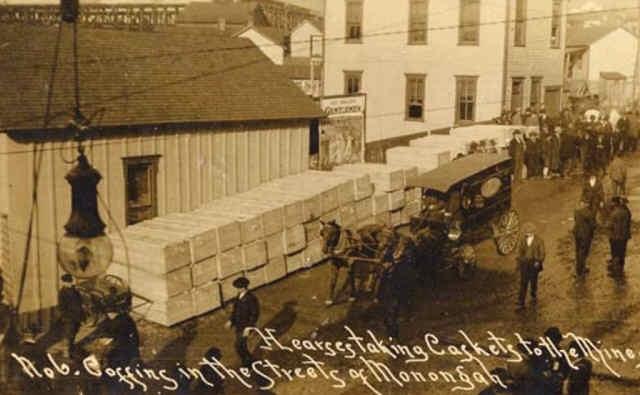
“75 men digging graves on the hillside, a depot platform piled high with pine boxes, a row of coffins in the main street stacked 3 high and nearly a block in length, a corps of undertakers as large as a regiment’s hospital corps, women whose eyes could weep no more, with orphaned children clinging to their skirts—these were some of the evidences that there would be no Christmas in Monongah for another year.” (Forbes)
m5

~ Noon

In Monongah:

“Many newspaper men, including photographers, from all over the country are at Monongah. All of the nearby cities have special reporters on the scene and there are newspaper men from Pittsburg, Wheeling, Cincinnati, Cleveland, Washington and other cities.” (CDT 12.8.07 pg. 1)

“Probably never before on any occasion have the interurban cars carried as many people as they have in the last few days since the mine disaster. All along the line hundreds of anxious people are found at every station eagerly trying to get on a car to go to the scene of the disaster. Many of them are foreigners who had relatives working in the two mines. Sunday the interurban station in this city was crowded all day and many people visited the scene of the disaster. The street cars were run double all day and every one was crowded to its utmost. Many people took advantage of it being Sunday, to go to Monongah.” (CDT 12.8.07 pg. 1)
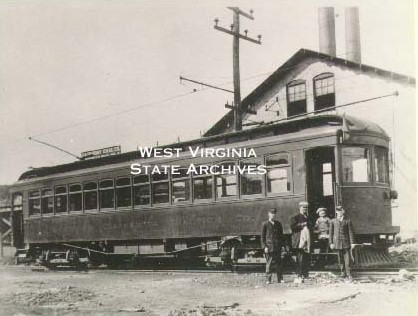
Fairmont and Clarksburg Traction Company streetcar in front of the Fairmont Coal Company Monongah Mine No. 8.jpg

Inside the mines:

“The farther into the mines the workers proceed the greater the destruction is found to be. Many side entries and rooms are completely blocked by falls of slate. One room where it was known two of the miners were working was entered but instead of finding the blackened bodies of the two miners tons and tons of slate were found burying them so that it will be several days before their bodies can be recovered. The same condition of affairs is reported at many other points in the mine.” (US Dept of Labor-mine disasters-Dispatch article)

Outside the mines:

“Finally, a horse came out of the hill and behind it a train of empty mine cars but the last car was loaded and covered with stained canvas and blankets. The coverings were thrown off and one by one the blackened and mutilated bodies of what had once been men were carried to the waiting wagons to be hauled over the bridge into the town and delivered to the undertakers.” (Forbes)

“They all looked as if they had been par-boiled, they were so red. Many of them were mutilated and in several cases the eyeballs had been split by the force of the explosion. The bodies were beginning to decompose.” (CET 12.10.07 pg. 6)

~2:00 pm

Col. J. H. McDermott arrives in Fairmont as representative of Gov. Dawson, who was unable to come to the scene of the Monongah disaster. Judge J.W. Mason and Clerk W.T. Black met him at the train station. (FWV 12.9.07 – pg. 1 – extra) (FWV 12.9.07 pg. 1)

“I am here to look over the situation,” said Col. McDermott, “and will advise Gov. Dawson from time to time what I learn. I am not here to interfere with any department of the mines, as each representative of every department will adhere strictly to his own work.” (WH 12.9.07 pg. 1)

“At the last meeting of the State legislature Col. McDermott, in his capacity as President of the Senate, appointed a committee to investigate the mines of West Virginia and the mine disasters. This committee had visited both the mines at which the explosion took place, about two months ago, and pronounced them as being as finely equipped and managed as any they had ever seen. It is quite probable that this same committee will arrive here shortly for another examination of the Monongah mines.” (WH 12.9.07 pg. 1)

At some point during the afternoon

In Fairmont:

“This town has some plucky girls, and it is a question as to whether their equal can be found. …Sunday there were 4 of them walked to Monongah, across the hill, taking all the near cuts and making the distance as short as possible. That’s game, that is.” (FWV 12.16.07 pg. )

“Headed by the churches, relief work was well started yesterday and a general appeal to the public is being made. Many West Virginia towns have already acted and others are ready to do so. The work will be thoroughly organized and systemized.” (ES 12.9.07 pg. 1-2)

“Relief corps were organized by the women of Fairmont today. Already hundreds of dollars are pouring in.” (WH 12.9.07 pg. 1)

In Morgantown:

Collections from all Morgantown churches are handed over to relief funds. (FWV 12.9.07 pg. ?)

At the morgue in Monongah:

“R.L. Cunningham, of Fairmont, who is one of the undertakers who have charge of the band of fifteen caring for the bodies brought out of the mines, preparing them for burial and placing them in coffins, met with an accident that has laid him up. While hurrying from the morgue in the First National Bank building on Main street to one of the branch morgues, he slipped and fell, spraining a weak knee joint so badly that he cannot walk. He is confined to his room in the Curry hotel under care of a physician and his work has devolved upon another undertaker. Messrs. W.G. Osborn and Sleppy & Warne, of this city, are still with the undertakers assisting in the work of taking care of the dead.” (CDT 12.8.07 pg. 1)
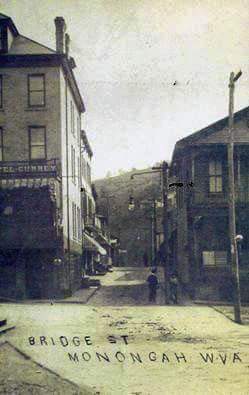
Intersection of Bridge St and Main street

At the cemeteries:

“About twenty victims were buried today in the three cemeteries near the town.” (AMJ 12.9.07 pg. 1)

“The bodies of fifteen Italians were buried in Holy Cross cemetery Sunday afternoon. The cemetery is located on the hill over the mines. The bodies of two Polanders were also buried the same afternoon in the Polish cemetery which is on the same hill adjoining Holy Cross cemetery. The bodies of two Polanders are lying in the Polish church where services will be held over them.” (CDT 12.9.07 xtra pg. 1) (CDT 12.9.07 xtra pg. 10)
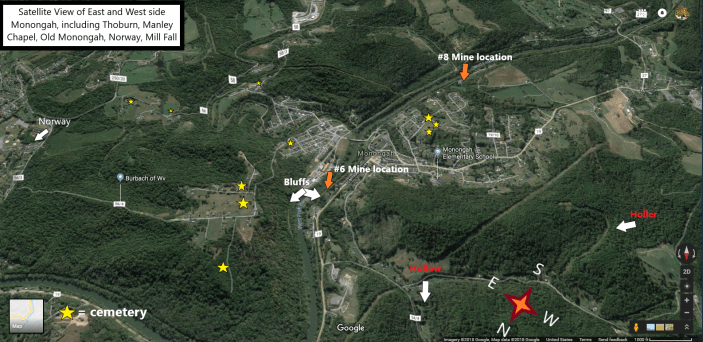
draft 1

In Monongah:

“Another woman, the mother of five little children, whose husband was killed in mine No. 8, became so distracted at her home that she began throwing household articles about the house and then to tear her clothing from her. She became so violent that friends had to tie her to a chair and stand watch over her until she became quieted.” (CDT 12.8.07 pg. 1)

“The body of Fred Rogers was taken to Fairchance Sunday afternoon and buried there.” (CDT 12.9.07 xtra pg. 1) (CDT 12.9.07 xtra pg. 10)

“…3 men who were thought to be victims but escaped are Ross Morka, Marie Bagenealla and Anebra Spaw. The 2 former went to Clarksburg to visit some friends early in the morning of the explosion but did not notify their boarding boss of their intentions. They were given a royal reception when they appeared today. Spaw, one of the men supposed to have been blown into the river at the entrance of No 6 was not at work that fateful morning. When he learned that his friends were mourning him as dead he lost no time in returning from a visit to Grafton.” (US Dept of Labor-mine disasters-Dispatch article)

At the mines:

“But 3 bodies have been removed from No 8 mine this afternoon, two being those of a motorman and a brakeman found near their car at the first left entry of the north heading near where the third body was found. All were badly burned about the face and hands but friends were able to recognize them at the morgue.” (US Dept of Labor-mine disasters-Dispatch article)

“A thrilling incident occurred on the bridge on which the mine cars were pulled from mine No. 8 in which an aged Polish woman nearly lost her life. Her only son, and the bread winner of the family, was killed in the awful explosion. She wandered out on the bridge and was climbing on some planks used as a temporary walk and was viewing the workers about the wreckage in front of the mine. Suddenly she staggered and fell. Several men ran to her side and caught her just as she was falling into the river. Friends carried her away in hysterics.” (CDT 12.8.07 pg. 1)
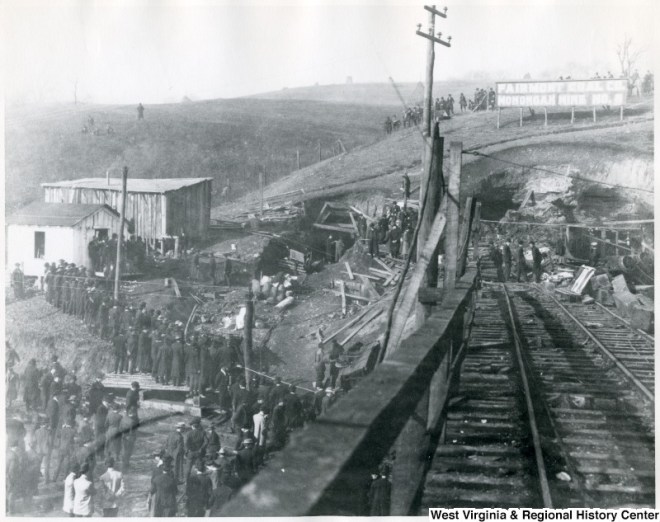
WVC 8

In McKeesport, PA:

Lester E. Trader and his brother are at their father’s home in McKeesport when General Manager Frank Haas “… called up and said he wants us to get back here. Frank and I couldn’t leave the company that way. I went back and they gave me a job in the auditor’s office in Clairmont.” (McAteer)

Victor told Trader that in return for being given an office and a job in the accounting department, he would be quoted as official spokesperson for company. (McAteer)
Trader - mine safety & health - ebook

In Fairmont:

The Union Relief Association is organized at the Methodist Protestant Temple for the purpose of receiving and distributing aid of all kinds to the stricken families in and about Monongah and is rapidly shaping plans through the various committees, to do the necessary work in a thoroughly business-like way. (FWV 12.9.07 pg. ?)

Collections from the morning’s church services are turned over to Mrs. Thomas W. Fleming, “who will see that it does the most possible good to lessen burdens that the grief-stricken ones are bearing.” (FWV 12.9.07 – pg. 1 – extra)

“Donations of money can be handed to any member of the following committee and receipt for the same will be sent to the donor by Mrs. Thomas W Fleming, chairman.”
12.9.07 - pg - Union relief organized - names detail 112.9.07 - pg - Union relief organized - names detail 212.9.07 - pg - Union relief organized - names detail 312.9.07 - pg - Union relief organized - names detail 4

~2:30 pm

Chief Mine Inspector J.W. Paul goes into #6 to inspect conditions. (McAteer)

“At both mines members of rescuing parties are being taken from the mines weakened and unconscious condition but after being out for a few hours they have fully recovered. None of the rescuers who have been overcome is now in serious condition.” (US Dept of Labor-mine disasters-Dispatch article)

At the morgue:

“One thing that is considered strange is that few things of value are being found among the effects of the dead. From information received from the company officials Coroner Amos was of opinion that large sums of money would be found in the clothes of the foreign miners and working upon this supposition a careful search was made of every garment removed from the body. It was known to be a custom of the foreigners to carry their money with them, but the most valuable article so far found was a silver watch in the pocket of Peter Alexander, who was removed to the morgue Sunday afternoon.” (CDT 12.9.07 pg. 1)

~3:00 pm

At #8:

“All Sunday until 3 o’clock in the afternoon, when the searching parties were ordered out so that the mine inspectors make a test and experiment with the new fan at No. 8, there were sixty men engaged in the work of recovering bodies and nearly a score were taken out during the day.” (CDT 12.9.07 xtra pg. 1) (CDT 12.9.07 xtra pg. 10)

*For the past 32 hours or so, all of the local mines owned by Fairmont Coal Company have been shut down and those miners have been reporting to Monongah for work. 2 small fans on loan from local smaller mines have been circulating air into #8. With rescue and recovery work now formally systemized under Inspector Paul and the other state inspectors and a plan to regularly change out volunteer crews, Fairmont Coal Company intends to restart regular work in their other local mines tomorrow.

*A replacement fan is currently is on its way from Pittsburg and scheduled to arrive on a special train around 4 pm. One of the fans is to be switched out and sent back to its original mine so that regular work may resume there tomorrow.

*Around 3 pm General Manager Frank Haas, who has been in charge of overseeing work at #8, begins to put their devised plan for switching out the fans into action. A majority but not all miners are ordered out of #8 just before one of the 2 fans is switched off. The outside crews are prepared to begin unmounting the fan from its temporary housing and get it across the trestle to the railroad line.

*Inside #8, small “hot spots” in explored and still unexplored areas of the mine (where coal is smoldering and radiating heat but there is not enough oxygen to ignite flame or smoke) become fully deprived of air. As the coal burns, it continues to release methane gases, but the air circulation is not powerful enough anymore to disperse or dilute these gases. Those who are permitted to remain in the mine during the fan switch are more than likely those who are working near or in the direct path of the 2nd fan which is not turned off.

*At #6, men are also ordered out at this time as the air current from #8 will likely push dangerous gases into the workings of #6.

“The work at No 6 progressed rapidly owing to the conditions of the powerful fan there, until the rescuers were ordered from the mine because of the temporary cessation at No 8.” (US Dept of Labor-mine disasters-Dispatch article)

“After the men were ordered to cease temporarily from the rescue work at No. 6 the opening was closed and late in the day the big new fan was set to work at No. 8. One reason for the ordering of the men out was the discovery of some gas at the connection of the two mines, and another was that it was the purpose to divert the air-course from No. 8 into No. 6, thus making it dangerous for men to work in No. 6. While this was going on a heavy guard was placed on the city side of the bridge running across the river to the tipple and no one was allowed to cross there, lest there might be a deadly current of air out of No. 6 at any moment.” (CDT 12.9.07 xtra pg. 1) (CDT 12.9.07 xtra pg. 10)

~4:00 pm

In Monongah:

The Company hires 3 Fairmont undertakers to manage the bulk of transporting the dead: Musgrove & Sons, R.I. Cunningham, and Jones & Co.; these 3 hire on 20 more undertakers from Fairmont and surrounding towns. (McAteer)

Unfortunately, the undertaker transport drivers are not very familiar with area of Monongah. Much confusion occurs over the next days in the transport of bodies to the correct homes. Priests will end up helping with most. (McAteer)

“The rapidity with which the remains began to be recovered late this afternoon and evening necessitated the coal company pressing into service a number of transfer wagons. These were filled with straw and the gruesome work of carting the charred remains across the river through the dense crowd began. Scenes that were sublimely pathetic transpired. The weeping of the bereaved ones as they madly chased after the vehicles was heartrending. They overwhelmed the morgue in their clamors for a look at the dead and it was necessary to drive them back by force and draw ropes across the main street. Pickets were stationed and the crowd thus held in check. It would only separate when the carriages of death were forced through to take the bodies to the cemeteries.” (US Dept of Labor-mine disasters-Dispatch article)

At #8:

*The anticipated 4 o’clock B&O special train arrives carrying very important materials for the rescue efforts and, more than likely, Paul U. Kellogg and several others who will become key figures over the next few days

“The victims at Monongah were working with open lamps on their caps; it was 2 days after the explosion before a supply of safety lights sufficient even for the exploring parties reached the mine.” (Forbes)

“A big mine fan, with auxiliary machinery arrived here on a special train from Pittsburg this afternoon at 4 o’clock, for use at the opening of Mine No. 8. Machinists and other workmen at once began work on installing it at the mine entrance and as soon as possible the machinery was in operation.” (CDT 12.8.07 pg. 1)

*When the train arrives, crews load the uninstalled fan onto an empty car or flat bed. The train pulls up slightly and crews unload the new fan and begin to haul it back across #8 trestle. The train continues on southbound to return the old fan to its proper mine in the Shinnston area.

*It takes approximately 45 minutes for this very experienced and driven crew to complete this task and get the fan running ventilation through #8 again. As far as Haas and the other onlooking reporters who may have known of this plan in advance, everything is going splendidly. Once ventilation has had some time to work its way through the mine, the state inspectors will perform the first formal fire and air check of #8.

“As soon as the fan was in operation the work of rescue was stopped at both Mine No. 6 and at Mine No. 8 for the purpose of testing the fan and ascertaining the result of the air current it would make.” (CDT 12.8.07 pg. 1)

*It does not take long for the new burst of air flowing through #8 to begin feeding these small “hot spots” throughout the mine. Smoke begins to fill the galleries and headings of the mine.

“New difficulties and complications have confronted the rescuers on every hand, but with only brief interruptions the work was continued until 3 o’clock yesterday afternoon. Then the fire drove all from the unexplored regions and the search had to be abandoned for the remainder of the day and for the night.” (TEW 12.9.07 pg. 7)


* = Author’s description of events. There is much conflicting information over the next 24 hours for several reasons and there will be an “Issues” post about this event and this author’s choices in the future. See ‘Dislaimer and Guide’ for more insight on this process.


More on How Death Gloated!

Bibliography

Disclaimer and Guide

Introduction

About the Author

Contact Information

Saturday, December 7, 1907, Early Afternoon – Dusk, 1:00 pm – 6:00 pm

12.9.07 - pg - Monongah 112.9.07 - pg - Monongah 212.9.07 - pg - Monongah 3

At the morgue:

“Nearly 400 coffins reached Monongah today from Pittsburg and from West Virginia cities.” (ES 12.7.07 pg. 1)

“Many coffins have arrived and more have been ordered and as fast as identification is made sure the bodies are being taken away by their friends for burial.” (FWV 12.7.07 – pg.1)

At the mines:

“The galleries are still filled with poisonous gases and it is impossible to open them till the main entries are opened and the fans can clear them.” (TBE 12.7.07 pg. 1)

“Working conditions are terrible, owing to gas and the wrecking, shifts can work less than an hour at a time.” (ES 12.7.07 pg. 1)

“While only sixteen bodies have been recovered or brought out of the mine, members of the rescuing parties stated that eighty bodies have been located.” (ES 12.7.07 pg. 1)

“Only sixteen of the dead bodies have been removed from the shaft entrance of No. 6, but 100 others are in the first level and are being kept in the mine until the authorities can get the half-crazed people away from the entrance.“ (TBE 12.7.07 pg. 1)

“Preparations are being made to bring the bodies from the mines in electric cars, with which the mines were equipped.” (WT 12.7.07 pg. 1)

“The rescuers in mine No. 6 report so many bodies that it will take hours to get them all out. In No 8 mine the rescuing parties are just getting started as poisonous gases there were worse than in No 6 mine.” (TEP 12.7.07 pg. 1)

~1:00 pm

At the mines:

“Up to 1 o’clock today but sixteen bodies have been brought to the surface…” (ES 12.7.07 pg. 1)

“A dozen undertakers are also in waiting in one of the buildings near the entrance to take charge of the bodies as soon as they are brought out and make them as presentable as possible.” (WT 12.7.07 pg. 1)

“A thousand men are working…” “About 130 corpses had been found in the wrecked Monongah mines here at 1 o’clock this afternoon.” (Pitt. Press. 12.7.07, Sparks)

In Monongah:

The body of Fred Cooper (one of first men found in the shanty of #6 mine) has been fully processed through the morgue and his body is brought into Fairmont on the one o’clock car. He is taken to his father-in-law’s home, Mr. Shingleton, at the corner of Locust Ave and 11th St. (FWV 12-7-07, pg. 1)

~1:30 pm

Clarksburg Daily Telegram puts out a special, extra edition:

The local newspapers are correcting their previously published information on the location of the mines. Though the Clarksburg Daily Telegram puts out far more accurate information now that they have their own reporters on the scene, their original source—the Associated Press—never corrects their original inaccurate information at any point and it continues to circle around the country for the next several weeks.

12.7.07 - pg 1 - #612.7.07 - pg 1 - #8

The results of just some of these inaccurate reports have already made their way back to Monongah. For the next several days, Watson and other officials will struggle with the press. They have little to no experience with mass swarms of reporters nor with managing a catastrophe of such magnitude. They will make several mistakes in their attempt to control the release of information over the next week, including the most devastating mistake of making it obvious to the press that information is being controlled.

12.01.07 - pg 1 - Xtra - sub-headline 212.7.07 - pg 1 - Xtra - watson telegram

Quietly tucked away on page 3 is an update on Sam Furk, reported leader of the local Black Hand, which would have taken front page status had the disaster in Monongah not occurred:

12.07.07 - pg 3 - Xtra - Furk Black Hand

~2:00 -2:30 pm

Inside #6:

Search parties find only 5 men between the bottom of the slope of #6 to the connection of the 2 mines – distance of about ¾ of a mile, over 4,000’. Only the main heading has proper ventilation and cleared wreckage that far back, but not the rest of the mines proper (rooms, hallways, etc.) where most of the victims surely lay. Ventilation systems “will have to be rebuilt throughout the mine” starting “this afternoon”.  (FWV 12.7.07 – pg.1)

4,000 feet into #6

“The resources are being reinforced as men are needed, so that as soon as one man is overcome his place is taken by another.” (FWV 12.7.07 – pg.1)

Though it is quite clear that the town is teaming with news reporters all day based on the sheer number of events accounted throughout the afternoon, few reporters managed to note the time of when certain events occurred. The best this author can provide at this moment is a list of these events in what is the most likely order in which they occur, trying to keep in mind that some of these may have been occurring simultaneously.

At some point during the afternoon,

“…with hysteria in all its devious forms rampant among the populace.” (RIA 12.7.7 pg. 1)

At the mines:

Several rescuers enter the mines “only to return to the open much more dead than alive.” (CDT 12.7.07 pg. 1)

“The first emergency hospital is crowded with men who have been overcome with the mine gas…” (FWV 12.7.07 – pg.1)

“The rescuers as they come out report that men to the right and left of them are lying all about the mine…” (FWV 12.7.07 – pg.1)

“A foreign woman whose husband was in the mine, rushed to the entrance but the gas forced her back. Realizing that she could do nothing toward aiding her husband, she tore the skin off her face with her finger nails and pulled out large twists of hair.” (WT 12.7.07 pg. 1)

At the morgue:

“The following bodies were identified in the morgue today: DOMINICK, who worked for John Preston. MIKE ____, also one of Preston’s men. FRANCISCO LORIA, who is horribly mangled. CARMO ZEVOLA, who was identified after some time by his [whole line of text is missing]. Much doubt existed in the authenticity of her identification but the small tobacco sack which he carried was the means of making the identification sure.” (FWV 12.7.07 – pg.1)

“Another body that has been positively identified is a man who is known as Louis, his other name not being known. Mr. Caldara says he is from Naples.” (FWV 12.7.07 – pg.1)

In Monongah:

Lorin Wise, brother of Charlie Wise, and Mabel & Edith Wise, his sisters, arrive from Canton, OH. (FWV 12.12.07 pg. 1)

A wagon load of bodies is trying to get from #6 mine across the Iron Bridge and to the morgue. Before it reaches the bridge, the crowd rushes the cart from all angles, pinning in and frightening the horses. The horses panic and bolt, racing through the crowd, overturning the cart, and dumping the bodies onto the ground before running over the embankment. The crazed horses continue down the river bank and run straight into the icy waters of the West Fork River, taking along the driver and his assistant. As the cart hits the water, the driver is violently thrown out and seriously injured. (McAteer)

“As the day advanced, [the widows] became almost crazed through grief and suspense. One pulled out her hair in handfuls at a time and another tore all the skin from both cheeks with her fingernails. Some lay down on the frozen ground and cried themselves asleep, and in this condition, many were carried to homes nearby without awakening.” (RIA 12.7.07 pg. 1)

“The company has provided clothing, food, and supplies for all who are in need and charity on every hand is being observed.” (CDT 12.7.07 pg. 1)

The body of a young man is brought to his home and placed inside. 2 hours later and one room away, his wife gives birth to their child. (FWV 12.9.07 – pg.8)

At the mines:

“The workers at both pits are being cheered and helped in their heroic task by the presence and good words of their bosses.” (FWV 12.7.07 – pg.1)

“Everything possible has been and is being done to recover the bodies of the dead miners and to take out any who might be alive. The coal company officials have given their best energies to the work and are yet grimly at work sleepless and hungry without thought of rest until all has been done to reach any miner possibly alive and to recover the bodies of the dead ones.” (CDT 12.7.07 pg. 1)

“Late today the deadly blackdamp became more pronounced as the more farther recesses of the mines were approached…” (DASB 12.8.07 pg. 1) (LODD 12.12.07 pg. 1)

ME46.JPG
History Inside Pictures (Radka)
At #8:

“One hundred men are working in mine No 8, where the damage was greatest…” (WT 12.7.07 pg. 1)

In Charleston, WV:

Gov. William M.O. Dawson calls out the National Guard: Company H of First Infantry under the direction of Col. M.M. Neely. Despite Watson’s telegram earlier in the day, the Governor is concerned about potential disturbances among immigrant families and the throngs of sightseers. (McAteer)

At #6:

“Some bodies have been brought to the mouth of #6 but have not yet been made known.” (FWV 12.7.07 – pg.1)

“In No. 6 there are 150 workers. Though the interior of this mine is not so badly damaged as the other, the gas in the tunnels is more troublesome, and it is necessary to come frequently to the surface for fresh air.” (WT 12.7.07 pg. 1)

“As the rescuers groping and dazed came from the mouth of the mine they were besieged by anxious ones and bringing no tidings or news of the unfortunate men below there were fresh outbursts of sobbing and cries of grief went up for their loved ones.” (CDT 12.7.07 pg. 1)

“Now and then rescuers came staggering forth, gasping for fresh breath but to hear from the women gathered near the pit renowned cries of distress and sorrow.” (CDT 12.7.07 pg. 1)

“And to add further to the mine horrors the wails and moans of the wives and daughters of the entombed miners were heartrending.” (CDT 12.7.07 pg. 1)

“In the great crowd one or two women would scream, perhaps faint, and be carried to their homes while the undertakers put the bodies in coffins and followed the bereaved ones to the little miners’ cottages. This scene was repeated again and again all day.” (TEP 12.7.07 pg. 1)

~4:00 pm

All saloons and bars in Marion county are closed by order of the mayors and the Marion county Sheriff and no liquor sales, anywhere, are permitted. “The saloon keepers willingly consented and will not open their places again until Monday.” (FWV 12.7.07 – pg.1)

As the main morgue in the bank overflows, bodies are taken directly from the mouth of mine to tent morgues at the cemetery or to church basements (McAteer)

If no ID has been made on a body within several hours, the dressed body is placed in a coffin and buried in the potter’s field as unknown.

“Foul gases in the No. 8 mine prevented any attempt at rescue until late this afternoon and even now it is impossible to make any headway. At this time the force of the explosion was so great that holes were blown through the side of the hill in several places along the river bank.” (TBE 12.7.07 pg. 1)

~5:00 pm

Newspapers are just beginning to hit the streets and stands. A majority will sell out within the hour.


More on How Death Gloated!

Bibliography

Disclaimer and Guide

Introduction

About the Author

Contact Information