

“The deaths of the three Morris brothers in the mine disaster wipes out a family of father, mother and 11 children with the exception of one small girl within the past ten years. The Morris family were former residents of Eldora and the sad incidents connected with their history are recalled by their neighbors and friends although there is but one member of the family left to relate the bereavement and she is most too young to remember all.
“Ten years ago, Mr. W. E. Morris and wife and 11 children settled at Eldora and there they lived happily for some time. Sickness of a pulmonary nature entered the family and soon the mother and six children were claimed within the course of a few years. One son was killed instantly while working in a coal mine on the Lowe farm, and last spring Mr. Morris contracted typhoid fever and died. For some time preceding his death Mr. Morris resided on the Harrison Manley farm above Monongah. Just four children were left out of the family of eleven and three of these, W.L., Cecil, and Marion met death together in the Monongah fatality. Mr. W.L. Morris leaves a wife, who was formerly a Miss Boone. His two younger brothers worked in the mines with him and resided at his home. The brothers were all found Monday night.” (CDT 12.11.07 pg. 1)
~12:00 am
At the mines:
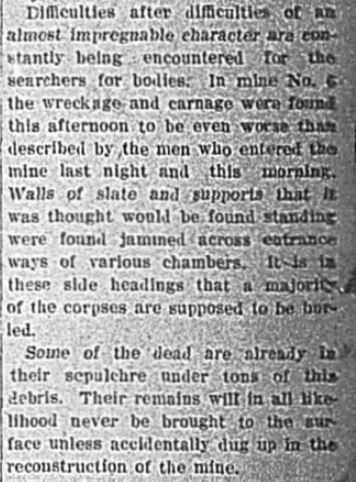
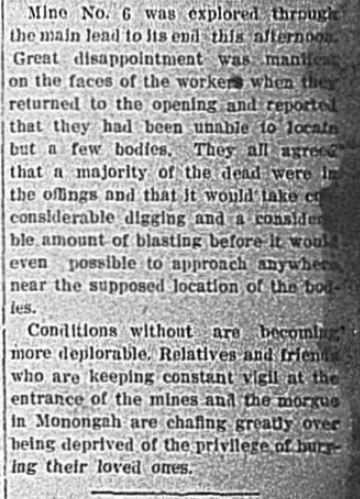
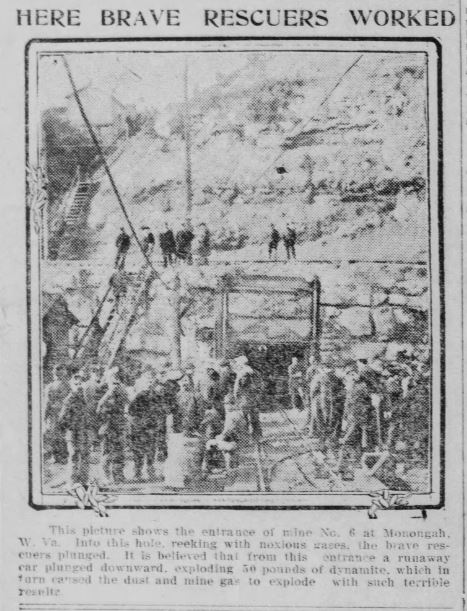
Rescue crews have been working around the clock for almost 6 days. Every section of the mines has been entered – no survivors found*.
“Much progress was made by the rescue parties yesterday, despite the rain, snow and mud.” (CET 12.11.07 pg. 1)
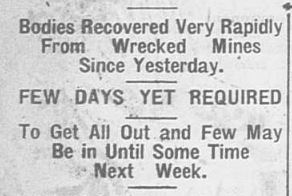
“At a late hour 142 bodies had been prepared for burial. Many more have been located and will be brought to the morgue today. If, as the mine owners declare, there were less than 400 victims, nearly half of the bodies have been recovered.” (CET 12.11.07 pg. 1)
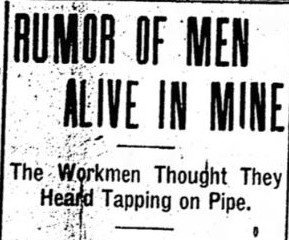
“There were reports last night that some of the miners entombed are yet living, but they are not generally believed. One workman claims to have heard knockings or raps in one section of a room cut off by debris. While it is believed he was mistaken, efforts are being redoubled to reach the spot.” (ES 12.11.07 pg. 1)
“The arrival of extra undertakers from Wheeling and the increase of morguers has lightened the work for those who have been on duty from the beginning.” (FWV 12.11.07 pg.1)
Water from the downpour rains and overflowing creeks have gotten into mines through the enlarged portals, fissures and toad holes.
~2:30 am
At #8:
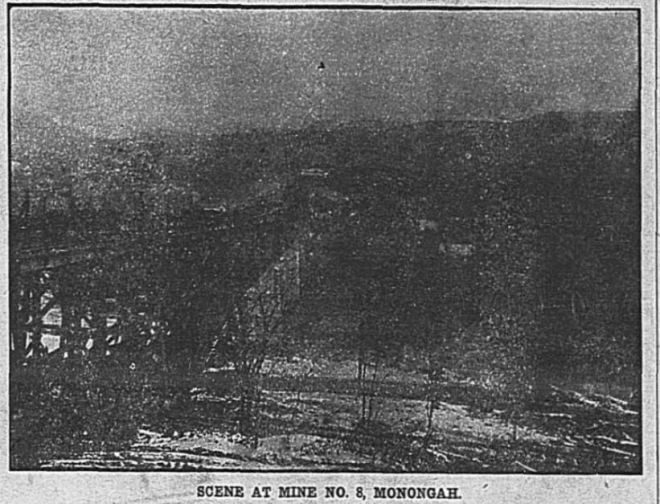
“The body of Thomas Killeen, one of the victims of the terrible mine disaster at Monongah, was recovered from Mine No 8 Wednesday morning at 2:30 o’clock. It will be brought to Clarksburg Thursday morning for burial. Killeen’s body was badly mangled; one side of the face being crushed and the abdomen was also crushed. The body was also scorched from the explosion. The body was taken to the morgue and identified and after it was prepared for burial it was removed to the home of the family in Monongah. Mr. Killeen was 43 years old and leaves a widow and five children. The oldest child’s name is Martin and he is about twelve years old. Mary and Kate are the next two older children. Killeen was a son of Patrick Killeen who makes his home with the family at Monongah and a brother of Martin Killeen. He was a brother-in-law of Patrick Martin of this city.” (CDT 12.11.07 pg. 1)
Through the night
Inside the mines:
“Horrible sights greet the working party.” (ES 12.11.07 pg. 1)
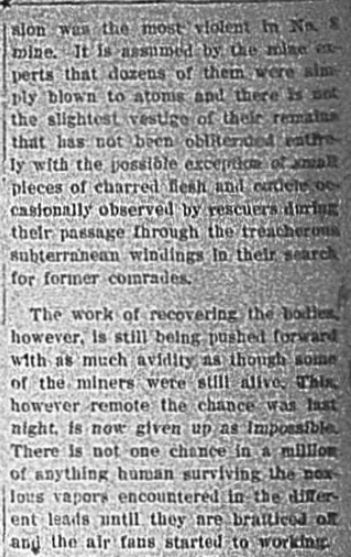
“In one room there were found two arms neatly severed from the body, of which there was not the slightest trace.” (ES 12.11.07 pg. 1)
“In other rooms are found missing limbs and a few heads.” (ES 12.11.07 pg. 1)
“One body was found seated with a lunch basket before it, while one arm was raised in the act of delivering a spoonful of beans to the mouth. Death came so quickly that the body grew instantly rigid in that position.” (ES 12.11.07 pg. 1)
At the morgue:
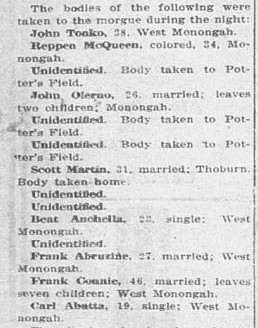
“Reports to the office of the Fairmont Coal Company here from mines Nos 6 and 8 at Monongah, the scene of last Friday’s death-dealing explosion, Wednesday morning state that the rescue work continued all last night and was without special feature or incident.” (GDS 12.13.07 pg. 4)
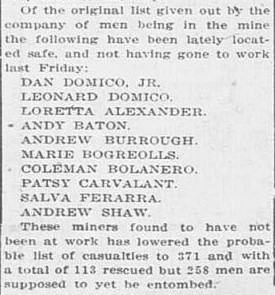
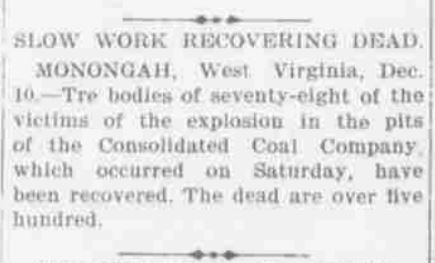
“A number of bodies brought out did not bear the brass checks used in the company’s system of records and accounts of a majority of its employees, thus sustaining the statements that a large number of men and boys in the mines were not included in the checking rolls on which estimates of the dead were largely based. There is reason to believe that the number will not fall short of 500.” (FCT 12.13.07 pg. 1)
In Monongah:
Rain and snow continue to fall, casting the entire valley in gloom. “The snow is quite welcome today after an experience with rain and mud for a day or two.” (FWV 12.11.07 pg. )
~6:00 am
“Most of the mines in the Fairmont and Clarksburg regions have a full run of empty cars for loading and the work has about resumed its normal condition. The independent mines are working although at some points all of the men are not back at work. The Fairmont Coal Company mines have resumed work except mine No. 2 and the ill-fated mines, Nos 6 and 8.” (CDT 12.11.07 pg. 1)
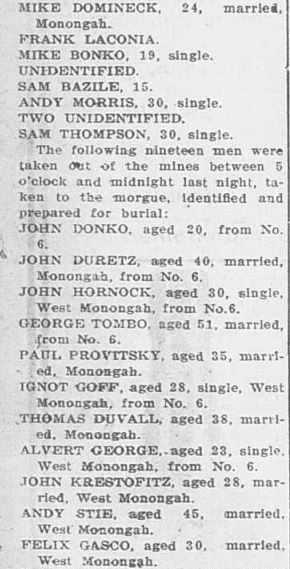
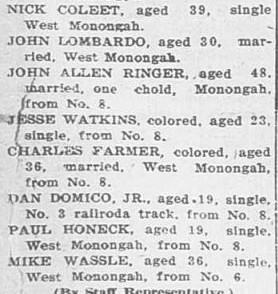
“When Wednesday’s force of rescuers went on duty there had been a total of 225 bodies taken out, most of which have been buried. Others were brought out in groups of two and three at short intervals.” (FCT 12.13.07 pg. 1)
In Monongah:
A number of men are sent up from New England and Gaston mines as well as about 20 miners from Frostburg to assist in the search work. (FWV 12.11.07 pg. 8)
“There are few people around today and this aids the men at work. The big crowds that rushed to the scenes were a hindrance to every part of the work.” (FWV 12.11.07 pg.1)
“Twenty-three bodies which were unidentified were buried in potter’s field. All the bodies were hauled to the cemetery in road wagons through mud. Fifty-five grave diggers are kept constantly busy.” (RP 12.11.07 pg. 1)
Inside the mines:
“A number of bodies were brought to the surface and others were located in the mine. The exact number recovered during the night has not been reported to the officers here.” (GDS 12.13.7 pg. 4)
South side of #8 has been entirely explored and all bodies from this section have been removed. Efforts shift to the North side to do the same. (FWV 12.11.07 pg.1)
“The carcasses of horses and mules in the mines will not be taken out but destroyed by the use of chemicals.” (CDT 12.11.07 pg. 1)

“Strange noises heard in the mine late last night gave some color to a report that there were living men in some part of the mine, but the workmen this morning found nothing.” (EJ 12.11.07 pg. 7)
At the morgue:
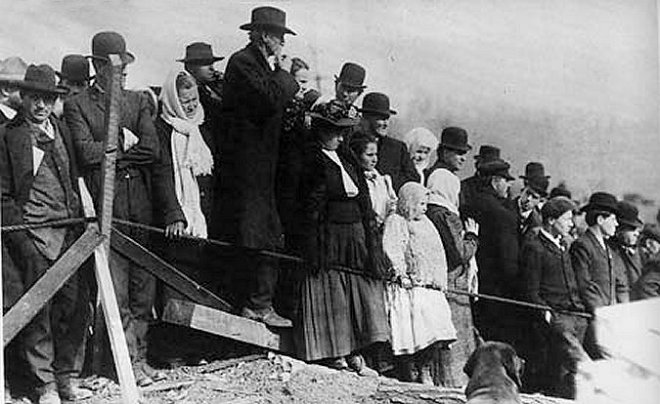
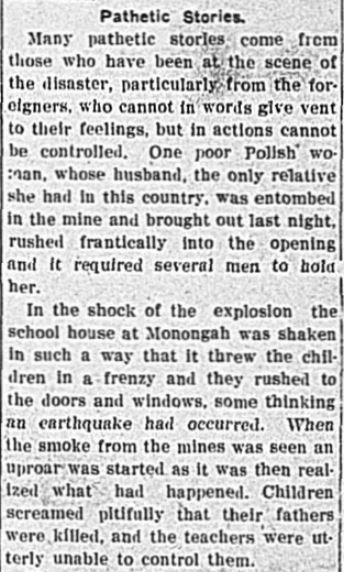
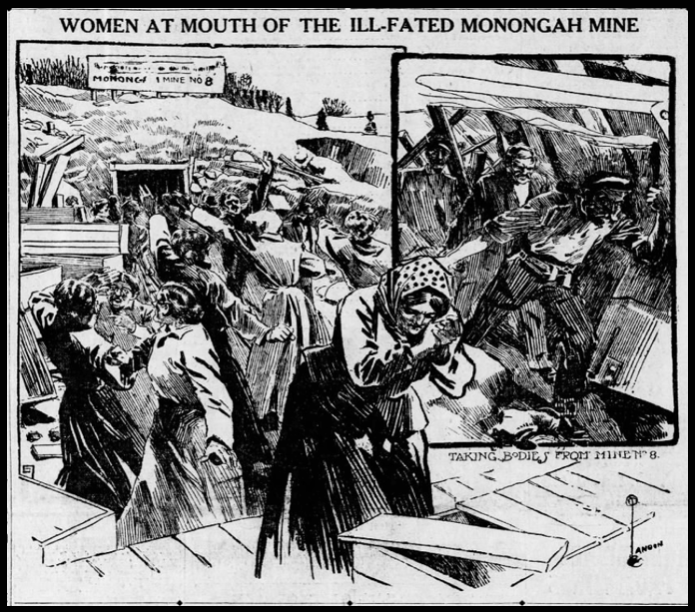
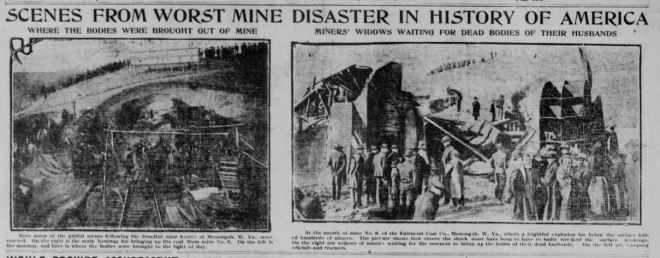
“At the morgue the scenes are pathetic. Many relatives wait about—in fact, many have stationed themselves in front of the door—hoping every dead cart will bring the body of the missing one who was so dear to them. In the driving snow and rain little parties of Slavs and Italians, among the women and small children, stood for hours. One at a time the crowds dwindled down as bodies were identified and sent on to one of the man’s forlorn homes.” (CET 12.11.07 pg. 1)
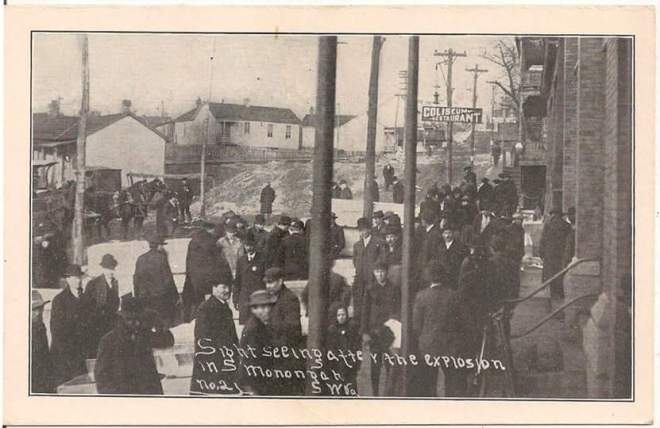
“Inside the deadhouse the undertakers worked as rapidly as possible and when six or seven bodies were brought in at a time their systematic work was wonderful to see. Even while the embalmers worked on the bodies other men were searching the pockets of the victims clothing for trinkets, valuables and marks of identification.” (CET 12.11.07 pg. 1)
“Nothing, no matter how insignificant, escaped the notice of the men who examined the clothing. Every little trinket was stored away and many strange things have been collected. In the collection are false teeth, whipstocks, pipes, whistles, old coins, all sorts of strange looking knives and about every kind of trinket poor people could have.” (CET 12.11.07 pg. 1)
“In the pocket of an unknown man a match box containing 13 matches was found. When they were counted there was significant silence.” (CET 12.11.07 pg. 1)
~9:00 am
In Fairmont:
The local German Beneficial Union announces it will cancel the 90-day clause of their contract and “will pay the policies taken out by men who were killed in the mine disaster immediately.” (FWV 12.11.07 pg. )
In Clarksburg:
“With his strength about exhausted, William G Osborn, of the Clifford-Osborn undertaking firm, returned Wednesday morning from the scene of the Monongah mine disaster where he had been at work almost continually since last Friday assisting in preparing the dead for burial. From Thursday night last until Wednesday morning he had but five or six hours of sleep. After resting up he will return to Monongah and help the other undertakers.” (CDT 12.11.07 pg. 1)
In Monongah:
“The scene at Monongah today is but a repetition of the scenes of Monday and Tuesday except that the bodies are being brought out at shorter intervals today.” (FWV 12.11.07 pg.1)
“Over fifty funerals were held Wednesday.” (FCT 12.13.07 pg. 1, McAteer)
“On each casket there was a bunch of American Beauty roses or white carnations. Miss Elizabeth Watson, daughter of S.L. Watson, treasurer of the coal company, sent them.” (FCT 12.13.07 pg. 1)

Rev. Father McEligott of Grafton is here giving words of comfort to the distressed and helping in any way that he can. (FWV 12.11.07 pg.1)
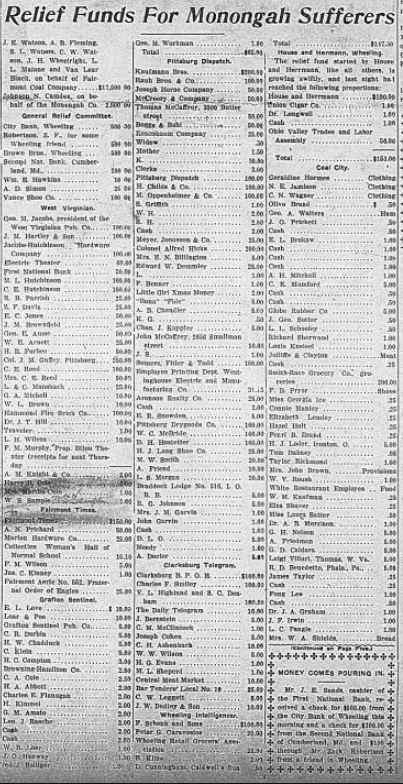
“The relief work is progressing in a satisfactory manner. A dozen relief stations are now in operation and supplies of all kinds are coming in rapidly and being as quickly disbursed.” (ES 12.11.07 pg. 1)
The company doctors are assigned to deal with shock among the widows. (McAteer)
“One Italian, whose body had not been found, is said to have had $300 in his possession when he left home.” (CET 12.11.07 pg. 1)
Inside the mines:
“The installation of additional fans has much improved the ventilation.” (ES 12.11.07 pg. 1)
“In the caverns penetrated today conditions were found to be much better. There was an absence of gas and the deadly black damp to interfere with the searchers and the wreckage was not so great.” (ES 12.11.07 pg. 1)
“Members of the rescuing party stated that the average conditions of the bodies recovered is bad, heads being blown off, arms and legs broken and twisted, and fine pieces of coal imbedded in the bodies showing the terrific force of the explosion.” (PES 12.11.07 pg. 8)
~10:30 am
In Clarksburg:
“The body of Leslie Spragg, one of the victims of the mine disaster at Monongah, was brought to this city from that place on the 10:30 o’clock interurban trolley car Wednesday morning and buried in Holy Cross cemetery after services were held over it at the Church of the Immaculate Conception.
“Spragg’s body was recovered Tuesday night from Mine No 8 and after being taken to the morgue, prepared for burial and identified, was taken in charge by relatives and removed to the home of the family at Monongah and from there it was brought to Clarksburg. The body was burned from the explosion but not mangled.
“The dead man leaves a wife and two children. He formerly resided in Clarksburg but at the time of the disaster was making his home at Monongah. He was a son-in-law of John Hyland, of Monongah, who also resided here formerly, and was 32 years old.” (CDT 12.11.07 pg. 1)
In Fairmont:
“Telegraphic service at Fairmont has been under a heavy strain the last week. Monongah has no telegraph office and the fifty correspondents on the scene have to go to Fairmont, eight miles distant, where they file their copy. The Western Union is the only services here, the local manager being Mr. W.T. McWhorter. Under ordinary circumstances there is only one operator, but five extra men have been at work day and night. Over 150,000 words have been sent out. There is appreciation among the newspaper men of the promptness with which their copy was handled by the Fairmont office.” (ES 12.11.07 pg. 1 – 2)
In Monongah:
“The excitement of the first few days…has about subsided and the situation has settled down into a steady systematic search for the bodies of victims.” (ES 12.11.07 pg. 1)
At the mines:
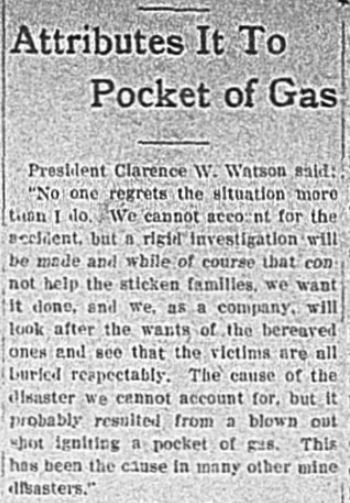
“The officials of the Fairmont Coal Company have been constantly on the scene working as hard as the men with shovels and picks. In many instances they have gone thirty-six hours at a stretch without sleep, while President Watson and Vice President Wheelwright have been on duty day and night. Mr. Wheelwright, clad in a miner’s togs, with rubber coat, boots and hat, was out in the rain nearly all day.” (ES 12.11.07 pg. 1)


“Two men who have rendered good service are Messrs. T.H. Bennett and J.R. Buckingham, who have handled a vast volume of detail associated with the direction of the rescue work.” (ES 12.11.07 pg. 1)
“Large pumps arrived at the mines from Pittsburg and were installed to remove water that had gotten into the mine from the river. The fires which at first threatened, and for a time did stop the work of rescue, have been controlled by shutting off the supply of air in the burning portions of the mines. However, all danger of further explosions is not past and no attempt will be made to reopen these sections of the mine until it is definitely ascertained that the fire had been extinguished.” (ES 12.11.07 pg. 2)
At the morgue:
“Although the bodies that are now being found are not so badly mangled or decomposed as the ones found in the main heading, they are not kept at the morgue long. Just as soon as the bodies are embalmed, they are sent to the room, where relatives of missing men can see the for the purpose of identification. If not claimed or identified they are hurried to the graveyard as known.” (CET 12.11.07 pg. 1)
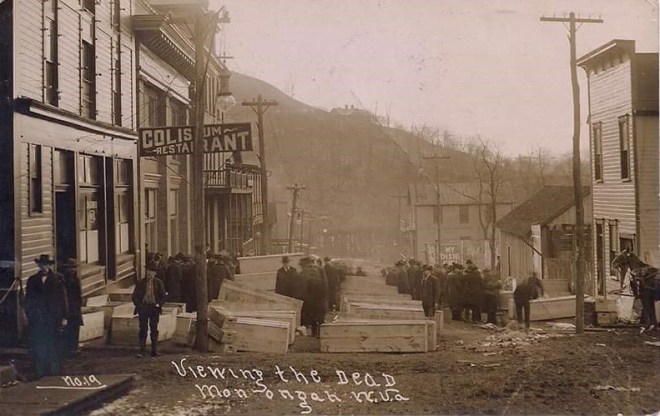
*= Technically, one more survivor was found: John Tomko. John was found alive and responsive in #8 and fought off his rescuers, similar to Peter Urban. Though he was alive on his way out of the mine, he did not survive to make it to the surface. John’s brother, George Tomko was found “nearby”, but already deceased. George is body #56, John is processed through the morgue during the early hours of today and is listed as body #114. As of now, the Tomkos have not been included in this timeline as the entire timeline of their events is very unclear. The Tomkos will be discussed later in an “Issues” post in an effort to troubleshoot this event and try to get a more clear understanding of John’s experience.
More on How Death Gloated!













 The Monongah Disaster