

“Over the heartrending protests of the widowed and orphaned, it has been necessary for the authorities to act to preserve the health of the living and orders for immediate burial of the victims has been issued. The only exception will be in cases of bodies that are fully preserved and can be embalmed. These will be taken care of and taken to the morgues for identification. Failing this, all will be buried in the common grave…”
(WT 12.9.07 pg. 5)
~8:00 am
In Fairmont:
Lawrence E Sands sends a message from Wheeling that “citizens of city are planning a relief fund for Monongah…thinks Wheeling will contribute at least $1,000.” (FWV 12.9.07 pg.8)
In Monongah:
“The fourth day was a repetition of its three predecessors in the matter of pathetic scenes. Hundreds of women remained near the mines all day screaming and crying until they almost collapsed. As on former days hot coffee was served at intervals by the company to keep the unfortunate women from falling to the ground from exhaustion.” (News)
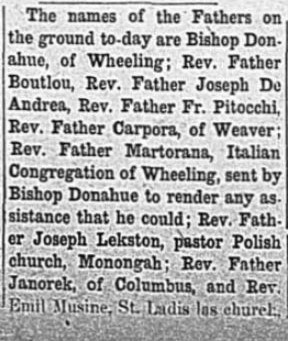
Bishop P.J. Donahue arrives by train from Wheeling joined by St. Peter’s of Fairmont priest Father Arsenius Boutou to assist the Monongah priests, Father Joseph Lekston & Father Joseph D’Andrea. Both Lekston and D’Andrea have been working nonstop since Friday and are close to exhaustion.
Father Joseph D’Andrea has also lost his brother, Victor D’Andrea, in the disaster. Victor was a father of 3 and his wife is 6 months pregnant. D’Andrea had worked for 3 days and nights, never stopping to sleep or bathe, continuously ministering to the bereaved and guiding coffin carts to correct homes.
The priests did services in the mornings and visited with families in the evenings.
Priests on the scene:
At the mines:
“The work of rescuing bodies was resumed this morning…”
52 bodies have been recovered and the remains of 43 have been identified. (FWV 12.9.07 – pg. 1 – extra)
“Most of the bodies found have been those of foreigners and nearly all have been identified by their pay checks. [Th]ree large fans are pumping air into the mines and a pipe line 2.500 feet long was put in on the advice of Chief State Mine Inspector Paul as a precaution against fires.” (CET 12.10.07 pg. 1)
Weekend crowds and sightseers are gone. Only somber groups of men—relief workers, explorers, brothers and men waiting their turn to go in—remained around mines.
At the churches in Monongah:
Church basements became make-shift funeral parlors.
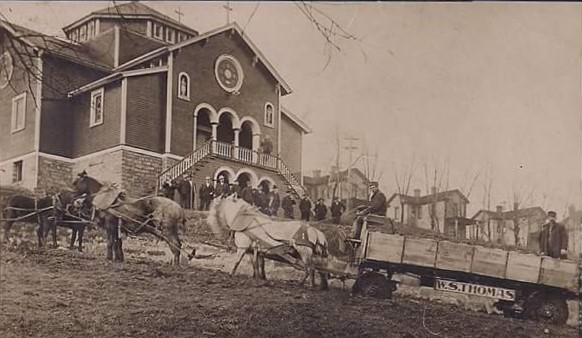
Many came early to the Polish Catholic church, St. Stanislaus, “…a-foot, with bowed heads, sorrowing in low voices, sometimes a woman half held up by her companions, to that basement where the coffin lids closed in on blistered, swollen faces and parts of men.” (Kellogg)
“4 or 5 widows wept compulsively.” (Kellogg)
“An older woman read from a religious book held to the flickering light of a candle at the head of a closed coffin.” (Kellogg)
“A peasant, ugly with her pitted face, but beautiful in her great sorrow, bent often and kissed the lips of her husband.” (Kellogg)
“All of a sudden there was cry more piercing than the others. It was from an older mother who has lost 7—her husband, a son, 2 sons in law, and 3 nephews. She had come upon one of them, and the people with her could scarcely hold her. She threw her head on the casket and spoke to the boy fondly, trying to caress the crumpled face with poor, wrinkled hands. She had moaned all the way that morning from her lonely house to the church door, giving infinite sorrow to those who heard, and here her grief at last found vent.” (Kellogg)

~8:30 am

~9:00 am
The court of inquiry convenes in Monongah. (FWV 12.10.07 pg. 1)
“Coroner E.S. Amos, of Fairmont, is personally engaged in looking after the identification of bodies and is having a complete list kept, as well as recording the circumstances of identification and the disposition of the bodies. In this he is ably assisted by the several undertakers of this town, Fairmont and Clarksburg and other places. The jury organized by him will meet in Fairmont this morning at 9 o’clock to begin its work of investigation. Such representative men as W.S. Hamilton, Festus Downs, and W.E. Codray are members of the jury. Their work it is announced will be thorough and complete.”
The jury with Coroner Amos and Prosecuting Att. Scott C. Lowe went to No 8 and then visited No 6.
At the morgue:
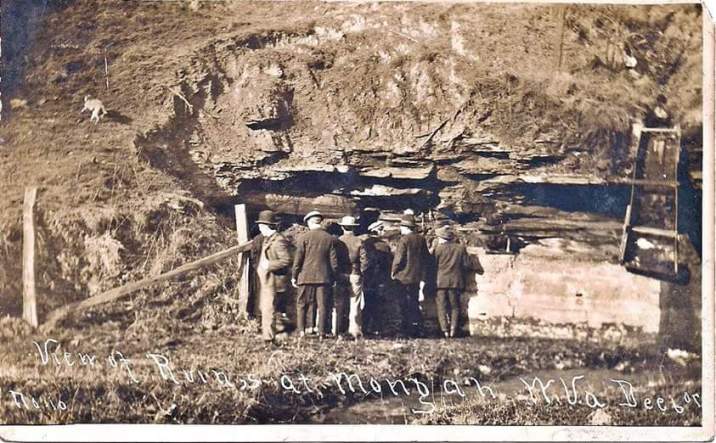
“There is no more room in the morgue and the bodies are prepared at the mouth of the mine for burial.” (CET 12.9.07 pg. 1)
“In the case of complete identification, the bodies, after being viewed by the coroner and jury, are not held, pending further action of the coroner, as it is established, they all came out of the mine and met death by the same cause.” (CDT 12.9.07 xtra pg. 1) (CDT 12.9.07 xtra pg. 10)
Widows and family members were permitted “ample time” to view the bodies and attempt to ID them, but the time allotted for the body to be identified has been drastically diminished since the decision of the Marion County Health Board last night.
“After the identification of the bodies and they are claimed by friends, Coroner Amos holds the inquest and permits the relatives to remove them to their homes. The bodies of all Polish miners are being removed to the Polish church just above Monongah as fast as they are identified and are being placed in the basement of that edifice.” (US Dept of Labor-mine disasters-Dispatch article)
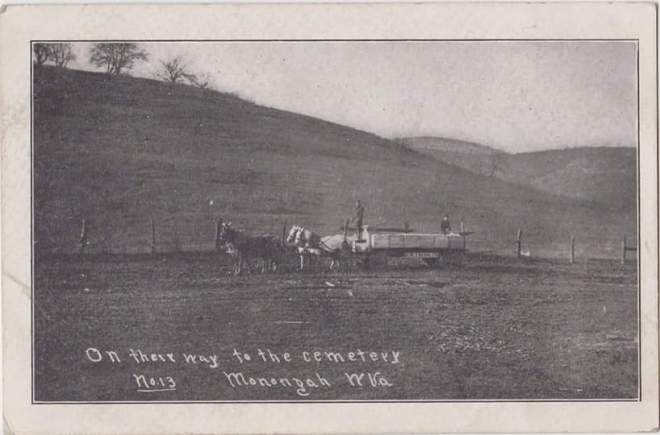
When ID is not possible, the body is taken directly from the mine entrance to the graveyard and buried immediately.
“Work of burying the dead that have been taken from the mines is in progress and because of the many bodies they have to be interred with dispatch and little ceremony.” (CDT 12.9.07 xtra pg. 1) (CDT 12.9.07 xtra pg. 10)
In Fairmont:
“All organizations in the city are taking steps to institute relief measures” (FWV 12.9.07 pg.8)
In Clarksburg:
“The body of Patrick McDonough, the miner who was killed in the Monongah disaster, was brought to this city Monday morning on the 9 o’clock interurban car. Funeral services were held at 9:30 o’clock at the Catholic church and interment was made in Holy Cross cemetery. McDonough was a brother-in-law of Pat Connell and Thomas Gill.” (CDT 12.9.07 pg. 1)
The remains of Patrick McDonough were taken to Clarksburg. Patrick is brother of townsman, Policeman Anthony McDonough. (FWV 12.9.07 pg. 1)
At the mines:
Miners linger outside waiting to go into the mines. “The knot of silent mine workers in boots and corduroys and overalls could be made out from the rim of the bluff…; and at its edge sat in heavier silence a group of shawled women, waiting. Behind them ran a little street, thick in mud, with domino shaped stepping stones at the crossways with colorless little houses and propped walks and here and there dove-cotes nailed under the eaves or reared on poles.” (Kellogg)
“The body of W.H. Byse will be taken to Roane county Monday for burial there.” (CDT 12.9.07 xtra pg. 1)
“Quite a number of Clarksburgers attended the funeral of John Howard Preston, at Monongah, Monday. Preston was a victim of the horrible mine disaster which occurred at Monongah Friday.” (TA 12.12.07 pg. 2)
“In the town families were mourning inconsolably the death or absence of a loved one and on all sides were little groups of weeping women and children. Thousands of strangers thronged the streets all day. They came from towns and country within a radius of many miles and by every means of travel.” (RP 12.9.07 pg. 2)
Some 30 – 40 funerals are performed throughout the day. “They were merely repetitions of those of Sunday, the crowds being almost as large and the scenes and incidents just as distressing.” (ES 12.10.07 pg. 1)
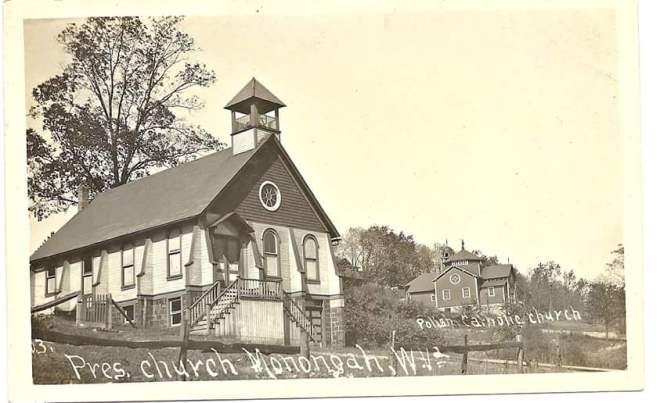
A majority of today’s funerals are held in the little Polish Catholic Church located between the two mines. 5 priests directed funerals.
Father Boutlou held short funeral services for the Irish Catholics. (FWV 12.9.07 pg. 1)
“Services were held over several of the bodies at one time.” (CDT 12.9.07 pg. 1)
“The people gathered above, the men on one side and the women on the other, as is the custom in the Polish church. The candles of the little altar lit up the chapel as they had done on other Sundays and the familiar intonations of the mass brought a brooding quiet. Then the priest addressed his people in Polish and with his first words, they began to weep aloud.” (Kellogg)
A service preached by Rev. Father Emil Musine, of St. Ladis Las Church of Wheeling was of “a very effective discourse. Sobs and wails went up from the wives and children of the unfortunate. After Father Emil Musine’s sermon Bishop Donahue of Wheeling spoke words of consolation promising relief to the orphans.” (FWV 12.9.07 pg. 1)
In English, Bishop Donahue told the congregants that he empathized with them and how much “the whole world laments” the terrible disaster which “robbed them” of their loved ones. He concluded in assuring that he would do his “utmost” to help the people and if any of them found that they could not support their children that he would see that they “all were sent to orphanages” where they “would be well cared for”. For those who could not understand his words, they were soon told by their fellow congregants that could. Though his words “cheered” them to a degree, there was not a single woman in the church “who would part with a child, no matter how many she had, even if the pangs of starvation tempted her.” (CET 12.10.07 pg. 1)
“Outside, an Italian laborer offered his services for carrying the dead to the church yard. He spoke to a Slovak and said that everyone is the brother of the other, no matter what nationality he belongs to. He said it in broken English.” (Kellogg)
“The ministers refrained from making any reference to the catastrophe and the commitment services at the graveyard were as short as possible. There were no carriages and no flowers. The caskets were hauled for the most part in undertakers’ wagons. Large crowds of pedestrians followed and the church was crowded almost to suffocation. Several of the services were interrupted by women fainting, causing momentary excitement, but this was soon dispelled.” (RP 12.9.07 pg. 2)
~10:00 am
“Up to 10 o’clock the list stood at 53.” (OTC 12.10.07 pg. 1)
At the morgue:
The temporary morgue inside the First National Bank is getting overwhelmed; coffins and bodies begin lining the streets in front of the bank.
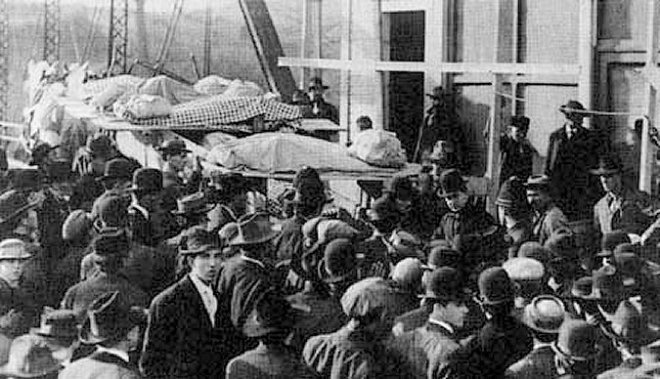
On the west side of Monongah:
The National Guard, called in by Governor Dawson, arrives and sets up on the north side of the Italian side of the largest graveyard. (McAteer)
They set up their large white tents in typical military fashion with graves in front, resembling military trenches.
These tents will act as a secondary morgue and will serve the needs of the gravediggers.
“Captain M.M. Neely furnished a big tent that has been pitched near the Catholic church. The tent is being used for the Italian morgue. The bodies are first identified at the morgue proper and are then taken to the tent. So far there has been a change in the name of one man.” (FWV 12.9.07 pg. 1)

On the east side of Monongah:
Paul Kellogg has wandered over to the corner of Main street, where the morgue has begun to lay coffins with prepared bodies out for identification. “At the end of the street were store buildings, and the Italian woman who kept one had let them leave a coffin box on her steps until the right household should be found.” Kellogg talks with this woman at length. “Standing at the head of the street, she pointed out with stretched finger the houses in a row on the bluff where the shawled women sat and waited…and she raised and lowered her arm in a counting of the houses, one after another.” She describes the condition inside several houses where losses have been felt:
Of the man and 7 boarders killed at house No 151— “All married. Old country. No see ‘tall, no see. He can’ find. All burn.”
“Woman cry all time,” she said of another house with three boys killed. (Kellogg)
“A hearse drove up to the corner house and the driver beckoned to me and to a workman who had come up. There was a coffin to be taken away and he needed help lifting it. The women had to be pushed back while he worked at closing the lid. Their cries rose and fell in that half unison of Slavic people which makes almost a ritual sobbing. The wife stood on the porch as they drove off; bare armed, stupid in her loss, her face knotted with two little, open-mouthed children whimpering and plucking at her apron and behind them a grandmother.
“A little red-cheeked Irish boy had poked his way into the Slavic house as they lifted the body out. He was going for the doctor, he said; the baby had been sick all night. ‘Got heem pap yet?’ asked the Italian woman. ‘Nope,’ said the boy.” (Kellogg)
“Across the street the tears were running down the face of the Italian storekeeper and she was giving herself up to the impetuous crying of her race.” (Kellogg)
~11:00 am
In Columbus, Ohio, Governor Andrew Harris has “ordered the chief state mine inspector, Harrison and deputies to Monongah, to make a careful investigation of the circumstance surrounding the explosion there. The information secured will be applied to correcting any shortcoming in Ohio mines. Inspector Harrison left for Monongah today.” (RP 12.9.07 pg. 2)
“It is a low estimate to say that the recovery of the bodies of the victims of the mine explosion will cost the coal company at least $75,000 and possibly a great deal more. But this is an item the company has not even thought of and it will spare no effort or money to recover every body from the mine.” (CDT 12.9.07 xtra pg. 1)
“The property loss will be very heavy, as the artificial interior work of the two mines was entirely destroyed to the extent of the tracks being torn all to pieces in the mine No. 8 especially where the rails broke and curled themselves up into rings.” (CDT 12.9.07 xtra pg. 1)
“Not taking the loss of life into consideration and the out lay that may result from that, the company’s loss will reach at least a quarter a million dollars, and, unless No 8 can be saved from fire, the loss will reach many millions.” (CDT 12.9.07 xtra pg. 1)
“The task of taking out bodies from Nos 6 and 8 mines will not be completed before the end of the week. Sixty-six bodies have been taken out of the mine heading of No. 6 at 11 o’clock. It is still impossible to reach many in the rooms leading off from way headings, owing to afterdamp which continues there.” (CET 12.9.07 pg. 1)
In Monongah:
“No more touching spectacle could possibly be witnessed by human eyes than to see the bereaved women and children of Monongah walking the streets wringing their hands and crying grief for loved ones…” (FWV 12.9.07 – pg. 7)
Women wander the streets aimlessly, wailing in the pouring rain. (Scalabrinians)
“Two Slav women, with big boned grief wrenched faces, were walking up and down the street, going nowhere. They wore great shawls, and diagonally across their breasts were the papoose-like bodies of their babies, wrapped in with a knack which is handed down by the mother wit of the old country.” (Kellogg)
“Part way along an angling road, lined with older company houses, I came upon a woman of perhaps 55 and her daughter. They walked spiritlessly as if climbing a long hill. 5 other daughters and a son’s wife were waiting for them in a house beyond, –8 women and 2 men gone. These were West Virginians, I took it; at least they had seen the settlement grow up about the mines and knew its people as only villagers do. What were just door steps and dull windows to me, were individualized to them…the mother counted them off as we went.” (Kellogg)
“Farther on was a little 5-year-old girl, playing by the fence. ‘We’ve got two dead in our house,’ she said, smiling.” (Kellogg)

More on How Death Gloated!
 The Monongah Disaster