

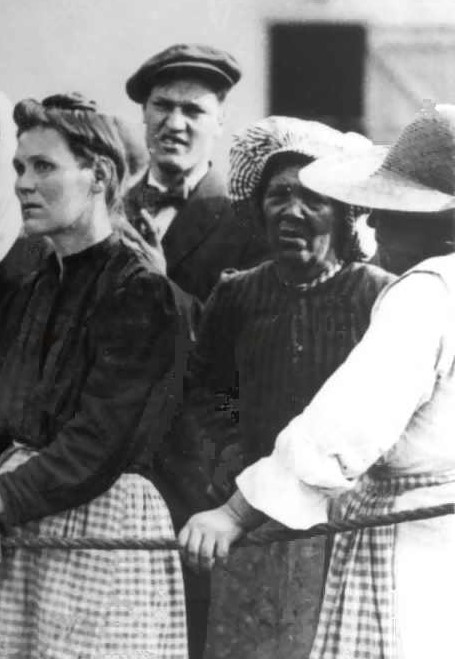
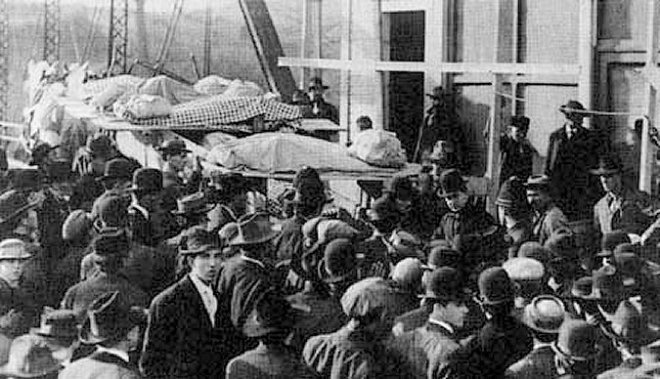
“No accident in the entire history of coal mining in America compares with this holocaust. It would be hard to picture a more complete scene of sorrow and desolation than that about the pit mouth. Everywhere are the blown and broken timbers, everywhere the blackened wreckage, showing the fearful force of the explosion. And over the wailing, desolate women and the gaunt, hard featured men working about the ruins, the black smoke hangs like a pall.” (TLA 12.12.07 pg. 1)
~Noon
“Governor Dawson today announced that he will personally attend the inquiry…” (CDT 12.12.07 pg. 1)
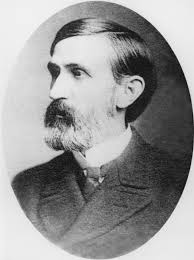
In Monongah:
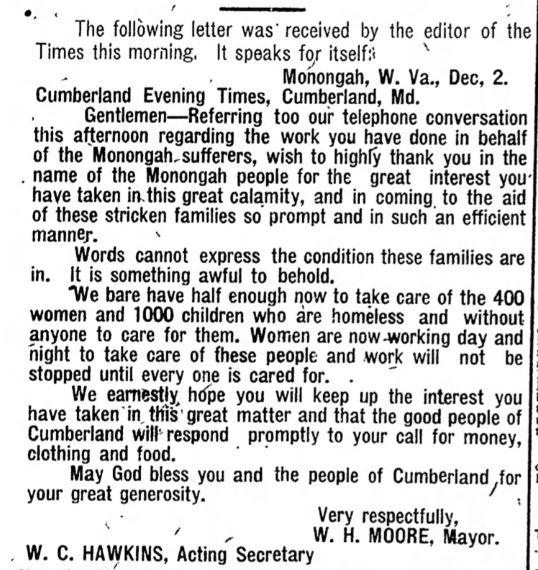
At the mines:
“Two hundred and eighty-five bodies were recovered at noon from the Monongah mines and twenty-five more were ready to be brought to the surface.” (CDT 12.12.07 pg. 1)
“Up to noon today 285 bodies had been recovered from the Monongah mines. They are being brought out more rapidly now and many more will have been recovered by night.” (ES 12.12.07 pg. 2)
“More than 400 bodies, it is expected, will have been recovered by Saturday night, by which time the rescuers hope to have found every body.” (ES 12.12.07 pg. 2)
2:22 pm
In Monongah:
The body of Timothy Lyden was taken from the morgue “to his home at Monongah to remain three hours and at 2:22 this afternoon accompanied by relatives and friends it was shipped to [Clarksburg] for burial.” (CDT 12.12.07 pg. 4)
“Mr. Lyden’s body will be at the home of his mother, Mrs. Ellen Lyden, on Jackson street tonight and until 10 o’clock tomorrow morning, when it will be taken to the Catholic church where funeral services will be held and interment will be in Holy Cross cemetery.” (CDT 12.12.07 pg. 4)
During the Afternoon
In Pittsburgh:
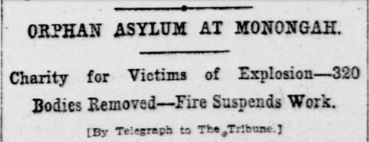
“Officials of the coal company were in Pittsburgh this afternoon, conferring with those familiar with hospital maintenance, and it is understood that $50,000 will be spent by the coal company in erecting a suitable orphan asylum building. After it is finished, the children will be taken care of and educated. It is understood that certain wealthy men have expressed a desire to assist in endowing such an asylum, making it permanent for use of orphans of those who lose their lives in the mines of the company.” (WH 12.13.07 pg. 1)
“A woman’s sympathetic heart coupled with her ability to accomplish her purposes has solved the distressing problem of the thousand children who have been made orphans by the mine explosion at Monongah, in which several hundred lives went out. The woman is Mrs. Clarence W. Watson [Minnie Owings Watson], wife of the president of the Fairmont Coal Company which owns the property in which the calamity happened. She is a social leader in Baltimore and New York, but since the explosion she has demonstrated that she can be notable for other things besides driving fine horses for prizes in show rings and planning cotillons. Acting on Mrs. Watson’s suggestion her husband came to Pittsburg today to make contracts for the erection of a $50,000 asylum for the homeless little ones at Monongah. Mr. Watson said that it was the one practical suggestion which had come to him or any of the members of the Fairmont Company.” (RP 12.14.07 pg. 4)
“Mrs. Watson took a prominent part at this season’s horse show in New York. She was a prize winner, carrying off ribbons with her famous Lord Baltimore and My Maryland. Lord Baltimore is considered one of the finest harness horses in America. Mrs. Watson and her millionaire husband carried off several prizes with them in the international show in London.” (RP 12.14.07 pg. 4)
“Bishop Donoghue, of the Wheeling district has been at Monongah leading in the relief work, and Mrs. Watson has been, perhaps, his most able assistant.” (RP 12.14.07 pg. 4)
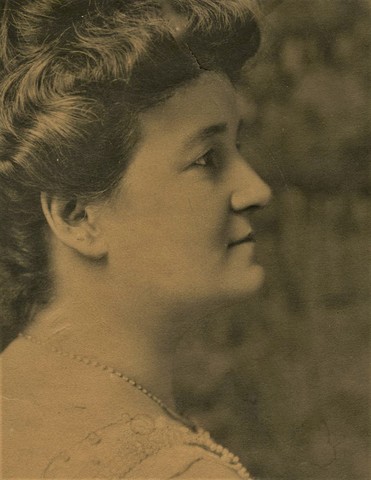
“The day of the explosion Mrs. Watson hurried to Monongah with her husband. She plunged into the work of relief with her heart open for the suffering and destitute. In a few hours she was recognized as good spirit of the place. Wherever she goes in the stricken town she carried light with her.” (RP 12.14.07 pg. 4)
“It was the children who made a special plea to her sympathy. Their helplessness, their absolute dependence overwhelmed her. After the first couple of days she went to her husband and demanded that he do something. He was at a loss and asked her for her suggestions. She said that the one thing for him and his company to do was build and asylum for the little ones.” (RP 12.14.07 pg. 4)
“How to care for the children of the explosion victims has been and will be a problem until Mrs. Watson’s home for them is built.” (RP 12.14.07 pg. 4)
In Fairmont:
“The body of Charles Wise of Fairmont, one of the best known men, was…brought here for interment this afternoon.” (ES 12.12.07 pg. 2)
Frank A. Wilmot and George A. Campsey from the Carnegie Hero Commission arrive in Fairmont. “After looking over the ground a while Mr. Wilmot decided to go to the Fairmont Coal Company offices at Monongah and make known his mission. Before going, however, he met Col. A.H Fleming of Fairmont whom he knew personally…” (FWV 12.23.07 pg. 1 – extra)
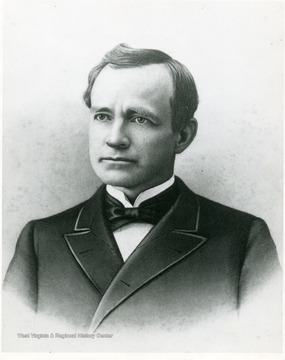
Mr. Harry H Stock, E.M. editor of “Mines and Minerals” of Scranton PA is visitor in the city. He procured copies of the West Virginian for every day since the mine disaster. (FWV 12.12.07 pg. 5)
In Monongah:
“The ladies of the relief corps are continuing their noble work and much food is being dispensed to the workers. Soups, meats, sandwiches, vegetables pie and coffee constitute the mean which is served night and day in a little building near the company office. Hundreds are thus fed every day.” (CDT 12.12.07 pg. 1)
C.W. Watson will not give a statement about the number of victims to the press until the “total number of miners is known…census of miners had not yet been completed. Three or four miners lived in the country and their families would have to be seen before the statement could be made. Mr. Watson said that the number would be between 328 and 334.” (FWV 12.12.07 pg. 1) (FWV 12.13.07 pg. 1)
He provides this statement instead:
“The work of removing bodies from the mines progressed very rapidly today and at the rate that the dead are brought out now the search work will be completed sooner than it was thought. The work in mine No 6 is practically done. The searchers have explored all the rooms of that mine.” (FWV 12.12.07 pg. 1)
Rumors of epidemic begin to surface and are attributed to the many maimed and decomposing bodies and carcasses about the town and still inside the mines. (McAteer) (News)
Mr. Fleming and Wilmot arrive in Monongah and go to the office where Wilmot is introduced to General Manager Lee. L Malone. “Mr. Malone at once placed the records of the company relative to the census of miners being taken at Mr. Wilmot’s disposal and after verifying the newspaper reports he hunted Mayor Moore to take some active steps for relief work.”
“Mr. Wilmot found Mayor Moore surrounded by a crowd of about 50 people engaged in relief work, but he gave Mr. Wilmot a hearing and very kindly consented to do whatever was thought best in the matter of organizing the committees.” (FWV 12.23.07 pg. 1 & 4 – extra)
At the mines:
The removal of livestock begins.

Marion County Board of Health issues a 2nd order: “…imminent danger of epidemic of disease breaking out…scores of men working in recovering dead are prostrated…so urgent…all of the streets of Monongah were heavily sprinkled with lime…odors emanating…unbearable.” (McAteer)
At #8:
1st full search is completed in #8 and a second search immediately begins. (McAteer) (Inquiry)
“Patrick Louchney’s remains were found in mines No. 8 and taken to the morgue this afternoon. His body was terribly mangled and mutilated. It will be taken to Clarksburg for burial.” (CDT 12.12.07 pg. 1)
~3:30 pm

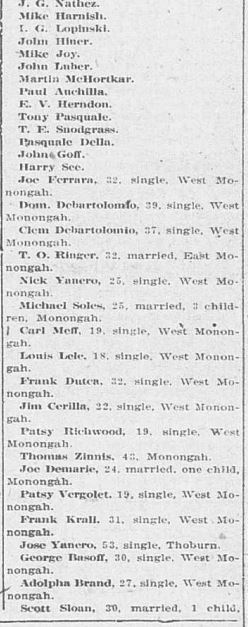
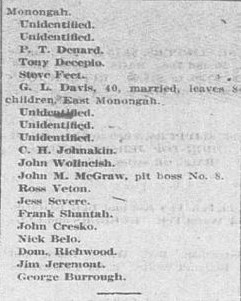
“A great many bodies remain unidentified as yet and probably most of these will never be identified or claimed by relatives. The number of the unidentified reached fully sixty so far and doubtless many of those yet to be recovered will be in the same class.” (CDT 12.12.07 pg. 1)
~4:00 pm
In Fairmont:
The 24 members and 2 guests of the Ladies Aid Society of the Diamond Street M.E. Church complete “40 pieces of clothing” and enjoy a dinner “for the small sum of $.15”, the proceeds intended to go to the relief fund. (FWV 12.12.07 pg. 2) (FWV 12.13.07 pg. 2)
~4:30 pm
In Wheeling:
The Wheeling Board of Trade holds special meeting of directors about the Monongah relief fund. Labor Commissioner I.V. Barton (who went to Monongah shortly after the disaster and stated he would bring a report of conditions to Board of Trade) “spoke at some length”.
“There are, Mr. Barton stated, from a thousand to twelve hundred orphans and at least 350 widows it has been estimated. The children have been born since the disaster and there are 60 expectant mothers among the widows. The Fairmont Coal Co. and the local relief committees are doing nobly, and are caring for the situation.” Mr. Barton stated that if the Board of Trade was to contribute, now is the time to do it. “The aid is not necessary now but in the future relief will be needed.”
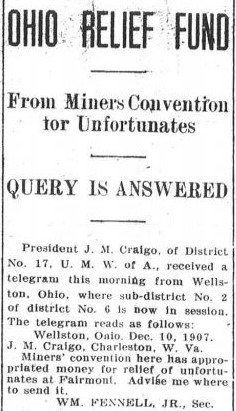
The Board of Trade contributes $1,000.00 to the relief fund. (FWV 12.13.07 pg. 1)
In Monongah:
In the earliest days after the disaster, various relief committees were formed by well-meaning individuals and groups but there is no representation for the immigrants and their various nationalities among them. Bishop Donahue was added to the initial general relief committee when he pointed out a lack of representation for the Italian and Polish-Slavic Catholic churches and the committee expanded to incorporate immigrant representation. (McAteer) (News)
Manager/Secretary of Carnegie Hero Fund Commission Frank M Wilmot combines the majority of these relief committees into one: the Monongah Mine Relief Committee. (McAteer)
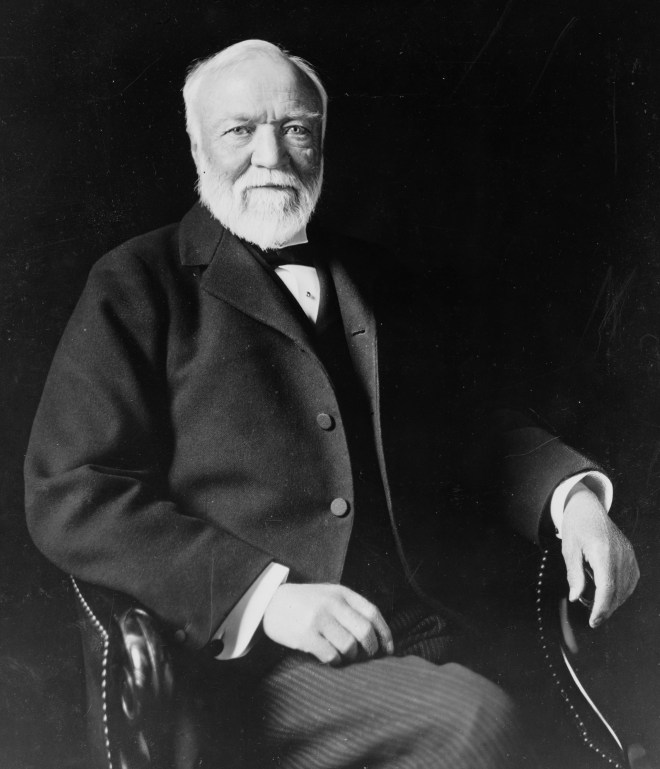
The Carnegie Hero Fund donates $35,000 to this relief committee and takes charge of the organizing. (McAteer) (News)
Wilmot then has a meeting with Watson, Fleming, and other company officials to discuss their role in the relief efforts. Watson and Fleming are cautious about endorsing notion of public appeal for funds. They are concerned about the effect such an appeal would have politically, particularly on the general public. Wilmot convinces them the response would be well received. Following the meetings with Wilmot and others they soon became supportive of the relief committees and assigned “various employees in the offices of FCC & others to work nights, Sundays, and other extra time helping the Subscription Committee to address envelopes and send out appeals”. Eventually, officials of mine, like Cunningham, serve as members of committee. (McAteer)
The Union Relief Association Committee, made up entirely of women from Fairmont and surrounding areas, is the only one not included into the MMRC.
~5:00 pm
Cunningham sends Watson a list of names along with morgue numbers. Bossilo Pillelo and Petro Frediro are listed with a note: “Italians were in #8. Selecting place to work. Chief Paul found their order copy x of mine laws.” (McAteer)
More on How Death Gloated!


 “The body of Timothy Lyden was found in mine No. 6 at Monongah at 3 o’clock this morning, taken to the morgue and prepared for burial.” (CDT 12.12.07 pg. 4)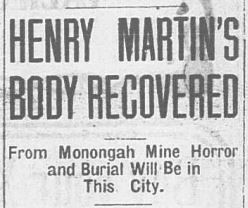



 The Monongah Disaster