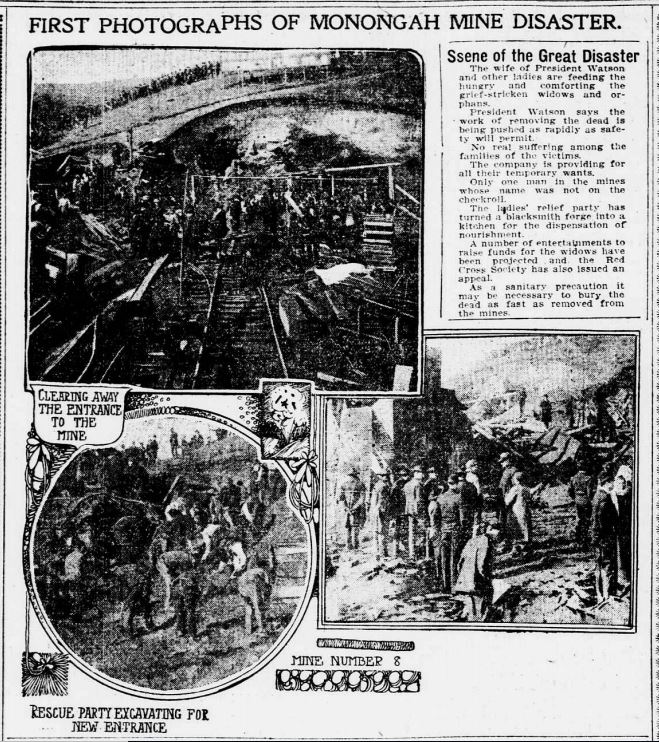
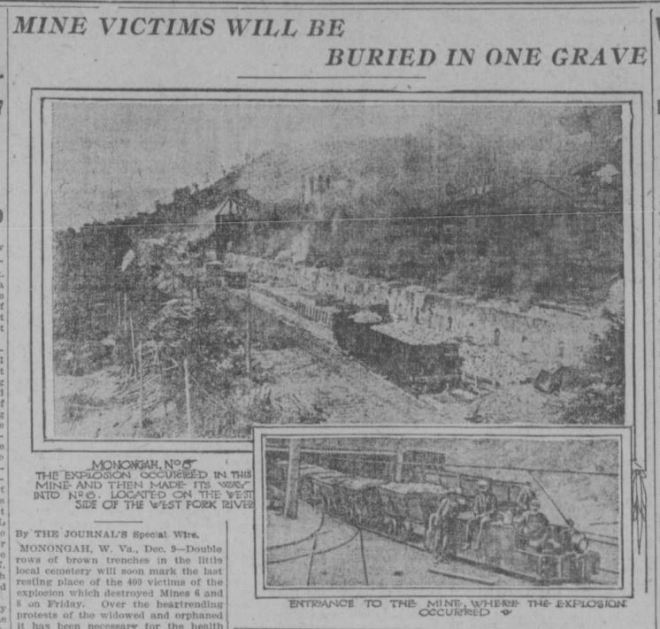
Tuesday, December 10, 1907, Morning

“This is the day of ‘little mothers’ in Monongah. The little girls tend the babies, wait on the sick and get what bits of food there are.” (NCH 12.10.07 pg. 1)

~7:30 am

The Fairmont West Virginian predicts even more rain for today and tonight, followed by snow and slightly cooler weather (12.10.07 pg. 1)

“It has been raining here steadily since last evening and wretched conditions prevail throughout this section today.” (WED 12.10.07 pg. 1) (ES 12.10.07 pg. 1)

At the mines:

“The stench from decomposed bodies in the mines is becoming almost unbearable to rescuers. The stench is made worse because thirty-six horses were also killed in the mines.” (GWA 12.12.07 pg. 7)

“Many rescuers have become sick. One hundred and fifty miners from the mines in George Creek district have been summoned here to assist in the rescue work.” (GWA 12.12.07 pg. 7)

“The health officers fear an epidemic of fever, due to the decaying bodies of the men and the animals caught in the mine, and have prepared to enforce heroic measures if it becomes necessary. Quicklime will be taken into the mine and scattered over the bodies if conditions become much worse.” (ES 12.10.07 pg. 1)

“The crowds of idlers who surged about the pit entrances…have been dwindling ever since the rainstorm last night…” (AR pg. 1) (LAH 12.11.07 pg. 2) (SFC 12.11.07 pg. 1)

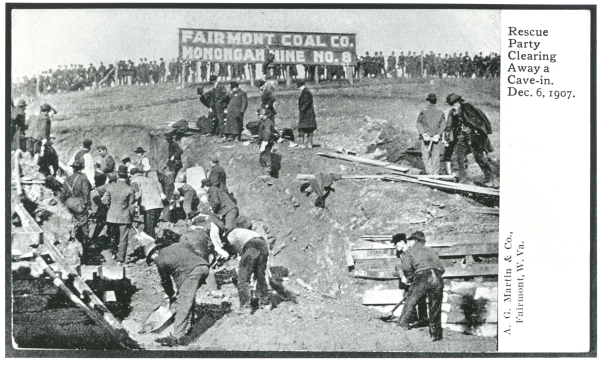
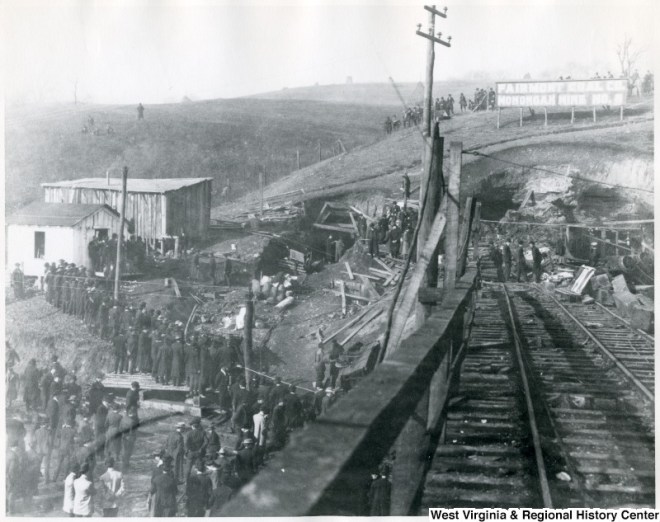
“The mud at the opening of the mines is several inches deep and has been trodden by the great crowds into a perfect quagmire, through which the men with the stretchers have to carry the dead. In conveying one of the recovered bodies down to the railroad tracks this morning a stretcher bearer slipped and the inanimate burden, which was wrapped in a blanket, was thrown into the mud. The sight of it gave the crowd a convulsion.” (RP 12.10.07 pg. 1)

At the morgues:

“Bodies brought from mines Nos 6 and 8 …during last night carried the list of victims beyond the hundred mark, and others are being carried into the morgue in intervals.” (WED 12.10.07 pg. 1)

2 men taken out this morning had some money on them: #101 – Salvadore Lobbs had $150 in a belt strapped around his leg and #110 – Andy Morris had $23.19 in his pocket-book. This brings the total amount of money found on the miners to $200.19. Money is in the hands of the coroner as are all other things that are found.  (FWV 12.10.07 pg. 1)

In Fairmont:

J.E. Sands, cashier of First National Bank, receives a check for $500.00 from the City Bank of Wheeling and a check for $100.00 from the Second National Bank of Cumberland, MD and $100 through Mr. Zack Robertson from a friend in Wheeling. (FWV 12.10.07 pg. 1)

In Grafton:

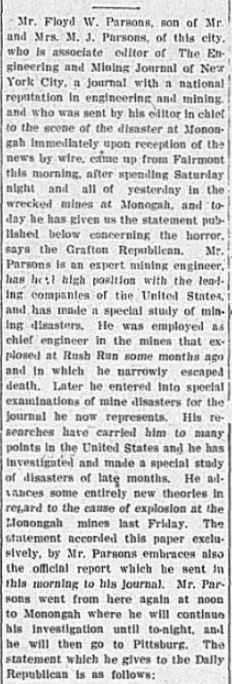
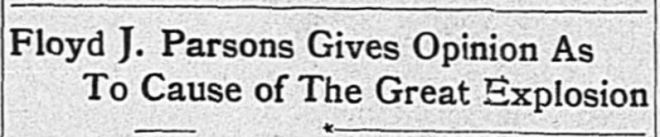
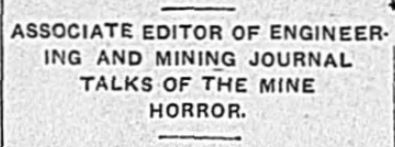
Floyd Parsons “came up from Fairmont” and gives the Grafton Republican newspaper his statement “concerning the horror…”. Floyd was employed as chief engineer in the mines that exploded at Rush Run some months ago and in which he narrowly escaped death. Later he entered into special examinations of mine disasters for the journal he now represents. (FWV 12.10.07 pg. 2)
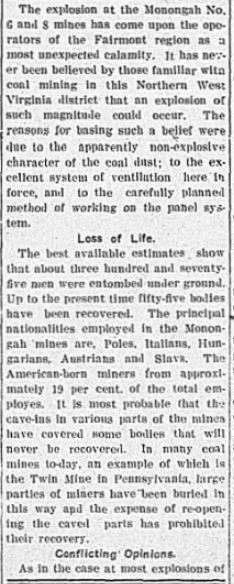
12.10.07 - pg 2 - Floyd J Parsons opinion on cause 1

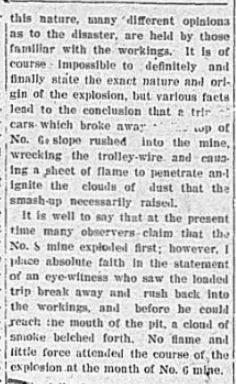
12.10.07 - pg 2 - Floyd J Parsons opinion on cause 2

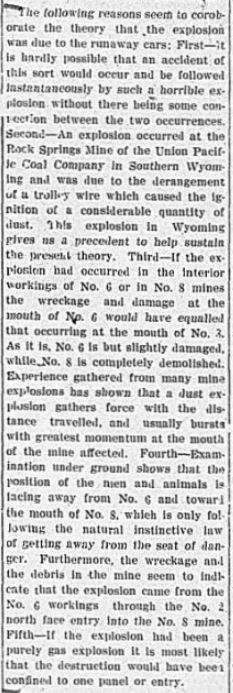
12.10.07 - pg 2 - Floyd J Parsons opinion on cause 312.10.07 - pg 2 - Floyd J Parsons opinion on cause 412.10.07 - pg 2 - Floyd J Parsons opinion on cause 512.10.07 - pg 2 - Floyd J Parsons opinion on cause 612.10.07 - pg 2 - Floyd J Parsons opinion on cause 712.10.07 - pg 2 - Floyd J Parsons opinion on cause 812.10.07 - pg 2 - Floyd J Parsons opinion on cause 9

~8:00 am

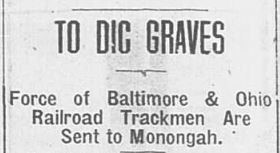
CDT 12.10.07 - pg 1 - BandO to Monongah

“Carrying out orders from officials of the Baltimore & Ohio railroad, a force of between forty and fifty trackmen that have been working on the railroad between this city and Parkersburg, left Clarksburg Tuesday morning on the interurban trolley line for Monongah to assist in digging graves for the dead that are taken from Monongah mines Nos 6 and 8. The men took picks, shovels and other tools with them and as soon as they arrived at Monongah they proceeded to the cemeteries and began work digging graves. The men were called to this city from various points along the railroad between Parkersburg and this city where they had been working.” (CDT 12.10.07 pg. 1)

In Monongah:

Milroy “Toy” Watkins is taken from Monongah to Montana for burial. The brother of Will Watkins, “…hearing that his brother was in No 6 mine went to work to help find him and he did not give up until he had found him and recognized him by a pair of black patent leather shoes and a black sateen shirt.” (FWV 12.12.07 pg. 2)

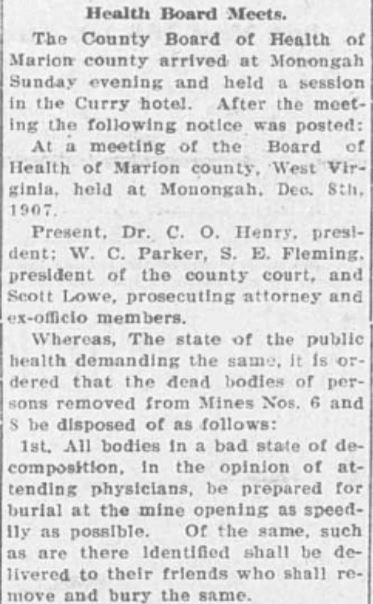
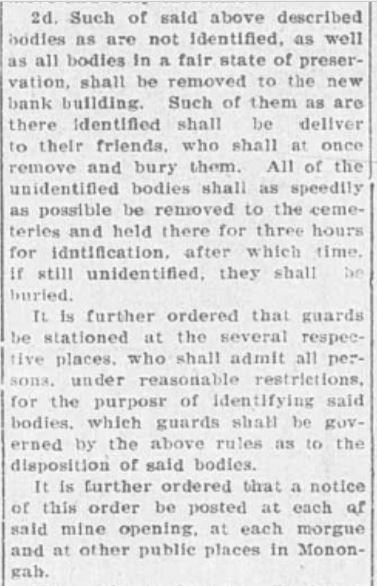
The Marion County Board of Health issues an order to advance the burial procedures. Viewing and ID opportunities for families and friends are limited to 4 hours maximum, no matter the condition of the body. The new accelerated ID and burial process cause many burials to occur immediately, without funeral masses. Catholic parishes hold whatever services they can at graveyards. (McAteer)

~9:00 am

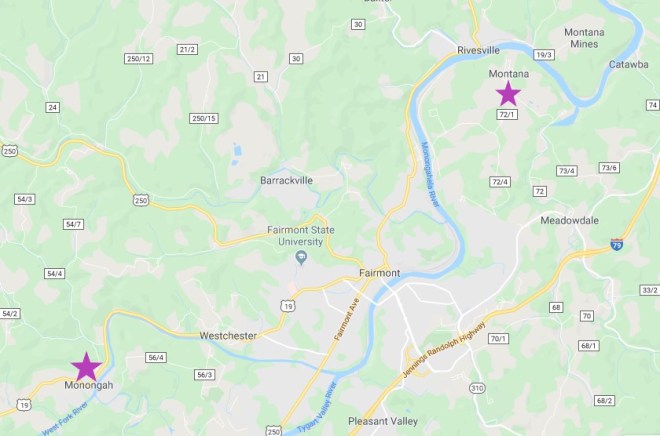
On the far east side of Fairmont:

“Impressive were the services conducted by Rev. Hess” for Toy Watkins which takes place at the United Brethren church at Montana. He was the son of Mr. Willis Watkins and was a grandson of Mr. and Mrs. John Freeman, “an aged and respected couple residing at Montana and was related to many people living in and around Hoult and Montana.” Toy is survived by “4 brothers and 2 sisters; his mother having died about one year ago.” He is also survived by wife, Gettie Hyson Watkins, of Simpson, “who is very poorly in Cook Hospital, she being almost prostrated by the awful shock and untimely end of her husband.” (FWV 12.11.07 pg. 2)
montana map

In Monongah:

“Shock and grief have already destroyed many of the little unborn lives. Many women are so distraught with suffering that they forget all about their children.” (NCH 12.10.07 pg. 1)

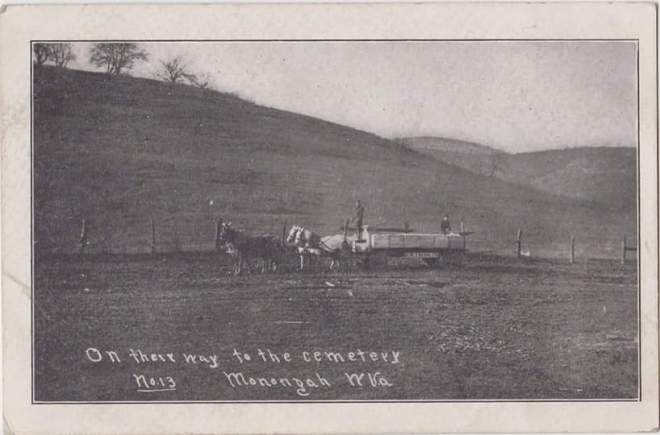
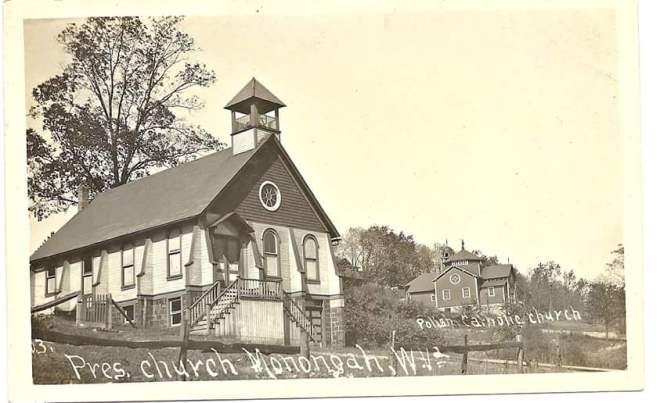
“Funeral after funeral is being held at the churches in Monongah. The funeral cars are on the move most of the time. The unknown dead are being buried in the potter’s field near the Polish Catholic church.” (FWV 12.10.07 pg. 1)

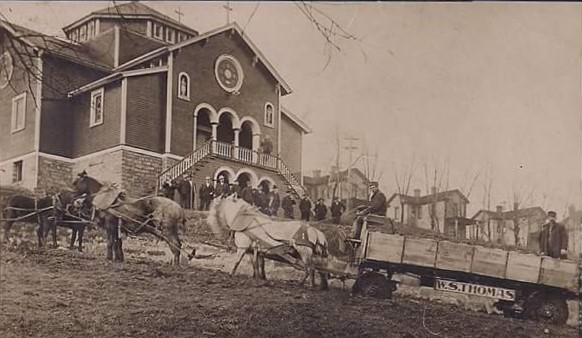
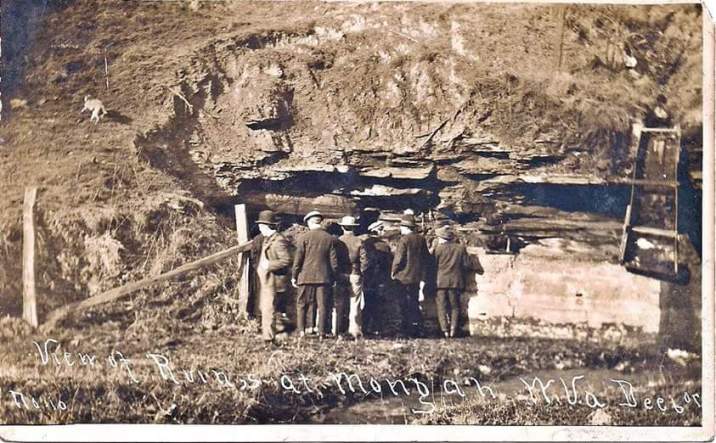
Over 70 bodies are interred throughout the day. Some of them get funerals at the church, particularly those who could be preserved, but due to the condition of so many of the bodies brought out in the past hours, more frequently they are simply taken to one of the cemeteries. If identified, a small prayer is said; if not they are just buried. (McAteer) (news)

“The relief work is well under way and will soon be systemized. There is now plenty of food but there is urgent need of clothing in many families. Cash funds are being raised in many places and installments have already been forwarded from some points. The coal companies of this district have contributed $20,000 cash.” (WED 12.10.07 pg. 1)

“Thirty-seven funerals were held Monday and a number today. One body was sent to the cemetery followed by one lone woman, the widow, who had stood for days at the mines waiting for it.” (GWA 12.12.07 pg. 7)

At the mines:

“Every day since the explosion, hands, legs and arms have been removed. The stench from the decomposed bodies in the mines is becoming almost unbearable. This is one of the greatest difficulties which the rescuers have to overcome.” (RP 12.10.07 pg. 1)

“Up to nine o’clock this morning one hundred and one bodies have been removed from the Monongah mines, thirty-one having been taken out since midnight.” (CET 12.10.07 pg. 1)

~10:00 am

In Clarksburg:

“Charles McKane, aged 28 years, one of the Monongah mine victims, was buried in Holy Cross cemetery here at 10 ‘clock Tuesday forenoon. McKain’s body was found in one of the rooms of No. 8 mine and was taken from the mine shortly after midnight. With others it was conveyed to the morgue at Monongah and prepared for burial. It was then sent to his late home in that town arriving there at 2:30 o’clock, and Tuesday morning it was brought up on the interurban and buried. Relatives and friends accompanied the body. Mr. McKain’s body was not mutilated. It is evident he smothered to death. He leaves a wife and one child.” (CDT 12.10.07 pg. 3)

holy cross map

“Mayor L.C. Crile announced Tuesday morning that all moneys received at the council chamber in response to his proclamation calling for donations for the relief of the Monongah mine suffered, would be turned over to the Telegram relief fund, and due credit will be given to each donor. The donations will be published in the Telegram daily. A list of all the donors who leave supplies, provisions, clothing, etc., at the mayor’s office for the Monongah mine sufferers will be published each evening in the Telegram also. Donations are coming in freely and they should continue so for there are many unfortunate women and children left in destitute circumstances by the awful disaster.”  (CDT 12.10.07 pg. 1)

In Monongah:

“Quite a number of Bridgeport people today went to the scene of the great mine disaster at Monongah. Some went for the mere sake of seeing, while others went with the hope of getting tidings from relatives and friends who were employed at the ill-fated mines.” (CDT 12.10.07 pg. 7)

“There is no change in the demeanor of the people of the stricken town except that the gloom of sadness and sorrow deepens all the time.  Funeral after funeral was held today, mostly at the Catholic cemeteries, where scenes are most sad. After loved ones have been identified at the morgue and prepared for burial, hundreds of women and children gather at the cemeteries on the hill instead of going to the churches and await the arrival of the dead.” (CDT 12.10.07 pg. 1)

“Women were found today weak from pain, who are also suffering from lack of proper nourishment. Some of the Fairmont women have depleted their own stores of winter supply food in relieving the distress.” (RP 12.10.07 pg. 1)

“Ever since the explosion the most heroic action has been displayed on all sides by the women who despite their great stress and suffering, clung to their children. From the start they realized that the little tots were to becomes a serious burden, but on all sides could be heard the same sentiment, they would rather die than give up their children.” (CET 12.10.07 pg. 1)

“Some of the widows have no relations in America, for many came to Monongah with their husbands from the old country. Others came as sweethearts, years ago, after the lovers had made enough money to send for them. And while their married lives began here, they apparently prefer, in their distress, the old homes far away.” (CET 12.10.07 pg. 1)

“There are not many of the women who can now find any charms about Monongah, and although foreigners, most of them want to return to their native country, feeling that the few short years of the country of liberty has brought them nothing but grief and suffering.” (CET 12.10.07 pg. 1)

Special correspondent for the United Press, Dorothy Dale, and her photographer are approached by “the brightest Italian girl in the settlement”, Faustina Davia (last name reported as “Daria”).

Faustina close up Wilkes-Barre Times - 12.14.07 pg 1
Faustina Davia

Faustina is the oldest child and only daughter of Victor and Catherina Davia (DaVia). Victor was a “day man” working in #6 at the time of the explosion and was recorded as the 15th body recovered from the mines and to go through the morgue. He was identified by George Gibbons at the Italian Catholic church in Monongah sometime on Monday, though it is generally known that none of the family got to actually view and confirm that the body which was buried in Row A Grave 9 of the Italian Catholic cemetery contained Victor’s actual remains. (Tropea) (News) (McAteer) (Loss) (Amos)

“’Please you get something for me, I can do.’ A little hand touched my arm. A curl-framed face of a girl of 10 looked into my face. ‘You know mans all dead. Boys all dead. Only girls left to work.’ Do you know the half apologetic half appealing look of the trembling old man who shoved out of his life’s track by younger men—the man who begs you to buy matches or shoestrings? Well, that was the expression in the old young eyes of little ten-year-old Faustina Daria. Faustina was in the sixth grade the day before the explosion. That is ages ago to her.” (NCH 12.10.07 pg. 1)

At the mines:

“With 112 bodies on the surface at 10 o’clock today, 25 more ready to be brought out of Mine No 6 and 4 awaiting removal from Mine No 8. It was expected that the total number of bodies recovered from the wrecked mines by noon would be 140.” (CDT 12.10.07 pg. 1)

“The rescuers are working the right side of mine No. 8, where, it is thought, a majority of the bodies yet in the mine will be found.” (ES 12.10.07 pg. 1) (RIA 12.10.07 pg. 1)

 “The rescue work is being pushed and before night it is expected that most of the bodies will have been taken out.” (WED 12.10.07 pg. 1) (ES 12.10.07 pg. 1)

~11:00 am

In East Monongah:

The General Relief Committee holds a meeting at the First National bank, which is currently operating as the primary morgue, and passes an order that the receipts and disbursements of the committee be published in the Fairmont papers from day to day. (McAteer)

Bishop Donahue of Wheeling and Judge Mason are added to the General Relief Committee. (FWV 12.10.07 pg. 1)

Donahue has “visited many of the homes of miners and found so many children made orphans by the disaster that he immediately took up the work of providing homes for them. He will arrange to have as many as can be accommodated sent to the orphanages maintained by the church at Huntington and Wheeling.” (WED 12.10.07 pg. 1)

In West Monongah:

Faustina Davia has taken Dorothy Dale and her photographer to her family’s three-room house on Walnut Avenue.

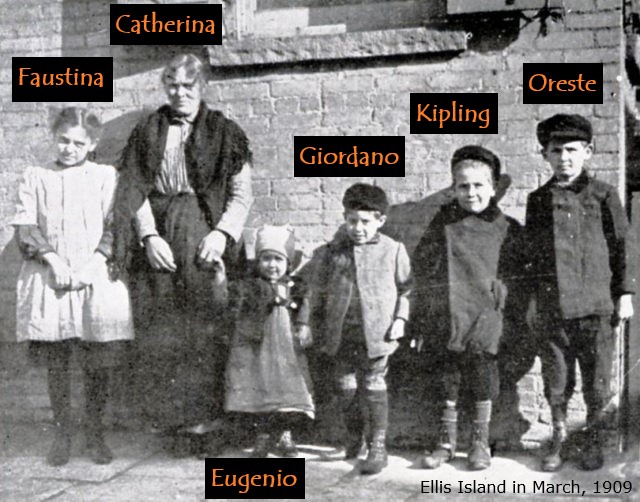
“‘See my Ma, Resta, Kipling, Georda and Ojgenia to work for,’ as she pointed at the group on the steps. ‘My pa make $2 a day,’ she explained. ‘And wasn’t it awful; three days he was home with a hurt on his back, and Friday he went in again and—and—’. But even the brave lips of strong hearted women of ten sometimes give way. The little figure crouched against the wall and quivered with sobs. ‘You know we paid $5 rent and had lard and cheese and bologna,’ she said with pride. The child spoke as rich people spoke of automobiles and theatre parties. And there was little Faustinas in almost every house in Monongah.” (NCH 12.10.07 pg. 1)

“I tell you there is nothing that makes one’s heart go out more to that stricken people than the way tiny girls put their little shoulders to the burdens that their mothers can not bear.” (NCH 12.10.07 pg. 1)
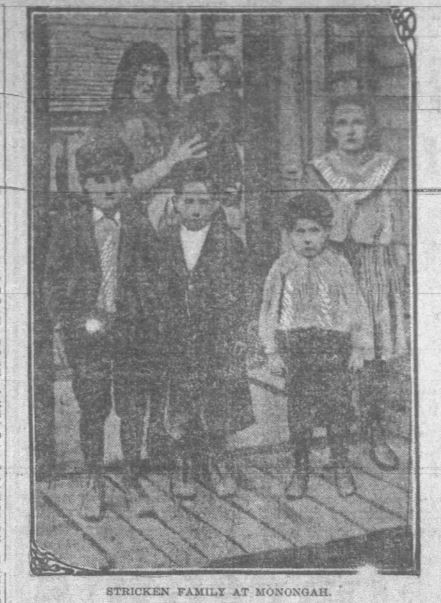
Wilkes-Barre Times - 12.14.07 pg 1
Photo taken of the Davia family on the porch of their home.
1909 ID photo
Photo of Davia family at Ellis Island. Catherina and her family is the focus of this author’s historic fiction, therefore, there will soon be areas of this site which will be dedicated solely to her story.

~11:30 am

“At eleven thirty, one hundred and thirteen bodies have been taken from the mine by rescuers. The bodies of those taken out since daylight are in good condition, and many were identified.” (CET 12.10.07 pg. 1)


More on How Death Gloated!
Bibliography

Disclaimer and Guide

Introduction

About the Author

Contact Information

Tuesday, December 10, 1907, Midnight – Dawn

“Every decade has had its horrors and every decade will have them until the end of time. It seems sometimes that the decades that have passed and gone were angelic compared to the present, but such is not the case.

“The terrible mine disaster at Monongah is still fresh in our minds, and it will remain fresh for many days for the parties of rescuers have scarcely begun to find the bodies of the victims of that catastrophe.” (AC 12.10.07 pg. 4)

~12:00 am

At the mines:

“At midnight a total of sixty-six bodies had been brought from the two wrecked mines at Monongah.” (BEB 12.10.07 pg. 7)

“The bodies taken out…were for the most part in bad condition, being maimed and blackened, and besides, many of them were far advanced in decomposition.” (ES 12.10.07 pg. 1)

“The work of rescue is daily becoming more difficult and dangerous. To the dangers of fire damp and explosive gases generated by the fire in Mine No 8 are now added the odors peculiar to decomposing bodies. The health of the rescue parties is endangered, and it is with the utmost difficulty that they are able to face these new terrors of the mines.” (LCT 12.10.07 pg. 8) (RP 12.10.07 pg. 1)

“…men who were unafraid to work 12, 24, 48, or 72 hours at a stretch if there were hope or help in it. This mustering of the minute men of the coal pits is one of the finest things in industrial life in America today. Some come because of the good pay there is in it, and some because of the adventure, but for many it is the response of working men to a human call stronger and more stirring than either of these.” (Kellogg)

me6

“Now, it having been determined that there can be no living men in the mine, the state and federal authorities have ordered a cessation of the rescue work. They rightly cannot see the necessity of sacrificing the living for the dead. But it is a notable fact that the work would have gone on, regardless of danger, if the authorities had not intervened. The men were willing and anxious to risk their lives, even though they knew they could not save lives by so doing.” (SLH 12.10.07 pg. 4)

“The coroner and his deputies remain constantly upon the scene, viewing the bodies as they come out, but no date has been set or other arrangements made for taking testimony or other features of the inquest.” (ES 12.10.07 pg. 1)

Inside the mines:

“Men are working incessantly.” (WH 12.11.07 pg. 3)

“They carried pick and shovel, but the weapons that for the most part they had to rely on were boards and canvas and cement and a spinning fan at the mine mouth.” (Kellogg)

These men “…must go ten feet ahead and try; must hold canvas barricades against the after-damp till their arms ached, while the brattices slowly went up; and all the time must forage for death in that breathless sweater, finding it in a disemboweled mule, or the charred, crushed thing that had been a miner, or a headless trapper boy, or an empty shoe.” (Kellogg)

ME18

“After the bodies are located, the rescuers say the most difficult part of the work is encountered. The bringing out of the bodies, a distance of a mile or more through the underground workings, it is tedious on account of meager facilities.” (WH 12.11.07 pg. 3)

12.10.07 - pg 1 - Mules in mnes

“There has been considerable apprehension that the work of rescue might be stopped on account of the many carcasses of horses and mules in mines Nos 6 and 8, but so far there has been little trouble from this source, and the stench has not been sufficient to overcome the workers.” (CDT 12.10.07 pg. 1)

“The official reports show that there were eleven horses and mules in No 6 mine and 38 in mine No 8. All were killed.” (CDT 12.10.07 pg. 1)

“Health authorities fear an epidemic of fever due to the decaying bodies of the men and the animals caught in the mine and have prepared to enforce heroic measures if it becomes necessary.” (WED 12.10.07 pg. 1)

At the morgues:

By an order of the County Board of Health, mutilated bodies are to be kept 3 hours for ID and at the expiration of that time shall be interred. The order has increased the anxiety of relatives of the victims who are eager for the news concerning the recovery of bodies. (FWV 12.10.07 pg. 1)

At #6:

“There was pathos enough in the scenes at the mines while the bodies were taken out to make a nation weep.” (AC 12.10.07 pg. 1)

“Early in the morning they took the body of a small boy about eleven years old from Mine No. 6. He bore on his begrimed little face a look of peace and happiness that doubtless never marked it in life.” (LCT 12.10.07 pg. 8) (RP 12.10.07 pg. 1)

“The little body they took out was that of a weakling, a mere child, who in life probably did not possess enough strength to lift a bushel of coal. But his hands were knarled and his shoes were those of a man laborer, rough and tough and hobnailed.” (LCT 12.10.07 pg. 8) (RP 12.10.07 pg. 1 & 2)

“It was identified as John Yaconis, and taken to the tumble-down shack up in Red Row over the mine, where a stony faced little woman kissed it till her face was black from the charred flesh.” (NCH 12.10.07 pg. 1)

“’Devil Johnny’ they called him, but there was nothing devilish about him. At 12 the stunted little overalled figure trudged every morning to the mines where he was a trapper. At 13 he died in those mines.” (NCH 12.10.07 pg. 1)

“Another body, that of the boy’s father, Franco Yaconis, is still concealed in one of those underground rooms.” (NCH 12.10.07 pg. 1)

“There are other little trapper boys, they say, in the hideous catacomb back under the hills, boys that have never known the delight of tops and marbles, and whose best comrades are the slow and patient mules that haul the black cars down the drifts.” (LCT 12.10.07 pg. 8) (RP 12.10.07 pg. 1)

“’My man ask for boy getta job. Company give it even to so little boy.’ Said the mother. The labor law of West Virginia requires a child to be 14 before he may work, and the white faced Monongah woman says that Johnny’s case was many a boy’s case. At any rate there are no boys of that age on the Monongah streets.” (NCH 12.10.07 pg. 1)

Tipple_Boy_and_Drivers._Maryland_Coal_Co._-_Sand_Lick__WV

~6:00 am

At the mines:

“Seventy-six dead bodies had been taken from the ill-fated Monongah mines when work was resumed today.” (WT 12.10.07 pg. 11)

“Mothers, wives, sisters, and children gathered at the entrance of the mines until driven away by the company’s police.” (AC 12.10.07 pg. 1)

“It is believed that the preliminary work of the rescuers has at last been completed…brave fellow workingmen to the number of hundreds have been risking their lives for nearly 96 hours.” (WED 12.10.07 pg. 1)

“There is now no fire in either mine and the air is such as not to materially interfere in the work. The order at the mines is perfect and the rescue work goes systematically on, notwithstanding the steady downpour of rain and deep mud.” (CDT 12.10.07 pg. 1)

“The company issued a statement yesterday saying later developments lead them to believe only 260 men were in the mines when the explosion occurred, but the miners insist that 406 men were checked…besides many having duties in the mine who are not under the checking system.” (OES 12.10.07 pg. 4)

“No man can write down in words the story of the pitiful grief and mental suffering that was witnessed during the hours I stood surrounded but those whose loves ones lay cold in death far beneath their feet in the workings of those wrecked mines.” (AC 12.10.07 pg. 1)

“Monongah is today a fatherless, husbandless village. In a moment the largest mining village in West Virginia was shorn of its bread-providing population as lint is swept by a white hot tongue of flame.” (AC 12.10.07 pg. 1)

~7:00 am

“Today dawned with the bright prospects for bringing to the surface a majority of those still in the workings, deep in the bowels of the hills and far from the entrances.” (WED 12.10.07 pg. 1)

12.10.07 - pg 3 - Rats

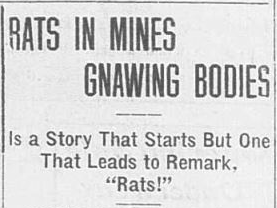
“A story started last night that rats were in the mines gnawing the bodies of victims, but it was too ridiculous to receive much credit. Doubtless there were numerous rodents in the mines at the time of the accident, as there always are in mines, but that even a rat escaped the awful death strike, when the explosion came is not at all possible. There has not been any opportunity since for rats to get into the mines as the entrances have had men constantly at them and hence there could be none within. Besides the bodies recovered shows no sign of the presence of rats in the mines.” (CDT 12.10.07 pg. 3)


More on How Death Gloated!

Bibliography

Disclaimer and Guide

Introduction

About the Author

Contact Information

Monday, December 9, 1907, Night

“It is beyond the human pen to describe the spectacle presented, when bodies are brought up from the bowels of the earth whither courageous men day in and day out were wont to toil for the support of their loved ones. Fathers, brothers, husbands and sons, are carried from the slope leading to the fatal regions of the earth. Their bodies are as black as the coal itself. The experienced eye of the undertaker cannot detect their color, whether white or black, until after the bodies have been washed. Even then the mutilation in some cases make it difficult.” (CDT 12.9.07 xtra pg. 4)

~7:30 pm

At the mines:

“Rain began falling early in the evening and continued almost incessantly throughout the night.” (WED 12.10.07 pg. 1)

“Last night they took out two bodies from No.8. Tonight, they will take out many more dead who have already been dug out of the wreckage and are lying along the catacombs ready for removal.” (RP 12.9.07 pg. 1)

“When darkness came tonight a total of sixty-six bodies had been brought to the surface from the two wrecked mines at Monongah.” (DASB 12.10.07 pg. 1) (LODD 12.13.07 pg. 3)

In Fairmont:

The Union Relief Association is formed by local women who were among the first responders to the disaster. Mrs. F. E. Nichols, President & Mrs. R. T. Webb, Secretary hold a meeting at M.P. Temple – “all ladies urged to be present.” “All women interested in the relief work are earnestly requested to be present. Committees will come prepared to report the progress made today.” (FWV 12.9.07 pg. 8)

Walter Zirkle is located safe and alive. He had been employed at the Gaston mines in Fairmont, not the Monongah mines. “The wish of his sister and mother were at once communicated to him and he has no doubt reached his home…” (FWV 12.10.07 pg. 2)

“Over $25,000 was added to the various relief funds during the day.” (BME 12.11.07 pg. 6)

In Monongah:

The General Relief Committee meets in Mayor Moore’s office. The first members are: Mayor Moore of Monongah; Mayor Arnett of Fairmont, chairman; Father Boutlou, Rev. J.C. Broomfield, Rev. H.G. Stoetzer; J.E. Sands, treasurer, and J.M. Jacobs, secretary. “Five responsible men will handle large gifts.” All checks will be payable to J.E. Sands, who will see that the funds are properly distributed. (FWV 12.10.07 pg. 1)

Paul Kellogg is talking with the children of a grieving family at their home. One of the oldest daughters tells him of the father they call “Pap” and brother, referred to as “George” who was a machine man:

“…and as we stood there on the door step, the sisters showed me his picture that of a clean cut young fellow, taken with his dog in a field. ‘Many’s the woman was dependent on each day’s wages,’ they said, –‘nothing at all ahead—and now that’s cut off.  We’re not that way—not quite. Pap was all we had and he was getting’ old and couldn’t do so much. But George—soon as he’d get through cutting, he’d come help him load and so Pap’d make more. That was the way with George—5 girls, the only brother we had, and he that good to us! And such a good wife.’ One after another, the sisters broke in parts with the story. ‘Pap was singing the morning he left when he went to work—we heard him as far’s it carried. It was Nearer My God to Thee. That’s what he was singing. They worked 3 miles in—Pap and George—r-right under us. Two of the girls broke off there and ran into the house, and a third, who had come out and was combing her hair while we talked, gave it a savage twist that would have brought tears to her eyes if they hadn’t been there already. ‘Oh, we know we’ve got to give him up. We know he’s dead; but if we could only get his body out of the pit.” (Kellogg)

In the morgue:

George Gibbons is very successful in telling who victims are as they are brought in through the night. (FWV 12.10.07 pg. 1)

The first money found on any of the victims is found on the 69th body to be taken out, Dan Dominico Jr.* He had $27 on him when found. (FWV 12.10.07 pg. 1)

*The paper reports that this is “Dan Domico”. However, body #69 on the Coroner’s List is actually Dan Dominico Jr.—the son of the injured miner who was among the 4 men to escape through a toad hole the morning of the explosion. Despite being seriously injured, his father ran to the mouth of the mine after escaping and wanted to go back inside in an attempt to save his son. Dan Domico did not attend work on Friday and is, in fact, still alive.

At the mines:

“The rescue work, while slow, is progressing smoothly and as rapidly as due precaution for the rescuers would permit. It is believed that close to a hundred dead will be recovered by daylight tomorrow.” (News)

~8:00 pm

In Monongah:

Paul Kellogg visits the Italian Catholic priest, Father D’Andrea. Kellogg writes that, “it was raining heavily and a hearse was ploughing up through the mud when I reached the little Italian church…where last year alone he [D’Andrea] baptized 170 American born children.”

Kellogg describes D’Andrea as “a young, spare man with a quick smile on his dark face. His beard had gone 3 days without shaving and his eyes were hollow for sleep.” D’Andrea has been so consumed with his duties as a priest and to his brother’s family that he has had no time to personally grieve his brother.

“It was only one cry all day until now,” he said and turned his palms out and dropped his shoulders. Then in answer to the door, he directed a driver who for 2 hours had been searching for the right house, and was going back with the body. (Kellogg)

~10:00 pm

C.W. Watson issues statement:

12.10.07 - pg 1 - Watson issues statement

At the mines:

“The heavy rainfall caused a veritable mortar of mud more than shoe top depth in many places through which the workers and the anxious watchers could make their way only with the greatest difficulty.” (WED 12.10.07 pg. 1)

The body of Charles McCain is finally reached. McCain was a well-known man of his city and had many friends here. Despite numerous early accounts of Charles being found  “blown to bits”, his body was in good condition. There were no marks on it showing that he was a victim of the after damp. His remains were brought to his home. (FWV 12.10.07 pg.1)

~11:00 pm

At the mines:

“Heavy rain storms make the conditions around the mine worse than any time since the explosion. Only a few stragglers are now keeping the gruesome vigil.” (DASB 12.10.07 pg. 1)

“Milder temperatures today resulted in a thaw which converted the soil near the entrance into a sticky, dirty mortar…now almost knee deep in places.” (SLH 12.10.07 pg. 1)

“It dispersed, however, a very large portion of the great, impatient surging crowd that from the first has hovered as near the entries as they could get, a constant handicap to the rescuing forces whose work they retarded.” (WED 12.10.07 pg. 1)

“The rain has also interrupted the makeshift telephone and telegraph communication between the mines this city and the outside world.” (AMJ 12.10.07 pg. 1)

“Twelve bodies have been taken from the mines tonight, bringing the total number up to 11 p.m., seventy-eight.” (DASB 12.10.07 pg. 1) (CB 12.10.07 pf 1)

“At a late hour, …the officials of the company said they had reached a point where there were a great many bodies. From this time on the work of bringing out the dead will be done more rapidly.” (CET 12.10.07 pg. 1)

At the morgue:

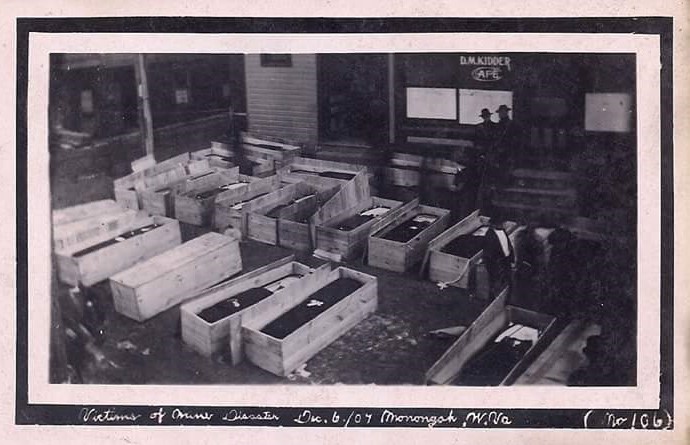
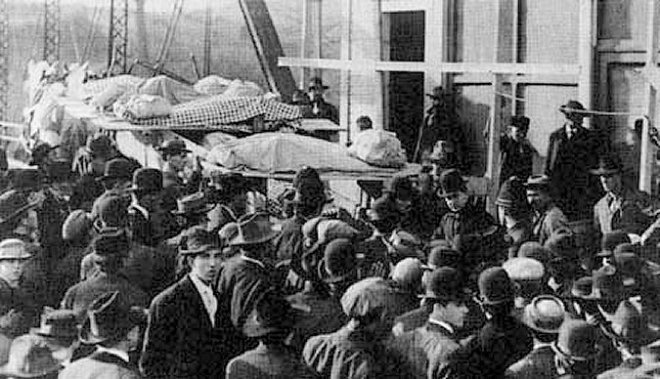
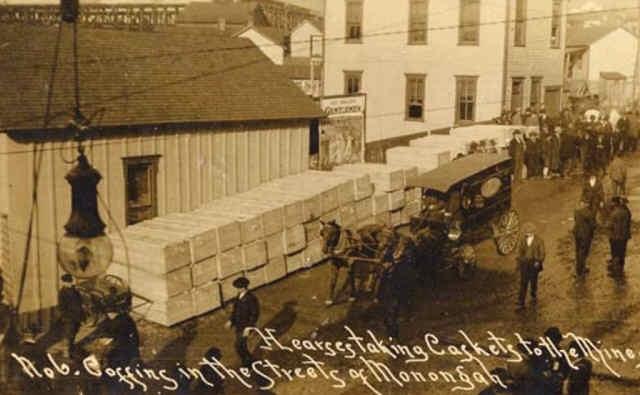
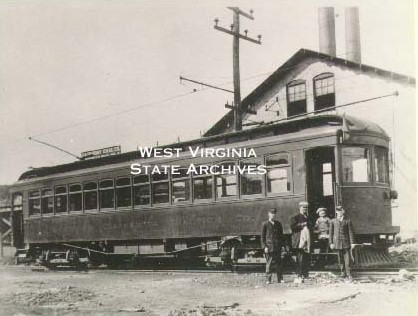
“The rapid recovery of the bodies is making lively work at the morgue and at a late hour…thirty-five more undertakers were telegraphed for besides the several who arrived early in the evening from Grafton and Fairmont. Spring wagons bringing the bodies from the traction station across the river, to which they are conveyed from the mine openings by an ambulance street car, are followed by throngs of men, women and children, who gather around the morgue and remain in the rain until the bodies are placed in the caskets and laid in state in the bank building for viewing and identification.” (CDT 12.10.07 pg. 1)

coffins


More on How Death Gloated!

Bibliography

Disclaimer and Guide

Introduction

About the Author

Contact Information

Monday, December 9, 1907, Afternoon – Evening

The utterness of that desolation seemed by sheer force of numbers to overshadow anything else she had to tell—the children of the McFeeleys, “all little ones and not a bite to eat yesterday and him home dead”—(in some cases the women were so broken as to be unable to prepare food for their children, even if they had it)… What the housewives said as they met on the narrow walks or rocked at each other’s door sills was after all close to the pith of the matter…The Italian mother, “where I got the peppers,” with no money and no English and “2 little bits of children”…The Slavish wife who “tore blood out of her face”…The two crazed women on the hill who, rumor had it, had to be tied down to their beds…The young widow of the English machine man who lived just over No 8 mine, “who tore out her beautiful yellow hair in grabs,”… (Kellogg)

~12:00 pm

At the mines:

“Fire which caused a suspension of rescue work yesterday and early today in Mine No. 8 was extinguished, it was said, at noon today.” (News)

At noon the body of Mike Cosic was taken out of Mine No. 8. (CDT 12.9.07 pg. 1)

“No identification has been made of the eight unknown men taken out Sunday.” (CDT 12.9.07 pg. 1)

carnations

“A pathetic incident of the day occurred at Mine No. 6. A foreign woman whose husband had been killed stood near the mine all day with a half dozen carnations in her hand. The little floral tribute was wrapped with white ribbons.  Shortly after noon her husband’s body was recovered in such condition that burial was necessary at once. She followed the wagon to the temporary morgue where the body was placed in a box, and then to the cemetery near by.” (NYTb 12.10.07 pg. 14)

In Monongah:

C.W. Watson gives the following statement:

12.9.07 - pg 1 - Watson statement
FWV 12.9.07 pg 1

“Senator J.A. McDermott, of Morgantown, president of the State senate, who was requested by Governor W.M.O Dawson to go to the scene of the mine horror, gave the Telegram representative the following statement at noon today:

‘I consider that the resolution passed by the legislature gives the mine investigating committee the power to investigate all mine horrors that occur during the existence of the committee. The coal company wants a most thorough investigation by that committee or by any other committee. I have been at both mines and looked over the whole situation. I notice a fine organization and a systematic plan of rescue work and everything possible is being done promptly. The number in the mines as given out is considerably overestimated. I am here for no special purpose but it is possible that this disaster might come before the legislature or come up in some other way and therefore desired to be personally informed.’” (CDT 12.9.07 pg. 1)

“There has been no change in the situation at Monongah today except that it is very probable that the death list is not so large as was first thought. According to a telegram sent to the Governor by Watson the dead number almost a hundred fewer than given out.” (FWV 12.9.07 pg. 1)

“When the explosion occurred the town officials ordered the saloons closed…there is no drinking and among the thousands of people who have flocked to Monongah to witness the grave disaster not one disorderly act has been committed…” (FWV 12.9.07 – pg. 7)

Fairmont West Virginian puts out an extra Noon paper. Bill Sloane is no longer included on the list of the dead.

12.9.07 - pg 1 - headline

12.9.07 - pg 1 - letter for aid from Moore

Chief of Police Shumaker received letter asking him for assistance to locate Walter Zirkle. (FWV.12.10.07 pg. 2)

12.9.07 - pg - missing man

~2:00 pm

12.10.07 - pg 6 - funeral 1
CET 12.10.07 pg 6

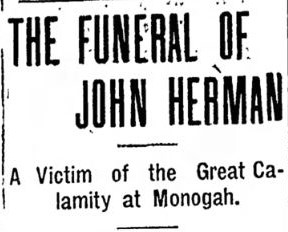
“The funeral of Mr. John Herman…whose remains were brought to Eckhart Mine for interment took place on Monday afternoon at 2 o’clock from the Jr. O.U.A.M. hall, as the church to which the deceased belonged is undergoing repairs.” (CET 12.10.07 pg. 6)

“The services were conducted by Rev. Edwards, pastor of Methodist Episcopal church, who spoke in a very beautiful and touching manner of the deceased’s past and of his terrible end. At the conclusion of the services the remains were taken to the Allegany cemetery at this place, where they were laid to rest, attended by a large concourse of friends and relatives.” (CET 12.10.07 pg. 6)

“The deceased was about thirty-eight years of age and is survived by his wife and several children, also his mother and several brothers and sisters residing in this vicinity. The floral offerings were very beautiful.” (CET 12.10.07 pg. 6)

~2:30 pm

“Five more bodies were removed from the mines today, making the total 58 up to 2:30 o’clock.” (ETR 12.9.07 pg. 1)

During the Afternoon

“A foreigner who is employed at the Riverdale Mine, ten miles above Monongah, lost a brother and thirteen other relatives in the catastrophe, and he is left alone in this country. Today he came to the offices of the coal company and reported that he wanted to remain at the mines until the bodies were recovered. He asked whether he would get his job back at Riverdale should he stay away from it for several days. He was assured he would not lose his place and became happy in the fact that he could assist in finding the bodies of fourteen loved ones.” (NYTb 12.10.07 pg. 14)

In Monongah:

“General Manager L.L. Malone told the Telegram representative this afternoon that likely all of the bodies, with perhaps the exception of a few in the remote parts of the mines, will be brought out within two or three days.” (CDT 12.9.07 pg. 1)

Fred Cooper’s funeral services held at the home of his uncle, Mr. Boggess, near Monongah. Rev. R.T. Webb of the M.E. Church South, pastor of the deceased, conducted the services, which were largely attended by friends of the deceased. Younger brother, Fay Cooper, also lost his life in the disaster but his body has not yet been found. Fred’s wife who survives him with one child has in the past 2 years lost 2 brothers, Fred Shingleton and an infant brother. Mr. Cooper’s mother, Mrs. Jerome Hobbs, who today mourns the loss of two sons, yesterday received announcement of the death of her husband, but today another message has corrected that statement. Mr. Hobbs is at Hot Springs, Arkansas, on account of rheumatism. (FWV 12.9.07 pg. ?)

“Considerable excitement was caused late this afternoon when rumors were current that a second explosion had occurred in the mines. An investigation made immediately by the company showed the reports had reached this vicinity from the East. There was absolutely no truth in the statement, and it was not necessary for the company to deny the report in this section.” (NYTb 12.10.07 pg. 14)

In Clarksburg:

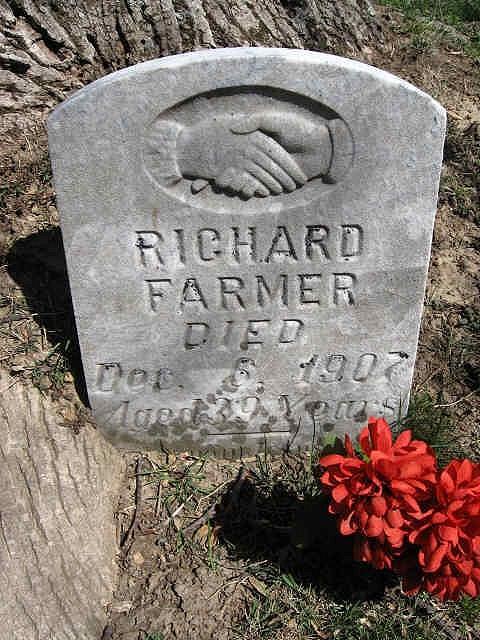
“The Richard Farmer, whose body was taken out of Mine No. 8, is a cousin of Policeman Farmer, of Clarksburg. His body was buried here this afternoon.” (CDT 12.9.07 pg. 1)

Grave of Richard Farmer on Tower Hill

In Fairmont:

The remains of Charles Honaker are brought to the city and buried at Woodlawn cemetery. The funeral was under the direction of the Improved Order of Red Men and the Degree of Pocahontas. (FWV 12.10.07 pg. 1)

“The work of caring for the widows and orphans has been entrusted to a committee headed by Rt. Rev. P.J. Donahue of the Catholic diocese of Wheeling.” Bishop Donahue estimates over 80% of dead were members of the Polish or Italian parishes. (Wash. Times 12.9.07 pg. 5) (McAteer)

In the cemeteries:

Burials are continual throughout the day. At the Catholic cemetery, there is great concern of bodies being buried in their proper ethnic graveyards; Polish on the Left, Italians on the right.

“Scenes of touching sadness were caused throughout the day by the burial of the recovered dead and the pitiful actions of relatives of the entombed victims.” (LODD 12.13.07 pg. 3)

Following the custom of old country, each family member would throw a handful of earth into the grave and say a final prayer.

Near Grant Town, WV:

The home of Mr. and Mrs. John Collins of Gray’s Flats is destroyed by fire while Mr. Collins is at work in mines and Mrs. Collins is at Monongah on account of the death of relatives caused by the great explosion. The fire was caused by the children knocking a stove leg off. There were 3 children in the house but they escaped. (FWV 12.10.07 pg. 8)

grey flats

At the mines:

“Nine more bodies were brought out of Monongah Mines Nos. 6 and 8 today. There are ten more bodies near the opening of No. 6 and they will be brought out by 5 or 6 o’clock.” (CDT 12.9.07 pg. 1)

~6:00 pm

Newspapers

Fairmont West Virginian:

Weather predicts more rain tonight; Tuesday, rain or snow; much colder (FWV 12.9.07 pg. 1)

12.9.07 - pg 1 - splash

Clarksburg Daily Telegram:

12.9.07 - pg 1 - headline

12.9.07 - pg 1 - list

“…the Clarksburg Amusement Company has decided to give the net receipts of both the Odeon and Bijou family theatres all of next week to the relief fund for the sufferers. The regular performances with vaudeville specialties will be given and all who wish to lend a little aid to the unfortunate people of Monongah should attend the theatres.” (CDT 12.9.07 pg. 1)

“The proceeds of the Dreamland theatre this week will also be for the miner’s relief fund. A National cash register will be placed in the ticket office and all the monies taken in will be put in this register. The key of the register will be given to Chief of Police Richard Scott, who will count the money every morning and announcement will be made in the Telegram of the amount taken in every day. All above, the running expenses will go to the miner’s relief fund.” (CDT 12.9.07 pg. 1)

12.9.07 - pg 3 - lodges and orders12.9.07 - pg 3 - officials 2

12.9.07 - pg 5 - Shinnston 1

“The Monongah mine horror is still the all-absorbing topic of interest to everyone here, many of our people having relatives or friends who were victims of that awful explosion, the concussion of which was plenty felt here, and telephone messages came from as far away as H.R. McCord’s on Simpson Creek, inquiring if there had been an explosion here. Relief parties were formed here, headed by Superintendent Thomas Jarrett and Mine Foreman E.P. McAlvin and O. Bush, of the local mines and hurried to the scene on a freight train and have been working there since. Superintendent Jarrett was twice very nearly overcome with the gaseous fumes, but each time after recovery he returned to the work of rescue.” (CDT 12.9.07 pg. 5)

Washington Times, page 5:

12.09.07 - pg 5 - Monongah 1

The D.C. Evening Star, page 12:

12.9.07 - pg 12 - photos of Monongah

Evening Journal in Deleware:

12.9.07 - pg 1 - Monongah 1

The Evansville Press:

12.9.07 - pg 1 - Monongah 1

Evening:

In Fairmont:

Mayor Arnett is strongly considering closing the saloons again tonight. (FWV 12.9.07 pg. 1)

The list of 406 dead published on Monday is “not complete”.  “Mr. Harry Dawson of Woodsfield, OH was in the office yesterday evening looking over the list for the name of his brother, Fred Dawson, who was employed at Monongah and is known to be lost but his name was not found. Mr. Dawson also says that J.L. Hunsaker was also employed with his brother and his name is not on the list. These were both young unmarried men and were machine men.” (FWV 12.10.07 pg. 7)

“So this proves that the list is not near large enough and how many more instances of this kind will appear will only be known by waiting.” (FWV 12.10.07 pg. 7)

In Monongah:

Jury and court of inquiry adjourn “but will be recalled by the Coroner.” (FWV 12.10.07 pg. 1)

“The company issued a statement today in which the claim is made that later developments lead the officials to believe that there were only 260 men in the mine when the explosion occurred. It is insisted by the miners that 406 men were checked off as entering…” (CB 12.10.07 pg. 1)


More on How Death Gloated!

Bibliography

Disclaimer and Guide

Introduction

About the Author

Contact Information

Monday, December 9, 1907, Morning

“Over the heartrending protests of the widowed and orphaned, it has been necessary for the authorities to act to preserve the health of the living and orders for immediate burial of the victims has been issued. The only exception will be in cases of bodies that are fully preserved and can be embalmed. These will be taken care of and taken to the morgues for identification. Failing this, all will be buried in the common grave…”

(WT 12.9.07 pg. 5)

~8:00 am

In Fairmont:

Lawrence E Sands sends a message from Wheeling that “citizens of city are planning a relief fund for Monongah…thinks Wheeling will contribute at least $1,000.” (FWV 12.9.07 pg.8)

In Monongah:

“The fourth day was a repetition of its three predecessors in the matter of pathetic scenes. Hundreds of women remained near the mines all day screaming and crying until they almost collapsed. As on former days hot coffee was served at intervals by the company to keep the unfortunate women from falling to the ground from exhaustion.” (News)

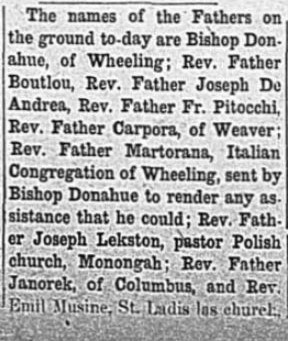
Bishop P.J. Donahue arrives by train from Wheeling joined by St. Peter’s of Fairmont priest Father Arsenius Boutou to assist the Monongah priests, Father Joseph Lekston & Father Joseph D’Andrea. Both Lekston and D’Andrea have been working nonstop since Friday and are close to exhaustion.

Father Joseph D’Andrea has also lost his brother, Victor D’Andrea, in the disaster. Victor was a father of 3 and his wife is 6 months pregnant. D’Andrea had worked for 3 days and nights, never stopping to sleep or bathe, continuously ministering to the bereaved and guiding coffin carts to correct homes.

The priests did services in the mornings and visited with families in the evenings.

Priests on the scene:

12.9.07 - pg 1 - Priests on ground
FWV 12.9.07 pg 1


At the mines:

“The work of rescuing bodies was resumed this morning…”

52 bodies have been recovered and the remains of 43 have been identified. (FWV 12.9.07 – pg. 1 – extra)

“Most of the bodies found have been those of foreigners and nearly all have been identified by their pay checks. [Th]ree large fans are pumping air into the mines and a pipe line 2.500 feet long was put in on the advice of Chief State Mine Inspector Paul as a precaution against fires.” (CET 12.10.07 pg. 1)

Weekend crowds and sightseers are gone. Only somber groups of men—relief workers, explorers, brothers and men waiting their turn to go in—remained around mines.

At the churches in Monongah:

Church basements became make-shift funeral parlors.

wagon by st stanislaus

Many came early to the Polish Catholic church, St. Stanislaus, “…a-foot, with bowed heads, sorrowing in low voices, sometimes a woman half held up by her companions, to that basement where the coffin lids closed in on blistered, swollen faces and parts of men.” (Kellogg)

“4 or 5 widows wept compulsively.” (Kellogg)

“An older woman read from a religious book held to the flickering light of a candle at the head of a closed coffin.” (Kellogg)

“A peasant, ugly with her pitted face, but beautiful in her great sorrow, bent often and kissed the lips of her husband.” (Kellogg)

“All of a sudden there was cry more piercing than the others. It was from an older mother who has lost 7—her husband, a son, 2 sons in law, and 3 nephews. She had come upon one of them, and the people with her could scarcely hold her. She threw her head on the casket and spoke to the boy fondly, trying to caress the crumpled face with poor, wrinkled hands. She had moaned all the way that morning from her lonely house to the church door, giving infinite sorrow to those who heard, and here her grief at last found vent.” (Kellogg)

frontThumbnail (6)

~8:30 am

12.9.07 - pg 3 - McDonough
CDT 12.9.07 pg 3

~9:00 am

The court of inquiry convenes in Monongah. (FWV 12.10.07 pg. 1)

“Coroner E.S. Amos, of Fairmont, is personally engaged in looking after the identification of bodies and is having a complete list kept, as well as recording the circumstances of identification and the disposition of the bodies. In this he is ably assisted by the several undertakers of this town, Fairmont and Clarksburg and other places. The jury organized by him will meet in Fairmont this morning at 9 o’clock to begin its work of investigation. Such representative men as W.S. Hamilton, Festus Downs, and W.E. Codray are members of the jury. Their work it is announced will be thorough and complete.”

The jury with Coroner Amos and Prosecuting Att. Scott C. Lowe went to No 8 and then visited No 6.

Jury visits

At the morgue:

“There is no more room in the morgue and the bodies are prepared at the mouth of the mine for burial.” (CET 12.9.07 pg. 1)

“In the case of complete identification, the bodies, after being viewed by the coroner and jury, are not held, pending further action of the coroner, as it is established, they all came out of the mine and met death by the same cause.” (CDT 12.9.07 xtra pg. 1) (CDT 12.9.07 xtra pg. 10)

Widows and family members were permitted “ample time” to view the bodies and attempt to ID them, but the time allotted for the body to be identified has been drastically diminished since the decision of the Marion County Health Board last night.

“After the identification of the bodies and they are claimed by friends, Coroner Amos holds the inquest and permits the relatives to remove them to their homes. The bodies of all Polish miners are being removed to the Polish church just above Monongah as fast as they are identified and are being placed in the basement of that edifice.” (US Dept of Labor-mine disasters-Dispatch article)

When ID is not possible, the body is taken directly from the mine entrance to the graveyard and buried immediately.

“Work of burying the dead that have been taken from the mines is in progress and because of the many bodies they have to be interred with dispatch and little ceremony.” (CDT 12.9.07 xtra pg. 1) (CDT 12.9.07 xtra pg. 10)

FB_IMG_1511974249680

In Fairmont:

“All organizations in the city are taking steps to institute relief measures” (FWV 12.9.07 pg.8)

In Clarksburg:

“The body of Patrick McDonough, the miner who was killed in the Monongah disaster, was brought to this city Monday morning on the 9 o’clock interurban car. Funeral services were held at 9:30 o’clock at the Catholic church and interment was made in Holy Cross cemetery. McDonough was a brother-in-law of Pat Connell and Thomas Gill.” (CDT 12.9.07 pg. 1)

The remains of Patrick McDonough were taken to Clarksburg. Patrick is brother of townsman, Policeman Anthony McDonough. (FWV 12.9.07 pg. 1)

At the mines:

Miners linger outside waiting to go into the mines. “The knot of silent mine workers in boots and corduroys and overalls could be made out from the rim of the bluff…; and at its edge sat in heavier silence a group of shawled women, waiting. Behind them ran a little street, thick in mud, with domino shaped stepping stones at the crossways with colorless little houses and propped walks and here and there dove-cotes nailed under the eaves or reared on poles.” (Kellogg)

12.9.07 - pg 4 - Funeral day
TES 12.9.07 pg 4

“The body of W.H. Byse will be taken to Roane county Monday for burial there.” (CDT 12.9.07 xtra pg. 1)

“Quite a number of Clarksburgers attended the funeral of John Howard Preston, at Monongah, Monday. Preston was a victim of the horrible mine disaster which occurred at Monongah Friday.” (TA 12.12.07 pg. 2)

“In the town families were mourning inconsolably the death or absence of a loved one and on all sides were little groups of weeping women and children. Thousands of strangers thronged the streets all day. They came from towns and country within a radius of many miles and by every means of travel.” (RP 12.9.07 pg. 2)

Some 30 – 40 funerals are performed throughout the day. “They were merely repetitions of those of Sunday, the crowds being almost as large and the scenes and incidents just as distressing.” (ES 12.10.07 pg. 1)

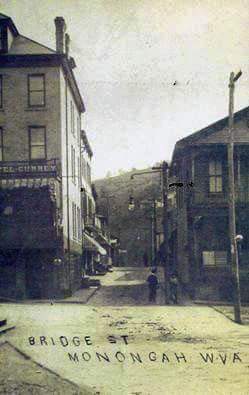
Churches near Bridge Street

A majority of today’s funerals are held in the little Polish Catholic Church located between the two mines. 5 priests directed funerals.

Father Boutlou held short funeral services for the Irish Catholics. (FWV 12.9.07 pg. 1)

“Services were held over several of the bodies at one time.” (CDT 12.9.07 pg. 1)

“The people gathered above, the men on one side and the women on the other, as is the custom in the Polish church. The candles of the little altar lit up the chapel as they had done on other Sundays and the familiar intonations of the mass brought a brooding quiet. Then the priest addressed his people in Polish and with his first words, they began to weep aloud.” (Kellogg)

A service preached by Rev. Father Emil Musine, of St. Ladis Las Church of Wheeling was of “a very effective discourse. Sobs and wails went up from the wives and children of the unfortunate. After Father Emil Musine’s sermon Bishop Donahue of Wheeling spoke words of consolation promising relief to the orphans.” (FWV 12.9.07 pg. 1)

In English, Bishop Donahue told the congregants that he empathized with them and how much “the whole world laments” the terrible disaster which “robbed them” of their loved ones. He concluded in assuring that he would do his “utmost” to help the people and if any of them found that they could not support their children that he would see that they “all were sent to orphanages” where they “would be well cared for”. For those who could not understand his words, they were soon told by their fellow congregants that could. Though his words “cheered” them to a degree, there was not a single woman in the church “who would part with a child, no matter how many she had, even if the pangs of starvation tempted her.” (CET 12.10.07 pg. 1)

“Outside, an Italian laborer offered his services for carrying the dead to the church yard. He spoke to a Slovak and said that everyone is the brother of the other, no matter what nationality he belongs to. He said it in broken English.” (Kellogg)

“The ministers refrained from making any reference to the catastrophe and the commitment services at the graveyard were as short as possible. There were no carriages and no flowers. The caskets were hauled for the most part in undertakers’ wagons. Large crowds of pedestrians followed and the church was crowded almost to suffocation. Several of the services were interrupted by women fainting, causing momentary excitement, but this was soon dispelled.” (RP 12.9.07 pg. 2)

~10:00 am

“Up to 10 o’clock the list stood at 53.” (OTC 12.10.07 pg. 1)

At the morgue:

The temporary morgue inside the First National Bank is getting overwhelmed; coffins and bodies begin lining the streets in front of the bank.

mmd-mining2

On the west side of Monongah:

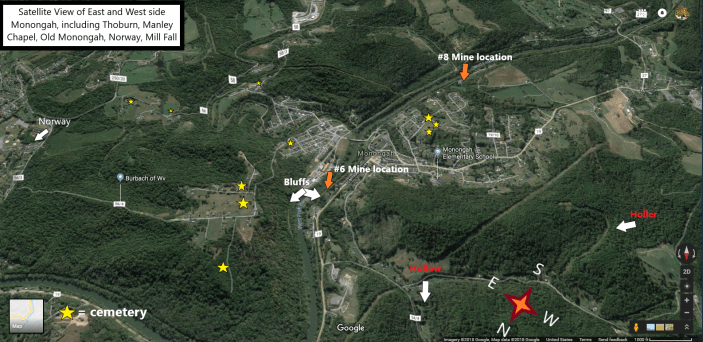
The National Guard, called in by Governor Dawson, arrives and sets up on the north side of the Italian side of the largest graveyard. (McAteer)

They set up their large white tents in typical military fashion with graves in front, resembling military trenches.

These tents will act as a secondary morgue and will serve the needs of the gravediggers.

“Captain M.M. Neely furnished a big tent that has been pitched near the Catholic church. The tent is being used for the Italian morgue. The bodies are first identified at the morgue proper and are then taken to the tent. So far there has been a change in the name of one man.” (FWV 12.9.07 pg. 1)

file


On the east side of Monongah:

Paul Kellogg has wandered over to the corner of Main street, where the morgue has begun to lay coffins with prepared bodies out for identification. “At the end of the street were store buildings, and the Italian woman who kept one had let them leave a coffin box on her steps until the right household should be found.” Kellogg talks with this woman at length. “Standing at the head of the street, she pointed out with stretched finger the houses in a row on the bluff where the shawled women sat and waited…and she raised and lowered her arm in a counting of the houses, one after another.” She describes the condition inside several houses where losses have been felt:

Of the man and 7 boarders killed at house No 151— “All married. Old country. No see ‘tall, no see. He can’ find. All burn.”

“Woman cry all time,” she said of another house with three boys killed. (Kellogg)

“A hearse drove up to the corner house and the driver beckoned to me and to a workman who had come up. There was a coffin to be taken away and he needed help lifting it. The women had to be pushed back while he worked at closing the lid. Their cries rose and fell in that half unison of Slavic people which makes almost a ritual sobbing. The wife stood on the porch as they drove off; bare armed, stupid in her loss, her face knotted with two little, open-mouthed children whimpering and plucking at her apron and behind them a grandmother.

“A little red-cheeked Irish boy had poked his way into the Slavic house as they lifted the body out. He was going for the doctor, he said; the baby had been sick all night. ‘Got heem pap yet?’ asked the Italian woman. ‘Nope,’ said the boy.” (Kellogg)

“Across the street the tears were running down the face of the Italian storekeeper and she was giving herself up to the impetuous crying of her race.” (Kellogg)

~11:00 am

In Columbus, Ohio, Governor Andrew Harris has “ordered the chief state mine inspector, Harrison and deputies to Monongah, to make a careful investigation of the circumstance surrounding the explosion there. The information secured will be applied to correcting any shortcoming in Ohio mines. Inspector Harrison left for Monongah today.” (RP 12.9.07 pg. 2)

“It is a low estimate to say that the recovery of the bodies of the victims of the mine explosion will cost the coal company at least $75,000 and possibly a great deal more. But this is an item the company has not even thought of and it will spare no effort or money to recover every body from the mine.” (CDT 12.9.07 xtra pg. 1)

“The property loss will be very heavy, as the artificial interior work of the two mines was entirely destroyed to the extent of the tracks being torn all to pieces in the mine No. 8 especially where the rails broke and curled themselves up into rings.” (CDT 12.9.07 xtra pg. 1)

“Not taking the loss of life into consideration and the out lay that may result from that, the company’s loss will reach at least a quarter a million dollars, and, unless No 8 can be saved from fire, the loss will reach many millions.” (CDT 12.9.07 xtra pg. 1)

“The task of taking out bodies from Nos 6 and 8 mines will not be completed before the end of the week. Sixty-six bodies have been taken out of the mine heading of No. 6 at 11 o’clock. It is still impossible to reach many in the rooms leading off from way headings, owing to afterdamp which continues there.” (CET 12.9.07 pg. 1)

In Monongah:

“No more touching spectacle could possibly be witnessed by human eyes than to see the bereaved women and children of Monongah walking the streets wringing their hands and crying grief for loved ones…” (FWV 12.9.07 – pg. 7)

Women wander the streets aimlessly, wailing in the pouring rain. (Scalabrinians)

“Two Slav women, with big boned grief wrenched faces, were walking up and down the street, going nowhere. They wore great shawls, and diagonally across their breasts were the papoose-like bodies of their babies, wrapped in with a knack which is handed down by the mother wit of the old country.” (Kellogg)

“Part way along an angling road, lined with older company houses, I came upon a woman of perhaps 55 and her daughter. They walked spiritlessly as if climbing a long hill. 5 other daughters and a son’s wife were waiting for them in a house beyond, –8 women and 2 men gone. These were West Virginians, I took it; at least they had seen the settlement grow up about the mines and knew its people as only villagers do. What were just door steps and dull windows to me, were individualized to them…the mother counted them off as we went.” (Kellogg)

“Farther on was a little 5-year-old girl, playing by the fence. ‘We’ve got two dead in our house,’ she said, smiling.” (Kellogg)

women at 8


More on How Death Gloated!

Bibliography

Disclaimer and Guide

Introduction

About the Author

Contact Information

Monday, December 9, 1907, Midnight – Dawn

“Semi-officially it is stated that the street cars hauled fully 35,000 people both ways yesterday, making it a record-breaking day in the history of the interurban line. Many thousands were here from Clarksburg and, owing to the lack of facilities on the upper end of the line to handle the immense crowd, they did not all get away until 9:30 at night. Many spent as many as three hours in attempts to board the cars. On the Fairmont end cars were more numerous and ran more frequently, but the crowds from that terminal of the line were much larger.” (CDT 12.9.07 xtra pg. 4)

MF17

~12:00 am

Outside the mines:

“Sixty hours after the explosion of black damp…, fifty-three bodies, or only about one-eighth of the total number of victims, have been brought to the surface and less than one-fourth of the total number have been actually located.” (SFNM 12.9.07 pg. 1)

“But, at midnight there was no indication that the work of rescue would be resumed so early, as the condition of mine No. 8 was very perilous, the heat there being registered at 110 degrees, and thus making it impossible to penetrate the mine. Most of the work of the night at this mine was in preparing to place brattices in No. 8.” (CDT 12.9.07 xtra pg. 4)

A majority of rescuers have not been home since Friday nor have they slept or rested. Doctors stand outside at the entries of the mines and give the men some “tablets to stimulate their over-worked hearts and lungs.”

“All night long hot soup was served to those who were exploring the mines in hope to find some fellow workman.” (FWV 12.9.07 – pg. 1 – extra)

“Several relatives from Clarksburg of entombed miners have been here since Friday evening awaiting the bringing of their loved ones from the ill-fated mines, with the result that to date but one—Patrick McDonough—has been recovered from the mine. They will continue to remain here as long as there is hope of getting their relatives out.” (CDT 12.9.07 xtra pg. 4)

“Here for 60 hours men had worked, feverishly and unafraid, to wrest blackened bodies out of the ground that they might be counted and put back; and here at this same pitiful commission they were to work for a week to come.” (Kellogg)

Inside the mines:

“The deadly black damp hinders the work of rescue quite as much as the broken rock and timbers. It is this which most exhausts the men.” (RP 12.9.07 pg. 1)

“Most of the bodies are decomposing and this renders the work of the searching parties doubly hard.” (WT 12.10.07 pg. 5)

In Monongah:

“During the night, guards employed by the owners have been greatly increased until each piece of property looks like a fortress. Pedestrians passing through the mining camp were held up by mine guards and compelled to account for themselves before they were allowed to proceed. This action was resented in a number of instances, but didn’t deter the guards from carrying out their instructions.” (PES 12.9.07 pg. 1)

~2:00 am

At #8:

Search given up for a while but resumed in early hours. “The fire, which broke out afresh in No. 8 shaft, was extinguished soon after 2 o’clock this morning. Almost before the smoke had ceased arising from the ruined workings a relief party had started down the shaft and were striving to clear the passage into the farther recesses.” (WT 12.9.07 pg. 5)

MON6LG

~2:15 am

At #8:

“At 2:15, however, another fire broke out beyond the third entry, accompanied by an explosion. The explosion did no additional damage but the fire once more drove the workers out.” (CET 12.9.07 pg. 1)

“Fire, which began yesterday, was extinguished early today in mine No. 8, but a second fire occurred, which delayed rescuing.” (PES 12.9.07 pg. 1)

“The fire in No 8 shaft broke out again this morning, followed by another explosion, which fortunately did little damage and hurt none of the rescuing party. It took three hours, however, to get the shaft in such condition that the workers could continue.” (WT 12.09.07 pg. 5)

~3:00 am

“At 3 o’clock this morning the rescue party had not resumed work. It is now accepted that mine No. 8 is on fire and the effort to divert the air current from No. 8 into No. 6 has not as yet been successful. Activity will be renewed at daybreak to get the fans in successful play on No. 8.” (CDT 12.9.07 xtra pg. 1) (CDT 12.9.07 xtra pg. 10)

4 bodies are taken out of #8. 3 bodies are taken out of #6 (FWV 12.9.07 – pg. 1 – extra)

~4:00 am

“The fire which started in mine No 8 this afternoon is now under control and is said to have done little damage. Rescue work will be resumed as soon as the federal and state authorities finish an investigation they are making and pronounce conditions safe.” (SLH 12.9.07 pg.1) (LAH 12.9.07 pg. 2)

All headings are explored and no active fire is found. Smoke fumes are present at all times but no fire. (McAteer)

~5:00 am

At the mines:

“A large force of skilled miners, volunteers for the hazardous task of rescue work are on the scene, ready to re-enter the mines and take up the work where they were forced to leave it yesterday when fire broke out in mine No 8. These men await only the word from Clarence Hall, the expert of the federal government, and J.W. Paul, West Virginia’s chief mine inspector. These men are now in charge, superseding officers of the mining company and others who directed the rescue work.” (ES 12.9.07 pg. 1)

“Moving steadily about the ground at the man-way, meeting them on equal terms, was Lee L Malone, who they tell you, worked his way up from digger to general manager and has always stood close to his men. I heard him speaking to J. H Wheelwright, VP of the company, during a lull in relief work while the state inspectors were investigating the localization of afterdamp to the left and south of No 8 mine. These two had been at the mine almost continuously since the disaster and they were going over some of the men who had been killed, calling many of them by their first names—the ‘best pit boss in the state’ and so on.” (Kellogg)

“Volunteers who had worked with them other years came up to shake hands and others to tell how old Jerry Nicholas had for a second time saved his skin in a mine disaster by going on a spree the night before.” (Kellogg)

“’We never thought we’d live to see the like of this in this country.’ Wheelwright stamped his feet with cold and impatience. ‘It seems so slow,’ he said, ‘when you aren’t taking men out and pushing ahead.’” (Kellogg)

Kellogg meets a “young foreigner with two checks pinned on the breast of his overalls, which showed that he had been working on the rescue shifts in both mines. He was an explorer and he had been out and in since Friday evening, 3 days and 3 nights without a break long enough to lie down.”

In the Monongah offices:

“Equally approachable was Pres. C. W. Watson, at the office of the company at Monongah, where relief workers and reporters were finding their way through every door and where 2 of the secretaries acted as a bureau of information. The general attitude of none of the public’s business, adopted by some corporate officials at such times, was entirely lacking.” (Kellogg)

Outside the mines:

“The fire in No 8 mine, which started late yesterday afternoon, was walled in this morning, and following an examination by… Inspector Paul the rescuing parties again began their quest for the dead.” (ES 12.9.07 pg. 1)

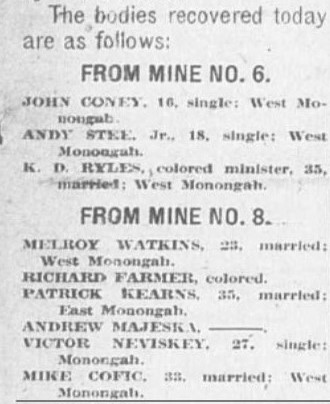
“From 5 until 7 o’clock this morning the bodies of John Coney, Andy Stee, and K.D. Ryles were taken out of Mine No. 6 and the bodies of Melroy Watkins, Richard Farmer, Patrick Kearns, Andrew Majeska, and Victor Neviskey were taken out of Mine No. 8.” (CDT 12.9.07 pg. 1)

These men will make up bodies #44-#51 of the Coroner’s List.

“All through last night the work of recovering the men entombed in the mines here went steadily forward, shift followed shift into the black opening of the man-ways, and shift after shift dragged themselves into the fresh air, reeling and exhausted. These, as they appeared were forced into the temporary hospitals, but they refused to take rest.” (RP 12.9.07 pg. 1)

At the morgue:

“Outside the morgue in the mud stands a shivering mass of humanity, many of the people have been there for hours, braving the cold to get a chance to once again gaze on the face of their dead loved ones.” (US Dept of Labor-mine disasters-Dispatch article)

Coroner Amos has this notice posted to the door:

12.9.07 - pg 1 - notice from Amos

Dawn:

In Fairmont:

“At dawn began the struggle of thousands of people to reach Monongah from Fairmont. The transportation facilities are meager and it is common sight to see persons boarding the cars through the windows.” (ES 12.9.07 pg. 1)

“There was a group of Italian laborers before the fog hung court house in Fairmont, where we took the car in the early morning. They were huddling, dark-skinned little men from South Italy, such as stand unnoticed; but my fellow traveler was Naples born, big-hearted in his love for humble folk, and his ears caught judgements being passed by these peasants from the Abruzzi, from Terra di Lavoro and Calabria. Now and then their words broke off in sighs—signs, he told me, ‘for the fate met by their brother workers and for the destitute condition in which so many families had been left.’ Today, tomorrow, and God knows till when, these laborers are to be grave diggers.” (Kellogg)

In Monongah:

“Guards have been placed about Monongah, and the town is practically under martial law, though good order has prevailed.” (WT 12.9.07 pg. 5)

Undertaker Cunningham is still confined to bed at the Curry hotel. (FWV 12.9.07 pg. 1)

“The details for the transportation of friends to the place of burial has not been worked out yet but will soon engage the attention of the officials. All the arrangements for the transportation of the corpses have been made.” (FWV 12.9.07 pg. 1)

At the mines:

“Here and there among the debris were groups of twinkling lights, the lamps of the dead miners. As the dawn brightened the car tracks became black with moving processions of people, which halted and bunched around the mine.” (RP 12.9.07 pg. 1)

“The hammers of a score of men working on a temporary morgue rang out sharply. Cots, beddings, blankets and stretchers were stacked here and there. Special officers kept the crowd beyond a barbed-wire barricade.” (RP 12.9.07 pg. 1)

“Though the rescuers have been practically through the main heading of mine No. 6, yet the larger portion of the mine has not yet been penetrated. There has been virtually no progress at the other mine, though a small number of men have been taken out at some of the hill openings. The main heading has not yet yielded to any appreciable extent to the work of the men engaged in trying to enter it.” (CDT 12.9.07 xtra pg. 1) (CDT 12.9.07 xtra pg. 10)

General Manager Malone said this morning that the searching parties are unable to find the ill-fated men. “Whether the men have been blown to atoms or whether they are still farther back is not apparent at this time.” (FWV 12.9.07 pg. 1)

Outside #8

“Suddenly out of the lark mouth of the slope came one of the night shifts, a dozen men in all, roped together like steers. Their faces were black and gleaming with sweat. Their eyes rolled whitely. The leader seemed strong enough but number 4 staggered and hung to his rope. The last man out, a huge Norwegian cursed savagely. “No use,” he said, “It’s hell in there. What’s the use anyway. The mine is on fire, look.” (RP 12.9.07 pg. 1)

~6:00 am

In Fairmont:

Fairmont mines back up and running. “There was little coal loaded. It is thought that in a few days that practically all the mines will be running about normally.” (FWV 12.10.07 pg. 1)

In Monongah:

“Double rows of brown trenches in the little cemetery will soon mark the last resting place of the 400 victims of the explosion…” (WT 12.9.07 pg. 5)

“On the hillside above the mines where there is a hamlet, women have stood and sat from the very hour of the catastrophe. Hunger and cold wake them not from care and grief and they have not been persuaded as yet to return to their homes or to take nourishment. Others lie at their homes prostrated. Some in delicate condition have been thrown into grave sickness since the news of the disaster reached them, and the unborn have been born but not to live to learn of the terrible fate of their fathers.” (CDT 12.9.07 xtra pg. 4)

“All business is suspended and the town and its surviving inhabitants have assumed an attitude of mourning and melancholy. All the stores and business places have been closed since the explosion occurred and those who are not prostrated with grief are making efforts to rescue the perished miners and comfort those who are stricken with grief.” (FWV 12.9.07 – pg. 7)

“While the coal company and others have furnished a great many food supplies, every car coming into the city, yet there is more than a well-founded belief that universal hunger and physical distress will soon prevail, in fact, there is already crying need for help.” (CDT 12.9.07 xtra pg. 1)

At the mines:

(By United Press) “Fire which broke out in No 8 mine, stopping the rescue of the bodies of the entombed miners yesterday, was extinguished at 2 o’clock this morning. At 2:15 a.m., however, another fire broke out beyond the third entry. This fire was put out at 6 o’clock and at 9 o’clock eight more bodies were brought out.” (TEP 12.9.07 pg. 1)

“The rescue forces at work at Mines Nos 6 and 8 have been augmented by men from Enterprise and Georges Creek and Frostburg, Md. These men kindly volunteered their services and have gone in work with the rescuing party with vim and willingness.” (CDT 12.9.07 pg. 1)

“It is expected that 100 bodies will be recovered today, if there are no more fires.” (PES 12.9.07 pg. 1)

“Cars have been stationed at the mouths of the shafts and as quickly as the bodies are taken out they will be cared for.” (Wash. Times 12.09.07 pg. 5)

“Trouble has arisen between the board of health and the mine officials.” (Wash. Times 12.9.07 pg. 5)

“Health authorities and the mine officers are now in a clash. The health board wants to bury the dead bodies in a trench without identification, while on the other hand, the mine officials wish to turn them over to friends. This argument between the two interested parties is doing much to increase sorrow of the immediate families of the dead miners. It too, is delaying the work of rescuing parties.” (RP 12.9.07 pg. 1)

At #8:

“While the company does not admit it, there is a general feeling that No. 8 is afire, and the intense heat would indicate it. The blaze it is believed is inside the mine a considerable distance. Owing to this work there will likely progress very slowly.” (CDT 12.9.07 xtra pg. 4)

“This morning a gaunt old miner named John Morgan came staggering out of the hole at No. 8, gasping for breath. He was noted for his bravery. He had been a miner all his life and his face was shot blue with oil burns from the blasting. ‘I have been back a mile and a half,’ he said. ‘I went in as long as I could get any air. I had to crawl out with my mouth to the ground to get breath. There is no hope. They are all dead. They are at least two miles in.’ Outside the crowd, gazing over the sunny hills, measured a mile and a half with their eyes. ‘Why it must be away over there,’ said one, indicating the far-off sky line. Yes, just beyond that sky line there were hills and hills outside the range of vision under which the dead were lying in hundreds.” (RP 12.9.07 pg. 1)

Inside the mines:

“…between 300 and 400 in number, lie in unknown sections of the vast workings in the bowels of the great hills that overlook the town and extend two miles and more back from the main entries to the mines. These unlocated bodies…are seriously menaced by two destroying elements—by decay in the overheated, humid and vapor-poisoned atmosphere of the mines, and by fires that are smoldering here and there in the workings, and from time to time, bursting into flame. Steadily the chance is ebbing that these bodies will be brought to the surface, identified by friends and relatives and given Christian burial.” (ES 12.9.07 pg. 1)

At the morgue:

“The body of Patrick McDonough, the Clarksburger, who was killed in the mine disaster, has been prepared for burial and will be taken to Clarksburg for burial Monday morning. Now is the time for all good men to come to the aid of the people.” (CDT 12.9.07 xtra pg. 1)

Bodies are getting to point of unidentifiable; “Many were brought forth with their heads literally torn off, others are without arms or feet. One was entirely naked, another had only a small part of the underpants, still another nothing but the heel of a shoe. Motorman Ford, only the arms and legs, which were found at the motor where he was stationed at the time of the explosion. His body has not been found and probably will not be. Many were terribly burned.” (CDT 12.9.07 xtra pg. 4)

“An undertaker is authority for the statement that of the fifty-three bodies handled only three were intact. Some were headless, arms were missing from some and legs or other members from others.” (ES 12.9.07 pg. 1)

~7:00 am

In Monongah:

Weather worsens. “It was drizzling and a heavy mist hung over the river, shutting off the bare hills that bunch close at #6 mine and blanketing the trestle work. Seemingly, from every pore of the earth there rose a white cloud which wrapped old objects in new meanings—a broken wheel, the dirty white of some clothes left in the corner, the gleam of the rails.” (Kellogg)

At the morgue:

“The reports here are as unreliable as they are numerous. The undertakers have lost about fifteen hours sleep on account of the fake reports of bringing in more bodies.” (FWV 12.9.07 pg. 1)

“Of the 43 bodies recovered from the mines, all but 9 have been identified. All of these bodies were horribly mutilated by the force of the explosion.” (Wash. Times 12.9.07 pg. 5)

At the mines:

“The scene at the mines has not changed much since Friday.” (FWV 12.9.07 pg.8)

The body of Charles McKain has been located and will soon be brought out. His remains will be interred at Clarksburg. (FWV 12.9.07 pg. 1) (FWV 12.10.07 pg.1

The body of Mike Cosic has been recovered and identified. (FWV 12.9.07 pg. 1) Mike is body #52 on the Coroner’s List.


More on How Death Gloated!

Bibliography

Disclaimer and Guide

Introduction

About the Author

Contact Information

Sunday, December 8, 1907, Night

“At the home of Mrs. John Hearmans, at Monongah, is one more little soul needing the care which the dead father cannot give. Yesterday at about the same time that the body of her husband was brought from the mines Mrs. Hearmans gave birth to a fifth child. Her condition is serious. ‘He shall never be a coal miner,’ she sobs of her little son, as her wet eyes rest upon the casket of her husband.” (CET 12.9.07 pg. 1)

~10:00 pm

“It seems that casualties and disasters follow so closely upon each other that events which in former years would have thrilled the country in when they happened now excites only conventional expressions of pity.”  (TBS 12.8.07 pg. 4)

 “… the city council sent messages for aid and quick response is expected from surrounding towns.” (TES 12.9.07 pg. 4)

At the mines:

“62 bodies have been taken from the mines late tonight. This number will be augmented by at least 30 more by daylight.” (US Dept of Labor-mine disasters-Dispatch article)

“A young volunteer in a smudged grey sweater, turned out to be the son of a Michigan judge. He had been a mine superintendent at one time and as he had taken a hand in rescue work following 3 explosions they had put him at the head of the exploring work of a party—the most ticklish job of all. ‘These are picked men,’ he explained, ‘at the same time, some hang back when it comes to going into the chambers. If a man goes in there with you, then he’s more than picked. Some like to feel that so we sort of pass the chance around.’ (Kellogg)

 “While more headway has been made, the herculean task of recovering scores of the bodies in any recognizable shape has been abandoned, according to the opinion of mine experts on the scene.”

“It was reported yesterday that the undertakers have ceased to embalm the bodies but it was stated at the morgue that these men will not shrink from their duty however unpleasant it is. The company is desirous that the bodies be made as presentable as possible but if the board of health decides that the decomposition is in a stage too far advanced for convenience and safety the bodies will be removed from the mines, identified at the mouth so far as possible, then buried immediately. It is quite likely that this will be done so the chances are that the majority of the women who saw their husbands or sons go down into the mines alive and happy Friday morning will never again gaze upon their faces that are now cold in death, battered, many of them into and unrecognizable mass” (CET 12.9.07 pg. 1)

“I talked with an Irishman from PA who had ‘come to help.’ Beside him was another Pennsylvanian, a rescue man, who had worked 5 days the week before in Naomi mine, where 36 had been killed.” (Kellogg)

“An old miner, with red cheek bones and dusty wisps of hair at the ears, had carried out two dead men who had been overcome by blackdamp while cementing.” (Kellogg)

“Hope has gone that there can be any living soul in the mines, but there is a burning desire on the part of relatives to obtain possession of the bodies. If this cannot be granted their grief will know no bounds. Thus in gloom and doubt and despair passed the saddest Sunday Fairmont has ever seen.” (CET 12.9.07 pg. 1)

In Monongah:

“One of the many sad occurrences of the disaster and its consequences was the death Sunday night of Mrs. Lawrence Heinerman, widow of one of the victims of the disaster, whose body was among the first taken out of Mine No. 6. She died of childbirth and doubtless her delicate condition was aggravated by the mine horror.” (CDT 12.9.07 pg. 1)

Mrs. John Hinerman, wife of one of the first victims that was found gives birth and dies in labor. Her death leaves 5 small children without any parent. The child died also. (FWV 12.9.07 pg. 1)


More on How Death Gloated!

Bibliography

Disclaimer and Guide

Introduction

About the Author

Contact Information

Sunday, December 8, 1907, Late Evening/Night

Stories told of a man working his first day in the mines on the 6th; he was a carpenter who leaves a wife and 6 small kids. Another miner had arranged to move away but decided not to move until Monday. An unknown young man from Cleveland came in a few days ago, saying he wanted to earn some money – family may not know of his whereabouts. (FWV 12.9.07 – pg.8)

Late Evening / ~ 7:00 pm

In Monongah:

Members of the County Board of Health, including Dr. C.O. Henry the county health physician, arrived at Monongah during the evening and held a session in the Curry Hotel and after the meeting this notice was issued:

12.9.07 - pg 1 - Health Board 112.9.07 - pg 1 - Health Board 212.9.07 - pg 1 - Health Board 3

Inside #8:

“The mines are on fire again tonight and the work of rescuing the bodies of the dead cannot proceed further until the flames have been extinguished.” (WH 12.9.07 pg. 1)

“The flames have been fought by every possible means, including the laying of a water pipe driven far into the mine. This was the second fire since the explosion. The first fire started Saturday morning but caused only a short delay.” (ES 12.9.07 pg. 1)

Outside of the mines:

“Rescue worker talking to crowd, ‘The people who are on the outside of the mines know nothing at all of the conditions in the mines. At one place we found 17 cars piled in a heap and legs of men could be seen but it was impossible to remove them.’ He said in places the rescuers had to crawl through small holes to get back to men.” (FWV 12.9.07 – pg.8)

“The scenes round about the entries to the mines and throughout the town are even more pathetic and heartrending than those that usually attend a mine disaster, because of the larger proportion of citizens, native and naturalized, than is usually found in a purely mining settlement.” (MD 12.11.07 pg. 2)

“Wives and mothers and sweethearts, together with children and members of the stronger sex, moving from place to place, vainly seeking information and making no attempt to conceal the grief that overwhelms them.” (MD 12.11.07 pg. 2)

In Monongah:

“An unknown boy was run over by one of the trolley cars Sunday evening and had a leg cut off. He was rushed to a hospital in Fairmont.” (CDT 12.9.07 xtra pg. 1)

“John A. Clark, coal operator, was injured in a runaway Sunday evening, but not seriously. He had a shoulder hurt and was badly bruised up.” (CDT 12.9.07 xtra pg. 1)

Nightfall / ~7:30 pm

Relief Committees are named and organized (FWV 12.9.07 pg. 8)

“But 53 bodies had been recovered…when darkness closed over the little town of Monongah Sunday night.” (News)

“Officials of the Fairmont Coal Company issued a statement Sunday night saying that 406 men were listed on the payrolls the day of the disaster, and that of these, so far as is known, 371 were victims of the explosion. Of the total listed on the payrolls, 35 have been accounted for. Two of these were injured, 18 located the day of the explosion and 15 accounted for Sunday. The number of victims according to the first report was placed at 391 men, but 7 men later reported at the company’s offices, swelling the number accounted for to 35 men.” (CDT 12.9.07 xtra pg. 1) (CDT 12.9.07 xtra pg. 10)

“It is now believed that the number of dead will not be over 400. A thorough investigation was instituted by the company today and it was discovered that many miners believed to have been entombed escaped because they had not gone to work Friday, after Thursday’s holiday. A score or more of these men reported to the officials during the past 24 hours.” (SLH 12.9.07 pg.1) (SFC 12.9.07 pg. 2)

~8:00 pm

“On account of fire in mine No 8, and imminent danger of an explosion in mine No 6, all rescue work has been suspended for the night.” (News)

Clarksburg Daily Telegram:

12.8.07 - pg 1 - headline

12.8.07 - pg 1 - Monongah - list 112.8.07 - pg 1 - Monongah - list 2

“At Monongah it is impossible to get any place to sleep or anything to eat. All the hotels are crowded and running over and most all of the restaurants are out of anything to sell. One is lucky to get a cup of coffee to drink and a chair to sleep in or a board to lie upon is the best that can be obtained. Many of the doctors, undertakers, and newspaper men sleep anywhere or upon any thing when the chance comes to get a wink of sleep.” (CDT 12.8.07 pg. 1)

“It is estimated that fully half of the English-speaking miners were at work in No. 6 and No. 8 when the disaster came.” (CDT 12.8.07 pg. 1)

“The Telegram men stayed at Monongah sending reports to this paper and as soon as they became exhausted, they returned to Clarksburg and were relieved by others from the office, who are now on the scene. Many newspaper men can find no place to sleep save in chairs and on boards and the find their work quite strenuous. Some of them stayed up working for forty hours at a stretch and then after a few hours nap they are up again and hard at it.” (CDT 12.8.07 pg. 1)

~9:00

“All twelve of the deputy mine inspectors in this State arrived last night and under direction of State Mine Inspector James Paul spent several hours testing the air in the mines. The work of searching and recovering bodies was suspended on that account until morning and the undertakers were all directed at 9 o’clock to retire for the night, but to be ready at 4 o’clock this morning for duty.” (CDT 12.9.07 xtra pg. 4)

“The coming of the county board of health reveals a troublesome situation.” (CET 12.9.07 pg. 1)

“The bodies recovered are in such an advanced stage of decomposition that they are regarded as dangerous to handle, in addition to being a menace to the community.” (CET 12.9.07 pg. 1)

Outside #8:

“Two arc lamps lighted up the manway and the bright tin tags of a new checkboard.” (Kellogg)

“By Sunday night, the crowd of watchers had thinned out, but a fire blazed in the roadway below the ropes, and a nondescript group sat about on kegs in the warmth of it and watched. I remember a middle-aged man with a seamed forehead and a heavy neck. He had big pads of hands and sat with them on his knees, gazing in the flame stolidly.” (Kellogg)

“There was a group of Fairmont boys who were there with the zest with which they would have gotten up to see the circus come in…2 or 3 Negroes with muddied shoes and torn clothes…a spare woman with a shawl over her head, pinched shoulders and the suggestion of approaching motherhood in the set of her figure. When she turned her back to get warm, you saw that she was twisting her thin fingers behind her and she kept it up indefinitely.”  (Kellogg)

Italian laborers are piling cots for stretchers and pushing carts of lumber across the trestle for brattices.  There was a “flare of torches part way over the trestle across the river, where they were pushing hand cars of lumber for brattices. (Kellogg) (McAteer)

frontThumbnail (31)


More on How Death Gloated!

Bibliography

Disclaimer and Guide

Introduction

About the Author

Contact Information

Sunday, December 8, 1907, Late Afternoon – Evening

“Tonight, the work of the rescue has been turned to a struggle to the death with the fire demon.” (US Dept of Labor-Dispatch)

~5:00 pm

“When the fire broke out forty-two bodies had been recovered, forty-two out of the 391 who were known to have been in the mine. Add these to those who worked outside who were hurried to death by the force of the explosion or struck by the flying missiles, and it makes a total death list of 406. The list may even be larger than that.” (WH 12.9.07 pg. 1)

“It is not known just how long a man can stay in the foul air of the mines and relays of fifteen minutes have been provided. With clock-like precision the relief appears and good progress was made all day until halted by the fire.” (RP 12.9.07 pg. 2)

MT6

At #6:

The fan is stopped and all are ordered out of the mine because of developments at #8.

Inside #8:

“Shortly after 5 o’clock Sunday afternoon fire broke out again in mine No. 8 and the rescuers were at once ordered to the surface.” (FCT 12.13.07 pg. 1) (AMJ 12.9.07 pg. 1)

*As #8 fills with smoke, all miners abandon for the surface.

“For the first time since Friday morning the heroes in the rescuing parties turned their backs on their dead comrades in the mines. If the flames are not soon extinguished there will be little hope of recovering many of the bodies which are hidden in the recesses of the frowning hill.” (US Dept of Labor-mine disasters-Dispatch article)

*As they emerge from the mine mouth, many miners report smoke and “fire” in parts the mine to the first officials or leaders they find, though no sign of burning is yet visible to the outside. To an experienced miner, “fire” can mean may more things than ‘flames’. But to the average onlooker, the word “fire” conjures only one meaning in their minds. These leaders at the mouth of the mine have the authority to take initiative without reporting to any other company official like Haas and so they do. They order immediate evacuation and send word directly to #6 to do the same.

*Even the reporters who are lingering about the mine mouth hear these reports before Frank Haas who is watching on (probably from the other side of the trestle) and sees only what he expects to see: a new fan installed and the remainder of the crews evacuating both #6 and #8 mine, just as planned.

“The fire was located by one of the rescuing parties which had penetrated 1,500 feet into No 8 mine.” (US Dept of Labor-mine disasters-Dispatch article)

The fans are stopped and “Efforts were then directed toward extinguishing the fire and it is thought it will be subdued within a few hours when the work of rescue will again be taken up.” (FCT 12.13.07 pg. 1) (LAH 12.9.07 pg. 2)

*Some people—either reporters, workers, visitors, etc.—rush to the company offices in the middle of town to announce that the workers have found “fire” in #8.

In the Monongah offices:

“When the report of the fire was first received at the offices of the company at Monongah, an official denial was made and the same explanation given of the stopping of the fans as had been made at the two mines.” (US Dept of Labor-mine disasters-Dispatch article)

“A second explanation was that it was feared the gas in some of the sidings and rooms bratticed off might escape and imprison the rescue parties in No 8, who were farther in the mine.” (US Dept of Labor-mine disasters-Dispatch article)

Inside #8

*3 smoldering areas discharging smoke are found and the water line is moved up to 1st south.

“…it was believed that another fire existed to the left of the main entry in No 8 and Chief Inspector Paul thought it advisable to withdraw all men from both mines and concentrate attention on this fire before carrying rescue work further. This plan was followed out…” (FWV 12.10.07 pg. 2)

“Later conditions became much worse and it was impossible to longer conceal the fact that fire had been discovered.” (US Dept of Labor-mine disasters-Dispatch article)

In Monongah:

*Word once again reaches the offices about “fire” in #8.

“It was declared that there was no fire in the mine and that the reason the fan had been stopped at that mine was to allow the installation of the second motor fan and to prevent fresh air reaching any possible explosion that might occur. Orders had been sent to No 6 mine to stop the big fan there for fear of an explosion.” (US Dept of Labor-mine disasters-Dispatch article)

At #8:

“Through the air holes leading to the surface and through fissures caused by the impact of the explosion smoke began to escape. The fire is in one of the left side entries of No 8.” (US Dept of Labor-mine disasters-Dispatch article)

Outside the mines:

*When smoke is visible in the air around #8, it is obvious to every one in the area that something within #8 is burning.

“Everyone was warned to be as far away from the mine as possible but this appeared to make people more anxious to approach the mine. The rumor spread like wildfire that No 8 was on fire and an explosion was feared in No 6 from gas communicating with the flames.” (US Dept of Labor-mine disasters-Dispatch article)

“It was necessary to have a large force of mine guards, special officers, and police from Fairmont to aid in holding the crowds in check at this point owing it to being situated near Fairmont.” (US Dept of Labor-mine disasters-Dispatch article)

At #8:

“Thousands of sightseers from the surrounding towns had gathered about the openings. Through megaphones the crowds were notified of the fire and the danger of another explosion, but they refused to leave, and it was with great difficulty that the special police, assisted by many miners, forced the people to seek places of safety.” (News)

“Tonight C.W. Watson, president of the company, stated that the serious were pressed back and left the scenes reluctantly until the guards announced that another explosion was liable to happen at any moment. Instantly the crowd scattered along the trolley tracks, over the hills and some ran pell mell across the bridge to the town.” (US Dept of Labor-mine disasters-Dispatch article)

“There were some about the mine entrances, however, who did not join in the panic. These were men and women who had dear ones in the smoking entries. Instinctively they desired to remain, regardless of their own danger. Some had to be driven back from the fatal site.” (US Dept of Labor-mine disasters-Dispatch article)

widows at 8

~6:00 pm

In Monongah:

Bodies are getting to be so numerous that the families’ abilities to ID and the morgue’s ability to wash, embalm, dress, prepare, and present the bodies cannot keep up.

“While the workers in the mines were assailing this new terror the work of relief was going on. The morgues were crowded and upon the hillside the bodies of some of the victims were being committed to the grave.” (US Dept of Labor-mine disasters-Dispatch article)

FCC gives an official statement to the press. (FWV 12.9.07 pg. 6)

12.9.07 - pg 6 - FCC statement - detail 1

12.9.07 - pg 6 - FCC statement - detail 2

12.9.07 - pg 6 - FCC statement - detail 3

“It was said by members of the rescuing party that over a hundred bodies have been located in both mines and that they will be brought to the surface as soon as the fire has been extinguished. It is not believed the fire will reach any of these bodies.” (FCT 12.13.07 pg. 1) (LAH 12.9.07 pg. 2)

Newspapers

Daily Arizona Silver Belt reports that, “Hundreds of women widowed and destitute of whom fifty at least are prostrated and a dozen insane…” (DASB 12.8.07 pg. 1)

Los Angeles Herald:

12.8.07 - pg 1 - headline12.8.07 - pg 1 - Monongah 1

Washington Herald:

The Pacific Commercial Advertiser in Hawaii:

12.08.07 - pg 1 - Monongah

The Richmond Palladium in Indiana:

12.8.07 - pg 1 - Monongah 1

The Albuquerque Morning Journal:

12.08.07 - pg 1 - Monongah 1

Salt Lake Herald:

12.08.07 - pg 1 - Monongah

The Baltimore Sun:

12.8.07 - pg 2 - Monongah 1

~6:30 pm

“Fifty-six hours after the terrible explosion in mines No. 6 and 8 of the Fairmont Coal company but fifty-three bodies had been recovered, and then fire broke out again in mine No. 8 and the rescuers were all ordered to the surface.” (MD 12.11.07 pg. 2)

“On account of fire in mine No 8 and imminent danger of an explosion in mine No 6, all rescue work has been suspended for the night. 56 hours have elapsed since the awful explosion and a majority of the bodies brought to the surface were in a terrible condition, necessitating immediate burial.” (News)

“Returning from a grave late in the day, a team drawing a hearse became frightened and ran away. Hundreds of people were in the path of the maddened animals and that all escaped injury or death seemed almost miraculous. The driver jumped to save himself, but was seriously, probably fatally hurt. The wagon was almost completely wrecked.” (RP 12.9.07 pg. 2)

Sightseers thin out around Monongah and the word spreads that fires are breaking out in the mines. (McAteer) (News)


* = Author’s description of events. There is much conflicting information over the next 24 hours for several reasons and there will be an “Issues” post about this event and this author’s choices in the future. See ‘Dislaimer and Guide’ for more insight on this process.


More on How Death Gloated!

Bibliography

Disclaimer and Guide

Introduction

About the Author

Contact Information

Sunday, December 8, 1907, Afternoon, 12:00 pm – 5:00 pm

“75 men digging graves on the hillside, a depot platform piled high with pine boxes, a row of coffins in the main street stacked 3 high and nearly a block in length, a corps of undertakers as large as a regiment’s hospital corps, women whose eyes could weep no more, with orphaned children clinging to their skirts—these were some of the evidences that there would be no Christmas in Monongah for another year.” (Forbes)

m5

~ Noon

In Monongah:

“Many newspaper men, including photographers, from all over the country are at Monongah. All of the nearby cities have special reporters on the scene and there are newspaper men from Pittsburg, Wheeling, Cincinnati, Cleveland, Washington and other cities.” (CDT 12.8.07 pg. 1)

“Probably never before on any occasion have the interurban cars carried as many people as they have in the last few days since the mine disaster. All along the line hundreds of anxious people are found at every station eagerly trying to get on a car to go to the scene of the disaster. Many of them are foreigners who had relatives working in the two mines. Sunday the interurban station in this city was crowded all day and many people visited the scene of the disaster. The street cars were run double all day and every one was crowded to its utmost. Many people took advantage of it being Sunday, to go to Monongah.” (CDT 12.8.07 pg. 1)

Fairmont and Clarksburg Traction Company streetcar in front of the Fairmont Coal Company Monongah Mine No. 8.jpg

Inside the mines:

“The farther into the mines the workers proceed the greater the destruction is found to be. Many side entries and rooms are completely blocked by falls of slate. One room where it was known two of the miners were working was entered but instead of finding the blackened bodies of the two miners tons and tons of slate were found burying them so that it will be several days before their bodies can be recovered. The same condition of affairs is reported at many other points in the mine.” (US Dept of Labor-mine disasters-Dispatch article)

Outside the mines:

“Finally, a horse came out of the hill and behind it a train of empty mine cars but the last car was loaded and covered with stained canvas and blankets. The coverings were thrown off and one by one the blackened and mutilated bodies of what had once been men were carried to the waiting wagons to be hauled over the bridge into the town and delivered to the undertakers.” (Forbes)

“They all looked as if they had been par-boiled, they were so red. Many of them were mutilated and in several cases the eyeballs had been split by the force of the explosion. The bodies were beginning to decompose.” (CET 12.10.07 pg. 6)

~2:00 pm

Col. J. H. McDermott arrives in Fairmont as representative of Gov. Dawson, who was unable to come to the scene of the Monongah disaster. Judge J.W. Mason and Clerk W.T. Black met him at the train station. (FWV 12.9.07 – pg. 1 – extra) (FWV 12.9.07 pg. 1)

“I am here to look over the situation,” said Col. McDermott, “and will advise Gov. Dawson from time to time what I learn. I am not here to interfere with any department of the mines, as each representative of every department will adhere strictly to his own work.” (WH 12.9.07 pg. 1)

“At the last meeting of the State legislature Col. McDermott, in his capacity as President of the Senate, appointed a committee to investigate the mines of West Virginia and the mine disasters. This committee had visited both the mines at which the explosion took place, about two months ago, and pronounced them as being as finely equipped and managed as any they had ever seen. It is quite probable that this same committee will arrive here shortly for another examination of the Monongah mines.” (WH 12.9.07 pg. 1)

At some point during the afternoon

In Fairmont:

“This town has some plucky girls, and it is a question as to whether their equal can be found. …Sunday there were 4 of them walked to Monongah, across the hill, taking all the near cuts and making the distance as short as possible. That’s game, that is.” (FWV 12.16.07 pg. )

“Headed by the churches, relief work was well started yesterday and a general appeal to the public is being made. Many West Virginia towns have already acted and others are ready to do so. The work will be thoroughly organized and systemized.” (ES 12.9.07 pg. 1-2)

“Relief corps were organized by the women of Fairmont today. Already hundreds of dollars are pouring in.” (WH 12.9.07 pg. 1)

In Morgantown:

Collections from all Morgantown churches are handed over to relief funds. (FWV 12.9.07 pg. ?)

At the morgue in Monongah:

“R.L. Cunningham, of Fairmont, who is one of the undertakers who have charge of the band of fifteen caring for the bodies brought out of the mines, preparing them for burial and placing them in coffins, met with an accident that has laid him up. While hurrying from the morgue in the First National Bank building on Main street to one of the branch morgues, he slipped and fell, spraining a weak knee joint so badly that he cannot walk. He is confined to his room in the Curry hotel under care of a physician and his work has devolved upon another undertaker. Messrs. W.G. Osborn and Sleppy & Warne, of this city, are still with the undertakers assisting in the work of taking care of the dead.” (CDT 12.8.07 pg. 1)

Intersection of Bridge St and Main street

At the cemeteries:

“About twenty victims were buried today in the three cemeteries near the town.” (AMJ 12.9.07 pg. 1)

“The bodies of fifteen Italians were buried in Holy Cross cemetery Sunday afternoon. The cemetery is located on the hill over the mines. The bodies of two Polanders were also buried the same afternoon in the Polish cemetery which is on the same hill adjoining Holy Cross cemetery. The bodies of two Polanders are lying in the Polish church where services will be held over them.” (CDT 12.9.07 xtra pg. 1) (CDT 12.9.07 xtra pg. 10)

draft 1

In Monongah:

“Another woman, the mother of five little children, whose husband was killed in mine No. 8, became so distracted at her home that she began throwing household articles about the house and then to tear her clothing from her. She became so violent that friends had to tie her to a chair and stand watch over her until she became quieted.” (CDT 12.8.07 pg. 1)

“The body of Fred Rogers was taken to Fairchance Sunday afternoon and buried there.” (CDT 12.9.07 xtra pg. 1) (CDT 12.9.07 xtra pg. 10)

“…3 men who were thought to be victims but escaped are Ross Morka, Marie Bagenealla and Anebra Spaw. The 2 former went to Clarksburg to visit some friends early in the morning of the explosion but did not notify their boarding boss of their intentions. They were given a royal reception when they appeared today. Spaw, one of the men supposed to have been blown into the river at the entrance of No 6 was not at work that fateful morning. When he learned that his friends were mourning him as dead he lost no time in returning from a visit to Grafton.” (US Dept of Labor-mine disasters-Dispatch article)

At the mines:

“But 3 bodies have been removed from No 8 mine this afternoon, two being those of a motorman and a brakeman found near their car at the first left entry of the north heading near where the third body was found. All were badly burned about the face and hands but friends were able to recognize them at the morgue.” (US Dept of Labor-mine disasters-Dispatch article)

“A thrilling incident occurred on the bridge on which the mine cars were pulled from mine No. 8 in which an aged Polish woman nearly lost her life. Her only son, and the bread winner of the family, was killed in the awful explosion. She wandered out on the bridge and was climbing on some planks used as a temporary walk and was viewing the workers about the wreckage in front of the mine. Suddenly she staggered and fell. Several men ran to her side and caught her just as she was falling into the river. Friends carried her away in hysterics.” (CDT 12.8.07 pg. 1)

WVC 8

In McKeesport, PA:

Lester E. Trader and his brother are at their father’s home in McKeesport when General Manager Frank Haas “… called up and said he wants us to get back here. Frank and I couldn’t leave the company that way. I went back and they gave me a job in the auditor’s office in Clairmont.” (McAteer)

Victor told Trader that in return for being given an office and a job in the accounting department, he would be quoted as official spokesperson for company. (McAteer)

Trader - mine safety & health - ebook

In Fairmont:

The Union Relief Association is organized at the Methodist Protestant Temple for the purpose of receiving and distributing aid of all kinds to the stricken families in and about Monongah and is rapidly shaping plans through the various committees, to do the necessary work in a thoroughly business-like way. (FWV 12.9.07 pg. ?)

Collections from the morning’s church services are turned over to Mrs. Thomas W. Fleming, “who will see that it does the most possible good to lessen burdens that the grief-stricken ones are bearing.” (FWV 12.9.07 – pg. 1 – extra)

“Donations of money can be handed to any member of the following committee and receipt for the same will be sent to the donor by Mrs. Thomas W Fleming, chairman.”

12.9.07 - pg - Union relief organized - names detail 112.9.07 - pg - Union relief organized - names detail 212.9.07 - pg - Union relief organized - names detail 312.9.07 - pg - Union relief organized - names detail 4

~2:30 pm

Chief Mine Inspector J.W. Paul goes into #6 to inspect conditions. (McAteer)

“At both mines members of rescuing parties are being taken from the mines weakened and unconscious condition but after being out for a few hours they have fully recovered. None of the rescuers who have been overcome is now in serious condition.” (US Dept of Labor-mine disasters-Dispatch article)

At the morgue:

“One thing that is considered strange is that few things of value are being found among the effects of the dead. From information received from the company officials Coroner Amos was of opinion that large sums of money would be found in the clothes of the foreign miners and working upon this supposition a careful search was made of every garment removed from the body. It was known to be a custom of the foreigners to carry their money with them, but the most valuable article so far found was a silver watch in the pocket of Peter Alexander, who was removed to the morgue Sunday afternoon.” (CDT 12.9.07 pg. 1)

~3:00 pm

At #8:

“All Sunday until 3 o’clock in the afternoon, when the searching parties were ordered out so that the mine inspectors make a test and experiment with the new fan at No. 8, there were sixty men engaged in the work of recovering bodies and nearly a score were taken out during the day.” (CDT 12.9.07 xtra pg. 1) (CDT 12.9.07 xtra pg. 10)

*For the past 32 hours or so, all of the local mines owned by Fairmont Coal Company have been shut down and those miners have been reporting to Monongah for work. 2 small fans on loan from local smaller mines have been circulating air into #8. With rescue and recovery work now formally systemized under Inspector Paul and the other state inspectors and a plan to regularly change out volunteer crews, Fairmont Coal Company intends to restart regular work in their other local mines tomorrow.

*A replacement fan is currently is on its way from Pittsburg and scheduled to arrive on a special train around 4 pm. One of the fans is to be switched out and sent back to its original mine so that regular work may resume there tomorrow.

*Around 3 pm General Manager Frank Haas, who has been in charge of overseeing work at #8, begins to put their devised plan for switching out the fans into action. A majority but not all miners are ordered out of #8 just before one of the 2 fans is switched off. The outside crews are prepared to begin unmounting the fan from its temporary housing and get it across the trestle to the railroad line.

*Inside #8, small “hot spots” in explored and still unexplored areas of the mine (where coal is smoldering and radiating heat but there is not enough oxygen to ignite flame or smoke) become fully deprived of air. As the coal burns, it continues to release methane gases, but the air circulation is not powerful enough anymore to disperse or dilute these gases. Those who are permitted to remain in the mine during the fan switch are more than likely those who are working near or in the direct path of the 2nd fan which is not turned off.

*At #6, men are also ordered out at this time as the air current from #8 will likely push dangerous gases into the workings of #6.

“The work at No 6 progressed rapidly owing to the conditions of the powerful fan there, until the rescuers were ordered from the mine because of the temporary cessation at No 8.” (US Dept of Labor-mine disasters-Dispatch article)

“After the men were ordered to cease temporarily from the rescue work at No. 6 the opening was closed and late in the day the big new fan was set to work at No. 8. One reason for the ordering of the men out was the discovery of some gas at the connection of the two mines, and another was that it was the purpose to divert the air-course from No. 8 into No. 6, thus making it dangerous for men to work in No. 6. While this was going on a heavy guard was placed on the city side of the bridge running across the river to the tipple and no one was allowed to cross there, lest there might be a deadly current of air out of No. 6 at any moment.” (CDT 12.9.07 xtra pg. 1) (CDT 12.9.07 xtra pg. 10)

~4:00 pm

In Monongah:

The Company hires 3 Fairmont undertakers to manage the bulk of transporting the dead: Musgrove & Sons, R.I. Cunningham, and Jones & Co.; these 3 hire on 20 more undertakers from Fairmont and surrounding towns. (McAteer)

Unfortunately, the undertaker transport drivers are not very familiar with area of Monongah. Much confusion occurs over the next days in the transport of bodies to the correct homes. Priests will end up helping with most. (McAteer)

“The rapidity with which the remains began to be recovered late this afternoon and evening necessitated the coal company pressing into service a number of transfer wagons. These were filled with straw and the gruesome work of carting the charred remains across the river through the dense crowd began. Scenes that were sublimely pathetic transpired. The weeping of the bereaved ones as they madly chased after the vehicles was heartrending. They overwhelmed the morgue in their clamors for a look at the dead and it was necessary to drive them back by force and draw ropes across the main street. Pickets were stationed and the crowd thus held in check. It would only separate when the carriages of death were forced through to take the bodies to the cemeteries.” (US Dept of Labor-mine disasters-Dispatch article)

At #8:

*The anticipated 4 o’clock B&O special train arrives carrying very important materials for the rescue efforts and, more than likely, Paul U. Kellogg and several others who will become key figures over the next few days

“The victims at Monongah were working with open lamps on their caps; it was 2 days after the explosion before a supply of safety lights sufficient even for the exploring parties reached the mine.” (Forbes)

“A big mine fan, with auxiliary machinery arrived here on a special train from Pittsburg this afternoon at 4 o’clock, for use at the opening of Mine No. 8. Machinists and other workmen at once began work on installing it at the mine entrance and as soon as possible the machinery was in operation.” (CDT 12.8.07 pg. 1)

*When the train arrives, crews load the uninstalled fan onto an empty car or flat bed. The train pulls up slightly and crews unload the new fan and begin to haul it back across #8 trestle. The train continues on southbound to return the old fan to its proper mine in the Shinnston area.

*It takes approximately 45 minutes for this very experienced and driven crew to complete this task and get the fan running ventilation through #8 again. As far as Haas and the other onlooking reporters who may have known of this plan in advance, everything is going splendidly. Once ventilation has had some time to work its way through the mine, the state inspectors will perform the first formal fire and air check of #8.

“As soon as the fan was in operation the work of rescue was stopped at both Mine No. 6 and at Mine No. 8 for the purpose of testing the fan and ascertaining the result of the air current it would make.” (CDT 12.8.07 pg. 1)

*It does not take long for the new burst of air flowing through #8 to begin feeding these small “hot spots” throughout the mine. Smoke begins to fill the galleries and headings of the mine.

“New difficulties and complications have confronted the rescuers on every hand, but with only brief interruptions the work was continued until 3 o’clock yesterday afternoon. Then the fire drove all from the unexplored regions and the search had to be abandoned for the remainder of the day and for the night.” (TEW 12.9.07 pg. 7)


* = Author’s description of events. There is much conflicting information over the next 24 hours for several reasons and there will be an “Issues” post about this event and this author’s choices in the future. See ‘Dislaimer and Guide’ for more insight on this process.


More on How Death Gloated!
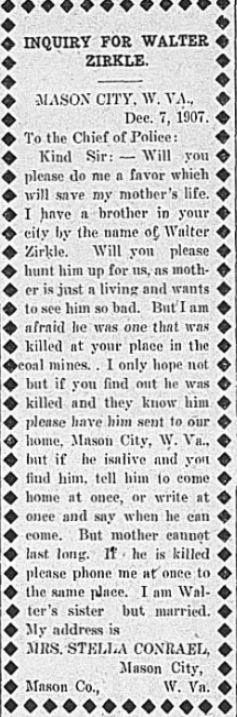
Bibliography

Disclaimer and Guide

Introduction

About the Author

Contact Information