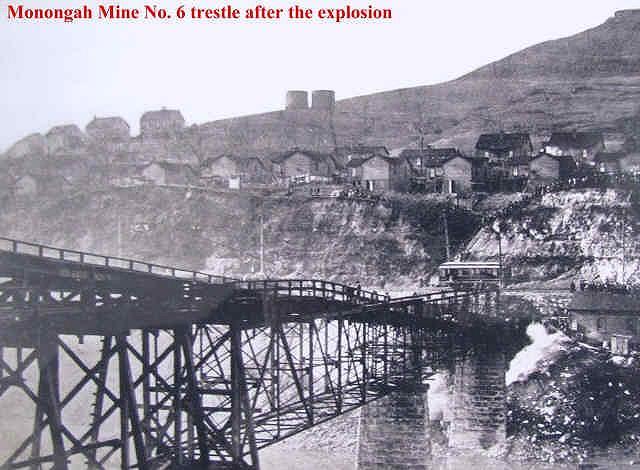
Friday, December 6, 1907, Early Afternoon, 1:00 pm – 3:00 pm

Early Afternoon

In Monongah:

“The women around the mine entrance are going crazy with grief and can hardly be handled.” (FWDN 12.6.07 pg. 1)

Crowds are growing to uncontrollable numbers. (News)

Agents for the company begin to prepare for the worst.

~1:00 pm

On the east side of Monongah:

“At one o’clock this afternoon the officials of the Fairmont Coal Co. revised their figures as to the number of men at work in the mines, making it three hundred, instead of five, and they do not believe any have escaped death or injury of a serious nature.” (CET 12.6.07 pg. 1)

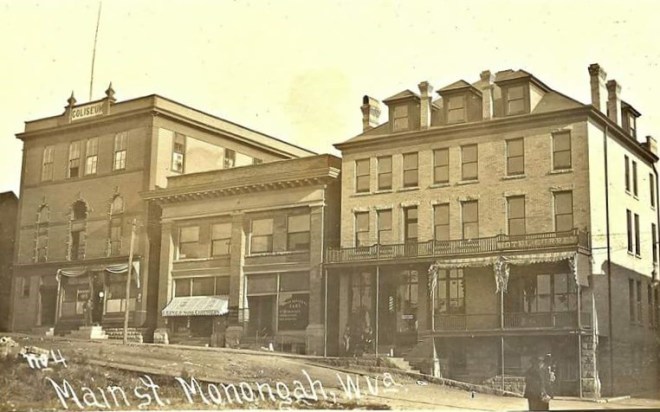
Coroner E.S. Amos prepares to set up a temporary morgue inside the unfinished First National Bank of Monongah (a new institution owned by the Watsons and others).


“The First National bank building…has been rigged up for a morgue and the dead will be taken there as soon as recovered.” (FWDN 12.6.07 pg. 1)

theater, bank,hotel

E.P. Knight brings the piece of broken coupling pin to Frank Morris in the office of the company store for safe keeping then returns to the relief work. (Inquiry)

~1:30 pm

Outside #6:

Dr. Cook sees first 3 bodies brought out of #6; the 3 men who were found in the shed at the foot of #6 slope. (Inquiry)

~2:00 pm

Outside #6:

8 bodies found near entrance of #6 “and had been taken out, but at that time dense volumes of smoke from a fire in the heart of the mine drove the rescuers to the open air and they have not since been able to return, although every effort is being made to get in.” (Pitt. Press Evening, 12.6.07 – pg.1)

“The fans were all blown out of mine No. 8 and it was the belief of some that the mine was afire.” (CDT 12.7.07 pg. 1)

At the mines:

“Little was done…until after three o’clock when several men were rescued.” (FWV 12.7.07 pg. 1 – noon)


Previous Post

Next Post


More on How Death Gloated!

Bibliography

Disclaimer and Guide

Timeline

Introduction

About the Author

Contact Information


Friday, December 6, 1907 12:00 pm – 1:00 pm

12:00 pm – Noon

In Fairmont:
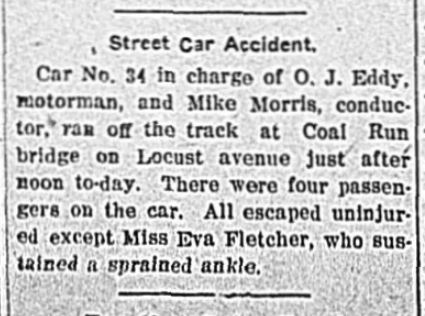
12.6.07 pg 5 - street car accident on Coal RUn in Fairmont
FWV 12.6.07 pg 5

Within the next few days, this event will gradually become entangled in the news coming out of Monongah. With so many people and newspaper reporters in and out of Fairmont, entirely unfamiliar with the area, this is more than likely how various reports begin to spread across the country that the trolley which ran passed #8 coal mine just before the explosion was blown off of its tracks, wrecked, and that a young female passenger was injured in the process. Though there is no information about what happened to the trolley after it passed #8 nor are there personal accounts from any of its passengers, the trolley at Monongah was not thrown from its tracks and wrecked.

At the company offices, “Mr. S.L. Watson was called up by many newspaper men but was unable to accommodate them because of lack of news.” (FWV 12.7.07 pg. 2 – noon)

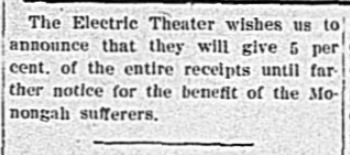
The Electric Theatre calls the Fairmont newspapers to make the announcement that they will give 5 percent of the entire receipts until further notice for the benefit of Monongah sufferers. (FWV 12.6.07 pg. 5)

12.6.07 pg 5 - Thater offers proceeds to Monongah
FWV 12.6.07 pg 5
Inside the mines of Monongah:

Localized explosions, ignitions, and fires continue consuming the oxygen throughout the mines. Afterdamp has had over hour and half to work through the mines and has already suffocated many. Some miners who survived the initial explosions are putting jackets over their heads or napkins over their mouths to try and prevent breathing in gases. (McAteer, News)

In the town of Monongah:

Monongah is getting positively ambushed with all varieties of people from the area. Train/Trolley loads of volunteers, mourners, amateur photographers and macabre sightseers start pouring in from Fairmont and surrounding areas.

Undertakers begin pouring into town, ”from Fairmont, Shinnston, and Clarksburg among whom are Clifford & Osborn, Sleppy & Warne, of Clarksburg, Harmer of Shinnston, and Musgrave and Bunningham*, of Fairmont, summoned at the instance of the coal company to take charge of the frightful morgue that will present itself when all the bodies are recovered.” (CDT 12.7.07 pg. 1) (*should be “Cunningham”)

Transport wagons and crews are hired. W.S. Thomas Transfer Co. (Fairmont firm) sends all available wagons and teams to Monongah. (News)

Communications within town, let alone outside of town, are extremely limited and reports about the events going on in the area begin to conflict from the very start. (News)

“The bodies of three miners were recovered near the mouth of Mine No. 6 at 12 o’clock.” (CDT 12.6.07 pg. 1)

“Up to noon four bodies had been recovered. These were found at the entrance of the mine.” (CDT 12.6.07 pg. 1)

Inside #6:

“Besides the broken cars that clogged the heading much of the brattice work was demolished and this too added to the delay in bringing bodies out. Many of the brattices were constructed of brick and were supposed to be permanent, thought to be sufficiently strong to withstand any concussion that might arise from an explosion; but these went down and were but a mass of debris.” (FWV 12.7.07 pg. 1 – noon)

The rescue crew headed by Supt. Gaskill continue exploring beyond the shanty at the foot of #6. They find another body, one they assume must belong to the car coupler, Bill Sloane, based on its location. There’s just one little problem; unknown to everyone else, Bill Sloane is at home sick in bed. Fred Shaver will later tell L.M. Davis of the Fairmont West Virginian about the four men he recognized, including Bill, and all four names will be published as the first identified dead. (News)

Not far beyond here, the crew encounters more afterdamp and are forced to turn back until proper ventilation is restored to these areas. They do not take any of the discovered victims with them. (Inquiry)

Outside #8:

Someone coming across #8 trestle finds Joe Newton among the debris “more dead than alive”, gets him up, and rushes him over to the interurban car.

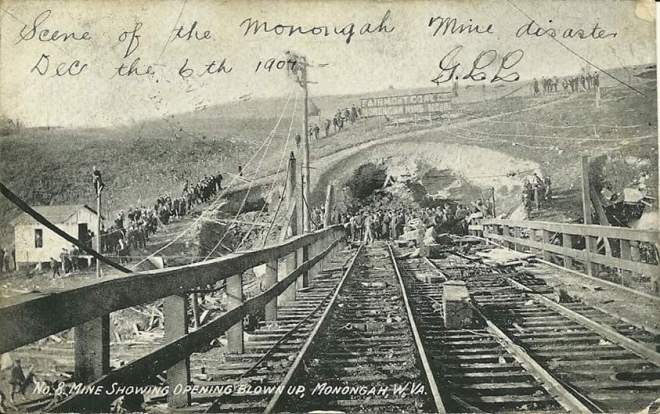
postcard - 8

~12:30 pm

Outside #6:

Pat McDonald is found unconscious on the #6 trestle walkway covered with severe burns and lacerations all over his face and torso. The interurban car carrying Joe Newton is stopped just above #6. Pat McDonald is quickly placed aboard and the two are rushed to the Miner’s Hospital in Fairmont.

On the east side of Monongah:

#6 tipple foreman E.P. Knight finds a piece of the coupling pin that broke away from the train of cars and puts it in his pocket.

In Monongah:

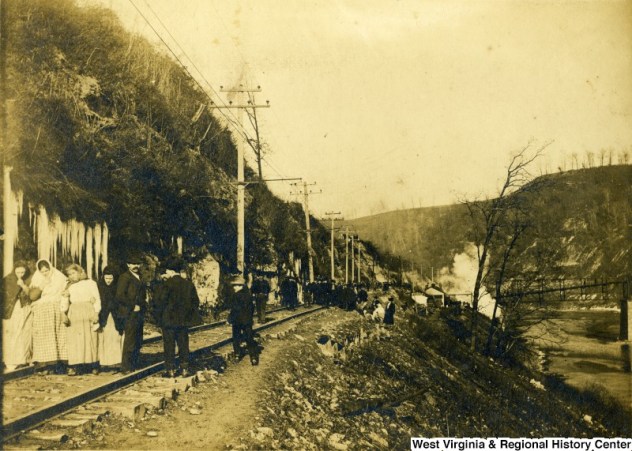
“The first dispatches told of women who tore their hair, or clawed their nails into the flesh of their cheeks or threatened to throw their babies into the river. The wife of the Presbyterian minister told me that she saw these things. Such a woman had run back along the railroad tracks tearing at her face and hair. They quieted her. 3 sons, 3 brothers, and a husband—all were in the mines she said.” (Kellogg)

women - zoom


Previous Post

Next Post


More on How Death Gloated!

Bibliography

Disclaimer and Guide

Timeline

Introduction

About the Author

Contact Information

Friday, December 6, 1907, 11:00 am – 12:00 pm

MR4

11:00 am

“The American miners of the town have been placed in charge of the relief work but the Italians and other foreigners are working under them most faithfully.”  (ES 12.7.07 pg. 2)

“Monongah…has a population…, most of whom are foreigners although there is a larger proportion of American miners in this district than in most of the other bituminous fields. Until about ten years ago the mines were operated almost exclusively by Americans, but during a general strike of Miners in the Pennsylvania and Ohio fields many of these West Virginia miners went out in sympathy to prevent the filling of contracts at lake ports and elsewhere with West Virginia coal by the companies in Ohio and West Virginia against which the strike was directed. At that time the mine owners brought a large number of foreigners into the field to take the places of the strikers and ever since the foreigners have been displacing Americans until they are now the majority.” (ES 12.7.07 pg. 2)

In the town of Monongah:

“The banks and hills surrounding the mine are literally crowded with anxious people, many women and children who are weeping and crying hysterically for love of their fathers, husbands and brothers known to be entombed. The foreign women are indeed to be pitied for their great sorrow and their way of expressing it by tearing their hair, scratching their faces with their finger nails until the blood runs down their cheeks. Several were witnessed in this condition leading their little children around through the mud and cold not noticing either in face or their great sorrow.” (FWV 12.6.07 pg. 1)
frontThumbnail (6)

Company officials Frank Haas and J.J. Burrett arrive from Fairmont as well as the representative of the Italian consulate, G.D. Caldara, who “was doing much to pacify the women of his country, who were most loudly giving vent to their terrible feelings.”  (FWV 12.6.07 pg. 1)

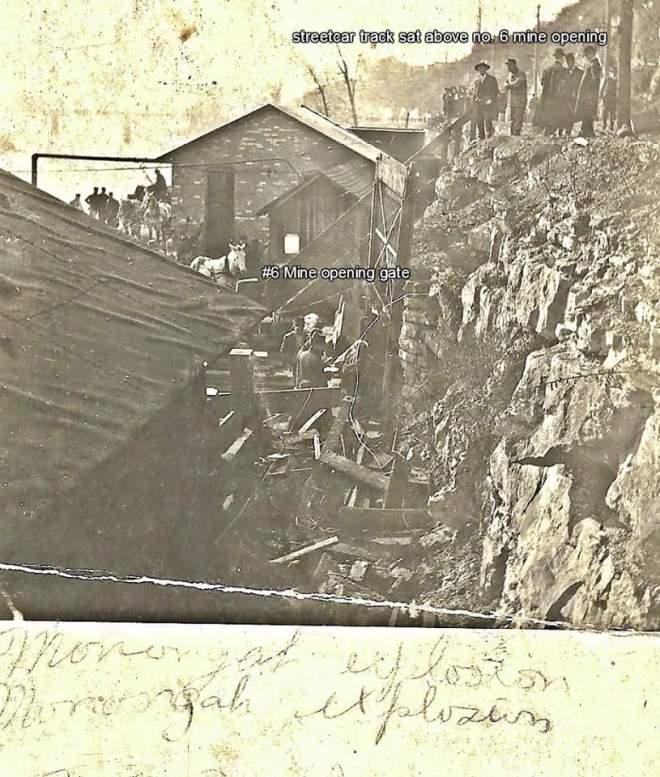
Over a dozen physicians are now on the scene: Dr. D.P. Fitch, Dr. John R. Cook, Dr. Brownfield, Dr. Jesse A Jamison, Dr. W.C. Jamison, Dr. Graham, Dr. Reidy, Dr. Bowcock, Dr. Durrett (mine physician of the New England mines), Dr. Howard, Dr. Carr, Dr. L.N. Yost, Dr. Sands, Dr. Nutter, and Dr. Hal Hall accompanied by nurses from the various hospitals in Fairmont. They begin to establish an emergency hospital in the blacksmith shop of #6. They have also arranged for the interurban trolleys and railroad companies to transport survivors to the Fairmont hospitals once they are tended and stabilized at the make-shift ER in the blacksmith shop (FWV 12.6.07 pg. 1) (Nurses on Front Lines)

“Medical men who came on the scene after…were: Dr. F.W. Hill, B.F. Bone of Fairmont, Drs. Culp and Thrash of Farmington, Dr. Falconer of Everson and Dr. Alkire of Chiefton.” (FWV 12.7.07. pg. 1 – noon)

Marion County Coroner E.S. Amos also arrives in Monongah.

Dr. Durrett of the New England mines tells a reporter with the Fairmont West Virginian that there is little hope for the men trapped in both mines; “He says that the force of the explosion traveled with the air courses and only those men who were in this air course were killed by the explosion or from the debris thrown in its wake.” (FWV 12.6.07 pg. 1)

Outside #6:

Carpenters are putting the last support boards along the roof of the approach which connects the mine shaft to the fan. It is just a temporary fix, but it is good enough to warrant restarting the fan.

In Washington D.C.:

Governor Dawson, A.B. Fleming, and a few other state/company officials receive word about the disaster. Gov. Dawson immediately telephones certain state officials while former Gov. Fleming immediately leaves D.C. for Monongah after sending word ahead to the sheriff to “preserve order”. (News, McAteer)

11:05 am

Outside #6:

35 minutes after the explosion, #6 fan is restored and started. However, the gage only rises “a little above 2” which is lower than prior to the explosion. This means that air is still not able to properly circulate through #6 because the partition which once divided the two mines has been destroyed by the explosion, allowing air to flow into #6 from #8.  This needs to be a closed system in order to properly circulate breathable air and it will be impossible to close this system without getting to one of the deepest parts of the two mines. (Inquiry)

11:30 am

Outside #6:

“The rescue was started in mine No 6 about 11:30 after the fan was again put in running order and the rescue work is being vigorously pushed by Mr. J.C. Gaskill and other mine officials.” (FWV 12.6.07 pg. 1)

“As soon as the men could be organized for a plan of action forty rescuers began the work.” (CDT 12.7.07 pg. 1)

Three teams were organized: one headed by #6 foreman Charlie Dean, another by Supt. Brennon of #8, and the other by Supt. J.C. Gaskill.

The first party to enter #6 was “composed of Messrs. D.C. Dean,—Toothman, — Nichols, —Graham, —Clayton, J.G. Smith, —Clayton, … these men, armed with all the available necessary tools and safety lamps marched undaunted back into the scene of carnage…”  This is an excellent choice crew. Being outside foreman of #6 mine, Charlie Dean still had plenty occasions when he had to go inside #6. He is the most ideal person available at the time to head the first relief crew and give instruction about what is and isn’t right about the conditions inside of #6 and what needs to be done to correct those conditions in order to get relief efforts underway. (FWV 12.6.07 pg. 1) (Inquiry) (News)

Dean and his crew have a primary goal—determine how far rescuers can get into the mine safely and if any victims can be reached. It is presumed that Dean and his crew are aware of the runaway trip which should most certainly be a pile of wreckage somewhere along the main shaft. Hopefully, they can reach this point and determine if the wreck and/or the explosion have caused any blockages of potential exits before they personally encounter any deadly gasses. (Inquiry, News)

~11:33-11:35 am

Inside #6

As these men steadily work their way down the #6 shaft portal, a second party of ten men headed by West Fairmont mine Supt. John Brannon prepare themselves for the decent.  They enter #6, following along and continuing to clean the path already partially cleared by Charlie Dean’s crew. Naturally, Dean and his crew only cleared what was necessary for them to pass so they can survey conditions and try to reach survivors as quickly as possible. As these rescuers expect to find survivors inside of the mine, they must also make as clear and safe a path through and out of the mine as they can while still constantly pushing forward, knowing that more crews will be following to pick up where they left off. (Inquiry, News)

~11:38-11:40 am

Supt. John Brannon and his team catch up with Charlie Dean and his crew near B face entry, where the slope of the portal changes to a more gradual angle. It is here, at B face, that several other track lines which branch out to the rest of the inner workings of the mine intersect with the main shaft line. At this spot they discover one of their worst fears to be confirmed: the only true way in and out of #6, the main shaft line just before B face, is entirely blocked with wrecked coal cars and debris at the worst possible point, literally entombing every miner—dead or alive—inside with no chance of escape. (Inquiry)

Dean’s crew has already begun to tear away what debris they can to create at least enough space for one man to cross the wreckage. Charlie Price, a member of Supt. Brannon’s crew, also begins working on clearing a way through the debris. After only a few more minutes, they successfully break through near the top left of the pile. Charlie Price is the first to take in the air coming out from the enclosed workings behind the debris pile. In a matter of moments, he collapses. (Inquiry, News)

~11:45-11:50 am

Outside #6

Gen. Supt. J.C. Gaskill has assembled his own relief crew on the surface and they are preparing to enter #6 when Supt. Brennon’s crew resurfaces from the mine shaft. A few of the rescuers are carrying Charlie Price. He was overcome by the fire damp which escaped from the inner workings. At this, both crews fled #6 to avoid the same fate. Charlie is in serious condition and taken to the make-shift hospital in the #6 blacksmith shop which is still being set up by the physicians and nurses which have since arrived on the scene. (Inquiry, News)

Inside #6

“When the Brennon forces returned C.E. Gaskill headed another relief party, which continued the work.” (WH 12.7.07 pg. 1)*

Despite the knowledge that toxic gases have been released, Gaskill and his team consisting of mine foreman PJ McGraw, #6 fire boss Lester Trader, and an extended crew of carpenters like Fred Shaver press back into #6. They continue to clear away debris along the main shaft until they reach the wreckage pile by B Face. Gaskill notes that the wreckage is, “piled up pretty bad—a lot of cars piled up just like any wrecked trip…crossways and piled up generally.” However, it was “not so bad but we could pass…by climbing over…”. (Inquiry)

~11:50 am-12:00 pm

Outside #6
FB_IMG_1511974211592

A key official of the Fairmont Coal Company, Supervisor and Chief Mine Inspector David Victor arrives in Monongah from the New England mines in Fairmont and immediately goes inside #6. He is aware that other crews of men are already working, including John Smith from Charlie Dean’s crew and Supt. Gaskill & crew, though he is not sure how much farther ahead they are at this point. (Inquiry, Victor)

Inside #6

“All of the headings leading off from the main entry are being cut off by canvas and barricaded as fast as they are reached by the relief workers, so that the inner most workings of the mine may be given the benefit of the ventilating system…” (ES 12.7.07 pg. 2)

Beyond the wreckage:

“The rescuing parties penetrated mine No 6 about 3500 feet before they came upon the first of the dead. A majority of the corpses will be found about a mile further back.” (LAH 12.8.07 pg. 1) (WED 12.7.07 pg. 1)

Supt. Gaskill and his team have successfully crossed over the wreckage pile and are now continuing along the main track into #6. At the very base of the slope, where the more gradual angle of the slope finally levels out to match the rest of the working areas, the team comes across a small shanty. Inside they find 3 men—all are dead. (Inquiry, News, McAteer)

The first is 23-year-old husband, father, and motorman Fred Cooper. He is lying on the ground, on his back, his head near the shanty door, his mouth wide open.

Another, 21-year-old brakeman Laurence “Larney” Hindman, is also on the floor lying face down with his feet toward the shanty door, the opposite direction as Fred.

The last man is still sitting upright on a bench, holding his opened dinner bucket between his legs, though his head and arms are drooped down. Lester Trader steps into the shanty and lightly pushes his head back to see the face. Coffee dribbles out of the lifeless mouth and Trader can tell it is 36-year-old driver John Herman.

This rescue crew of Gaskill, Trader, McGraw, Fred Shaver and others will not linger at the shanty long—their primary goal is to find survivors—though they do take a few solemn moments to examine and observe that not one of these men shows a single sign of traumatic impact to their bodies and yet their positions, paired with John Herman’s mouthful of unswallowed coffee, indicate an instantaneous death for them all. (Inquiry)

At the wreckage site:

David Victor makes it to the general area known as the ‘foot’ of the slope and sees the “badly wrecked” trip on the main track. He counts 14 loaded cars wrecked on the middle track but, “The fellow who had been cleaning up the cars told me that he had taken two off the trip that had come back down the slope.” As David Victor begins to examine the area “to a certain extent”, he notes that there is another trip with a motor about 20 feet away “standing on the side track of about the same number of cars, 2 or 3 of the first cars had been wrecked…”, behind that was another trip of coal cars. (Inquiry, Victor)

One of the first concerns relating to the cause of the explosion circles around the new addition of electricity and the relatively recent introduction of live, uninsulated wires inside the mines. Victor examines for any evidence of a short circuit in these wires which could have sparked a fire or explosion, but he finds that the wires are surprisingly still intact, hanging along the roof of the mine and no such evidence these wires fusing or burning at the foot of the slope or on any wires, the mine roof, or walls. He decides to move on. (News, Inquiry)

“I remember climbing over the wrecked cars but had plenty of room to go over. I remember the wrecked trip happened right on the switch where there were 3 entries opened up. The wreck had happened in the middle entry and that entry was closed. The entry to the left was not closed. I remember climbing over the empty cars in order to get through to build brattices.” (Inquiry)

Not far beyond the wrecked pile, Victor sees a coal car laying “crossways of the track” and just beyond that, the shanty at the bottom of #6 slope. He does not go in nor does he take any time to examine the 3 dead men other than to acknowledge their positions. (Inquiry)

1907-monongah-wv-mining-disaster


Previous Post

Next Post


More on How Death Gloated!

Bibliography

Disclaimer and Guide

Timeline

Introduction

About the Author

Contact Information

December 5, 1907 – Eve of St. Nicholas Feast Day

 “The dawn of a new era of prosperity is here.” (FWV 12.5.07 pg. 1)

During the day:

The country is beginning “to recover from the severe shock of the recent panic” on Wall Street. “Naturally there was a little scare at first, but when the people saw that there were rotten spots only here and there they quickly recovered from their fright.” (FWV 12.5.07 pg. 1)

In Pennsylvania:
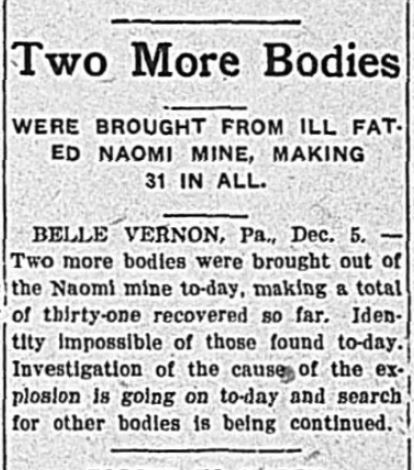
12.5.07 - pg 1 - Naomi
FWV 12.5.07 pg 1
In Washington D.C.:

Gov. Dawson of West Virginia gives the opening speech at the river convention. (FWV 12.5.07 pg. 1)

“He said his state was particularly interested in the comprehensive improvement of the inland waterways of the country…The governor referred particularly to the resources of West Virginia, the State being second in the production of coal and fifth or sixth in hard wood timber. The bulk of the coal has to find a market outside of the State and if, by water transportation, the state could save the ten cents a ton it would aggregate $3,000,000 a year.” (FWV 12.6.07 pg. 1)

“’We are one people and have a common destiny,’ said he, in conclusion. ‘We want nothing in West Virginia that is forbidden to any other part of the country; but I say to you, gentlemen, that we want to be ready for the Panama Canal when the great waterway is ready for us.’” (FWV 12.6.07 pg. 1)

In Grafton:

Sam Furk, an Italian, has been held for the grand jury on the charge of extorting money at the point of a revolver from several of his fellow countrymen of this section.” An Italian witness from the same area of Italy as Sam Furk ‘testifies’ that Furk is wanted on two murder charges back in Italy, “so it is probable that the local authorities will take up this matter with the Italian embassy at Washington.” (CDT 12.5.07 pg. 1)

“The hearing developed the fact that Furk had been playing the hold-up game among members of his race successfully at Brooklyn, N.Y., Rowlesburg, Manheim, Fairmont, Clarksburg and Grafton.” (CDT 12.5.07 pg. 1)

“Furk is in jail here.” (CDT 12.5.07 pg. 1)

In Fairmont:

The Fairmont West Virginian reports the weather as: Fair tonight and Friday, warmer Friday

In Monongah:

Mines #6 & #8 are not running at full production today but the fans continue running for the skeleton crew inside. Due to the recent stock market crash, there is still a lack of orders & a majority of the working immigrant population will be celebrating the eve of St. Nicholas Feast Day tonight. In these days of “miner’s freedom”, many miners would choose not to go to work during their holidays.

In the Afternoon

In Fairmont:

The Isabella Davis Circle of King’s Daughters opens their annual Christmas Bazaar in the Sunday school room of M.E. Church on Main Street in Fairmont. “The different booths are all decorated in the Christmas colors red and green the color scheme being carried out by the use of crepe paper and autumn leaves in the colors.” (FWV 12.5.07 pg. 1)

In Monongah:

Anestis Stamboulis & several Greek miners take advantage of the holiday and good weather. They take a walk up into the hills surrounding the town and pick some wild mushrooms to be used for dinner. (McAteer)

~5:30 pm – 6 pm

In Monongah:

The Who’s Who Club of Wahoo (a neighborhood of Monongah) holds its monthly meeting where they “disposed of large quantities of the amber fluid, red liquor and refreshments of all varieties.” 8 members will not go into work tomorrow but will end up digging graves. (McAteer)

Homer Pyle and his mother are “sitting before the bright blazing fire” at their home,“…he said let us have a song for it is too cold to go over in town tonight, so he and his mother sang two or three songs and the last song was ‘Will There be Any Stars in My Crown?’”

“But little did Homer think that the next evening he wouldn’t be alive to sing with his mother.” (FWV 12.19.07 pg. 2)

At the mines:

The night shift skeleton crew comes onto work.

Over the next 12 hours these workers will do various jobs throughout the mines.

Inside #8

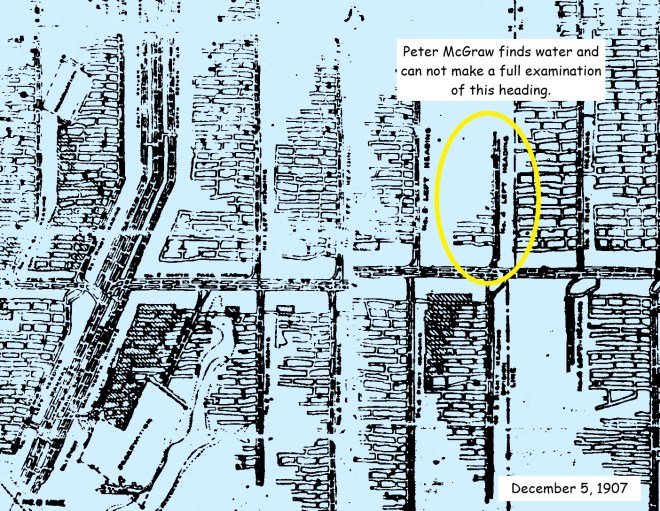
Peter J. McGraw came in for his fire boss shift around 6 pm.

He does his examinations of the mine alone.

He finds water in 4th left so significant that he can’t get in there to properly examine the heading. (Inquiry)

map - McGraw - water

Inside #6

22-year-old Lester E. Trader arrives for his fire boss shift around 6 pm. (Inquiry, McAteer)

Trader inherited his job when the previous fire boss got sick during Trader’s apprenticing. Trader lacked 3 years necessary experience, training, and certification for his official position so he was kept on the night shift so as to “not run into the inspector”. (McAteer)

Trader worked alone like most fire bosses. He led a horse drawn water cart to sprinkle the mine walls in order to dampen any renegade coal dust.

To check for dangerous gas levels, he used a Wolf Safety Lamp to check for methane. However, due to the size of #6 mine, Trader cannot check everywhere.

~7:00 pm

At the mines:

Libberato Delesandro works the night shift, “helping to get #6 and #8 through together”. (Inquiry)

Inside #8:

Tony Pasquaele arrives to work and drives the horse-drawn water cart in #8 through the night. “The watering carts carried large wooden barrels filled with 300 gallons of water; perforated ends of the barrels were plugged by wooden combs that could be removed to allow water to sprinkle out.” (McAteer)

As he is leading the horse and water cart, he notices that the heading is “a little dry” for this time of year. (Inquiry)

Tony is also responsible for pumping out any rising or standing water which had seeped into the mines. His pattern is systematic; he “would start the pumps then go water mines for a bit, and then would check back on the pumps every 2 hours to see how they were doing.” (Inquiry)

Inside #6:

Ludwig Strezelecki works at F face: 1st right, room 15. His task for the night involves working with his brother-in-law taking out stumps and finishing the headings.

Night

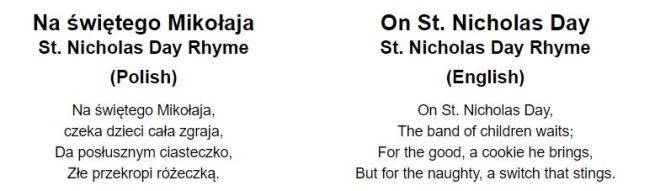
It is the eve of St. Nicholas Day for Italian Catholic and some Polish Catholic immigrants.

At night, the families gather around their coal stoves or fireplaces (if they are fortunate enough to have a fireplace) and tell stories, sing hymns, or verse simple rhymes about St. Nicholas De Bari.

Polish- St Nick rhyme-mamalisa
Polish rhyme to St. Nicholas
Italian - St Nick rhyme - mamalisa
Italian rhyme for St. Nicholas

Children leave their shoes lined up side-by-side next to the door, window, or hearth. If possible, some would place bits of carrot, oat, or hay inside as a gift for the trusty mule/white horse which traveled along with St. Nicholas as he delivered small gifts.

8:00 pm

In Clarksburg:

At the Bacon & Godfrey skating rink a “Who’s Who” Carnival is held. “Upon entering the rink, you will be furnished with a false head or some contrivance of that kind which will make it almost impossible for your mother to even know you. With everybody thus attired the big show will start, with everyone wondering who is who.”   (CDT 12.5.07 pg. 1)

~10:00 pm

Inside #8:

Homer C. Palmer (electrician) arrives for his night shift.

Through the night:

Inside the mines:

The main ways of the mines are watered.

Fire bosses like Lester Trader and P.J. McGraw walk their respective mine checking for dangerous conditions in both #6 and #8.

Inside #8:

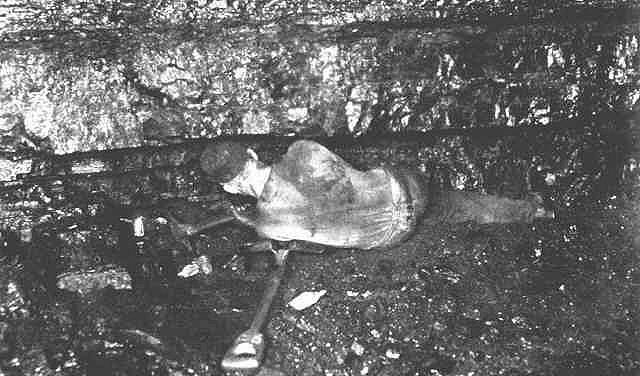
George Bice dug coal (pick work) on 5th right, 2nd north in #8

MF7

Inside #6:

Fred Cooper (motorman) sprinkled headings in #6. (Inquiry)

In Monongah:

Not long after the children have fallen to sleep, several parents quietly replace the bits of hay or carrot in their children’s shoes with a sweet treat, like candy or fruit, and a small present—typically a (gold) coin.


Previous Post

Next Post


More on How Death Gloated!

Bibliography

Disclaimer and Guide

Introduction

About the Author

Contact Information