In Appalachia, we consider our folklore and oral storytelling traditions to be very credible sources of information, often more credible than any ‘official’ report on an event. In places where ‘official’ reports mean revealing only the information which has been ‘company approved’ (like accurate reports on the number of victims in mine disasters) and especially in times when the company owned you as much as it owned the house in which you and your family lived, oral storytelling tradition was known to be the real and trusted account of how it went down, told by the people who lived it or knew those who did.
For example, in the case of the Monongah Mine Disaster which occurred in West Virginia on December 6, 1907, we now know that the accepted ‘official’ number of 365 fatalities, including their names, was given by the coal company and it is nothing more than the list of those on the payroll at the last pay period of the month prior. Though the list does include miners who were lost, like my great-great-grandfather, the ‘official’ list does not include those who worked off-the-books as subcontractors for payroll miners (many of whom were boys as young as 10 or 12), those who were hired onto payroll in the few weeks prior or those known to have gone into the mines looking for work that day, nor does it even include the names of B&O Railroad employees on loan to the coal company or the insurance salesman killed inside the mine while selling life insurance to the miners. Thanks to Davitt McAteer’s 20+ years of detailed research and subsequent book, Monongah: The Tragic Story of the Worst Industrial Accident in U.S. History, we know that the most accurate count of victims came not from the experimental American Red Cross survey, or the ‘official’ coal company reports or surveys, but from the surveys done by the local parish priests of the Italian and Polish Catholic churches.
“… independent surveys by the parish priests of Italian and Austro-Hungarian members of the two immigrant churches was 410. When added to the ‘Americans’, both black (11) and white (74), and the Turks (5) the total comes to 500, so it is reasonable to conclude that the disaster at the Monongah mines certainly claimed in excess of 500 lives and probably more than 550 men.” (McAteer, pg. 241)
However, this total of at least 500 lives is no shocker to the people of Monongah. Ask anyone who grew up there or has heard tales of the disaster from family elders. We have always known. For us, it is historical fact that the number of dead, especially our dead children, was far higher than the company ever wanted to publically admit. To the rest of the “outside” world, it’s whatever the ‘official’ sources say and what exactly counts as an ‘official’ source could change depending on where you are in the country or in the world. There are areas of Italy where Monongah is still a familiar name, but they may also claim that over 1,000 people died in the disaster. Misinformation over the better part of the last century has led many in other countries to believe that Monongah’s Breaker Boys were located inside the mines, not across the river in the tipple.
So, how do you know what or who to believe? Well, that’s always a difficult question, but getting to the truth inside the tales of mountain people really just takes a little extra effort in understanding. Your starting perspective will always make a difference when it comes to analyzing anything unfamiliar as it reflects your personal biases.
To “outsiders”, mountain people are famous for “tellin’ tales” or “spinnin’ yarns” – a phrase which likened our oral storytelling tradition of history lessons with important messages of morality to the way one weaves a long thread from many small fibers. Eventually, it was turned into a phrase conveniently synonymous with “lies” that worked so well during the 20th that many of the local people now think of them as nothing more than “tall tales” like those of Paul Bunyan and his giant blue ox, Babe.
To the mountain folk, “outsiders” are notorious for being over-privileged and dismissive – with access to better education and living resources, they are more likely to side with and willingly listen to those who match their own standards, like those of the non-mining middle class or the elite extraction barons. Even Ruth Ann Musick acknowledged this suspicion as a significant barrier in her process of collecting WV folklore. In her introduction of The Tell Tale Lilac Bush, she discusses that the, “…elderly people will often hesitate to make known to a stranger what they might willingly tell a younger friend or relative.” This is why she credits every book and so many of the tales to students whom she had to enlist in order to collect these tales from their rural home towns. Despite Musick’s love and respect of the place and its people, she was an “outsider”, an “academic”, the type of person who typically exploits our traditions and perspectives to enforce common stereotypes for personal gain as if we are some new zoological study.
Even I, an educated Millennial, today, would trust my 5 year-old nephew with certain local tales that I wouldn’t dare share with an academic peer from the “outside” and my reasons are all based on personal experience of being dismissed by these same types of academics for no other reason than they are convinced that their way is the ‘right’ way and any other way of thinking is a “lesser than”.
If you want to believe from the get-go that the only sources of information which are credible are those which are documented by ‘educated’ or ‘trained’ sources making them “more reliable”, that is your liberty. But, it also means you are only willing to consider the things which are easiest for you to understand in the manner of thinking which you already possess.
As one who grew up in Monongah and its public schools then proceeded to get an advanced ‘credible’ education, I have a perspective which the average ‘credible’ outside source does not – one that learned to find the truth within the tales before learning the forms considered to be standard or ‘credible’, which makes me a translator of sorts.
But, if you are willing to try just a little harder to call out and then put aside your biases, to use your basic education as a guideline rather than a rule book, you will start to see between the ‘yarns’ and begin to tell the difference between the tiny fibers of fact and fiction.
A mountain local will probably ask, ‘Who do you really want to believe? The people who knew them in life, buried their bodies and mourn them still, or a company who, for the first time ever in Industrial history, was suddenly coming under a real public outrage at the staggering loss of life and demanded the company be held financially accountable for everysinglevictimand was beginning to be used as reason to establish federal regulation laws on mine operators and their practices?’.
Or, to put it in a more relevant example, if the current administration and other sources considered ‘credible’ told you that the death toll in Puerto Rico was still under 1,000 when the locals and other on-site sources are telling you it is over 3,000 at this point, who do you want to believe and how does that influence your starting perspective on finding the truth of the situation in Puerto Rico?
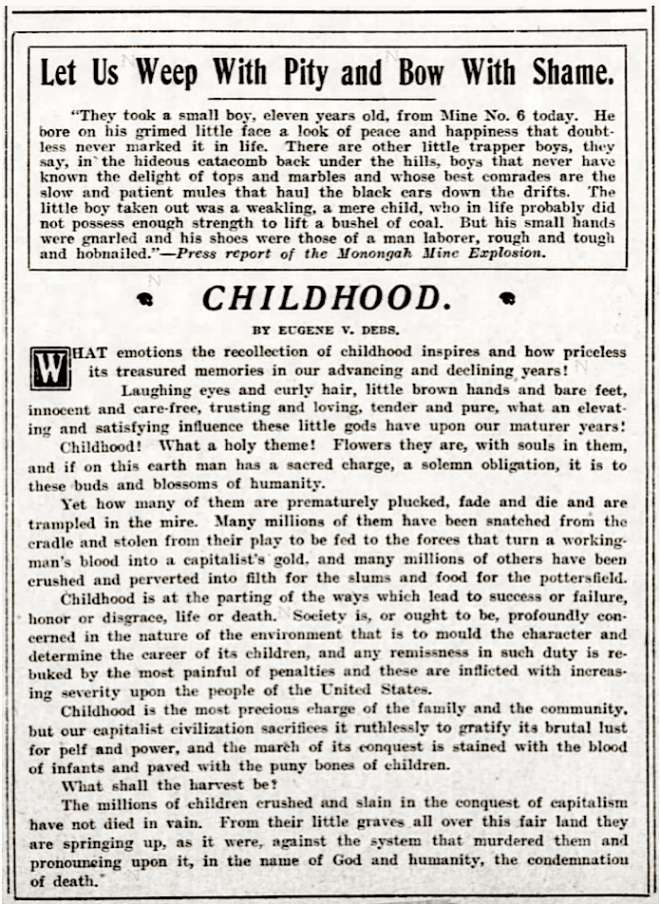
Excerpts from published articles on Monongah were frequently used in the Progressive movement over the following 20 years in attempts to abolish Child Labor in America. Unfortunately, since the ‘official’ report does not claim any victim this young, despite this being taken from news reports on-site and local people confirming his identity and age, it is considered vintage “fake news”.

 The Monongah Disaster