After almost a week of reporting on the disaster and as the work in and around Monongah becomes more and more organized, there is less to actually ‘report’ on the disaster itself. Journalistic columns and public opinions begin to fill the papers across the country.
~6:00 pm
Newspapers
Clarksburg Daily Telegram:

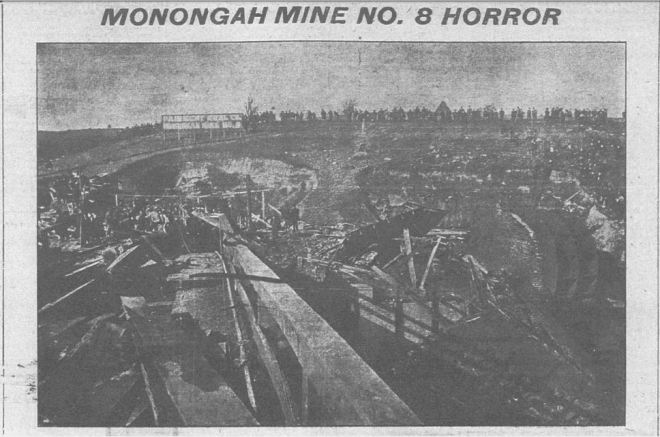
“Those of the bodies recovered today that have been identified so far are as follows:

“The rescue workers have finished the main headings and the sections to the right of the main headings and all work is now in the interior heading and rooms.” (CDT 12.11.07 pg. 1)
“I.C. White of Morgantown, state geologist is on the scene making observations. Mr. White has a practical knowledge of mining.” (CDT 12.11.07 pg. 1)
“Additional miners from Maryland and eastern parts of the State have arrived to aid in the rescue work.” (CDT 12.11.07 pg. 1)

“All theories that have been advanced as to the cause of the explosion are being thoroughly investigated, but explanations up to this time are not thorough enough to locate the immediate cause.” (CDT 12.11.07 pg. 1)
“According to experienced miners the interior of the mines show evidences of an explosion from dust, but there are many who adhere to the gas theory. The inspectors hope to find the exact spot where the explosion originated and when this place is located the exact cause of the disaster may be determined.” (CDT 12.11.07 pg. 1)

“D.F. Lepley, of Connellsville, who is a representative of the company which placed the fan at No. 8 mine at Monongah, is a visitor at the scene of the disaster. He says that he can have the fan replaced in a period of two weeks. The damages to the mine are not nearly so great as at first though and it is not unlikely that both mines will be working again inside of 90 days. One estimate puts the damage to the mines as low as $125,000.” (CDT 12.11.07 pg. 1)
On page 3, a poem written by Pastor E.V. Potter of the Wesleyan Methodist Church is published:


“The woman who has never experienced widowhood can scarcely know, in fact, would not know the fears for the future in this life of a woman left with a dependent family without means of support. Indeed, happy families with plenty never know. They can not. It is impossible for them to realize the drudgery, the sacrifices, the care that the widow has under such conditions. A double duty devolves upon her. She must be mother and she must be bread-earner. Not only must the household be taken care of by her but she must also provide shelter, clothing, education and all for the children. Scarcely a man is there who would not shrink from suck a task and why should a woman be expected to accomplish such an undertaking? Fate sometimes cruelly devolves it on woman to have this terrible lot in life, but, perhaps, it will not always be so.” (CDT 12.11.07 pg. 4)
“Certainly, the time in American brotherhood is passing beyond that stage, and the love for mankind in American hearts is above the miserly point of keeping all we have and doing nothing for our fellows, unfortunate not from their own acts but from a fate that they themselves did not bring about. God forbid that there should be any such.” (CDT 12.11.07 pg. 4)
“This is no time for prejudice, no time for class hatred, no time to argue that others ought to come to the rescue and relief. The only thing to do now is follow the Golden rule. The Telegram offers the opportunity, and yet it matters not to if what medium or avenue is used in reaching the suffering.” (CDT 12.11.07 pg. 4)
“Those who are in distress themselves ought not to contribute, as the widow’s mite, though an example, need not be given, for that sort of charity works a hardship materially, though in the end it has its richest blessings. It is to those who have plenty that this appeal should be most effective. And yet none should give who cannot cheerfully do so.” (CDT 12.11.07 pg. 4)
“The rumor that has reached the ears of many in Clarksburg to the effect that the air fans at Monongah Mines Nos 6 and 8 were not in good order and not working properly the day of and just prior to the terrible disaster last Friday, is false.” (CDT 12.11.07 pg. 6)
“Tuesday night the Telegram telegraphed to President C.W. Watson, of the Fairmont Coal Company, at Monongah, as follows: ‘Please inform us as to the rumor that fans at Mines 6 and 8 were not in good order and not working properly just before the explosion.’ To this Mr. Watson replied by wire as follows: ‘Absolutely false. Be no foundation for the report.’” (CDT 12.11.07 pg. 6)
“How the report was started that there had been something wrong with the mine fans just before the disaster and that possibly that had something to do with the explosion is a matter of mere conjecture, but nevertheless there is nothing to the report as had been shown by the words of President Watson. The machinery at both of the mines was in good working order. Experienced workmen were at their posts of duty at the mines and it is absurd to entertain the thought that either they or officials of the company would permit a big force of men to go into the mines while there was something the matter with the ventilating machinery.” (CDT 12.11.07 pg. 6)
Evansville Press in Indiana:
“There is not much danger of mine explosions like the Monongah disaster in mines about Evansville, it was stated at the mines today. There is but little gas and the mines are damp, so that there is no dry coal dust to explode as in West Virginia. The only danger is from powder explosions through sparks from the miners’ lamps.” (TEP 12.11.07 pg. 1)


By: Geo. Satterfield
“I came to Monongah—to this charnel house of the coal mining industry—to draw in pen and ink some of the scenes of the great disaster that the camera failed to depict.” (TEP 12.11.07 pg. 2)
“I have gazed with wonder on the piled up, wrenched and torn surface ruins, evidences of the titanic shock that in a second blasted the lives out of nearly 500 human beings.” (TEP 12.11.07 pg. 2)
“I saw brave men in jeans, heroes born of the moment, plunge into the hell pits, risking their own lives in noxious gas and fire, that they might save the earthly remains of their comrades.” (TEP 12.11.07 pg. 2)
“With gruesome fascination I inspected great piles of coffins, heaped up within 100 feet of the mouth of the mines, ready to receive the burdens they will carry in long procession to the grave. But God knows how commonplace all this was when I turned my face to that fringe of helpless humanity on the outskirts—that group of agonized women and orphans.” (TEP 12.11.07 pg. 2)
“Carry your imagination this winter day, you who read these lines, to this little village of Monongah and calculate if you can the horror, the agony, the despair, the utter desolation and destitution of these 300 widows and these 1000 orphans.” (TEP 12.11.07 pg. 2)

“They wait about the mine mouths; dry-eyed, grief-exhausted, heartbroken, they wait. Waiting for what? For the right to claim the inanimate, blackened clay of what was so short a time before a loved one. It is all that is left in the hour when the hand of the Great Master seems to lie so heavily upon them, the primal instinct is strong. Each demands that which, when the divine spark glowed, was all the world to them.” (TEP 12.11.07 pg. 2)

“Their hands and faces dirty, clothes awry and covered with the yellow clay of the neighborhood or the soot which lies over all, the widows and orphans are heedless of the present. They can see through the mountainside, where the loved one lies as the fire damp caught him.” (TEP 12.11.07 pg. 2
“Everyone is dry-eyed, for grief such as this call not for tears; is too deep to be assuaged by welling eyes, this affliction which has fallen upon those left helpless by the catastrophe.” (TEP 12.11.07 pg. 2)
“I saw them bring bodies from No. 8. It was at night. They could have taken them out sooner, but waited for the merciful shadows to fall. Only the workers and the hushed, ever-waiting women and children remained.” (TEP 12.11.07 pg. 2
“Four men bore a blanket-covered figure from the black mouth of Monongah’s hell. A sound, as of the night wind gently sighing, passed over the watchers, eloquent in its concert of relief.” (TEP 12.11.07 pg. 2
“Reverently the bearers passed between rows of the bared, bowed heads to where the piled up rough boxes were awaiting their own. Suddenly a woman, gaunt and pallid, evaded the guards and rushed forward. She half-carried, half-dragged a child; two others clung to her thin skirt. Dante never depicted the grief, fear, agony, and expectation which marked her face as she sped over the debris-covered ground toward the body.” (TEP 12.11.07 pg. 2)

“The men deposited their burden and the poor, distraught creature stopped and seemed to recoil. One hand clutched her bosom convulsively. One the brink of the great unknown she hesitated. But she had waited through long dark hours for this moment and was not to be balked. Leaning forward she lifted the covering from the face of the dead, looked, gave utterance to a wailing shriek, heart-rending in its pathos—and sank unconscious to the ground. It was not the face of her husband, and the reaction mercifully broke the terrible strain.” (TEP 12.11.07 pg. 2)

(Special to The Press)
“The theory that an accidental explosion of dynamite was the cause of the disaster that killed nearly 500 in the Fairmont Coal company’s collieries here, is the one now generally accepted.” (TEP 12.11.07 pg. 2)
“The explosion of dynamite caused the explosion of dust which is a most dreadful force when loose.” (TEP 12.11.07 pg. 2)
“In the narrow tunnels the explosion sought an outlet to expand and rushed along the line of the least resistance, toward the mouth of No 6, mowing down men as stalks of grain before the sickle. When it reached the heavy atmosphere at the mouth of No 6 the explosion rebounded going back over its original track, still seeking an outlet. As it swept along, the body of flaming, seething gases, compressed by the confines of the mine, found the underground entrance into mine No. 8 through which it leaped madly and tore its devastating way to the mouth of this mine, where it ripped the masonry from the earth, hurling great blocks of cement and stone in all directions. The heat engendered left nothing but bare walls in its path. It burned the oxygen out of the atmosphere, leaving only the deadly afterdamp, which claimed those left alive by the explosion in various drifts.” (TEP 12.11.07 pg. 2)
Cumberland Evening Times in Maryland:
“The matins of the Sabbath tolled a death knell a hundred, aye four hundred times and the vespers were like the mourning of a dove—for a pall hangs over the valley.” (CET 12.11.07 pg. 11)
“When the flash of a mysterious explosion heaved the earth and hurled the timbers of the mines at Monongah and twisted the ponderous machinery within and without, the gaunt specter of death floated through the caverns and touched the men who went to their toil with music and laughter in their souls.” (CET 12.11.07 pg. 11)
“No human agency could stay that hand and the ghoulish monster called Death had its moment of glee uninterrupted and alone.” (CET 12.11.07 pg. 11)
“Man with his cunning and his knowledge cannot stay the mysterious ways of an inscrutable Providence.” (CET 12.11.07 pg. 11)
“Those stricken stand in awe as the grimy-faced men bear from the mines the stretchers, for sooner or later, today or tomorrow, the carriers will bring to the sunlight that one whose mute lips cannot answer the wails of the loved ones—that one whose children are fatherless.” (CET 12.11.07 pg. 11)
“Paled are the cheeks of the men whose money had builded those works.” (CET 12.11.07 pg. 11)
“The huge fan is a tangled mass of wreckage, a mockery to human endeavor. Stockholder, official, superintendent, boss, miner, volunteers, all work side by side to rescue—no, not to rescue, to bring out the mangled forms of those corpses of what were once men in the pride of manhood health and happiness.” (CET 12.11.07 pg. 11)
“General Manager L.L. Malone, of the Fairmont Coal Company, received offers of assistance from all over several states, while others hurried to the scene, experts, officials, plain miners, those who knew what was to be done and came to do it, of their own free will.” (CET 12.11.07 pg. 11)
“Far and wide the Fairmont Coal Company has been reputed as a humane and generous company. Lee Malone has lived close to his men. He knows them by name. He had toiled with them in the early days and he insists always that the best of machinery for the safety of the toilers should be bought and constantly used. Today his face is blanched, for a mysterious force laid low the men whose interest was his interest. His heart is bowed down.” (CET 12.11.07 pg. 11)
“A ribbon of moving restless humanity has moved in and out of this city toward the mines where death is holding a gruesome feast. This stream of human beings will continue to move throughout the coming days, until the last body is borne out into the sunlight and the last clod falls upon the last coffin. Yet this mass of humanity, pulsating with life and health, can not solve the mystery or speak the words of condolence to those who mourn.” (CET 12.11.07 pg. 11)
“The officials of the Fairmont Coal Company clasp hands across this unspeakable harvest of souls with those who mourn their loved ones and no man will ever be able to tell the story or give reason why Monongah mines should have become a tomb. The curtain will never be lifted. It is held taunt by bony hands, death-gripped, for eternity.” (CET 12.11.07 pg. 11)
“We ride and walk and work side by side with death every day and can not see the dreadful monster through life-lit eyes. With what ghoulish satisfaction the silent companion touches a victim with icy finger. We do not feel his breath or realize his proximity until with chattering jaws and rattling frame, he springs forward to drag a nearby friend from our side. How death gloated!” (CET 12.11.07 pg. 11)

More on How Death Gloated!
Bibliography
Disclaimer and Guide
Introduction
About the Author
Contact Information





 The Monongah Disaster