The funeral for David Riggins is “largely attended”. (FWV 01.06.08 pg. 1)
~6:00 pm, News Hour
New York Tribune:
NYTb 01.05.08 – pg 5
Evening Star in D.C.:
ES 01.05.08 – pg 12
Night
In Baltimore:
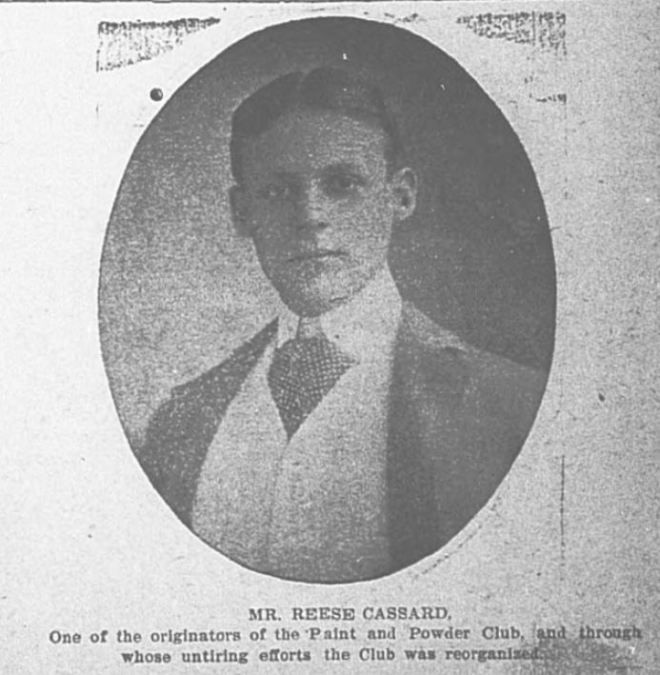
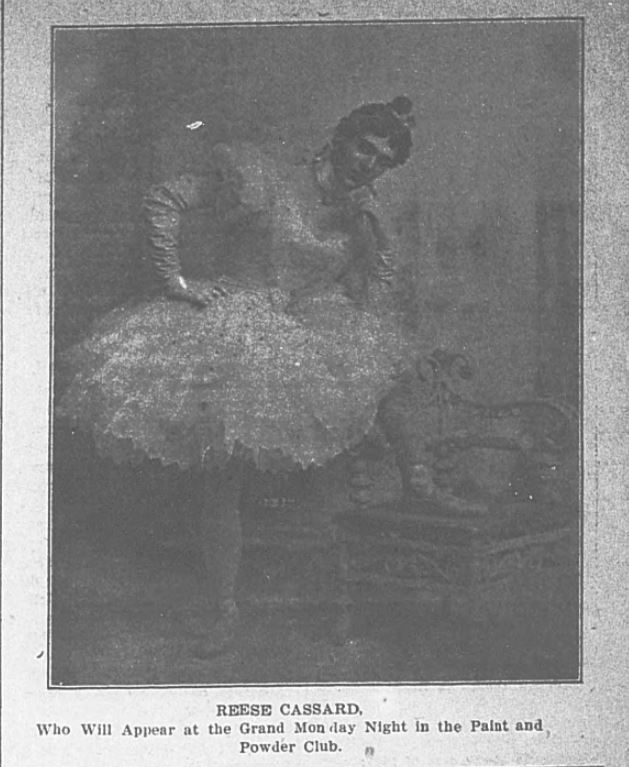
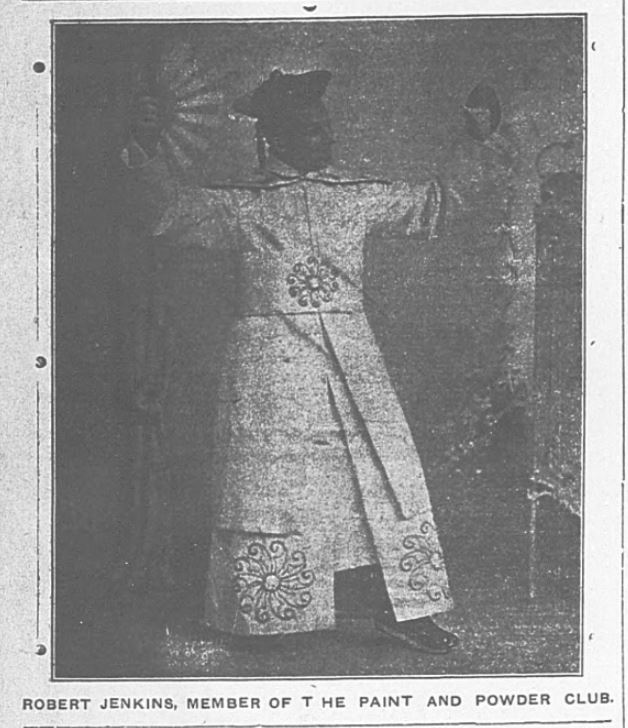
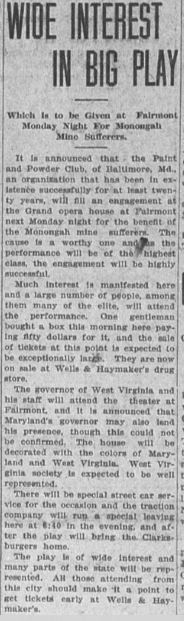
The Paint and Powder Club performers leave for Fairmont.
“For the last three weeks the members of the Paint and Powder Club have been holding three rehearsals daily and took their parts up until time of the train’s departure from Baltimore and no part of the programme has been scamped” (FWV 01.06.08 pg. 1)
“President Murray, of the Baltimore and Ohio R.R., through his assistant, Mr. Geo. M. Shriver, has tendered to the committee free transportation and special cars, leaving Baltimore…Sunday night on No. 3 and arriving in Fairmont, Monday. Returning, leaving Fairmont on No. 14, Tuesday.” (FWV 01.02.08 pg. 5)
Instructions have been given to “division superintendents along the line of route to instruct their forces to do everything possible to make the trip pleasant, to even putting on extra air on the curves and not bantering loud words with passing crews as that tends to make the ‘girls’ hysterical and unfit for work.” (FWV 01.02.08 pg. 5)
The Fairmont West Virginian reports the weather as: rain or snow and colder tonight; Sunday fair and colder
George Riggins, an electrician in the mines of the region, awakes after having dreamt for the past 3 nights about his brother, David, whose body is still in Monongah mines. David Riggins was one of the best-known miners of this section of the State. (FWV 01.06.08 pg. 1)
In Monongah:
George Riggins has some presentments as to where his brother’s body will be found. He starts to this remote section of the mine with a friend and the body was found in the exact spot where George dreamed David was lying dead. The body was badly decomposed but was fully identified by the clothing. (FWV 01.06.08 pg. 1)
This brings the number to 353. (FWV 01.06.08 pg. 1)
During the Day
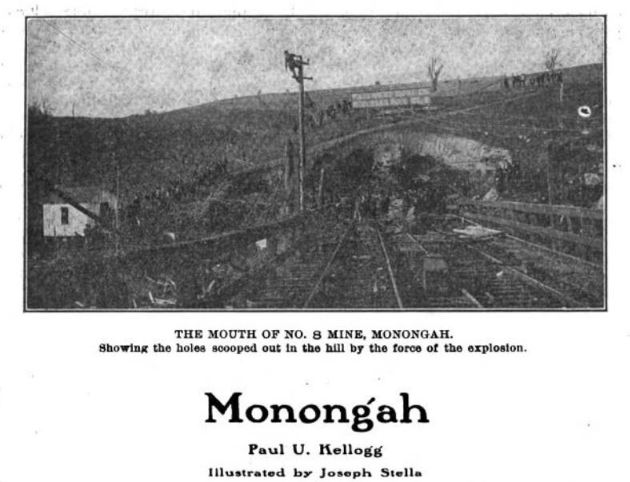
Paul U. Kellogg publishes his article on the days he spent in Monongah after the disaster in the January edition of Charities and Commons.
In Fairmont:
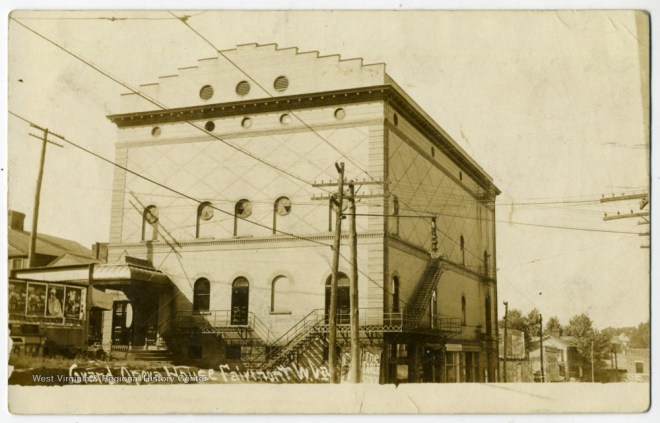
The Grand Opera House produces a Matinee performance of “A Pair of Country Kids”; “…one of the best country comedies of the day…”. (FWV 01.03.08 pg. 2 & 8)
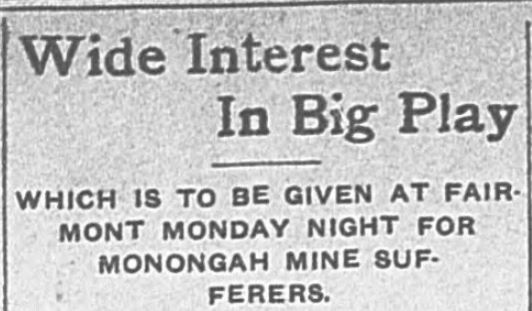
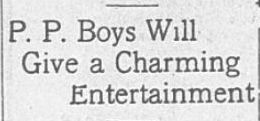
“By far the most pretentious entertainment ever attempted in this part of the State will be the performance of the Paint and Powder Club…The fact that Governor Dawson and the members of his staff are coming…and that tickets are being sold at most of the larger cities in the State is sufficient to prove the importance of it. With the box prices at $100 and the seats each $3, the P.P. Boys must put on a superb show or they could not get the patronage. Again, we all know that Mr. C.W. Watson, who spends much of his time in Baltimore, would not vouch for the show were it not strictly of high order; neither would the Baltimore and Ohio Railroad Company transport free of charge a troupe…” (FWV 01.04.08 pg. 4)
FWV 01.04.08 – pg 1
FWV 01.04.08 – pg 1
“There are hundreds of people in Fairmont who have not yet contributed anything for the relief of the widows and orphans of the near neighbors at Monongah and this will give them opportunity to aid the sufferers and at the same time spend a most enjoyable evening. The entire receipts of the performance above the actual expenses will be turned over for the relief of the unfortunate people at Monongah, so this is a good way to turn in a small amount for their assistance.” (FWV 01.04.08 pg. 4)
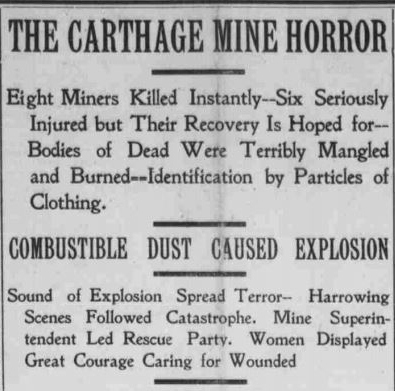
“Death in one of its most gruesome forms lurked in the Bernal mine of the Carthage Fuel company at Carthage during the losing hours of the old year.” (TSC 01.04.08 pg. 1)
“The cause of the catastrophe is believed to have been what coal miners know as a ‘wind shot’. This means that a shot put in to break down a quantity of coal for removal later did not explode in the usual fashion but merely fizzled, raising a cloud of highly combustible coal dust. This dust was doubtless ignited by the explosion of another shot and instantly death had done its gruesome work.” (TSC 01.04.08 pg. 1)
“On every hand were abundant evidenced of the terrific force of the explosion. The bodies of some of the dead were blown against the walls of the mine with such a force as to flatten them almost beyond, recognition. In one instance, at least, a dead body was identified only by particles of clothing adhering to the mangled flesh. The body of one miner who was coming out of the mouth of the mine was shot a hundred yards into the air as from the mouth of a cannon and nearly all the bones in it were broken by the fall. In the case of some of the injured, small stones were driven into their flesh like bullets and had to be extracted with the surgeon’s knife.” (TSC 01.04.08 pg. 1)
“Even the sound of the explosion spread terror throughout the mining camp. It must be left to the imagination to picture the distressing scenes which followed. It was no time for the useless wringing of hands, however, for the living in the mine, if any, must be rescued from the jaws of death. Heroic rescue work was done by W.L. Weber, mine superintendent, and by many others. Doctor Bacon, company surgeon, worked like a Trojan to save and relieve the injured, and women were not lacking to aid him heroically at his task. Willing hands and sympathetic hearts were everywhere to care for the dead, and minister to the necessities of the living victims of the awful disaster.” (TSC 01.04.08 pg. 1)
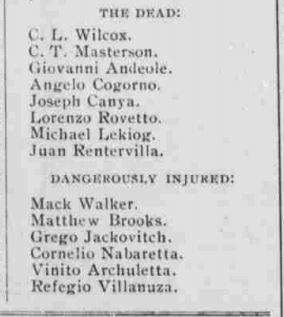
“The latest report from Carthage is to the effect that all the six injured miners will recover, except Villanuza, whose chances are not considered good. The company officials are doing all they can in caring for him and the other injured, and are sparing in no expense in providing for the future of the bereaved families. All the mines of the camp were shut down on New Year’s day on account of the funerals, but have since resume operations at the request of the miners themselves, who thin work the best means of relieving the nervous strain under which they have been since the disaster. The mine was not injured by the explosion.” (TSC 01.04.08 pg. 1)
TSC 01.04.08 – pg 1
The Labor World in Minnesota:
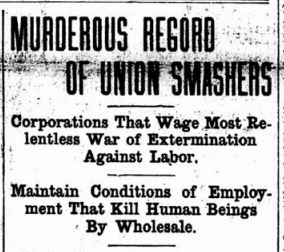
“During the month just closing two accidents about 100 miles apart, on the same river, fully 500 souls were launched into eternity in a twinkling of an eye by the lawlessness of mine authorities. There can be no doubt of this, the order of Inspector Louttit to Superintendent Morris of the Naoma mine proves one case and the fact that the mines at Monongah, W.Va., were operated without two openings, contrary to the laws of West Virginia, proves the other. In neither mine were the laws governing ventilation obeyed. On the contrary, the plainest and most self-evident necessities to secure proper ventilation were ignored. It proves nothing to say that the mines were finely equipped with machinery, etc. An elaborate and gorgeous palace is unsafe to live in when it has an open sewer in its cellar.” (TLW 01.04.08 pg. 1)
“The innocent public are called upon to succor the dependents of the unfortunate victims in every instance and especially is this so in the Monongah disaster. The public does not participate in the profits of this greatest of bituminous coal combinations. The Consolidation Coal company, the parent corporation of the Fairmont, Somerset combine, operates extensive mines in three states, under the fostering care of the Baltimore and Ohio Railroad company, all of these corporate combinations have waged a relentless war of extermination against individual coal operators and labor organizations since the early forties.” (TLW 01.04.08 pg. 1)
“It is high time some radical steps were taken to safeguard life in the more dangerous occupations. If the mine owners had spent half the time and money at Monongah, W. Va. In making reasonably safe conditions that they have spent in fighting the labor unions that were trying to give the miner a dog’s chance, this nation would not be a byword as it is. Extract the last dollar from the business, never mind the human heart!” (TLW 01.04.08 pg. 1)
The Detroit Times in Michigan:
TDT 01.04.08 – pg 1
Evening Star in D.C.:
ES 01.04.08 – pg 9ES 01.04.08 – pg 11
Evening
In Fairmont:
The Grand Opera House produces a Night performance of “A Pair of Country Kids”; “…one of the best country comedies of the day…”. (FWV 01.03.08 pg. 2) (FWV 01.03.08 pg. 8)
FWV 01.03.08 – pg 2
The Electric Theater again presents “Passion Play”. “Misses Lula and Eva Barnes, of the Presbyterian Choir, will sing for this occasion.” (FWV 01.03.08 pg. 8)
Miss Zanie Martin, daughter of Mrs. Mary Martin, is seriously, possibly fatally, burned at her home on High Street by falling in the fire in a fainting spell. Miss Martin was subject to such spells and it had always been feared that she should fall into the fire at such a time. Medical assistance was rendered at once. (FWV 01.06.08 pg. 8)
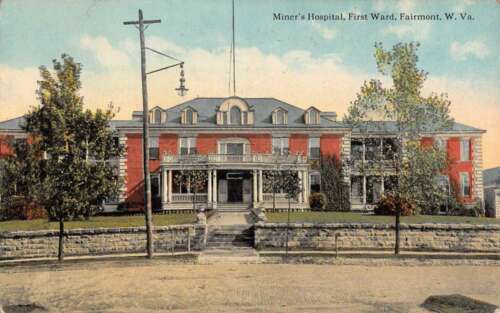
Jack Wilson, an employee at the round house, lights a match and carelessly throws it down. The match falls into a can of powder. Jack is severely burned and taken to the Miner’s Hospital. It is feared he will lose his eyes. (FWV 01.03.08 pg. 1)
Early Morning
In Elwood City, PA:
The dead bodies of Chris Evans and Bertha Gordon are found along the track of the B&O railroad. “The couple were on their way to the woman’s house when they became confused, a fast freight train coming out of the tunnel and running them down before they had an opportunity to escape.” (FWV 01.03 08 pg. 1)
Morning
In New York:
7 men who survived the wreck of the Germanic arrive and “told the story of the wreck of the bark Germanic, the captain drowning, and the disappearance of eight crew members. The horrors endured were terrible.” (FWV 01.03.08 pg. 1)
In the Flemington/Grafton, WV area:
James Clevenger, of Flemington, is gradually losing his family to starvation. “It is said that the awful state of affairs was brought about by the extreme poverty of the family and the refusal of the father and husband to work.” Miss Cleveland Clevenger (aged 18) and Julia Clevenger (aged 14) die of starvation while “another is critically ill and the other five are eking out a bare existence.” (FWV 01.03.08 pg. 1)
“The residents of the community in which the Clevengers live were ignorant of the awful state of affairs existing at their residence, which is a mere shanty, almost devoid of furniture, until the deaths occurred.” (FWV 01.03.08 pg. 1)
“Since, the charitably inclined neighbors have furnished food and clothing and medical attention, so the surviving members of the family will fare much better in the future.” (FWV 01.03.08 pg. 1)
In Fairmont:
The Fairmont West Virginian reports the weather will be: Fair tonight and Saturday; warmer Saturday
Misses Edith and Mabel Wise, sisters of Charles Wise, return to their home in Canton, Ohio. (FWV 01.03.08 pg. 8)
During the day
At the Alpha mine in Nevada:
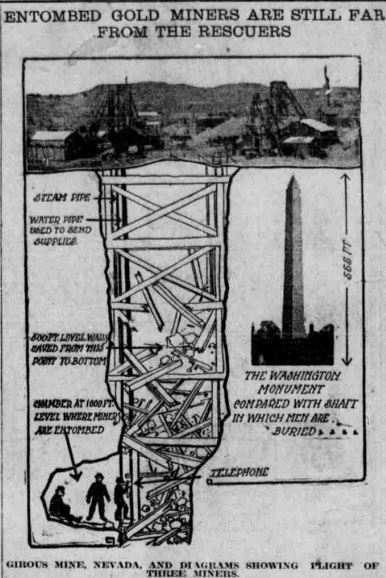
AC 12.31.07 pg 1
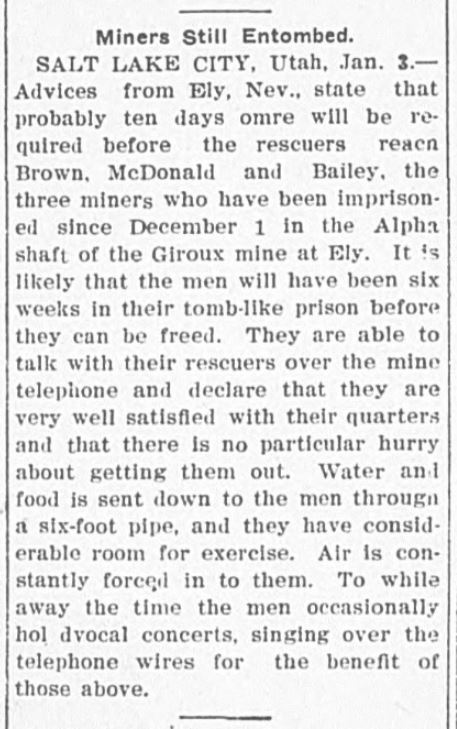
“Advices from Ely, Nev., state that probably ten days more will be required before the rescuers reach Brown, McDonald and Bailey, the three miners who have been imprisoned since December 1 in the Alpha shaft of the Giroux mine at Ely. It is likely that the men will have been six weeks in their tomb-like prison before they can be freed.” (FWV 01.04.08 pg. 2)
“They are able to talk with their rescuers over the mine telephone and declare that they are very well satisfied with their quarters and that there is no particular hurry about getting them out. Water and food is sent down to the men through a six-foot pipe, and they have considerable room for exercise. Air is constantly forced in to them. To while away the time the men occasionally hold vocal concerts, singing over the telephone wires for the benefit of those above.” (FWV 01.04.08 pg. 2)
At the Darr mines in PA:
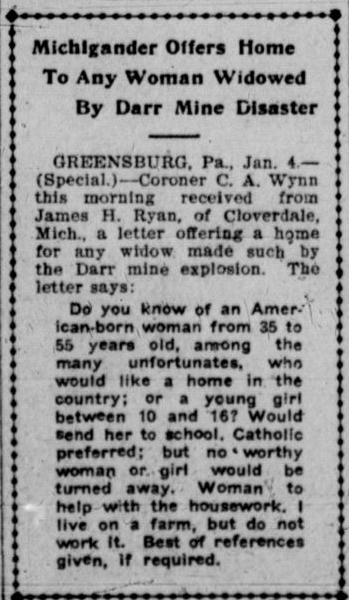
TDT 01.03.08 pg 2MJ 01.03.08 pg 3
~6:00 pm, News Hour
Fairmont West Virginian:
FWV 01.03.08 – pg 1FWV 01.03.08 – pg 1
“The Paint and Powder Club plays for charitable benefits only and its appearance here is for the benefit of the Monongah sufferers.” (FWV 01.03.08 pg. 1)
“This club is made up of the best talent in Baltimore. Its actors are artists and a first class show is assured.” (FWV 01.03.08 pg. 1)
“…almost decided that Parkersburg would get it. But when the Monongah explosion came, the members of the club desired to assist in raising the big relief fund that will be required to take care of the sufferers. They wired people here and the arrangements were made for their coming.” (FWV 01.03.08 pg. 1)
Avg. nightly receipts = $4,000 in most places (FWV 01.03.08 pg. 1)
“The general committee composed of Sprigg D. Camden, Walton Miller, J.O. Watson, Brooks Fleming and Geo. A. Alexander have enlisted the services of a number of young men and women who are selling tickets in Wheeling, Parkersburg, Clarksburg, Grafton and Morgantown.” (FWV 01.03.08 pg. 1)
The young ladies of the city give a Leap Year dance at the Tavern. “The invitations to the young men were extended through the young ladies who called for them at their homes.” (FWV 01.03.08 pg. 5)
“The young ladies will do the Leap Year act from start to finish.” (FWV 01.03.08 pg. 5)
“At the dance, dances were engaged by the young ladies and all the little courtesies heretofore confined to the masculine sex were performed by the hostesses.” (FWV 01.04.08 pg. 5)
“The ballroom at the Tavern was in holiday attire and Omen’s Orchestral furnished an excellent program for the dancing.” (FWV 01.04.08 pg. 5)
This slideshow requires JavaScript.
The Electric Theater again presents “Passion Play”. “Misses Lula and Eva Barnes, of the Presbyterian Choir, will sing for this occasion.” (FWV 01.03.08 pg. 8)
Steve Duma and Mike Hazugo were arranging to fill the powder flasks for the days work, when a spark from the miner’s lamp held by Duma was dropped into the keg of powder. Powder explosion wrecked 2 houses. “Both men were lacerated and burned…brought to hospital in serious condition.” (FWV 12.31.07 pg. 4)
In Fairmont:
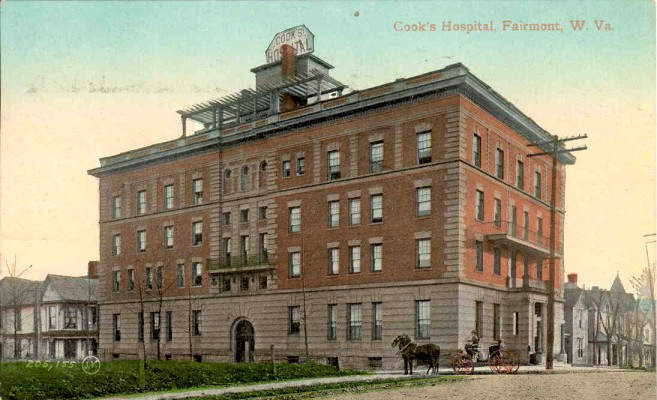
Earl Fluharty, the 15 year old son of Jefferson Fluharty of Monongah, dies in Cook’s Hospital after an illness of typhoid fever. “He came to the hospital on Saturday of last week and at that time his condition was serious.” His remains are taken to Cunningham’s morgue. (FWV 12.31.07 pg. 4)
~11:50 am
In Carthage, New Mexico:
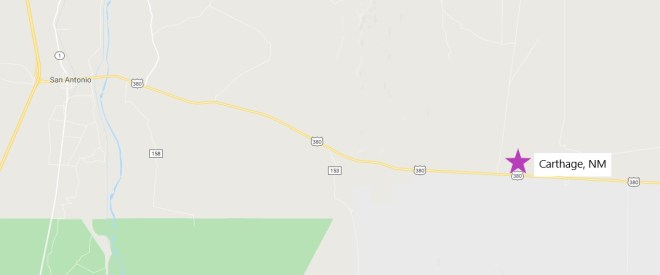
“Carthage is a small town on a branch line, twenty miles from San Antonio, on the Santa Fe railroad…” in Socorro county New Mexico. (AC 12.31.07 pg. 1) (TSJ 01.01.08 pg. 1)
It’s time for lunch break at the Bernal coal mine in Carthage, New Mexico which is owned and operated by the Carthage Fuel Company. “The greater part of a force of fifty men” begin to leave the mine for lunch while several others stay behind and continue to work. (AC 12.31.07 pg. 1)
The Bernal mine is about to become #5 on Bloody December’s list.
Philip Biglioni (14 years), Angelo Talmeiri (16 years), and Peter Falconi (17 years) are skating on a pond near Bangor when the ice gives way. All 3 boys are drowned but the bodies are recovered. (FWV 12.30.07 pg. 1)
In Stroudsburg, PA:
Mrs. Geo. Hoonshilt is talking to a friend over the telephone while her 8-year-old son, Lewis, had been “shooting at a mark with a flobert rifle”. At one point, her son “came into the room and pointing the weapon at her pulled the trigger. The bullet struck Mrs. Moonshilt in a vital spot and she lived but a short time.” (FWV 12.30.07 pg. 1)
In Pittsburg, PA:
Miss May Messmer, a school friend of Stella Hartzell, calls and spends a pleasant afternoon with Stella and her husband George. George was “27 years old and for a number of years had been employed as a brakeman…at the Piticarn yards of the PA Railroad Co.” Stella was “15 years old May 23, 1907, and was married to Hartzell August 14, last.” (FWV 12.30.07 pg. 5)
“After their marriage Mrs. Hartzell complained of being lonely and afraid to remain alone at nights” while her husband worked. (FWV 12.30.07 pg. 5)
“On several occasions she went during the night to the office in the railroad yards and sought her husband with tears in her eyes, declaring she was afraid to remain alone.” (FWV 12.30.07 pg. 5)
Her husband was unable to secure a position which kept him home at nights, “so she gradually grew despondent and often declared she hated to see the approach of night.” (FWV 12.30.07 pg. 5)
Ms. Messmer remained for supper and after the meal was over Mrs. Hartzell asked her friend to remain and keep her company so she would not be lonesome but Ms. Messmer was unable to stay longer and left for home. (FWV 12.30.07 pg. 5)
~6:00 pm, News Hour
The Tombstone Epitaph in Arizona:
“Phoenix is raising funds for the sufferers of the Monongah mine disaster.” (TE 12.29.07 pg. 2)
Los Angeles Herald in California:
“LURAY—The mass meeting of citizens of Luray held in the Main Street Baptist church to raise a fund for the relief of the Monongah mine sufferers resulted in securing about $100. A committee was appointed to get further subscriptions from the citizens of Luray and it is thought about $200 will be realized. A resolution was passed directing that the money be forwarded to the Red Cross society.” (LAH 12.29.07 pg. 11)
Omaha Daily Bee in Nebraska:
ODB 12.29.07 – pg 2
“The rescuers believe they are within reach of all of the bodies that will be recovered and as air is now being forced to the most remote workings it is hoped to have the work practically completed early tomorrow.” (ODB 12.29.07 pg. 2)
ODB 12.29.07 – pg 2
Salt Lake Herald in Utah:
SLH 12.29.07 – pg 2
The Boston Globe in Massachusetts:
BG 12.29.07 pg 12
Pittsburgh Post-Gazette in Pennsylvania:
PPG 12.29.07 pg 7
“The question of undercutting coal in mines before blasting it is an important one just now between the coal operators and mine inspectors of this region; and is, therefore of interest everywhere in the bituminous districts of this state. Particularly in this case since the recent great mine catastrophes have raised into prominence the matter of making such provisions as will insure the miner’s safety.” (PPG 12.29.07 pg. 7)
“The law says the coal shall be ‘properly’ undercut before blasting. But nothing is said about the reach of the undercut. Mine owners insist that the extent of the undercutting is thus left to the discretion of the mine boss.” (PPG 12.29.07 pg. 7)
“The effect of blasting after deep undercutting is that the coal comes away in large blocks. In this region, where the coal is soft, the more it is broken up by the blast the better it is for coking.” (PPG 12.29.07 pg. 7)
“Undercutting is done by miners both with picks and by machines. The miner cuts away about a foot thickness of coal at the bottom of the vein. The distance of this cut must be the same as that of the hole bored higher up into the body of the coal in which the explosive is placed, usually about six feet. When the blast is effectively set off it dislodges the entire six feet of coal that has been undercut. This mass comes away in blocks. And it is this fact which is said to have been potential in securing the enactment of the undercutting law for the benefit of owners of river mines, where the coal is hard. These owners want their coal in lumps.” (PPG 12.29.07 pg. 7)
“Owners of coking coal mines want their coal crushed and this is better accomplished by abolishing undercutting.” (PPG 12.29.07 pg. 7)
“Coal mine owners do not want the undercutting law strictly enforced in this region. They say it adds nothing to the safety of the mine, and that it is burdensome to them in its application. But mine inspectors and mining engineers think differently. They insist that it tends to the safety of the miner and should be enforced by law.” (PPG 12.29.07 pg. 7)
“What is regarded by some as an objectionable feature of the coal mining business in the bituminous region is the facility with which mine owners can get rid of mine foreman who, for any reason whatever, may become obnoxious to them. Such a foreman is an officer of the state. He has to pass an examination by the state and get his certificate from the state. Yet when appointed to the foremanship of a mine he is subject to dismissal at any moment, without knowing why, by the superintendent of the mine, who may or may not be a practical foreman, and who is responsible only to his employer.” (PPG 12.29.07 pg. 7)
“A well-known and thoroughly capable local mining engineer is authority for the statement that the mining laws in Pennsylvania are largely farcical, and ineffective in practical application, and have been moulded and managed for years, in some localities, with the express purpose of putting moral responsibility for disasters upon the state, so far as possible.” (PPG 12.29.07 pg. 7)
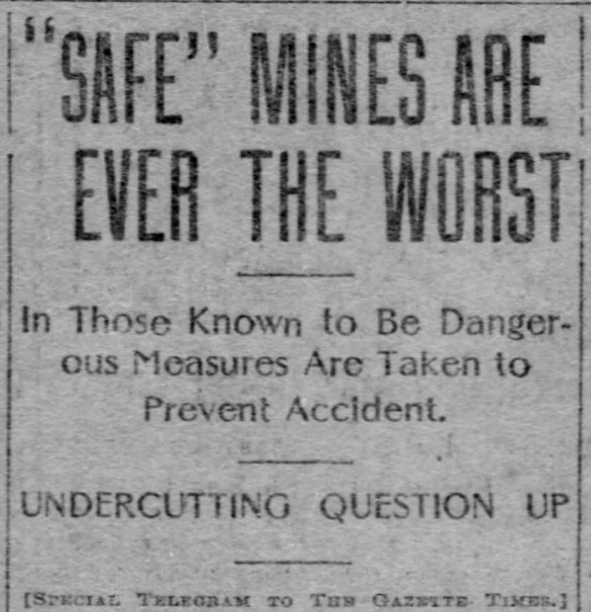
“Experts regard the most dangerous active mines in the gas coal region as really the safest in which to work, because knowledge of the danger has made both miners and operators very cautious. An expert said yesterday that it had been so long since there had been an explosion in a so-called dangerous mine that he could not recall it. But he could recall many, and all of the later ones in mines accounted safe—so safe that it was not thought much worth while either by miners or operators to take any particular pains against disasters. The Naomi, Monongah, and Darr mines were all known as ‘safe’ mines.” (PPG 12.29.07 pg. 7)
“One of the great mines near Uniontown is known as ‘dangerous’ yet there never has been a serious accident in it. Great fans are not alone relied upon for ventilation. Holes or wells have been drilled at eight widely separated spots over the surface of the mine down into its heart and cased with iron tubing, like oil wells. An additional well is sunk whenever its need has become apparent. The tube reaches up about 10 feet into the air and through this vent an immense quantity of gas escapes unassisted from the mine. The natural draft thus created is very strong. A man with a torch passing within 50 feet of one of the tubes recently ignited the gas flowing from it. This indicates the volume coming from a single vent. What must it be from all?” (PPG 12.29.07 pg. 7)
Mrs. Messmer has left the Hartzell home and Mrs. Hartzell packs her husband’s dinner bucket. She again asks him not to go to work. “He explained that he must be at work, and his wife grew despondent because he insisted, he must leave her.” Stella hands George his packed dinner bucket then, “shot herself behind the right ear with her husband’s revolver…She died instantly.” (FWV 12.30.07 pg.5)
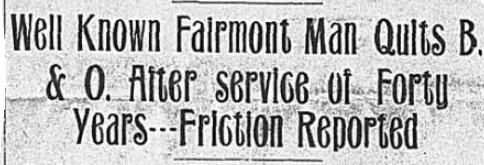
Thomas Fitzgerald, general manager of the B&O Railroad company has resigned his position to take effect the first of the year. Fitzgerald was born and raised in Fairmont “and was considered one of Fairmont’s greatest sons.” (FWV 12.28.07 pg. 1)
“He was an able official, having attained his position by merit working up from the bottom of the ladder.” (FWV 12.28.07 pg. 1)
“When asked the significance of General Manager Fitzgerald’s resignation, MR. C.W. Watson said that for a long time there had been considerable friction in the operating department of the B&O and his resignation was no unexpected by his friends.” (FWV 12.28.07 pg. 1)
“Hon. A.B. Fleming said: ‘I am personally very fond of Tom Fitzgerald. If he leaves the B&O it will be a loss to the community.” (FWV 12.28.07 pg. 1)
“Mr. J.E. Watson said: “I have known Fitzgerald ever since he has been connected with B&O, nearly 40 years, and believe his resignation will be a greater loss to the B&O than to him.” (FWV 12.28.07 pg. 1)
Clarksburg Daily Telegram:
CDT 12.28.07 pg 1CDT 12.28.07 pg 1
Daily Arizona Silver Belt:
DASB 12.28.07 – pg 1
Williams News in Arizona:
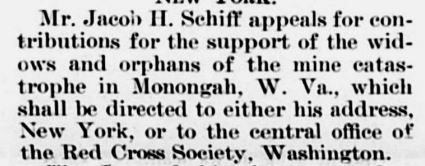
“This office is in receipt of a circular letter from the Monongah Relief Committee, which is asking financial aid for the widows and children of the 350 miners whom were killed in the recent Monongah mine horror. The officers of the committee are some of the most prominent men in West Virginia, Governor Dawson himself being chairman, and there is no doubt but what all money sent them will be properly used. The people in the neighbor where the accident occurred have subscribed $50,000, and fell justified in asking the remainder of the country to assist. All remittances should be made to J.E. Sands, Post office box 306, Fairmont, West Virginia.”
Washington Times in D.C.:
WT 12.28.07 – pg 10
Richmond Palladium in Indiana:
RP 12.28.07 – pg 2
The Marion Daily Mirror in Ohio:
TMDM 12.28.07 – pg 2
Pittsburgh Daily Post in Pennsylvania:
PDP 12.28.07 pg 3
Pittsburgh Post-Gazette in Pennsylvania:
PPG 12.28.07 pg 5PPG 12.28.07 pg 5
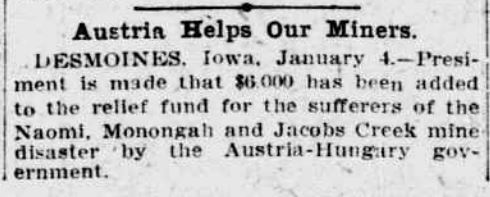
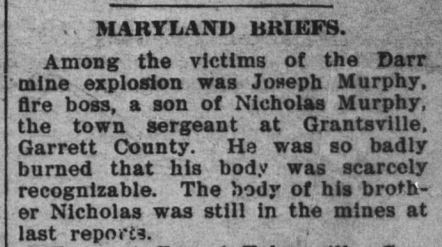
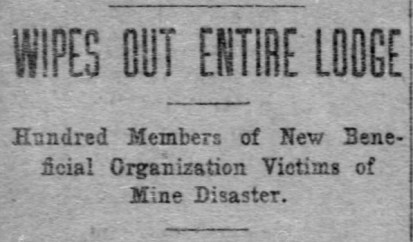
“The Darr mine disaster completely wiped out an organization among the miners, known as St. Mary’s Beneficial lodge, of Jacobs Creek, which had more than 100 members, every one of whom as in the mine when the explosion occurred. Not a member was left to administer the affairs of the lodge and the Rev. Father Kalmon Kovatz, of McKeesport and the Austro-Hungarian consul at Pittsburgh have taken charge.” (PPG 12.28.07 pg. 5)
“The body was formerly affiliated with the McKeesport organization of the same name. Difficulty over the paying of assessments arose and the Jacobs Creek members organized independently. It had just succeeded in establishing itself on a new basis when it was wiped out.” (PPG 12.28.07 pg. 5)
PPG 12.28.07 pg 5
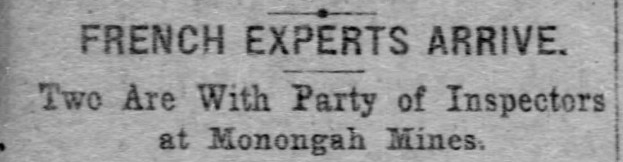
“The work of the inspectors has been resumed after the Christmas rest and today two French experts were with the party. They are M. Jaques Caffauel and M. Dumaine, who came direct from France to look into the situation. M. Caffauel says it is probably dust caused the explosion. They will remain here several days.” (PPG 12.28.07 pg. 5)
Night
At the Darr Mines in PA:
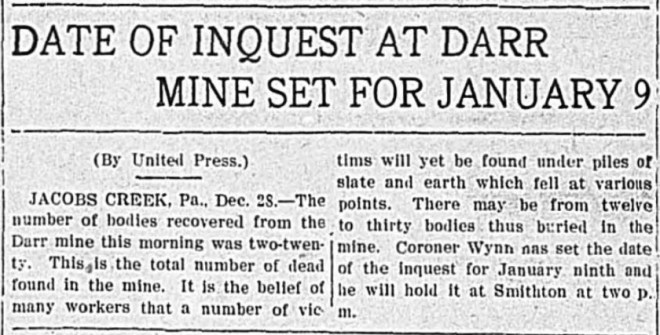
“It is the belief of many workers that a number of victims will yet be found under piles of slate and earth which fell at various points.” (FWV 12.28.07 pg. 1)
“There may be from 12-30 bodies thus buried in the mine.” (FWV 12.28.07 pg. 1)
“The dead are being buried fast and on Sunday it is expected the temporary morgue at the mine will be cleared. The last of the unidentified dead will be buried Sunday afternoon.” (PDP 12.29.07 pg. 4)
“The graves cannot be prepared as fast as the bodies are being shipped here. Thirty-two bodies arrived today. More came in tonight and still more will arrive tomorrow for burial in the foreign cemeteries.” (PDP 12.29.07 pg. 4)
“…a loud explosion at the home of R. Frediani tore out the front of his house but luckily none of the family were injured. The cause of the explosion is attributed to the Black Hand, as Frediani received several demands and letters for money but paid no attention to them. The police found a large quantity of dynamite. So far no arrests have been made.” (FWV 12.28.07 pg. 1)
Morning
In New York City:
FWV 12.28.07 – pg 1
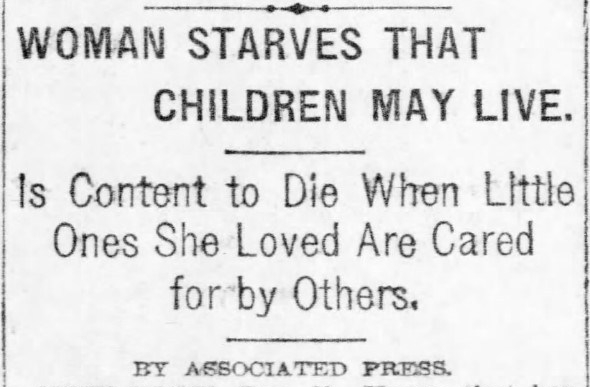
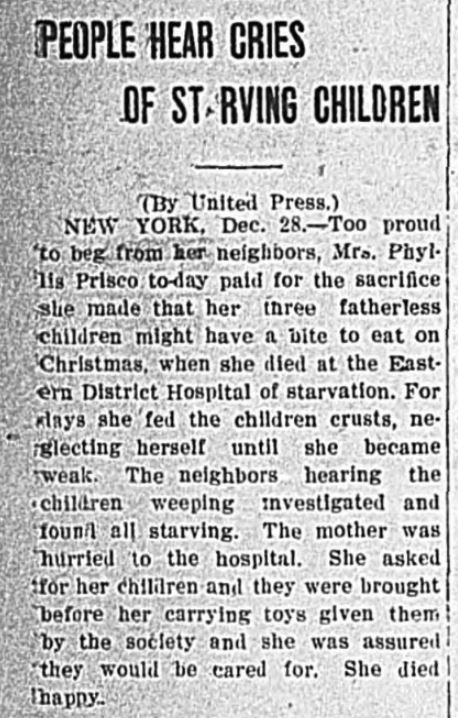
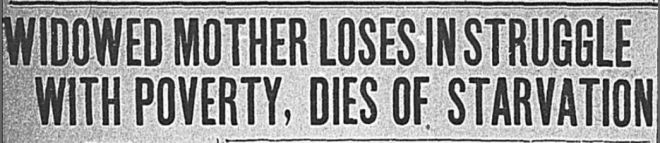
“Happy that her children, for whom she had sacrificed everything, even the last scraps of food, had at last found friends, Mrs. Phyllis Prisco died at a Brooklyn hospital today of starvation. Mrs. Prisco’s husband has been dead for some months and four little ones, the eldest four years, the youngest four months old, to care for, she labored day and night until she was taken ill.” (PDP 12.29.07 pg. 5)
“Her pride prevented her from asking for aid so she saved what bits of food she could obtain for her little ones, while she gradually grew weaker and weaker from the lack of food. The last bits of crusts went for the children’s Christmas dinner and the next morning neighbors heard the crying of the little ones in the unfurnished room in which the mother and children lived. They entered and found Mrs. Prisco dying the children weak from the lack of food and from the cold. The police removed the mother to a hospital and the Children’s society took care of the little ones.” (PDP 12.29.07 pg. 5)
“When the physicians found that all hope for the mother was gone, the little ones were sent for and Mrs. Prisco was assured that they would be cared for. They were happy again for they had had plenty of food and toys. Rosie and Katherine cooed over pretty dolls. Sam’s eyes glistened at a furry horse and baby Angeline clutched in her chubby hands a wooly lamb.” (PDP 12.29.07 pg. 5)
“Their troubles were forgotten in their new found happiness and as they played with their treasures on the floor beside the hospital cot the tired woman realized that their sufferings were over. And as she watched them playing there, the mother smile faded out of her eyes, the mother heart was stilled and the mother’s sacrifice was complete.” (PDP 12.29.07 pg. 5)
At the Darr Mines in PA:
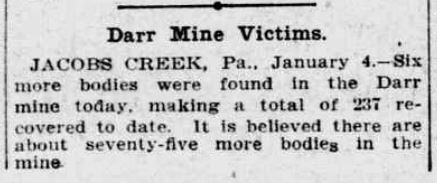
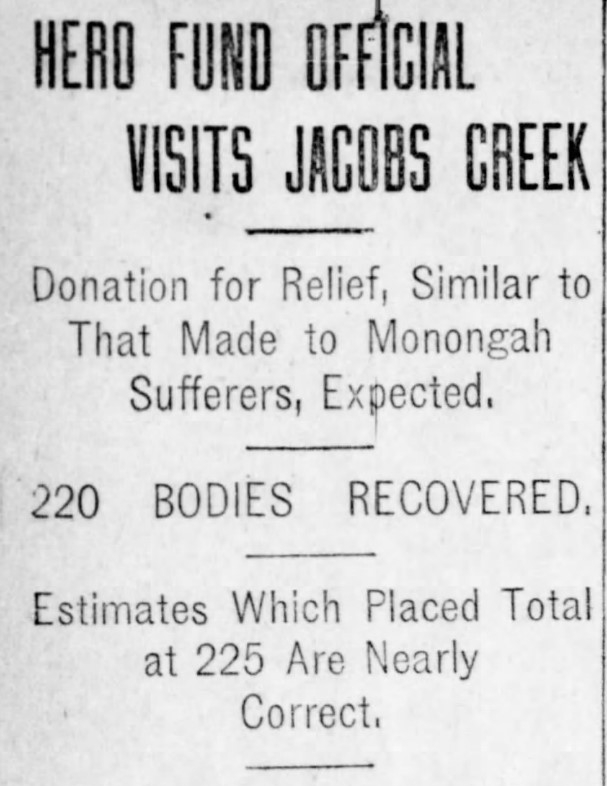
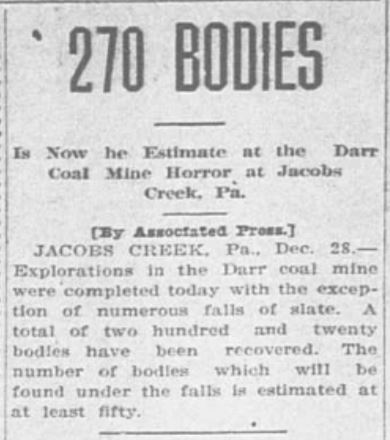
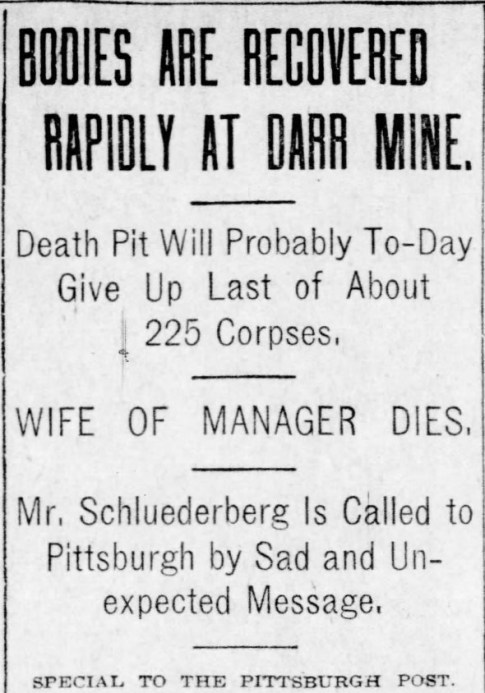
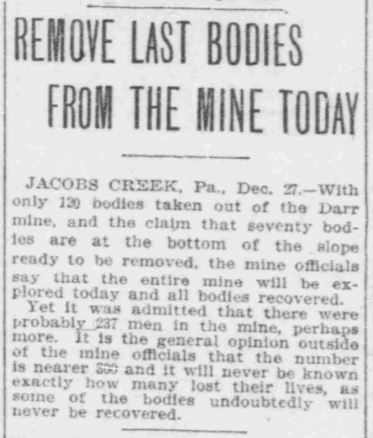
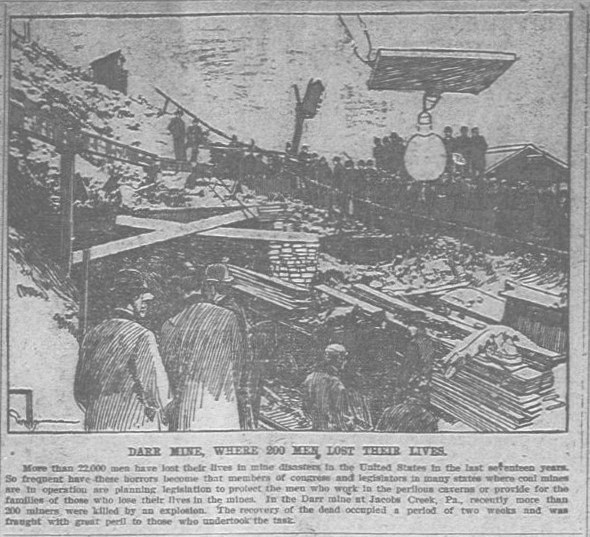
“During the work last night the removing of corpses from the fatal entry No. 27, which held 74 bodies, was accomplished and the total death list was swollen to 220.” (PDP 12.29.07 pg. 4)
“The excact number of victims will not be known until the last vestige of wreckage is removed, but developments show the estimate of 225 dead was nearly correct.” (PDP 12.29.07 pg. 4)
“Some of the bodies last removed were in better shape than those taken out earlier. They had fewer burns and were less mutilated.” (PDP 12.29.07 pg. 4)
The “task of clearing up the workings” begins. “The dead horses, of which there are 20 in the mine, will first be hauled out. This will be a difficult task because of the limited space and the numerous falls which are encountered.” (PDP 12.28.07 pg. 3)
Afternoon
In Baltimore, MD:
BS 12.28.07 pg 7
In Parkersburg, WV:
Charles Huffman is dead, Orland Bennett will lose his eye sight and Ruday Backman will lose a leg as the result of hunting accidents near Wadesville over Christmas. (FWV 12.28.07 pg. 1)
“Huffman was killed by a discharge from a shotgun when he had been holding on his lap while sitting on a fence. The gun fell from his grasp and the hammer struck the fence and the content of the shell entered the stomach of Huffman. His funeral will be held this afternoon…” (FWV 12.28.07 pg. 1)
At the Darr mines in PA:
“Workmen this afternoon removed the carcasses of 20 horses and mules.” (PDP 12.29.07 pg. 4)
“Attention will now be directed toward clearing away the piles of debris. Under this, according to the company officials, probably six or eight more bodies will be found, but others think 20 to 30 corpses will be located beneath the masses of wreckage.” (PDP 12.29.07 pg. 4)
“Coroner Wynn has set the date of the inquest for January ninth and he will hold it at Smithton at two p.m.” (FWV 12.28.07 pg. 1)
“By that time all the bodies will have been recovered.” (PDP 12.29.07 pg. 4)
“George A. Campsey, representing the Carnegie Hero Fund commission, which gave $35,000 to the Monongah sufferers, was at Jacobs Creek yesterday investigating the conditions of stricken families. It is expected that the commission at its January meeting will take action similar to that in the Monongah disaster.” (PDP 12.29.07 pg. 4)
“The Darr death pit gave up its dead more rapidly today than at any other time since the explosion…” (PDP 12.28.07 pg. 3)
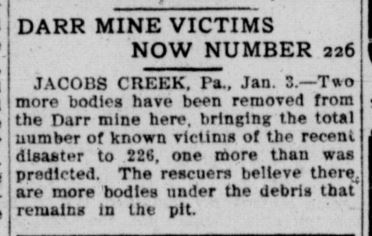
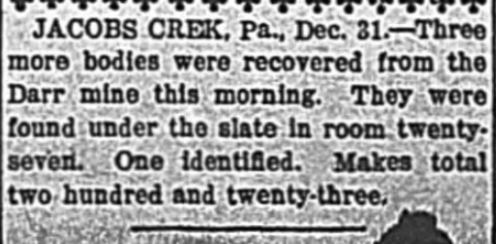
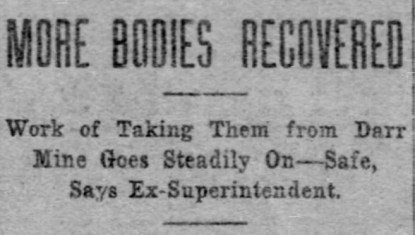
“The work of getting bodies out of the Darr mine goes on without delay, and at dusk today a total of 218 had been recovered. It is possible that 30 more will be taken out during the night.” (PPG 12.28.07 pg. 5)
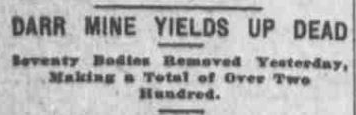
“Seventy or more bodies have been brought to the surface during the past 24 hours. The bodies with those already brought out total over 200. It is hoped to have the work practically completed early tomorrow.” (DASB 12.28.07 pg. 1)
“Fresh air is now being circulated through every nook of the immense mine and by noon tomorrow every corpse out to be above ground. Tomorrow the task of clearing up the workings will be started.” (PDP 12.28.07 pg. 3)
PDP 12.28.07 pg 3
In Fairmont:
High School Alumni Basketball game (FWV 12.21.07 pg. 1)
In Monongah:
“The mines at Monongah still give up victims of the explosion which occurred three weeks ago. One body was taken out of mine No. 6 this morning and another tonight from No. 8. Neither was identified. The total death list is now 352. The bodies last night and today were taken out in sections, in some cases only an arm and a leg being recovered.” (PPG 12.28.07 pg. 5)
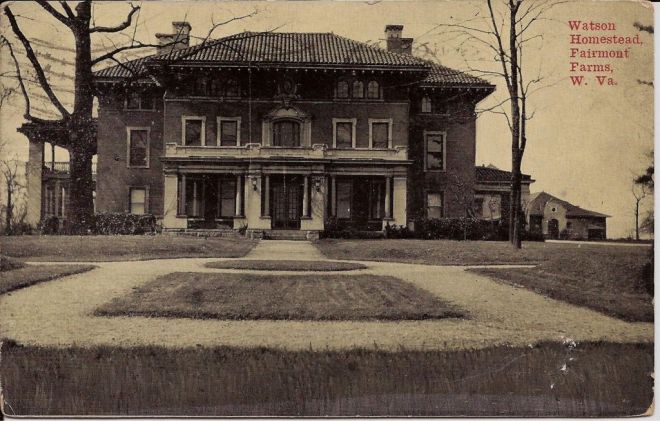
C.W. Watson hosts “an informal dinner” at his home, Fairmont Farms, “…given in honor of President B.F. Bush of Western Maryland Railroad Company…” and “…the two French experts, M. Jaques Caffauel and M. Dumaine, who are there examining the Monongah mines. Covers were laid for about twelve and elegant menu was served.” (CDT 12.28.07 pg. 5 & 8) (FWV 12.28.08 pg. 5)
“Pray God that your footsteps may never, so long as you live, lead you to the pit mouth of an exploded mine.” (TSP 12.27.07 pg. 4)
“Death we all have with us from the cradle to the grave, but death as I saw it here had added to its terrors a frightful gruesomeness, a crushing nightmare of grief on grief, and a repulsive atmosphere of indifference to the sorrowing ones that told you plainly of the cheapness in which human life is held where men go below the surface to labor.” (TSP 12.27.07 pg. 4)
“I need not describe the awful effect of the explosion on those bodies. The news dispatches have told how these 200 men were torn limb from limb, their flesh lacerated and blackened and charred.” (TSP 12.27.07 pg. 4)
“Only those who have been through such a catastrophe can begin to appreciate the gigantic, irresistible force generated by the explosion of gas or dust in the narrow confines of a mine.” (TSP 12.27.07 pg. 4)
“First there is the tiny spark which in a bewilderingly short time is an explosion. The gas lying close to the roof of the tunnel breaks into a flame. It is blue but almost instantly turns white, like the flame that leaps from ovens of giant steel mills.” (TSP 12.27.07 pg. 4)
“It rushes along the leads, sweeping everything in its path with the fury which only it possesses. In the wake of the constantly increasing tongue of fire sweeps the vacuum known as black death and firedamp.” (TSP 12.27.07 pg. 4)
“Occasionally a man is left alive by the flame in its lightning like passage. But he never escapes the crushing power of the vacuum which rends him and crushed his heart until it bursts.” (TSP 12.27.07 pg. 4)
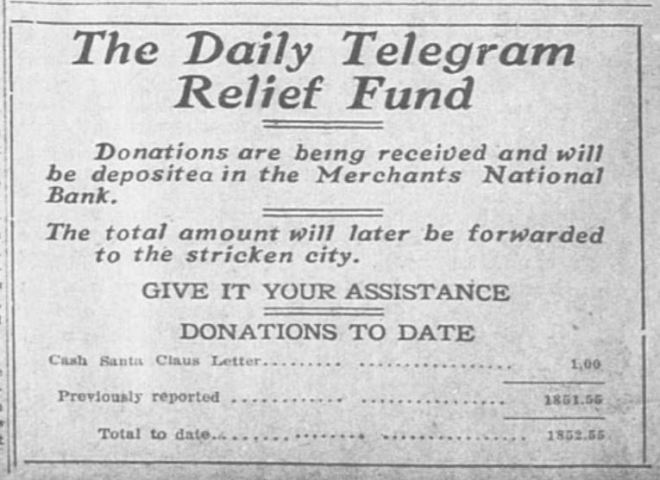
“The Monongah mines relief committee…has issued a circular setting forth the horrors imposed by the recent mine disaster and appealing for aid to take care of the widows and orphans left penniless.” (TSP 12.27.07 pg. 4)
“The proposition is too big for the state to handle, and hasty action is needed as the company in whose service the miners met death is impatient to secure the houses that now shelter the stricken families for other families that can furnish and resume production. “(TSP 12.27.07 pg. 4)
“The company owns all the houses and is apparently suffering for the surfeit of widows and orphans it has created. The idea of building more houses seems to be outside consideration.” (TSP 12.27.07 pg. 4)
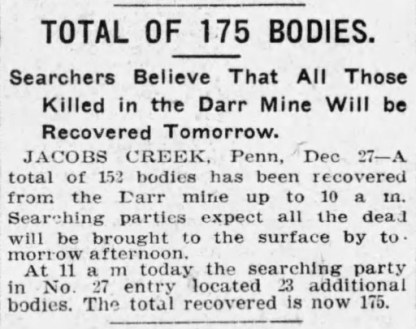
While the noon shift is working in entry 27 they locate 23 bodies. Mostly all are in a mutilated state. “The bodies will be brought out immediately, making the total 175.” (FWV 12.27.07 pg. 1)
“Expert miners say the damage wrought inside the Darr mine is small, compared with the other mine disasters in history and claim that two months will be ample time to put the mine in its former good working order.” (PDP 12.28.07 pg. 3)
“Despite the fact that scores of bodies have been identified and taken away, the crowd in the morgue tent does not seem to diminish. There was the usual crush today when relatives were admitted to look for the bodies of husbands, fathers, and brothers.” (PDP 12.28.07 pg. 3)
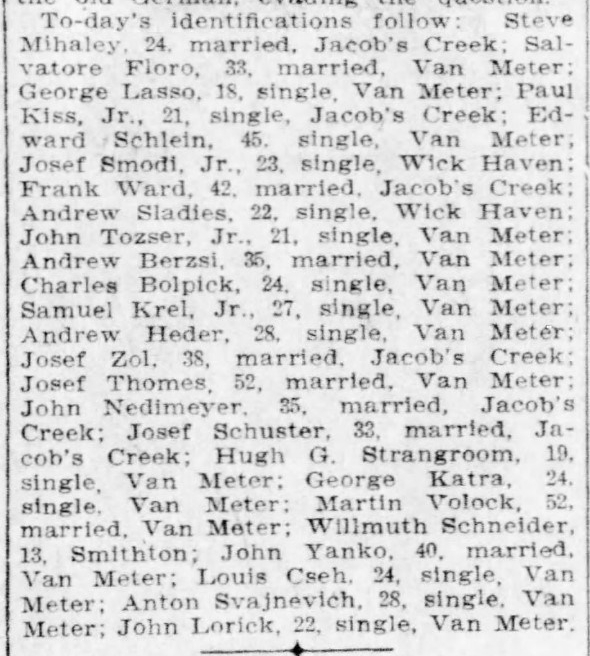
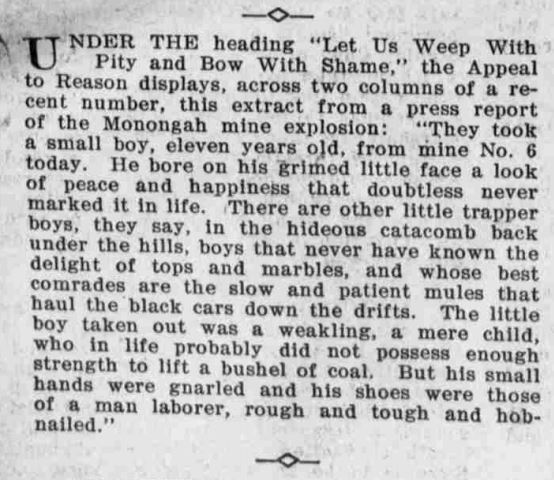
“Wilmuth Schneider, a trapper boy, who was taken out last night, would have been 14 years old July 6 next. Coroner Wynn asked the boy’s father, Henry Schneider, if he did not know it was against the law for children of that age to be working. ‘Didn’t you have to certify his age?’ queried the coroner. ‘I didn’t want my boy to work,’ answered the old German, evading the question.” (PDP 12.28.07 pg. 3)
In Monongah:
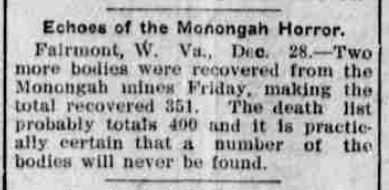
“Two more bodies were recovered from the Monongah mines today, making the total recovered 351 of a death list that will probably total 400. It is practically certain that a number of bodies will never be found.” (DASB 12.28.07 pg. 1)
“It is said that the mines will be opened for work just as soon as the investigation is completed.” (SSV 12.27.07 pg. 3)
~3:30 pm, Press Time
At the Darr mines in PA:
“The total recovered is now 175.” (BG 12.27.07 pg. 5)
“George A. Campsey, representing the Carnegie hero fund commission, is here investigating conditions with a view to reporting the amount of a donation that likely will be made.” (PPG 12.28.07 pg. 5)
“A number of bodies in the temporary morgue are in such condition as to menace the health of those who must frequent the place. A little trouble has occurred over the matter of funeral arrangements, but tomorrow it is expected everything will be cleared up.” (PPG 12.28.07 pg. 5)































 The Monongah Disaster