

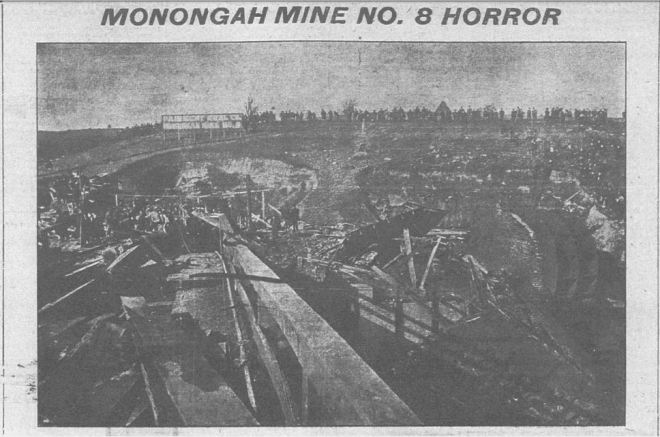
“The disaster at Monongah seems too terrible to contemplate, too pathetic for feeble words to describe. The imagination wanders in vain through the realms of philosophy and religion for a reason for such events.” (FWV 12.12.07 pg 2)
~6:00 pm
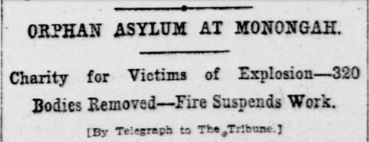
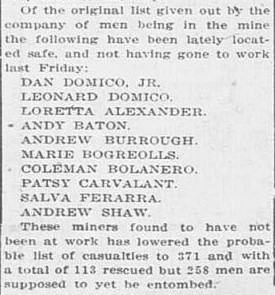
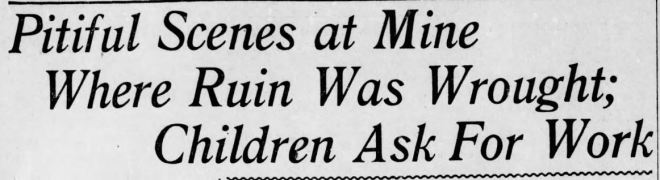
C.W. Watson gives a statement that: “After a careful census of the community we can say positively that the death list does not exceed 338. A total of 320 bodies have been recovered. All working places in Nos 6 & 8 have been explored. Some additional bodies may be found under wreckage or falls. Of the accounted for list of 338 a few may be found safe. A large force of men are now looking for bodies under falls.” (FWV 12.13.07 pg. 1)
Newspapers
Fairmont West Virginian:

“Although it will be a week tomorrow since the Monongah mine disaster, the story is still holding front page position on many of the leading daily papers both outside and inside of the state. Conditions in that regard will hardly change until the search for bodies is given up and the findings in the coroner’s jury are reported.” (FWV 12.12.06 pg. )
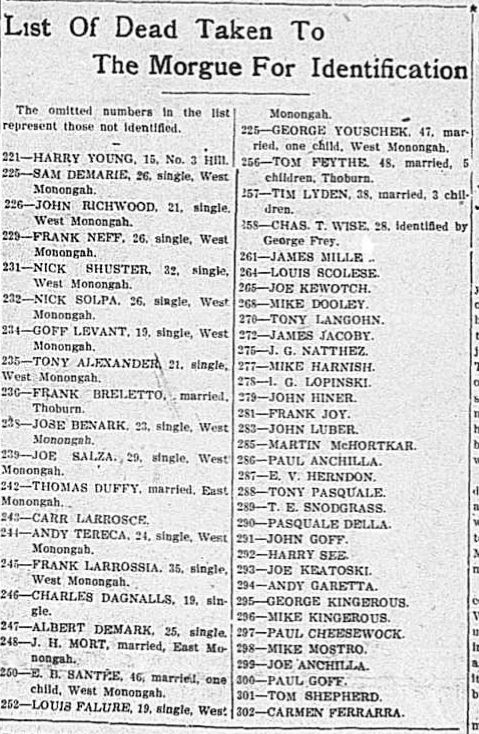
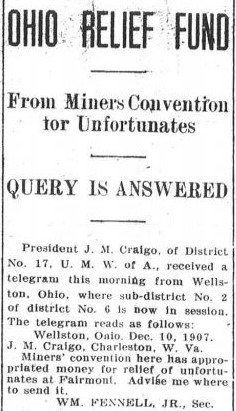
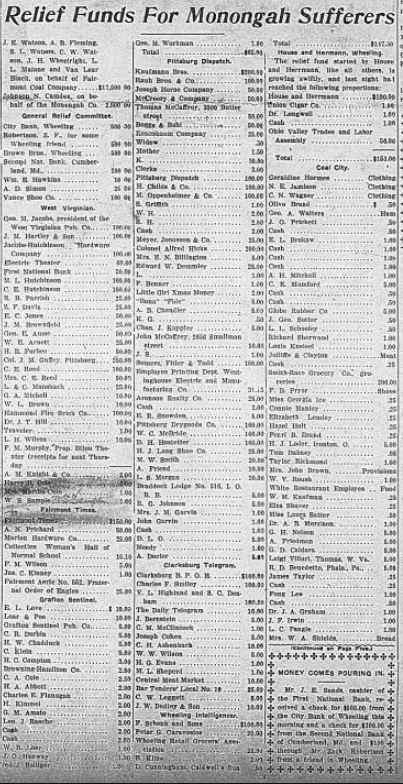
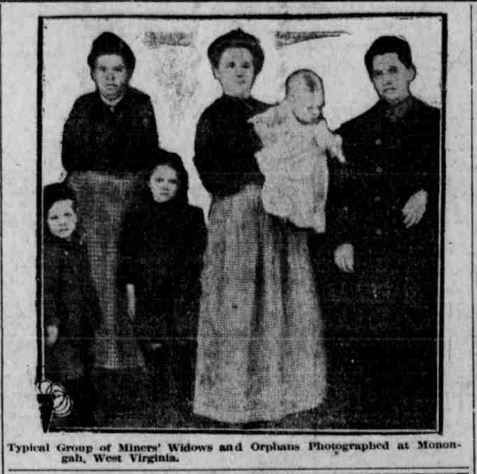
“The total relief receipts so far reported amount to $34,651.15 which seems to some to be a large amount but when it is considered there are 300 widows and 1,000 orphan children to divide this amount with it brings the amount per capita down to $26.65 which is a small sum to go through winter on to say nothing of their welfare for future years. (FWV 12.12.07 pg. 1)
“To name each person from here who has been to Monongah since Friday noon would be to almost mention by name the total population of Hoult and the vicinity.” (FWV 12.12.07 pg. 2)
“At first, people seemed dazed by the news and nobody took in its full import seemingly and are just now beginning to realize the awfulness of the terrible tragedy that has happened at our very doors.” (FWV 12.12.07 pg. 2)
“We notice a refrain constantly repeated in all the Fairmont papers that ‘nobody’s to blame’ least of all the Fairmont Coal Company…Why the necessity for all this? The echo of the explosion had scarcely wore out with which brush and pot of whitewash and had begun to administer a snowwhite coat to everybody connected with the Fairmont Coal Company.” (FWV 12.12.07 pg. 2)
“For instance, it was said that nobody around here believes that the coal company is in any way to blame, that the company’s employees all felt that there was no dissatisfaction, etc. Now on the contrary the writer has heard the company bitterly arraigned and condemned since the explosion, often by miners. I have talked with scores of people all of whom declare that the fans were not run at Monongah on Thursday, that as the day was an ‘off-day’ the fans were stopped two nights and a day to save expense and started again a few hours before the explosion. I don’t know that it’s true but it is one of the most persistent rumors or report circulated about the explosion and is believed by practically everybody and I have seen no attempt to dispute it. It is easily proved or disproved.” (FWV 12.12.07 pg. 2)
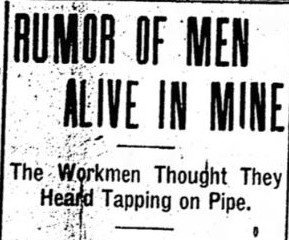
“No one knows better than the writer the unreliability of rumors. There has been a very persistent rumor that No 8 is on fire and although denied time and again, keeps bobbing up, even persons who have been working with rescue parties helping circulate it.” (FWV 12.12.07 pg. 2)
“But laying all that aside why pass judgement at all until the truth is ascertained if possible…But while that does not mean to condemn it does not mean to do any white washing. The writer believes somebody is to blame, but why not assume a calm and judicial attitude until the truth is known?…We should not condemn the company or anyone else without satisfactory proof. Neither are we called upon by common sense to throw over them a saintly mantle of innocence. Wait for the truth. ‘Suspend judgement’.” (FWV 12.12.07 pg. 2)

Dr. Henry Mace Payne of school of mining engineering is interviewed by the Fairmont West Virginian and asked if “West Virginia mining laws are adequate for the protection of the men in the mines.” (FWV 12.12.07 pg. )
“No laws, no matter how perfect, can absolutely protect the miner under all circumstances from the dangers incident to his calling. Nor can any set of rules and regulations for the conduct of mine laborers be enforced with such stringency as to prevent ignorant or reckless disregard of wise and necessary precautions.” (FWV 12.12.07 pg. )
“There are, however, some points at which our laws are probably at fault.” He points out the “…striking illustration of the unwisdom of allowing two or more mines to be connected as were Nos 6 and 8.” (FWV 12.12.07 pg. )
“Undoubtedly, too there should be some legislative requirement looking toward the prevention of any possibility of dust explosions.” (FWV 12.12.07 pg. )
“Our laws are defective in reference to the limitations which they place on the use of explosives in the mines. There are other points, perhaps, at which the laws are weak; but after all is said and done, the ignorance and recklessness of the one careless miner always to be found in any considerable number of them is the most serious menace to his own life and that of his fellows.” (FWV 12.12.07 pg. )
“You may show a group of miners just how a fulminate cartridge explodes and the danger of crimping the cartridge with their teeth. Then you may give them all copper crimpers which do the work better. Some of the men will use the crimpers all right, but you may be just as sure that as soon as your back is turned some of the boys will be crimping cartridges with their teeth in the old way.” (FWV 12.12.07 pg. )
Not long after Dr. Payne’s talk with the newspaper man, the doctor was suddenly summoned to Fairmont by one of the high officials of the Fairmont Coal Company. (FWV 12.12.07 pg. )
Clarksburg Daily Telegram:

“The Rev. L.W. Sifferd, pastor of Park Avenue Lutheran church, requests the Telegram to announce that the members of that church will be given the opportunity to contribute to the relief fund for the Monongah mine sufferers at Sunday morning’s service, and it is expected the congregation will make a very neat contribution. They all appreciate the seriousness of the situation at Monongah and the urgent necessity of helping the suffering.” (CDT 12.12.07 pg. 4)
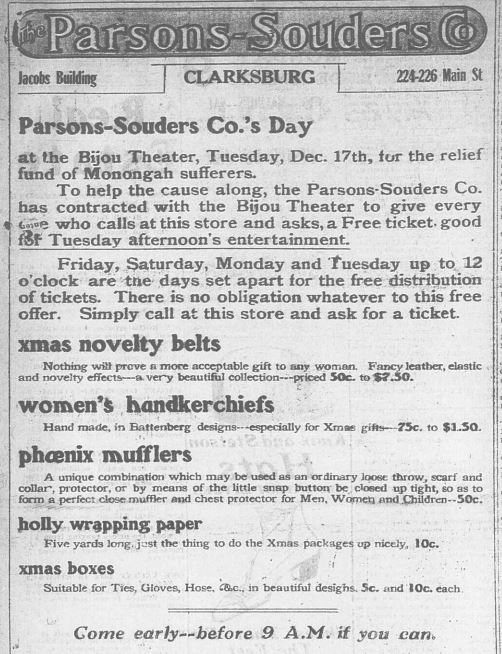
“Substantial donations are being received daily at the Telegram office for the relief fund…and the Telegram is glad to note that such is the case—that the people of Clarksburg are always ready and willing to lend assistance to their brothers and sisters in the time of deep distress and misfortune.” (CDT 12.12.07 pg. 4)
“Entertainments, socials and other events have been planned by some of the churches and other societies and the Telegram, desiring to lend further aid to the most worthy cause, will gladly print, free of all charges, admission tickets for these affairs.” (CDT 12.12.07 pg. 4)
“If charity should begin at home, surely now is the time for Clarksburgers to extend to the suffering at their very doors.” (CDT 12.12.07 pg. 4)
The Advocate in West Virginia:
“Senator T.C. Gartlan, of Parkersburg, has called a meeting of the mining investigating committee appointed by Pres. McDermott of the senate and Speaker Scaman of the House of Delegates at the last session of the legislature, to meet at Clarksburg Dec 17th for the purpose of making an investigation into the Monongah disaster in which the lives of 400 men were sacrificed last Friday.” (TA 12.12.07 pg. 1)
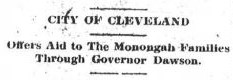
“Owing to the destitute circumstances in which many of the bereaved families at Monongah are placed offers of air are pouring in from all over the country.” (TA 12.12.07 pg. 1)
The Advocate is one of the few papers to do the following:
First, the correspondent for The Advocate waits several days before reporting on very personal and dramatic events like the births of a few children, specifically the 5th child of John Harriman (also reported as Herman, Hearman, Hearmans, Hearmons, and on Sunday they were catastrophically confused with the Hinermans).
But The Advocate waits to publish Caroline’s story, and will get it the most accurate of all reports:
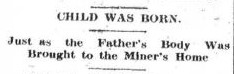
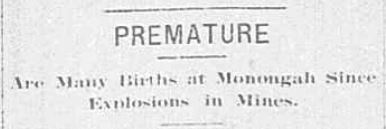
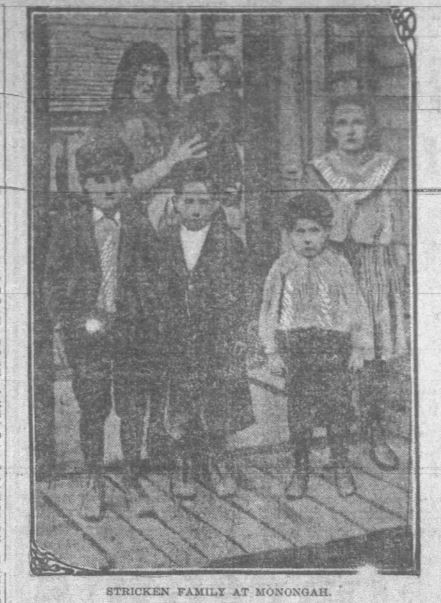
“A fifth child was born to Mrs. John Hearmans, at Monongah, just as the corpse of her husband was brought from the morgue and laid in the front parlor of the miner’s cottage for the view of the four orphaned children and other relatives.
“Mrs. Hearmans’ condition is very serious. She is aware of the fact that there has been an explosion, realizes that the entombed miners are dead beyond her adventure, and knows that the little son whose coming has been looked forward to for months is born into the world of an orphan.” (TA 12.12.07 pg. 1)
On Sunday, many papers scrambled to report the dramatic tale of both Mrs. Harriman and Mrs. Hinerman and as a result of their exhaustion combined with being utterly overwhelmed by the events around them, the stories get confused and, unfortunately, Caroline Harriman and her new child, James, repeatedly get reported as deceased across the country for the next several weeks when they did, in fact, survive. As far as is known, Mrs. Lawrence Hinerman and her child did not survive.
Another thing that is particular to The Advocate is their regular attempts at informing the public about the black miners who were killed at the Monongah mines. They more than any other paper outside of the local area, strive to make the black miners known.
“The loss of life is unknown, but it is estimated at between 400 and 500, twelve of whom were colored so far as known.” (TA 12.12.07 pg. 3)
“The colored men entombed in the mines are Richard Farmer, K.D. Kyalls [K.D. Ryles], John Adkins, Hall Perkins and others whose names are not known by your correspondent.” (TA 12.12.07 pg. 3)
The Labor Argus in West Virginia:

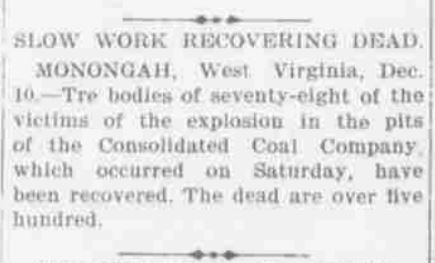
“It is believed that over five hundred perished, but the exact number may never be known, as many of the men employed ‘back hands’ of whom the company had no record. The latest reports given out by the company place the death list at about 260, but it is claimed by others that double that figure will be nearer the number.” (TLA 12.12.07 pg. 1)
Arizona Republican:
C.L. Michael, formerly of Fairmont, WV, now resident of Phoenix received copy of Morgantown Chronicle containing account of disaster. (AR 12.12.07 pg. 5)
“The paper states that the shock of the explosion was felt in Morgantown, which is nearly 30 miles away from the mines, Fairmont being about 5 miles away.” (AR 12.12.08 pg. 5)
“In this instance the news from the local papers indicates that the dispatches have but weakly painted the real effect of the trouble, though there is little to add except the story of horror, for the facts as to the death list etc. have been very accurate.” (AR 12.12.08 pg. 5)
“Mr. Michael says he was acquainted with a few men who had employment at the mine as engineer or some similar capacity but he has not heard whether they escaped or not.” (AR 12.12.08 pg. 5)
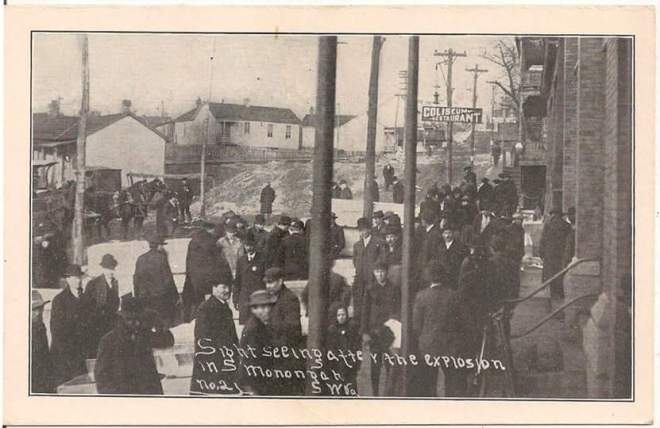
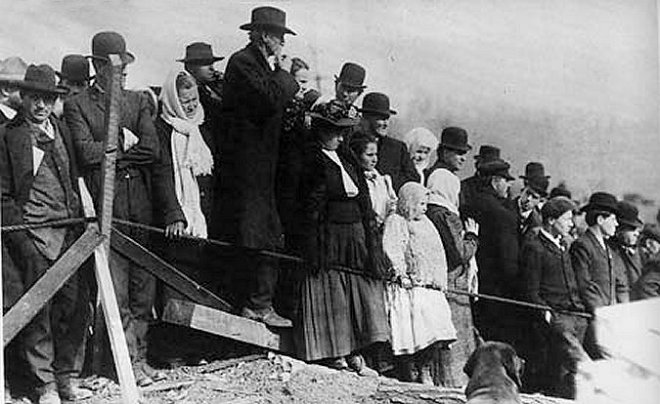
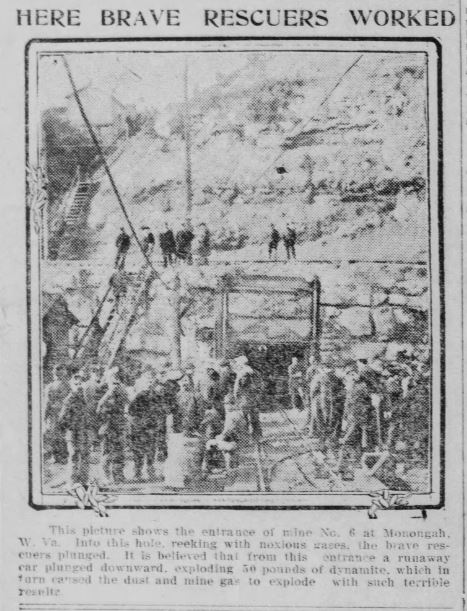
“The paper relates that thousands of people gathered at the mines and remained, only being succeeded by other thousands who came to relieve them.” (AR 12.12.08 pg. 5)
“Some were drawn by curiosity but by far the most of them were interested in learning the fate of some relative or friend.”
“All the friends of 500 entombed men would make a good big army.” (AR 12.12.08 pg. 5)
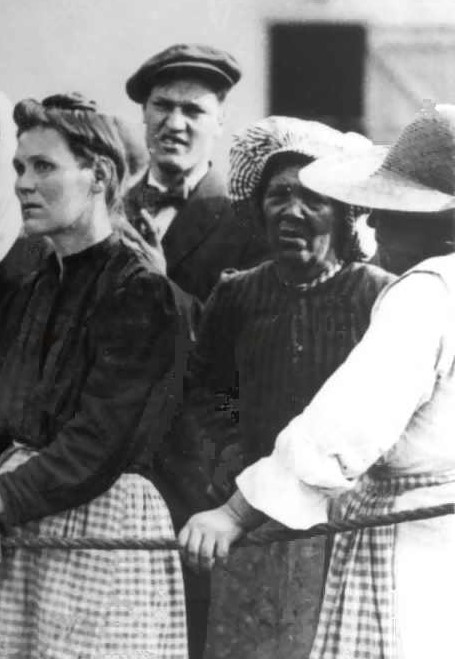
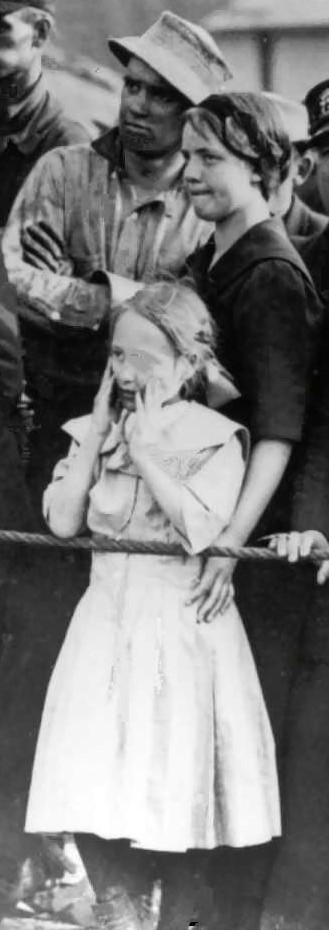
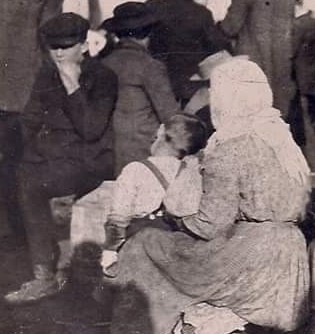
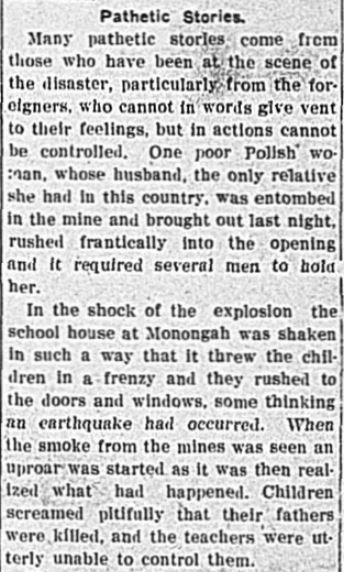
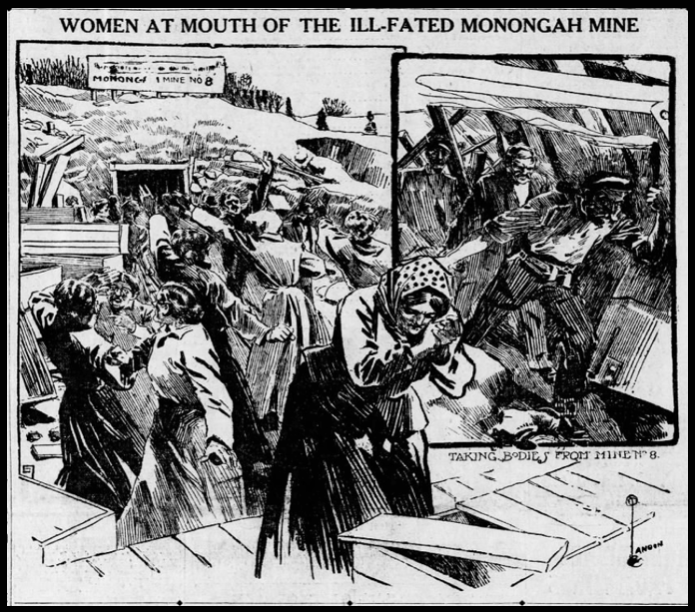
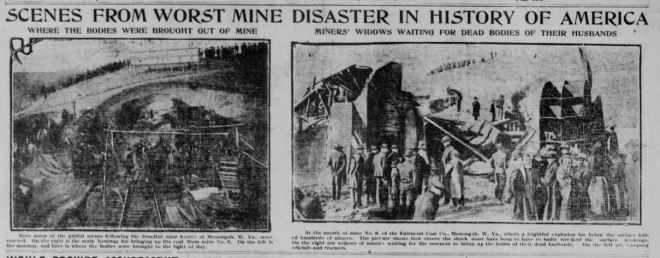
“Frantic women and children have collected in crowds about the mines. Some of them are able to control their emotions and stand about sad-eyed but stolidly waiting and prepared to hear the worst. It is not so with a great majority of them however, and many of the women, principally foreigners, are hysterical. They run about screaming and wailing at the top of their voices, tearing their hair and shouting out the names of their dead ones who they believe are lost.” (AR 12.12.08 pg. 5)
“Everything possible is being done to allay the fears of the women and children and keep them composed, but it is a difficult problem, and one that is meeting with but little success.” (AR 12.12.08 pg. 5)
“Wild eyed women and children go about in the crowds from man to man, peering anxiously into the smutted and coal dusted features of each of the men, looking for a husband a son or a father. The saddest and most heartrending scenes are being witnessed.” (AR 12.12.08 pg. 5)
Evening Star in D.C.:
“The opening of the coroner’s inquest has been set for next Monday.” (ES 12.12.07 pg. 2)
“Governor Dawson announced today that he will personally attend the inquiry for the purpose of instituting a rigid investigation with a view to ending West Virginia mine disasters.” (ES 12.12.07 pg. 2)
The Washington Times:

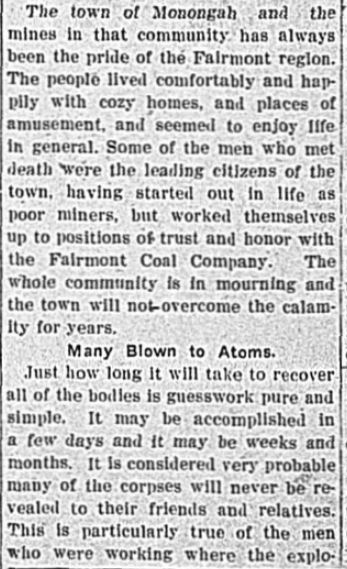
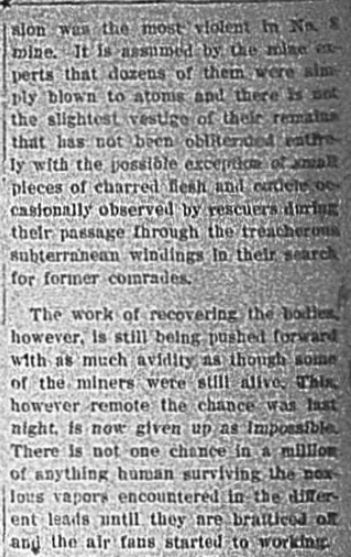
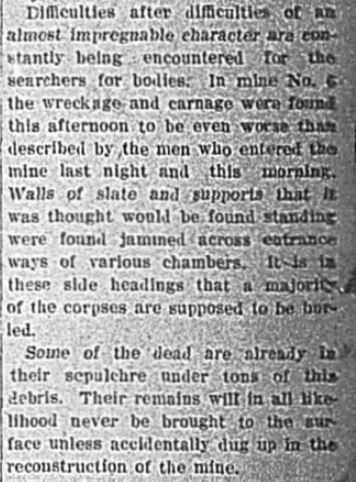
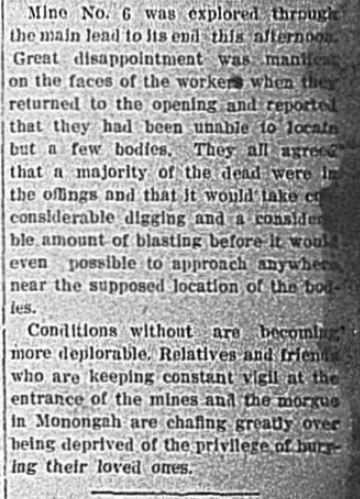
“It is said by the officers of the company that there are bodies in the mine that will never be recovered. They are lying under a fall of slate, and it may be months before this section of the mine is opened.” (WT 12.12.07 pg. 3)
“It is hoped, however, to have most of the bodies recovered before Saturday night.” (WT 12.12.07 pg. 3)
“Governor Dawson will come to Fairmont to hear the testimony at the coroner’s inquest which will probably begin next week.” (WT 12.12.07 pg. 3)
The Brandon News in Mississipi:
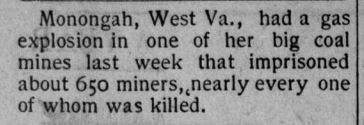
The Marion Daily Mirror in Ohio:
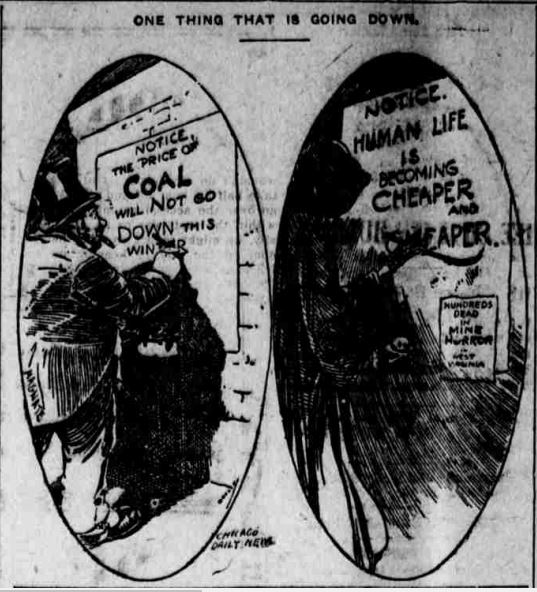
The Daily Press in Virginia:

“…and there was no question that the destitution among them would be very great.” (DP 12.12. 07 pg. 1)
Cumberland Evening Times:

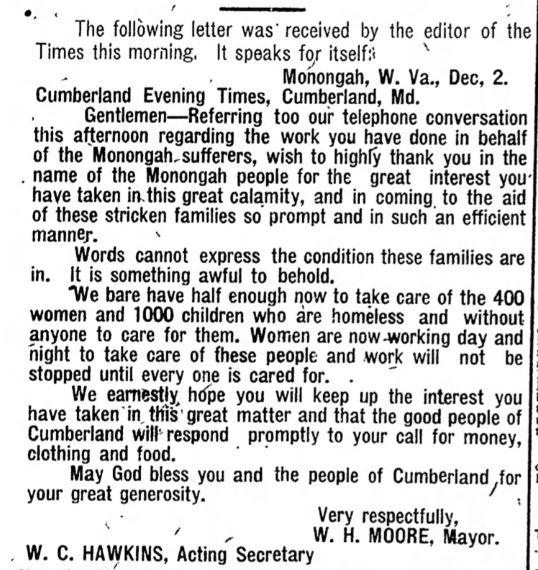
“Mayor Moore, of Monongah, wires the editor of the Times that the need of the community is very great, and that the sufferings of the bereaved women and children will be intense unless assistance comes promptly and generously. Let all who have an abundance of those world’s goods give freely and promptly.” (CET 12.12.07 pg. 4)
More on How Death Gloated!


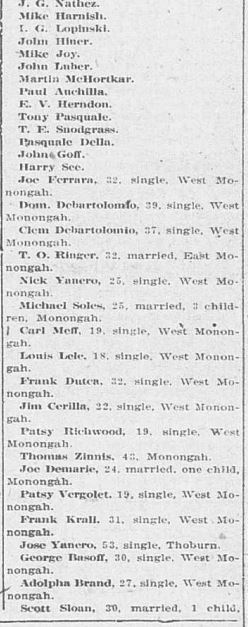
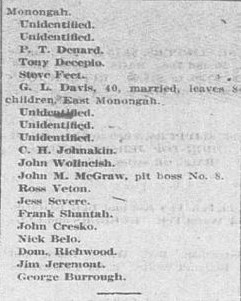


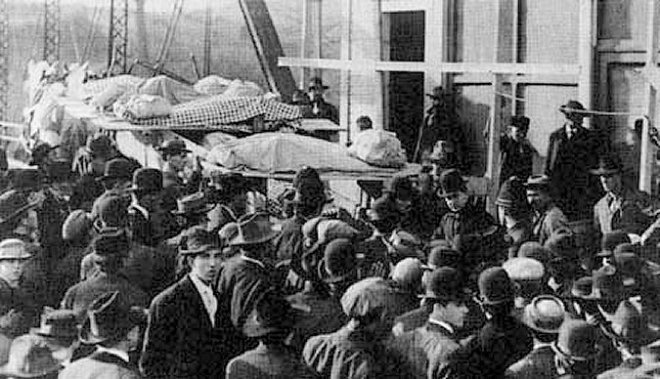
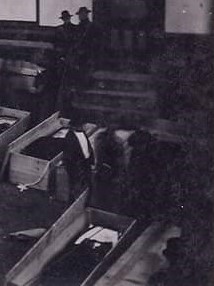
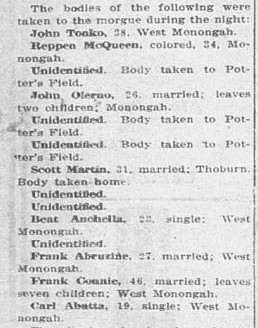
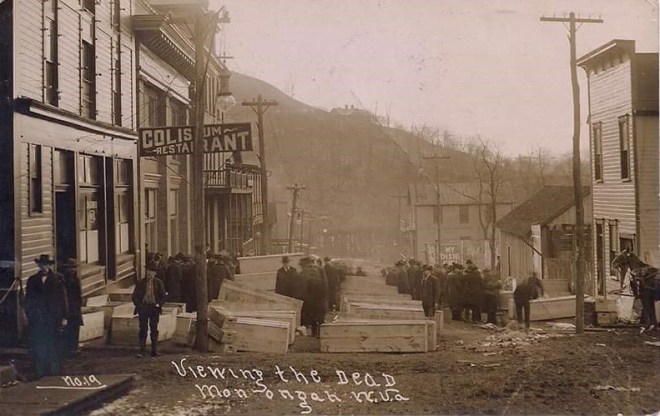
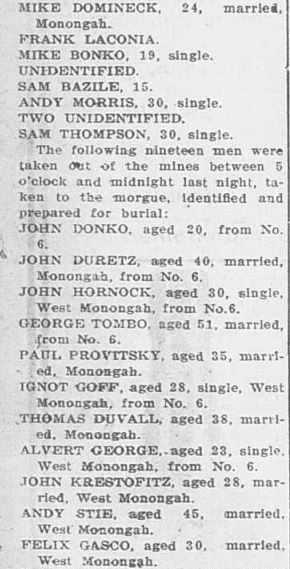
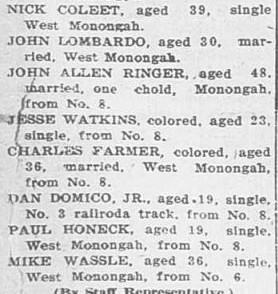
 “The body of Timothy Lyden was found in mine No. 6 at Monongah at 3 o’clock this morning, taken to the morgue and prepared for burial.” (CDT 12.12.07 pg. 4)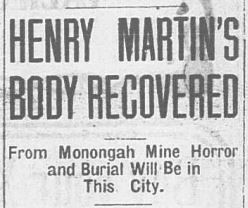


































 The Monongah Disaster