

The relief committee’s call to the public for aid spreads across the country. As crews at work in the mines at Monongah become focused on the tedious work of cleaning up roof falls in order to get to more entrapped bodies, newspapers focus on their own eye-catching headlines to attract the public to the call for aid and their own summaries events of the past week while others are just starting to print their first words on Monongah.
~6:00 pm, News Hour
Fairmont West Virginian:
“Every one is writing a little poetry about the terrible explosion at Monongah but we will not write any for a while yet.” (FWV 12.16.07 pg. )
In notice of donation from Mr. C.L. Topping, FWV says “This copy of the West Virginian can be considered as a receipt for the contribution and it will be turned over to the General Relief Committee.” (FWV 12.16.07 pg. 1)
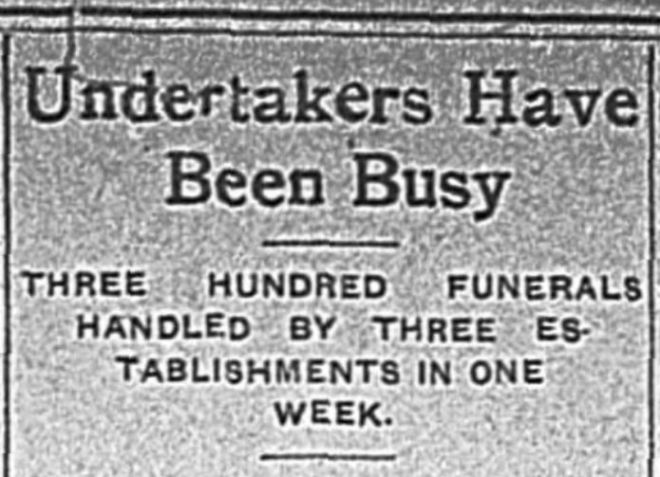
“Mr. I.A. Foglesong has returned from Monongah where he spent several days and nights working at preparing the victims of the mine horror for burial. He was accompanied by his brother, Will, who is employed by R.L. Cunningham at Fairmont.” (FWV 12.16.07 pg. )

“It seems quite possible that this week will be a record breaker in all the stores of the city and the merchants are all getting ready for the tremendous rush that is sure to come.” (FWV 12.16.07 pg. 4)
Clarksburg Daily Telegram:


“…one of its most striking features has not been publicly dwelt upon to the extent it deserves—the heroic rescue work by both operator and miner.” (CDT 12.16.07 pg. 4)
“No sooner did the explosion occur than company officials were on the way to the scene of the disaster as speedily as steam and electricity would carry them. No sooner did the new reach the mining villages than miners laid down their picks and started to the scene.” (CDT 12.16.07 pg. 4)
”With wonderful speed and amazingly dispatch a perfect organization of work was built up, mapped out in a few hours at most and put into successful system and execution before the darkness of the first night came.” (CDT 12.16.07 pg. 4)
“Under a systematic plan of cooperation big officials of the company and the humblest miners went to work in the earnest in the rescue work. Though appalled at the terrible task that confronted them they did not allow terror and fear to become master of them, but with determined resolve and brave effort the rescue work was stared by them and day and night they worked unceasingly in the very face of danger and with the knowledge that their own lives might be sacrificed.” (CDT 12.16.07 pg. 4)
“Much needed sleep was baffled off by them, they took barely enough time to eat a sandwich, a cup of coffee or soup and a drink of water, and they worked on and on, with but one end in view to get out the living and when it was found that none did survive they turned their efforts to the gruesome task of getting out the dead.” (CDT 12.16.07 pg. 4)
“All in the rescue work faint at heart through they worked like Trojans. Mine superintendents and men still higher up enlisted in the rescue work the same as did scores of miners volunteer and they all worked together on a common plane, entered the mine together, picked up the dead together, exposed themselves together to the dust and gas, the rain and the mud, with never a thought of distinction in position. Indeed, they were all just plain men seeking he bodies of their fellows.” (CDT 12.16.07 pg. 4)
“There never was, perhaps, a greater exhibition of common brotherhood than the mine horror brought about, and assuredly it has established the fact that heroism exists alike in the bosom of the high and the low.” (CDT 12.16.07 pg. 4)
Evening Star in D.C.:
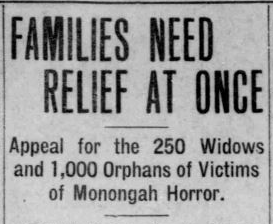
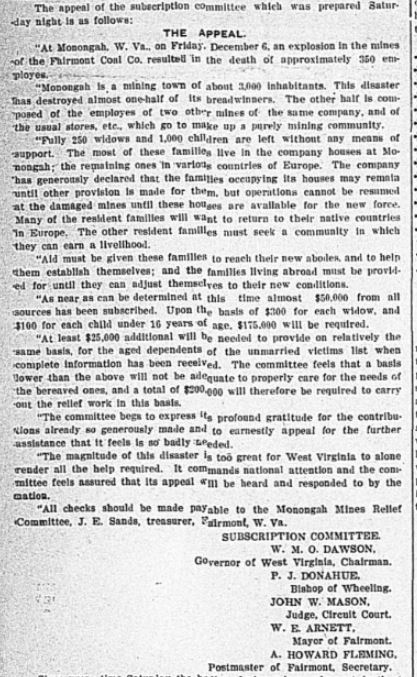
“An appeal for $150,000 more for the relief of the widows, orphans and others…has been sent broadcast by the permanent committee in charge of the work of caring for the unfortunates and it is estimated that a total of $250,000 will be needed. It is believed that the Carnegie hero fund may make a large contribution.” (ES 12.16.07 pg. 2)
“F.M. Wilmot, secretary of the commission, spent several days of last week in personal investigation at Monongah. Mr. Carnegie has already contributed $2,000.” (ES 12.16.07 pg. 2)
Washington Times in D.C.:
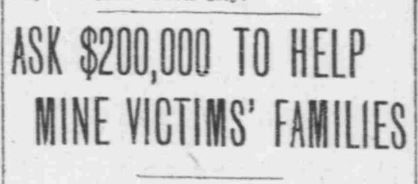
(Out of Pittsburg) “West Virginia alone cannot meet the exigencies of the occasion, and so sends its appeal for aid into every State of the Union. The needs of the women and children in distress are urgent.” (WT 12.16.07 pg. 4)
“The chamber of commerce here will be asked to handle the funds.” (WT 12.16.07 pg. 4)
“The Carnegie hero fund commission will meet in a few days to consider the question of relief, and may recommend a large contribution.” (WT 12.16.07 pg. 4)
Richmond Palladium in Indiana:

“Governor Dawson has received the report of Mr. Joseph H McDermott, president of the West Virginia senate, who was sent to Monongah by the executive to make an investigation of the recent mine horror there. In his report Senator McDermott endeavors to relieve the Fairmont Coal Company of any responsibility for the explosion which snuffed out the lives of approximately 500 men and boys. Neither does he attribute it to any carelessness on the part of the miners. This is the first official statement made relative to the causes of the disaster.” (RP 12.16.07 pg. 4)
“Senator McDermott says in part: ‘My conclusion is that the accident was not due to any negligence or improper management on the part of the company or carelessness on the part of the miners. My opinion is that the loaded train of the cars which parted near the mouth of mine No. 6, and the last half of which ran back into the mine, jumped the track, or in some way was wrecked at the bottom of the slope, and this accident broke the electric wires, causing a short circuit or other fire in the cloud of dust which followed the runaway train, and the explosion started at that point, following the air current back into No. 6 and then on through No. 8 to the entry of the same. Everything indicates that the force of the explosion was in the direction indicated. The effect was the same as that following the firing of a cannon ball.’” (RP 12.16.07 pg. 4)
“The coroner’s inquest was begun today but Gov. Dawson was not in attendance, as there are several big railroad suits coming up in the courts next week which will require his presence.” (RP 12.16.07 pg. 4)
Evening Times Republican in Iowa:
The New York Tribune:

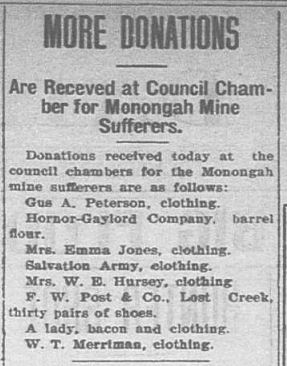
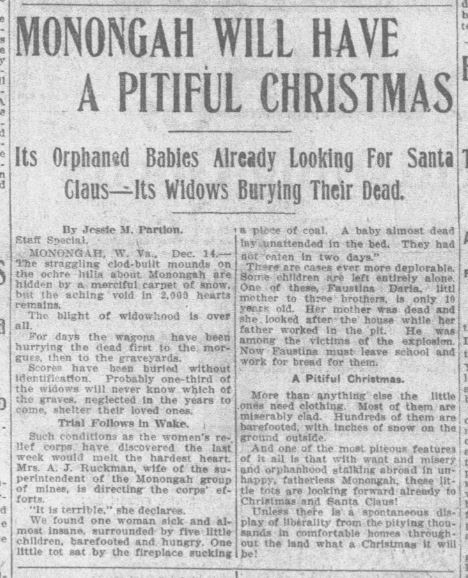
“Contributions of clothing, toys for the orphans at Christmas time and similar donations are to be sent to W.H. Moore, Mayor of Monongah and chairman of the committee looking after the temporary wants of the victims.” (NYTb 12.16.07 pg. 4)
The Marion Daily Mirror in Ohio:

Salt Lake Herald in Utah:
Pittsburgh Post-Gazette:

“Announcement was made last night that plans ae well under way to give the orphans of the victims of the disaster the most bountiful Christmas of their lives. Toys and candles and other things have been pouring into Monongah for several days. Mayor Moore of Monongah has taken charge of these contributions, and the woman’s auxiliary relief committee is arranging for their distribution. Bountiful table will also be set in the homes of the bereaved families on Christmas.” (PPG 12.16.07 pg. 1)
“None of the families of the victims will be required to leave the houses of the Fairmont Coal Company, owner of the mines in which the disaster occurred, until arrangements have been made for getting them into other quarters or sending them to their friends in the old countries. The mines cannot be worked until homes are found for the new miners to be employed. ‘There certainly will be no evictions,’ one official is quoted as saying.” (PPG 12.16.07 pg. 1)
“The Fairmont Coal Company already has donated $17,500 to the relief fund and Senator Camden, owner of the land under which the coal is being mined, has given $2,500.” (PPG 12.16.07 pg. 1)

The Evansville Press in Indiana:


Cumberland Evening Times in Maryland:


More on How Death Gloated!
Issues with the Monongah Timeline



















 The Monongah Disaster