Will Jenkins arrives to 4th left but finds that the horse in question does not need a new shoe and begins out of the mine. (Inquiry) ◊
10:00 am
At the mines:
All day shift workers, at least those who are coming to work today, have arrived and are at work. (News, Inquiry)
In East Monongah:
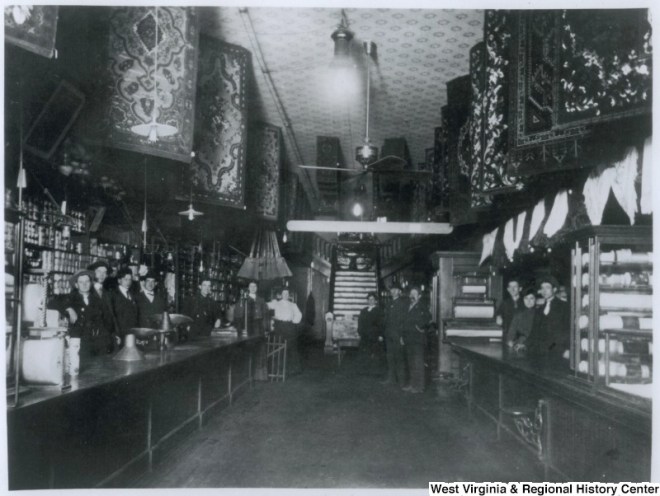
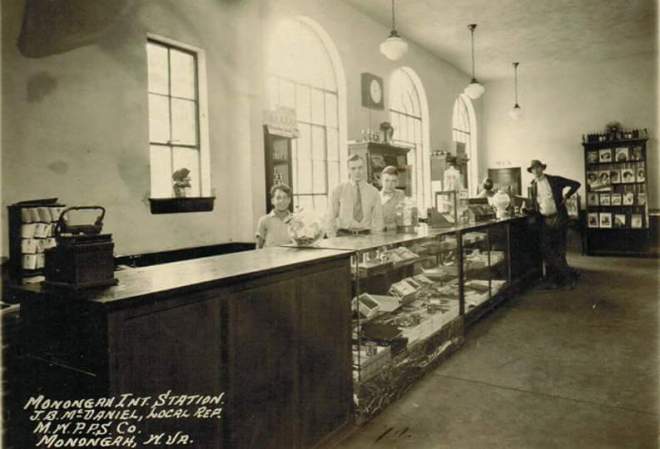
Frank Morris is in his office at the Company Store. (Inquiry)
Inside the Company Store.
George Peddicord is in the supply house, located on the opposite side of the river from the mine, collecting more chain buckets. (Inquiry)
John Talbott is working in the shipping office between the company store and main offices. (Inquiry)◊
Inside #6
Will Jenkins is on his way out of the mine and back to the blacksmith shop when he meets Charlie Wise on his way out. They are about a half mile in #6 and Wise was going down the heading, deeper into the mine. (Inquiry) ◊
10:10 am
Outside #6:
Will Jenkins exits the mine and heads back to the blacksmith shop to start shoeing another horse. (Inquiry) ◊
In East Monongah:
H.L. Sloan is on the hill cleaning coal cars at Mine #2, across the river and “right in front of #6”. (Inquiry)
At the bottom of the slope, the coupler connects a train of between 15-19 fully loaded, 3-ton coal cars onto the wire rope of the wench and, using modern electrical systems, signals Ed Fry in the engine house to start the wench and pull up the first haul of the day. (McAteer, Inquiry)◊
Outside #6
In the engine house, Ed Fry receives the electric light signal from the bottom of #6 slope and pulls the winch engine arm to begin hauling the train of cars from the bottom, up the slope, across the trestle, and to the tipple on the opposite side of the river. (McAteer, Inquiry)◊
“The dawn of a new era of prosperity is here.” (FWV 12.5.07 pg. 1)
During the day:
The country is beginning “to recover from the severe shock of the recent panic” on Wall Street. “Naturally there was a little scare at first, but when the people saw that there were rotten spots only here and there they quickly recovered from their fright.” (FWV 12.5.07 pg. 1)
Gov. Dawson of West Virginia gives the opening speech at the river convention. (FWV 12.5.07 pg. 1)
“He said his state was particularly interested in the comprehensive improvement of the inland waterways of the country…The governor referred particularly to the resources of West Virginia, the State being second in the production of coal and fifth or sixth in hard wood timber. The bulk of the coal has to find a market outside of the State and if, by water transportation, the state could save the ten cents a ton it would aggregate $3,000,000 a year.” (FWV 12.6.07 pg. 1)
“’We are one people and have a common destiny,’ said he, in conclusion. ‘We want nothing in West Virginia that is forbidden to any other part of the country; but I say to you, gentlemen, that we want to be ready for the Panama Canal when the great waterway is ready for us.’” (FWV 12.6.07 pg. 1)
In Grafton:
“Sam Furk, an Italian, has been held for the grand jury on the charge of extorting money at the point of a revolver from several of his fellow countrymen of this section.” An Italian witness from the same area of Italy as Sam Furk ‘testifies’ that Furk is wanted on two murder charges back in Italy, “so it is probable that the local authorities will take up this matter with the Italian embassy at Washington.” (CDT 12.5.07 pg. 1)
“The hearing developed the fact that Furk had been playing the hold-up game among members of his race successfully at Brooklyn, N.Y., Rowlesburg, Manheim, Fairmont, Clarksburg and Grafton.” (CDT 12.5.07 pg. 1)
The Fairmont West Virginian reports the weather as: Fair tonight and Friday, warmer Friday
In Monongah:
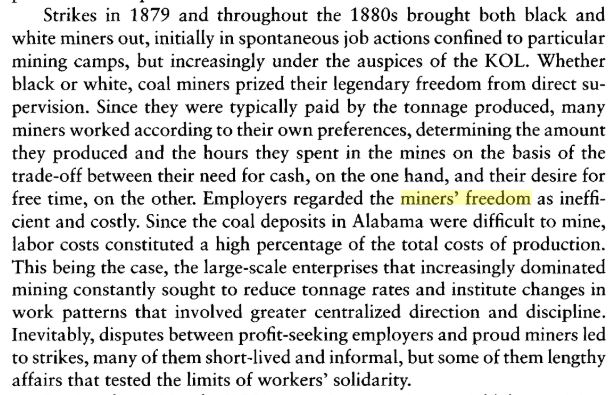
Mines #6 & #8 are not running at full production today but the fans continue running for the skeleton crew inside. Due to the recent stock market crash, there is still a lack of orders & a majority of the working immigrant population will be celebrating the eve of St. Nicholas Feast Day tonight. In these days of “miner’s freedom”, many miners would choose not to go to work during their holidays.
In the Afternoon
In Fairmont:
The Isabella Davis Circle of King’s Daughters opens their annual Christmas Bazaar in the Sunday school room of M.E. Church on Main Street in Fairmont. “The different booths are all decorated in the Christmas colors red and green the color scheme being carried out by the use of crepe paper and autumn leaves in the colors.” (FWV 12.5.07 pg. 1)
In Monongah:
Anestis Stamboulis & several Greek miners take advantage of the holiday and good weather. They take a walk up into the hills surrounding the town and pick some wild mushrooms to be used for dinner. (McAteer)
~5:30 pm – 6 pm
In Monongah:
The Who’s Who Club of Wahoo (a neighborhood of Monongah) holds its monthly meeting where they “disposed of large quantities of the amber fluid, red liquor and refreshments of all varieties.” 8 members will not go into work tomorrow but will end up digging graves. (McAteer)
Homer Pyle and his mother are “sitting before the bright blazing fire” at their home,“…he said let us have a song for it is too cold to go over in town tonight, so he and his mother sang two or three songs and the last song was ‘Will There be Any Stars in My Crown?’”
“But little did Homer think that the next evening he wouldn’t be alive to sing with his mother.” (FWV 12.19.07 pg. 2)
At the mines:
The night shift skeleton crew comes onto work.
Over the next 12 hours these workers will do various jobs throughout the mines.
Inside #8
Peter J. McGraw came in for his fire boss shift around 6 pm.
He does his examinations of the mine alone.
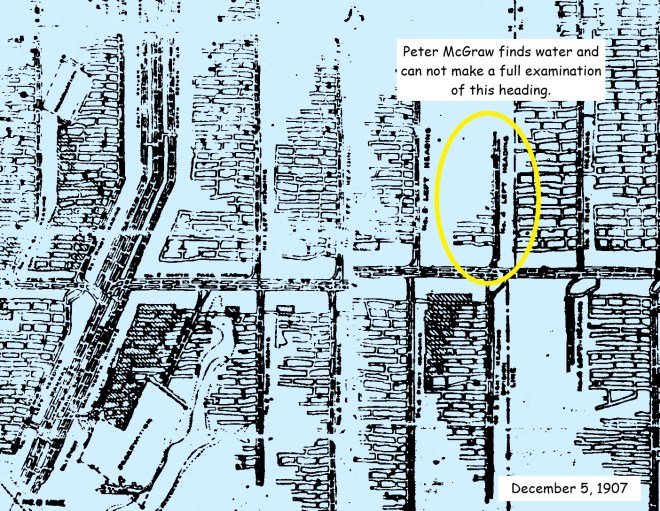
He finds water in 4th left so significant that he can’t get in there to properly examine the heading. (Inquiry)
Inside #6
22-year-old Lester E. Trader arrives for his fire boss shift around 6 pm. (Inquiry, McAteer)
Trader inherited his job when the previous fire boss got sick during Trader’s apprenticing. Trader lacked 3 years necessary experience, training, and certification for his official position so he was kept on the night shift so as to “not run into the inspector”. (McAteer)
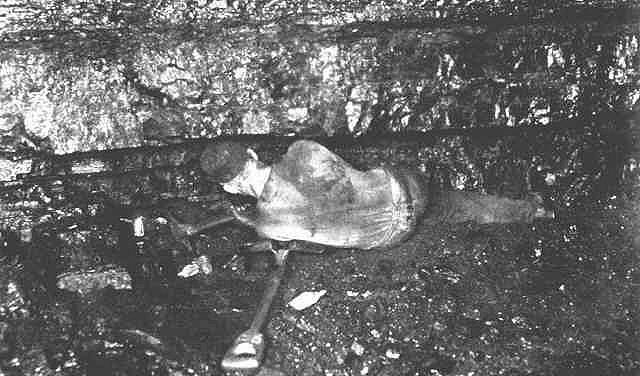
Trader worked alone like most fire bosses. He led a horse drawn water cart to sprinkle the mine walls in order to dampen any renegade coal dust.
To check for dangerous gas levels, he used a Wolf Safety Lamp to check for methane. However, due to the size of #6 mine, Trader cannot check everywhere.
~7:00 pm
At the mines:
Libberato Delesandro works the night shift, “helping to get #6 and #8 through together”. (Inquiry)
Inside #8:
Tony Pasquaele arrives to work and drives the horse-drawn water cart in #8 through the night. “The watering carts carried large wooden barrels filled with 300 gallons of water; perforated ends of the barrels were plugged by wooden combs that could be removed to allow water to sprinkle out.” (McAteer)
As he is leading the horse and water cart, he notices that the heading is “a little dry” for this time of year. (Inquiry)
Tony is also responsible for pumping out any rising or standing water which had seeped into the mines. His pattern is systematic; he “would start the pumps then go water mines for a bit, and then would check back on the pumps every 2 hours to see how they were doing.” (Inquiry)
Inside #6:
Ludwig Strezelecki works at F face: 1st right, room 15. His task for the night involves working with his brother-in-law taking out stumps and finishing the headings.
Night
It is the eve of St. Nicholas Day for Italian Catholic and some Polish Catholic immigrants.
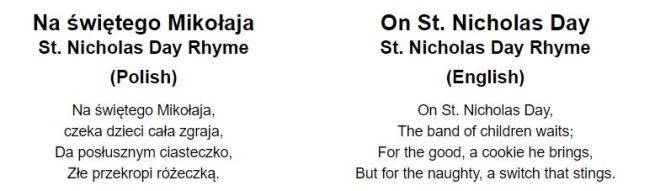
At night, the families gather around their coal stoves or fireplaces (if they are fortunate enough to have a fireplace) and tell stories, sing hymns, or verse simple rhymes about St. Nicholas De Bari.
Children leave their shoes lined up side-by-side next to the door, window, or hearth. If possible, some would place bits of carrot, oat, or hay inside as a gift for the trusty mule/white horse which traveled along with St. Nicholas as he delivered small gifts.
8:00 pm
In Clarksburg:
At the Bacon & Godfrey skating rink a “Who’s Who” Carnival is held. “Upon entering the rink, you will be furnished with a false head or some contrivance of that kind which will make it almost impossible for your mother to even know you. With everybody thus attired the big show will start, with everyone wondering who is who.” (CDT 12.5.07 pg. 1)
~10:00 pm
Inside #8:
Homer C. Palmer (electrician) arrives for his night shift.
Through the night:
Inside the mines:
The main ways of the mines are watered.
Fire bosses like Lester Trader and P.J. McGraw walk their respective mine checking for dangerous conditions in both #6 and #8.
Inside #8:
George Bice dug coal (pick work) on 5th right, 2nd north in #8
Inside #6:
Fred Cooper (motorman) sprinkled headings in #6. (Inquiry)
In Monongah:
Not long after the children have fallen to sleep, several parents quietly replace the bits of hay or carrot in their children’s shoes with a sweet treat, like candy or fruit, and a small present—typically a (gold) coin.
Governor William M.O. Dawson arrives in D.C. for the national river convention. Governor Dawson conferred “with river enthusiasts from many States and is rejoiced at the enthusiasm…”. (FWV 12.5.07 pg. 1)
Former West Virginia Governor and current Fairmont Coal Company associate, A.B. Fleming, is also at the convention in D.C. (FWV 12.5.07 pg. 1)
In Grafton, WV:
Sam Furk has been arrested in Grafton by local authorities for crimes associated with the Black Hand. Furk is described as a “tough-looking” “big Italian”, believed to be “king of the Black Hand society of this section of the country”.
“Nothing concerning where Furk came from can be elicited from any of the local foreigners and all of them seem to be afraid of him. He arrived here a short time ago and has been spending his time among the foreigners.”
Furk is charged with extorting other Italians for money around the Grafton and Fairmont areas.
“From what could be learned of the matter from the foreigners, most of whom were so badly scared they would not talk, it appears that Furk, since he came here, has been posing as the ‘big man’ in the ‘Black Hand’ society and in making his demands upon the foreigners has emphasized his remarks by the flourish of a big revolver.”
Many local terrorized Italians are “afraid that if they do appear against the fellow that he should not be held for court that he would kill them as soon as he could find them after being released.”
“…Furk was not given a hearing yesterday, but he will probably be arraigned today.” (FWV 12.4.07 pg. 2 & 6)
At the Monongah mines:
Day shift worked at mines #6 and #8
Fred Stubbs is among them but this will be his last day of work for the rest of the week because his wife is very sick at home. At this time, a system known as “miners freedom” allows Fred to choose if he wants to work, rather than requesting the time off.
It is the first day on the job for 3 Russian immigrants: Paul Goff, John Goff, and Frank Kreger.
Fred Vandatti works the gathering motor in #8: 4th right, 2nd north. Hugh Reese (brakeman) was his helper.
Motorman driving a gathering motor.
In #6:
James Rogers (assistant foreman in #6 and foreman in #3) is working in #6. This will be his last day of work this week due to illness.
George Simko works in #6: 2nd right, E face, room 8. This will also be his last day of work this week due to sickness.
Libberato Delasandro is working in #6 and finds gas accumulation earlier in the day at 2nd right off of D face, in rooms 2 & 3. However, it was only a slight trace – normal and relatively safe—so he does what most miners do: he takes off his coat and waves it around, fanning the gases out of the air and working space. Later, he will find gas and dust accumulation on 2nd right of G face in #6. At one point a foreman comes into where he is working, notices the gas and shouts at Libberato to lower the flame on his cap and so he does. (Inquiry, McAteer)
In Fairmont, WV:
The Fairmont West Virginian reports the weather as: Snow tonight. Thursday fair. Minimum temperature tonight about 15 degrees.
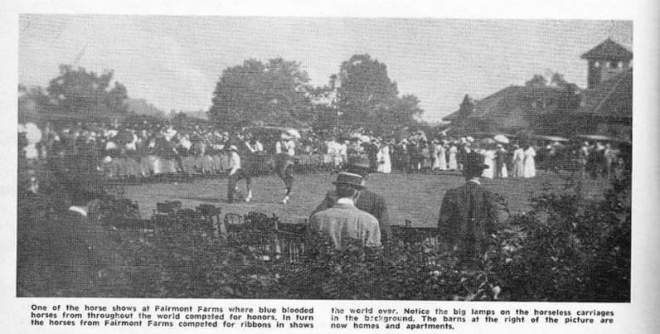
Fairmont Coal Company and Consolidated Coal Company President Clarence Wayland Watson is world-renowned for his show horses. 14 of C.W. Watson’s show horses arrive in Fairmont on train No. 7., care of the US Express company from New Haven, Conn. (FWV 12.4.07 pg. 5)
Night
In Monongah:
A meeting of Monongah mine foremen & superintendents is held in J.C. Gaskill’s office. The meeting is called to go over things regarding safety of the mines.
Fairmont Coal Company supervisor David Victor, Tom Donlin (foreman at #6), and foreman Pete McGraw are present for the meeting.
Gaskill asks McGraw and Donlin about conditions inside and about the mines and they replied that it was good in both cases. “…McGraw said he had a little bit of shooting off the solid that he had not been able to eliminate. He was instructed to eliminate all of that and that he must get rid of the men who had that practice.” (Inquiry– Victor)
James Rogers, assistant foreman in #6, talks with foreman Tom Donlin in the company supply store about watering the mines tonight.
At the mines:
Night shifts work and, per usual, the main-ways of the mines are watered, but not the branching off hallways and rooms. (Inquiry, McAteer)
Very icy conditions – “The walking…was very treacherous and many people got falls” (FWV 12.4.07 pg. 8)
Mrs. Jacob M Watkins of 5th ward fell and broke her wrist.
Miss Edith Frey slipped on icy pavement on her way to school and broke her elbow.
Mrs. Ellis Billingsiea fell and was unconscious for some time. No broken bones.
Mr. Crawford M. Shaw, a well-known B&O Engineer, fell on icy pavement and broke his arm.
Mrs. J.M. Watkins fell at home on Locust Ave and broke her wrist.
Afternoon
The Women’s Auxiliary of Christ Episcopal church routinely shift hostesses for their meetings. Today the collective leaves Fairmont on the 2:00 pm trolley headed for Monongah. After about a 20 minute ride, they meet up with their hostess, Mrs. Ruckman at Monongah. (FWV 12.2.07 pg. 8)
Night
In Viropa (mining town one mile north of Shinnston):
Fire destroys the houses of five miners. “As there was no means of fighting the fire except by volunteer bucket brigade another house was dynamited to prevent the flames from reaching a large boarding house and the mine tipple.” (CDT 12.4.07 pg. 8)
The houses actually belong to the Fairmont Coal Company. “The company’s loss is between $3,000 and $4,000, but the property was fully insured. The houses were occupied by foreigners who saved most of their household goods.” (CDT 12.4.07 pg. 8)
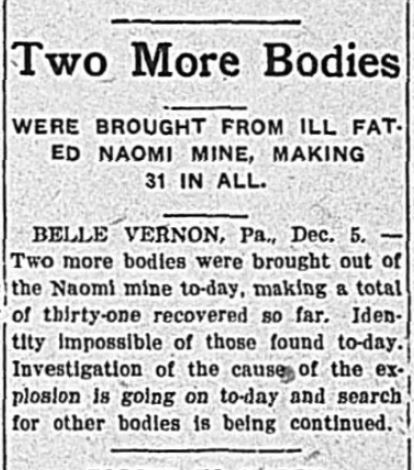
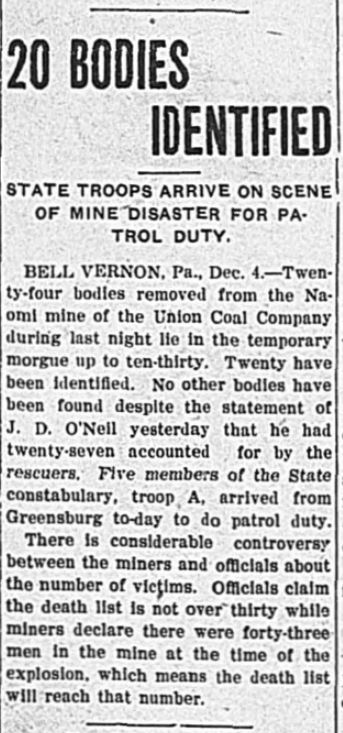
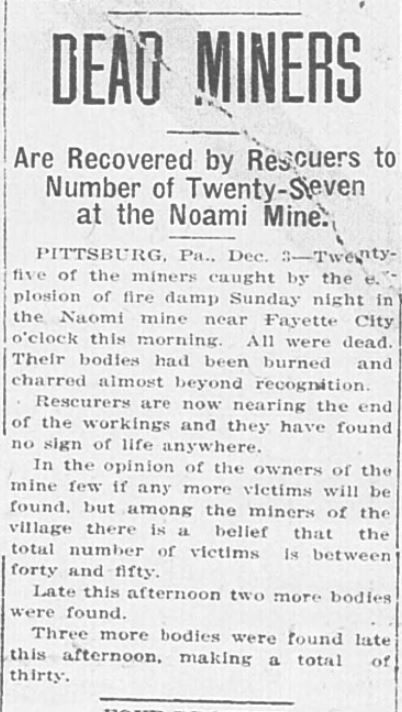
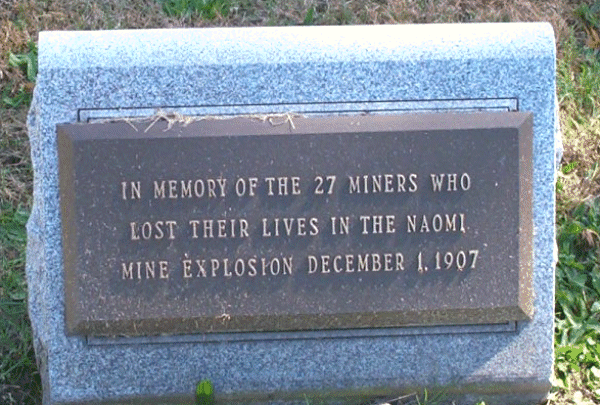
Sometime between 7:15pm – 7:30 pm, the Naomi mine explodes “with a roar that shook the whole countryside.”1
“The explosion was caused by gas being ignited by an open light or an electric spark or flame from the electric wires, and it was greatly augmented by coal dust.”4
Fires inside the mines immediately follow the explosion. The Sunday night shift is relatively small so it is believed some 30 – 60 miners are entombed underground where the fires steadily consume all breathable oxygen and replace it with toxic gases known as black damp.
“Within a few minutes hundreds of people surrounded the pit mouth. The screams were indescribable. Wives and children and friends of the men entombed wrung their hands and begged piteously for rescuing parties to enter the mines and bring out their loved ones. All night they refused to leave the pit mouth.”1
“After a brief examination of the conditions, the impression prevailed among the inspectors that no one would be found alive in the mine, as the after damp would in all probability have smothered those who were not burned by the gas or hurled to death against the sides of the mine by the force of the explosion. The miners, most of whom were foreigners, were at work almost a mile from any entrance.”4
“Only one man, an unknown foreigner, (out of 34 employees), reached the surface after the explosion occurred, and as he reached the open air he fell unconscious from inhaling the gas fumes and died in a few minutes.”4
Governor Dawson leaves for Washington D.C. to attend a meeting of rivers and harbors congress which will be in session for several days. (FWV 12.4.07 pg. 4)
Welcome to Bloody December.
1907 is considered the deadliest year of the mining industry in the United States.2The month of December produced 5 separate major disasters and numerous accidents which cost the lives of over 800 men and boys, the majority of whom are minorities and immigrants.
This month will be the real catalyst to a decades-long fight to bring an end to negligent labor practices across the country. Bloody December is so horrific that the American public finally lets its government and its industries know that they have had enough. The devastating and very preventable loss of life sparks a heavy push for government regulation in private industry and labor practices.











 The Monongah Disaster