10:30 am
At the mouth of #6:
J.H. Leonard and Alonzo Shroyer are staring down the portal of #6 mine, bracing for the imminent impact of the runaway train of coal cars. Inside the #6 fan house, the clock connected to the sensitive pressure gauges of the fan marks that at 10:30 am the gages “go up a little then drop clean to the bottom” (Inquiry, Victor).
Somewhere in the deep recesses of the two mines, a massive explosion erupts. As it tears through the workings of the mine, following the paths of least resistance, it consumes all oxygen, extinguishes the carbide lamps of the miners, and destroys most of their belongings.
Many men within the mines die instantly as a result of traumatic injuries such as burns, blunt force impacts, and decapitation. Others get caught up in the blast and carried away as, “Every movable object shot with terrific force through the mine.” Majority if not all of the workers caught in this wave are utterly demolished, several of their bodies will be found “strewn at the mouth” or not found at all, having been disintegrated in the force. (Nurses) (LAH 12.8.07 pg. 1) (McAteer)
Inside #8 mine:
The DePetris brothers are violently thrown off their feet, the blast hurling them against a rib then to the mine floor. (McAteer, Inquiry)
Nearby, Dan Dominico is smashed to the ground with such force that his ear is badly cut and one arm is injured so seriously he cannot move it. (McAteer, Inquiry)
Outside #8 mine:
The south-bound interurban trolley is only a few yards beyond the mouth of mine #8 when the crowd of passengers begin to feel and hear the earth rumble around them. (News)
On the East side of Monongah:
George Peddicord has barely begun to cross the Iron Bridge between the two mines when he feels everything around him shake and hears a rumbling noise from up river, in the direction of #8. (Inquiry)
At the Traction Park Interurban station between #6 & #8:
George Bice is around 330 yards north of #8, by the Traction Park interurban station when he hears the report, “likened to the discharge of a cannon,” from behind. He spins around to look at #8 and sees tons of brick, 8×8 timbers, infrastructure, machinery, coal cars, tools and other debris from deep within the mine hurled up and out the entrance by the explosive force. The miners’ check-tag board is eviscerated, the brass ID tags scatter into the river and are lost. (McAteer, Inquiry, News)
At #8:
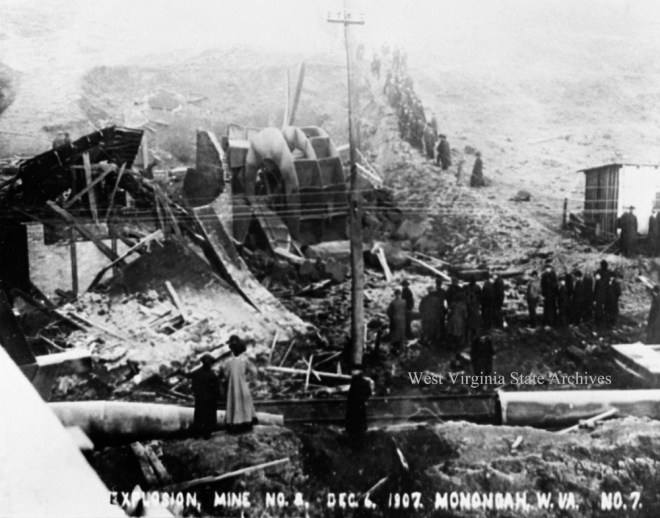
The large iron gate at the mouth of #8 is ripped away as the force exits through the mine mouth. But the pressure is simply too much and the force tears a 100-foot hole in the hillside where the entrance once stood, tossing the iron gate and chunks of concrete, one “weighing fully 1000 pounds”, across the river and embedding them into the eastern river bank. (McAteer, Inquiry, News)
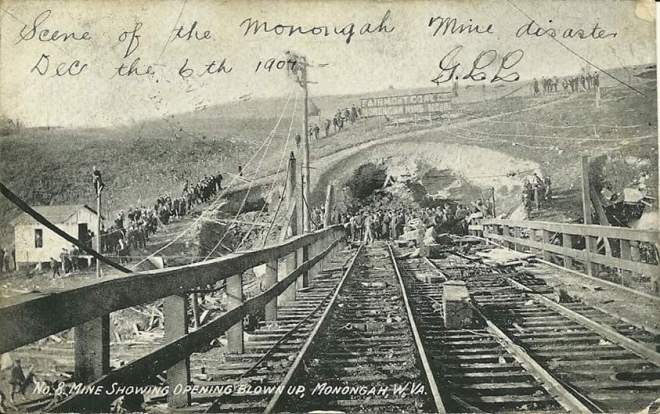
“So great was the force of the explosion that one man was blown out of a pit mouth a distance of 400 feet.” (WT 12.7.07 pg. 1) Charles Honaker is caught by the first blast wave at the entrance of #8. His clothing is “lit ablaze” and his body is hurled into the air along with the debris and blown hundreds of yards away, toward the river. (McAteer)
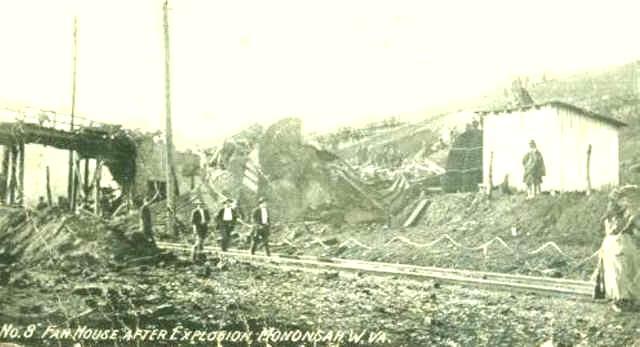
The 10 ton, 30’ tall fan for #8 is considered one of the most powerful fans in the country. It is ripped from its concrete moorings, chucked across the river, and embedded in a hillside almost a half mile away from its original location. The large powerhouse, with all its large machinery and boiler room is blown all the way to other side of the river. (McAteer, News, Inquiry)
Electric wires about the mouth of #8 mine are ripped apart and strewn across the ground. (News, Inquiry)
Across the river at #8 tipple:
Otto Smith yells out to the #8 tipple boss, “I reckon the mine has blown up!”. He turns around to see a plume of fire and smoke shoot from the open hillside of #8 more than 60 feet into the sky. (Inquiry)
In the vicinity of #8:
Windows shatter in the buildings around #8, including those all the way across the river in the house next to the tipple. Hyre Stalnaker hears the blast inside the carpenter shop and attempts to run outside but the shock of the blast throws him back into the shop and knocks him out. (Inquiry, News, McAteer)
In the center of town:
George Peddicord can not see the #8 portal from his position on the Iron Bridge, but the force is so intense he can see the timbers and debris flying above through the air followed by a tower of black smoke. (Inquiry)
In Monongah:
Lester Trader was in bed, though not yet asleep, when “the whole house lifted, then the sound of a terrible roar and I felt the earth shaking with such intensity causing objects to fall from shelves…”. He rises from bed and races for the door.
Almost instantly, before Lester Trader can make it to his door, a second report comes from down river in the direction of #6. When he reaches his door, he can feel the wind still coming off of #8. (Inquiry, McAteer)
Inside #8:
Dan & Leo Dominico and the DePetris brothers are just getting to their feet when they are knocked down again by a second, equally powerful explosion. (Inquiry)
Peter & Stan Urban hear and feel the second explosion; they begin to run. (Inquiry, McAteer)
On the East side of Monongah:
Christina Cerdelli hears the noise of the blast in her doorway. She sees smoke coming from the toad holes all along the west side. The smoke is so thick and abundant some believe it is coming from St. Stanislaus Catholic Church. A bit farther up river, Lee Curry also sees the smoke above houses and St. Stanislaus on the west side of town from his vantage point on the #8 tipple. (Inquiry)
Beneath the #6 tipple, E.P. Knight hears something that sounds like dynamite with “a roar to it” come from #6.(Inquiry)
At #6:
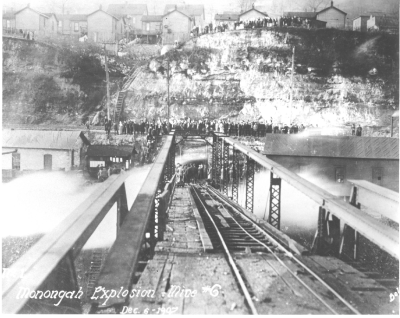
Tons of earth are heaved high into the air around #6 and adjacent buildings are damaged. (News, Inquiry, McAteer)
At the mouth of #6, J.H. Leonard and Alonzo Shroyer are thrown back as the blast exits through the portal. Leonard is covered in rubble; his arm and ankle are very hurt. Shroyer slams into something hard, possibly the derailing switch, cutting him to the bone behind his right ear. (Inquiry, McAteer)
A piece of rail track comes down into the #6 blacksmith shop though the blacksmith, Will Jenkins, only sees a sootish-colored smoke with no flame coming from #6 in a steady blowout. (Inquiry)
Pat McDonald, who was still running toward #6 on the trestle, is also hurled over 100 feet backwards and badly injured. (Inquiry, News, McAteer)
The top of the #6 fan house is “blown in the air a considerable distance”, more than 400 feet. (FWV 12.6.07 pg. 1)
Ed Fry is in the doorway of #6 engine room when he is physically jarred by the second blast, though he hears no report. (Inquiry, McAteer)
On the East side of Monongah:
E.P. Knight is still on the telephone with John Talbott until he glances out his shanty window, then runs out the door to see a good bit of dark brown smoke coming out of the #6 air shaft. On the other end of the line, inside the company offices, John Talbott heard the report and saw the flash of fire at #8 through the 2 large bay windows in his office which faced both mines.(Inquiry, McAteer)
The outside foreman, Charlie Dean, and Superintendent of #6, A.J. Ruckman, are talking in the company offices in Monongah when they feel the building shake from the concussion. The loud report causes Charlie Dean to assume that the #8 boiler has blown up. A.J. Ruckman, looks out to #6 and sees smoke coming out of the air shaft “strong, under high pressure”. (Inquiry, McAteer)
Frank Morris feels the jar in his office inside the company store. He runs outside to see smoke coming out of the mouth of #6 and begins running toward the mine. (Inquiry, McAteer)
At #6:
J.H. Leonard does his best to crawl away from the #6 portal to an area where he could let himself down under the trestle and protect himself from flying debris with the door from a coal car. (Inquiry, McAteer)
In the center of town:
George Peddicord drops his buckets and rushes across the Iron Bridge, not to the mine, but to his home. (Inquiry, McAteer)
At #8:
The interurban trolley is rocked on its tracks by the concussion, but holds its bearings and continues on with a crowded car of stunned and terrified passengers. (News, McAteer)
In the surrounding areas:
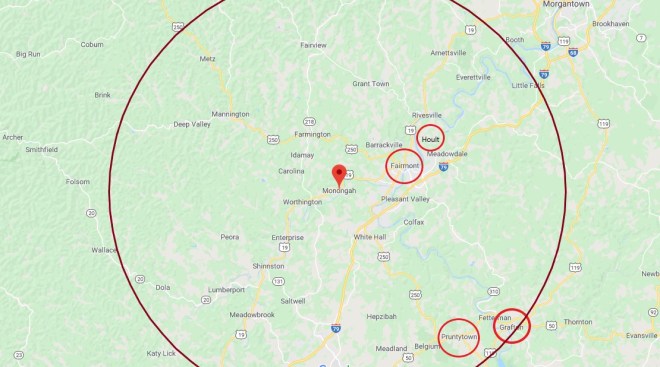
The “shock from the explosion was distinctly heard” 12 miles away in Pruntytown. (FWV 12.7.07 – pg.1)
The concussion is reportedly heard up to 50 miles away and is “distinctly felt” in Grafton and in the school house at Hoult where the “erasers were jarred from the blackboard and struck to the floor with a bang.” (WED 12.7.07 pg. 8) (FWV 12.12.07 pg. 2)
“People for miles in every direction begin to make inquiries over the telephone…” (FWV 12.7.07 pg. 1 – noon)
Lee Lichtenstein of Columbus was 6 miles away in Fairmont at the time. He will later tell The Baltimore Sun that, “The explosion shook Fairmont…as if by earthquake…a rumbling noise, houses rocked to and fro, people rushed wildly to the street and it was 15 minutes before it was known what occurred.” (News, McAteer)
In the town of Monongah:
No one in Monongah needed to ask what had happened. “They divined instantly that another great mine horror had taken place.” (WED 12.7.07 pg. 8)
The sounds of the blasts were deafening. “The buildings of the cities tottered and waved as if they would collapse. The pavements were upheaved and some of the frailer structures fell into ruins.” (WED 12.7.07 pg. 8)
“Pedestrians and even horses were knocked off their feet… Fires started in various parts of the city.” (WED 12.7.07 pg. 8)
“In the shock of the explosion the school house at Monongah was shaken in such a way that it threw the children in a frenzy and they rushed to the doors and windows some thinking an earthquake had occurred. When the smoke from the mines was seen an uproar was started as it was then realized what had happened. Children screamed pitifully that their fathers were killed and the teachers were utterly unable to control them.” (FWV 12.10.07 pg. 8)

Previous Post
Next Post
More on the Monongah Disaster of 1907
Introduction
Disclaimer and Guide
How Death Gloated!: A Timeline of the Monongah Disaster and Bloody December of 1907
Who is Guilty?: A Timeline of January 1908 and the Coroner’s Inquiry
Issues with the Monongah Timeline
Bibliography/Resources
About the Author
Contact Information



 The Monongah Disaster