Thursday, December 12, 1907 Midnight – Morning

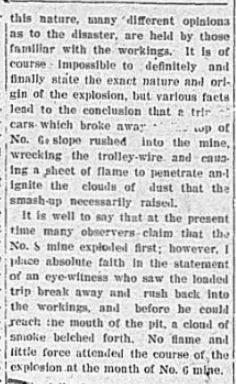
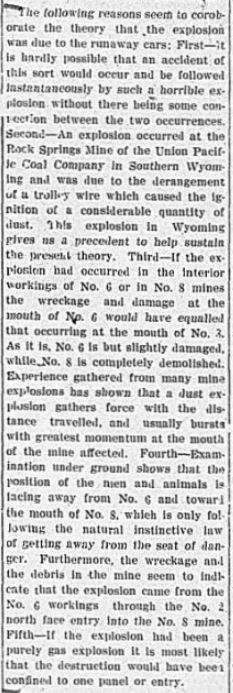
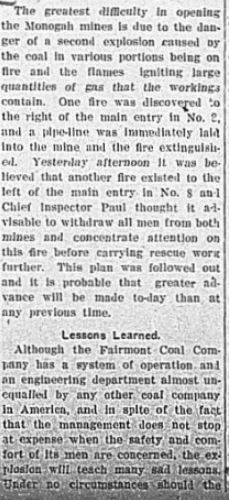
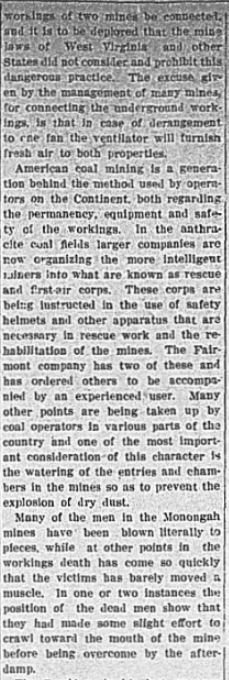
CDT 12.12.07 - pg 1 - Monongah 5
CDT 12.12.07 pg 1

In the early hours of the morning

12.12.07 - pg 6 - Monongah
TMDM 12.12.07 pg 6
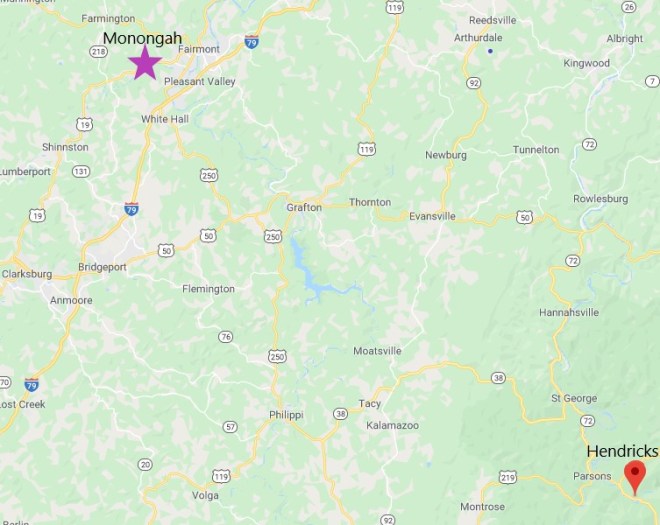
In Hendricks, WV:

Roy Yaeger, 28 year old engineer for Western Maryland railroad, detects an odor of gas in his home and starts to investigate. He quickly finds that a rubber hose has come loose from a stove and “just as he was in the act of turning the gas off the gas was ignited from an oil lamp in another part of the house and the explosion followed.” (FWV 12.13.07 pg. 2)

“Yaeger was ablaze in an instant and jumping out of a window he rushed up street, his clothes burning fiercely. Before he could be succored his clothes were all burned off and was a mass of charred flesh.” (FWV 12.13.07 pg. 2)

Yeager “met with a terrible death”. His wife and little child were severely burned and the home in where they lived was practically blown to pieces. (FWV 12.13.07 pg. 2)
hendricks

~3:00 am

CDT 12.12.07 - pg 4 - Lydens Body“The body of Timothy Lyden was found in mine No. 6 at Monongah at 3 o’clock this morning, taken to the morgue and prepared for burial.” (CDT 12.12.07 pg. 4)

“Relatives identified the body by his clothes and the back of his head. The body was well preserved but the face was badly mutilated.” (CDT 12.12.07 pg. 4)

“Mr. Lyden was 38 years of age and leaves a widow and five children. He was a brother of Patrick J., Michael and Margaret Lyden and Mrs. P.F. Tiernery.” (CDT 12.12.07 pg. 4)

~3:30 am
CDT 12.12.07 - pg 1 - Henry martin

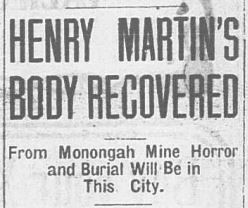
“Henry Martin’s body was found in mine No. 6 at Monongah at 3:30 o’clock this morning and identified by his brother, Patrick Martin, of this city. Mr. Martin has another brother here, too, Thomas Martin.” (CDT 12.12.07 pg. 1)

“Mr. Martin was 42 years of age.” (CDT 12.12.07 pg. 1)

“Mr. Martin leaves a wife and five children making his death particularly sad, as they were dependent upon him for support.” (CDT 12.12.07 pg. 1)

“Accompanied by relatives and friends, the body will leave Monongah at 8:22 o’clock tomorrow morning for Clarksburg, and will be taken to the Catholic church, where at 10 o’clock funeral services will be held at the same time that the Timothy Lyden obsequies are held. It will be a double funeral at the church—all at the same mass. Interment will be in Holy Cross cemetery.” (CDT 12.12.07 pg. 1)

At some point during the early morning hours

The body of John T. McGraw, pitt boss at Monongah mine No. 8, “was recovered from the mine early Thursday morning”. (CDT 12.13.07 pg. 1)

~4:30 am

“The body of Charles Wise of Fairmont, one of the best known men, was recovered at 4:30 o’clock…” (ES 12.12.07 pg. 2)

Wise was personal surveyor for Senator J.N. Camden. He surveyed inside of mines to ensure Camden and others were properly paid by Consolidated Coal Company. (FWV 12.12.07 pg. 1)

The 37 year old Chief Engineer “went into the ill-fated mine only a short time before the explosion.” (ES 12.12.07 pg. 2) (FWV 12.12.07 pg. 1)

Despite early reports announcing that only his jack and shoes had been found, leading people to believe Charles had been “blown to atoms”: “The body was in a good state of preservation and easily recognized. Besides in his pockets were his B&O mileage book, street car book, watch, ring and pipe, which were means to identify him.” (FWV 12.12.07 pg. 1)

Wise was found in #6 near the main heading, in a sitting position ½ mile away from his jacket. He had wrapped his waistcoat around his head indicating that he had survived the explosion and attempted to find his way out but got lost in the darkness and was eventually overcome by afterdamp. (FWV 12.12.07 pg.1)

Charles becomes body #258 to pass through the morgue. (Amos)

He leaves a widow, Pearl Reed Wise, and 2 sons: Thomas Reuben, 2 years, and Lorin Turney, 2 months old. (McAteer) (FWV 12.12.07 pg. 1)

~6:00

In Fairmont:

All mines in the Fairmont Coal Field are up and running to almost full capacity except those in Monongah. (FWV 12.11.07 pg.1)

The Fairmont West Virginian reports the weather as: Partly cloudy tonight and Friday, nearly stationary temperature (FWV 12.12.07 pg. 1)

In Monongah:

The remains of Charles D. Wise are taken to Musgrave’s undertaking parlors “just as they were taken from the mine” on 6:15 street car. (FWV 12.12.07 pg. 1)

At the mines:

“Officials…feel hopeful that the large force of rescuers, entering the mines at Monongah this morning will be the last necessary to send into the workings to recover the bodies…” (ES 12.12.07 pg. 2)

~8:00 am

In Clarksburg:

“The body of Thomas Killeen was brought here Thursday morning from the Monongah mine horror. The funeral was held in the Catholic church and burial in Holy Cross Cemetery.” (CDT 12.12.07 pg. 5)

In Fairmont:

Tom Donlin’s funeral is held at St. Peter’s Catholic church under the direction of the Ancient Order of Hibernians. Services are largely attended by friends and relatives following with interment at Holy Cross cemetery. Pallbearers were: Messrs. M.J. O’Neil, Anthony McDonough, John Kelley, John D Barry, Michael Ford and Jas. Erwin. (FWV 12/12/07 pg. 5)

In Monongah:

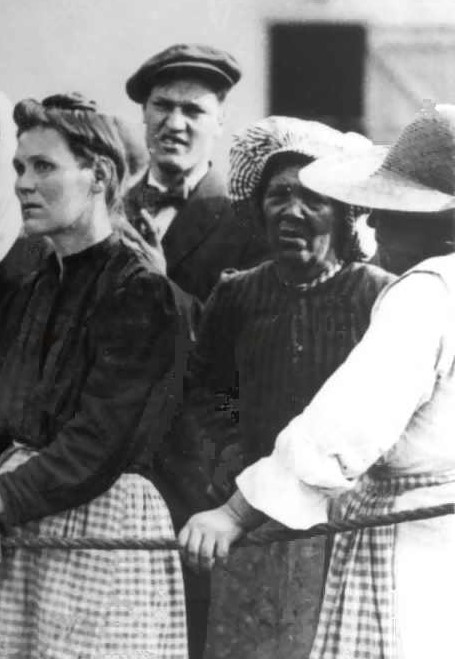
Women and children are still standing guard by the morgue.
women

At the mines:

Ventilation is restored to 8 miles of room headings, 550 rooms have been explored and tracks in 5.5 miles of main headings are cleaned up enough to allow hauling of bodies and materials. (McAteer)

1st full search completed in #6. The search parties have explored all the rooms of the mine and 20 searchers transfer from No 6 to No 8. “…the work in No 8 will be practically completed tonight when all the men will have been removed except those under falls.” (McAteer) (FWV 12.12.07 pg. 1)

The bodies taken out this morning are in “pretty good condition” so as George Gibbon, who has been able to identify most of the miners, was very successful. (FWV 12.11.07 pg.1) (FWV 12.12.07 pg. 1)

Among them is body #287—Ellis V. Herndon, this author’s great-great grandfather. Ellis’s son, Ira Herndon, was unable to go to work Friday morning due to his wet boots, and has had no need to take part in the rescue efforts as “they had other people who did that”.  Ira is able to stay with his family throughout the whole ordeal and mourn their elder. Ellis was found in excellent condition and buried in the cemetery “on the back of Tower Hill, in the hollow.” (Loss)

cemeteries
The mass grave donated earlier this week due to inclement weather is by the Catholic cemetery. However, the original potter’s field, which was used and became full within the first few days after the disaster, is currently unknown/lost. This author has quite the theory as to its potential location and this will be discussed later in an “Issues” post.

~9:00 am

In Belle Vernon, PA:

Coroner Hagan commences the official inquiry into the December 1st Naomi mine explosion. A number of officials testified and it was heavily discussed whether or not electricity should be used in mines.

In Fairmont:

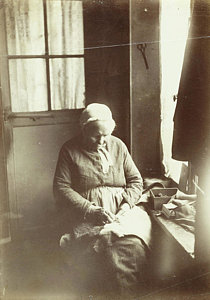
Ladies Aid Society of the Diamond Street M.E. Church meets at the home of Mrs. Priscilla Merrifield on Wilson St. between 9am-4pm. 24 members and 2 visitors spend the day “sewing or doing any other work that may be done for the Monongah sufferers. Clothing or anything which will be donated for the cause will be gladly received by the ladies.” (FWV 12.10.07 pg. 2) (FWV 12.12.07 pg. 2)
old-woman-sitting-by-a-window-sewing-anonymous-artokoloro

“A Pittsburgh man said this morning that he was surprised at the small contributions being sent in for the Monongah relief fund. He thought the big cities were taking too little interest in the matter and that the papers ought to take the question up with a view to creating a larger fund. He thinks there ought to be a fund of at least $200,000 to properly care for 300 widows and 1,000 orphans.” (FWV 12.12.07 pg. )

In Monongah:

2 men try the same trick from day before of posing as workmen to get food and goods. They are caught, arrested, and put in the Monongah jail. (FWV 12.11.07 pg.1)

“About 100 men are digging graves for the dead and as fast as the bodies are prepared and identified they are taken to the cemeteries or shipped to the places designated by friends.” (FWV 12.11.07 pg.1)

Messrs. S.E. Jenkins and J.A.C. Prickett, representatives of the Setting Sun Tribe of the Improved Order of Red Men, accompanied the body of one of the Monongah victims to the home at Connellsville, PA. (FWV 12.12.07 pg. 2)

~10:00 am

“Two hundred and eighty-five bodies were recovered at 10 o’clock today, and 25 more were ready for removal to the surface.” (LET 12.12.07 pg. 1)

~11:00 am

In Pittsburgh, PA:
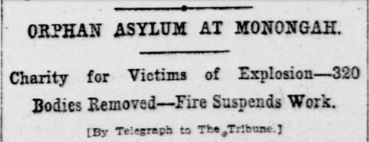
NYTb 12.13.07 - pg 5 - Monongah

“C.W. Watson…will, in the name of his wife, erect an orphan asylum at Monongah in which will be cared for and educated the children of the men who lost their lives in the disaster. Today representatives of Mr. Watson visited this city, where they inspected various orphan asylums, and announced that work on the new asylum at Monongah will be started at once.” (NYTb 12.13.07 pg. 5)

In Charleston, WV:
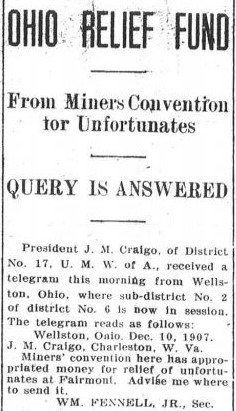
TA 12.12.07 - pg 1 - Ohio Relief Fund

“President Craigo called at the office of the Mail, where a relief fund is being collected and was advised that it would be better to have the contribution from the Wellston miners sent direct from that point to Mayor Moore, at Monongah, rather than have it come to Charleston and then be remitted from here to Monongah. Mr. Craigo adopted the suggestion and wired the convention to the that effect.” (TA 12.12.07 pg. 1)

In Monongah:

“R.H. Spahr went to Monongah this morning and spent a few hours viewing the mine horror.” (CDT 12.12.07 pg. 8)

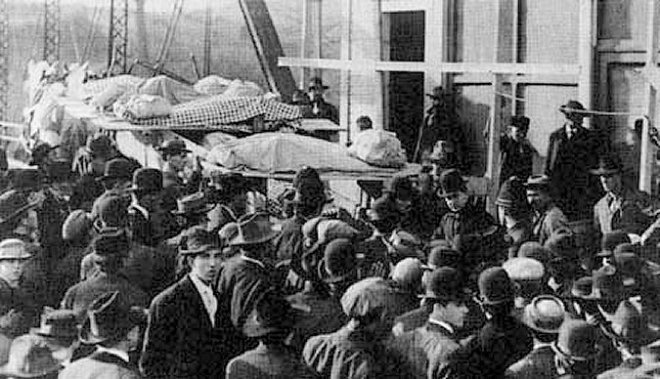
“At 11 0’clock this morning 256 bodies have been waiting for transportation. It is estimated that there are still 145 bodies in the mines. Eighty-five bodies are unidentified. The greater number of these have already been buried.” (WT 12.12.07 pg. 3)
mmd-mining2


More on How Death Gloated!

Bibliography

Disclaimer and Guide

Introduction

About the Author

Contact Information

Tuesday, December 10, 1907, Morning

“This is the day of ‘little mothers’ in Monongah. The little girls tend the babies, wait on the sick and get what bits of food there are.” (NCH 12.10.07 pg. 1)

~7:30 am

The Fairmont West Virginian predicts even more rain for today and tonight, followed by snow and slightly cooler weather (12.10.07 pg. 1)

“It has been raining here steadily since last evening and wretched conditions prevail throughout this section today.” (WED 12.10.07 pg. 1) (ES 12.10.07 pg. 1)

At the mines:

“The stench from decomposed bodies in the mines is becoming almost unbearable to rescuers. The stench is made worse because thirty-six horses were also killed in the mines.” (GWA 12.12.07 pg. 7)

“Many rescuers have become sick. One hundred and fifty miners from the mines in George Creek district have been summoned here to assist in the rescue work.” (GWA 12.12.07 pg. 7)

“The health officers fear an epidemic of fever, due to the decaying bodies of the men and the animals caught in the mine, and have prepared to enforce heroic measures if it becomes necessary. Quicklime will be taken into the mine and scattered over the bodies if conditions become much worse.” (ES 12.10.07 pg. 1)

“The crowds of idlers who surged about the pit entrances…have been dwindling ever since the rainstorm last night…” (AR pg. 1) (LAH 12.11.07 pg. 2) (SFC 12.11.07 pg. 1)

“The mud at the opening of the mines is several inches deep and has been trodden by the great crowds into a perfect quagmire, through which the men with the stretchers have to carry the dead. In conveying one of the recovered bodies down to the railroad tracks this morning a stretcher bearer slipped and the inanimate burden, which was wrapped in a blanket, was thrown into the mud. The sight of it gave the crowd a convulsion.” (RP 12.10.07 pg. 1)

At the morgues:

“Bodies brought from mines Nos 6 and 8 …during last night carried the list of victims beyond the hundred mark, and others are being carried into the morgue in intervals.” (WED 12.10.07 pg. 1)

2 men taken out this morning had some money on them: #101 – Salvadore Lobbs had $150 in a belt strapped around his leg and #110 – Andy Morris had $23.19 in his pocket-book. This brings the total amount of money found on the miners to $200.19. Money is in the hands of the coroner as are all other things that are found.  (FWV 12.10.07 pg. 1)

In Fairmont:

J.E. Sands, cashier of First National Bank, receives a check for $500.00 from the City Bank of Wheeling and a check for $100.00 from the Second National Bank of Cumberland, MD and $100 through Mr. Zack Robertson from a friend in Wheeling. (FWV 12.10.07 pg. 1)

In Grafton:

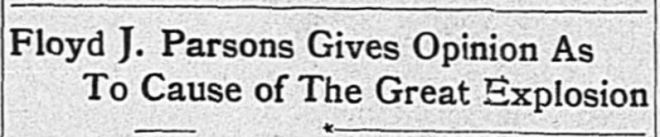
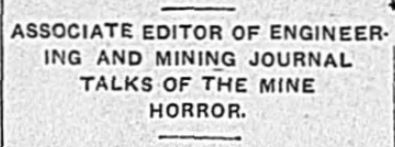
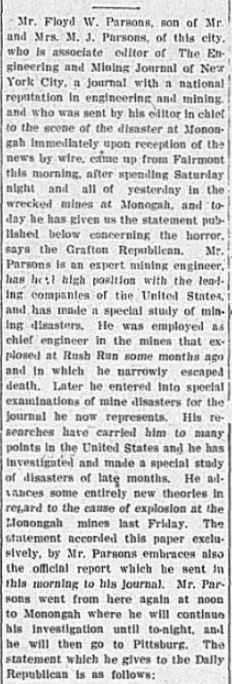
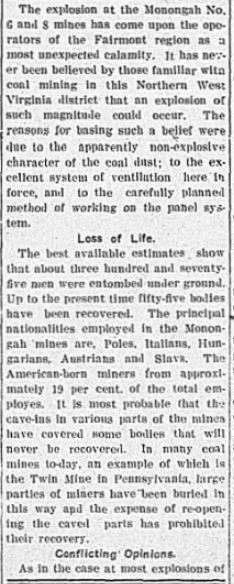
Floyd Parsons “came up from Fairmont” and gives the Grafton Republican newspaper his statement “concerning the horror…”. Floyd was employed as chief engineer in the mines that exploded at Rush Run some months ago and in which he narrowly escaped death. Later he entered into special examinations of mine disasters for the journal he now represents. (FWV 12.10.07 pg. 2)

12.10.07 - pg 2 - Floyd J Parsons opinion on cause 1

12.10.07 - pg 2 - Floyd J Parsons opinion on cause 2

12.10.07 - pg 2 - Floyd J Parsons opinion on cause 312.10.07 - pg 2 - Floyd J Parsons opinion on cause 412.10.07 - pg 2 - Floyd J Parsons opinion on cause 512.10.07 - pg 2 - Floyd J Parsons opinion on cause 612.10.07 - pg 2 - Floyd J Parsons opinion on cause 712.10.07 - pg 2 - Floyd J Parsons opinion on cause 812.10.07 - pg 2 - Floyd J Parsons opinion on cause 9

~8:00 am

CDT 12.10.07 - pg 1 - BandO to Monongah

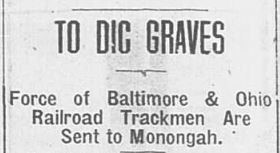
“Carrying out orders from officials of the Baltimore & Ohio railroad, a force of between forty and fifty trackmen that have been working on the railroad between this city and Parkersburg, left Clarksburg Tuesday morning on the interurban trolley line for Monongah to assist in digging graves for the dead that are taken from Monongah mines Nos 6 and 8. The men took picks, shovels and other tools with them and as soon as they arrived at Monongah they proceeded to the cemeteries and began work digging graves. The men were called to this city from various points along the railroad between Parkersburg and this city where they had been working.” (CDT 12.10.07 pg. 1)

In Monongah:

Milroy “Toy” Watkins is taken from Monongah to Montana for burial. The brother of Will Watkins, “…hearing that his brother was in No 6 mine went to work to help find him and he did not give up until he had found him and recognized him by a pair of black patent leather shoes and a black sateen shirt.” (FWV 12.12.07 pg. 2)

The Marion County Board of Health issues an order to advance the burial procedures. Viewing and ID opportunities for families and friends are limited to 4 hours maximum, no matter the condition of the body. The new accelerated ID and burial process cause many burials to occur immediately, without funeral masses. Catholic parishes hold whatever services they can at graveyards. (McAteer)

~9:00 am

On the far east side of Fairmont:

“Impressive were the services conducted by Rev. Hess” for Toy Watkins which takes place at the United Brethren church at Montana. He was the son of Mr. Willis Watkins and was a grandson of Mr. and Mrs. John Freeman, “an aged and respected couple residing at Montana and was related to many people living in and around Hoult and Montana.” Toy is survived by “4 brothers and 2 sisters; his mother having died about one year ago.” He is also survived by wife, Gettie Hyson Watkins, of Simpson, “who is very poorly in Cook Hospital, she being almost prostrated by the awful shock and untimely end of her husband.” (FWV 12.11.07 pg. 2)

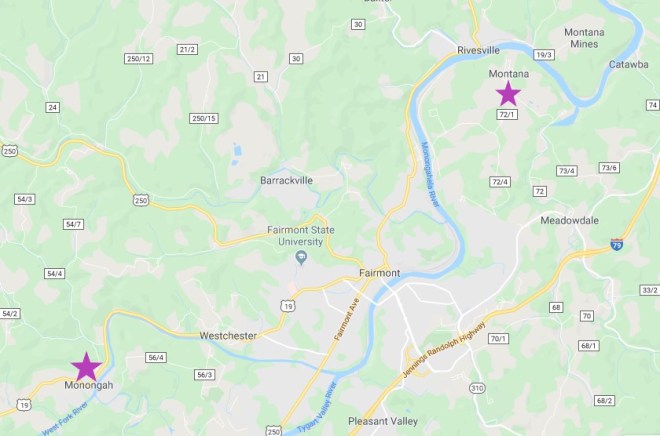
montana map

In Monongah:

“Shock and grief have already destroyed many of the little unborn lives. Many women are so distraught with suffering that they forget all about their children.” (NCH 12.10.07 pg. 1)

“Funeral after funeral is being held at the churches in Monongah. The funeral cars are on the move most of the time. The unknown dead are being buried in the potter’s field near the Polish Catholic church.” (FWV 12.10.07 pg. 1)

Over 70 bodies are interred throughout the day. Some of them get funerals at the church, particularly those who could be preserved, but due to the condition of so many of the bodies brought out in the past hours, more frequently they are simply taken to one of the cemeteries. If identified, a small prayer is said; if not they are just buried. (McAteer) (news)

“The relief work is well under way and will soon be systemized. There is now plenty of food but there is urgent need of clothing in many families. Cash funds are being raised in many places and installments have already been forwarded from some points. The coal companies of this district have contributed $20,000 cash.” (WED 12.10.07 pg. 1)

“Thirty-seven funerals were held Monday and a number today. One body was sent to the cemetery followed by one lone woman, the widow, who had stood for days at the mines waiting for it.” (GWA 12.12.07 pg. 7)

At the mines:

“Every day since the explosion, hands, legs and arms have been removed. The stench from the decomposed bodies in the mines is becoming almost unbearable. This is one of the greatest difficulties which the rescuers have to overcome.” (RP 12.10.07 pg. 1)

“Up to nine o’clock this morning one hundred and one bodies have been removed from the Monongah mines, thirty-one having been taken out since midnight.” (CET 12.10.07 pg. 1)

~10:00 am

In Clarksburg:

“Charles McKane, aged 28 years, one of the Monongah mine victims, was buried in Holy Cross cemetery here at 10 ‘clock Tuesday forenoon. McKain’s body was found in one of the rooms of No. 8 mine and was taken from the mine shortly after midnight. With others it was conveyed to the morgue at Monongah and prepared for burial. It was then sent to his late home in that town arriving there at 2:30 o’clock, and Tuesday morning it was brought up on the interurban and buried. Relatives and friends accompanied the body. Mr. McKain’s body was not mutilated. It is evident he smothered to death. He leaves a wife and one child.” (CDT 12.10.07 pg. 3)

holy cross map

“Mayor L.C. Crile announced Tuesday morning that all moneys received at the council chamber in response to his proclamation calling for donations for the relief of the Monongah mine suffered, would be turned over to the Telegram relief fund, and due credit will be given to each donor. The donations will be published in the Telegram daily. A list of all the donors who leave supplies, provisions, clothing, etc., at the mayor’s office for the Monongah mine sufferers will be published each evening in the Telegram also. Donations are coming in freely and they should continue so for there are many unfortunate women and children left in destitute circumstances by the awful disaster.”  (CDT 12.10.07 pg. 1)

In Monongah:

“Quite a number of Bridgeport people today went to the scene of the great mine disaster at Monongah. Some went for the mere sake of seeing, while others went with the hope of getting tidings from relatives and friends who were employed at the ill-fated mines.” (CDT 12.10.07 pg. 7)

“There is no change in the demeanor of the people of the stricken town except that the gloom of sadness and sorrow deepens all the time.  Funeral after funeral was held today, mostly at the Catholic cemeteries, where scenes are most sad. After loved ones have been identified at the morgue and prepared for burial, hundreds of women and children gather at the cemeteries on the hill instead of going to the churches and await the arrival of the dead.” (CDT 12.10.07 pg. 1)

“Women were found today weak from pain, who are also suffering from lack of proper nourishment. Some of the Fairmont women have depleted their own stores of winter supply food in relieving the distress.” (RP 12.10.07 pg. 1)

“Ever since the explosion the most heroic action has been displayed on all sides by the women who despite their great stress and suffering, clung to their children. From the start they realized that the little tots were to becomes a serious burden, but on all sides could be heard the same sentiment, they would rather die than give up their children.” (CET 12.10.07 pg. 1)

“Some of the widows have no relations in America, for many came to Monongah with their husbands from the old country. Others came as sweethearts, years ago, after the lovers had made enough money to send for them. And while their married lives began here, they apparently prefer, in their distress, the old homes far away.” (CET 12.10.07 pg. 1)

“There are not many of the women who can now find any charms about Monongah, and although foreigners, most of them want to return to their native country, feeling that the few short years of the country of liberty has brought them nothing but grief and suffering.” (CET 12.10.07 pg. 1)

Special correspondent for the United Press, Dorothy Dale, and her photographer are approached by “the brightest Italian girl in the settlement”, Faustina Davia (last name reported as “Daria”).

Faustina close up Wilkes-Barre Times - 12.14.07 pg 1
Faustina Davia

Faustina is the oldest child and only daughter of Victor and Catherina Davia (DaVia). Victor was a “day man” working in #6 at the time of the explosion and was recorded as the 15th body recovered from the mines and to go through the morgue. He was identified by George Gibbons at the Italian Catholic church in Monongah sometime on Monday, though it is generally known that none of the family got to actually view and confirm that the body which was buried in Row A Grave 9 of the Italian Catholic cemetery contained Victor’s actual remains. (Tropea) (News) (McAteer) (Loss) (Amos)

“’Please you get something for me, I can do.’ A little hand touched my arm. A curl-framed face of a girl of 10 looked into my face. ‘You know mans all dead. Boys all dead. Only girls left to work.’ Do you know the half apologetic half appealing look of the trembling old man who shoved out of his life’s track by younger men—the man who begs you to buy matches or shoestrings? Well, that was the expression in the old young eyes of little ten-year-old Faustina Daria. Faustina was in the sixth grade the day before the explosion. That is ages ago to her.” (NCH 12.10.07 pg. 1)

At the mines:

“With 112 bodies on the surface at 10 o’clock today, 25 more ready to be brought out of Mine No 6 and 4 awaiting removal from Mine No 8. It was expected that the total number of bodies recovered from the wrecked mines by noon would be 140.” (CDT 12.10.07 pg. 1)

“The rescuers are working the right side of mine No. 8, where, it is thought, a majority of the bodies yet in the mine will be found.” (ES 12.10.07 pg. 1) (RIA 12.10.07 pg. 1)

 “The rescue work is being pushed and before night it is expected that most of the bodies will have been taken out.” (WED 12.10.07 pg. 1) (ES 12.10.07 pg. 1)

~11:00 am

In East Monongah:

The General Relief Committee holds a meeting at the First National bank, which is currently operating as the primary morgue, and passes an order that the receipts and disbursements of the committee be published in the Fairmont papers from day to day. (McAteer)

Bishop Donahue of Wheeling and Judge Mason are added to the General Relief Committee. (FWV 12.10.07 pg. 1)

Donahue has “visited many of the homes of miners and found so many children made orphans by the disaster that he immediately took up the work of providing homes for them. He will arrange to have as many as can be accommodated sent to the orphanages maintained by the church at Huntington and Wheeling.” (WED 12.10.07 pg. 1)

In West Monongah:

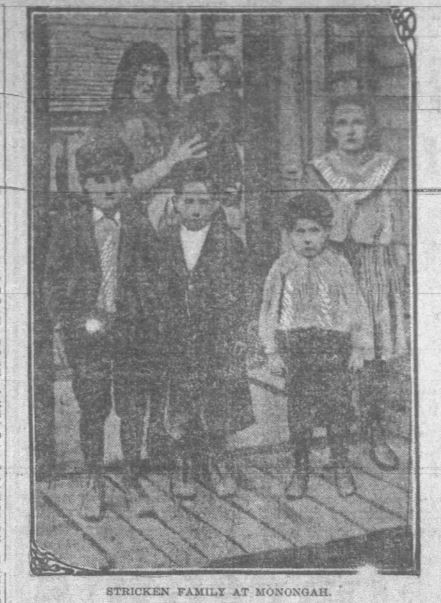
Faustina Davia has taken Dorothy Dale and her photographer to her family’s three-room house on Walnut Avenue.

“‘See my Ma, Resta, Kipling, Georda and Ojgenia to work for,’ as she pointed at the group on the steps. ‘My pa make $2 a day,’ she explained. ‘And wasn’t it awful; three days he was home with a hurt on his back, and Friday he went in again and—and—’. But even the brave lips of strong hearted women of ten sometimes give way. The little figure crouched against the wall and quivered with sobs. ‘You know we paid $5 rent and had lard and cheese and bologna,’ she said with pride. The child spoke as rich people spoke of automobiles and theatre parties. And there was little Faustinas in almost every house in Monongah.” (NCH 12.10.07 pg. 1)

“I tell you there is nothing that makes one’s heart go out more to that stricken people than the way tiny girls put their little shoulders to the burdens that their mothers can not bear.” (NCH 12.10.07 pg. 1)

Wilkes-Barre Times - 12.14.07 pg 1
Photo taken of the Davia family on the porch of their home.
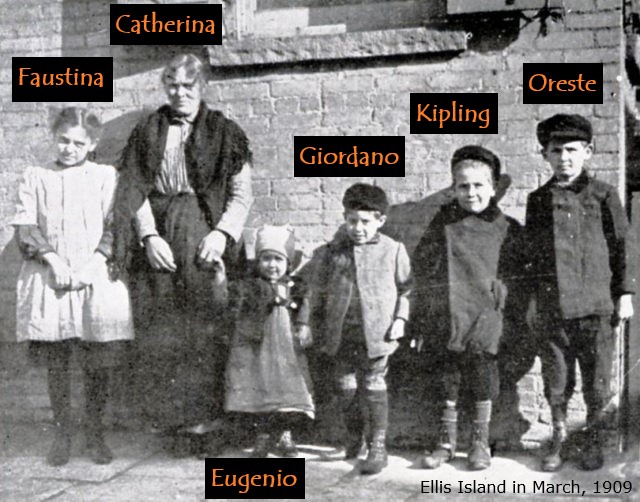
1909 ID photo
Photo of Davia family at Ellis Island. Catherina and her family is the focus of this author’s historic fiction, therefore, there will soon be areas of this site which will be dedicated solely to her story.

~11:30 am

“At eleven thirty, one hundred and thirteen bodies have been taken from the mine by rescuers. The bodies of those taken out since daylight are in good condition, and many were identified.” (CET 12.10.07 pg. 1)


More on How Death Gloated!
Bibliography

Disclaimer and Guide

Introduction

About the Author

Contact Information