Tuesday, December 10, 1907, Morning

“This is the day of ‘little mothers’ in Monongah. The little girls tend the babies, wait on the sick and get what bits of food there are.” (NCH 12.10.07 pg. 1)

~7:30 am

The Fairmont West Virginian predicts even more rain for today and tonight, followed by snow and slightly cooler weather (12.10.07 pg. 1)

“It has been raining here steadily since last evening and wretched conditions prevail throughout this section today.” (WED 12.10.07 pg. 1) (ES 12.10.07 pg. 1)

At the mines:

“The stench from decomposed bodies in the mines is becoming almost unbearable to rescuers. The stench is made worse because thirty-six horses were also killed in the mines.” (GWA 12.12.07 pg. 7)

“Many rescuers have become sick. One hundred and fifty miners from the mines in George Creek district have been summoned here to assist in the rescue work.” (GWA 12.12.07 pg. 7)

“The health officers fear an epidemic of fever, due to the decaying bodies of the men and the animals caught in the mine, and have prepared to enforce heroic measures if it becomes necessary. Quicklime will be taken into the mine and scattered over the bodies if conditions become much worse.” (ES 12.10.07 pg. 1)

“The crowds of idlers who surged about the pit entrances…have been dwindling ever since the rainstorm last night…” (AR pg. 1) (LAH 12.11.07 pg. 2) (SFC 12.11.07 pg. 1)

“The mud at the opening of the mines is several inches deep and has been trodden by the great crowds into a perfect quagmire, through which the men with the stretchers have to carry the dead. In conveying one of the recovered bodies down to the railroad tracks this morning a stretcher bearer slipped and the inanimate burden, which was wrapped in a blanket, was thrown into the mud. The sight of it gave the crowd a convulsion.” (RP 12.10.07 pg. 1)

At the morgues:

“Bodies brought from mines Nos 6 and 8 …during last night carried the list of victims beyond the hundred mark, and others are being carried into the morgue in intervals.” (WED 12.10.07 pg. 1)

2 men taken out this morning had some money on them: #101 – Salvadore Lobbs had $150 in a belt strapped around his leg and #110 – Andy Morris had $23.19 in his pocket-book. This brings the total amount of money found on the miners to $200.19. Money is in the hands of the coroner as are all other things that are found.  (FWV 12.10.07 pg. 1)

In Fairmont:

J.E. Sands, cashier of First National Bank, receives a check for $500.00 from the City Bank of Wheeling and a check for $100.00 from the Second National Bank of Cumberland, MD and $100 through Mr. Zack Robertson from a friend in Wheeling. (FWV 12.10.07 pg. 1)

In Grafton:

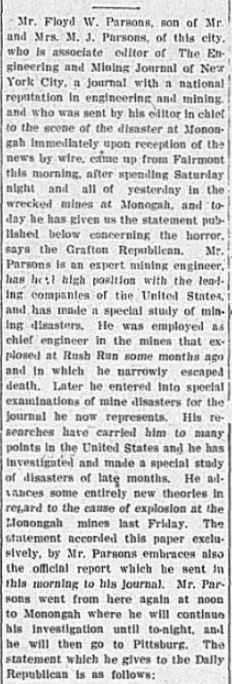
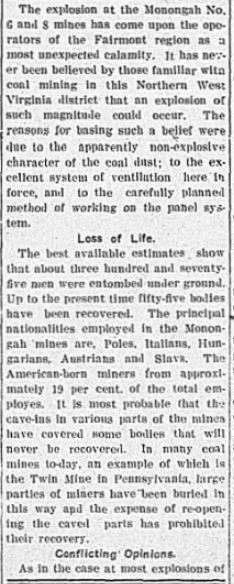
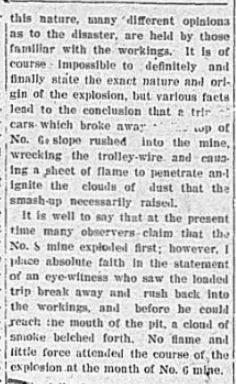
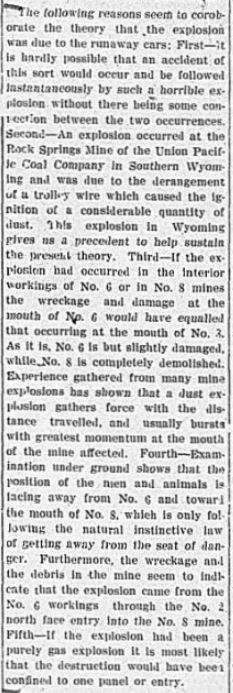
Floyd Parsons “came up from Fairmont” and gives the Grafton Republican newspaper his statement “concerning the horror…”. Floyd was employed as chief engineer in the mines that exploded at Rush Run some months ago and in which he narrowly escaped death. Later he entered into special examinations of mine disasters for the journal he now represents. (FWV 12.10.07 pg. 2)
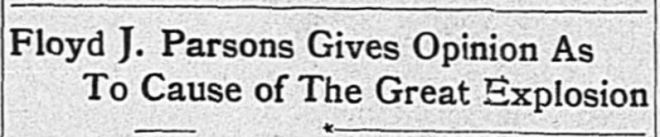
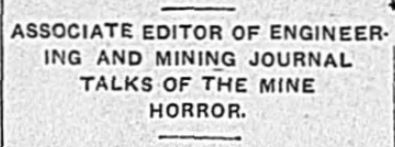
12.10.07 - pg 2 - Floyd J Parsons opinion on cause 1

12.10.07 - pg 2 - Floyd J Parsons opinion on cause 2

12.10.07 - pg 2 - Floyd J Parsons opinion on cause 312.10.07 - pg 2 - Floyd J Parsons opinion on cause 412.10.07 - pg 2 - Floyd J Parsons opinion on cause 512.10.07 - pg 2 - Floyd J Parsons opinion on cause 612.10.07 - pg 2 - Floyd J Parsons opinion on cause 712.10.07 - pg 2 - Floyd J Parsons opinion on cause 812.10.07 - pg 2 - Floyd J Parsons opinion on cause 9

~8:00 am

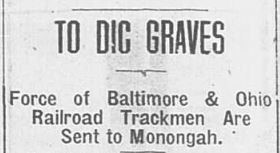
CDT 12.10.07 - pg 1 - BandO to Monongah

“Carrying out orders from officials of the Baltimore & Ohio railroad, a force of between forty and fifty trackmen that have been working on the railroad between this city and Parkersburg, left Clarksburg Tuesday morning on the interurban trolley line for Monongah to assist in digging graves for the dead that are taken from Monongah mines Nos 6 and 8. The men took picks, shovels and other tools with them and as soon as they arrived at Monongah they proceeded to the cemeteries and began work digging graves. The men were called to this city from various points along the railroad between Parkersburg and this city where they had been working.” (CDT 12.10.07 pg. 1)

In Monongah:

Milroy “Toy” Watkins is taken from Monongah to Montana for burial. The brother of Will Watkins, “…hearing that his brother was in No 6 mine went to work to help find him and he did not give up until he had found him and recognized him by a pair of black patent leather shoes and a black sateen shirt.” (FWV 12.12.07 pg. 2)

The Marion County Board of Health issues an order to advance the burial procedures. Viewing and ID opportunities for families and friends are limited to 4 hours maximum, no matter the condition of the body. The new accelerated ID and burial process cause many burials to occur immediately, without funeral masses. Catholic parishes hold whatever services they can at graveyards. (McAteer)

~9:00 am

On the far east side of Fairmont:

“Impressive were the services conducted by Rev. Hess” for Toy Watkins which takes place at the United Brethren church at Montana. He was the son of Mr. Willis Watkins and was a grandson of Mr. and Mrs. John Freeman, “an aged and respected couple residing at Montana and was related to many people living in and around Hoult and Montana.” Toy is survived by “4 brothers and 2 sisters; his mother having died about one year ago.” He is also survived by wife, Gettie Hyson Watkins, of Simpson, “who is very poorly in Cook Hospital, she being almost prostrated by the awful shock and untimely end of her husband.” (FWV 12.11.07 pg. 2)
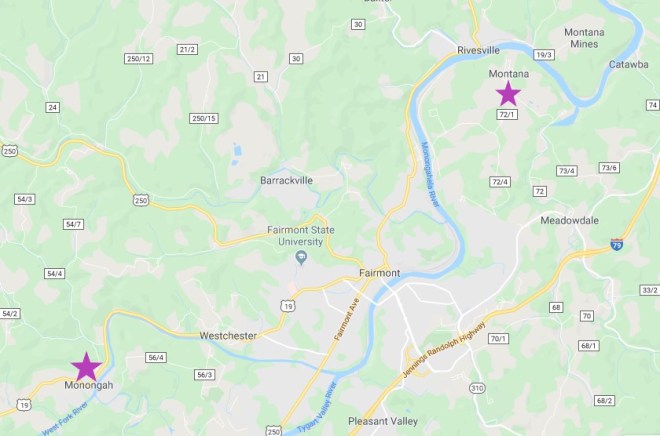
montana map

In Monongah:

“Shock and grief have already destroyed many of the little unborn lives. Many women are so distraught with suffering that they forget all about their children.” (NCH 12.10.07 pg. 1)

“Funeral after funeral is being held at the churches in Monongah. The funeral cars are on the move most of the time. The unknown dead are being buried in the potter’s field near the Polish Catholic church.” (FWV 12.10.07 pg. 1)

Over 70 bodies are interred throughout the day. Some of them get funerals at the church, particularly those who could be preserved, but due to the condition of so many of the bodies brought out in the past hours, more frequently they are simply taken to one of the cemeteries. If identified, a small prayer is said; if not they are just buried. (McAteer) (news)

“The relief work is well under way and will soon be systemized. There is now plenty of food but there is urgent need of clothing in many families. Cash funds are being raised in many places and installments have already been forwarded from some points. The coal companies of this district have contributed $20,000 cash.” (WED 12.10.07 pg. 1)

“Thirty-seven funerals were held Monday and a number today. One body was sent to the cemetery followed by one lone woman, the widow, who had stood for days at the mines waiting for it.” (GWA 12.12.07 pg. 7)

At the mines:

“Every day since the explosion, hands, legs and arms have been removed. The stench from the decomposed bodies in the mines is becoming almost unbearable. This is one of the greatest difficulties which the rescuers have to overcome.” (RP 12.10.07 pg. 1)

“Up to nine o’clock this morning one hundred and one bodies have been removed from the Monongah mines, thirty-one having been taken out since midnight.” (CET 12.10.07 pg. 1)

~10:00 am

In Clarksburg:

“Charles McKane, aged 28 years, one of the Monongah mine victims, was buried in Holy Cross cemetery here at 10 ‘clock Tuesday forenoon. McKain’s body was found in one of the rooms of No. 8 mine and was taken from the mine shortly after midnight. With others it was conveyed to the morgue at Monongah and prepared for burial. It was then sent to his late home in that town arriving there at 2:30 o’clock, and Tuesday morning it was brought up on the interurban and buried. Relatives and friends accompanied the body. Mr. McKain’s body was not mutilated. It is evident he smothered to death. He leaves a wife and one child.” (CDT 12.10.07 pg. 3)

holy cross map

“Mayor L.C. Crile announced Tuesday morning that all moneys received at the council chamber in response to his proclamation calling for donations for the relief of the Monongah mine suffered, would be turned over to the Telegram relief fund, and due credit will be given to each donor. The donations will be published in the Telegram daily. A list of all the donors who leave supplies, provisions, clothing, etc., at the mayor’s office for the Monongah mine sufferers will be published each evening in the Telegram also. Donations are coming in freely and they should continue so for there are many unfortunate women and children left in destitute circumstances by the awful disaster.”  (CDT 12.10.07 pg. 1)

In Monongah:

“Quite a number of Bridgeport people today went to the scene of the great mine disaster at Monongah. Some went for the mere sake of seeing, while others went with the hope of getting tidings from relatives and friends who were employed at the ill-fated mines.” (CDT 12.10.07 pg. 7)

“There is no change in the demeanor of the people of the stricken town except that the gloom of sadness and sorrow deepens all the time.  Funeral after funeral was held today, mostly at the Catholic cemeteries, where scenes are most sad. After loved ones have been identified at the morgue and prepared for burial, hundreds of women and children gather at the cemeteries on the hill instead of going to the churches and await the arrival of the dead.” (CDT 12.10.07 pg. 1)

“Women were found today weak from pain, who are also suffering from lack of proper nourishment. Some of the Fairmont women have depleted their own stores of winter supply food in relieving the distress.” (RP 12.10.07 pg. 1)

“Ever since the explosion the most heroic action has been displayed on all sides by the women who despite their great stress and suffering, clung to their children. From the start they realized that the little tots were to becomes a serious burden, but on all sides could be heard the same sentiment, they would rather die than give up their children.” (CET 12.10.07 pg. 1)

“Some of the widows have no relations in America, for many came to Monongah with their husbands from the old country. Others came as sweethearts, years ago, after the lovers had made enough money to send for them. And while their married lives began here, they apparently prefer, in their distress, the old homes far away.” (CET 12.10.07 pg. 1)

“There are not many of the women who can now find any charms about Monongah, and although foreigners, most of them want to return to their native country, feeling that the few short years of the country of liberty has brought them nothing but grief and suffering.” (CET 12.10.07 pg. 1)

Special correspondent for the United Press, Dorothy Dale, and her photographer are approached by “the brightest Italian girl in the settlement”, Faustina Davia (last name reported as “Daria”).

Faustina close up Wilkes-Barre Times - 12.14.07 pg 1
Faustina Davia

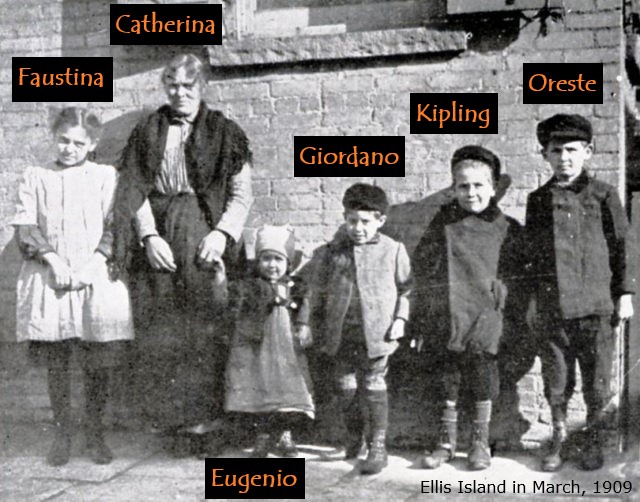
Faustina is the oldest child and only daughter of Victor and Catherina Davia (DaVia). Victor was a “day man” working in #6 at the time of the explosion and was recorded as the 15th body recovered from the mines and to go through the morgue. He was identified by George Gibbons at the Italian Catholic church in Monongah sometime on Monday, though it is generally known that none of the family got to actually view and confirm that the body which was buried in Row A Grave 9 of the Italian Catholic cemetery contained Victor’s actual remains. (Tropea) (News) (McAteer) (Loss) (Amos)

“’Please you get something for me, I can do.’ A little hand touched my arm. A curl-framed face of a girl of 10 looked into my face. ‘You know mans all dead. Boys all dead. Only girls left to work.’ Do you know the half apologetic half appealing look of the trembling old man who shoved out of his life’s track by younger men—the man who begs you to buy matches or shoestrings? Well, that was the expression in the old young eyes of little ten-year-old Faustina Daria. Faustina was in the sixth grade the day before the explosion. That is ages ago to her.” (NCH 12.10.07 pg. 1)

At the mines:

“With 112 bodies on the surface at 10 o’clock today, 25 more ready to be brought out of Mine No 6 and 4 awaiting removal from Mine No 8. It was expected that the total number of bodies recovered from the wrecked mines by noon would be 140.” (CDT 12.10.07 pg. 1)

“The rescuers are working the right side of mine No. 8, where, it is thought, a majority of the bodies yet in the mine will be found.” (ES 12.10.07 pg. 1) (RIA 12.10.07 pg. 1)

 “The rescue work is being pushed and before night it is expected that most of the bodies will have been taken out.” (WED 12.10.07 pg. 1) (ES 12.10.07 pg. 1)

~11:00 am

In East Monongah:

The General Relief Committee holds a meeting at the First National bank, which is currently operating as the primary morgue, and passes an order that the receipts and disbursements of the committee be published in the Fairmont papers from day to day. (McAteer)

Bishop Donahue of Wheeling and Judge Mason are added to the General Relief Committee. (FWV 12.10.07 pg. 1)

Donahue has “visited many of the homes of miners and found so many children made orphans by the disaster that he immediately took up the work of providing homes for them. He will arrange to have as many as can be accommodated sent to the orphanages maintained by the church at Huntington and Wheeling.” (WED 12.10.07 pg. 1)

In West Monongah:

Faustina Davia has taken Dorothy Dale and her photographer to her family’s three-room house on Walnut Avenue.

“‘See my Ma, Resta, Kipling, Georda and Ojgenia to work for,’ as she pointed at the group on the steps. ‘My pa make $2 a day,’ she explained. ‘And wasn’t it awful; three days he was home with a hurt on his back, and Friday he went in again and—and—’. But even the brave lips of strong hearted women of ten sometimes give way. The little figure crouched against the wall and quivered with sobs. ‘You know we paid $5 rent and had lard and cheese and bologna,’ she said with pride. The child spoke as rich people spoke of automobiles and theatre parties. And there was little Faustinas in almost every house in Monongah.” (NCH 12.10.07 pg. 1)

“I tell you there is nothing that makes one’s heart go out more to that stricken people than the way tiny girls put their little shoulders to the burdens that their mothers can not bear.” (NCH 12.10.07 pg. 1)
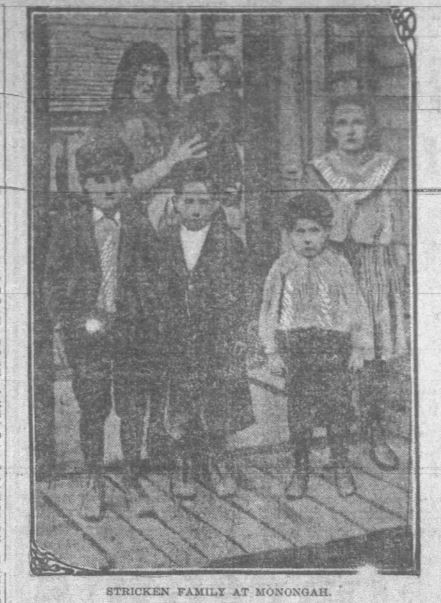
Wilkes-Barre Times - 12.14.07 pg 1
Photo taken of the Davia family on the porch of their home.
1909 ID photo
Photo of Davia family at Ellis Island. Catherina and her family is the focus of this author’s historic fiction, therefore, there will soon be areas of this site which will be dedicated solely to her story.

~11:30 am

“At eleven thirty, one hundred and thirteen bodies have been taken from the mine by rescuers. The bodies of those taken out since daylight are in good condition, and many were identified.” (CET 12.10.07 pg. 1)


More on How Death Gloated!
Bibliography

Disclaimer and Guide

Introduction

About the Author

Contact Information

Friday, December 6, 1907, Evening into Night, 7:00 pm – 10:00 pm

“Tonight, thousands are gathered at …No 6 and 8, aghast of the horror of the explosions…in fact, the entire town of several thousand people are crowded about the mine openings anxiously awaiting the work of the rescue party, but without even the slightest hope of seeing any of their loved ones alive.” (CDT 12.7.07 pg. 1)

~7:00 pm

In Monongah:

“Trolley cars and trains over the Baltimore and Ohio brought great crowds of people from Clarksburg and Fairmont, many of whom have relatives in the terrible catastrophe, all anxious to learn the worst, as all hope had been abandoned that any survived and the only hope that remained was that the bodies at least might be recovered.” (CDT 12.7.07 pg. 1)

Vice President Potter, General Manager Thomas Fitzgerald and Division Superintendent and other officials of the Baltimore and Ohio Railroad Company heard of the horrible disaster and arrive to offer their services.

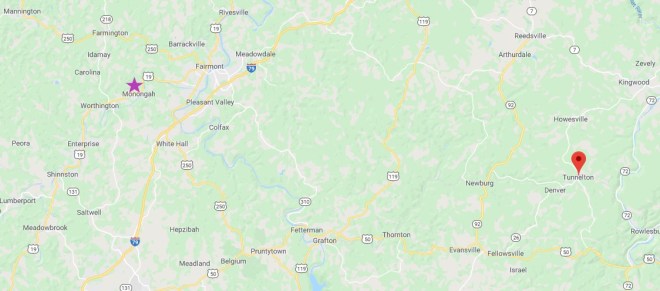
14 miners also arrive from Tunnelton, WV, to aid in the rescue (FWV 12.7.07 pg. 1)

map - tunnelton

“The general opinion in the town is that the number of dead and imprisoned will reach 500. A few persons believe this number will be exceeded, claiming that more than half the total force worked during the day, while on the other hand some think the number will be smaller. The most conservative estimates place the number of victims at 300 or more.” (DASB 12.07.07 pg. 1)

~7:30 pm

At #8:

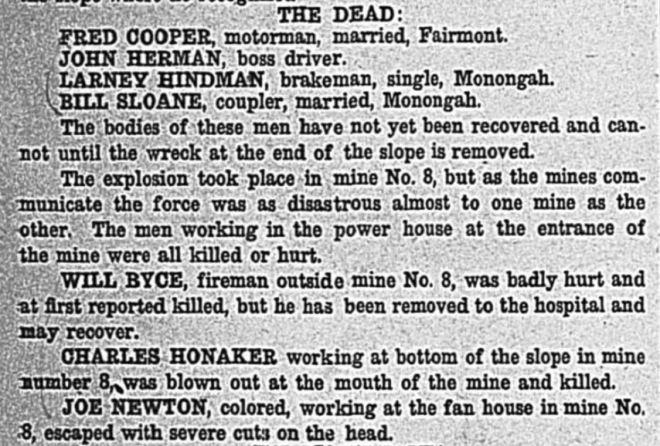
Superintendent A.J. Ruckman finds the body of Charles Honaker. “…it was thought that Honaker had been blown in the river but he had not. He was lying about 70ft from the mouth of No 8. When he was found his watch was still keeping time and this property was the means of his identification. Mr. Ruckman still has his watch.” (FWV 12.7.07 pg. 2 – noon)

“Undertakers on the scene have converted the First National bank building into a morgue to take care of the bodies and all the caskets possible have arrived from Clarksburg and Fairmont with a special order on the way from Wheeling.” (CDT 12.7.07 pg. 1)

~8:00 pm

At the mines:

“At this time the rescuers are hard at work digging debris, dirt, coal, timbers, and the like away so as to get further into the mine. The efforts are to rescue any live men who may possibly be in the mine and dead bodies are now being removed.” (CDT 12.7.07 pg. 1)

“The chief efforts of rescue are at mine No 6, where the explosion was not so terrific.”  “At No 8 the rescue work is difficult and proceeding very slowly on account of the afterdamp.” (CDT 12.7.07 pg. 1)

In Monongah:

“The saloons have all been closed by order of the mayor. The great crowds still linger at the mines. The order is good.” (CDT 12.7.07 pg. 1)

West Virginia Governor Dawson wires a message to Pres. C.W. Watson: “Inspector to arrive tomorrow. Do not hesitate to call upon me for assistance.” Watson replies, “Our accident was deplorable indeed. Very much obliged for your offer…glad to know Chief Mine Inspector Paul will be here in the morning. Impossible to tell extent of fatalities at this time. Will advise you early tomorrow.” (FWV 12.7.07 pg. 1 & 2 – noon)

 ~8:30 pm

Evening presses from major papers across the country are putting out some of the first words the country will read about the disaster in Monongah. At some point during the day, either General Manager Malone or someone who had talked with Malone had a telephone conversation with a reporter at the Associated Press. As a result of this too early conversation which will be reprinted again and again nationwide, much of the first and perhaps only words many people will read about the disaster over the next month are highly inaccurate.

~9:00 pm

Inside #6:

Rescuers begin investigating side entries and rooms further from explosions. As each crew moves forward, they stumble over material debris as well as dead bodies of miners and horses.

“Relay parties bring no work of encouragement, to the contrary their only report is the finding of dead bodies piled up in the mine pits in heaps of twenty, indicating that when the explosion occurred, many of them rushed to the openings and perished on the way—overcome by gas.” (CDT 12.7.07 pg. 1)

In Monongah:

Another special train arrives, this one from Baltimore carrying V.P. Wheelwright of Consolidated Coal Company, President Oscar G Murray and General Manager Thomas Fitzgerald from the B&O railroad company along with more company officials, volunteers, newspaper reporters, and sightseers.

It becomes clear to company officials that many burial sites will be needed, and the existing potter’s field is insufficient.

“C.W. Watson, president of the company, is deeply affected by the accident and refused to give out a statement tonight. He only observed that it was ‘Too bad! Too bad!’” (TS 12.7.07 pg. 1)

Outside #8:

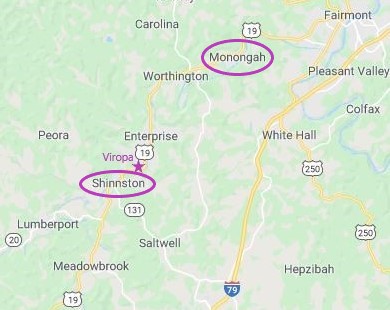
“The deadly fire damp made it impossible to do much rescue work early in the day, especially at Mine No. 8, where the explosion had completely wrecked the fan, until another fan could be brought from Shinnston, twelve miles away, and put in working order, the men labored at a disadvantage…” (WH 12.7.07 pg. 1)

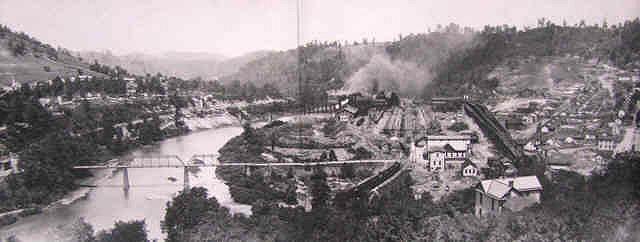
map 1 - Viropa crop

Relief crews have managed to create a stable air hole about a half mile from the mine mouth. A temporary 7-foot-wide fan has arrived from Shinnston and put into place at #8 mine. But, “When the fan that was installed at the mouth of mine No 8 was started…it caused a small fire.” (FWV 12.7.07 pg. 1 & 2 – noon)

Inside #8:

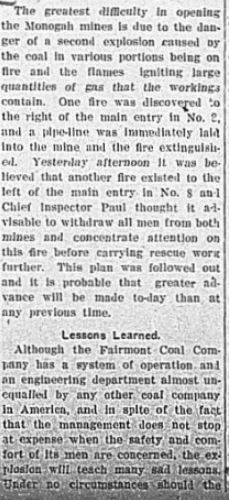
“One fire was discovered to the right of the main entry in No. 8 and a pipeline was immediately laid into the mine and the fire extinguished.” (FWV 12.10.07 pg. 2 – Floyd Parsons)

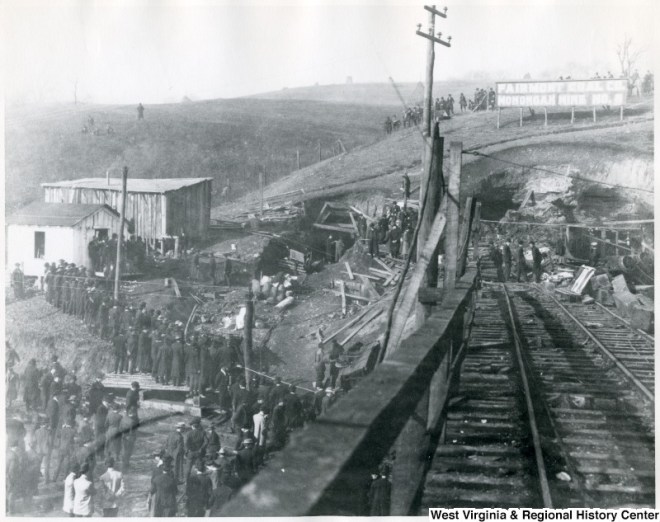
WVC 8

~9:30 pm

“Up to 9:30 Peter Roisberg is the only man brought out alive.” (TS 12.7.07 pg. 1)


Previous Post

Next Post


More on How Death Gloated!

Bibliography

Timeline

Disclaimer and Guide

Introduction

About the Author

Contact Information

Friday, December 6, 1907, Mid-Afternoon – Dusk, 3:00 pm – 7:00 pm

“Not less than 400 are dead and the number may run to 700, as officials have been keeping down the number as much as possible.” (FWDN 12.6.07 pg. 1)

~3:00 pm

“At 3 o’clock this afternoon it is known that the mine disaster is the worst in the history of the country.” (FWDN 12.6.07 pg. 1)

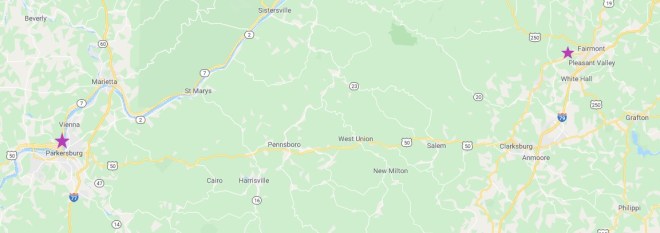
In Parkersburg:

“Mr. Watson was in Parkersburg at the time of the accident and went at once to the scene.” (TBS 12.7.07 pg. 2)

map - parkersburg

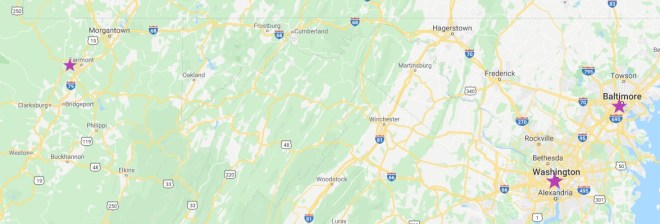
In Baltimore:

“Mr. Wheelwright left here at 3 pm over the Baltimore and Ohio for the mines. He was accompanied by Mr. J.R. Buckingham, his secretary, and some of the others of the company’s officers.” (TBS 12.7.07 pg. 2)

map - baltimore and DC

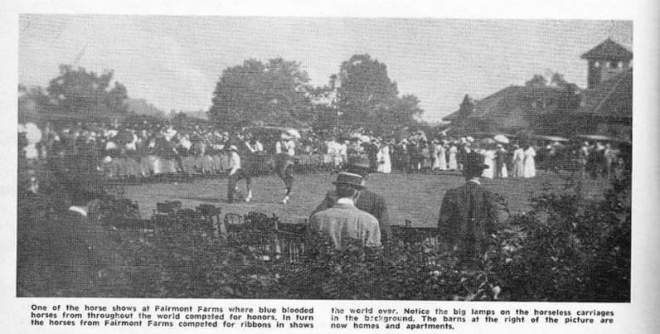
“Mr. Clarence W. Watson is the president and Mr. Jere H. Wheelwright the vice-president, both of whom spend most of their time here in directing the executive affairs of the corporation. Mr. Watson has a home at Fairmont, where he spends the summer. On this estate, which is just on the outskirts of that city, he has recently built a magnificent stable for his famous show horses and also a half-mile track for their exercise.” (TBS 12.7.07 pg. 2)

FB_IMG_1516709527023

In Monongah:

It is “Press Time” and some of the reporters are in line to use the telegraph or telephone in the company store post office or the company office just across the river from #6 to submit their reports in time for the evening papers. A majority have had to go into Fairmont to find more communication resources. (News)

Outside #6:

Carl Tarleton arrives from the mines just down the tracks in Enterprise to help with the recovery. He works personally with David Victor on restoring proper ventilation to the mines, despite only having one working fan. By this point they have only achieved breathable air in most of the main shaft of #6, but they are almost to the area where the two mines are conjoined. David Victor decides to go ahead and make an attempt at a fire examination of #6. (Inquiry)

~3:30 pm

The two staff writers for The Clarksburg Daily Telegram make “fast time” despite taking the back roads to Monongah. “…they arrived some time before the first train and about two hours before the first trolley car arrived from Clarksburg, beating other newspaper representatives.” (CDT 12.8.07 pg. 1)

Outside #6:

The second round of rescue crews is starting to be organized just as several experienced miners arrive from the Montana mines just outside of Fairmont. As these men already work together as a congruent team underground, they are formed into a rescue crew all their own. (FWV 12.7.07 pg. 1 – noon)

Outside #8:

Someone standing near a toad hole, possibly a company watchman, happens to hear a sound like moaning coming from the ground. He calls out to nearby work crews for help. Several run off to a nearby supply house to collect materials.

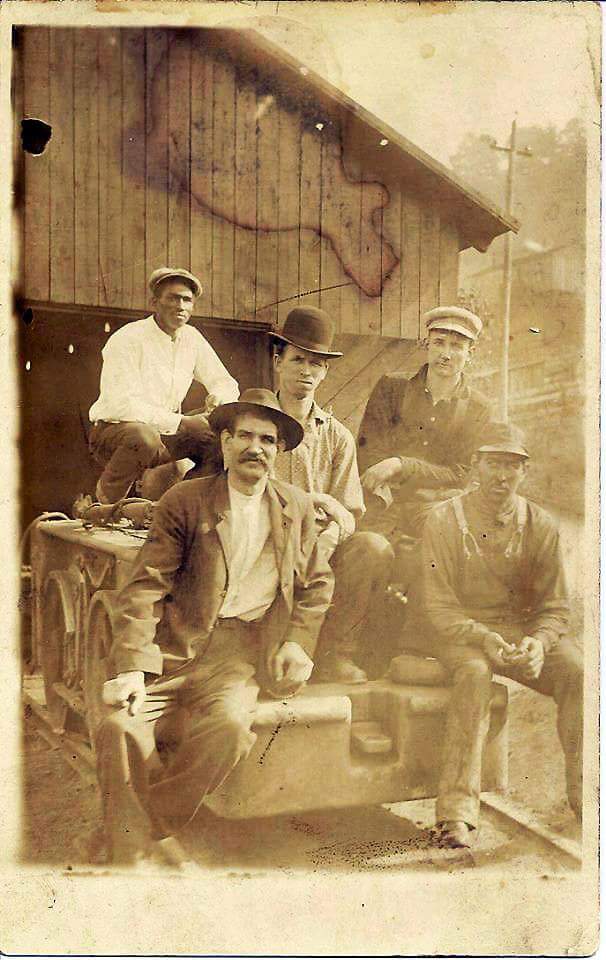
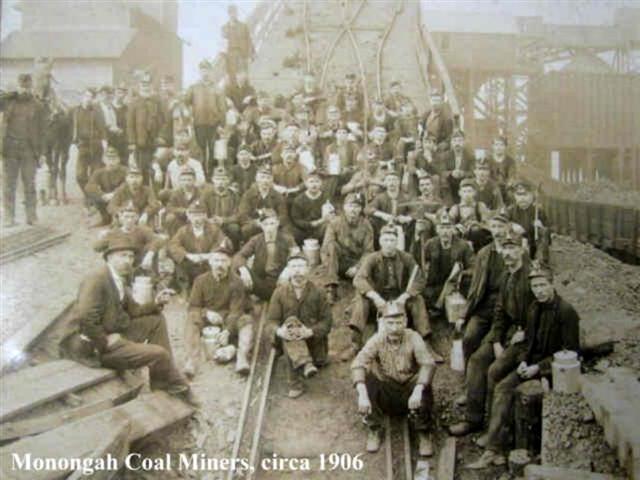
miners-monongah

~3:33-3:35 pm

Outside #8:

The rescuers have returned quickly from the supply house with armloads of rope and begin tying critical hitch and harness knots in one end to safely support the men who will be lowered down through the toad hole.

~ 3:40 – 3:45 pm

Inside #8:

The first rescuer, a long slender rail worker in the mines named Charlie “Skinny” McGraw, has been lowered over 100 feet before getting to the floor of the mine. He unties himself from the lowering lines so they can be raised back to the surface for the next man to follow down and help.

He follows the moans through the dark and soon finds the Urban brothers. Stan is lying face down in a puddle of water and Peter is sitting atop Stan’s back sobbing uncontrollably, simply staring ahead into the dark space with wide glassy eyes.

~3:45 – 3:50 pm

Inside #8:

The second rescuer, Tom Weeks, has been lowered into the room with McGraw and the Urbans. As they come upon Peter and Stan, Peter begins to shout at them and protect his nonresponsive brother. The Urbans are from Poland (their original last name is Rosebeiq) and, unfortunately, Stan knew more American English than Peter and neither of the two rescuers speak or understand Polish. (News, Ancestry, Inquiry, McAteer)

Absolutely crazed by the trauma, fear, and utter darkness he has endured for the past 5-6 hours, Peter begins to aggressively fight with McGraw and Weeks to keep them away from his brother. He shouts at them but they do not understand him and again try to grab Peter and force him away from his brother. A full-on struggle ensues.

~3:50-3:55 pm

Inside #8:

Weeks and McGraw have managed to wrangle Peter into submission. They tie him into the rope hitch and give a signal to the men on the surface to start pulling. The workers on the surface grapple with the line as Peter continues reaching and screaming for his brother on his way back up the 100’ ascent to the surface

As Tom Weeks keeps an eye on Peter from below, Charlie McGraw rushes back to check on Stan’s condition. Despite the severe head injury and 5 hours face down in a puddle, Stan is still breathing but barely hanging on to life.

~3:55 – 4:00 pm

Outside #8:

Several people grab a hold of Peter as he nears the surface and assist in pulling him out. They get him safely out of the hole, pull him away to solid ground and untie his rope when, again, Peter begins to fight off the rescuers around him. The rope is dropped back into the toad hole again as Peter continues to struggle against those trying to help him.

Inside #8:

McGraw and Weeks have moved Stan out of the puddle and closer to the toad hole. They begin to tie him into the rope harness, just as they did with Peter. Stan is still breathing but unconscious.

~4:00 – 4:10 pm

Inside #6:

“For fully two hours nothing but wreckage, such as blocks of coal mine timbers and machinery rewarded the search, but at 4 o’clock in mine No. 6, twenty bodies were found in a heap a short distance from the opening. These were not brought out at the time as the purpose of the searches was to find if any survived the awful disaster and to bring them out first.” (CDT 12.7.07 pg. 1)

MT6

“Men who entered the mine say there are twenty dead men sitting on one bench, where they were awaiting their turns to take cars.” (TS 12.7.07 pg. 1)

Outside #8:

Peter Urban manages to break free from the rescuers. He tears through the crowd of onlookers, screaming and crying, sprints down the bank towards the river but crashes full-force into a fence. Rescuers follow and though Peter gives them quite the chase he begins to put up another brief fight as they catch up with him. Peter is simply too exhausted by this point and they manage to subdue him again with little issue.

Inside #8:

At some point during the ascent back to the surface, Stan Urban dies.

~4:10 – 4:15 pm

Outside #8:

Dr. F.W. Hill quickly looks over Peter Urban for any sign of significant injury or need for hospitalization. Though Peter is so distressed and upset that he can not even give the doctor his own name, Dr. Hill finds no reason to hospitalize him and sends Peter home to his family to rest.

At the toad hole, Stan is pulled out and taken to the side. Though he shows no signs of life, the warmth coming off his body gives them hope. Resuscitation is attempted but soon it is accepted that they are too late.

Stanislaus Urban is put onto a horse drawn cart, sent across the river to the morgue.

~4:30 pm

Word has already begun to spread through town and reaches #6 that at least one man has been found alive and rescued from #8.

MT39
Peter Urban
Outside #6:

Crowds swarm in the direction of #8. For some, especially many newspaper reporters who have arrived from out of town, this is the first notice they get that the #8 mine they have just submitted reports on isn’t actually #8 mine at all. Dozens of reporters who have been on or around the Iron Bridge all day have already gone to print and have mistakingly identifyied either #1 or #2 mine, which are across the river from #6, as being mine #8 simply because they can see smoke coming out of this mine from their vantage point.

Outside #8:

Despite the lack of ventilation and being driven out hours earlier by toxic gases, the discovery of Peter Urban alive and relatively well encourages another round of rescue crews to prepare to attempt another tour into #8. John C Thompson is in charge of one of those crews. (News, Inquiry)

Inside #6

By late afternoon, part of the broken trip that clogged the heading of mine #6 was removed and the entrance to the mine proper was clear enough to allow for the removal of bodies. “It was the blockade of broken cars that made it so difficult to get the work started.” (FWV 12.7.07 – pg. 1 – noon)

“The entry of No 6 mine, 300 feet from the mountain is piled high with wreckage of two strings of cars and two electric motors. Some of the rescuers have climbed over this and found dead bodies beyond, but have made no attempt to remove these to the surface, partly because it would be almost impossible to carry the bodies over the debris, but more particularly because they do not want to lose any time in reaching other sections of the mine where it is possible men still living may be imprisoned.” (ES 12.7.07 pg. 2)

~5:00 pm

At the mines:

By now, it has become very clear to the physicians and nurses who rushed to the scene that their services will not be needed. Some stay for the night to care for the rescue workers who are injured or overcome by the gases. Many leave on the 5 o’clock trolley car as a 3rd round of rescue crews gets organized.

~6:00 pm

In Monongah:

By this time, only Stan Urban has been recovered from the inside of #8 mine and arrangements are being made to begin bringing bodies out of #6.

Dr. Hill calls on Peter Urban at his house just to check on his condition. Peter can finally tell the doctor his name and now that Peter is around those who can understand him, he tells them that not far from where he and Stan were found, another man was also trapped but still alive.

A special train arrives on the main B&O line from Parkersburg and pulls into the center of Monongah carrying C.W. Watson, president of Consolidated Coal Company and its subsidiary Fairmont Coal Company, along with his private secretary.

ME56

In Fairmont and other cities around the country:

Newspapers are already publishing reports in their evening editions which have been circulating for about an hour now. Local papers from Monongah’s neighboring cities will put out several special extra additions over the next few days in an attempt to keep the local populace as updated as possible.

The Fairmont West Virginian publishes these headlines along with an article written by reporter L.M. Davis who was on the very first trolley to Monongah and got the opportunity to watch the action go down all day long and speak directly to some rescue workers like Fred Shaver.

12.6.07 - pg 1 - headline

They also publish a list of those “known” to be dead or injured based solely on what little information they have received from rescuers like Fred Shaver and officials who are simply too busy at the time to give in depth, detailed statements.

12.6.07 - pg 1 - Davis article - detail 2

In the next city south of Monongah, the Clarksburg Daily Telegram publishes slightly different information.

12.06.07 - pg 1 - headline


Unlike the Fairmont West Virginian, The Clarksburg Daily Telegram is not yet publishing personal reports from those directly on the scene, though they do include a small announcement that they have reporters on the scene and will put out a special evening edition with those updates. Rather, for this first printing they rely on an article created by the Associated Press after a candid conversation with an official from either the Consolidated Coal Company or Fairmont Coal Company, or possibly a combination of both.

At this point in U.S. history, the Associated Press has a practical monopoly over the spread of news across the country and a majority of U.S. papers rely almost entirely on the Associated Press for national news at this time. To battle what many saw as a corrupt control of information, The United Press formed earlier in the year to challenge that hold. Over the next month they will both make drastic, lingering mistakes in the mad dash to be the first to publish the latest information to the country.

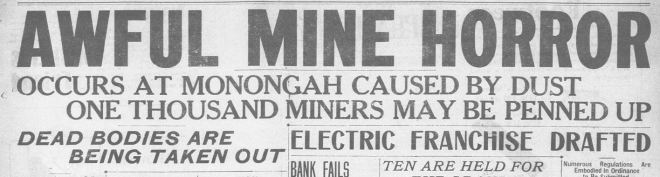
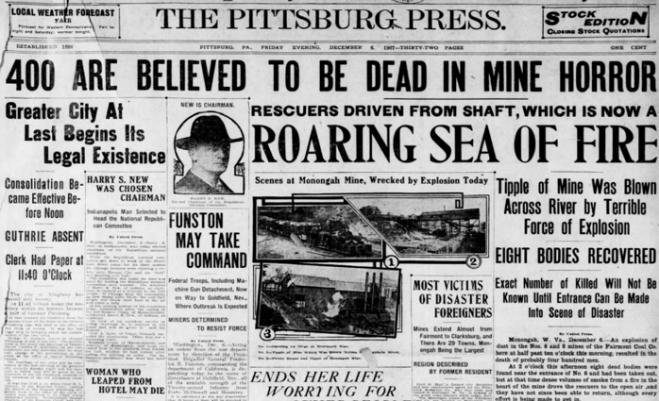
The Pittsburg Press is just one of the many papers that uses the United Press to collect their information. On the evening of Dec. 6, it publishes what will become one of the most notorious headlines associated with the disaster, some of the first photos of Monongah, and several articles detailing events that have taken place through the day.

Almost all of it is wrong.

Monongah-MnDs-HdLn-Ptt-Prs-Dec-6-1907

The Cumberland Evening Times in Maryland also uses the United Press as a primary source and reports that, “The accident happened in Monongahela mines Nos 6 and 8 and was caused by the fan house, which supplied the miners with air, failing to work.” They follow, “The mines were idle yesterday and that is why it is thought that the fans failed to work this morning.” They will also, unfortunately, report that “Over one hundred men are known to have escaped.” (CET 12.6.07 pg. 1)

~6:30 pm

In the Monongah offices:

C.W. Watson and several other company officials hold a meeting to bring the president up to date with events. Watson decides that, “the bodies of the miners, so far as could be reached should be taken out during the night.”  From here, Watson personally supervises all rescue work aided by General Manager Malone. (CDT 12.7.07 pg. 1)

At #8:

Word makes it back to #8 mine that Peter Urban has revealed that another man was still trapped in the mine, not far from where he and his brother were found.

General Manager Frank Haas is personally overseeing the rescue work at #8 but little progress has been made compared to #6. Nonetheless, rescue crews, again led by “Skinny” McGraw, reenter #8 through the toad hole. True to Peter’s word, 20-year-old Francisco Loria is found nearby, but it is too late.

Francisco will be the 5th body to enter the morgue.

At the mines:

By dusk, rescue crews are once again pushed out of the mines by gases but it is confirmed to those on the surface that there is no hope of finding any survivors inside of #6.

“Men and women who had congregated around the mine knelt down in the falling snow and prayed, offering a miner’s benediction.”

me6


Previous Post

Next Post


More on How Death Gloated!

Bibliography

Timeline

Disclaimer and Guide

Introduction

About the Author

Contact Information