“This great transformation was all brought about in less than three hours. This whole settlement is bereaved and weeping. Those who have been more fortunate and are known positively to have lost no loved ones when the explosion let go are downcast and mourn for those who lost relatives and friends.” (AR 12.12.07 pg. 5)
Evening
In Wheeling:
Bishop Donahue sends a message to several New York newspapers in answer to inquiries made from that city as to the extent of the disaster. “I have the honor to be a member of the general relief committee and will take pleasure in receiving any sums, however small, in aid of the fund, and seeing to it that it reached the right hands. There are approximately 400 widows and 1,000 orphans.” (FWV 12.13.07 pg. 1)
The Wheeling relief fund reaches $2,860.00. Contributions to the fund are being made through Bishop Donahue, the Intelligencer, the Board of Trade, House & Herrmann and direct to Mr. Sands. (FWV 12.13.07 pg. 1)
In Fairmont:
Mayor Arnett receives 3 packages of children’s clothing “expressed” from “HUB” in Wheeling. (FWV 12.13.07 pg. 1)
~7:00 pm
Remains of Jess Sever and J.W. Miller are brought to Fairmont on the 7 o’clock car. (FWV 12.13.07 pg. 1)
After Dark
In Clarksburg:
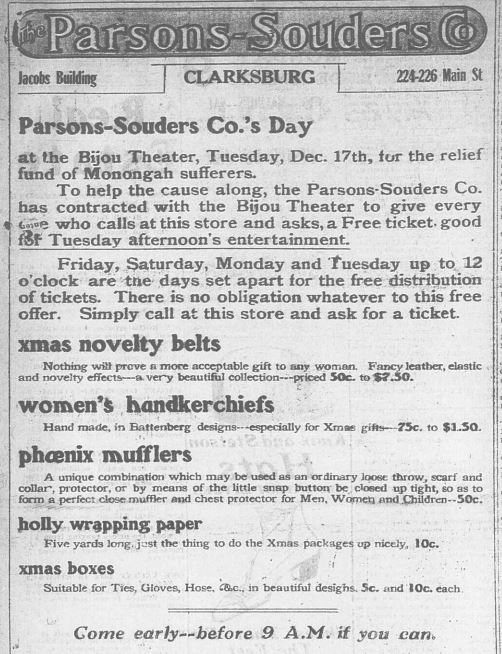
Mr. F. M. Murphy gives the entire receipts of tonight’s performance at the Bijou Theatre to the relief fund. (McAteer)
In Fairmont:
The remains of J.W. Miller are buried at Woodlawn cemetery. The funeral is under the direction of the Improved Order of Red Men. Miller leaves a wife and 2 children. (FWV 12.13.07 pg. 1)
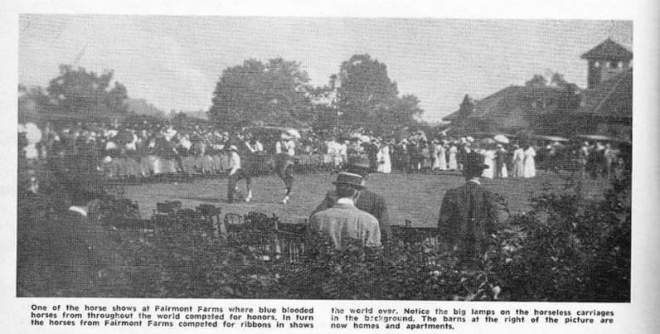
C.W. Watson invites and hosts the visiting mine safety experts to a magnificent dinner at his home, LaGrange. (McAteer)
La Grange on Fairmont Farms
At the mines:
“Vice president Wheelwright and General Manager Lee L. Malone believe that all the bodies not deeply buried in the old workings have been removed.” (BDT 12.13.07 pg. 1)
TEW 12.13.07 pg. 10
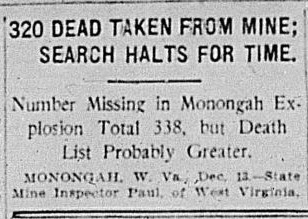
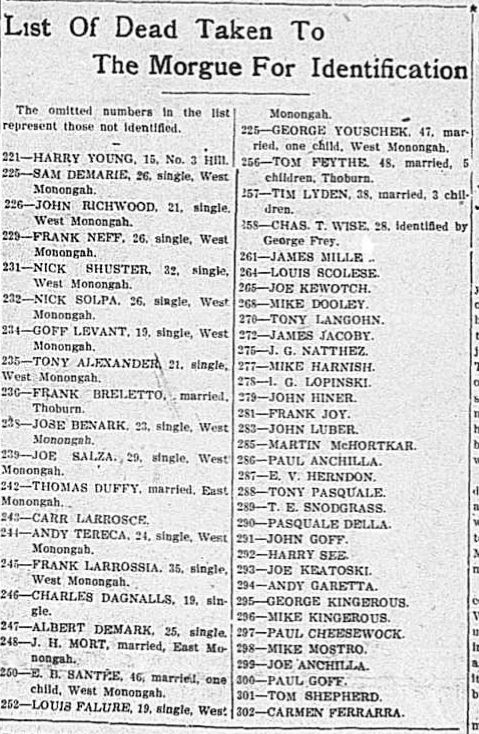
“Explorations stopped in wrecked mines Nos 6 and 8 last night at which time a total of three hundred and twenty bodies had been recovered.” (CDT 12.13.07 pg. 1)
“The search…for victims…was suspended early tonight, partly because fire had broken out again in Mine 8 and partly because practically every section of the two mines has been explored and it was not believed that further search along the same lines would result in the finding of more bodies.” (NYTb 12.13.07 pg. 5)
“Three hundred and twenty bodies have been removed. Of these 71 were Americans, 11 Negroes, 146 Italians, 54 Slovaks, 31 Poles, 5 Greeks and 2 Hungarians.” (NYTb 12.13.07 pg. 5)
“A force of ninety men will begin in the morning to clean up the mine and remove the heavy falls that were not disturbed by the rescuing parties and it is understood that some additional bodies will be found.” (BDT 12.13.07 pg. 1)
“The fire which started this evening is not considered serious. No trouble in controlling it is anticipated.” (BDT 12.13.07 pg. 1)
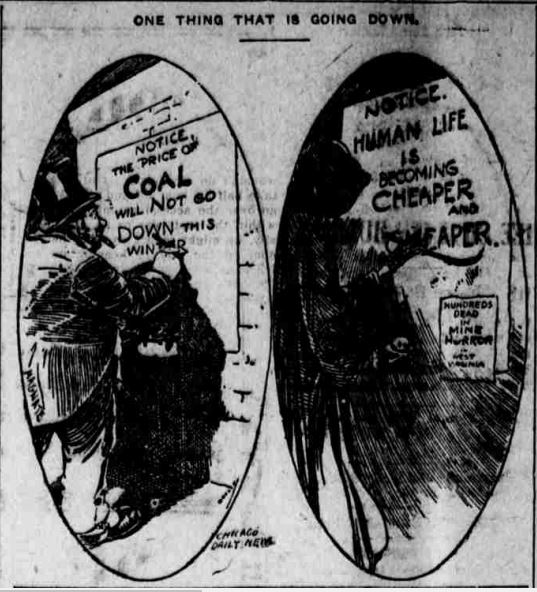
“The disaster at Monongah seems too terrible to contemplate, too pathetic for feeble words to describe. The imagination wanders in vain through the realms of philosophy and religion for a reason for such events.” (FWV 12.12.07 pg 2)
~6:00 pm
C.W. Watson gives a statement that: “After a careful census of the community we can say positively that the death list does not exceed 338. A total of 320 bodies have been recovered. All working places in Nos 6 & 8 have been explored. Some additional bodies may be found under wreckage or falls. Of the accounted for list of 338 a few may be found safe. A large force of men are now looking for bodies under falls.” (FWV 12.13.07 pg. 1)
Newspapers
Fairmont West Virginian:
“Although it will be a week tomorrow since the Monongah mine disaster, the story is still holding front page position on many of the leading daily papers both outside and inside of the state. Conditions in that regard will hardly change until the search for bodies is given up and the findings in the coroner’s jury are reported.” (FWV 12.12.06 pg. )
“The total relief receipts so far reported amount to $34,651.15 which seems to some to be a large amount but when it is considered there are 300 widows and 1,000 orphan children to divide this amount with it brings the amount per capita down to $26.65 which is a small sum to go through winter on to say nothing of their welfare for future years. (FWV 12.12.07 pg. 1)
“To name each person from here who has been to Monongah since Friday noon would be to almost mention by name the total population of Hoult and the vicinity.” (FWV 12.12.07 pg. 2)
“At first, people seemed dazed by the news and nobody took in its full import seemingly and are just now beginning to realize the awfulness of the terrible tragedy that has happened at our very doors.” (FWV 12.12.07 pg. 2)
“We notice a refrain constantly repeated in all the Fairmont papers that ‘nobody’s to blame’ least of all the Fairmont Coal Company…Why the necessity for all this? The echo of the explosion had scarcely wore out with which brush and pot of whitewash and had begun to administer a snowwhite coat to everybody connected with the Fairmont Coal Company.” (FWV 12.12.07 pg. 2)
“For instance, it was said that nobody around here believes that the coal company is in any way to blame, that the company’s employees all felt that there was no dissatisfaction, etc. Now on the contrary the writer has heard the company bitterly arraigned and condemned since the explosion, often by miners. I have talked with scores of people all of whom declare that the fans were not run at Monongah on Thursday, that as the day was an ‘off-day’ the fans were stopped two nights and a day to save expense and started again a few hours before the explosion. I don’t know that it’s true but it is one of the most persistent rumors or report circulated about the explosion and is believed by practically everybody and I have seen no attempt to dispute it. It is easily proved or disproved.” (FWV 12.12.07 pg. 2)
“No one knows better than the writer the unreliability of rumors. There has been a very persistent rumor that No 8 is on fire and although denied time and again, keeps bobbing up, even persons who have been working with rescue parties helping circulate it.” (FWV 12.12.07 pg. 2)
“But laying all that aside why pass judgement at all until the truth is ascertained if possible…But while that does not mean to condemn it does not mean to do any white washing. The writer believes somebody is to blame, but why not assume a calm and judicial attitude until the truth is known?…We should not condemn the company or anyone else without satisfactory proof. Neither are we called upon by common sense to throw over them a saintly mantle of innocence. Wait for the truth. ‘Suspend judgement’.” (FWV 12.12.07 pg. 2)
Dr. Henry Mace Payne of school of mining engineering is interviewed by the Fairmont West Virginian and asked if “West Virginia mining laws are adequate for the protection of the men in the mines.” (FWV 12.12.07 pg. )
“No laws, no matter how perfect, can absolutely protect the miner under all circumstances from the dangers incident to his calling. Nor can any set of rules and regulations for the conduct of mine laborers be enforced with such stringency as to prevent ignorant or reckless disregard of wise and necessary precautions.” (FWV 12.12.07 pg. )
“There are, however, some points at which our laws are probably at fault.” He points out the “…striking illustration of the unwisdom of allowing two or more mines to be connected as were Nos 6 and 8.” (FWV 12.12.07 pg. )
“Undoubtedly, too there should be some legislative requirement looking toward the prevention of any possibility of dust explosions.” (FWV 12.12.07 pg. )
“Our laws are defective in reference to the limitations which they place on the use of explosives in the mines. There are other points, perhaps, at which the laws are weak; but after all is said and done, the ignorance and recklessness of the one careless miner always to be found in any considerable number of them is the most serious menace to his own life and that of his fellows.” (FWV 12.12.07 pg. )
“You may show a group of miners just how a fulminate cartridge explodes and the danger of crimping the cartridge with their teeth. Then you may give them all copper crimpers which do the work better. Some of the men will use the crimpers all right, but you may be just as sure that as soon as your back is turned some of the boys will be crimping cartridges with their teeth in the old way.” (FWV 12.12.07 pg. )
Not long after Dr. Payne’s talk with the newspaper man, the doctor was suddenly summoned to Fairmont by one of the high officials of the Fairmont Coal Company. (FWV 12.12.07 pg. )
Clarksburg Daily Telegram:
“The Rev. L.W. Sifferd, pastor of Park Avenue Lutheran church, requests the Telegram to announce that the members of that church will be given the opportunity to contribute to the relief fund for the Monongah mine sufferers at Sunday morning’s service, and it is expected the congregation will make a very neat contribution. They all appreciate the seriousness of the situation at Monongah and the urgent necessity of helping the suffering.” (CDT 12.12.07 pg. 4)
“Substantial donations are being received daily at the Telegram office for the relief fund…and the Telegram is glad to note that such is the case—that the people of Clarksburg are always ready and willing to lend assistance to their brothers and sisters in the time of deep distress and misfortune.” (CDT 12.12.07 pg. 4)
“Entertainments, socials and other events have been planned by some of the churches and other societies and the Telegram, desiring to lend further aid to the most worthy cause, will gladly print, free of all charges, admission tickets for these affairs.” (CDT 12.12.07 pg. 4)
“If charity should begin at home, surely now is the time for Clarksburgers to extend to the suffering at their very doors.” (CDT 12.12.07 pg. 4)
The Advocate in West Virginia:
“Senator T.C. Gartlan, of Parkersburg, has called a meeting of the mining investigating committee appointed by Pres. McDermott of the senate and Speaker Scaman of the House of Delegates at the last session of the legislature, to meet at Clarksburg Dec 17th for the purpose of making an investigation into the Monongah disaster in which the lives of 400 men were sacrificed last Friday.” (TA 12.12.07 pg. 1)
“Owing to the destitute circumstances in which many of the bereaved families at Monongah are placed offers of air are pouring in from all over the country.” (TA 12.12.07 pg. 1)
The Advocate is one of the few papers to do the following:
First, the correspondent for The Advocate waits several days before reporting on very personal and dramatic events like the births of a few children, specifically the 5th child of John Harriman (also reported as Herman, Hearman, Hearmans, Hearmons, and on Sunday they were catastrophically confused with the Hinermans).
But The Advocate waits to publish Caroline’s story, and will get it the most accurate of all reports:
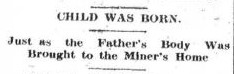
“A fifth child was born to Mrs. John Hearmans, at Monongah, just as the corpse of her husband was brought from the morgue and laid in the front parlor of the miner’s cottage for the view of the four orphaned children and other relatives.
“Mrs. Hearmans’ condition is very serious. She is aware of the fact that there has been an explosion, realizes that the entombed miners are dead beyond her adventure, and knows that the little son whose coming has been looked forward to for months is born into the world of an orphan.” (TA 12.12.07 pg. 1)
On Sunday, many papers scrambled to report the dramatic tale of both Mrs. Harriman and Mrs. Hinerman and as a result of their exhaustion combined with being utterly overwhelmed by the events around them, the stories get confused and, unfortunately, Caroline Harriman and her new child, James, repeatedly get reported as deceased across the country for the next several weeks when they did, in fact, survive. As far as is known, Mrs. Lawrence Hinerman and her child did not survive.
Another thing that is particular to The Advocate is their regular attempts at informing the public about the black miners who were killed at the Monongah mines. They more than any other paper outside of the local area, strive to make the black miners known.
“The loss of life is unknown, but it is estimated at between 400 and 500, twelve of whom were colored so far as known.” (TA 12.12.07 pg. 3)
“The colored men entombed in the mines are Richard Farmer, K.D. Kyalls [K.D. Ryles], John Adkins, Hall Perkins and others whose names are not known by your correspondent.” (TA 12.12.07 pg. 3)
The Labor Argus in West Virginia:
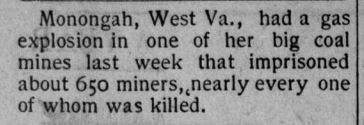
“It is believed that over five hundred perished, but the exact number may never be known, as many of the men employed ‘back hands’ of whom the company had no record. The latest reports given out by the company place the death list at about 260, but it is claimed by others that double that figure will be nearer the number.” (TLA 12.12.07 pg. 1)
Arizona Republican:
C.L. Michael, formerly of Fairmont, WV, now resident of Phoenix received copy of Morgantown Chronicle containing account of disaster. (AR 12.12.07 pg. 5)
“The paper states that the shock of the explosion was felt in Morgantown, which is nearly 30 miles away from the mines, Fairmont being about 5 miles away.” (AR 12.12.08 pg. 5)
“In this instance the news from the local papers indicates that the dispatches have but weakly painted the real effect of the trouble, though there is little to add except the story of horror, for the facts as to the death list etc. have been very accurate.” (AR 12.12.08 pg. 5)
“Mr. Michael says he was acquainted with a few men who had employment at the mine as engineer or some similar capacity but he has not heard whether they escaped or not.” (AR 12.12.08 pg. 5)
“The paper relates that thousands of people gathered at the mines and remained, only being succeeded by other thousands who came to relieve them.” (AR 12.12.08 pg. 5)
“Some were drawn by curiosity but by far the most of them were interested in learning the fate of some relative or friend.”
“All the friends of 500 entombed men would make a good big army.” (AR 12.12.08 pg. 5)
“Frantic women and children have collected in crowds about the mines. Some of them are able to control their emotions and stand about sad-eyed but stolidly waiting and prepared to hear the worst. It is not so with a great majority of them however, and many of the women, principally foreigners, are hysterical. They run about screaming and wailing at the top of their voices, tearing their hair and shouting out the names of their dead ones who they believe are lost.” (AR 12.12.08 pg. 5)
“Everything possible is being done to allay the fears of the women and children and keep them composed, but it is a difficult problem, and one that is meeting with but little success.” (AR 12.12.08 pg. 5)
“Wild eyed women and children go about in the crowds from man to man, peering anxiously into the smutted and coal dusted features of each of the men, looking for a husband a son or a father. The saddest and most heartrending scenes are being witnessed.” (AR 12.12.08 pg. 5)
Evening Star in D.C.:
“The opening of the coroner’s inquest has been set for next Monday.” (ES 12.12.07 pg. 2)
“Governor Dawson announced today that he will personally attend the inquiry for the purpose of instituting a rigid investigation with a view to ending West Virginia mine disasters.” (ES 12.12.07 pg. 2)
The Washington Times:
“It is said by the officers of the company that there are bodies in the mine that will never be recovered. They are lying under a fall of slate, and it may be months before this section of the mine is opened.” (WT 12.12.07 pg. 3)
“It is hoped, however, to have most of the bodies recovered before Saturday night.” (WT 12.12.07 pg. 3)
“Governor Dawson will come to Fairmont to hear the testimony at the coroner’s inquest which will probably begin next week.” (WT 12.12.07 pg. 3)
The Brandon News in Mississipi:
The Marion Daily Mirror in Ohio:
The Daily Press in Virginia:
“…and there was no question that the destitution among them would be very great.” (DP 12.12. 07 pg. 1)
Cumberland Evening Times:
“Mayor Moore, of Monongah, wires the editor of the Times that the need of the community is very great, and that the sufferings of the bereaved women and children will be intense unless assistance comes promptly and generously. Let all who have an abundance of those world’s goods give freely and promptly.” (CET 12.12.07 pg. 4)
“Not less than 400 are dead and the number may run to 700, as officials have been keeping down the number as much as possible.” (FWDN 12.6.07 pg. 1)
~3:00 pm
“At 3 o’clock this afternoon it is known that the mine disaster is the worst in the history of the country.” (FWDN 12.6.07 pg. 1)
In Parkersburg:
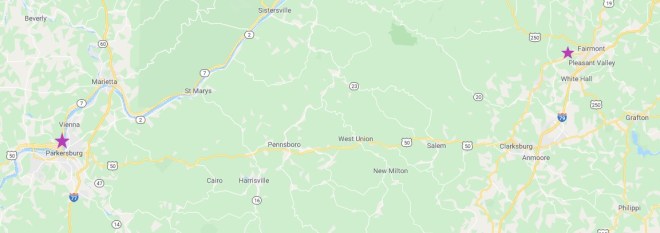
“Mr. Watson was in Parkersburg at the time of the accident and went at once to the scene.” (TBS 12.7.07 pg. 2)
In Baltimore:
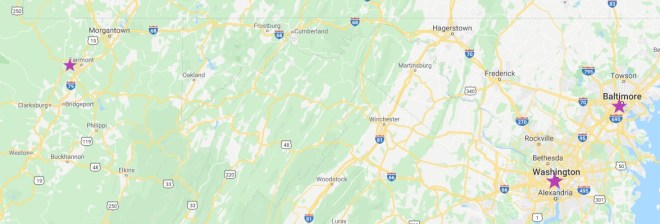
“Mr. Wheelwright left here at 3 pm over the Baltimore and Ohio for the mines. He was accompanied by Mr. J.R. Buckingham, his secretary, and some of the others of the company’s officers.” (TBS 12.7.07 pg. 2)
“Mr. Clarence W. Watson is the president and Mr. Jere H. Wheelwright the vice-president, both of whom spend most of their time here in directing the executive affairs of the corporation. Mr. Watson has a home at Fairmont, where he spends the summer. On this estate, which is just on the outskirts of that city, he has recently built a magnificent stable for his famous show horses and also a half-mile track for their exercise.” (TBS 12.7.07 pg. 2)
In Monongah:
It is “Press Time” and some of the reporters are in line to use the telegraph or telephone in the company store post office or the company office just across the river from #6 to submit their reports in time for the evening papers. A majority have had to go into Fairmont to find more communication resources. (News)
Outside #6:
Carl Tarleton arrives from the mines just down the tracks in Enterprise to help with the recovery. He works personally with David Victor on restoring proper ventilation to the mines, despite only having one working fan. By this point they have only achieved breathable air in most of the main shaft of #6, but they are almost to the area where the two mines are conjoined. David Victor decides to go ahead and make an attempt at a fire examination of #6. (Inquiry)
~3:30 pm
The two staff writers for The Clarksburg Daily Telegram make “fast time” despite taking the back roads to Monongah. “…they arrived some time before the first train and about two hours before the first trolley car arrived from Clarksburg, beating other newspaper representatives.” (CDT 12.8.07 pg. 1)
Outside #6:
The second round of rescue crews is starting to be organized just as several experienced miners arrive from the Montana mines just outside of Fairmont. As these men already work together as a congruent team underground, they are formed into a rescue crew all their own. (FWV 12.7.07 pg. 1 – noon)
Outside #8:
Someone standing near a toad hole, possibly a company watchman, happens to hear a sound like moaning coming from the ground. He calls out to nearby work crews for help. Several run off to a nearby supply house to collect materials.
~3:33-3:35 pm
Outside #8:
The rescuers have returned quickly from the supply house with armloads of rope and begin tying critical hitch and harness knots in one end to safely support the men who will be lowered down through the toad hole.
~ 3:40 – 3:45 pm
Inside #8:
The first rescuer, a long slender rail worker in the mines named Charlie “Skinny” McGraw, has been lowered over 100 feet before getting to the floor of the mine. He unties himself from the lowering lines so they can be raised back to the surface for the next man to follow down and help.
He follows the moans through the dark and soon finds the Urban brothers. Stan is lying face down in a puddle of water and Peter is sitting atop Stan’s back sobbing uncontrollably, simply staring ahead into the dark space with wide glassy eyes.
~3:45 – 3:50 pm
Inside #8:
The second rescuer, Tom Weeks, has been lowered into the room with McGraw and the Urbans. As they come upon Peter and Stan, Peter begins to shout at them and protect his nonresponsive brother. The Urbans are from Poland (their original last name is Rosebeiq) and, unfortunately, Stan knew more American English than Peter and neither of the two rescuers speak or understand Polish. (News, Ancestry, Inquiry, McAteer)
Absolutely crazed by the trauma, fear, and utter darkness he has endured for the past 5-6 hours, Peter begins to aggressively fight with McGraw and Weeks to keep them away from his brother. He shouts at them but they do not understand him and again try to grab Peter and force him away from his brother. A full-on struggle ensues.
~3:50-3:55 pm
Inside #8:
Weeks and McGraw have managed to wrangle Peter into submission. They tie him into the rope hitch and give a signal to the men on the surface to start pulling. The workers on the surface grapple with the line as Peter continues reaching and screaming for his brother on his way back up the 100’ ascent to the surface
As Tom Weeks keeps an eye on Peter from below, Charlie McGraw rushes back to check on Stan’s condition. Despite the severe head injury and 5 hours face down in a puddle, Stan is still breathing but barely hanging on to life.
~3:55 – 4:00 pm
Outside #8:
Several people grab a hold of Peter as he nears the surface and assist in pulling him out. They get him safely out of the hole, pull him away to solid ground and untie his rope when, again, Peter begins to fight off the rescuers around him. The rope is dropped back into the toad hole again as Peter continues to struggle against those trying to help him.
Inside #8:
McGraw and Weeks have moved Stan out of the puddle and closer to the toad hole. They begin to tie him into the rope harness, just as they did with Peter. Stan is still breathing but unconscious.
~4:00 – 4:10 pm
Inside #6:
“For fully two hours nothing but wreckage, such as blocks of coal mine timbers and machinery rewarded the search, but at 4 o’clock in mine No. 6, twenty bodies were found in a heap a short distance from the opening. These were not brought out at the time as the purpose of the searches was to find if any survived the awful disaster and to bring them out first.” (CDT 12.7.07 pg. 1)
“Men who entered the mine say there are twenty dead men sitting on one bench, where they were awaiting their turns to take cars.” (TS 12.7.07 pg. 1)
Outside #8:
Peter Urban manages to break free from the rescuers. He tears through the crowd of onlookers, screaming and crying, sprints down the bank towards the river but crashes full-force into a fence. Rescuers follow and though Peter gives them quite the chase he begins to put up another brief fight as they catch up with him. Peter is simply too exhausted by this point and they manage to subdue him again with little issue.
Inside #8:
At some point during the ascent back to the surface, Stan Urban dies.
~4:10 – 4:15 pm
Outside #8:
Dr. F.W. Hill quickly looks over Peter Urban for any sign of significant injury or need for hospitalization. Though Peter is so distressed and upset that he can not even give the doctor his own name, Dr. Hill finds no reason to hospitalize him and sends Peter home to his family to rest.
At the toad hole, Stan is pulled out and taken to the side. Though he shows no signs of life, the warmth coming off his body gives them hope. Resuscitation is attempted but soon it is accepted that they are too late.
Stanislaus Urban is put onto a horse drawn cart, sent across the river to the morgue.
~4:30 pm
Word has already begun to spread through town and reaches #6 that at least one man has been found alive and rescued from #8.
Peter Urban
Outside #6:
Crowds swarm in the direction of #8. For some, especially many newspaper reporters who have arrived from out of town, this is the first notice they get that the #8 mine they have just submitted reports on isn’t actually #8 mine at all. Dozens of reporters who have been on or around the Iron Bridge all day have already gone to print and have mistakingly identifyied either #1 or #2 mine, which are across the river from #6, as being mine #8 simply because they can see smoke coming out of this mine from their vantage point.
Outside #8:
Despite the lack of ventilation and being driven out hours earlier by toxic gases, the discovery of Peter Urban alive and relatively well encourages another round of rescue crews to prepare to attempt another tour into #8. John C Thompson is in charge of one of those crews. (News, Inquiry)
Inside #6
By late afternoon, part of the broken trip that clogged the heading of mine #6 was removed and the entrance to the mine proper was clear enough to allow for the removal of bodies. “It was the blockade of broken cars that made it so difficult to get the work started.” (FWV 12.7.07 – pg. 1 – noon)
“The entry of No 6 mine, 300 feet from the mountain is piled high with wreckage of two strings of cars and two electric motors. Some of the rescuers have climbed over this and found dead bodies beyond, but have made no attempt to remove these to the surface, partly because it would be almost impossible to carry the bodies over the debris, but more particularly because they do not want to lose any time in reaching other sections of the mine where it is possible men still living may be imprisoned.” (ES 12.7.07 pg. 2)
~5:00 pm
At the mines:
By now, it has become very clear to the physicians and nurses who rushed to the scene that their services will not be needed. Some stay for the night to care for the rescue workers who are injured or overcome by the gases. Many leave on the 5 o’clock trolley car as a 3rd round of rescue crews gets organized.
~6:00 pm
In Monongah:
By this time, only Stan Urban has been recovered from the inside of #8 mine and arrangements are being made to begin bringing bodies out of #6.
Dr. Hill calls on Peter Urban at his house just to check on his condition. Peter can finally tell the doctor his name and now that Peter is around those who can understand him, he tells them that not far from where he and Stan were found, another man was also trapped but still alive.
A special train arrives on the main B&O line from Parkersburg and pulls into the center of Monongah carrying C.W. Watson, president of Consolidated Coal Company and its subsidiary Fairmont Coal Company, along with his private secretary.
In Fairmont and other cities around the country:
Newspapers are already publishing reports in their evening editions which have been circulating for about an hour now. Local papers from Monongah’s neighboring cities will put out several special extra additions over the next few days in an attempt to keep the local populace as updated as possible.
The Fairmont West Virginian publishes these headlines along with an article written by reporter L.M. Davis who was on the very first trolley to Monongah and got the opportunity to watch the action go down all day long and speak directly to some rescue workers like Fred Shaver.
They also publish a list of those “known” to be dead or injured based solely on what little information they have received from rescuers like Fred Shaver and officials who are simply too busy at the time to give in depth, detailed statements.
In the next city south of Monongah, the Clarksburg Daily Telegram publishes slightly different information.
Unlike the Fairmont West Virginian, The Clarksburg Daily Telegram is not yet publishing personal reports from those directly on the scene, though they do include a small announcement that they have reporters on the scene and will put out a special evening edition with those updates. Rather, for this first printing they rely on an article created by the Associated Press after a candid conversation with an official from either the Consolidated Coal Company or Fairmont Coal Company, or possibly a combination of both.
At this point in U.S. history, the Associated Press has a practical monopoly over the spread of news across the country and a majority of U.S. papers rely almost entirely on the Associated Press for national news at this time. To battle what many saw as a corrupt control of information, The United Press formed earlier in the year to challenge that hold. Over the next month they will both make drastic, lingering mistakes in the mad dash to be the first to publish the latest information to the country.
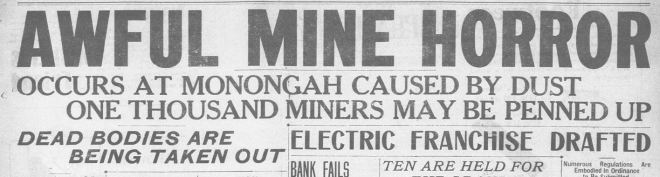
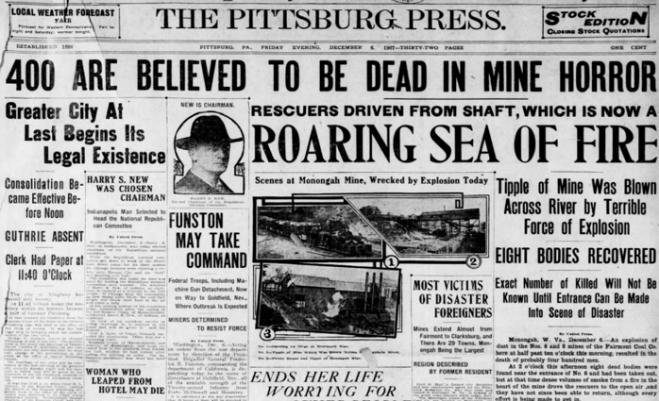
The Pittsburg Press is just one of the many papers that uses the United Press to collect their information. On the evening of Dec. 6, it publishes what will become one of the most notorious headlines associated with the disaster, some of the first photos of Monongah, and several articles detailing events that have taken place through the day.
Almost all of it is wrong.
The Cumberland Evening Times in Maryland also uses the United Press as a primary source and reports that, “The accident happened in Monongahela mines Nos 6 and 8 and was caused by the fan house, which supplied the miners with air, failing to work.” They follow, “The mines were idle yesterday and that is why it is thought that the fans failed to work this morning.” They will also, unfortunately, report that “Over one hundred men are known to have escaped.” (CET 12.6.07 pg. 1)
~6:30 pm
In the Monongah offices:
C.W. Watson and several other company officials hold a meeting to bring the president up to date with events. Watson decides that, “the bodies of the miners, so far as could be reached should be taken out during the night.” From here, Watson personally supervises all rescue work aided by General Manager Malone. (CDT 12.7.07 pg. 1)
At #8:
Word makes it back to #8 mine that Peter Urban has revealed that another man was still trapped in the mine, not far from where he and his brother were found.
General Manager Frank Haas is personally overseeing the rescue work at #8 but little progress has been made compared to #6. Nonetheless, rescue crews, again led by “Skinny” McGraw, reenter #8 through the toad hole. True to Peter’s word, 20-year-old Francisco Loria is found nearby, but it is too late.
Francisco will be the 5th body to enter the morgue.
At the mines:
By dusk, rescue crews are once again pushed out of the mines by gases but it is confirmed to those on the surface that there is no hope of finding any survivors inside of #6.
“Men and women who had congregated around the mine knelt down in the falling snow and prayed, offering a miner’s benediction.”



















 The Monongah Disaster