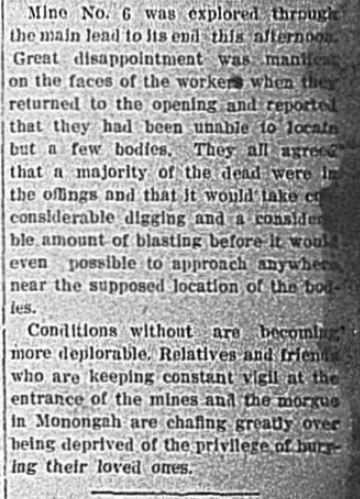
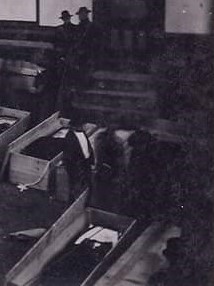
“The moment it is announced in town that bodies have been brought from the mines there is a renewed stir of expectancy and anxiety until the bodies have been viewed in the bank building. Relatives and friends press forward to get the first glimpse of the features of the dead, eye them closely and turn away in deeper sadness and depression, if they recognize them not. Recognition is followed by outburst of grief and distraction, which with some impends upon the very brink of insanity.” (CDT 12.10.07 pg. 1)
~12:00 pm
At the mines:
“At noon today the bodies of 146 of the men…had been taken out and it was said at that time that by the night a majority of those not buried under the debris would be removed.” (TMDM 12.10.07 pg. 1)
Snow and sleet fall all day long and “…miserable conditions prevail throughout this section.” (CDT 12.10.07 pg. 1)
“Rescuing parties are able today to reach all parts of the mine.” (TMDM 12.10.07 pg. 1)
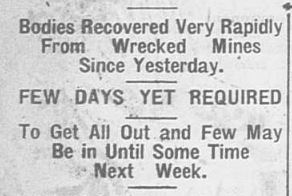
“The work of rescue is being pushed along rapidly and by night it is expected most of the bodies will have been taken out.” (CDT 12.10.07 pg. 1)
“At noon today the company announced that at least three or four more days would be required to get all the bodies out, unless the work of recovery becomes still more rapid. There is every reason to believe that the bodies will be taken out even faster as all the brattices have now been installed and the air currents amply furnish opportunity to get into all the side headings and rooms.” (CDT 12.10.07 pg. 1)
“The wide scope of territory to be searched, however, will prolong the search even beyond the next three or four days and the same may even extend into next week for scattering bodies.” (CDT 12.10.07 pg. 1)
Floyd Parsons leaves Grafton to return to Monongah “where he will continue his investigation until tonight, and he will then go to Pittsburg.” (FWV 12.10.07 pg. 2)
During the Afternoon
At the mines:
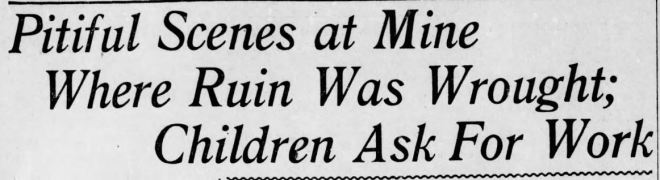
“…rescuers…in a sorry plight this afternoon. In a driving rain, which is more unpleasant and discouraging even than last night, the workers are, nevertheless, able to do more than yesterday as the smoldering fires have practically been put out…” (PP 12.10.07 pg. 1)
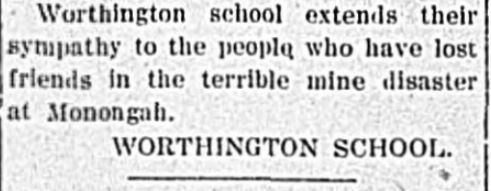
“One young woman on Tuesday viewed the charred remains of the man she was to marry that day as they were brought from the fatal hill.” (FWV 12.12.07 pg. )
In Monongah:
The Union Relief Association completes its own survey of the community.
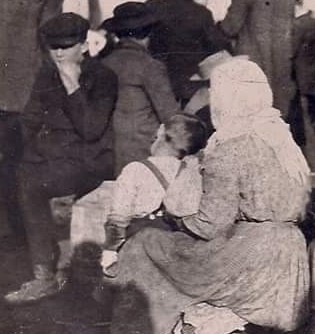
“A canvas by women workers of Fairmont, completed today, develops the fact that practically 100 women who were made widows…are soon to be mothers. As a consequence of the fearful strain of the past few days, at least 20 of these women are seriously ill. 10 of the babies are said to have died unborn and into 30 or 40 of the little cottages physicians have been called within the last 24 hours. Four of the afflicted widows are at the point of death today…48 of the men killed were widowers with small children. There are 19 brides of 3 months. This feature of the disaster appealed to the women of Fairmont, who organized yesterday for relief. They called it the ‘Mother’s Work’ and enlisted the sympathies of woman friends and relatives in Fairmont and nearby towns. Some of the prominent women, known throughout this section of the state, volunteered to assist financially at least, personally if possible.” (RP 12.10.07 pg. 1)
“A count by the women has said to have developed nearly 900 fatherless children.” (RP 12.10.07 pg. 1)
Out of 30 houses on Camden Ave., 27 didn’t have a man left in them.
“Deeper and more hopeless depression now seems to have seized the town of Monongah.” (TMDM 12.10.07 pg. 1)
The Monongah Verdi Brass Band suffers greatest loss from the disaster. “This was a very proficient musical organization of the mining town and had gained a reputation for the discoursing of high-grade music.” (FWV 12.10.07 pg. 6)
Professor Verdi disbands the group and will be returning to Italy. (McAteer)
“Undertaker R.C. Jones came down from Monongah today to attend to business matters. Mr Jones stated that he had found it necessary to send for three extra men to aid in the embalming the bodies from the Monongah mine. Two men are expected from Wheeling and one from Parkersburg.” (FWV 12.10.07 pg. 5)
“Many bodies are being buried direct from the mine entrance, while others were buried yesterday either from the residences or from Catholic churches.” (TMDM 12.10.07 pg. 1)
~3:30 pm
“Up to press time there were no official statements given out. The search work is being done with all possible dispatch. There is no one in destitution. All are being cared for and the relief organizations are doing effective work.” (FWV 12.10.09 pg. 1)
“Special guards are still on duty, while physicians under the direction of the Marion County Guards are looking after the injured.” (WT 12.10.07 pg. 11)
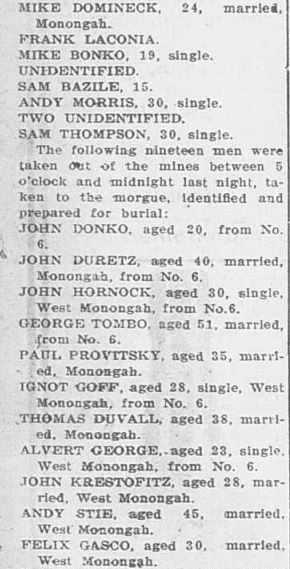
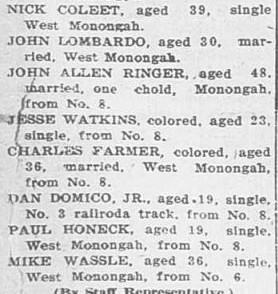
“There is not much change in the situation at Monongah today except that the mines are yielding up more of their dead. Of the 114 bodies that had been found up to 3:30 today, 13 bodies were unidentified, having nothing on them to indicate who they were.” (FWV 12.10.07 pg. 1)
“The work of relief is becoming better systemized and is performed with much more ease on account of the crowds of curious having departed.” (WT 12.10.07 pg. 11)
~6:00 pm
Newspapers
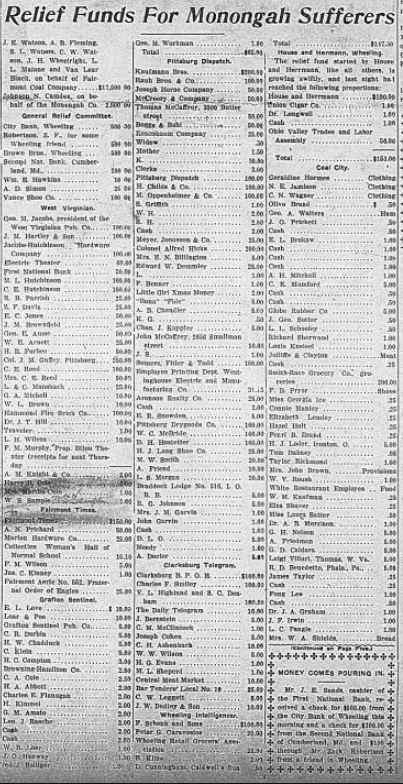
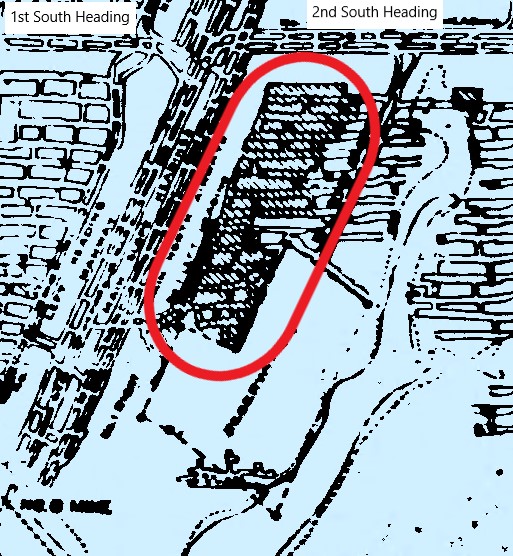
The Fairmont West Virginian publishes a list those who have already contributed to the various relief funds and a rather unclear picture of #8 on the first page: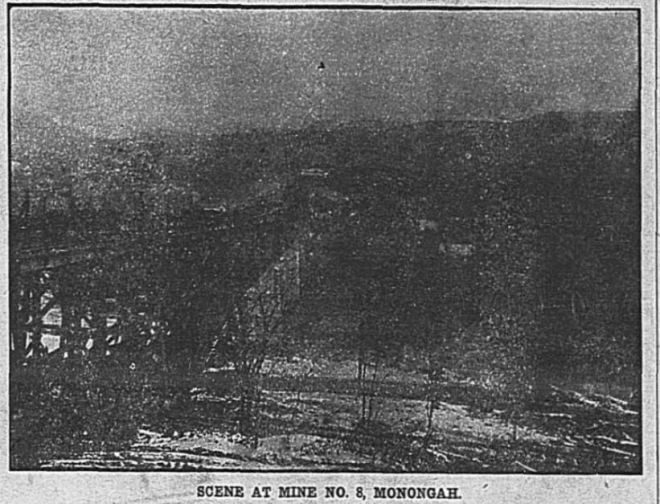
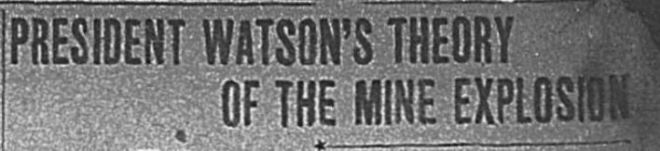
Floyd Parsons publishes his theories in FWV and Grafton papers. (FWV 12.10.07 pg. 2)
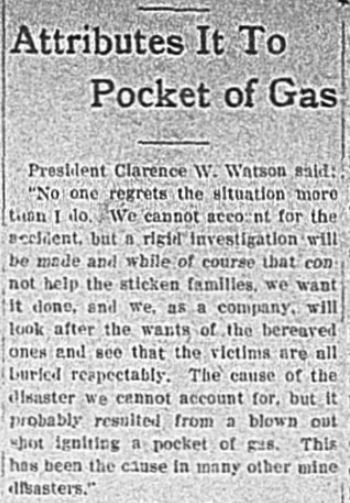
C.W. Watson’s theory is also published. It is apparent he wrote it over the course of a few days and that Watson is utterly exhausted and overwhelmed. (FWV 12.10.07 pg. 7)

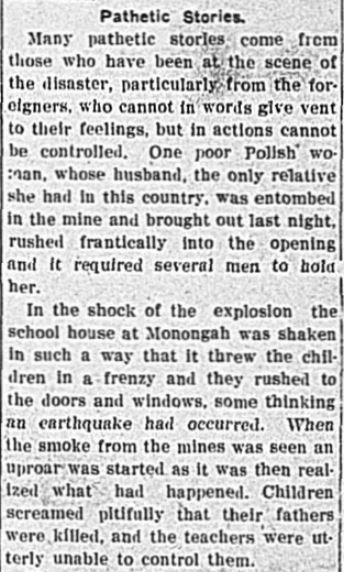
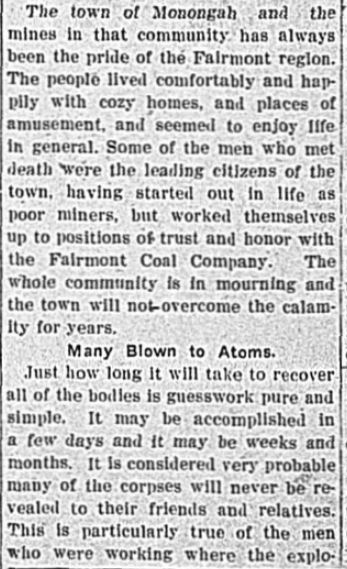
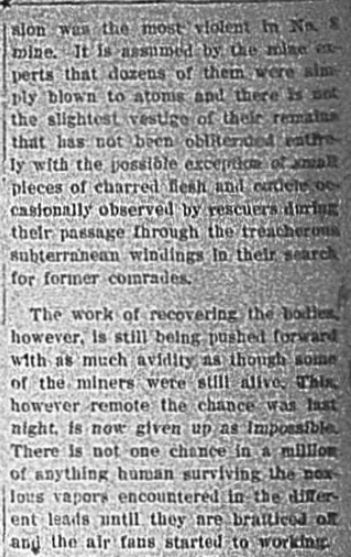
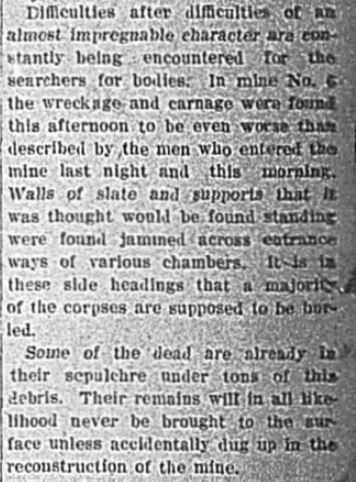
Clarksburg Daily Telegram:


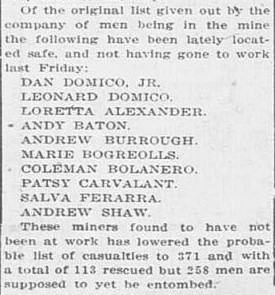
“Among the bad effects of the terrible mine disaster is the continuance of premature births. It is estimated that there has been more than forty of these since last Friday morning, when the explosion occurred. In some instances, the mothers have died.” (CDT 12.10.07 pg. 7)
Waterbury Evening Democrat:
“Chief State Mine Inspector J. W. Paul is quoted as saying he believes the explosion was started by an electric spark from runaway cars in the main entry. A string of these cars was piled up in the entry at the bottom of a slope.” (WED 12.10.07 pg. 1)
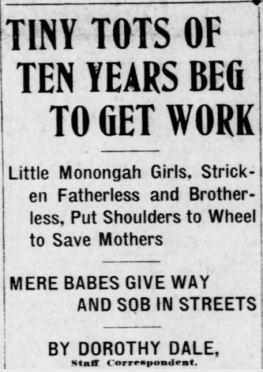
The Pittsburg Press:
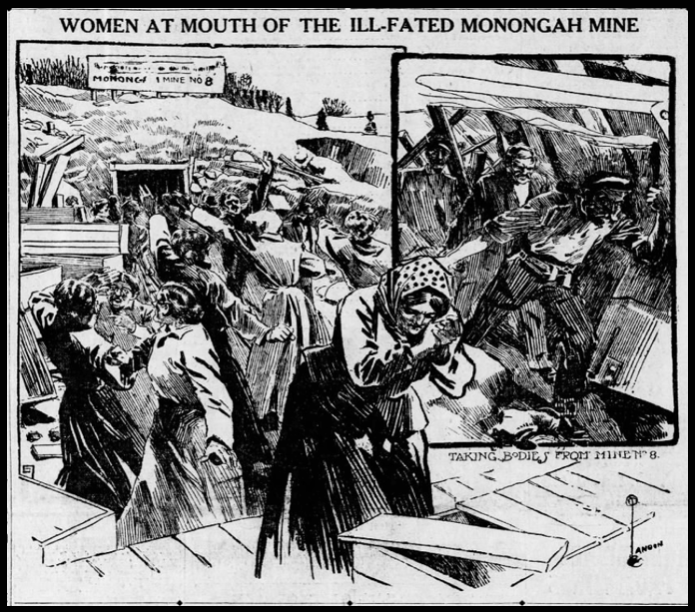
The D.C. Evening Star:

“Many of the rescuers have been stricken with illness and it was found necessary to bring a number of recruits here from the George Creek district.” (ES 12.10.07 pg. 1)

“…considerable suffering is likely to occur during the winter months and for such a contingency assistance should be available. Mayor W.H. Moore of Monongah has telegraphed to the headquarters of the organization here that contributions would be gratefully received.” (ES 12.10.07 pg. 1)
The Evening Journal in Deleware:
“During the great anthracite coal strike of 1903, George Baer, president of the Reading Railroad Company, said there were no particular dangers attached to the mining of coal. As a matter of course he gave out this piece of information to offset the claim of the miners, and when he uttered the words he either falsified or exhibited his ignorance. The terrible calamity at Monongah, West Virginia, is the answer to his statement. How long will God’s children permit such men as George Baer to fool them is the question I would like someone to answer. Sincerely yours, William John Hogan. Wilmington, December 8” (EJ 12.10.07 pg. 4)
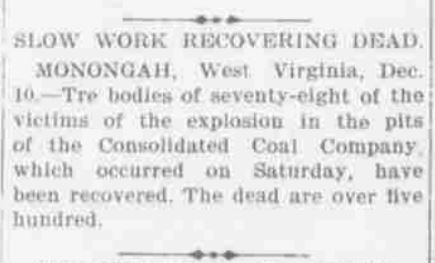
The Hawaiian Star, page 3:
Lake County Times in Indiana prints:
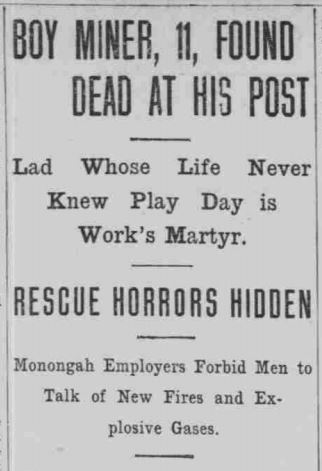
“The coal company officials have adopted a scheme of news suppression. The men in the rescue shifts were given explicit orders not to talk to any outsiders, and the policemen around the temporary morgue were told to allow no newspaper men to enter. The explosion, therefore, takes on a propriety air—it belongs exclusively to the Fairmont Coal Company.” (LCT 12.10.07 pg. 8)
“There is no doubt that there is a serious fire in No. 8 and that the work of rescue in that mine has been hampered. The smoke of it was visible over the mouth of the shaft on Sunday and all miners were ordered out.” (LCT 12.10.07 pg. 8)
“The people were driven away from the mouth of the mines by the authorities because they feared another explosion. The miners themselves confessed that the smoke inside the shaft was practically unbearable.” (LCT 12.10.07 pg. 8)
“’I don’t know why they should deny it,’ said one of the miners this morning. ‘It does not do any harm and we have it under control right now. Neither do I understand why they will not allow us to take the bodies out as fast as we find them. Yesterday we found and dug out thirty bodies. We placed them all in a row, according to the company’s orders. Then the fire drove us out and the bodies are there yet. Many of them are so torn up that they cannot be recognized. But I’m pretty sure I recognized Tom Duval and John Bloner. Somebody else said that Nick Sandy was there, too, but I did not see anything that looked like him. Several of the ones we dug out were trapper boys.’” (LCT 12.10.07 pg. 8)
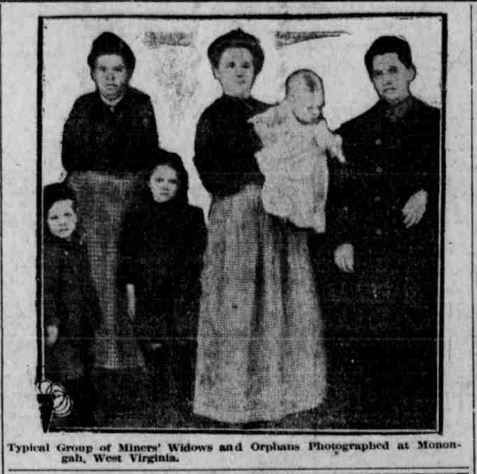
Albuquerque Citizen publishes 2 pictures:
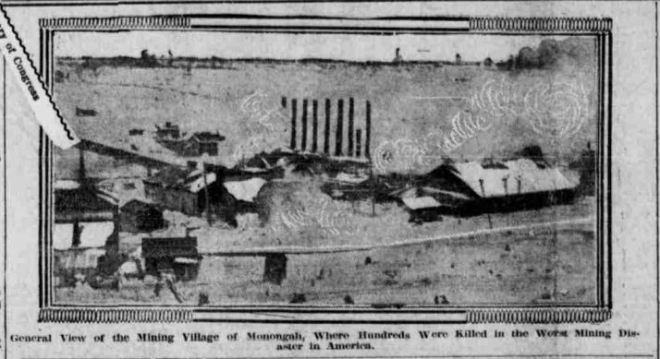
“Who is guilty? Is a question newspaper men and others are asking. The only answer obtainable is the echo, ‘guilty’.” (AC 12.10.07 pg. 1)
“Theory follows theory regarding the cause.” (AC 12.10.07 pg. 1)
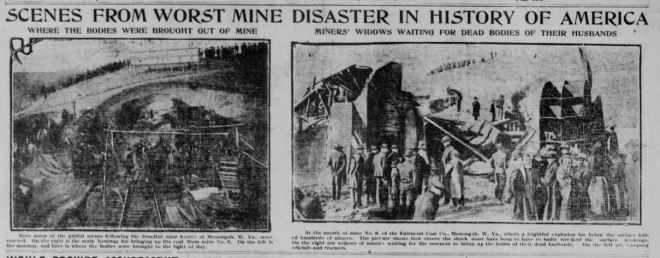
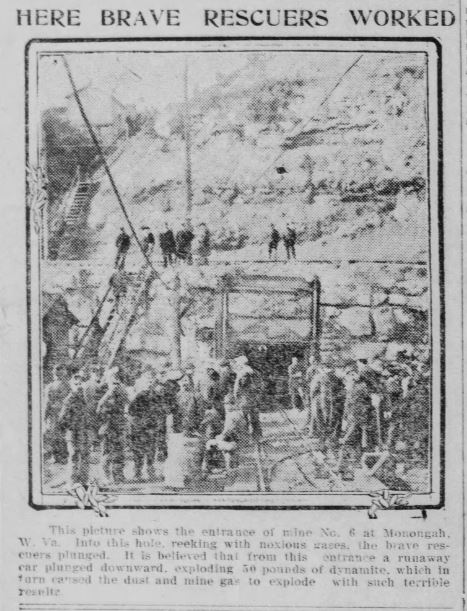
“A possible explanation which old miners give is that a string of coal cars, breaking loose, plunged down the tunnel and probably crashed into a lot of dynamite, which is taken into the mines in 50-pound lots. This, it is thought, caused an explosion which in turn exploded the first collection of deadly coal dust, wrecking both mines.” (AC 12.10.07 pg. 1)
“Another story, and one that is given credence despite the fact that every effort to hush it has been made, is that a connection was made between the two mines, and that the gases rushing together exploded.” (AC 12.10.07 pg. 1)
“This is West Virginia’s fourth mine horror in 10 months and the governor has promised swift punishment if negligence has been shown.” (AC 12.10.07 pg. 1)
“A New York correspondent, who was hurried to the scene of the recent big disaster by his paper, wrote a short description—a word picture of the flight of the women and children left to shift for themselves by the sudden taking off of their husbands and fathers and sons and brothers.” (AC 12.10.07 pg. 4)
“The men who died in the mine met a merciful fate as compared to the ones they left behind.” (AC 12.10.07 pg. 4)
“A flash and it was all over, so far as they were concerned. They were stricken down in nearly every instance without a minute’s warning and with no time in which to suffer.” (AC 12.10.07 pg. 4)
“But up above, in the little mining town, were women and children whose sufferings will only be cured by time.” (AC 12.10.07 pg. 4)
“Writing of these—the ones who bore real suffering, the New York correspondent in his paper said:
‘The tragedy of the wives, mothers, the sisters and sweethearts of the victims of this awful mine horror is the tragedy of the mine women the world over.
‘Her whole life is one of apprehension. And when at last the blow falls, her lot is to wait and suffer, to hope against hope, to meet the worst with such courage as God has given her, to take up the miserable battle of life again single handed and to retain her faith in Omnipotence if she may.
‘There is a grewsome sameness in these mine horrors which differ only in detail, the number of dead, the periods of heart wringing uncertainty, the waiting women must endure, the pitiable harvest of widows and orphans that is left. There is always the same agonizing despair, the same utter hopelessness.
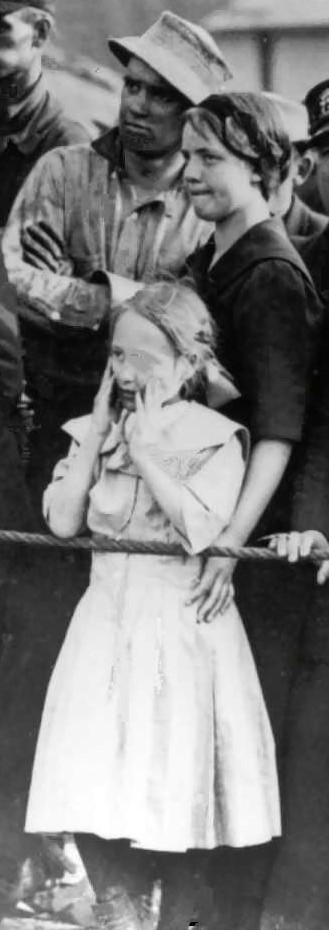
‘The surmounting of it all centers about the newly made orphans who do not understand. They follow their mothers to the pit mouth, where the rope cordon keeps back the swaying crowd and upon the strange shifting scene of woe with inexplicable tearless wonder written in every line of their little faces. Perhaps it is their common fate in the years to come, but mercifully they do not know.
‘For hours, long, agonizing, almost never-ending hours, the women weep and wait before the first return party of rescuers, smoke-blackened and dirt-begrimed, emerges from the yawning mouth of this subterranean hell. The first revolution of the throbbing engine starts a quiver of alternating hope and fear in every heart, there is the distracted babble of many tongues, but above and over and through it all the woman’s cry of heartbreak.
‘Perhaps they bring only a comrade who has been overcome by the dread black damp in his heroic effort to rescue. Mayhap they bring a body, burned and blackened, the arms crooked over the scorched, coal-pitted face in a last pitiable effort at protection. Be it the one or the other, the first sight of the inanimate body opens the long pent-up floodgate of that awful terror which has held them in its thrall. Here is all the horror of the inferno itself; here seems the concentrated agony of the universe.
‘And so it is until the bodies are all removed. Perhaps some are still missing after a week, but haunting the pit-mouth, even as the myriad tolling of the bells tells its own mute story, are the women of the dead, faithful to the last, waiting and weeping and suffering as is their fate.
‘And the real tragedy of it all is only begun. The woman has lived and obeyed and suffered. Now does her real trials begin. She has children, perhaps; boys big enough to be door-tenders and oilers, who to help her in her fight to keep the wolf from the door, must go into the pit where their father went down to death. If there be babies, only so much the worse.” (AC 12.10.07 pg. 4)
The Stark County Democrat in Ohio attempts to correct rumors:

“The force of the explosion was awful. Fifty bodies, at least, have been blown to atoms. One motorman had his head cut off at the neck.”
“Charles D. Wise’s body was blown to atoms. His overcoat and shoes alone were recovered. Wise represented Senator J.N. Camden of Parkersburg, who owned the mines, and the Fairmont coal company paid him five cents a thousand royalty as the coal was mined.” (SCD 12.10.07 pg. 1)
“Advices from Monongah, W. Va., last night were to the effect that the body of Charles Wise, civil engineer and brother of Lorin C Wise, the local attorney, had not been removed from the mine in which he was making an inspection at the time of his supposed death. There were contradictory reports out, some to the effect that the body had been found and others that it had not. The latter statement proved to be the truth.” (SCD 12.10.07 pg. 1)
“Attorney Wise left for Monongah the night he heard of the mine accident and of his brother’s probable death. Since that time numerous messages have been received from him.” (SCD 12.10.07 pg. 1)
“At the mine, waiting for the searchers to find the engineer, either dead or alive, are, besides Attorney Wise, the wife and two children of the missing man. The wife had not given up hope of her husband’s safety yesterday afternoon and had their home prepared for his coming. She said, however, that if he is found dead she wants the body taken home as soon as [text missing] where the funeral will be held is not yet known but it is thought it will be in West Virginia at the home of the engineer.” (SCD 12.10.07 pg. 1)
The Salt Lake Herald:

“The hearts of the people of Utah will go out to the stricken ones, for the disaster of May 1, 1900, at Scofield, is still fresh in the minds of this people. And there is a striking similarity in the causes.” (SLH 12.10.07 pg. 4)
“The Scofield catastrophe was caused by an explosion of coal dust. That at Monongah seems to have come from the same cause.” (SLH 12.10.07 pg. 4)
“The great different between the two is in the rescuing of the bodies of the unfortunates who lost their lives. At Scofield, where 299 perished, it was possible to go into the mine almost immediately. At Monongah the deadly after-damp is seriously hampering the work of the rescuers. It is in connection with this rescue work that a bright light is cast over the gloom.” (SLH 12.10.07 pg. 4)
“According to the dispatches the men who form the rescue parties, though thoroughly cognizant of the danger of suffocation, are valiantly battling to bring forth the bodies of their comrades. There has been no hesitation, no halting, no falling back. Ten men are said to be dying as a result of their attempts at rescuing bodies. Every one, if he lives, should be given a medal for bravery and the families of those that die should be cared for.” (SLH 12.10.07 pg. 4)
“Another bright feature of these situation is the prompt relief that is being given to the families of the men who were lost. Every case of distress and there must have been many, have been relieved, and all that is humanly possible is being done for the afflicted. This was done also in Utah. The public remembers that we took care of our own without help from outside sources.” (SLH 12.10.07 pg. 4)
“There will be time enough later for investigations with a view to fixing the responsibility for the disaster. And, if the responsibility can be fixed, the guilty party should be made to suffer the extreme penalty of the law.” (SLH 12.10.07 pg. 4)
Times Dispatch in Virginia:

“It is distressing beyond the power of words to express that several hundred men who had the hardihood and industry to dig the coal from the bowels of the earth for the world’s benefit should have been caught in the mine, like so many rats in a hole, and smothered to death.” (TD 12.10.07 pg. 6)
“There is necessarily some risk in mining, but the public and the legislative bodies should demand that this risk be reduced to the minimum by the use of scientific agencies of prevention.” (TD 12.10.07 pg. 6)
The Evansville Press in Indiana:
Lincoln Journal Star in Nebraska:

New Castle Herald in Pennsylvania:

More on How Death Gloated!
Bibliography
Disclaimer and Guide
Introduction
About the Author
Contact Information


 The Monongah Disaster