Coroner’s Inquiry of January, 1908

Tuesday, January 7, 1908 – Morning

Midnight – 3:15 am

In Fairmont:

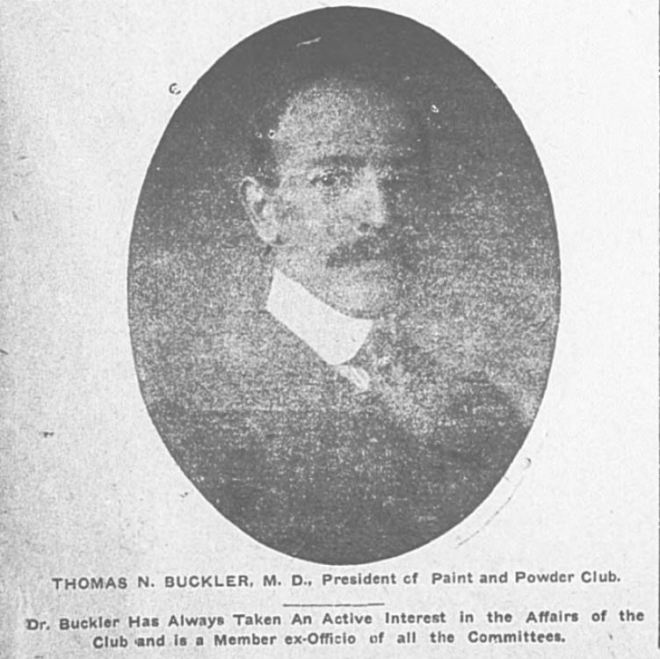
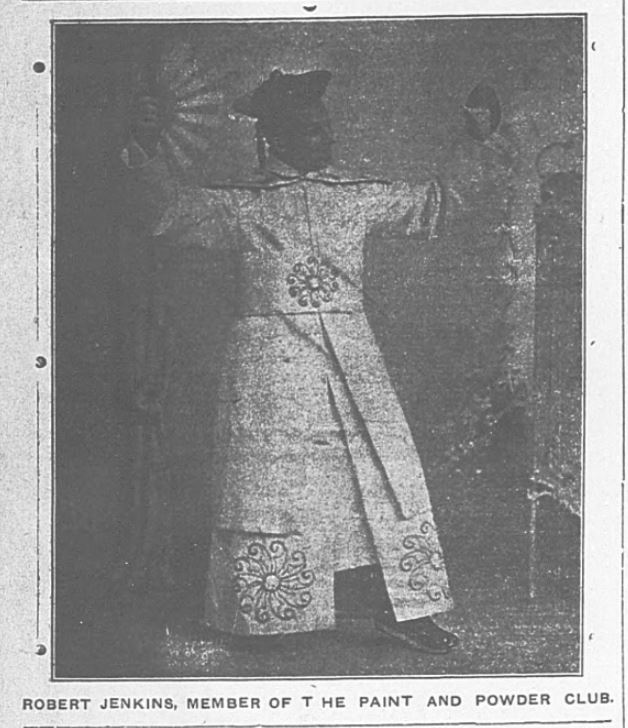
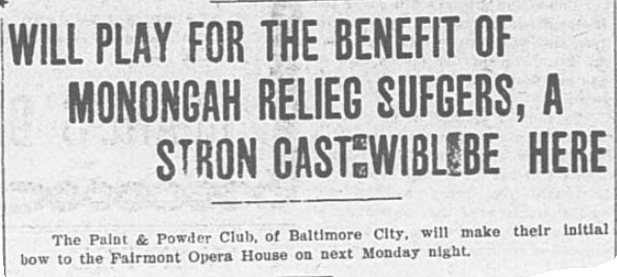
“About one hundred gentlemen comprising of Fairmont’s representative citizens, gave the Paint and Powder boys an elaborate reception at the Elks club between the hours of 12 and train time (3:15).” (FWV 01.07.08 pg. 5)
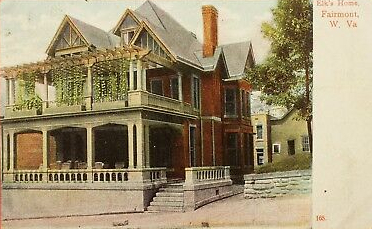
1908-Postcard-Elks-Home-Fairmont-West-Virginia-Wv

“A splendid collection was served by Steward Pangle and speeches were made and responded to by the P.P. Boys.” (FWV 01.07.08 pg. 5)

“The boys rolled out of the station to the strain of “Maryland, My Maryland” played by Prof. Omen’s band and the lusty cheers of the delegation of Fairmonters there to see them off.” (FWV 01.07.08 pg. 5)

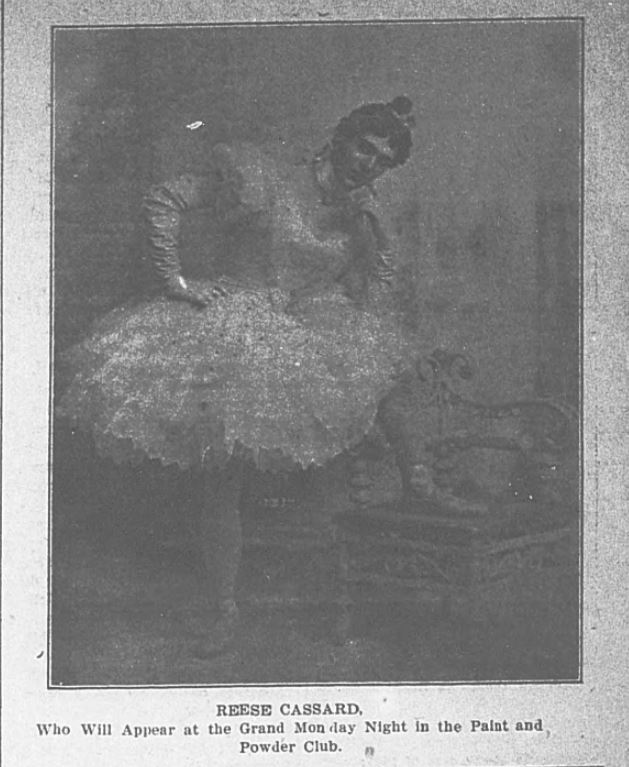
“Reese Cassard in his parting from the rear of the slowly moving train expressed most feelingly the grateful thanks of all the boys for the hearty and successful efforts made for their comfort and the generous applause for their work and said Fairmont is on the P&P annual itinerary as long as there is a P&P.” (FWV 01.07.08 pg. 5)
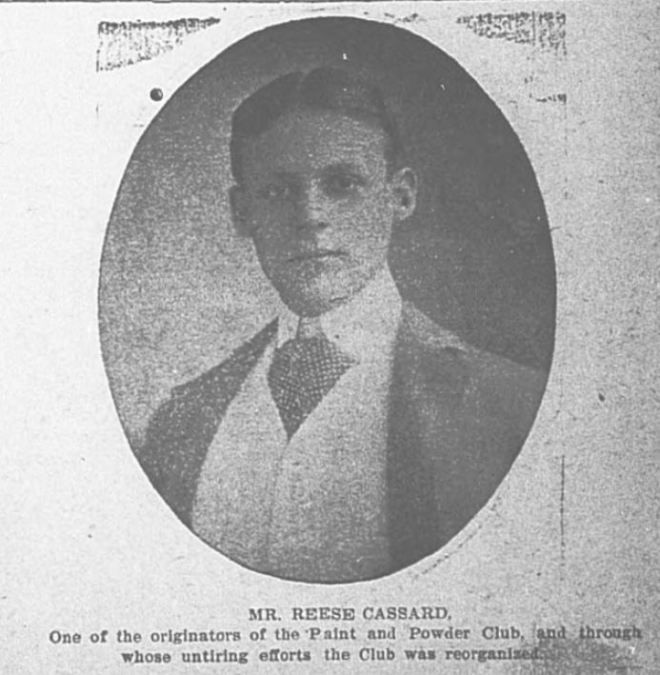
FWV 01.04.08 - pg 1 - Paint and Powder lead
FWV 01.04.08 – pg 1

“Fairmont is indeed to be congratulated on this acquisition to her artistic entertainment, for she will now each year have the benefits of the Club’s annual production, not only from the enjoyment view point, but the proceeds going to some worthy Fairmont charity.” (FWV 01.07.08 pg. 5)

Morning

In Fairmont:

The Fairmont West Virginian reports the weather will be: Rain or snow tonight and Wednesday.

The West Virginia Joint Legislative Committee has arrived from Clarksburg to attend the hearings. (CDT 01.07.08 pg 1)

~10:30 am

In Fairmont:

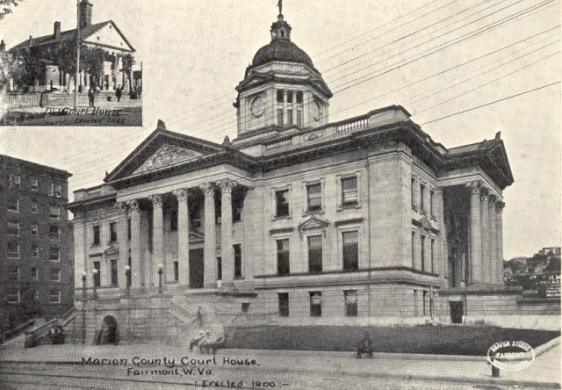
Testimonies continue in the Fairmont Courthouse. “The second day of the court inquiry was held in the Circuit Court room, where many listeners assembled eager to catch every word of evidence from the witness.” (FWV 01.07.08 pg. 1)
Fairmont - Old & OO_large

“William Vokolek, an attorney at law of Pittsburg, representative of the National Slavonic Society, is here to aid in any way that he can to arrive at the cause of the explosion. He is also settling claims of widows against the society. So far the society has distributed $250.” (FWV 01.07.08 pg. 1)

01.07.08 - Inquiry - Alonzo Shroyer

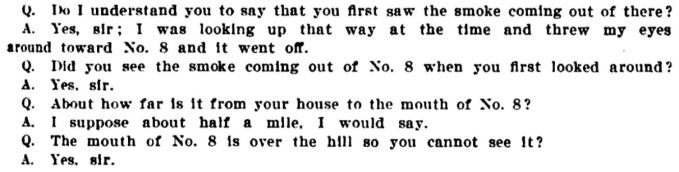
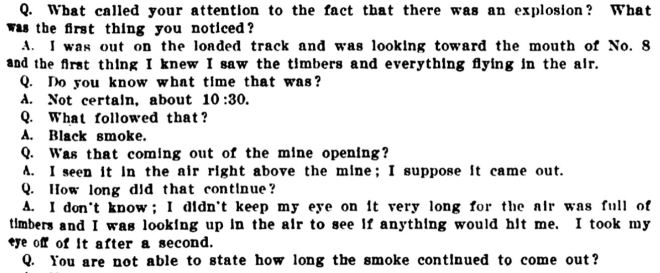
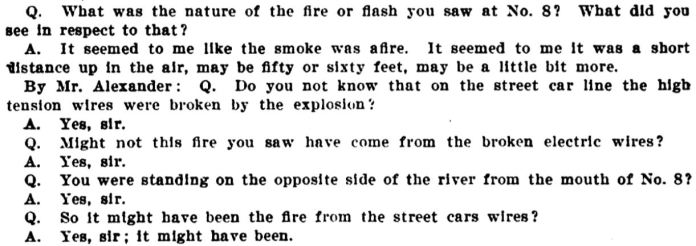
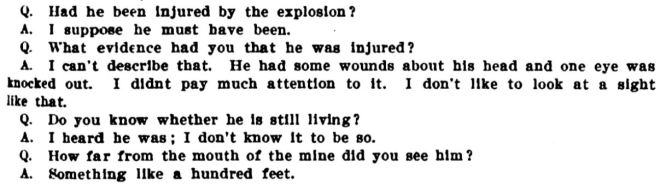
Alonzo Shroyer lives in Mill Fall, a hollow connected to Monongah, and works in the #6 blacksmith shop as a carpenter doing repair work. He is examined by Inspector Paul. (Inquiry)

Alonzo was only 50-60 feet from the mouth of #6 mine, closer to the fan and near the derailing switch, when the trip of cars broke loose. However, he did not actually see the trip until it was already passing him, so he made no attempt to throw the derailing switch. Once it passed him, he went “immediately to the mouth of the mine or near it.”
01.07.08 - Inquiry - Alonzo Shroyer 1

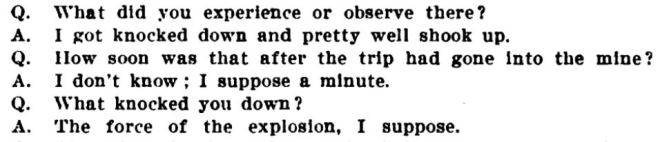
Alonzo thinks he was standing maybe 10 or 15 feet away from the mouth of the mine when the force knocked him down. His right ear was cut open in the fall “and a gash behind the ear to the bone”; he believes he was knocked against the derailing switch stand.

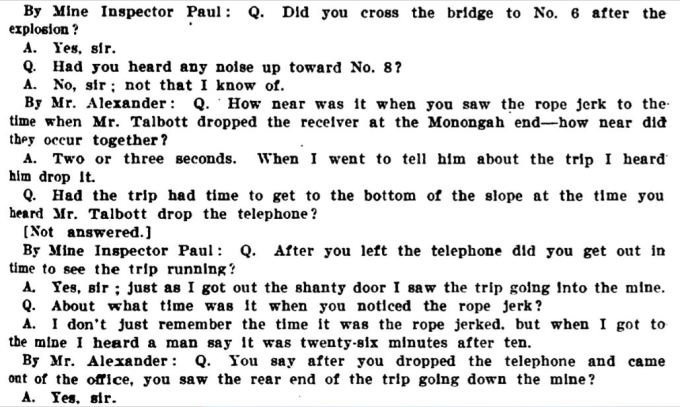
Alonzo also says that he thinks the runaway trip had time to get to the bottom of the mine slope.

01.07.08 - Inquiry - Alonzo Shroyer 2

Alonzo states that he heard no noises from the direction of #8. Once the trip passed, Alonzo intended to follow the trip into the mine and says he was on his way to the shop “to get a torch to follow the trip.”

He again estimates that it was around a minute from the time the trip passed him to the time of the explosion.


01.07.08 - Inquiry - Alonzo Shroyer 301.07.08 - Inquiry - Alonzo Shroyer 4

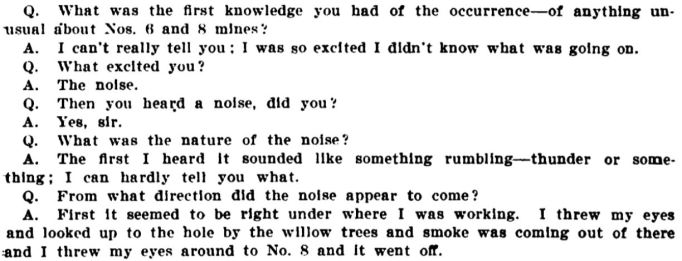
Alonzo states that he saw dark smoke coming from the mouth of the mine but neither saw nor felt signs of flame. Based on “the distance I went and where I went”, he estimates that the smoke must have continued coming out of the mine mouth for 4-5 minutes and agree that it could have been even longer than that.

01.07.08 - Inquiry - J.H. Leonard

J.H. Leonard has lived in Monongah for 16 years and has been a fan operator at #6 for the past 6 or 7 years. He is examined by Inspector Paul.
01.07.08 - Inquiry - J.H. Leonard 1

Leonard was working on the 5th and confirms that the fan was running all day and hadn’t even been stopped “since the Sunday a week before” until that the evening of the 5th when it was stopped for 2 ½ hours.
01.07.08 - Inquiry - J.H. Leonard 2

Leonard says the explosion knocked him down and bruised his arm and ankle. “I crawled around above to a pile of old stuff there and there was a hole there and I let myself through down under the trestle.”

Leonard says that, to him, the mouth of the mine looked “like a big steam pipe”.

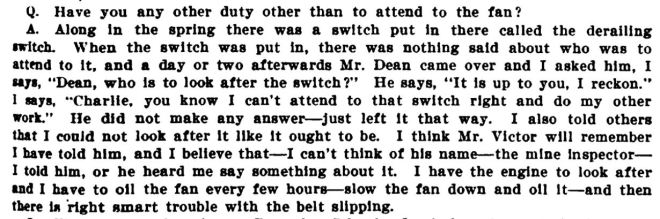
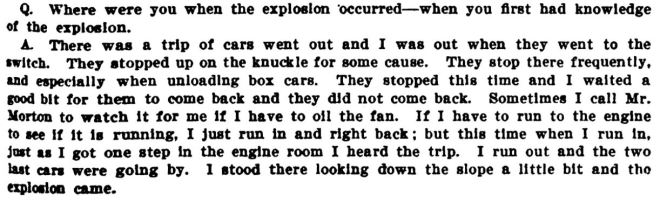
Leonard had gone into the fan house and oiled the fan only a 15-20 minutes prior to the explosion. “The oil sometimes stops in the cups on the wrist pin and it only takes a couple of minutes to get it hot. I run in to see if the oil was running.”

01.07.08 - Inquiry - J.H. Leonard 3

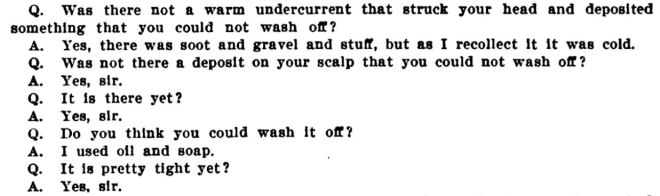
Leonard confirms that the fan has a pressure gauge to indicate and record the pressure. He says that it is normally the night shift operator who changes out the indicator cards. Leonard got his first experience in changing the card when he was working the night shift on Wednesday, Dec. 4th.
01.07.08 - Inquiry - J.H. Leonard 4

Leonard explains further that they feared someone, or perhaps a motor trip, was coming up the slope at the time the trip ran back into the mine on the very same track. He says he saw nor felt any sign of flame and the smoke was not hot.
01.07.08 - Inquiry - J.H. Leonard 5

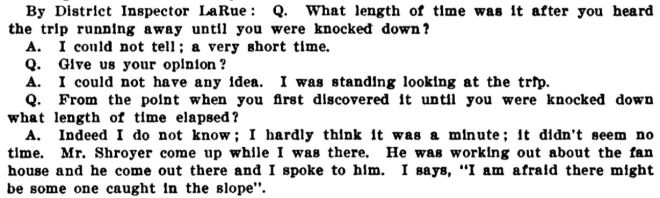
Leonard does not believe that the smoke was blowing out for very long. “I crawled around there when it struck me and I was not long about it; I dropped down under the trestle and I don’t think I was there more than a minute until I came up and it was still blowing some.” He says there was no backward motion of the smoke getting sucked back into the mine, just a “continuous blow like a steam pipe.”

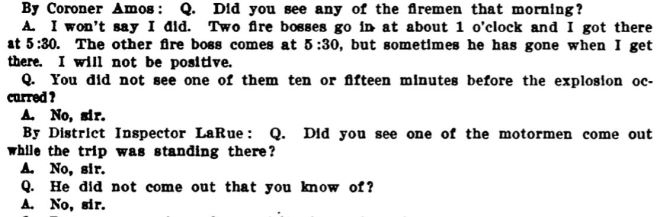
When he was hiding under the trestle, he pulled a piece of a coal car door over top of him; “I thought it would protect me.” He also saw Mr. Graves under there and says he was under there at the time of the explosion.”
01.07.08 - Inquiry - J.H. Leonard 6

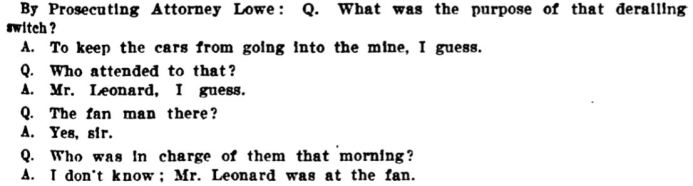
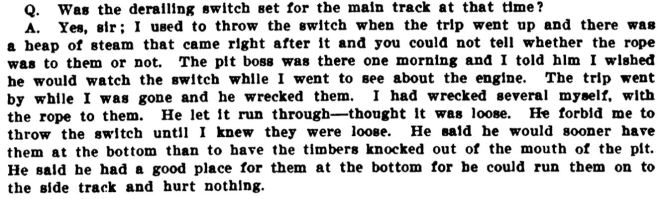
Inspector LaRue asks Leonard if he recalls LaRue’s visit to the mine and discussing the “matter of the throw-off switch”. Leonard recalls telling him that he could not properly attend to watching the derailing switch and that he had never received any orders from any “superior officers” to call someone over to watch the switch if he had to leave it unattended to tend to the fan engine. He did not call anyone over to watch the switch that morning as the “blacksmith was shoeing horses and I did not know there were two men there. There was only two carpenters there and they were both busy back of the fan house.”
01.07.08 - Inquiry - A.J. Ruckman 7

Leonard is not sure of the speed of the fan at the time of the explosion other than “it was the same all morning before that.” He remained at the mine in charge of the fan.

The fan did not shut off on its own, according to Leonard, but was shut down by orders of Mr. Dean so that certain repairs could be made as quickly as possible. “It was not very long until it was started; maybe a half hour.” He states that the fan “had not been shut down since the Sunday a week before, until some one ordered me to shut it down to make that repair.”

Leonard estimates that the derailing switch is about 25-30 feet from the mouth of #6 and possibly 75 to 100 feet away from the fan house, though he has never measured the distance.

01.07.08 - Inquiry - J.H. Leonard 8

Leonard again states that he did not call anyone on the day of the explosion because “there were only two men close and one was shoeing a horse and the other was working back of the fan house. I did not see him at that time but he was working there, I know.” And he thought he had time to get back to the switch if needed.

By the time Leonard reached the switch, however, the last two cars of the runaway trip were passing by him. He says that he does not know how many cars were part of that trip but the usual trip runs anywhere from 8-15 cars, nor does he recall seeing a water-car on that trip.

01.07.08 - Inquiry - J.H. Leonard 9

Leonard says that the normal fan engineer who runs the opposite shift is Michael McDonald but he was sick on that day, so it was run by Mr. Lambert.

Leonard states that the runaway trip of 4 cars he had mentioned earlier happened possibly a “week or two before” the explosions and that they wee just 4 empty cars which had been accidentally shoved back over the knuckle.
01.07.08 - Inquiry - J.H. Leonard 10

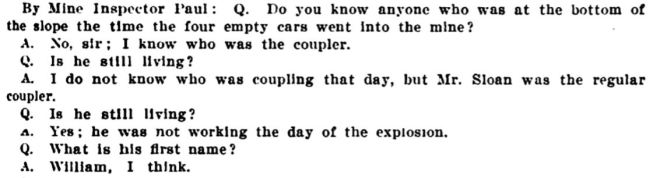
He goes on to say this pit boss was Mr. Donlin.

Leonard says that the mine foreman gives him “more instructions than anyone else, and about the fan, too. He always cautioned me to be very careful and keep it at a proper speed and see that nothing went wrong, regardless of anything else.” Leonard says that he obeyed the foreman’s orders about the switch and the fan.
01.07.08 - Inquiry - J.H. Leonard 11

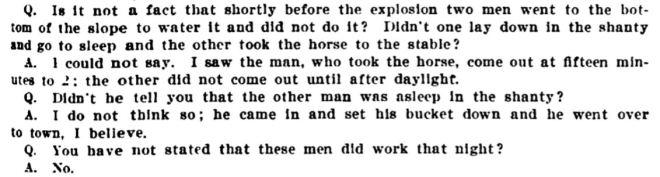
Inspector LaRue asks Leonard if he knows of anyone being sent into #6 to water the headings the night before the explosion (Dec. 5th) or coming out the morning of (Dec. 6th). Leonard responds that he worked the night of the 4th and on that night, “…there is a signal to let the men out of the pit, and a man came out. He was an Italian. He had a horse, and said he had been watering the track. Motorman Cooper came out in the morning.” Though he does not know what part of the mine was watered, he recalls this man came out around 1:45 a.m. because Mr. Donnelly “wanted to know the time the men came out. Mr. Cooper came out after daylight.”

Leonard can not testify to how frequently the tracks are watered because, “…I worked in the day time and they waster at night and on Sundays. Very frequently they water on Sunday. I think Saturday night and Sunday is the general time for watering.”
01.07.08 - Inquiry - J.H. Leonard 12

Leonard states that he knows that Fred Cooper watered the mines on the night of the 4th. He tells Inspector Paul that he had not seen any men or animals brought out that had been burnt by gas “for a good while”. He says that a year ago, “I saw a mule that had gotten its ears singed and they said it was by gas.”

Leonard tells Att. Lowe that he knows of no other explosions in the mine, big or small, prior to those on Dec. 6th.

01.07.08 - Inquiry - Ed Fry

Ed Fry has been a stationary hoisting engineer at #6 “since it started”, about 6 years. He is examined by Inspector Paul.

Ed was working in the engine room on Dec. 6 and knew something occurred when the trip broke loose, left the rope which caused the hoisting engine to speed up. He says he had no knowledge of what had happened to the train before he actually left his post in the engine room.

01.07.08 - Inquiry - Ed Fry 1

However, Ed can not recall if he was still in the engine house or in the doorway when that light went off, but he knows that he heard no sound of the explosions and only felt the “jar” while standing in the doorway. He says he stayed within the doorway as the concussion continued and first learned of what happened when a fireman from the powerhouse “came across and told me that No. 6 had exploded.”

Ed says he then went to the power house, “the lower side there, next to the river” where he observed “smoke and dust coming out of the air shaft” of #6.

Ed is not sure how long it was between the time of the trip breaking loose and the fireman telling him of the explosion.

01.07.08 - Inquiry - Ed Fry 2

Ed says that if that light goes out while he is pulling a trip he stops pulling because it is “likely to have a wreck.” Ed does not really answer the question of what the light going out indicates other than it isn’t necessarily an indication that the wrecked trip tore down wires when it went back into the mine. “Sometimes the circuit breaker goes out frequently during the day” and turns the light off, he says, which could simply indicate some other kind of “heavy work” being done inside of the mine and not necessarily a wrecked trip.

Ed confirms that, if the trip breaks loose, the ropes which were attached to the train do not “rebound” back. Rather, the engine simply “speeds up and takes up the slack.”

Ed also believes that the trip was stuck at the knuckle for, “Probably ten minutes.” However, he does not know exactly how many were on the trip as, from his vantage point in the engine room, he could only see “one or two” once the train arrived to the tipple. He confirms that the entire trip broke loose and went back and says that “a minute” probably passed between the time the trip broke loose and when he was notified that the explosion occurred.

01.07.08 - Inquiry - Ed Fry 3

Ed does recall that some empty cars had gone back into the mine on a day he was working, but he can not recall how long ago this occurred or if that wreck caused the light to turn off in his engine room. He can confirm that those cars were not coming out of the mine, but were in preparation to be lowered into #6 when they went back.

01.07.08 - Inquiry - A.H. Yost

A.H. Yost has lived in Monongah for 9 years and runs the fan on the night shift for #8. He is examined by Att. Lowe.

Yost confirms that William Bice runs the fan during the day shift and died in the disaster. He says that there was no one else who worked his night shift for the fan and that he did work on the night before the explosion and left his post around 5:30 or 6 o’clock a.m. on the 6th when Bice took his place.

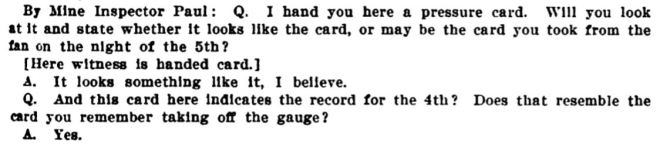
Yost confirms that the fan ran “all night” without stopping. He states that the pressure gauge for the fan records the pressure and is changed “every twelve hours” when they change shifts. He states that the sheet was changed at 12 o’clock that night. He knows that night Pete McGraw and Patsy Kerns were the fire bosses on duty in #8 the night before the disaster, however, only McGraw is still alive. He says he only knew of two fire bosses for #8 and one foreman, John McGraw, though he assumes McGraw had an assistant.

Yost says it was he who changed the gauge sheet on that night, as he “sometimes” would and that night he “hung it on a nail and the fire boss got it.” Yost presumes that the fire boss took the sheet to the office but he has not seen it since that night.

Yost is asked what the gauge was reading that night when he took it down, but he does not know nor does he know the average speed typically indicated on the card.

01.07.08 - Inquiry - A.H. Yost 1

Att. Lowe asks if #8 was working on the 5th, to which Yost responds that the fan was running but the mine itself was not. Yost says that he took over Bice’s place at the fan on the evening of the 5th and that the fan was indeed running at that time.
01.07.08 - Inquiry - A.H. Yost 2

Yost says that he was at home asleep at the time of the explosions and tells Mr. Alexander that fire boss Pete McGraw collected the fan records the morning of the explosion, “I suppose, about 2 o’clock.” He is then asked about the last time the fan was stopped at #8. “I could not tell you. They generally stopped it on Sunday, if they stopped at all, to do packing or something” but he does not believe it was stopped on the Sunday before the explosions.

It is reported in the Fairmont West Virginian on this same day by a courtroom reporter that, right after being asked about his whereabouts at the time of the explosion, “The witness said there was a large volume of smoke emitted from No 6 which lasted about 6 minutes. The smoke was continuous. There was no flame.”  (FWV 01.07.08 pg. 1)

However, this part of Yost’s testimony is absent from this author’s copy of the Inquiry. (Page 277 of Inquiry)

01.07.08 - Inquiry - A.J. Ruckman

A.J. Ruckman has lived in Monongah for 18 years and is the Superintendent for #6 & #8 mines. He is examined by Att. Lowe.

Ruckman was in his office with the outside foreman, Mr. Charlie Dean, at the time of the explosions and therefore did not see them occur. “The first thing we heard was the loud report and severe concussion.” Charlie Dean then stated, “There goes No. 8 boiler.” They then “went out on the porch and looked toward No. 8, as that is where the report sounded, but there was nothing visible—didn’t see any smoke or anything.” Ruckman and Dean were then “attracted to No. 6 by a loud noise and looked down and the smoke was coming out of the air-shaft pretty strong, under high pressure.” Ruckman says he turned to Dean and said, “From the appearance it looks like No. 6 fan house is damaged. Get the men and material there as soon as possible and I will go to No. 8, and if that fan is not damaged, we will reverse it.” Unfortunately, the fan at #8 was badly damaged.

01.07.08 - Inquiry - A.J. Ruckman 1

Ruckman says that the coal is hauled up the slopes and out of the mines in Monongah with “electric locomotives on the main haulway” then a stationary engine with a wire rope hauls it the rest of the way. He is asked about how long #6 & #8 have been in operation to which he replies that “No. 6 was started in 1900, and in No. 8 the ground was broken on the 12th day of May, 1905.”

01.07.08 - Inquiry - A.J. Ruckman 2

Ruckman says that a “great deal” of the mining is done with an electric mining machine; “A seven-foot undercut chain machine. Some of the work was done with a pick, in case of a bad roof where the machine couldn’t work, or pillar work.” He says that the part of the mining done by the chain machine produced “Small coal—dust in it,” and a “considerable” amount of it produced on the first cutting.
01.07.08 - Inquiry - A.J. Ruckman 3

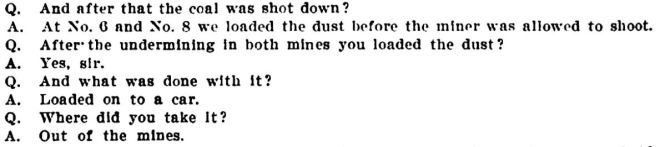
Ruckman states that no watering was done in the rooms before shots were fired, the dust was loaded and removed then the coal was shot and loaded by the miners.
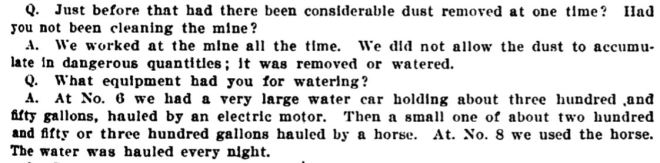
01.07.08 - Inquiry - A.J. Ruckman 4

Ruckman can recall that Tony Pasquale is the “regular man” to water #8 mine and that he is still alive, but “at No. 6 it was a different motorman—whoever the pit boss would designate.” He says that there are no motormen from #6 who survived the explosions. He can not say how often or necessarily what part of the mines were watered as that is “the pit boss’s duty” and none of them survived either.

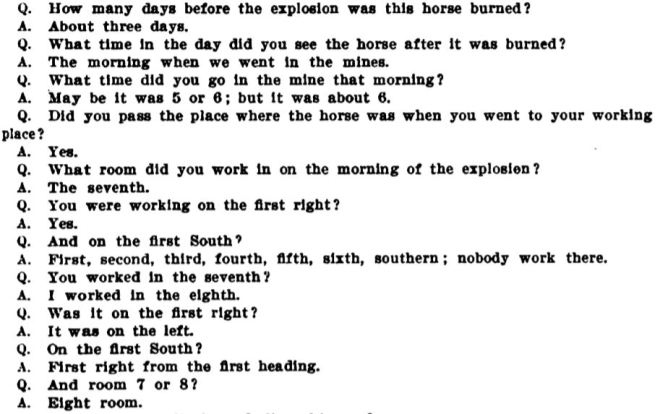
Ruckman says he neither knows nor has heard of any accident or explosion in either of the mine just prior to this one. He is asked about Peter Urban’s testimony of “a horse being killed by gas as short time before this in No. 8”, possibly just 3 days earlier.
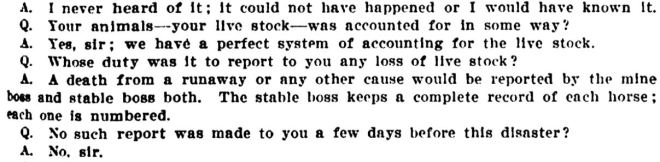
01.07.08 - Inquiry - A.J. Ruckman 5

Ruckman states that Ben Coon was stable boss for #8 and Charlie Dean “has general supervision over the work.” He says that such an accident would have been reported by the pit boss and stable boss, including a description of the event. However, the pit boss for #8 is no longer living to account for this.

Ruckman confirms that there was a “small explosion of gas” in #8 which slightly hurt a horse “about two months” prior. He says the horse’s ears were burned but really no other damage and the horse was back to working inside again within “six or seven days”. This same horse was working on the day of the explosion and killed in the mine.
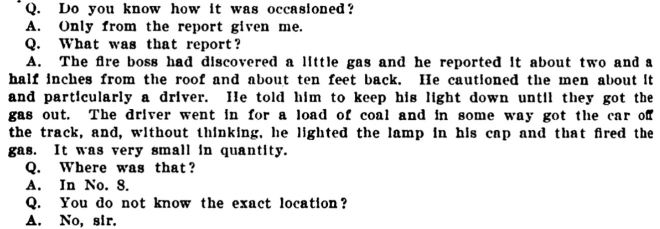
01.07.08 - Inquiry - A.J. Ruckman 6

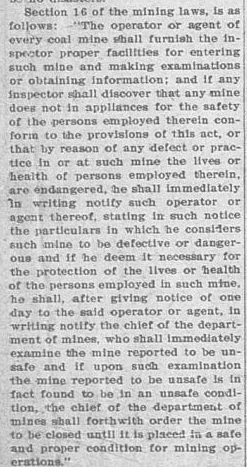
Ruckman states that the employees were furnished with a copy of the mining laws in the form of a printed pamphlet. Att. Lowe hands Ruckman a pamphlet to which he confirms is the same pamphlet that was distributed to the miners about “two or three months” prior to the explosion. “They were given out as soon as we got them.” He confirms that the “card of instructions” was tacked up outside of the mine openings in seven different languages. “We had them up in different languages for several years, but after the change in rules they were put up immediately.”

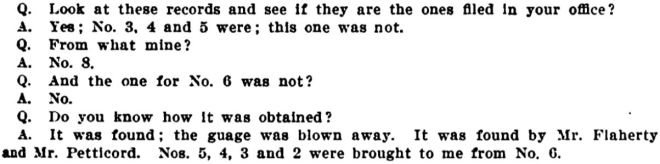
Ruckman believes he made it from his office to #8 in “possibly five minutes.” He found that the “danger signal”, which warns if the mine is in a dangerous state, at #8 had been “blown away”, along with the blackboard containing the report of the fire boss. He states that he did not go over to #6 “for some time” but can confirm that the blackboard at #6 was “out of the direct road of the explosion and was not blown away.” It is currently sitting in his office in Monongah. Att. Lowe asks him to “bring it down in the next day or so.”

Ruckman confirms the fan operators’ testimonies that the records for the fan house are taken by the fire boss to the Monongah office, however, he says that he only has the records for the 5th and prior, not for the 6th.
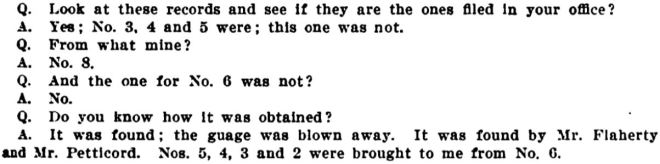
01.07.08 - Inquiry - A.J. Ruckman 7

Inspector Paul asks for the dimensions of the fan at #6 to which Ruckman replies that it was a “triple fan, made by Clifford” that measured 9 x11 feet with the larger dimension being the fan’s diameter. Ruckman gets weekly reports on the fans.

01.07.08 - Inquiry - A.J. Ruckman 8

He is asked the same question about the fan at #8. He says it was a “Connellsville fan made by Lepley—8 by 22.” He does not know of it’s capacity, however. “I never saw the rating. Whether if would hold up or not I don’t know, but it makes over 220 feet of cubic air per revolution.”

01.07.08 - Inquiry - A.J. Ruckman 9

Ruckman testifies that no dynamite was used for blasting in the mines, but rather “3F black powder” is used. He says that the drilling for the blasting is done manually by the miners themselves, “except one face at No. 8” (which one, he is not sure) where “A contractor by the name of Preston had a portable Jeffrey’s auger and he worked four or five men.”

Ruckman says that there are no regulations to the amount of powder to be used in the blasting; “only what instructions the pit boss would give the men.” He also states that they do not keep the records of the pressure charts from the fan but that they are mailed to the general superintendent in Fairmont. He states that the charts are “a record of whether the fan man is doing his duty.” Ruckman explains that, “if the engineer would allow his steam to go down or slow the engine down to take it easier; it would show instantly.”

Ruckman is not sure if the electric chain machines cause a “greater quantity of fine dust than would be made by pick mining”; he figures “that would depend on how it was run.”

01.07.08 - Inquiry - A.J. Ruckman 10

Ruckman presumes that shots are done in threes—“the same as the heading”. “One shot is placed in the center, shot out and loaded up, and the other shots are placed a foot or so from the rib.” The powder is issued in 5-pound cans and he does not know of any instance where men were burned by the ignition of gas prior to the explosions. He states that the driver of the horse that was burned some months prior, Fred Stubbs, was not hurt and is still living.
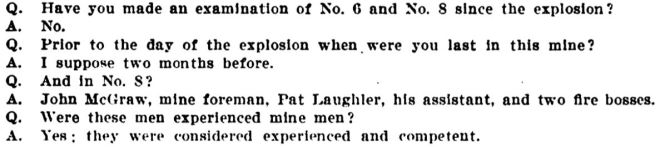
01.07.08 - Inquiry - A.J. Ruckman 11

Ruckman says that the foreman and fire bosses meet “once a week” to discuss the conditions and safety of the mines. He states that David Victor was the general mine foreman “until recently”. Victor is now an inspector for the company and there was no general foreman at the time of the disaster.

Ruckman recalls that Victor was in the mines about two weeks prior to the disaster and got a copy of his report which stated that the conditions of the mines were “good”.

Att. Lowe hands Ruckman a photograph “of a blackboard with some writing on it”, which Ruckman identifies as the “Fire boss’s blackboard on the morning of the 6th.” He is familiar with the name L.E. Trader as a fire boss and confirms that he still lives. The court room reporter for the Fairmont West Virginian points out that, “in three places there were traces of gas” marked on the board in the photograph. (FWV 01.07.08 pg. 1 & 4)

Lowe then asks if Ruckman has a copy of the inspection report. “No; not with me,” he replies, but expects that he can produce it if needed. Ruckman explains that he never actually sees the Inspector’s reports as they are given directly to the mine foremen.

01.07.08 - Inquiry - A.J. Ruckman 12

Ruckman explains that the cuttings and dust are loaded up before the coal is shot as it is dangerous if the dust is dry; “It is a matter of precaution.” He has charge of 2 other mines in town and says that the method of mining and shooting the coal is done “practically the same” in all.

Coroner Amos asks about what is done with the dust after it is loaded. Ruckman simply says it is loaded and “taken away”.
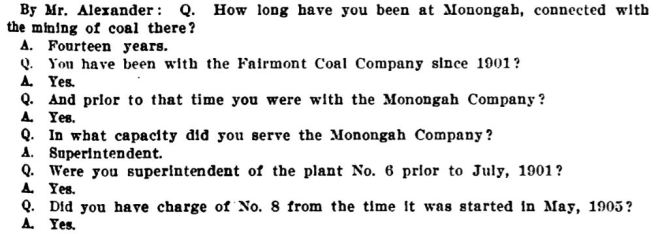
01.07.08 - Inquiry - A.J. Ruckman 13

Mr. Alexander wants to know how far #6 had been driven and developed when FCC took charge in 1901. Ruckman is not positive about the exact depth but acknowledges that it has increased significantly since. He says that the same exhaust system from the Monongah Company was used when FCC took over and is still used now, as well as how the coal is hauled; “The only change is the increased number of locomotives on account of the increase in the length of the haul.”

Ruckman states that the mines are watered with a 300 gallon car in #8 and with one large car, about 350 gallons, and one small car that holds around 275 gallons in #6. They are filled at one of the three pumps located through the mine and moved via electric locomotives. “The end of the car is perforated and filled with wooden plugs. They take them out and spray the track.” However, he confirms that this does not spray the ribs, just the tracks.

Ruckman states that it was up to the mine foreman to determine when watering needed to happen and where. His instructions on watering were just to “keep down the dust—not to allow it to accumulate—not to take any chances. ”He says it was watered “very often” in the colder months but the summer time doesn’t require as much watering.

A large iron gate is placed at the mouth of both mines so as not to “allow anyone in until the fire boss had completed his examination.” The fire bosses Ruckman knows of at #8 are “Kerns and McGraw”.
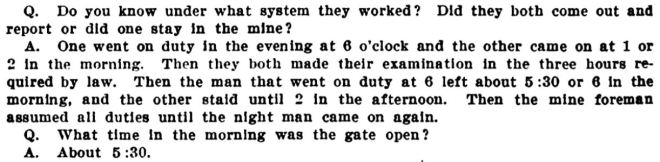
01.07.08 - Inquiry - A.J. Ruckman 14

Ruckman lists 3 fire bosses for #6: “Jim Lyden, Mr. Morris and L.E. Trader.” He says their system was the same as #8 and that at least one fire boss was there “practically all the time.”

He cites the foreman for #8 as John McGraw, his assistant as Mr. Laughler, and the foreman for #6 as Tom Donlin, his assistant as Mr. Rogers.

Ruckman has known John McGraw for 12 years or so and says that McGraw worked in Pennsylvania prior to Monongah. Though he is not sure of the experience McGraw had in Pennsylvania, he considered him “Good—well posted” in his capacity as mine foreman. He believes McGraw had been a foreman for about 2 years prior to the opening of #8 as he was transferred from foreman in #3 to foreman in #8.

He says that John McGraw “first started in Monongah, helping his father. He was then only fourteen or fifteen years old. After that he was driver boss and gradually worked up.” He had worked in almost every capacity, “from trapper boy up.” However, he was never a fire boss as “he never worked in #6 and that was the only place we had a fire boss until we opened No. 8.”

Ruckman says he has known Tom Donlin, foreman for #6, for “about the same length of time.” Donlin also worked his way around the mine as “a miner for a while, then a machine man, then assistant boss, then mine foreman.” Ruckman says that Donlin was “a man of considerable experience in Pennsylvania and all of the coal mines, I think, in this state.” Though Ruckman is not sure if Donlin had any formal training or instruction on mining, he knows that John McGraw received some “from this Scranton school.”

Ruckman says that he has known the fire bosses for #8—Pete Kerns and Pete McGraw—for 10 or 12 years. He says that Pete McGraw had been working there at least 14 years “in nearly every capacity.” Pete had been “a miner and a machine man and boss driver” but had taken a course at the Scranton school and this was his first fire boss position. He is not sure if Pete Kerns also took the course at Scranton but includes that he is “a man of considerable experience.” Likewise, he is sure that Trader has also taken the course, but is not sure if Morris did. Morris had been in Monongah around 4 years and worked in Pennsylvania prior to then.

Tim Lyden has also been there around 12-14 years but Ruckman only acknowledges that Lyden “had the same experience”. Ruckman is not sure if any of the men carried fire boss certification from Pennsylvania but he thought of them as competent and qualified. “I think they were—all five of them. They were very energetic and loyal.”
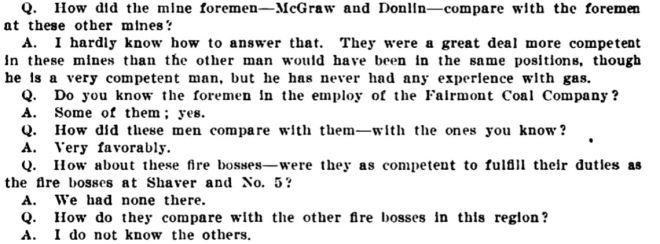
01.07.08 - Inquiry - A.J. Ruckman 15

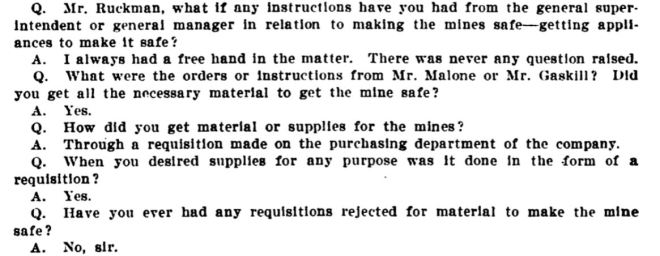
Ruckman cites L.L. Malone as general manager of FCC and J.C. Gaskill as general superintendent. When any inspectors visited the mines, they reported to Gaskill who in turn provides Ruckman with a copy with instructions as well as two more copies of the report—one for each mine foreman.
01.07.08 - Inquiry - A.J. Ruckman 16

Ruckman says these materials were furnished “very quickly” whenever requested and if needed in a hurry, they could be ordered by telephone “to be followed up by a requisition.”

He says that the Lepley fan at #8 “showed up in our test to be a very good fan”, one of the best in the U.S. and among the largest capacities available. It had been in use at #8 for about a year and they never had much difficulty with it.

J.H. Leonard was in charge of the Capell fan at #6 and Ruckman says he had been “since we started—six or seven years.” Ruckman says that Leonard was “put in charge” of the derailing switch “immediately” after it was installed by “Donlin’s track man”, “over a year ago.” Ruckman says he told Leonard “if a trip went in the mine and it was necessary for him to oil the fan for him to call a carpenter to attend the switch and not to leave it under any circumstances.” He acknowledges that Leonard “frequently got someone to take his place” at the switch when he had to leave.

01.07.08 - Inquiry - A.J. Ruckman 17

Ruckman is asked again about reports and records made about injured livestock. He says that these reports are “not necessarily” written reports from the start. Whoever is reporting the incident “comes in the office and reports it and we make a written report to the Fairmont Coal Company.” The stable boss “makes a monthly report of the stock and reports the loss of any” in the same manner.

Ruckman disputes Peter Urban’s testimony saying, “nothing of that kind happened. I heard that evidence yesterday. If there had been an explosion sufficient to kill a horse there must have been a man with the horse to set the gas off and it would have killed him, too.” Ruckman enforces that they have a “regular form for accidents and death reports” which must be made according to the law and no such report matching Urban’s testimony was made prior to the explosions.

01.07.08 - Inquiry - Recess


More on the Monongah Disaster of 1907

Introduction

Disclaimer and Guide

How Death Gloated!: A Timeline of the Monongah Disaster and Bloody December of 1907

Who is Guilty?: A Timeline of January 1908 and the Coroner’s Inquiry
Issues with the Monongah Timeline

Bibliography/Resources

About the Author

Contact Information

Monday, January 6, 1908, News Hour – Night

~6:00 pm, News Hour

Fairmont West Virginian:
FWV 01.06.08 - pg 1 - sub-headline
FWV 01.06.08 – pg 1

Secretary of State Swisher arrives for the Paint and Powder Club show. “Governor Dawson had also planned to come but was unavoidably detained at the last moment.” (FWV 01.06.08 pg. 1)

FWV 01.06.08 - pg 1 - headline 2
FWV 01.06.08 – pg 1
FWV 01.06.08 - pg 1 - miners body found via dream
FWV 01.06.08 – pg 1

FWV 01.06.08 - pg 5 - Hartleys ad - P.P. show attire

FWV 01.06.08 - PG 8 - COAL MEN METT
FWV 01.06.08 – pg 8

“Representative coal men from all the coal mining fields of West Virginia will meet at Washington this week for the purpose of discussing among themselves and the representatives of the United States Geological Survey, means for the betterment of the conditions of mines in West Virginia, in reference to legislation and regulations governing the mining industry in the State.” (FWV 01.06.08 pg. 8)

“Committees were appointed in the different coal fields who will make efforts to bring as many operators to the national capital as possible in order to discuss the conditions in general. The recent explosions occurring in West Virginia and other States have resulted in an agitation for better conditions in all the coal mining States.” (FWV 01.06.08 pg. 8)

The Committee for the Fairmont District: Ex-Governor A.B. Fleming, C.W. Watson and L.L. Malone (FWV 01.06.08 pg. 8)

Clarksburg Daily Telegram:
CDT 01.06.08 - pg 8 - Inqiury
CDT 01.06.08 – pg 8

“The coroner’s inquest to ascertain the cause of the Monongah mine disaster began at Fairmont this morning, and the sessions are being held in the circuit court room, on account of the large crowd in attendance.” (CDT 01.06.08 pg. 8)

“The inquest is attracting experts and mine officials from various parts of the country, Coroner E.S. Amos is conducting the investigation but the county and state officials are looking into the matter from the state’s interest. Every effort will be made to get to the very bottom of the situation and to ascertain if possible at all, the real cause of the disaster…” (CDT 01.06.08 pg. 8)

“The Polander, the only man who escaped alive, will give his testimony, but this will not likely be of much value, as he was in the mine only a short distance from the opening hen the explosion occurred.” (CDT 01.06.08 pg. 8)

“The testimony of expert and investigators will be of vast importance and several days will be required to hear this. The inquest will likely continue for a week or ten days and probably longer.” (CDT 01.06.08 pg. 8)

The Detroit Times in Michigan:
TDT 01.06.08 - pg 4 - Monongah
TDT 01.06.08 – pg 4
The Evening Star in D.C.:
ES 01.06.08 - pg 1
ES 01.06.08 – pg 1

Evening

In Clarksburg:

The West Virginia Joint Legislative Committee is called together by the chairman to the Hotel Waldo.

In Fairmont:

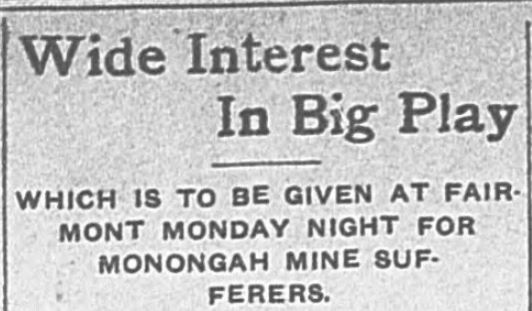
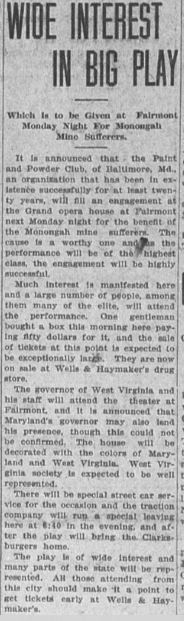
The Paint and Powder Company of Baltimore plays a benefit performance at the Grand Opera House for Monongah Relief sufferers. (FWV 01.02.08 pg. 1)

The Grand Opera House - Fairmont

Inside the opera house, “draperies are blended in the colors of the State of West Virginia – Old Gold and Blue – the State of Maryland, Orange and Black, Baltimore Athletic Club – Maroon and Blue, and Paint and Powder Club – Pink and White. The decorations are being carried out on an elaborate scale. Emblems of the two Sates and of the two clubs will be interspersed equal around the entire border of the house and curtain. When the lights are set aglow the color scheme presented will be as beautiful as any ever seen in this section. The intertwining of colors is a symbol of the closer tie that binds these two States…” (FWV 01.06.08 pg. 1)

“The general committee has had the eight colors…made into boutonnieres. All the men of the committee composed of the citizens and the ladies of the town who have offered and done much and are rooking towards the successful consummation of this entertainment have all donned these rosettes.” (FWV 01.06.08 pg. 4)

“Secretary Swisher’s box and Mr. C.W. Watson’s box were tastefully decorated in the colors of West Virginia with a sprinkling here and there of the State flower, rhododendron.” (FWV 01.07.08. pg. 5)

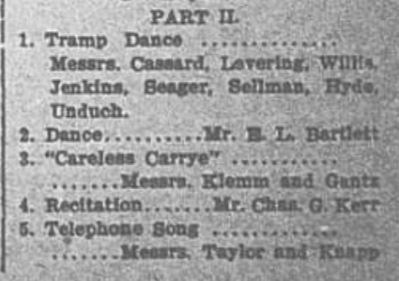
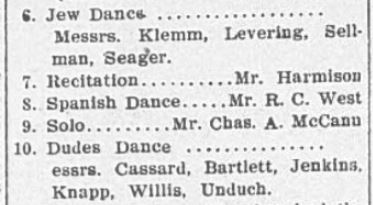
The P&P Club will be performing, “Don of Doraya”. (FWV 01.02.08 pg. 1)

FWV 01.06.08 - pg 1 - P&P show set 1FWV 01.06.08 - pg 1 - P&P show set 201.06.08 - pg 4 - P.P. show set list cont.

“The actors not only possessed talent along the lines assigned them so that they could perform their work well but by long, hard, careful, superior training and by faithful work they were able to bring out the best that was in them and they created and art eliminating all that was worthless and retaining all that was valuable. Truly the boys were there with the goods without one thread of shoddy in it.” (FWV 01.07.08 pg. 1)

“Program was a pleasing on throughout and was just the right length. It was not so short as to make the audience feel that it had been skimped nor was it so long as was thoroughly enjoyed by the large audience and the actors responded liberally to the encores.” (FWV 01.07.08 pg. 1)

“The clever impersonation of femininity by the whole cast was carried out to a high degree of perfection and to many they appeared as real girls.” (FWV 01.07.08 pg. 1)

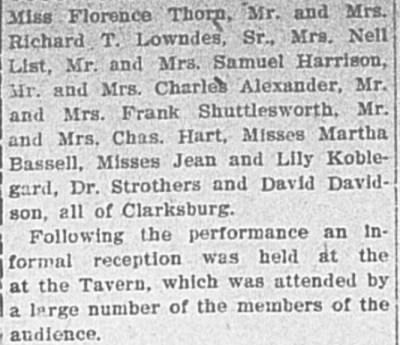
Some of the elite in attendance:

FWV 01.07.08 - pg 1 - P.P. Production - detail
FWV 01.07.08 – pg 1
FWV 01.07.08 - pg 5 - P.P show cont. - attendance detail;
FWV 01.07.08 – pg 5

Skinners tavern - fairmont - wvhistoryonview

“The Paint and Powder Club has been accustomed to playing in the east where art is amply rewarded by its favorable reception by the people, but since the boys have visited our city they are cognizant that our appreciation of their work is as keen as that displayed in the cities they play regularly.” (FWV 01.07.08 pg. 1)

Night

In Fairmont:

“The special mine investigating committee will arrive here tonight and will remain during the inquest.” (FWV 01.06.08 pg. 4)

The Paint and Powder Club performers are treated throughout the night. “Tonight after the show they will be entertained at the Elks’ Home on Main street.” (FWV 01.06.08 pg. 1)

FWV 01.04.08 - pg 1 - Paint and Powder lead
FWV 01.04.08 – pg 1
FWV 01.03.08 - pg 6 - Paint and Powder photo
FWV 01.03.08 – pg 6
FWV 01.04.08 - pg 1 - Paint and Powder Pres
FWV 01.04.08 – pg 1
FWV 01.04.08 - pg 5 - P&P photo
FWV 01.04.08 – pg 5


More on the Monongah Disaster of 1907

Introduction

Disclaimer and Guide

How Death Gloated!: A Timeline of the Monongah Disaster and Bloody December of 1907

Who is Guilty?: A Timeline of January 1908 and the Coroner’s Inquiry

Issues with the Monongah Timeline

Bibliography/Resources

About the Author

Contact Information

Monday, January 6, 1908, Afternoon

Afternoon

In Fairmont:

“Mr. Zack Robertson on Monday afternoon in the Masonic hall will deliver the last of his series of lectures ‘No matter how many you skin alive just so the company gains.’” (FWV 01.02.08 pg. 5)

1:30 pm

In Fairmont:

The Paint and Powder Club performers are brought to the brewery where a dutch luncheon was served (FWV 01.06.08 pg. 1)

Upon arrival, “the boys will each have one of…the ribbons of different colors pinned on their coat, with the understanding that everyone who comes up to them and says, ‘Hello, Careless Karrie,’ they’ll know they are about to become acquainted with a part of the best this State is so proud of…” (FWV 01.06.08 pg. 4)

afternoon session

Testimonies resume at the courthouse. “This afternoon the evidence was taken down by Mr. E. C. Frame.” (FWV 01.06.08 pg. 4)

Fairmont - Old & OO_large

01.06.08 - Inquiry - Burrett

J.J. Burrett, a physician and surgeon in Fairmont, volunteered immediately after the explosion and worked at #6 most of the time. He is examined by Att. Lowe.

Burrett states that the victims he saw showed marks of violence such as bruises, contusions, broken bones, lacerations, and missing limbs. “I think a majority of the men had their hair singed and some had large burns on their bodies, faces and hands.” (Inquiry)

Burrett believes he saw the first three men taken out of #6 and that “there was one of these bodies that didn’t look so much like it had been subjected to so much violence, but the others did.” However, he also admits that he is not positive that these same bodies were those of Cooper, Hinerman, and Harriman as he was not constantly present and “there might have been a few bodies taken out that I did not see.” (Inquiry)

He did examine victims who seemed to show signs of suffocation but he does not know where any of the bodies were found within the mine. (Inquiry)

He is “theoretically but not practically” familiar with the gases found inside of mines and their effect on the human body. He states that is very difficult to determine specific gases without a spectroscope but, at his best guess, carbon monoxide was the mostly likely culprit. “…if an individual were exposed to air containing one per cent of carbon monoxide, he would become sleepy and would probably sit down and die.” (Inquiry)

01.06.08 - Inquiry - Burrett 1

01.06.08 - Inquiry - Lenardo Dominico

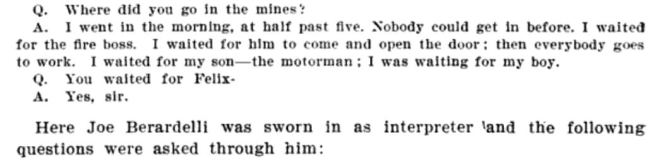
Lenardo Dominico, the son of Dan Dominico, is examined by Att. Lowe. They both escaped through the toad hole of #8.

Lenardo has worked in #8 mine since it opened, “about three years”. On the morning of the explosion, he says he went into work and found the mine open around 5:30 am. He worked alone on the 2nd right of 1st south in #8 then changed to 3rd left. He knows the fire boss that came in around 9 am, but he did not see any other bosses that morning. (Inquiry)

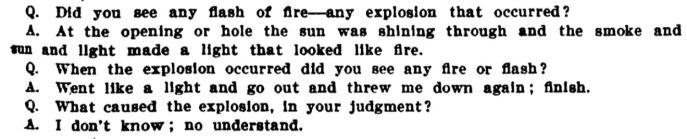
At the time of the explosion he states that “I never seen at all; I tried to get out, but couldn’t see—just knocked down.” He could only see smoke and heard “lots of noise” for about ten minutes. (Inquiry)

01.06.08 - Inquiry - Lenardo Dominico 1

He estimates that the toad hole was about 55 yards away from where he was working. Once he reached the surface, he and Jim Rogers went to the front of the mine. He states that Jim went in the mine again and brought out another victim around 11 am. Though he is not sure of the victim’s identity, the Fairmont West Virginian states it was the body of a Bice—more than likely William Bice, the fan engineer who was trapped beneath the wreckage of the #8 fan house. (Inquiry) (FWV 01.06.08 pg. 1)

01.06.08 - Inquiry - Lenardo Dominico 2

01.06.08 - Inquiry - Dan Dominico

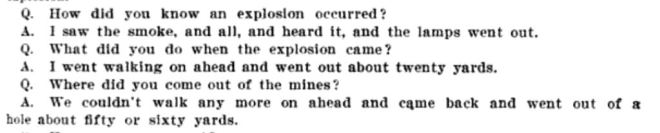
Dan Dominico has lived in Monongah for 17-18 years and was working in #8 with his son, Lenardo, at the time of the explosion. His entire testimony is given through interpreter Joe Beradelli. (Inquiry)

Dan says he didn’t see anything either nor did he hear any noise, he was just thrown down by the shock. However, he was hurt on his ear and arm when thrown down. (Inquiry)

01.06.08 - Inquiry - Dan Dominico 1

Dan states that he didn’t see any gas in the mine before the explosion and when it comes to ventilation in the mine: “Sometimes plenty of it and sometimes less.” (Inquiry)

Dan says that he went into the mine “by myself” that morning but he is not sure of the time as, “I didn’t have any watch.” He is also not sure if there were any other men already in the mine by the time he went in to work nor of the name of the worker or fire boss who came into his work area that morning. He can only say that, whoever it was, “he went away right away.” (Inquiry)

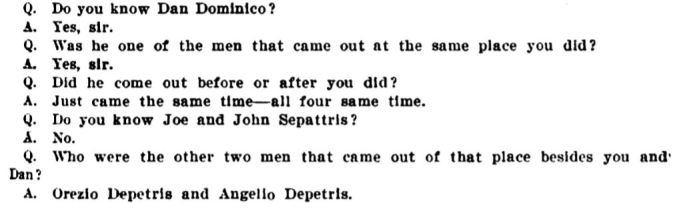
Att. Lowe asks Dan if he is aware of any other men ever getting in or out of the mine via the hole from which he and the other three men escaped and he simply replies that, “I don’t know if the other people were there before or not.” (Inquiry)

He knows of no other explosion within these mines prior to that of Dec. 6, nor does he know the cause of the explosions on that day. (Inquiry)

01.06.08 - Inquiry - Dan Dominico 2

01.06.08 - Inquiry - Angelo DePetris

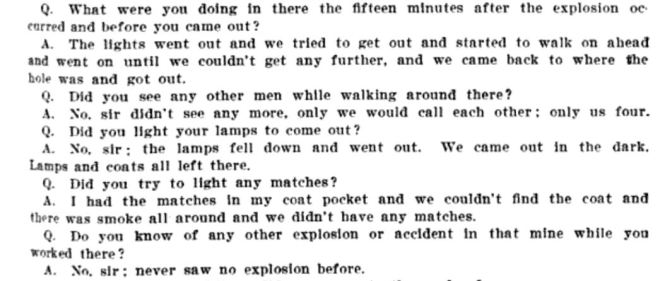
Angelo DePetris, brother of Crazic DePetris, is the last of the 4 men who escaped from #8 to be examined. Angelo has been in living and working Monongah “about eighteen or nineteen years” but had only been working in #8 for “about a month and a half” before the explosions. (Inquiry)

Almost right away, Angelo also encounters misunderstanding / misinterpretation issues with his testimony:

01.06.08 - Inquiry - Angelo DePetris 1

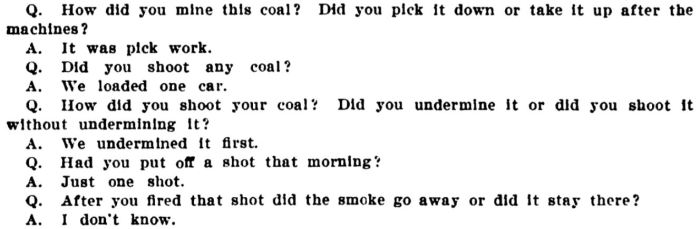
Att. Lowe moves on from that question and asks what type of work they were doing at the time of the explosion. “We had put a shot in and I was picking the coal down from the roof.” When asked about whether or not the smoke from the shot lingered in his area (a question of the ventilation), Angelo states that, “The smoke kind of went away; the air coming in the smoke kind of disappeared.” (Inquiry)

He says the explosion threw him down. He couldn’t find his cap or the light from it. His brother carried the matches and could not find them, so they were left in the dark. After that, they “Walked around to find a way to get outside.” (Inquiry)

01.06.08 - Inquiry - Angelo DePetris 2

01.06.08 - Inquiry - E.P. Knight

E.P. Knight has been the tipple foreman at #6 for “Three years in March.” He is examined by Att. Lowe. (Inquiry)

Knight tells the jury that, on the morning of the disaster, he “didn’t see anything of it,” and only saw a “good bit” dark brown smoke as it “came out of the air-shaft of No. 6. That was about 10:25.” (Inquiry)

He does not recall hearing any noise prior to the explosion but that the explosion itself sounded like “a dead shot some place—dynamite or something”. (Inquiry)

01.06.08 - Inquiry - E.P. Knight 1

Knight was not within sight of #8 mine as he was not on the tipple, but under it at the time of the explosions. He does recall the runaway trip of “About nineteen cars”, which he assumes were fully loaded, being around “50 feet beyond the knuckle” before they all fell back. (Inquiry)

01.06.08 - Inquiry - E.P. Knight 2

Inspector Paul asks if Knight feels that the trip had time to reach the bottom of the slope before he saw the smoke. He does not think it did. He also says he was not in a position to see any smoke coming out of the mouth of #6 because he started right up the steps of the tipple from which he could only see the smoke coming out of the air shaft.  He believes the smoke was coming out the air shaft for “five to eight minutes.” (Inquiry)

Paul also asks if Knight knows of any other time, prior to the explosions, when coal cars had broken loose and run back into the mines. Knight acknowledges that it has happened, though he cannot recall much about the last time it occurred other than going down into the mine and helping to clean it up. He guesses that it may have been 6 months prior to the explosions when this coupling hitch broke between the cars which sent them racing back into the mine though, “It didn’t do any damage; only broke some of the cars and tore up a little track.” However, the reporter in the courtroom for the Fairmont West Virginian includes that this runaway trip also tore down some wires. (Inquiry) (FWV 01.06.08 pg. 4)

In all he can only recall 2 loaded trips having broken loose and falling back into the mine, other than the train on the 6th. Other trips had broken loose but did not make it into the mine thanks to someone throwing the derailing switch. (Inquiry)

01.06.08 - Inquiry - E.P. Knight 3

Knight says he was able to look at the place where the cars broke “and saw the pin had broken.” (Inquiry)

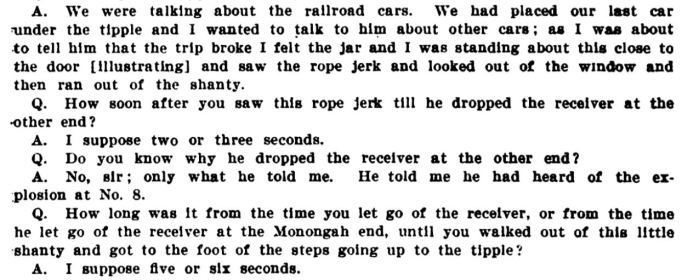
He also states that he was on the phone with Mr. Talbott in the company shipping department when the trip broke loose. (Inquiry)

01.06.08 - Inquiry - E.P. Knight 4

01.06.08 - Inquiry - E.P. Knight 5

Knight is also asked if he recalls the last car on that trip being a water car, but he does not. He states that he did, however, find the broken coupling pin and saw no defect in it or its iron at a glance. (Inquiry)

Knight stated that Talbott had “dropped the telephone” before they could finish their conversation. (Inquiry)

01.06.08 - Inquiry - E.P. Knight 6

It was at the foot of this set of steps that Knight first saw the smoke coming from the air shaft. He is then questioned about distances, stating that he heard a foreman say it was 900 feet from the top of the knuckle on the tipple to the foot of #6 shaft; 400 feet from the top of the knuckle to the pit mouth; from his view under the tipple, the rear car of the trip “looked” to be about 50 feet from the knuckle. Meaning that the cars “would have to run then about 1250 feet to the bottom of the slope”. (Inquiry)

Knight is the presented with wit a portion of a coupling pin and asked to identify it as “a part of the pin that you picked up”. To which Knight replies that, “It looks very much like it.” Knight pocketed the pin on the day of the explosion and gave it to Frank Morris later. (Inquiry)

01.06.08 - Inquiry - E.P. Knight 7

Knight confirms that he was working the tipple on the day prior to the explosion and that, yes, the fans were running in the mines but he does not know which of the fan men, Mr. Lambert or Mr. Snider, was running it. (Inquiry)

01.06.08 - Inquiry - E.P. Knight 8

01.06.08 - Inquiry - Levi Martin

Levi Martin is a laborer outside #6 where he “repairs cars and different things”. He has lived in Monongah for 15 years and at the time of the explosions he was home “near what is called the Willow tree; it is due west” of the mines. He is examined by Chief Mine Inspector Paul. (Inquiry)

Levi is asked about what first alerted him to the explosions. (Inquiry)

01.06.08 - Inquiry - Levi Martin 1

Levi does not know where this hole by the willow trees is located in reference to the mine workings below—“I was never in there and I don’t know anything about it”—but believes he saw smoke rising out around 10:30. He could not see #8 directly but saw the smoke rising. He says he did not see or hear anything from the direction of #6 until after he started over to #8; “I looked down there and saw smoke, but never heard any report down there.” (Inquiry)

01.06.08 - Inquiry - Levi Martin 2

Levi was last at work on the 4th of December and has been working at the mines for about three years. He states that he has no knowledge of any explosions in the mines prior to those of the 6th or of dust ever being “inflamed by an explosion at any time a trip of cars might have run back into the mine”. (Inquiry)

Mr. Alexander asks Levi again about the toad hole. “I think that’s what it is—there by the school house; a drilled hole.” He includes that the hole was recently drilled and just beyond the school house.” (Inquiry)

01.06.08 - Inquiry - Levi Martin 3

01.06.08 - Inquiry - Carl Meredith

Carl Meredith is the foreman for #8 tipple. He is examined by Att. Lowe. (Inquiry)

Carl came into work at the #8 tipple, across the river from #8 mine, around 6:30 on the morning of the 6th but he did not notice if the fan was running in the mine. (Inquiry)

01.06.08 - Inquiry - Carl Meredith 1

He did not see anything from #6 nor is he sure he could even see #6 from his position on the #8 tipple. He states that he saw the timbers and debris flying in the air before he heard the report. He can also state that he did see fire among the smoke at #8. However, he never looked in the directions of #6; “I didn’t think anything about No.6”, so he can not say that he saw smoke coming from that mine. (Inquiry)

01.06.08 - Inquiry - Carl Meredith 2

Levi states that he first thought the boiler for #8 had blown up until he “saw the timbers and brick falling and it was only just an instant until I saw the smoke and knew it was the mine.” He has no knowledge of any prior explosions in the mine nor does he have any working association with #6, only #8. (Inquiry)

01.06.08 - Inquiry - Hyre Stalnaker

Hyre “Harry” Stalnaker is a laborer/carpenter for #6 who has lived in Monongah around 5 years. He was working in #8 shop, across the river from the mine “down toward the tipple from the barn”, on the day of the explosions. He is examined by Inspector Paul. (Inquiry)

Hyre is asked if he was looking at the mine at the time of the explosion. “Well, I can’t say I was, in the first place. I was in the shop not expecting anything like that; when I came to myself I was in line with the mouth of the pit.” The force of the explosion “shocked” him; “nearly stunned”. (Inquiry)

01.06.08 - Inquiry - Hyre Stalnaker 1

Hyre says that immediately following this, he rushed across the bridge to “rescue who might be over there. It was a very short while.” He also did not see or hear anything from the direction of #6 mine. (Inquiry)

Hyre states that he did find Joe Newton on the bridge to #8. (Inquiry)

01.06.08 - Inquiry - Hyre Stalnaker 2

Hyre found George Bice, fan engineer, trapped beneath debris “down next to the street car line. He was lying outside the wall.” Hyre did hear that George did not survive. (Inquiry)

01.06.08 - Inquiry - Hyre Stalnaker 3

Mr. Alexander asks if any of the stone, brick, or other debris from the explosion injured the carpenter shop in which he was working. (Inquiry)

01.06.08 - Inquiry - Hyre Stalnaker 4

He is asked if that occurred before or after he heard any noise or shock but he says it al seemed to happen “about the same time to me.” He says that the shock “caused the iron and everything to give in the shop and the widows to break out. Of course a person couldn’t realize the difference between the times.” (Inquiry)

Hyre confirms that a piece of the large fan at No. 8 was blown across to his side of the river. (Inquiry)

01.06.08 - Inquiry - Hyre Stalnaker 5

01.06.08 - Inquiry - Lee Curry

Lee Curry is the stationary engineer for #8 who was running the hoisting engine for the rail cars that morning. He has lived in Monongah since 1900. He is examined by Inspector Paul. (Inquiry)

Curry was in the engine house at the time of the explosion and could not see the mine but knew something was wrong when the glass broke out of the window “in the house next to the tipple”, but he thought something had occurred with the boiler. “I went out of the house and started around the house to go to the boiler house.” (Inquiry)

01.06.08 - Inquiry - Lee Curry 1

Though he did not hear anything from the direction of #6, he did see smoke coming out and going into the air. (Inquiry)

01.06.08 - Inquiry - Lee Curry 2

Lee figures that it was only five or six seconds between the time he felt the jar and saw smoke coming out of #6 mine as he “only had about twenty-five to thirty feet to go” to the boiler house. He saw the smoke from #8 “as soon as I could get out” from the carpenter shop. (Inquiry)

But Lee could not see #6 mine directly from his location, only “directly over the mine” and the area around 75 feet in front of the mine mouth. (Inquiry)

He states that he noticed smoke coming from the toad holes around St. Stanislaus Catholic church before seeing smoke at #6 but he thinks that smoke first came from #8. (Inquiry)

01.06.08 - Inquiry - Lee Curry 3

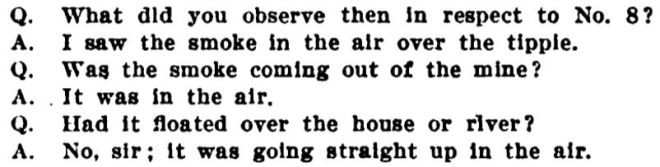
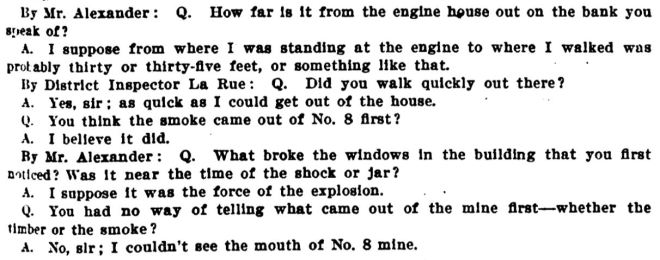
Lee tells Inspector Paul that he saw the smoke over the tipple first. “I ran out on top of the bank facing up toward the church and No. 6 and when I got out there I saw the smoke coming out of the hole and as I looked down at No. 6 the smoke whirled up in the air.” He estimates this bank was about 30-35 feet from the engine house by which he was standing. (Inquiry)

Lee says that the toad hole of which he is speaking is actually “a slope to take the horses in at” though he is not sure if it is supported with timbers. (Inquiry)

01.06.08 - Inquiry - Lee Curry 4

01.06.08 - Inquiry - Peddicord

George E. Peddicord has been the outside foreman for #8 for about 6 months and has never worked inside either of the mines. He is examined by Att. Lowe. (Inquiry)

George was on the approach leading to the East end of the Iron Bridge at the time of the explosions. “I had been down to the supply house for chain buckets, and was coming up to No. 8 on the west side of the river.” (Inquiry)

George first noticed the “earth shaking” but not a “loud report—a rumbling noise” from up river toward #8. He then saw timbers and debris in the air “right above” the area he knew was #8 mine, though he could not directly see the mouth. (Inquiry)

He looked at No. 6 “as soon as No. 8 went off” and saw smoke coming out of the air-shaft at #6. He can not say how long the smoke continued to pour out of the mine; “I didn’t look; I knew the mines had exploded and went across the river up to my home and then to No. 8 mine.” He did not notice any flame but did see a distinctive difference between the color of the smoke emitting from each mine— “The smoke that came out of No. 8 was black and that which came out at No.6 was a reddish brown.” (Inquiry)

George was within sight of the #6 tipple but did not see the runaway trip of cars. (Inquiry)

01.06.08 - Inquiry - Peddicord 1

Inspector La Rue asks about the length of time George estimates that he saw the smoke appear between the two mines to which he responds, “Not more than a second.” (Inquiry)

George restates that he did not see smoke coming from #6 mouth because he could not see the mouth, only the smoke coming from the air shaft and confirms that smoke from one mine was black and that from the other was brown in color. (Inquiry)

He estimates that he arrived back at #8 mine in about 10 minutes. There was no steam coming out of the boilers when he arrived. (Inquiry)

Att. Lowe inquires about any former explosions or accidents at these mines but George knows of none. “I had nothing to do with the inside; I was an outside man.” (Inquiry)

George states that he had been at #8 that morning and that Will Bice was running the fan; “the fan ran all the time.” He also states that, though #8 did not technically run the day before the explosions, he was at work on the 5th with many others, including William Bice who was running the #8 fan. “Alvy Yost worked the night shift.” (Inquiry)

Inspector Paul asks if George had charge of the livestock outside of the mine but George says those duties fell to the general foreman, Charlie Dean. (Inquiry)

01.06.08 - Inquiry - Peddicord 2

01.06.08 - Inquiry - Will Jenkins

Will Jenkins has been a blacksmith for FCC at the #6 mine for about “seventeen months”. He is examined by Att. Lowe. (Inquiry)

Will arrived at work around 6:40 am that morning. He had gone into the mine before the explosions occurred to shoe a horse. (Inquiry)

01.06.08 - Inquiry - Will Jenkins 1

Will estimates that he was inside the mine “about half an hour—a little bit longer than that probably.” He also estimates that he had only be out of the mine 15 or 20 minutes before the explosions occurred. While inside, he did not notice any evidence of gas and that the ventilation was “Good. I made a remark to myself about my lamp nearly blowing out two or three times.” (Inquiry)

Will says there was a horse waiting to be shod in the blacksmith shop, some 25-30 feet down river from the mine, so that is where he went after coming out. He had only gotten one shoe on and was reaching around to pick up the next shoe when the explosion happened. (Inquiry)

01.06.08 - Inquiry - Will Jenkins 2

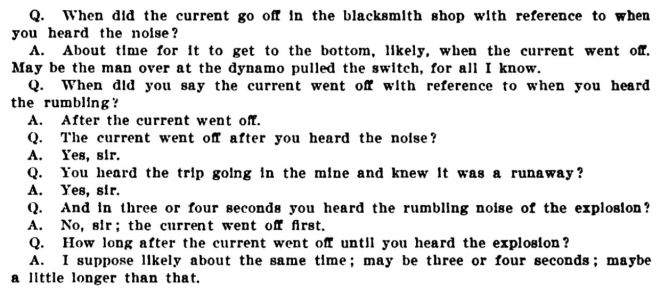
Even though Will is not familiar with the exact numerical distance it is “from the bottom of the slope to the bottom of the mine” he believes that the trip of cars “must have gotten to the bottom, for the power went off at the blacksmith shop.” (Inquiry)

01.06.08 - Inquiry - Will Jenkins 3

Will confirms that he knew the trip of cars must have been a runaway trip and that it was accompanied by an “unusual noise”. (Inquiry)

01.06.08 - Inquiry - Will Jenkins 4

Will says it was about 2-3 seconds between the time the power went off in the shop and smoke started coming out of the mine and again confirms that he believes that the trip of cars had enough time to reach the bottom of the mine. (Inquiry)

01.06.08 - Inquiry - Will Jenkins 5

Will says he saw no flame, just a steady blow out of smoke with a “kind of sootish color” and no return. (Inquiry)

Inspector Paul asks how long it took Will to get from the blacksmith shop to the mouth of #6 mine. Will says he was “right over the mouth while it was still blowing” but he heard no other noise after the one he first heard in the shop. Inspector La Rue asks is the rumblings were steady or jerky “as if explosions were going on at different places”. But Will is not sure, he says he was pinned down under the horse and was struggling to get out at first. (Inquiry)

Will is asked about the quality of ventilation in the areas that he worked inside of #6 that morning, if it was “fully as good as at any time prior?” Will recalls it as being even better that morning, “I remember of pulling the wick up out of my lamp three or four times on account of the current.” (Inquiry)

He says he did not walk in and out of the mine that morning but, instead, took the motor. (Inquiry)

01.06.08 - Inquiry - Will Jenkins 6

Will states that based on “the way it was going past”, he figured the trip must have reached the bottom. He is not sure exactly how many feet it is to the bottom of the slope and he guesses 500 feet or more. (Inquiry)

01.06.08 - Inquiry - Will Jenkins 8

Will is asked if he stopped shoeing the horse when he heard the runaway trip go by but Will says he could not as he was already down under the horse. “The trip going by scared it. He was still tramping around over me when the explosion occurred. I didn’t see the first start of it, but felt the jar of it.” (Inquiry)

01.06.08 - Inquiry - William Finley

William Finley is the “Town Sergeant” for Monongah. He is examined by Inspector Paul.(Inquiry)

At the time of the explosions, Finley was “standing on the street by the coal company’s office, at the south side of it” where he could see # 8 mine. He says he “heard a report of some kind up the river like a heavy blast and I seen smoke coming up over the bridge at No. 8.” He noticed smoke coming out of #6 afterward, 4-6 seconds later “or something like that.” (Inquiry)

Finley did not see or hear the runaway trip of cars at #6. (Inquiry)

01.06.08 - Inquiry - Peter Urban

Peter Urban (Rosebeig) is the only man to survive rescue from the mines. He is examined by Inspector Paul. (Inquiry)

01.06.08 - Inquiry - Peter Urban 1

Peter has lived in Monongah on No. 3 hill for around 6 months. He went into work around 6 am on the morning of the explosions and began work in 1st Right off the 1st heading. He is asked if anything “unusual” occurred in the mine. “I know nothing what happened.” (Inquiry)

01.06.08 - Inquiry - Peter Urban 2

When asked if the force of the explosion extinguished his light he replies, “I don’t remember; I was so frightened I don’t remember anything.” However, his brother, Stan did have a light. (Inquiry)

01.06.08 - Inquiry - Peter Urban 3

Peter states that he does not know what caused the explosion. He says he has, however, encountered gas in the mine before, but not on the day of the explosion. “It was some time before. At this time we were driving a heading and gas and water came in. We were driving a hole—I suppose high up—and gas and water came.” (Inquiry)

01.06.08 - Inquiry - Peter Urban 4

Peter says that he encountered this gas no more than 3 days prior to explosions, but they were told to stay. He states that there was “bad air” on the heading they were working on and that gases were “allowed” to accumulate “after the firing; after we fired them there would be heat and here and there a little flame burning of the gas.” Peter says he has never been burned or harmed from the lighting of these gas traces. (Inquiry)

01.06.08 - Inquiry - Peter Urban 5

Peter says this occurred at the end of a North entry heading in the 7th room, though he is not sure exactly which heading as it is not one he goes to very often, but he did see the horse and aftermath in person as they came through, “…they said it had been killed by an explosion.” (Inquiry)

Peter states that no human was injured in the event and that the carcass was buried at night; “It happened about 8 o’clock in the morning, about in the evening.” (Inquiry)

01.06.08 - Inquiry - Peter Urban 6

Peter is not sure who exactly buried the horse other than “it was someone from the company pulled him out and buried him.” However, Peter says that no one told him the horse had been burned, he saw it with his own eyes. “I saw the horse that was burned and then I heard he was hurt from others; he was burned by gas. When I went down to the mine we passed the horse.” (Inquiry)

Mr. Alexander, a lawyer for FCC, asks about the color of the horse but Peter replies that he couldn’t really see the color of the horse in the mine, “and after he was buried I couldn’t tell.” When asked about why he knows that the horse was buried, Peter says that he also saw this with his own eyes as it was buried “near the No. 3 mine where they buried the other horses now”, meaning those who perished in the disaster. (Inquiry)

When asked if he could point out this grave, Peter says if he couldn’t, his wife probably could, and that “right next to this horse they buried the other horses.” (Inquiry)

01.06.08 - Inquiry - Peter Urban 7

Mr. Alexander makes Peter run through the questioning again:

01.06.08 - Inquiry - Peter Urban 8

Peter says that Stan told “John, the boss” about the gas and water they encountered the same week that it happened and that they couldn’t work in that area; “Not the old one—but the tall one—the big boss.” (Inquiry)

At some point, Italian Consulate, G.D. Caldera, storms out of the courtroom in protest of Mr. Alexander’s aggressive attacks against the witness. (McAteer)

01.06.08 - Inquiry - Peter Urban 9

COURT IS ADJOURNED UNTIL TOMORROW


More on the Monongah Disaster of 1907

Introduction

Disclaimer and Guide

How Death Gloated!: A Timeline of the Monongah Disaster and Bloody December of 1907

Who is Guilty?: A Timeline of January 1908 and the Coroner’s Inquiry
Issues with the Monongah Timeline

Bibliography/Resources

About the Author

Contact Information

Monday, January 6, 1908, Morning

5:30 am

Engine No. 1779, helper on the B&O between Piedmont and Altamont blows up. Engineer Frank Smith was buried under debris and it was thought at first that he was killed, but he was gotten out alive. The fireman jumped or was thrown off and escaped unhurt. Traffic was delayed several hours, No. 8 getting to Clarksburg about 4 hours late.  (FWV 01.06.08 pg. 5)

During the Morning

The Paint and Powder Club performers arrive in Clarksburg “this morning on train No 3 and they there boarded a special and were brought to Monongah…” (FWV 01.06.08 pg. 1)

In Monongah:

George T. Watson is in charge of keeping the men of the theatrical company entertained and is “arranging a trolley trip to show points of interest and Mr. Brooks Fleming is going to show them the disrupted Monongah mines, take them on a trip into New England (mines) and give them an idea of the intricacies encountered in the mining of coal before it reaches their furnace doors, a lecture as only a Princeton man like himself can give.” (FWV 01.02.08 pg. 5)

“Dr. Hugh Carr, now of Fairmont, met many of these boys when he was a member of Cornell’s Silk Stocking Vendettas, an organization on the same lines, and the doctor now will be right on hand to give first aid to those of the boys who may perchance imbibe too freely of the Monongahela river water and if any of them are stung by the snakes around the mines he has a barrel of a special rubber glove 3 ply killer variety locked up in his office which he will administer freely to those bitten only.” (FWV 01.02.08 pg. 5)

At the mines:

8-fan


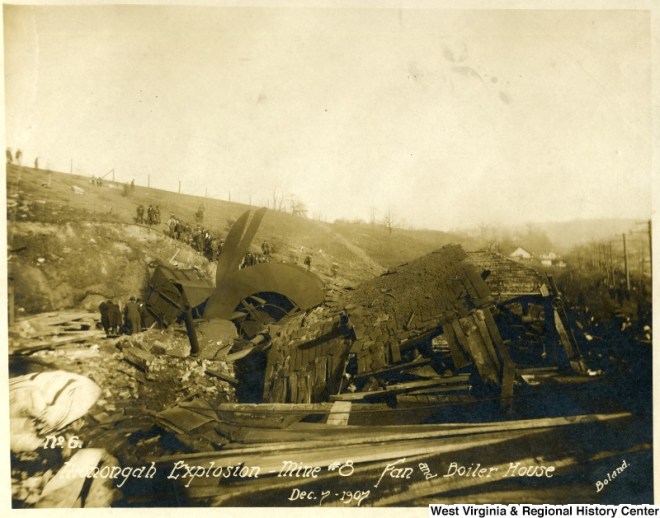
Work begins on the foundation for the “big fan that will be rebuilt at Monongah mine…”. The trenches for the concrete work have been dug. The damaged pieces have been shipped to Connellsville, where they will be remolded and when finished, which will take about two weeks, will be shipped back here. It will take about a month before the fan will be in working order. (FWV 01.06.08 pg. 5)

~9:00 am

In Fairmont:

Fairmont West Virginian reports that the weather will be: Rain or snow tonight and Tuesday; warmer tonight.Fairmont - Old & OO_large

Coroner E.S Amos and his selected jury: W.E. Corday, G.H. Richardson, A.S. Prichard, Festus Downs, J.M. Jacobs, and W.S. Hamilton meet at the Marion County Court house and prepare for the first day of hearing evidence from witness testimony. (Inquiry)

~10:20 am

In Fairmont:

FWV 01.06.08 - pg 1 - headline

“The presiding investigators are Coroner E.S. Amos, Prosecuting Attorney S.S. Lowe and State Mine Inspector J.W. Paul of West Virginia.” (ES 01.06.08 pg. 1) (Inquiry)

George W. Alexander, Charles Powell, and Harry Shaw—lawyers for the Fairmont Coal Company—are also among the investigators. (Inquiry)

“M. Tomasko, of Connellsville, Pa., representative of the Slovish Catholic Union and C.L. Orbach, of New York, representative of the Slavish Evangelical Union, P. Bufano, of Connells, and M.G. Bufano, of Morgantown are here.” (FWV 01.06.08 pg. 4)

Over the next several days, “Fully one hundred witnesses will give testimony…”  (FWV 01.06.08 pg. 1)

“The evidence this morning was taken down in shorthand by Miss Nellie Bly Clemmer.” (FWV 01.06.08 pg. 4)

E.C. Frame was also sworn in “to take in shorthand and transcribe all the evidence of witnesses.” (Inquiry)

“The evidence will be transcribed to long hand as fast as the stenographers can do it.” (FWV 01.06.08 pg. 4)

01.06.08 - Inquiry - Gibbons

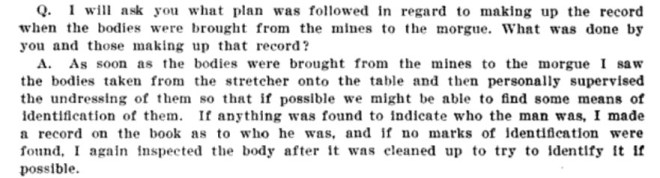
George S. Gibbons, payroll clerk for FCC who assisted the coroners with keeping the record of the dead at the morgue, is examined by Prosecuting Attorney Lowe. (Inquiry)

Gibbons was present when the bodies were taken from the stretcher and he personally superintended the work of making inquiries as to the identity of each victim. He was in turn assisted by Mr. Charles Rabson and Mr. S.J. Brobst.  (Inquiry) (FWV 01.06.08 pg. 1)

01.06.08 - Inquiry - Gibbons 1

A detailed record was kept and a number given each body as it came into the morgue, “…afterwards when the name of the party was ascertained the name was written opposite the number”. Att. Lowe hands Gibbons a copy of this record book, “made there by you and those assisting you”, and Gibbons confirms that this is an accurate list of those who died in the disaster, so far as he knows. (Inquiry) (FWV 01.06.08 pg. 1)

01.06.08 - Inquiry - Gibbons 2

01.06.08 - Inquiry - Brobst

S.J. Brobst, who assisted the coroners and George Gibbons in making records at the morgue, is examined by Attorney Lowe. Brobst has little to contribute other than acknowledging that he assisted in the morgue with these details, that he made the most of the records himself—”put down the facts”, and that they “tried our very best” to give ample time for identification and correct names for the bodies. (Inquiry)

01.06.08 - Inquiry - Rabson

Charles A Rabson, clerk for 2 years at Fairmont Coal Company office in Monongah, is examined by Att. Lowe. Rabson issues the store checks on the company store in Monongah and was aquainted with the miners who worked in #6 & #8.

Rabson helped the coroners and Gibbons ID the dead and states that all the information he obtained was placed in the main record. (Inquiry) (FWV 01.06.08 pg. 1)

01.06.08 - Inquiry - Amos

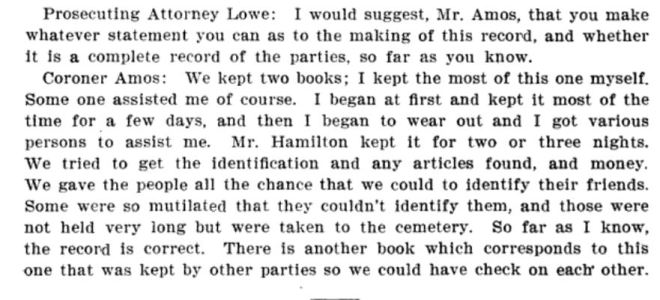
E.S. Amos, coroner for Marion County, adds his testimony to the record.

01.06.08 - Inquiry - Amos 1

01.06.08 - Inquiry - Dr. HillF. W. Hill, a physician in Fairmont who volunteered at #8 immediately after the explosions is examined by Att. Lowe.

Dr. Hill “rendered assistance to the relief corps that were overcome by the gas, and as the bodies were brought out (of #8) I looked after them.” (Inquiry)

Dr. Hill is the physician who examined Peter Urban (Rosbieg) and believes he did so around “2:30 ‘clock”.  Peter is the only living man brought out of the mine which he saw and at the time Peter’s pulse was very weak and “he was not rational. He was in a condition of shock”. He went back on Sunday, the 8th, to examine Peter again and “found him improving”. (Inquiry) (FWV 01.06.08 pg. 1)

Att. Lowe asks for Dr. Hill’s opinion as to the cause of this state of shock.

01.06.08 - Inquiry - Dr. Hill 3

Dr. Hill also states that the some of the victims were badly mutilated or burned which “showed that they had come to their death by an explosion—by violence—probably due to the explosion or other cause” while others were not. (Inquiry)

01.06.08 - Inquiry - Dr. Hill 1

Inspector Paul asks about those that died from asphyxiation but Dr. Hill states that he did not examine them close enough to determine what gases caused death, nor is there a quick or easy way to determine what gases caused death to each individual. (Inquiry) (FWV 01.06.08 pg. 1)

01.06.08 - Inquiry - Crazic DePetris

Crazic “Orazio” DePetris is one of the four men who escaped from the toad hole in #8. He is examined by Att. Lowe.

Crazic tells Att. Lowe that he first came to Monongah in 1889 and did pick work in the mines but had to go back to the old county for four years to care for his wife while she was sick, having only returned a few summers ago—“two years next June”. (Inquiry)

He tells Att. Lowe that on the morning of the explosion he was in the mines with his brother, Dan, and his son, Felix.  (Inquiry)

01.06.08 - Inquiry - Crazic DePetris 1

Crazic testifies that he began work in 2nd right south, room 15, in #8 until he was stopped and sent to work in an area he had never worked before, left south. He was able to make a cut, shoot down the coal, and load a car before the explosion happened. They were working about 50 yards from the toad hole where he and 3 others made their escape. (Inquiry) (FWV 01.06.08 pg. 1)

01.06.08 - Inquiry - Crazic DePetris 2

At this point, either Crazic or his interpreter, Joe, mistakenly list Crazic’s son, Felix, among the men who escaped through the toad hole. He states that he and his brother, Dan, were working “in the right room, and the others were about from here to the wall, but all in one room.”

Inspector Paul asks Crazic about the ventilation in his area but Crazic says he “didn’t notice any change, because it was the same as other places.”

01.06.08 - Inquiry - Crazic DePetris 3

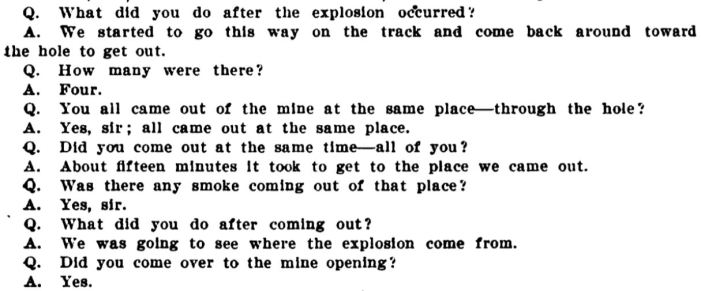
Crazic estimates he was in the mine about 15 minutes after the explosion until the time he escaped. Inspector Paul asks if he knew the fire boos working at the time. Crazic did and says that “he came in and left us about ten minutes before the explosion”, but could not recall his name. Paul also asks about encounters with gas in the mines, to which Crazic replies that he has never seen any.

01.06.08 - Inquiry - Crazic DePetris 4

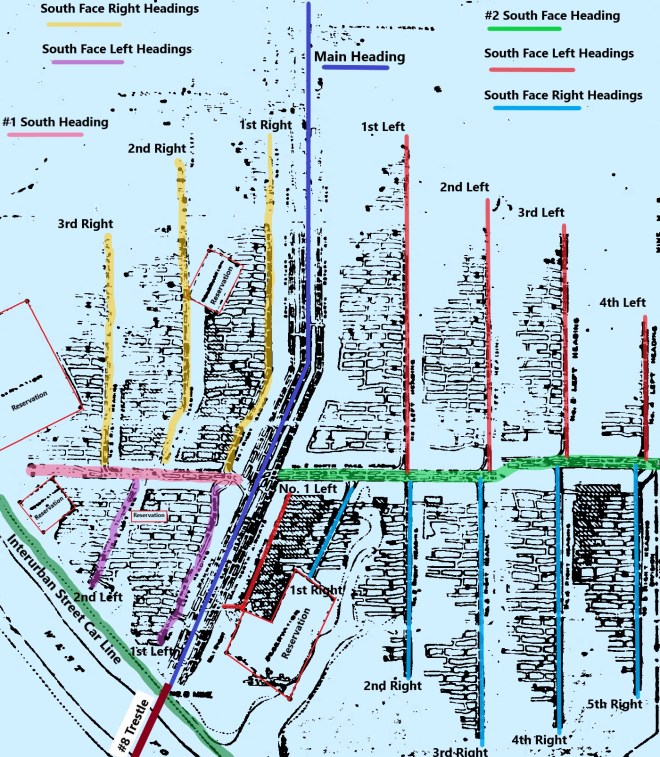
A juror asks Crazic about the location of the toad hole from which he and the others escaped. He is provided with a map and Mr. Alexander asks him to point out this location on the map. (Inquiry)

#8 map - marked

01.06.08 - Inquiry - Crazic DePetris 5

Crazic says he can not read English but “didn’t see” the fire boss’s blackboard when he went into work that morning, He also says that the gate to the mine shaft was closed prior to 5:30 am and that the fire boss must have opened it on his way out, as Crazic found it open upon his arrival. (Inquiry)

01.06.08 - Inquiry - Dr. CookJ. R. Cook is a physician and surgeon who volunteered outside of both #6 & #8 mines the day of the disaster and for several subsequent days following. He is examined by Att. Lowe. (Inquiry) (FWV 01.06.08 pg. 1)

Dr. Cook states that many victims, nearly every one he saw, showed marks of violence such as burns—the hair, the clothing, and skin scorched on many. He reinforces that this is only among those that he saw as he was “not in constant attendance”. He did not, however, see any who appeared to have suffocated, only those who “showed some marks of violence, like something thrust against them or something. In nearly every instance there was some injury.” (Inquiry)

Dr. Cook stated he did not hold any post mortem examinations, that there could not have been any special benefit gained by the post mortem; “If I had thought so I would have made a special effort and had the post mortem.”

He states that the matter of holding such an examination was discussed, but it was given up because “there could not be anything specially derived from an examination at that time.” (Inquiry) (FWV 01.06.08 pg. 1)

Dr. Cook was present and examined the first 3 men brought out of #6—Fred Cooper, John Harriman, and Lawrence Hinerman who were found in the cabin at the foot of #6 slope. He says that their bodies “were considerably bruised and there was some singeing of the hair.” He recalls that their faces were bruised and that one of the men “had very considerable bruises along the body.” (Inquiry)

01.06.08 - Inquiry - Dr. Cook 1

Recess is called until 1:30 pm


More on the Monongah Disaster of 1907

Introduction

Disclaimer and Guide

How Death Gloated!: A Timeline of the Monongah Disaster and Bloody December of 1907

Who is Guilty?: A Timeline of January 1908 and the Coroner’s Inquiry
Issues with the Monongah Timeline

Bibliography/Resources

About the Author

Contact Information

Sunday, January 5, 1908

During the Day

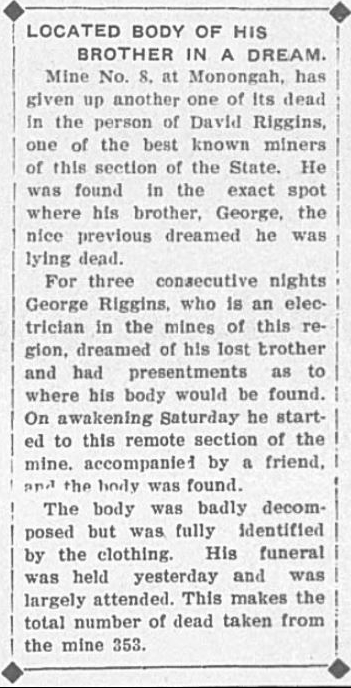
The funeral for David Riggins is “largely attended”. (FWV 01.06.08 pg. 1)

~6:00 pm, News Hour

New York Tribune:
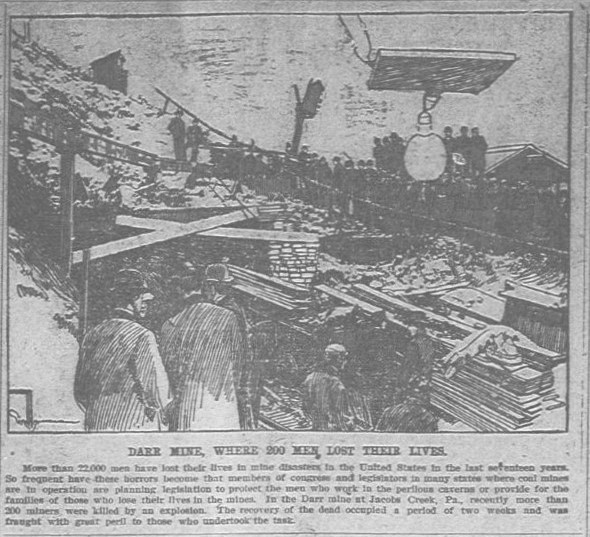
NYTb 01.05.08 - pg 5 - Darr
NYTb 01.05.08 – pg 5
Evening Star in D.C.:
ES 01.05.08 - pg 12 - Darr
ES 01.05.08 – pg 12

Night

In Baltimore:

The Paint and Powder Club performers leave for Fairmont.

“For the last three weeks the members of the Paint and Powder Club have been holding three rehearsals daily and took their parts up until time of the train’s departure from Baltimore and no part of the programme has been scamped” (FWV 01.06.08 pg. 1)

“President Murray, of the Baltimore and Ohio R.R., through his assistant, Mr. Geo. M. Shriver, has tendered to the committee free transportation and special cars, leaving Baltimore…Sunday night on No. 3 and arriving in Fairmont, Monday. Returning, leaving Fairmont on No. 14, Tuesday.” (FWV 01.02.08 pg. 5)

Instructions have been given to “division superintendents along the line of route to instruct their forces to do everything possible to make the trip pleasant, to even putting on extra air on the curves and not bantering loud words with passing crews as that tends to make the ‘girls’ hysterical and unfit for work.” (FWV 01.02.08 pg. 5)

FWV 01.04.08 - pg 1 - Paint and Powder lead
FWV 01.04.08 – pg 1
FWV 01.03.08 - pg 6 - Paint and Powder photo
FWV 01.03.08 – pg 6


More on the Monongah Disaster of 1907

Introduction

Disclaimer and Guide

How Death Gloated!: A Timeline of the Monongah Disaster and Bloody December of 1907

Who is Guilty?: A Timeline of January 1908 and the Coroner’s Inquiry
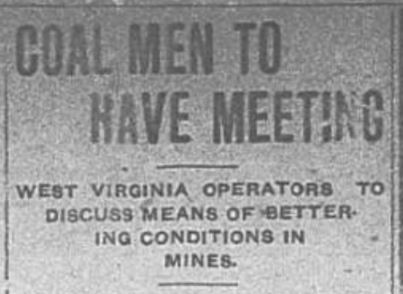
Issues with the Monongah Timeline

Bibliography/Resources

About the Author

Contact Information

Saturday, January 4, 1908

Morning

In Fairmont:

The Fairmont West Virginian reports the weather as: rain or snow and colder tonight; Sunday fair and colder

George Riggins, an electrician in the mines of the region, awakes after having dreamt for the past 3 nights about his brother, David, whose body is still in Monongah mines. David Riggins was one of the best-known miners of this section of the State. (FWV 01.06.08 pg. 1)

In Monongah:

George Riggins has some presentments as to where his brother’s body will be found. He starts to this remote section of the mine with a friend and the body was found in the exact spot where George dreamed David was lying dead. The body was badly decomposed but was fully identified by the clothing. (FWV 01.06.08 pg. 1)

This brings the number to 353. (FWV 01.06.08 pg. 1)

During the Day

Paul U. Kellogg publishes his article on the days he spent in Monongah after the  disaster in the January edition of Charities and Commons.

title image

In Fairmont:

The Grand Opera House produces a Matinee performance of  “A Pair of Country Kids”; “…one of the best country comedies of the day…”.  (FWV 01.03.08 pg. 2 & 8)

The Grand Opera House - Fairmont

~6:00 pm, News Hour

Fairmont West Virginian:
FWV 01.04.08 - pg 2 - jokes
FWV 01.04.08 – pg 2
FWV 01.04.08 - pg 2 - nevada miners entombed
FWV 01.04.08 – pg 2
FWV 01.04.08 - pg 2 - P&P show
FWV 01.04.08 – pg 2

“By far the most pretentious entertainment ever attempted in this part of the State will be the performance of the Paint and Powder Club…The fact that Governor Dawson and the members of his staff are coming…and that tickets are being sold at most of the larger cities in the State is sufficient to prove the importance of it. With the box prices at $100 and the seats each $3, the P.P. Boys must put on a superb show or they could not get the patronage. Again, we all know that Mr. C.W. Watson, who spends much of his time in Baltimore, would not vouch for the show were it not strictly of high order; neither would the Baltimore and Ohio Railroad Company transport free of charge a troupe…” (FWV 01.04.08 pg. 4)

“There are hundreds of people in Fairmont who have not yet contributed anything for the relief of the widows and orphans of the near neighbors at Monongah and this will give them opportunity to aid the sufferers and at the same time spend a most enjoyable evening. The entire receipts of the performance above the actual expenses will be turned over for the relief of the unfortunate people at Monongah, so this is a good way to turn in a small amount for their assistance.” (FWV 01.04.08 pg. 4)

FWV 01.04.08 - pg 5 - P&P photo
FWV 01.04.08 – pg 5
FWV 01.04.08 - pg 8 - Cresko_Kresko Fudiciary - Hungarian
FWV 01.04.08 – pg 8
FWV 01.04.08 - pg 8 - Duresz_Durectz Fudiciary - Hungarian
FWV 01.04.08 – pg 8
FWV 01.04.08 - pg 8 - Ignocok_Ignacsak Fudiciary - Hungarian
FWV 01.04.08 – pg 8
FWV 01.04.08 - pg 8 - Stopiro_Stofira Fudiciary - Hungarian
FWV 01.04.08 – pg 8
Clarksburg Daily Telegram:
CDT 01.04.08 pg 1 - govt. contributes
CDT 01.04.08 pg 1
CDT 01.04.08 - pg 8 - officials coming
CDT 01.04.08 pg 8
The Socorro Chieftain in New Mexico:

TSC 01.04.08 - pg 1 - Bernal - detail 1

“Death in one of its most gruesome forms lurked in the Bernal mine of the Carthage Fuel company at Carthage during the losing hours of the old year.” (TSC 01.04.08 pg. 1)

“The cause of the catastrophe is believed to have been what coal miners know as a ‘wind shot’. This means that a shot put in to break down a quantity of coal for removal later did not explode in the usual fashion but merely fizzled, raising a cloud of highly combustible coal dust. This dust was doubtless ignited by the explosion of another shot and instantly death had done its gruesome work.” (TSC 01.04.08 pg. 1)

“On every hand were abundant evidenced of the terrific force of the explosion. The bodies of some of the dead were blown against the walls of the mine with such a force as to flatten them almost beyond, recognition. In one instance, at least, a dead body was identified only by particles of clothing adhering to the mangled flesh. The body of one miner who was coming out of the mouth of the mine was shot a hundred yards into the air as from the mouth of a cannon and nearly all the bones in it were broken by the fall. In the case of some of the injured, small stones were driven into their flesh like bullets and had to be extracted with the surgeon’s knife.” (TSC 01.04.08 pg. 1)

“Even the sound of the explosion spread terror throughout the mining camp. It must be left to the imagination to picture the distressing scenes which followed. It was no time for the useless wringing of hands, however, for the living in the mine, if any, must be rescued from the jaws of death. Heroic rescue work was done by W.L. Weber, mine superintendent, and by many others. Doctor Bacon, company surgeon, worked like a Trojan to save and relieve the injured, and women were not lacking to aid him heroically at his task. Willing hands and sympathetic hearts were everywhere to care for the dead, and minister to the necessities of the living victims of the awful disaster.” (TSC 01.04.08 pg. 1)

“The latest report from Carthage is to the effect that all the six injured miners will recover, except Villanuza, whose chances are not considered good. The company officials are doing all they can in caring for him and the other injured, and are sparing in no expense in providing for the future of the bereaved families. All the mines of the camp were shut down on New Year’s day on account of the funerals, but have since resume operations at the request of the miners themselves, who thin work the best means of relieving the nervous strain under which they have been since the disaster. The mine was not injured by the explosion.” (TSC 01.04.08 pg. 1)

TSC 01.04.08 - pg 1 - Bernal - detail 2
TSC 01.04.08 – pg 1
The Labor World in Minnesota:

TLW 01.04.08 - pg 1 - mines 1

“During the month just closing two accidents about 100 miles apart, on the same river, fully 500 souls were launched into eternity in a twinkling of an eye by the lawlessness of mine authorities. There can be no doubt of this, the order of Inspector Louttit to Superintendent Morris of the Naoma mine proves one case and the fact that the mines at Monongah, W.Va., were operated without two openings, contrary to the laws of West Virginia, proves the other. In neither mine were the laws governing ventilation obeyed. On the contrary, the plainest and most self-evident necessities to secure proper ventilation were ignored. It proves nothing to say that the mines were finely equipped with machinery, etc. An elaborate and gorgeous palace is unsafe to live in when it has an open sewer in its cellar.” (TLW 01.04.08 pg. 1)

“The innocent public are called upon to succor the dependents of the unfortunate victims in every instance and especially is this so in the Monongah disaster. The public does not participate in the profits of this greatest of bituminous coal combinations. The Consolidation Coal company, the parent corporation of the Fairmont, Somerset combine, operates extensive mines in three states, under the fostering care of the Baltimore and Ohio Railroad company, all of these corporate combinations have waged a relentless war of extermination against individual coal operators and labor organizations since the early forties.” (TLW 01.04.08 pg. 1)

“It is high time some radical steps were taken to safeguard life in the more dangerous occupations. If the mine owners had spent half the time and money at Monongah, W. Va. In making reasonably safe conditions that they have spent in fighting the labor unions that were trying to give the miner a dog’s chance, this nation would not be a byword as it is. Extract the last dollar from the business, never mind the human heart!” (TLW 01.04.08 pg. 1)

The Detroit Times in Michigan:
TDT 01.04.08 - pg 1 - Darr
TDT 01.04.08 – pg 1
Evening Star in D.C.:
ES 01.04.08 - pg 9 - Austria donates
ES 01.04.08 – pg 9
ES 01.04.08 - pg 11 - Darr
ES 01.04.08 – pg 11

Evening

In Fairmont:

The Grand Opera House produces a Night performance of “A Pair of Country Kids”; “…one of the best country comedies of the day…”.  (FWV 01.03.08 pg. 2) (FWV 01.03.08 pg. 8)


The Electric Theater again presents “Passion Play”. “Misses Lula and Eva Barnes, of the Presbyterian Choir, will sing for this occasion.” (FWV 01.03.08 pg. 8)

Miss Zanie Martin, daughter of Mrs. Mary Martin, is seriously, possibly fatally, burned at her home on High Street by falling in the fire in a fainting spell. Miss Martin was subject to such spells and it had always been feared that she should fall into the fire at such a time. Medical assistance was rendered at once. (FWV 01.06.08 pg. 8)


More on the Monongah Disaster of 1907

Introduction

Disclaimer and Guide

How Death Gloated!: A Timeline of the Monongah Disaster and Bloody December of 1907

Who is Guilty?: A Timeline of January 1908 and the Coroner’s Inquiry
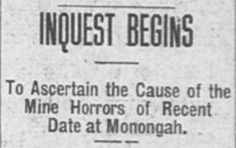
Issues with the Monongah Timeline

Bibliography/Resources

About the Author

Contact Information

Friday, January 3, 1908

12:30 am

In Fairmont:

Jack Wilson, an employee at the round house, lights a match and carelessly throws it down. The match falls into a can of powder. Jack is severely burned and taken to the Miner’s Hospital. It is feared he will lose his eyes. (FWV 01.03.08 pg. 1)

miner's hospital - postcard

Early Morning

In Elwood City, PA:

The dead bodies of Chris Evans and Bertha Gordon are found along the track of the B&O railroad. “The couple were on their way to the woman’s house when they became confused, a fast freight train coming out of the tunnel and running them down before they had an opportunity to escape.” (FWV 01.03 08 pg. 1)

Morning

In New York:

7 men who survived the wreck of the Germanic arrive and “told the story of the wreck of the bark Germanic, the captain drowning, and the disappearance of eight crew members. The horrors endured were terrible.” (FWV 01.03.08 pg. 1)

In the Flemington/Grafton, WV area:

James Clevenger, of Flemington, is gradually losing his family to starvation. “It is said that the awful state of affairs was brought about by the extreme poverty of the family and the refusal of the father and husband to work.”  Miss Cleveland Clevenger (aged 18) and Julia Clevenger (aged 14) die of starvation while “another is critically ill and the other five are eking out a bare existence.” (FWV 01.03.08 pg. 1)

“The residents of the community in which the Clevengers live were ignorant of the awful state of affairs existing at their residence, which is a mere shanty, almost devoid of furniture, until the deaths occurred.” (FWV 01.03.08 pg. 1)

“Since, the charitably inclined neighbors have furnished food and clothing and medical attention, so the surviving members of the family will fare much better in the future.” (FWV 01.03.08 pg. 1)

In Fairmont:

The Fairmont West Virginian reports the weather will be: Fair tonight and Saturday; warmer Saturday

Misses Edith and Mabel Wise, sisters of Charles Wise, return to their home in Canton, Ohio. (FWV 01.03.08 pg. 8)

During the day

At the Alpha mine in Nevada:
AC 12.31.07 pg 1 - Trapped Gold miners 1
AC 12.31.07 pg 1

“Advices from Ely, Nev., state that probably ten days more will be required before the rescuers reach Brown, McDonald and Bailey, the three miners who have been imprisoned since December 1 in the Alpha shaft of the Giroux mine at Ely. It is likely that the men will have been six weeks in their tomb-like prison before they can be freed.” (FWV 01.04.08 pg. 2)

“They are able to talk with their rescuers over the mine telephone and declare that they are very well satisfied with their quarters and that there is no particular hurry about getting them out. Water and food is sent down to the men through a six-foot pipe, and they have considerable room for exercise. Air is constantly forced in to them. To while away the time the men occasionally hold vocal concerts, singing over the telephone wires for the benefit of those above.” (FWV 01.04.08 pg. 2)

At the Darr mines in PA:
Darr Mine Victims Now Number 226. Jacobs Creek, Pennsylvania., January 3rd. Two more bodies have been removed from the Darr mine here, bringing the total number of known victims of the recent disaster to 226, one more than was predicted. The rescuers believ there are more bodies under the debris that remains in the pit.
TDT 01.03.08 pg 2
Maryland Briefs. Among the victims of the Darr mine explosion was Joseph Murphy, fire boss, a son of Nicholas Murphy, the town sergeant at Grantsville, Garrett County. He was so badly burned that his body was scarely recognizable. The body of his brother Nicholas was still in the mines at last reports.
MJ 01.03.08 pg 3

~6:00 pm, News Hour

Fairmont West Virginian:
Standing Room Only Is Expected At The big Performance
FWV 01.03.08 – pg 1
FWV 01.03.08 - pg 1 - Baltimore troupe
FWV 01.03.08 – pg 1

“The Paint and Powder Club plays for charitable benefits only and its appearance here is for the benefit of the Monongah sufferers.” (FWV 01.03.08 pg. 1)

“This club is made up of the best talent in Baltimore. Its actors are artists and a first class show is assured.” (FWV 01.03.08 pg. 1)

“…almost decided that Parkersburg would get it. But when the Monongah explosion came, the members of the club desired to assist in raising the big relief fund that will be required to take care of the sufferers. They wired people here and the arrangements were made for their coming.” (FWV 01.03.08 pg. 1)

Avg. nightly receipts = $4,000 in most places (FWV 01.03.08 pg. 1)

“The general committee composed of Sprigg D. Camden, Walton Miller, J.O. Watson, Brooks Fleming and Geo. A. Alexander have enlisted the services of a number of young men and women who are selling tickets in Wheeling, Parkersburg, Clarksburg, Grafton and Morgantown.” (FWV 01.03.08 pg. 1)

Price of ticket = $3 (FWV 01.03.08 pg. 1)

FWV 01.03.08 - pg 6 - Paint and Powder photo
FWV 01.03.08 – pg 6
FWV 01.03.08 - pg 1 - Union Relief donation
FWV 01.03.08 – pg 1
FWV 01.03.08 - pg 1 - 1907 Lynchings
FWV 01.03.08 – pg 1
FWV 01.03.08 - pg 1 - Kids taught to steal
FWV 01.03.08 – pg 1

01.03.08 - pg 1 - middle headline

FWV 01.03.08 - pg 1 - Monongah elections
FWV 01.03.08 – pg 1
FWV 01.03.08 - pg 3 - recipe 2
FWV 01.03.08 – pg 3
01.03.08 - pg 3 - recipe
FWV 01.03.08 – pg 3
FWV 01.03.08 - pg 4 - Monongah likes liquor
FWV 01.03.08 – pg 4
FWV 01.03.08 - pg 2 - grand opera
FWV 01.03.08 – pg 2

01.03.08 - pg 8 - The Grand- Winkle - 101.03.08 - pg 8 - The Grand- Winkle - 2

01.03.08 - pg 8 - Jefferson - winkle sprit picture
FWV 01.03.08 pg. 8
FWV 01.03.08 - pg 6 - woman killers
FWV 01.03.08 – pg 6
FWV 01.03.08 - pg 8 - rent own house ad
FWV 01.03.08 – pg 8
Clarksburg Daily Telegram:
CDT 01.03.07 - pg 1 - Paint and Powder
CDT 01.03.07 – pg 1

CDT 01.03.08 - pg 7 - mining - detail

CDT 01.03.08 - pg 7 - mining - detail 2
CDT 01.03.08 – pg 7
The Washburn Leader in North Dakota:
TWL 01.03.08 pg 2 - mine events
TWL 01.03.08 pg 2
Topeka State Journal in Kansas:
TSJ 01.03.08 pg 1 - Monongah
TSJ 01.03.08 pg 1
The Bottineau Courant in North Dakota:
BCz 01.03.08 pg 3 - Little dead Miner
BCz 01.03.08 pg 3

Evening

At the Darr Mines in PA:
Recover More Bodies. List of Dead From the Darr Mine Now Numbers 231. Jacobs Creek, Pennsylvania, January. 3rd. - Five more bodies were recovered today from the Darr mine, bringing the list of dead up to 231.
ETR 01.03.08 pg 1
In Fairmont:

The young ladies of the city give a Leap Year dance at the Tavern. “The invitations to the young men were extended through the young ladies who called for them at their homes.” (FWV 01.03.08 pg. 5)

Skinners tavern - fairmont - wvhistoryonview

“The young ladies will do the Leap Year act from start to finish.” (FWV 01.03.08 pg. 5)

“At the dance, dances were engaged by the young ladies and all the little courtesies heretofore confined to the masculine sex were performed by the hostesses.” (FWV 01.04.08 pg. 5)

“The ballroom at the Tavern was in holiday attire and Omen’s Orchestral furnished an excellent program for the dancing.” (FWV 01.04.08 pg. 5)

This slideshow requires JavaScript.

The Electric Theater again presents “Passion Play”. “Misses Lula and Eva Barnes, of the Presbyterian Choir, will sing for this occasion.” (FWV 01.03.08 pg. 8)


More on the Monongah Disaster of 1907

Introduction

Disclaimer and Guide

How Death Gloated!: A Timeline of the Monongah Disaster and Bloody December of 1907

Who is Guilty?: A Timeline of January 1908 and the Coroner’s Inquiry
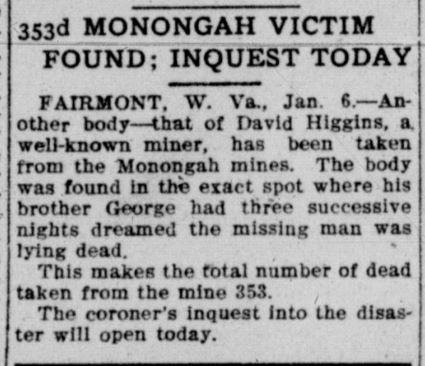
Issues with the Monongah Timeline

Bibliography/Resources

About the Author

Contact Information

Thursday, January 2, 1908

Morning

In Carthage, NM:

“All of the coal mines in Carthage shut down yesterday and will probably not resume operations before tomorrow after which most of the bodies will have been disposed of. Several of the dead miners were buried at Carthage yesterday, with simple but impressive services. Others were embalmed and will be sent to their homes today.” (AC 01.02.08 pg. 1)

“It is now asserted by Dr. G.H. Bacon that all of the wounded will recover with the exception of Refergio Villanuza, who is in a dangerous condition. However, his life will not be despaired of until the physicians have done everything in their power to save him. His chances, however, are not considered good. Much will depend upon careful nursing. Villanuza has a family in Guanahuta, Mexico.” (AC 01.02.08 pg. 1)

“The body of ‘Charlie’ Wilcox, as he was familiarly known, will be embalmed and will be turned over to his father, who will reach Carthage today from Maffa, Texas. Wilcox came from a well to do family.” (AC 01.02.08 pg. 1)

“Company officials have announced that no expense will be spared in caring for the injured and in providing for the future of the bereaved families. Everything that can be done, has already been ordered by the officials and the company is showing a disposition that is very credible.” (AC 01.02.08 pg. 1)

Carthage, map satellite - marked

“Outside of the killing and injuring of the miners caught in the mine, not ten dollars worth of damage was done.” (AC 01.02.08 pg. 8)

“A few timbers were blown out of place but the mine acted much like a gun barrel and discharged the explosive dust into the air through the mouth of the tunnel. The workings were quickly cleared and as far as the damage is concerned, work could have been resumed within twelve hours after the explosion took place.” (AC 01.02.08 pg. 8)

“A feature of the explosion was the fact that out of 150 native families, nearly all of whom have some member who has worked in the Carthage mines for the past twenty-seven years, not one was injured. Those who were caught were nearly all recent arrivals in the field.” (AC 01.02.08 pg. 8)

All Day

In Fairmont:

Local elections are held throughout the area. (FWV 01.03.08 pg. 1)

The Fairmont West Virginian reports the weather as: fair tonight and Friday.

“M. Chaffanel and M. Dunaine, the French experts who came to this country for the purpose of making an examination of the mines, have left for Jacobs Creek to examine the Dar mine. From there they will return to France as M. Chaffanel, national inspector, has to attend an important meeting of mine inspectors at Paris on the 10th day of this month. He sails from New York in a day or so.” (CDT 01.02.08 pg. 2)

During the Afternoon

In Carthage, NM:

“The Bernal mine was thoroughly inspected today and it was found to be in good condition. The explosion did very little damage in the workings. U.S. Mine Inspector Jo Sherridan, Powell Stockhouse, Jr., president of the Carthage Fuel Company, and W.P. Thompson, of Denver, general manager of the Colorado Fuel and Iron company made personal inspections of the mine. They also investigated the cause of the explosion as far as possible but made no statement for publication.” (AC 01.02.08 pg. 1)

“The Carthage Fuel company operated three mines at Carthage and it was stated that all of them, including the Bernal, will be working again by Saturday. This is made necessary by a rush to orders of coal.” (AC 01.02.08 pg. 1)

“The miners are anxious to resume work as they have been suffering from a severe nervous strain for the past two days and desire to be actively employed again. There is no further danger in the Bernal mine.” (AC 01.02.08 pg. 1)

In Fairmont:

The Ladies’ Aid Society was to meet at the home of Mrs. Miles Prickett but instead had a “…very enjoyable meeting at the home of Mrs. John S. Scott on Columbia St….”.  (FWV 12.20.07 pg. 2) (FWV 01.03.07 pg. 2)

A long distance telephone call announces that Secretary of State Chas. W. Swisher and Governor Dawson will arrive on Sunday evening or Monday morning and will likely be in the city for about two days and will be present at the benefit to be given by the Paint and Powder Club at the Grand Opera House on Monday night. Gov. Dawson and Sec. Swisher will likely be in the city about 2 days. (FWV 01.02.08 pg. 1)

Senator J.H. McDermott will also be here and invitations were also extended to Congressman Hubbard and Sturgiss. (FWV 01.02.08 pg. 1)

“Hon. Chas. Swisher has wired his intention to bring Governor Dawson and some of his staff in uniform and a box will be specially decorated for their use. Hon. J.H. McDermott has said he will bring a delegation of University boys.” (FWV 01.02.08 pg. 1)

FWV 01.03.08 - pg 6 - Paint and Powder photo
FWV 01.03.08 – pg 6

“Prof. Omen has offered the services of his entire orchestra. The score will arrive today from Baltimore and he will immediately begin practice. It must be understood that this is not an opera but high class vaudeville produced by the stars or headliners of the club. The opera is what is expected to be brought here in the spring, as the costumes and scenery of the last one produced by the club have long since been disposed of, as a new and complete show is given each year.” (FWV 01.02.08 pg. 5)

George T. Watson is in charge of keeping the men of the theatrical company entertained and is “arranging a trolley trip to show points of interest and Mr. Brooks Fleming is going to show them the disrupted Monongah mines, take them on a trip into New England and give them an idea of the intricacies encountered in the mining of coal before it reaches their furnace doors, a lecture as only a Princeton man like himself can give.” (FWV 01.02.08 pg. 5)

“Coal from the cradle of the grave as it were from Mother Earth to the ash heap after it has served its useful purposes for without coal the world would cease to move, and people should realize generally that no matter the amount of capital forthcoming we have got to have these humble sons of toil to get it out for that’s the only way it can be done and that is one of the best arguments we can use that it is the duty of the entire world to make these producers of sustenance for us all, feel and believe we are sincerely sorry and lament with them in their great loss and appreciate the hazardousness of their employment. The whole world is their servants—for without their aid the wheels of commerce and life would stop.” (FWV 01.02.08 pg. 5)

“Dr. Hugh Carr, now of Fairmont, met many of these boys when he was a member of Cornell’s Silk Stocking Vendettas, an organization on the same lines, and the doctor now will be right on hand to give first aid to those of the boys who may perchance embibe too freely of the Monongahela river water and if any of them are stung by the snakes around the mines he has a barrel of a special rubber glove 3 ply killer variety locked up in his office which he will administer freely to those bitten only.” (FWV 01.02.08 pg. 5)

“The average nightly receipts are $4,000. They show each year in Baltimore, Philadelphia, Washington and Norfolk and it is their intention this year to place West Virginia on their itinerary. Quite a few places in this state have made requests for the to use their cities, but Fairmont at present has the going next to the pole as so many of her boys are familiar in Baltimore and made themselves so well liked and have always taken big delegations to the shows in both Baltimore and Washington and have come so much in contact with the P. & P. boys that when this Monongah explosion occurred and the world was hastening tot eh relief of the unfortunate, the officers of the Paint and Powder Club telegraphed to a few of her members who are now natives of Fairmont if it would be acceptable to the citizens of Monongah to permit a performance of their club in Fairmont.” (FWV 01.02.08 pg. 5)

“The Fairmont members went back and said they would be received with open arms, and aside from the Relief benefit it would give Fairmont an opportunity to show the class of audience she will turn out to see the show when it comes here in the spring, and also to show just how up to date and modern Fairmont is, and have them see the marks of advanced culture and class that are supposed to exist universally only in big cities.” (FWV 01.02.08 pg. 5)

“George Malls Wilshire will wear his long coat just from Bells and take all credit to himself for bringing the ethics of Fairmont ‘dressers’ up to the standard of Fifth avenue.” (FWV 01.02.08 pg. 5)

“Mr. Robert Nelson will sing his new song ‘Beat me to it Kid,’ accompanied by Mr. C.W. Watson’s valet, Monsieur Micham, formerly of Paris but now a proud citizen of Fairmont on a bass drum.” (FWV 01.02.08 pg. 5)

“President Murray, of the Baltimore and Ohio R.R., through his assistant, Mr. Geo. M. Shriver, has tendered to the committee free transportation and special cars, leaving Baltimore next Sunday night on No. 3 and arriving in Fairmont, Monday. Returning, leaving Fairmont on No. 14 Tuesday.” Instructions have been given to “division superintendents along the line of route to instruct their forces to do everything possible to make the trip pleasant, to even putting on extra air on the curves and not bantering loud words with passing crews as that tends to make the ‘girls’ hysterical and unfit for work.” (FWV 01.02.08 pg. 5)

“The general committee here is Sprigg D Camden, Walton Miller, J.O. Watson and Brooks Fleming and W.A. Alexander, and they have enlisted the aid of dozens of hustling men and women in Fairmont, Clarksburg, Wheeling, Morgantown and Parkersburg for the sale of tickets and the soliciting of advertisements for the souvenir programme in the club colors—Pink and White of the P. & P. The committee has asked about twenty-five of Fairmont’s pretty younger Misses to assist in selling these programmes and acting as ushers and the color scheme of the club will be carried out even to these dainty little Misses. The blondes will dress in white and wear a big red rose and the brunettes will dress in pink and wear a big white rose. Miss Ida Watson will be very glad to have the boys go over her farm and see her cows and dogs.” (FWV 01.02.08 pg. 5)

“Mrs. Clarence W. Watson and Miss Lucy Watson have been asked to carry out the decoration of the Opera House, streamers of bunting in the colors of West Virginia, Maryland and the Paint & Powder intertwined symbolic of the two States being bound closer through the medium of the Paint & Powder.” (FWV 01.02.08 pg. 5)

“Miss Virginia Fleming, Mis Elizabeth Watson and Miss Jean Fleming will arrange the fernery around the Opera House.” (FWV 01.02.08 pg. 5)

“Mr. Rathburn will give them his little well known drawing room talk on how to remain beautiful. He generally charges for this but has agreed to make exception, considering how well versed these ‘girls’ will be in this theme.” (FWV 01.02.08 pg. 5)

“Mr. Clarence Watson will be asked to allow an exhibit of his world famous show horses now stabled at his Fairmont Farms, as until the even of Mr. Watson settling in Fairmont permanently, Baltimore always claimed these horses as her own, but the honor has now passed on to Fairmont Farms.” (FWV 01.02.08 pg. 5)

“Mr. Zack Robertson on Monday afternoon in the Masonic hall will deliver the last of his series of lectures ‘No matter how many you skin alive just so the company gains.’” (FWV 01.02.08 pg. 5)

“Clarksburg will likely send a good delegation and a record breaking audience will see the big performance.” (FWV 01.02.08 pg. 1)

“When the curtain rises on Monday we will all see as fair and fine and well garbed audience that has ever graced the Auditorium of any Metropolitan house.” (FWV 01.02.08 pg. 5)

FWV 01.04.08 - pg 5 - P&P photo
FWV 01.04.08 – pg 5


Rev. C.L. Orbach, president of Slovak Press and representative of the Slavic Evangelical Union, of NYC, registers at the Tavern. Rev. Orbach came to the city to inquire into the conditions here and will work with Slavonic Catholic Union representative, Jacob Vrostek of Braddock, PA, to find out the true conditions.

He will attend the coroner’s inquest over the Monongah victims and  Rev. Martin Tomoski, of Connellsville, and Edward F Duffy, an attorney of Pittsburg, will also be here to assist in the inquest. (FWV 01.02.08 pg. 1)

~6:00 pm, News Hour

Fairmont West Virginian:

Several days ago, Charley Davis’ horses drowned in the river at Everson and are still in the river, polluting the water. Mr. Davis notified officers that one of the horses is lying along the bank of the West Fork river just above the New England railroad bridge, the other horse is in the river somewhere. The horses will have to be removed and buried. (FWV 01.02.08 pg. 1)

FWV 01.02.08 - pg 1 - Donations
FWV 01.02.08 – pg 1
FWV 01.02.08 - pg 3 - Balimore troupe for Monongah
FWV 01.02.08 – pg 3
FWV 01.02.08 - pg 3 - Balimore troupe for Monongah
FWV 01.02.08 – pg 3
FWV 01.02.08 - pg 3 - Balimore troupe Don of Doraya setlist
FWV 01.02.08 – pg 3
FWV 01.02.08 - pg 3 - Colorado theatre realism
FWV 01.02.08 – pg 3
FWV 01.02.08 - pg 5 - Elizabeth Watson's whereabouts
FWV 01.02.08 – pg 5
FWV 01.02.08 - pg 5 - Women's Club - detail
FWV 01.02.08 – pg 5
Labor Argus in West Virginia:
TLA 01.02.08 pg 1 - Facts suppressed - detail
TLA 01.02.08 pg 1

“’Some of the hideous facts are coming to light at Monongah. The Journal is creditably informed that the air fan had been idle for twenty-four hours previous to the explosion. Also that there are nearly two hundred men whose bodies lie under masses of slate and rock, and that no effort will be made to recover them. Also that the Cumberland (Md.) News of Monday, the 16th contained an article stating that $100 will be paid to any man marrying of the widows at Monongah. As the News is owned by the Lowndeses, who are heavy stockholders in the Fairmont Coal Company its significance can be realized. A healthy colored slave woman sold in Maryland prior to the war at from $1,000 to $1,500!’” (TLA 01.02.08 pg. 1)

“’It is also stated on the authority of a correspondent to the Pittsburgh Dispatch that the Fairmont company has retained or will retain, every lawyer in that vicinity. Again, we are creditably informed that the state officials are using all of their power to suppress the details in order that miners can be retained or secured elsewhere. The effect of the original negligence of these sworn to uphold the law can be seen in the fact that West Virginia dropped from second to third place in the production of coal, as her miners—those who know the dangers of the mines and see the shameful conduct of the law’s servant’s—are leaving the state in droves.’” (TLA 01.02.08 pg. 1)

“’In contrast with this miserable conduct on the part of the West Virginia authorities and the Fairmont company is that of the Pittsburgh Coal Company, at whose mines the latest accident occurred. There under its former president, Francis Robbins, Superintendent Schludenberg and others, a system had been provided whereby a decent Christian funeral was provided for such occasions. In addition each widow received $150 and a small pension. Compare that with the sordid conduct of the Fairmont company, where the widows and orphans of its victims are to be sold for $100.’” (TLA 01.02.08 pg. 1)

“The Journal does not desire to minimize in any way the horrors of the Darr mine, it merely contrasts the conduct of two corporations under similar circumstances.’” (TLA 01.02.08 pg. 1)

“’Again, the necessity of complying with President Roosevelt’s recommendations is emphasized with horror. The things he recommends are an imperative necessity and the blood of these slaughtered miners calls like the blood of Abel from the ground of remedial measures, for measures that are based on common sense. These things can be prevented. The one needful thing is sufficient fresh air, air distributed where it is needed, namely, at the face of the workings. That is all there is to it. There will be a thousand and one remedies and scientific theories offered, but they all will resolve themselves into the one thing—plenty of fresh air at the proper place.’” (TLA 01.02.08 pg. 1)

Clarksburg Daily Telegram:
CDT 01.02.08 - pg 1 - Camden vacations
CDT 01.02.08 – pg 1
CDT 01.02.08 - pg 1 - Monongah
CDT 01.02.08 – pg 1
CDT 01.02.08 - pg 1 - Indiana strike
CDT 01.02.08 – pg 1
CDT 01.02.08 - pg 2 - family starves
CDT 01.02.08 – pg 2
CDT 01.02.08 - pg 2 - Monongah exam
CDT 01.02.08 – pg 2
Albuquerque Citizen in New Mexico:
AC 01.02.08 - pg 1 - Bernal - detail
AC 01.02.08 – pg 1

“The Bernal mine was the last of the coal mines in the Carthage district opened by A.H. Hilton, of San Antonio, together with the Hilton mine and the Government mine, the last of which was opened up before the war and is the oldest coal mine in New Mexico. It furnished coal for the government at old Fort Craig and Fort McRae. Mr. Hilton sold the mines to the Carthage Fuel company about three years ago.”  (AC 01.02.08 pg. 1 & 8)

“In speaking of the mines in the Carthage field, Mr. Hilton said they were always considered safe because they were known to have no dangerous gases such as are found in so many mines. The explosion which was occasioned by the dust, was one which no human agency could foresee and which might occur at any time in any mine.” (AC 01.02.08 pg. 8)

Plymouth Tribune in Indiana:
PT 01.02.08 - pg 6 - Monongah
PT 01.02.08 – pg 6
Los Angeles Herald in California:

“Another mine horror is added to the list of casualties of this class. Although the New Mexico disaster did not approximate those of West Virginia or Pennsylvania, so far as loss of life was concerned, it was of sufficient gravity to direct attention once more to the great menace to life accompanying carelessness or neglect in the operation of theses subterranean industries.” (LAH 01.02.08 pg. 4)

“Several hundred men have gone to their death in coal mines in America during the past month or so.” (LAH 01.02.08 pg. 4)

“Soon after the catastrophe at Monongah W.Va., about a month ago, charges were made by writers in a number of eastern papers that the companies operating the mines in the Allegheny fields were criminally negligent by reason of their having failed to take the most ordinary precautions to insure the safety of their employees. Whether this charge is well grounded or not investigation will prove.” (LAH 01.02.08 pg. 4)

“In this country there appears to have been conscientious effort to reduce the hazard to human life in this direction, but if some investigators, whose studies necessarily have been of a more or less superficial character, may be relied on certain of the more important corporations operating big mines in the Appalachian fields have thought more of producing dividends than of attempting adequate protection to the lives of their employees. The mater certainly is one which demands a careful inquiry; and it should be made by scientists whose efforts shall not be impeded by politics.” (LAH 01.02.08 pg. 4)

Bisbee Daily Review in Arizona:
BDR 01.02.08 pg 1 - Darr photo and map
BDR 01.02.08 pg 1

Evening

In Fairmont:

Rev. Orbach leaves Fairmont for New York and will return Monday morning. (FWV 01.02.08 pg. 1)

Electric Theater presents the “Passion Play”.

“…everyone was loud in praise of the picture representing the sacred production.” (FWV 01.03.08 pg. 8)


More on the Monongah Disaster of 1907

Introduction

Disclaimer and Guide

How Death Gloated!: A Timeline of the Monongah Disaster and Bloody December of 1907

Who is Guilty?: A Timeline of January 1908 and the Coroner’s Inquiry
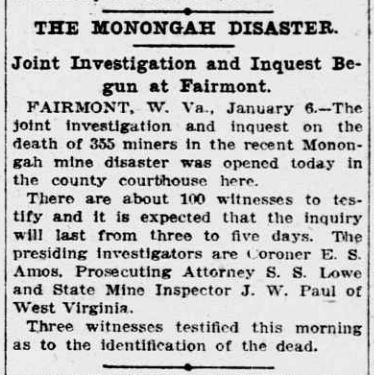
Issues with the Monongah Timeline

Bibliography/Resources

About the Author

Contact Information

Wednesday, January 1, 1908

Morning

In San Antonio, NM:

“Eight new coffins formed part of the express of a special train which was run from this place to Carthage…carrying U.S. Mine Inspector Jo Sheridan, William Lane, an undertaker of San Marcial and several trained nurses who will care for those injured in the explosion in the Bernal mine…” (AC 01.02.08 pg. 1)

In Carthage, NM:

“All of the coal mines in Carthage shut down…and will probably not resume operations before [Friday] after which most of the bodies will have been disposed of.”

“Several of the dead miners were buried at Carthage [today], with simple but impressive services. Others were embalmed and will be sent to their homes [tomorrow].” (AC 01.02.08 pg. 1)

Afternoon

In Fairmont:

FWV 01.02.08 - pg 4 - Monongah rescue worker dies

Morris Beetle dies at Cook Hospital after illness of pneumonia which he contracted while aiding in the rescue work. “Mr. Beetle was another member of the Monongah rescue band to succumb to pneumonia.” He was a pit boss at Riverdale, 57 years old and is survived by his wife and children. (FWV 01.02.08 pg. 4)

cookhosp

Newspapers

Clarksburg Daily Telegram:

CDT 01.01.08 - pg 1 - Bernal

CDT 01.01.08 - pg 7 - Monongah inquiry
CDT 01.01.08 – pg 7
CDT 01.01.08 - pg 7 - Darr photo
CDT 01.01.08 – pg 7
Bisbee Daily Review in Arizona:
BDR 01.01.08 - pg 1 - Bernal
BDR 01.01.08 – pg 1
Daily Arizona Silver Belt:
DASB 01.01.08 - pg 1 - Bernal
DASB 01.01.08 – pg 1
Arizona Republican:
AR 01.01.08 - pg 2 - Bernal
AR 01.01.08 – pg 2
San Francisco Call in California:
SFC 01.01.08 - pg 4 - Bernal
SFC 01.01.08 – pg 4
New Ulm Review in Minnesota:

NUR 01.01.08 - pg 4 - For Shame - detail

“A half-century of progress and this is what we have to show for it! Is it strange socialism grows; socialism, which hurls its challenge in the face of the system that has given us this sorry product? Is it strange that, despite its fundamental fallacies, it appeals to the fathers and mothers of the poor when it can launch, with justice, the terrific indictment against a ‘capitalist civilization’ that’ the march of its conquest is stained with the blood of infants and paved with the puny bones of children?’ People were poor enough, God knows, in the dark ages of medieval ignorance and in the still earlier days of paganism; but never, till modern industrialism joined hands with Christian civilization, did they have to send their children to work as children are sent today. Ancient greed held its hand in pity or shame, and spared the child. The greed of today knows neither shame nor pity and in children it finds succulent morsels.” (NUR 01.01.08 pg. 4)

Omaha Daily Bee in Nebraska:
OBD 01.01.08 pg 4 - mining disasters
OBD 01.01.08 pg 4
The Breckenridge News in Kentucky:
BN 01.01.08 - pg 7 - Monongah
BN 01.01.08 – pg 7
Morning Astorian in Oregon:
MA 01.01.08 - pg 1 - Bernal
MA 01.01.08 – pg 1
Topeka State Journal in Kansas:
TSJ 01.01.08 - pg 1 - Bernal
TSJ 01.01.08 – pg 1
Evening Star in D.C.:
ES 01.01.08 - pg 18 - Bernal
ES 01.01.08 – pg 18
Rock Island Argus in Illinois:
RIA 01.01.08 - pg 1 - Bernal
RIA 01.01.08 – pg 1
Evening Times Republican in Iowa:
ETR 01.01.08 - pg 1 - Bernal
ETR 01.01.08 – pg 1
The Adair County News in Kentucky:

ACN 01.01.08 - pg 2 - life is cheap - detail

“Life is cheap. If you doubt it look at the stories of disaster in the mines of this country during the past three weeks. Over 500 men have perished in the recesses of the earth as the result of explosions in three different coal mines. Can you think of what suffering that means? Five hundred men represent probably at least 2,000 dependent upon them, who are thus suddenly robbed of their bread winners, and whose homes are darkened with the terrible shadow of tragically sudden death.” (CAN 01.01.08 pg. 2)

“Life is cheap. It is probably true there will always be danger in mining, that risk cannot be wholly eliminated; but it is not conceivable that in this Twentieth century of invention and discovery it is necessary to supply the nation with coal at such tremendous cost. We are forced to the belief that many such disasters might be averted if proper precautions were taken, and all mines were properly equipped with the best safety appliances.” (CAN 01.01.08 pg. 2)

“Unhappily, while this is a century of invention and discovery, it is also a century of indifference to human life in the pursuit of the dollar. Life is cheap. It will be easy to find 500 more men to take the place of those who died at Monongah a week ago, and Monday at Yolande, near Birmingham, Ala. It is cheaper to hire new men than to install safety appliances and take the necessary care to prevent accidents.” (CAN 01.01.08 pg. 2)

“The Government ought to interfere, you say. The Government does interfere. It requires certain things to be done, and it appoints inspectors and officials to see that they are done; but the field to be covered is wide, and there are many ways of escaping from strict obedience to the law for the man who wants to. Not until the mine operators are made to feel their personal responsibility for the safety of the men whom they employ, will it be possible to secure a full measure of protection. That realization can only come in one or two ways. Either by a sudden development of the altruistic spirit to a degree not usually found in mine operators; or by a campaign of prosecution on the part of the law against all men on whose property accidents happen that can in any way be subscribed to negligence. The latter will probably prove to be the quicker and more effective under present circumstances. —Louisville Herald” (CAN 01.01.08 pg. 2)

Salt Lake Herald in Utah:
SLH 01.01.08 - pg 1 - Bernal
SLH 01.01.08 – pg 1
Bluefield Evening Leader in West Virginia:
BEL 01.01.08 - pg 1 - Bernal
BEL 01.01.08 – pg 1
Mt. St. Clair Advocate in Kentucky:
MSCA 01.01.08- pg 1 - Darr
MSCA 01.01.08- pg 1
MSCA 01.01.08- pg 1 - no mine horrors
MSCA 01.01.08- pg 1
MSCA 01.01.08 - pg 8 - Darr
MSCA 01.01.08 – pg 8

8:00 pm – 11:00 pm

In Fairmont:

The Women’s Club of Fairmont hosts “At Home” at the Masonic Temple. Invitations were sent to members of the club with a card enclosed which announced that each member was entitled to bring 3 guests. “Omen’s Orchestra will furnish music throughout the evening.” (FWV 12.27.07 pg. 5)

“After the guests had passed the receiving line they were invited to the punch bowl.” (FWV 01.02.08 pg. 5)

A “delicious luncheon” was served in the dining room which was decorated in the “club colors of red and green… the table being very effective in its decorations of asparagus, fern and many red candles.” (FWV 12.31.07 pg. 5)

masonic temple - fairmont - wvhistoryinview


More on the Monongah Disaster of 1907

Introduction

Disclaimer and Guide

How Death Gloated!: A Timeline of the Monongah Disaster and Bloody December of 1907

Who is Guilty?: A Timeline of January 1908 and the Coroner’s Inquiry
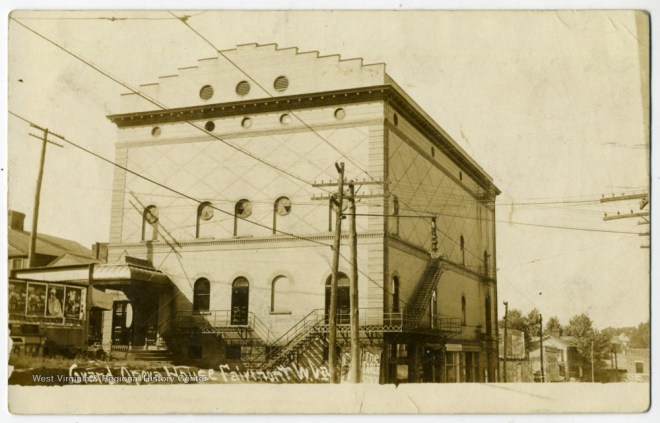
Issues with the Monongah Timeline

Bibliography/Resources

About the Author

Contact Information


Tuesday, December 31, 1907, News Hour—Night

~6:00 pm, News Hour

At the Bernal mine in New Mexico:

“Rescuers are still searching the Bernal mine of the Carthage Fuel company at Carthage, N.M., for the five miners known to be still in the shaft. Eight dead miners and five seriously injured have already been taken out.” (BEL 01.01.08 pg. 1)

Fairmont West Virginian:
FWV 12.31.07 - pg 1 - Monongah inquest date
FWV 12.31.07 – pg 1
FWV 12.31.07 - pg 1 - Taft donates to Monongah
FWV 12.31.07 – pg 1

The Fairmont Coal Company announces that it will purchase 2 bloodhounds which will be kept at Enterprise, midway between Fairmont and Clarksburg, partly in Marion County partly in Harrison County. “The dogs are Morrison’s famous hounds, so criminals beware.”  (FWV 12.31.07 pg. 4)

FWV 12.31.07 - pg 4 - undesirable citizens
FWV 12.31.07 – pg 4
Clarksburg Daily Telegram:

“A member of the house of delegates, whose name is suppressed for some reason, rushed into print at Charleston, through the agency of the Charleston Gazette, about the mining laws of West Virginia and makes some cracks so raw that they show ignorance, prejudice, or a lack of desire to be just to any one. The trend of his remarks convinces one that there is a deeper design than to be square with anyone—mine inspector, operator or miner. He talks like he is wiser, rather thinks he is, than other people. His very first sentence condemns his position. He does not want anyone to find the cause of the Monongah explosions. Every one who has any regard for human life does want the cause found. Every miner, every operator, every citizen wants the cause found. But, that this ‘wise’ sage, a member of the legislature, may not be misunderstood or misquoted, the Telegram gives at some length what he has to say on the subject, as follows:

“‘The work which the experts should now seek to do,’ said the legislator, ‘is not to find the cause of the explosion at Monongah, but to find and point out wherein if at all, our mining laws are defective, and if they are, as I believe, not defective, find where and why the laws are not being enforced. The Monongah explosion is now history and the cause of that is only important insofar as the knowledge of it might prevent future disaster.

“‘I believe that the law passed at the last session of the legislature, if enforced to the letter, would prevent mine explosion entirely. The law is complete, covering the ground thoroughly, I think, and if this provision, (here he read section 16 of the mining law) be enforced, there would be no disasters.’” (CDT 12.31.07 pg. 4)

CDT 12.31.07 - pg 4 - Mine Horrors and Law 2
CDT 12.31.07 – pg 4

“’Now,’ continued the legislator, ‘the question which remains to be solved is: Is miner, operator, or the department of mines responsible for the non-enforcement of the law?’” (CDT 12.31.07 pg. 4)

“The mine is doubly good as far as it goes and to the general run of mine operations is doubtless sufficient, but it does not cover sudden happenings. Suppose the rules and regulations were strictly enforced at Monongah, and, so far there has been nothing to develop showing that they were not, how would the mine laws have prevented the explosion? Certainly, the mine inspector is not expected to be at a single mine every minute in the year. Surely, the operator himself can not be there at all times. And it is not reasonable to believe that the miner himself would snuff his life out. Indeed, there is no credence to be put in the assertion that operator, mine inspector or miner would knowingly cause such a disaster as that at Monongah.” (CDT 12.31.07 pg. 4)

“Again, it is strange that there should be an epidemic of carelessness and indifference spreading over the vast territory, in which four bad mine horrors occurred within a single month.” (CDT 12.31.07 pg. 4)

“All-wise legislator needs more knowledge on the subject than merely to assert that a new mine law observed would prevent horrors which the best experts of the country have thus far failed to account for. And, it is conclusive that he does not know very well what he is talking about, when he says it is of no concern that the cause of the Monongah disaster be learned. All other men believe it is important to mining in West Virginia that the cause should be ascertained, if possible, but, if legislator wants to be in a class by himself let it be so. All others are not satisfied to content themselves thus.” (CDT 12.31.07 pg. 4)

Waterbury Evening Democrat in Connecticut:
WED 12.31.07 - pg 9 - 1907 in review
WED 12.31.07 – pg 9
Rock Island Argus in Illinois:
RIA 12.31.07 pg 7 - headline
RIA 12.31.07 pg 7
New York Tribune:

WED 12.31.07 - pg 5 - Killed or Maimed 1

“The total number of killed and injured in the principal accidents during the calendar year 1907, as chronicled in The Tribune, reached enormous proportions. If the killed had been concentrated in one day at Elmira that city of politicians and prosperity would have been wiped out of existence as completely as was Pompeii or Herculaneum.” (WED 12.31.07 pg. 5)

“Aside from earthquakes and similar upheavals of nature, practically all of these accidents were in the United States.” (WED 12.31.07 pg. 5)

“The great disparity between the total of killed and injured—the latter usually more than doubling the former—is due to a number of causes.” (WED 12.31.07 pg. 5)

“Mine explosion and various kinds stand second in the totals for the year. Moreover, the killed in the month of December through this agency aggregate more than one-quarter of the total for the entire year.” (WED 12.31.07 pg. 5)

“Close scrutiny into the causes of these disasters tends to place the responsibility in great measure on the contributory negligence of the employees. Investigation in some cases has revealed almost criminal carelessness in the carrying of lighted lamps in the danger zones, despite the most stringent regulations prepared by the officials.” (WED 12.31.07 pg. 5)

“The noxious black damp, though, is the deadliest foe of the miner, and both state and national governmental investigations are now under way to ascertain how the fatal power of this noxious underground ruler can be curbed. In December alone its irreversible fumes killed more than five hundred coal diggers in Fayette City, Penn,; Monongah, W.Va., and Yolande, Ala. The explosion at Jacobs City, Penn., in which nearly two hundred and fifty men lost their lives, was merely a trifling variation of this cause of disaster. A miniature mine is to be constructed in or near Pittsburgh by the United States authorities, and experiements on an exhaustive scale are to be conducted in order to ascertain how these dangers can be best avoided. Both miners and mine owners look hopefully to this source for relief from present perils.” (WED 12.31.07 pg. 5)

WED 12.31.07 - pg 5 - Killed or Maimed 10WED 12.31.07 - pg 5 - Killed or Maimed 11

Bismarck Daily Tribune in North Dakota:

BDT 12.31.07 - pg 2 - 1907

BDT 12.31.07 - pg 2 - Obituary Roll
BDT 12.31.07 – pg 2
Wilkes-Barre Record in Pennsylvania:
WBR 12.31.07 pg 5 - Mines detail
WBR 12.31.07 pg 5

“The recent and frequent disasters in the coal fields of Pennsylvania, West Virginia and Alabama have served to call the attention of the public in a tragic manner to the immense loss of life that occurs in the coal mines of the country and have resulted in starting a great wave of popular sympathy for the families of the victims of these terrible disasters.” (WBR 12.31.07 pg. 5)

Pittsburgh Daily Post in Pennsylvania:
PDP 12.31.07 pg 6 - insurance vs coal companies
PDP 12.31.07 pg 6
Albuquerque Citizen in New Mexico:
AC 12.31.07 pg 1 - Bernal 1
AC 12.31.07 pg 1
AC 12.31.07 pg 1 - Trapped Gold miners 2
AC 12.31.07 pg 1

Ely, Nevada—“What will day light look like to men who have been imprisoned for a month and a half in mine darkness so impenetrable, so dense, so blanket-like that it seemed one could almost reach out and seize it?” (AC 12.31.07 pg 1)

“Will they be totally blind? Will their hair be white and their nerves shattered?” (AC 12.31.07 pg 1)

“What will the fresh, invigorating ozone of the mountains feel like to lungs that have been weakened and clogged by sucking in so long the dust-laden stifling, befouled air of a shut-in cavern 1,000 feet beneath the surface of the earth?” (AC 12.31.07 pg 1)

“And what will be the reactionary effect of the absorption of so much poison from the noxious, fume-laden atmosphere? Will it be typhoid fever, jaundice, or what racking disease?” (AC 12.31.07 pg 1)

“These are the questions that stand out first when you consider the plight of three men entombed in the most remarkable mine disaster of a generation. These men, R.A. Bailey, Pete McDonald, and Fred Brown, were imprisoned by a cave-in Dec. 1. They were caught on the 1,000 foot drift of the Alpha shaft of the Girous gold mine here with hundreds of feet of almost solid debris above them.” (AC 12.31.07 pg 1)

“They are still there. There is little prospect that they will be reached before January 15th.” (AC 12.31.07 pg 1)

“Waiting a few minutes after the accident Bailey communication with the upper levels by telephone, giving instructions that probably saved their lives. Then the wire was broken by another cave.” (AC 12.31.07 pg 1)

“It was three days before communication was reopened by means of a six-inch water pipe.” (AC 12.31.07 pg 1)

“Imagine the horror of that desperate wait. Imagine if you can the terrible apprehension which has enshrouded them ever since, knowing as they do that at any moment many come another slipping of the drift that may crush out their lives in a twinkling. This is the menace both prisoners and rescuers fear most.” (AC 12.31.07 pg 1)

“The best progress yet on the filled in mines shaft lying between their place of refuge and the feverishly working rescue party has been only 25 feet a day. Over 400 feet of debris remains.” (AC 12.31.07 pg 1)

“Food is let down to the men daily through the six inch water pipe. A chain of metal tubes in two-foot lengths, connected by wire couplings is used for this. Food and water fill the tubes. The telephone is repaired and they talk to friends and relatives.” (AC 12.31.07 pg 1)

“The men display wonderfully good spirits; they joke with their friends and jibe the rescuers for their slowness, and Mrs. Bailey talks hours each day with her husband.” (AC 12.31.07 pg 1)

“Yet the terrible nervous strain must tell, the horrible uncertainty, that day and night fear, ever present that something may happen at the last moment.” (AC 12.31.07 pg 1)

AC 12.31.07 pg 1 - Trapped Gold miners 1
AC 12.31.07 pg 1


Night

At the Bernal mine in New Mexico:

“Nine dead bodies have already been taken out. Although the mine is still filled with gas, it is believed that no more victims remain in the workings. All the men had apparently been killed instantly and some of the bodies were mangled beyond recognition.” (BDR 01.01.08 pg. 1)

“…communication is difficult.” (BDR 01.01.08 pg. 1)

SLH 01.01.08 pg 1 - Bernal detail
SLH 01.01.08 pg 1

“No cause for the explosion is assigned.” (BDR 01.01.08 pg. 1)

“The explosion resulted from ignition of coal dust by a windy shot.” (BEL 01.01.08 pg. 1)

In Fairmont:
FWV 12.31.07 - pg 5 - Women's Club
FWV 12.31.07 – pg 5
In Wheeling, WV:

Miss Elizabeth Watson, Dr. Hugh Carr, Sweeney Fleming and Carney Carpenter attend the New Years assembly ball. (FWV 01.02.08 pg. 5)

In Clarksburg:

CDT 12.31.07 - pg 1 - Monongah

“The last car to be sent out by Parkersburgers with provisions and clothing for the Monongah sufferers will arrive here late tonight and be transferred to the river division and taken down to Monongah.” (CDT 12.31.07 pg. 1)

This concludes the posts for Bloody December of 1907. However, this does not conclude the Monongah Timeline as the Coroner’s Inquiry  for the Monongah Disaster begins January, 6.

Thank you for reading through this epic month.

This slideshow requires JavaScript.


Previous Post


More on the Monongah Disaster of 1907

Introduction

Disclaimer and Guide

How Death Gloated!: A Timeline of the Monongah Disaster and Bloody December of 1907

Who is Guilty?: A Timeline of January 1908 and the Coroner’s Inquiry
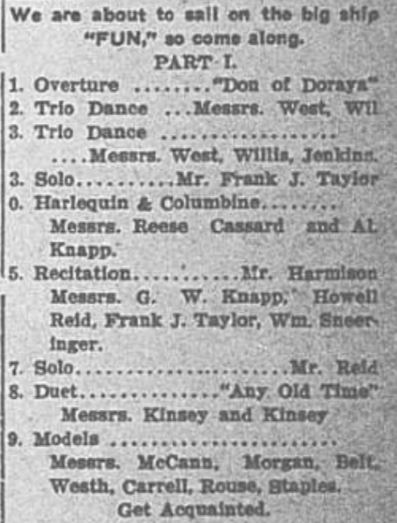
Issues with the Monongah Timeline

Bibliography/Resources

About the Author

Contact Information